

Introduction
Cancer is a disease characterised by abnormal proliferating cells caused initially by genetic mutations including non-small cell lung cancer (NSCLC) and other cancers. The causes of genetic mutations can be roughly divided into two categories: acquired mutations, including TP53, PTEN and other somatic mutations induced by ageing, poor lifestyles, environmental factors, etc., and inherited mutations, such as mutations in the BRAC1/BRAC2. In a retrospective study, researchers showed that 13.3% of cancer patients had inheritable cancer-related genetic mutations, including six most common types: BRCA1/BRCA2 mutation, MUTYH mutation, CHEK2 mutation, ataxia-telangiectasia mutated (ATM) mutation, mismatch repair (MMR) gene mutations including MLH1, MSH6, MSH2, MSH3, PMS2 (Ref. Reference Samadder1). In addition, most of the somatic mutations are passenger mutations but they still occupy the predominate gene mutations leading to the initiation of a tumour. Driver mutations are recognised to be the origin of malignances, such as encoding oncogenes (MYC, anaplastic lymphoma kinase (ALK), V-Ki-ras2 Kirsten rat sarcoma viral oncogene (KRAS), mesenchymal-to-epithelial transition (MET), epidermal growth factor receptor (EGFR), nuclear factor erythroid 2-like factor 2/Kelch-like ECH-associated protein 1 (NRF2/KEAP1), and BRAF) and tumour suppressors (TP53, PTEN, serine/threonine kinase 11/liver kinase B1 (STK11/LKB1), ATM) (Ref. Reference Martinez-Jimenez2). Genetic mutations or alterations affect a series of biological behaviours of tumour including tumour occurrence, development, invasion, metastasis, and so on (Refs Reference Martinez-Jimenez2, Reference Thomas3). And they remain widely prevalent in NSCLC. Thus, driver gene mutations become targets of therapy and biomarkers of predicting the efficacy of therapy, including ICIs, especially in NSCLC.
In the tumour microenvironment (TME), there're various genes exerting immunomodulation function via activating their downstream signalling pathways (Refs Reference Boussiotis4, Reference Lastwika5, Reference Zhang6, Reference Roelands7). The immune response involves tumour antigen exposure, antigen presentation, main histocompatibility complex (MHC) expression, the expression of cell surface receptors, the secretion of cytokines and chemokines, and the endocytosis and degradation of immune checkpoints (Refs Reference Wu8, Reference Chen and Mellman9, Reference Chen and Mellman10). At present, diverse approaches have been targeted to these processes to develop treatments for tumours, such as adoptive cell therapy (ACT), ICIs, cancer vaccines, and oncolytic viruses (Refs Reference Zhao11, Reference Kelly12). Nonetheless, the efficacy of current approaches remains limited. Previous studies suggested that co-mutations were effective biomarkers of immunotherapy (Refs Reference Wang13, Reference Marinelli14) and patients with 2 or more compound mutations were relevant to the significant benefit of ICIs (Ref. Reference Pan15). A genomic mutation signature encompassing eight genes (TP53, KRAS, STK11, EGFR, PTPRD, KMT2C, SMAD4, and HGF) was developed to predict the efficacy of ICIs in non-squamous NSCLC (Ref. Reference Bai16). Not only that, Sun et al. found that MGA mutation, a tumour suppressor gene was related to a response of ICIs (Ref. Reference Sun17). Our analysis from The Cancer Genome Atlas (TCGA) dataset also identified that the co-mutations and single mutations of KEAP1, KRAS, and STK11 indicated TME alteration (Ref. Reference Wu18). In molecular mechanism, the downstream pathways of these genes, including phosphatidylinositol 3 kinase (PI3 K)/AKT, MEK/extracellular regulated protein kinases (ERK)/mitogen-activated protein kinases (MAPK), MAPKs, signal transducer and activator of transcription (STATs), and nuclear factor-kappa B (NF-κB) etc., are closely correlated with an immune response (Refs Reference Zhang6, Reference Kumagai, Koyama and Nishikawa19). With the advances of sequencing technology, there is an expanding spectrum of identified oncogenic driver mutations in NSCLC. Based on these studies, the relationship between co-mutations and tumour sensitivity to immunotherapy needs to be further explored. Therefore, this review focused on the mono- and co-occurring genomic alterations as novel biomarkers of immunotherapy and sought to shed light on the underlying mechanism.
Current situation of immunotherapy
Although targeted therapy has inspiring therapeutic benefits in lung cancer patients with certain oncogenic mutations, the 5-year survival rate is still less than 20% due to the inevitable drug resistance and intra-driver heterogeneity (Refs Reference Siegel, Miller and Jemal20, Reference Skoulidis and Heymach21). Immunotherapy to revolutionise the cancer therapy, however, has overwhelmingly appeared and been widely utilised in lung cancer patients by inducing or reactivating antitumour immune response. For example, cytotoxic T lymphocyte-associated antigen-4 (CTLA-4) is a coinhibitory molecule expressed on T lymphocytes which, upon a stronger affinity for CD80 and CD86 than for CD28, contributes to T cell anergy (Refs Reference Facchinetti22, Reference Rudd, Taylor and Schneider23). Programmed cell death ligand 1 (PD-L1) primarily exists in tumour cells and interacts with its receptor, programmed cell death 1 (PD-1), expressed notably on T lymphocytes. Once coupled with its receptor, PD-L1 inhibits CD8 T cell cytotoxic immune response to suppress the antitumour immune response (Refs Reference Barber24, Reference Xia, Liu and Wang25). Of note, a few of ICIs have been U.S. Food and Drug Administration (FDA)-approved through clinical trials, such as anti–CTLA-4 agent ipilimumab, tremelimumab and anti–PD-1/PD-L1 antibodies nivolumab, pembrolizumab, atezolizumab, durvalumab and avelumab (Ref. Reference Xia, Liu and Wang25). They have provided more personalised and accurate options for lung cancer patients, though the fact that the response rates of these ICIs only range from 14 to 20% in unselected patients and some even suffer severe immune-relate adverse events(irAEs) exists (Refs Reference Xia, Liu and Wang25, Reference Brahmer26, Reference Fehrenbacher27). Thus, highly specific, and sensitive predictive markers for ICIs are urgently needed to be found.
Currently, microsatellite instability (MSI) status and PD-L1 expression on tumour cells by immunohistochemical (IHC) stain are approved biomarkers to predict ICIs efficacy. Numerous studies have demonstrated that MSI is caused by the defect of the DNA MMR gene, which is closely related to the occurrence of tumours. MSI has been proved to improve immune-related objective response rate and immune-related progression-free survival rate in different types of solid tumours (Refs Reference Le28, Reference Le29), especially in colorectal cancers (Refs Reference Moreira30, Reference Sargent31). Thus, MSI is widely regarded as an important and effective marker for predicting the response of ICIs efficacy (Ref. Reference Le28). However, the researches of MSI in lung cancer are rare and the ratio of dMMR/MSI-H in lung cancers is very low and thus hasn't been widely used in lung cancer patients.
Testing for PD-L1 expression on tumour cells by IHC has a huge challenge because some PD-L1-negative patients exhibit a dramatic response to ICIs while a part of PD-L1-positive patients have no or low response (Ref. Reference Champiat32). In the KEYNOTE-024 trial (Ref. Reference Reck33), pembrolizumab monotherapy as the first-line therapy significantly improved progression-free survival (PFS), objective response rate (ORR) and overall survival (OS) in patients with tumours with PD-L1 ≥ 50%, while atezolizumab as the second-line therapy in metastatic patients, showed an improved survival versus docetaxel in all subgroups with different PD-L1 IHC assays and its benefit was independent of PD-L1 expression compared with pembrolizumab (Ref. Reference Rittmeyer34). Meanwhile, different detection platforms and assay conditions in distinct immunotherapy agents (Ref. Reference Osmani35), the inconsistent cut-points for PD-L1 expression and the heterogeneity of PD-L1 expression in different tumours (Refs Reference Bodor, Boumber and Borghaei36, Reference Zhou37) have indicated that it is a profound issue to identify more powerful predictive markers for ICIs response in NSCLC patients.
Subsequently, TMB as the potential predictive biomarkers for ICIs response, in view of the occurrence of neoantigen presented to reactivate immune responses, needs to be explored more. Previous studies have demonstrated the compelling evidence for TMB to predict the response rates of ICIs in various tumours including NSCLC across whole-exome sequencing (WES) or next-generation sequencing (NGS) to assess mutational burden through quantifying the number of non-synonymous mutations (Refs Reference Yarchoan, Hopkins and Jaffee38, Reference Rizvi39). Of note, the CheckMate 227 trial (Ref. Reference Hellmann40) elaborated the significant value of a high tumour mutational burden, independent of PD-L1 expression level in predicting response to the combination of ipilimumab with nivolumab. Nonetheless, a combination of a low TMB (<10 mutations per Mb) with a PD-L1 TPS <1% was regarded as exclusion criteria to exclude patients who were not benefiting from ICIs in CheckMate 227 trial (Ref. Reference Hellmann40). Likewise, Hellmann et al. presented compelling evidence that TMB is a potent biomarker with improved objective response, durable benefit, and progression-free survival, even OS in lung cancer patients (including NSCLC and SCLC) with combination immunotherapy though WES (Refs Reference Hellmann41, Reference Hellmann42, Reference Assoun43). Furthermore, TMB as a predictive marker exists other limitations such as the discrepancy between blood-based TMB and tissue-based TMB (Refs Reference Gandara44, Reference Cabel45, Reference Guibert46), the difference of testing platforms and the definite define of ‘higher’ TMB within various tumours (Refs Reference Bodor, Boumber and Borghaei36, Reference Camidge, Doebele and Kerr47). Although TMB-H (≥10 mut/Mb) was FDA-approved to screen progressed advanced NSCLC patients after receiving standard-of-care to use pembrolizumab based on the Keynote 158 study, patients of TMB-H did not show significantly improved PFS and OS.
With the knowledge of various predictive biomarkers of ICIs response, due to the wide genomic testing, many clinical trials found the association between genomic mutation and ICIs. In the following text, we will introduce the common mutations in NSCLC and demonstrate the value of their mutation profiles (especially co-mutations) as the independent predictors of immunotherapy and the potential and underlying mechanisms.
The major types of gene mutations in tumour and their downstream signals
Single mutations modulate the different signalling, including RAS/MEK/ERK/MAPK, PI3 K/AKT, STK11/adenosine monophosphate-activated protein kinase (AMPK)/mammalian target-of-rapamycin (mTOR), JAK/STAT3, phospholipase C gamma (PLCγ)/phosphatidylinositol-4,5-biphosphate (PIP2), and NF-κB etc. (Ref. Reference Rotow and Bivona48). These pathways participate in the signal transduction, cell circle, proliferation, apoptosis, and immune response (Refs Reference Baluapuri, Wolf and Eilers49, Reference Cuadrado50, Reference Kotler51, Reference Shaw and Engelman52, Reference da Cunha Santos, Shepherd and Tsao53, Reference Guertin and Sabatini54). Co-mutations may synergise to activate or suppress signalling pathways (Fig. 1). Therefore, we briefly summarised several signals of the driver gene in the following.
The downstream signalling pathway of Tumour-related gene mutation. Bold fonts indicated that the protein existed corresponding gene mutation. Green represented suppressor gene while orange represented proto-oncogene.

TP53
TP53, the tumour suppressor genes, encoding the p53 transcription factor, is related to regulating various cancer-associated pathways including cell cycle arrest, DNA damage repair, metabolism, apoptosis, angiogenesis, and metastasis, and even inflammation and the immune response (Refs Reference Kotler51, Reference Kastenhuber and Lowe55). TP53 was commonly mutated in 46% lung adenocarcinoma (LUAD) patients according to TCGA data. Consistent with the role of p53 in tumour suppression, p53 protein is in low levels because of the regulators like MDM2. MDM2 is a p53 ubiquitin ligase to promote the degradation of P53 in normal cells while stimulus-dependent activities such as DNA damage facilitate p53 phosphorylation to activate p53's function through blocking MDM2-mediated degradation (Ref. Reference Kastenhuber and Lowe55). However, the study has demonstrated that the p53 gene is transcriptionally induced by IFN-α/β through IFN-activated transcription factor interferon-stimulated gene factor 3 (ISGF3) activation, demonstrating that p53 gene is induced by a cytokine (Ref. Reference Takaoka56). Likewise, toll-like receptors (TLR) gene expression pattern could be changed by the presence of p53 in damage situation (Ref. Reference Shatz, Menendez and Resnick57), which shows the relationship between p53 mutation and immune response. TP53 mutations have been identified as controversial biomarkers for ICIs in NSCLC patients due to the co-occurring mutations and mutation subtypes (Ref. Reference Sun58), while MDM2/MDM4 amplifications have been proved to be correlated with hyperprogression with anti-PD-1 therapy (Ref. Reference Kato59).
KRAS
KRAS, as a member of the GTPase family, is one of the most frequently oncogenes aberrations in NSCLC, occurring in 0%~33% of adenocarcinomas (Ref. Reference Cancer Genome Atlas Research60). Despite the KRAS-MAPK as the downstream of EGFR signalling, KRAS activation still signals through the mitogen-activated protein kinase and PI3 K/AKT/mTOR cascade mediated by EGF, irrespective of EGFR state (Refs Reference Rotow and Bivona48, Reference Martin Martorell61, Reference Roman62). KRAS mutations in lung cancer have been regarded to be mutually exclusive driver mutations on behalf of a genetically heterogeneous subgroup due to the variety of KRAS-mutations and co-mutations (Ref. Reference Scheffler63). Strikingly, up to now, Sotorasib is the only FDA-approved tyrosine kinase inhibitors (TKIs) targeting KRASG12C, which is a milestone of KRAS-specific inhibitor (Ref. Reference Hong64). A previous meta-analysis suggested that NSCLC patients with KRAS mutations responded well to ICIs compared with KRAS-wild types (p = 0.001) (Ref. Reference Landre65). This may be attributed to that KRAS mutations are closely associated with smoking, so as to increase the expression of neoantigens and TMB levels (Ref. Reference Scheel66).
PI3 K/PTEN
PI3 K-AKT signalling is involved in various biological processes in many types of cancer, its overactivation contributes to abnormal cell cycle progression, epigenetic modification, adhesions and motility changes, inhibition of apoptosis and induction of angiogenesis (Refs Reference Yang, Jiang and Hou67, Reference Fruman68) by activating mutations in PIK3CA, loss of PTEN and so on. PIK3CA gene encodes a catalytic subunit, p110α, which catalyses PIP2 into phosphatidylinositol triphosphate (PIP3) to mediate the phosphorylation of Akt at thr308 by promoting PDK1 (phosphoinositide-dependent kinase 1) and Akt interaction, and thus activating downstream signalling (Ref. Reference Alzahrani69). While the tumour suppressor gene PTEN negatively regulates the PI3 K/AKT activation by encoding a dual protein/lipid phosphatase (Ref. Reference Vazquez and Devreotes70). PTEN dephosphorylates PIP3 to PIP2 to antagonises the function of PI3 K, and thus, the loss of PTEN also contributes to the activation of Akt (Refs Reference Alzahrani69, Reference Vazquez and Devreotes70). There were 7% LUAD patients harbouring PI3KCA mutation (Ref. Reference Cancer Genome Atlas Research60). There is a lack of data to find out the association between PI3KCA mutation and ICIs efficacy in NSCLC patients.
KEAP1/NRF2
NRF2 is encoded by NFE2L2, a member of a transcription factor family which can be translocated into the nucleus and regulate the transcription of target genes (Ref. Reference Ahmed71). KEAP1, recognised as the principle negative regulator of NRF2, is a cysteine-rich and redox-sensitive protein, binding to NRF2 and inducing the CUL3-mediated ubiquitination and proteasomal degradation (Ref. Reference Ahmed71). The KEAP1/NRF2 axis is pivotal in the defence mechanism against oxidative and electrophilic stress by eliciting antioxidant, detoxification, and anti-inflammatory proteins (Ref. Reference Cuadrado50). Thus, alterations in the KEAP1 and NRF2 genes mainly contribute to the constitutive activation of NRF2, which accounts for the activation of downstream target genes for cell proliferation and resistance to therapy (Ref. Reference Hammad72). The mutation of KEAP1/NRF2 was found in 17% LUAD patients (Ref. Reference Cancer Genome Atlas Research60), have a poor prognosis and may not benefit from anti-PD-L1 treatment (Ref. Reference Singh73). Meanwhile, this study demonstrated that KEAP1 mutation synergises with alterations in STK11 and KRAS to represent a more aggressive NSCLC subtype in promoting early-onset, initiation, and proliferation of tumour (Ref. Reference Singh73). The underlying mechanism may be related to immune escape in the tumour immune microenvironment regulated by KEAP1 (Ref. Reference Best and Sutherland74), which promoted the cytokines secretion including IL-6 and IL-11 and reduced leucocyte infiltration (Ref. Reference Matsuoka75).
STK11/LKB1
STK11/LKB1 encodes a serine-threonine kinase, which is recognised as a tumour suppressor and a regulator in the metabolism of glucose and lipid in cells, cell growth and polarity through phosphorylation of AMPK and 12 AMPK-related kinases (Ref. Reference Shackelford and Shaw76). STK11 mutation occupied about 17% LUAD patients (Ref. Reference Cancer Genome Atlas Research60). The downstream pathway of STK11/AMPK is the mTOR pathway suppressed by AMPK phosphorylation of TSC2 and raptor and mTOR complex 1 (mTORC1) modulates the expression of cell growth regulators, such as cyclin D1, hypoxia-inducible factor 1α (HIF-1α), and C-Myc, all of which relate to tumorigenesis and immune response (Ref. Reference Guertin and Sabatini54). Other associations between STK11, AMPK and p53 have been identified, including directly or indirectly activating p53 through phosphorylation (Ref. Reference Shackelford and Shaw76). Nonetheless, STK11 mutations in NSCLC patients may not respond to ICIs therapy (Ref. Reference Rizvi39). Research has shown that STK11/LKB1 deficiency led to an immunosuppressive tumour microenvironment by increasing neutrophil recruitment and reducing T cell activity in the TME (Ref. Reference Koyama77).
EGFR
EGFR gene encodes a type I transmembrane growth factor receptor with the tyrosine kinase domain, mutant EGFR has been proven to contribute to increased proliferation, metastasis, angiogenesis, and decreased apoptosis by activating the PI3 K-PTEN-AKT and RAS/MEK/ERK/MAPK pathways (Ref. Reference da Cunha Santos, Shepherd and Tsao53). It's reported that EGFR mutation only occurred 14% in lung adenocarcinoma in TCGA data (Ref. Reference Cancer Genome Atlas Research60). Nonetheless, cancers with EGFR alterations generally exhibit the non-inflamed TME with reducing infiltrating CD8+ T cells and so on (Ref. Reference Kumagai, Koyama and Nishikawa19), via PI3 K/AKT pathways. Thus, the studies demonstrated that NSCLC patients with EGFR mutation had poor response to ICIs in NSCLC due to the uninflamed TME with weak immunogenicity, low T cell infiltration and low PD-L1 expression (Refs Reference Dong78, Reference Gainor79).
BRAF
BRAF as a serine/threonine-protein kinase, its mutations occur in 3–10% of lung adenocarcinoma, the most common mutation of which is the BRAFV600E mutation (Refs Reference Rotow and Bivona48, Reference Cancer Genome Atlas Research60), others including BRAFG469A/V and BRAFD594 G mutations. Constitutive BRAF activation induced by BRAFV600E mutation activates downstream MEK/ERK signalling pathway, thus promoting tumour proliferation and growth (Refs Reference Dankner80, Reference Negrao81). The combination of MEK and BRAF-V600-specific inhibitors further enhance treatment outcomes in BRAF-V600E-positive NSCLC patients (Ref. Reference Planchard82). However, there are still approximately 50% non-BRAF-V600E-mutated NSCLC patients who cannot receive specific BRAF-inhibitor (Ref. Reference Negrao81), indicating that it is an urgent need to explore the potency of immunotherapy application in these patients. The research showed that NSCLC patients harbouring BRAF mutations showed limited response to ICIs although these mutations were associated with high expression of PD-L1 and low/intermediate TMB level (Refs Reference Dudnik83, Reference Murciano-Goroff84).
MET
Activating mutation and genomic amplification were discovered in the MET gene, a novel and potential therapeutic target in NSCLC (Ref. Reference Trusolino, Bertotti and Comoglio85). Meanwhile, a mutation in MET was variable, including exon 14 skipping and amplification. Both mutations occupied less than 7% NSCLC patients (Refs Reference Cancer Genome Atlas Research60, Reference Awad86). MET as a member of proto-oncogenes, encodes a receptor tyrosine kinase binding of hepatocyte growth factor (HGF), inducing downstream RAS-ERK/MAPKs, PI3 K/Akt, STAT, and NF-κB cascades (Ref. Reference Trusolino, Bertotti and Comoglio85). MET mutations were modestly correlated with the efficacy of ICIs treatment in NSCLC patients in spite of high PD-L1 expression (Refs Reference Li, Wang and Wang87, Reference Sabari88). There is evidence that NSCLC patients harbouring MET exon 14 mutation exhibited remarkably low TMB levels, which is similar to BRAF mutant NSCLC and MET exon 14 mutation contributed to an immunosuppressive TME by inhibition of DCs and suppression of T-cell proliferation induced by neutrophils (Refs Reference Sabari88, Reference Papaccio89).
ALK
The echinoderm microtubule-associated protein-like 4 (EML4) and ALK fusion gene was initially found in NSCLC patients by Soda, resulting from an inversion in chromosome 2 (Ref. Reference Golding90). The inversion protein mediates constitution activation of ALK by ligand-independent dimerisation. The activation of RAS/MEK/ERK, JAK/STAT3, PLCγ and PI3 K/AKT pathways are vital signalling pathways contributing to cellular proliferation and growth, which can be modulated by ALK activity (Ref. Reference Shaw and Engelman52). However, in TCGA data, ALK fusion gene mutation was found only in 1% LUAD patients (Ref. Reference Cancer Genome Atlas Research60). NSCLC patients harbouring ALK rearrangements were associated with a low response to ICIs due to the low PD-L1 expression and low infiltration of CD8+ tumour infiltrating lymphocytes (Ref. Reference Gainor79).
ATM
ATM gene, initially mutated in the autosomal recessive disease ataxia–telangiectasia (AT), encodes a 370-kDa protein of the PI3 K superfamily and activates downstream protein targets in different cell circles when it senses double-strand breaks of cellular DNA damage caused by ionising radiation (IR) and other agents (Refs Reference Bakkenist and Kastan91, Reference Mitui92). Whereas, the activation of ATM is correlated with the protein serine–threonine phosphatase 5 (PP5) (Ref. Reference Ali93). Studies also have illustrated that ATM and XRCC4-like factor (XLF) have redundant functions in the process of V(D)J recombination in developing lymphocytes and ATM and XLF co-deficiencies contribute to a severe combined immunodeficiency (SCID) phenotype similar to that observed in the background of canonical-nonhomologous end-joining (C-NHEJ) deficiency (Ref. Reference Kumar, Alt and Oksenych94). Thus, ATM plays a pivotal role in various pathways including genomic instability, cancer susceptibility, as well as immunodeficiency and so on. However, there is a lack of research to study the role of ATM mutation in NSCLC and in NSCLC patients treating with ICIs.
Myc
Myc oncoproteins are regarded as transcription factors with three members in its family, C-Myc, N-Myc, and L-Myc (Ref. Reference Dang95), which is amplified in approximately 3.3% of LUAD patients. They are called ‘super-transcription factors’ due to latently modulating the transcription of more than 15% of the entire genome (Ref. Reference Dang96). Thus, Myc oncogenes regulate a number of biological functions, including cell proliferation, differentiation, survival, as well as immune surveillance through orchestrating downstream effectors, such as ribosome synthesis, protein translation, metabolism and cell cycle progression (Ref. Reference Chen, Liu and Qing97). The underlying mechanism of Myc oncoproteins to promote cell proliferation and tumourigenesis may not only alter target gene expression but also change the basic transcription mechanisms by modulating transcription elongation with cell cycle progression (Ref. Reference Baluapuri, Wolf and Eilers49). In addition, Myc has been discussed to regulate the association between tumour cells and immune cells by controlling the synthesis of relevant cytokines. Nonetheless, Myc mutation reprogrammed the tumour immune microenvironment by loss of T cells, NK cells and B cells mediated by CCL9 and IL-23 (Ref. Reference Kortlever98). Their relationship with ICIs efficacy is still unclear.
Although most of the single gene mutations, including TP53, KRAS, KEAP1, STK11, BRAF, MET and ALK, have been verified to be related to the efficacy of ICIs, not all mutations of them have equivalent effects due to the different mutation subtypes among these mutations. For example, TP53 missense has shown better clinical benefits from anti-PD-1/PD-L1 therapy compared with nonsense mutants. In addition, co-occurring mutation subtypes such as mutations in KRAS and other genes (STK11 or TP53) also have different influences on the ICIs efficacy in NSCLC. Next, we predominantly reviewed the research of co-mutations in NSCLC patients receiving ICIs to explore the independent predictors of immunotherapy and the potential and underlying mechanisms.
The co-mutation subtypes related to ICIs
The Underlying mechanism of co-mutation
The underlying mechanisms of genetic mutations including oncogenic mutation and suppressor genetic mutation are very complicated. Currently, a study (Ref. Reference Sanchez-Vega99) analysed ten typical and classical pathways with commonly altered genes to explore the patterns of reoccurrence, co-mutations, and mutual exclusivity. The results were that co-mutation events mediated synergistic activation of each pathway such as LKB1 and KEAP1/NRF2 pathways synergically driving glutamine-dependent metabolic reprogramming (Ref. Reference Galan-Cobo100) and explicitly showed that some pathways were markedly mutually exclusive such as RTK-RAS pathway while others often had co-occurring mutations per tumour including PI3 K and NRF2 pathways (Ref. Reference Nissan101). Moreover, resistance to therapy was also reflected by patterns of co-mutation in many tumours when targeting one of the alterations (Ref. Reference Nissan101). For example, TP53 co-mutation in Her2-mutant LUAD cause resistant to Afatinib (Refs Reference Yuan102, Reference Fang103). Major studies have identified that mutations are mutually exclusive due to pathway structure which may correlate with functional redundancy.
Genetic epistasis may account for that a driver mutation is unlikely to occur after an existing mutation with common or superfluous functional effects in the same molecular pathway due to non-additively to tumour fitness in the same pathway with multiple genes (Refs Reference Mina104, Reference van de Haar105). Furthermore, the latter mutation will not provide a further evolutionary advantage of tumours in the presence of the prior mutation because of the effect of synthetic lethality, as cells cannot survive with both alterations (Ref. Reference Etemadmoghadam106). Thus, it may be promising to exploit and identify the second-site targets including oncogenic and non-oncogenic mutations, which are aberrant in alliance with a tumour-specific mutation, based on synthetic lethality. For instance, poly (ADP-ribose) polymerase (PARP) inhibitors are used to treat BRCA1/2 mutated ovarian cancers (Refs Reference Brown107, Reference George, Kaye and Banerjee108) and together with MYC blockade to treat triple-negative breast (Ref. Reference Carey109).
Of note, Haar et al. (Ref. Reference van de Haar105) illustrated that mutually exclusive mutations also resulted from interactions with disease subtype and tumour mutation load through pan-cancer analysis. It demonstrated that mutations contributing to low mutation load in tumour subtype might be mutually exclusive. For example, oncogene EGFR with low tumour mutation load in LUAD of nonsmoking patients presented with mutual exclusivity (Ref. Reference Cancer Genome Atlas Research60). ‘Mutation load association’ (MLA) was calculated to estimate the higher mutation frequencies in cancers with low or high mutation loads. In addition, due to different cancer types, gene mutation status was significantly distinct in different pathways. Thus, the specific MLA of each gene correlated with cancer type. Researchers speculated that gene with low MLA was more likely to be mutual exclusive by correcting for tumour type. Moreover, driver mutation might tend to have a low MLA while passenger mutation might positively correlate with higher MLA. In conclusion, the results demonstrated that complicated interactions between mutation loads, gene mutation frequencies, gene mutation state, gene mutation types and tumour subtypes contributed to a complex system in which both direct gene-gene interactions (epistasis) and indirect causal paths, which might drive patterns of mutual exclusivity or co-mutation between mutations (Ref. Reference van de Haar105).
The co-mutation subtypes and predictive role of ICIs
Generally, EGFR mutation is mutually exclusive. However, Yang et al. found patients with EGFR-MAPK co-mutations had increasing levels of both TMB and PD-L1 protein expression through analysing data from TCGA and The Cancer Proteome Atlas (TCPA), which might identify a subgroup of NSCLC patients benefiting from ICIs with longer disease-free survival (DFS) (median DFS: EGFR-Mut: WT: Co-Mut = 1.87: 3.77: 7.82 (months), p-value = 0.03) (Ref. Reference Yang110). Nonetheless, due to the advances and benefits of TKIs, scarce studies explore the efficacy of ICIs in NSCLC patients with EGFR mutation or co-mutation. The KRAS-mutation is the opposite, and there has been no effective drugs targeting KRAS mutation sites in the past except Sotorasib, which makes it difficult to treat. Thus, KRAS-mutation was reported to have a causal relationship with immunoresistance in the lung cancer microenvironment with coexisting alterations and correlated with poor prognosis. For co-mutation, Kortlever et al. initially identified that Myc and KRAS co-mutation elicit immunosuppressive TME through exclusion T, B, and NK cells in the mice model (Ref. Reference Kortlever98). Furthermore, studies also defined KRAS-STK11/LKB1 (KL) or KRAS-TP53 (KP) co-mutations as distinct subgroups of KRAS-mutant LUAD patients. KL tumours were recognised to be resistant to PD-1/PD-L1 inhibitors while KP LUAD were relatively responsive to PD-1/PD-L1 inhibitors (mOS: KP: K-only: KL = 6.4: 16.1: 16.0 (months), p-value = 0.0045) (Ref. Reference Skoulidis111). What is more, studies demonstrated that KP lung cancers associated with epithelial–mesenchymal transition (EMT) were more sensitive to PD-1/PD-L1 axis inhibitors than epithelial KP tumours (Ref. Reference Peng112). Additionally, co-mutation of KEAP1/NFE2L2 and KRAS, as an independent prognostic factor, demonstrated worse OS in NSCLC patients with ICIs (mOS: KRAS-KEAP1/NFE2L2: K-only = 10: 24 (months), p-value < 0.001), irrespective of the level of TMB (Ref. Reference Arbour113). However, not all KRAS mutations were equal in predicting the efficacy of ICIs in LUAD patients. For example, KRASG12C-TP53 co-mutation identified the positive responders to PD-1 inhibitor pembrolizumab in PD-L1 high (≥50%) LUAD patients ICIs (mOS: KRASG12C-TP53mut: KRASother-TP53wt = NE: 22.2 (months), HR for mOS: 0.17 (95% CI 0.04–0.76), p-value = 0.02) while KRASG12D/TP53 co-mutation created an immunosuppressive microenvironment and might be a negative predictive biomarker for anti-PD-1/PD-L1 ICIs in LUAD (Refs Reference Frost114, Reference Gao115). Additionally, KEAP1-PTEN co-mutation also exhibited an immunosuppressive microenvironment in the LUAD of mice model, along with the high expression of PD-L1, which might be sensitive to ICIs (Ref. Reference Best116). A sustained PI3 K signalling in combination with the activated KEAP1 pathway might facilitate lung tumourigenesis (Ref. Reference Best116). KEAP1 and STK11 co-mutation was reported to increase the risk of death in NSCLC patients with ICIs, such as in the tNGS cohort (HR of Co-Mut vs. WT for OS: 1.73 (95% CI 1.17–2.57)), thus as a predictor to recognise population of NSCLC patients unresponsive to ICIs (Ref. Reference Marinelli14).
Likewise, TP53 mutations are also varied and distinct. For example, TP53 missense and nonsense mutations were correlated with elevated neoantigen and TMB levels, and lead to DNA damage repair deficiency (Ref. Reference Assoun43). However, TP53 missense but not nonsense mutants were associated with better clinical benefits from anti-PD-1/PD-L1 therapy (Ref. Reference Assoun43). Thus, only such TP53 subgroups are expected to respond well to ICIs. A current study found that in lung cancer patients with DSPP and TP53 co-mutation subtype had a better PFS of immunotherapy with significantly infiltrated CD8 + T cell and decreased M2 macrophage level compared with wild-type (mPFS: co-mutation: WT = 9.3:4.9 (months), p-value = 0.008) (Ref. Reference Jiang117). Not only that, lung cancer patients harbouring TP53/Histone-lysine N-methyltransferase 2C (KMT2C) co-mutation also had significant benefit from ICIs (HR of Co-Mut vs WT for DFS: 0.48 (95% CI 0.24–0.94)) (Ref. Reference Shi118). TP53 and ATM co-mutation was correlated with better OS compared with a single mutation or no mutation in NSCLC patients treated with ICIs (mOS: TP53-ATM co-mutation: TP53 mutation alone: ATM mutation alone: no mutation = not reached: 11.0: 16.0: 14.0 (months), p-value = 0.24) (Ref. Reference Chen119). In patients with TP53 and ATM co-mutation, other mutations such as EGFR or ALK occurred in parallel without concurrent or exclusive patterns (Ref. Reference Chen119).
Notably, TP53 and ATM are also members of the DNA damage response (DDR) pathway, other co-mutations in which were also demonstrated to associate with the efficacy of ICIs in NSCLC patients, such as homologous recombination repair and mismatch repair (HRR-MMR) or HRR and base excision repair (HRR-BER) (Ref. Reference Wang13). Moreover, co-mutation between other signal pathways, such as NOTCH, and homologous repair genes were also reported to associated positively with the efficacy of ICIs in patients with advanced NSCLC (Ref. Reference Mazzotta120). The DDR systems contain eight pathways: MMR, BER, check point factors, Fanconi anaemia, HRR, nucleotide excision repair (NER), nonhomologous end-joining, and DNA translesion synthesis (Refs Reference Wang13, Reference Scarbrough121). DDR genes are responsible to regulate genetic instability and susceptibility due to its involvement in the damaged repertoire of DNA repair and DNA-damage signalling capabilities. The alteration in the DDR system will lead cells to fail to protect the genome against endogenous and exogenous damage (Ref. Reference Brown107). Therefore, many gene mutations in DDR pathways have been identified to relate with tumourigenesis, such as MMR (MLH1, MSH2, MSH6, as well as PMS2), BER (POLE), HRR (BRCA2), and ATM (Ref. Reference Wang13). Overall, DDR pathway alteration is related to tumour mutation burden and tumour-specific neoantigen load, which may be the explanation of its predictive value in ICIs efficacy in cancer. Moreover, the gene mutation disrupting the DDR pathway will present as high mutation loads and indicate benefit from ICIs, such as KMT2C mutation (Refs Reference Chang122, Reference Zhang and Huang123).
However, not all co-mutations have been defined to be a biomarker of ICIs in NSCLC patients. For instance, the correlation between MET exon 14 skipping and TP53 co-mutation and immunotherapy hasn't been identified although they are associated with increased PD-L1 expression (Refs Reference Wong124, Reference Albitar125). TP53 and EGFR co-mutation is also lack of evidence for predicting the response of ICIs (Ref. Reference Labbe126) although the co-mutation is closely associated with poor prognosis in LUAD (Ref. Reference Zheng127). The study demonstrated that EGFR and co-mutational tumour suppressor genes (TP53, KEAP1, STK11, etc.) had increased TMB, as an independent subtype of LUAD (Ref. Reference Zhao128). To date, the sparse study evaluates the association between EGFR co-mutation with the efficacy of ICIs. Besides, the value of KRAS mutation patients harbouring with CDKN2A/B or PIK3CA mutations in predicting the ICIs response is also still uncertain (Refs Reference Gu, Xu and Chang129, Reference Wang130). In total, the relationship between co-mutation and efficacy of immunotherapy may rely on mutation subtypes, mutation sites, a function of mutant genes, and their association with TMB and immune response, which needs a more comprehensive evaluation.
Potential Mechanisms of predicting ICIs by co-mutation
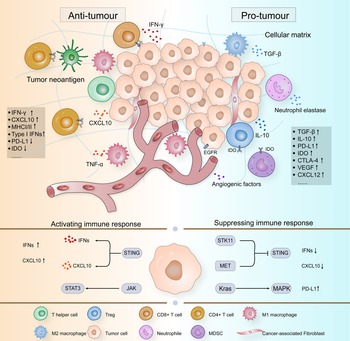
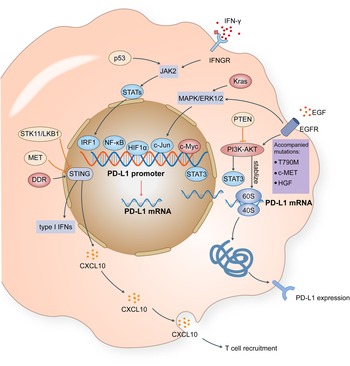
Although NSCLC patients with driver gene mutations are usually regarded to have a low response to ICIs (Refs Reference Gainor79, Reference Lee131), several driver genes have participated in the signalling pathway related to immune response and the regulation of tumour immune microenvironment (Refs Reference Koyama77, Reference Cho132, Reference Chen133, Reference Shamalov134, Reference Topper135, Reference Parkes136) (Figs 2 and 3). For instance, evidence from several research studies demonstrated that tumour suppressor proteins participate in modulating immune response and regulating the expression of immune checkpoints proteins. Thiem et al. found that P53 played a pivotal role in boosting IFN-γ-induced PD-L1 expression by inducing JAK2 expression (Ref. Reference Thiem137). IFN-γ produced by CD8+ cells was also reported to elicit the expression of the immune checkpoints in contrast to attracting cytotoxic immune cells, including PD-L1 on tumour cells and indoleamine-2,3-dioxygenase (IDO) on dendritic cells or macrophages, which promoted tumour evading and created the immunosuppressive TME. Besides that accumulated IFN-γ was recognised as the best incentive for PD-L1 expression, IL-17, as a proinflammatory cytokine secreted by Th17 cells (Ref. Reference Lei138), has also been reported to regulate the expression of PD-L1 or modulate the level of CD38 to facilitate immunotherapy resistance in KP lung cancer (Ref. Reference Peng112).
The immune microenvironment of tumour. The tumour immune microenvironment changed with the onset and evolution of tumour. Tumour antigen was presented to CD8+ T cells directly or presented to CD4+ T cells indirectly by APC (antigen-presenting cell) to elicit anti-tumour response. M1 macrophage cells also exerted anti-tumour immune response. Additionally, tumour cells also secreted chemokines such as CXCL10 to recruit lymphocytes. Tumour-associated macrophage, Tregs and MDSC play a role in suppressing anti-tumour immune response through secreting TGF-β, IL-10, and expressing IDO-1 and IDO-2. Neutrophils secreted neutrophil elastase (NE) to promote tumour proliferation. Meanwhile, cellular matrix mediated by TGF-β in tumour blocked the infiltration of lymphocytes. Cancer-associated fibroblasts (CAFs) released stromal cell derived factors, angiogenic factors to promote tumour cell growth and tumour blood vessel regeneration.

The pathway of gene mutation to influence the tumour-associated immune response. The diverse signalling pathways and transcriptional factors promoted the expression of PD-L1 to assist tumour to evade immune response. Tumour cells evade anti-tumour effects of T cells in part by elevating PD-L1 mRNA expression at transcriptional level via activation of different upstream signalling pathways.

What's more, cell-intrinsic oncogenic signalling, such as EGFR, was reported to facilitate PD-L1 expression in cancer cells via PI3 K-AKT-mTOR pathway (Ref. Reference Lastwika5). In addition, studies showed that EGFR-TKI resistant NSCLC may respond to ICIs therapy, based on the expression of PD-L1 (Refs Reference Nogami139, Reference Peng140). Thus, resistant mechanisms in EGFR mutation of increasing PD-L1 expression and attenuating immune response were identified (Ref. Reference Peng140). MAPK, PI3 K and NF-κB pathways participated in resistance mechanism-induced PD-L1 overexpression, such as HGF, c-MET amplification and EGFR-T790 M resistance mechanisms (Ref. Reference Peng140). EGFR co-occurring alterations with interferon regulatory factor 1 (IRF1) was reported to downregulate CXC-chemokine ligand 10 (CXCL10) and thus decrease effector CD8+ T cells infiltration (Refs Reference Kumagai, Koyama and Nishikawa19, Reference Matsuzaki141). The activation of MYC also indirectly increased the expression of PD-L1 in tumour cells through the influx of Chemokine (C-C motif) ligand 9 (CCL9)-dependent macrophage while Myc and KRAS co-mutation in LUAD haven't shown the similar mechanism to exert the immunosuppressive tumour environment (Ref. Reference Kortlever98). Meanwhile, the studies identified that RAS signalling upregulated PD-L1 expression in tumour cells through inhibition of the AU-rich element-binding protein tristetraprolin (TTP) via MEK signalling to increase the stability of PD-L1 mRNA (Refs Reference Chen133, Reference Coelho142).
DDR gene mutations, leading to unpaired DNA lesions and S-Phase-Specific DNA Damage, may enhance the accumulation of cytosolic DNA, which activates the stimulator of interferon genes (STING)-mediated pathway and then induces the expression of type I IFN, indicating neoantigen-independent pathways to activate innate antitumour immunity and boost the immune recognition and response. What's more, DDR-deficient molecular subtype may promote the expression of PD-L1 both in tumour cells and infiltrating lymphocytes (Refs Reference Barber143, Reference Hartlova144). The HR mutation in DDR gene mutations contributed to increased TMB and neoantigen exposure, enhancing the immune response against tumours while NOTCH was associated with the development, maintenance, and activation of T cells, in which co-mutation will represent the distinct subtype sensitive to ICIs in NSCLC (Ref. Reference Mazzotta120). Conversely, MET amplification decreased STING expression through inducing phosphorylation of UPF1 and attenuated the IFN response. Thus, the tumour infiltrating CD8+ T and NK cells were reduced (Ref. Reference Zhang145).
STK11 mutation was initially shown to upregulate the expression of KRAS genes and enhance the KRAS-induced signalling and gene expression responses for driving tumourigenesis. And in parallel it was correlated with reduced T cells in tumours likely through reducing the activity of NF-κB pathways, a pivotal immune regulatory pathway to mediate inhibition of immune surveillance (Ref. Reference Schabath146). Additionally, co-mutation STK11 and KRAS in a mouse model contributed to the recruitment of neutrophils with T cell suppressive effects and increasing the levels of T cell exhaustion markers (PD-1, CTLA-4, and T-cell immunoglobulin and mucin-domain containing-3 (TIM3)) as well as tumour-promoting cytokines by interleukin-6 (IL-6) (Ref. Reference Koyama77). In addition, STK11/LKB1 loss contributed to significant silencing of STING expression which may be insensitivity to cytoplasmic double-strand DNA (dsDNA) (Ref. Reference Kitajima147). Thus, co-occurring KRAS and STK11/LKB1 alterations reduced the level of innate immune signalling including inhibition of cytotoxic type 1 IFNs and chemokines CXCL10 which promoted T-cell recruitment by silencing STING and thus, promoted tumour immune escape (Refs Reference Barber143, Reference Kitajima147). Importantly, they correlated with low expression of PD-L1 whether in a mouse model or in patient tumours (Ref. Reference Koyama77). Thus, STK11 was associated with primary immunotherapy resistance. Likewise, in a cohort of NSCLC patients harbouring STK11/KEAP1 alterations, patients manifested as lower T cell receptor (TCR) richness and diversity and lower expression of Th1 and immunomodulatory genes, but had higher wound healing subsets compared with wild type, which was regarded as predictors of poor survival.
TP53 mutation causing loss of TP53 function, co-occurring with KRAS or not, was closely correlated with increased TMB and significantly enhance the tumour genomic instability to generate tumour neo-antigens, thereby eliciting tumour immunogenicity with increasing recruitment of cytotoxic T lymphocytes into TME, thus improving the efficacy of ICIs (Refs Reference Shamalov134, Reference Schumacher and Schreiber148). Neutrophils and dendritic cells were also closely correlated with TP53 mutation status (Ref. Reference Zhao149). Moreover, studies also demonstrated that altered unfold TP53 proteins caused by destabilising TP53 may also become tumour-specific antigens presented by class I MHC molecules, which could augment T cell reactivity (Ref. Reference Shamalov134). In contrast, Cha et al. has shown that p53 aberrant mutation assessed by IHC was closely correlated with PD-L1 expression in tumour cells (Ref. Reference Cha150). Likewise, p53 was proved to modulate PD-L1 expression by regulating the transcription of miR-34, a specific microRNA binding to PD-L1 in p53R172HΔg/ + K-rasLA1/+ syngeneic mouse model with lung adenocarcinoma. However, the inert relationship among them needs more evidence from clinical specimens to verify. Strikingly, TP53 and KRAS co-mutation presented with increased expression of PD-L1, and decreased expression of other non-PD-L1 immune inhibitory checkpoints, including Lymphocyte Activating 3 (LAG3) and V-Set Domain Containing T Cell Activation Inhibitor 1 (VTCN1), indicating a potential population benefiting from ICIs (Ref. Reference Cortez151).
In conclusion, the aberrant co-mutations of genes synergistically contribute to the immune function disorder to promote tumour immune evasion by influencing the immune checkpoint expression, the level of cytokines and inflammatory factors. The underlying complex mechanism may account for why patients with single gene mutation have no response to ICIs, but co-mutations have a surprising effect on predicting the response of ICIs.
The Relationship between co-mutations and current biomarkers of immunotherapy
A large body of studies has revealed that both single mutation and co-mutation affect the current biomarkers of immunotherapy, such as PD-L1, TMB and so on (Refs Reference Skoulidis and Heymach21, Reference Gao115, Reference Shi118). For example, EGFR mutations are correlated with a lower TMB (Ref. Reference Singal152) and lack of tumour infiltrating lymphocytes (TIL) (especially PD-L1 + /CD8 + TIL) that contributes an uninflamed TME and weak immunogenicity (Ref. Reference Dong78), suggesting an inferior response to ICIs in NSCLC patients (Refs Reference Dong78, Reference Gainor79). Interestingly, the aberrant mutations in EGFR can also drive PD-L1 expression, which indicates potential benefits from immunotherapy (Ref. Reference Gettinger and Politi153). The discrepancy between the above studies seems unable to determine whether patients with EGFR mutation can benefit from immunotherapy, so we expect more clinical/pre-clinical studies to demonstrate the response of ICIs in these patients. Meanwhile, we also lack the data of the PD-L1 expression, TMB, and TIL in different EGFR co-mutation subtypes.
Dong et al. found that TP53 and KRAS co-mutation had a possible synergistic effect on boosting PD-L1 expression (Ref. Reference Dong154). They also correlated with increased TMB level, accelerated T cell infiltration, as well as enhanced tumour immunogenicity (Ref. Reference Dong154). Likely, higher TMB and copy number alteration (CNA) are presented by co-occurring TP53- or STK11-KRAS co-mutation than KRAS mutation alone. However, as mentioned above, the biological phenotype may differ among different KRAS mutation sites. However, KRASG12D/TP53 co-mutation showed decreased TMB, PD-L1 expression, and immune cells infiltration, consisting of activated CD4 memory T cells, T helper cells, NK cells and M1 macrophages (Ref. Reference Gao115). KMT2C was associated with a higher level of TMB and higher PD-L1 expression compared with the wild type due to the genetic instability (Ref. Reference Shi118). In this regard, Zhao et al. demonstrated that truncating TP53 mutations were associated with poor survival in NSCLC patients in ICIs therapy with low TMB (Ref. Reference Zhao149), indicating that the TP53 mutation status may associate with different prognostic outcomes in NSCLC patients with ICIs. For TP53 co-mutation in NSCLC patients, increased TMB and PD-L1 expression were reported, such as TP53 and ATM co-mutation (Ref. Reference Chen119). Furthermore, TP53 and ATM co-mutation were correlated with high TMB regardless of the presence of other driver mutations, such as KRAS (Ref. Reference Chen119). Similarly, in mechanism, co-mutations in DDR way (HRR-MMR or HRR-BER) also presented with increased TMB and neoantigen load and may elevate the expression of immune checkpoint (PD-L1 and LAG3) and T-effector and IFN-γ-associated signatures and so on (Ref. Reference Wang13). Beyond above reports, some co-mutations may exert predictive value independent to TMB. Although emerging studies suggested that high TMB positively correlated with the efficacy of ICIs, Marinelli and coworkers demonstrated that co-mutation of KEAP1-STK11 had a shorter survival in LUAD patients receiving ICIs, even with high TMB, indicating that the level of TMB may not absolutely associated with the efficacy of ICIs (Ref. Reference Marinelli14). Concomitant STK11-KEAP1 loss has been reported to enhance the activation of NRF2 (Ref. Reference Wohlhieter155), which modulates antioxidant response proteins, upregulates ferroptosis-protective mechanisms, and decreases inflammatory factors. Therefore, whether the patients with co-mutation benefit from ICIs may be influenced by various factors, including the interaction between co-mutation genes.
Other mutations were also reported associating with TMB, TIL, and PD-L1 expression. KMT2C was associated with a higher level of TMB and higher PD-L1 expression compared with the wild type due to the genetic instability (Ref. Reference Shi118). MET exon 14 skipping has been reported to have a median TMB burden and demonstrate a poor response to ICIs albeit the higher of PD-L1 expression (Ref. Reference Sabari88) and CD8 + T cell infiltration level (Ref. Reference Li, Wang and Wang87). The co-mutation of MET exon 14 skipping with TP53 will not change the phenomenon. We analysed that the prevalence of co-mutation types of NSCLC patients in TCGA, and summarised the relationship between co-mutation types and their relationship with ICIs therapy (Table 1).
The incidence of co-mutations in TCGA and their relationship with ICIs therapy

LUAD, Lung adenocarcinoma; LUSC, Lung squamous cell carcinoma; TCGA, The Cancer Genome Atlas.
Given the relationship between gene mutations and tumour immunity as mentioned, the genetic alterations may influence the TIL in the TME so as to account for tumour immune heterogeneity and immunotherapy sensitivity. The immune-inflamed tumours are recognised as ‘hot tumour’ with high infiltration of CD8 + T lymphocytes, expression of PD-L1, and level of TMB and are more responsive to ICIs (Refs Reference Chen and Mellman9, Reference Chen and Mellman10, Reference Liu and Sun156). While immune-excluded tumours and immune-desert tumours are characterised as ‘cold tumour’ with poor T-cell infiltration or high immunosuppressive cell populations infiltration such as T-regulatory cells (Tregs), myeloid-derived suppressor cells (MDSCs), and tumour-associated macrophages (TAMs) (Ref. Reference Liu and Sun156). For example, EGFR mutation contributes to ‘cold tumour’, characterised as lack of tumour infiltrating lymphocytes (Ref. Reference Dong78) while TP53 and KRAS co-mutation may generate ‘hot tumour’ by increasing T cell infiltration, PD-L1 expression and TMB level (Ref. Reference Dong154). Thus, targeting specific gene mutations or signal pathways may provide us a more insightful perspective to alter tumour immune microenvironment and improve the efficacy of ICIs (Ref. Reference Galon and Bruni157). Meanwhile, gene mutations may also predict the efficacy of ICIs by reconstructing tumour immune microenvironment.
Prospective
In The past, studies demonstrated that NSCLC patients with driver mutations may be less responsive to ICIs than wild type, irrespective of PD-L1 expression. Nonetheless, cancer therapy has a tremendous shift with the advances in sequencing technologies (Ref. Reference Hyman, Taylor and Baselga158). Tumour-specific genetic mutation profile unveils that each patient exists more than one mutation with synergistical or complementary biological changes, indicating that personalised/precision genotype-targeted cancer treatment is imperative (Ref. Reference Martinez-Jimenez2). In addition, immunotherapy intrigues the predominant attention in cancer therapy with the gorgeous advent of several ICIs. The current predictive biomarkers of ICIs have some limitations of PD-L1 expression and TMB level in NSCLC. However, some single-gene mutations have been indicated to correlate with the efficacy of ICIs (such as TP53, KRAS, KEAP1, STK11, BRAF, MET and ALK) or correlated with hyperprogression with anti–PD-1 therapy (such as MDM2/MDM4 amplifications) in NSCLC patients but their predictive ability is influenced by co-occurring mutations and mutation subtype. At the same time, a genomic mutation signature risk model has successfully predicted the efficacy of ICIs in non-squamous NSCLC (Ref. Reference Bai16). Herein, we laid special stress on analysing the recent studies about co-mutations in NSCLC patients, which may be more capable of predicting the effect of ICIs than monogenetic mutations, coping with the dilemma of small groups of immunotherapy response. Given the emergence of co-mutation subtypes, we hope that these specific tumour subtypes will provide better evidence and reference for future clinical decision-making and improve the response rate of ICIs.
We further explored several potential mechanisms among them. Most of the tumour-specific genetic mutations are related to immune-related pathways and T lymphocytes infiltration signalling pathways, such as the secretion of cytokines and the expression of an immune checkpoint. Current researches support that these cellular and molecular properties of lung cancer may construct a vital framework for a patient with immunotherapy. However, more clinical trials with genetical and histological testing are still needed to validate the prognostic effect of co-mutation in immunotherapy by assessing tumour subtype-specific efficacy. With the further study of tumour-specific genetic mutations and its relevant signalling, it is not long before they can be applied to predicting immunotherapy response in patients with NSCLC.
Acknowledgements
We thank Dr Huibo Zhang, Dr Lan Li, Dr Haohan Zhang and Dr Yaqi Zhao of Cancer Center, Renmin Hospital of Wuhan University for their helps in figures preparation.
Financial support
Wuhan University Medical Faculty Innovation Seed Fund Cultivation Project (TFZZ2018025), Chen xiao-ping foundation for the development of science and technology of Hubei province (CXPJJH12000001-2020313) and National Natural Science Foundation of China (grant no. 81670123 and no.81670144).
Conflict of interest
The authors declare no conflict of interest.
Ethical standards
Not applicable.