

INTRODUCTION: BARROW CEMETERIES AND TIME
Early Bronze Age round barrow cemeteries have an unusual temporality to them. Within archaeology over the past century and more, we have become used to appreciating time in section, where its progression is represented vertically and layers are equivalent to temporal phases (Lucas Reference Lucas2012, 76–82). Even where excavation has not taken place, we are often still able to infer the progression of time through the superimposition of cut features or upstanding earthworks. These are the fundamentals of archaeological chronology. In most Early Bronze Age (EBA) round barrow cemeteries, however, the different mounds usually have no stratigraphic relationship with one another, and there is no clear physical sequence to the monuments. Unusually though, it is nonetheless still perfectly possible to infer a temporality to the build-up of these sites. If it is accepted that the people buried within the barrows did not all die at once, then it can also be assumed that the barrow group built up over an extended period of time – the period required for several, and in some cases dozens, of people to die and be buried. Additionally, some sites have a distinct linearity to them, with the barrows forming neat linear strings across the landscape (Woodward Reference Woodward2000, chap. 4). In these cases especially, time has often been read straightforwardly into those lines, the spatial relationships within the cemeteries being viewed as directly chronological (see also Needham et al. Reference Needham, Lawson and Woodward2010a, 4). The unusual strength of barrow cemeteries’ temporal characteristics might, however, also be said to be their weakness. The fact that their temporality is seemingly so readily apparent has arguably led to a weakness in archaeological approaches to time on these sites (see below); because their temporality appears so obvious, it has perhaps too readily been assumed that we understand it.
Interestingly, in the earliest archaeological accounts, the overall chronology of barrow cemeteries was hardly discussed. Having excavated these sites, now-legendary excavators/interpreters such as Colt Hoare, Greenwell, and Pitt-Rivers focused predominantly on other kinds of chronological issues – whether inhumation had preceded cremation (Colt Hoare Reference Colt Hoare1812, 24), whether round barrows were actually Bronze Age (Pitt-Rivers Reference Pitt-Rivers1898, 22), or how far apart in time the primary and secondary burials within a single mound might have been (Greenwell Reference Greenwell1877, 17) for example. The questions these earliest excavators were asking were, on the one hand, broad and big and, on the other, site-specific and relatively small. Sitting somewhere between these two ends of the spectrum, the issue of how multiple barrows within a cemetery would have been related to one another chronologically appears to have been out of focus at that time. In saying this, it is important to note that issues such as the low resolution of artefact chronologies at the time, and the general absence of clear stratigraphic relationships between barrows, did make any such discussions difficult.
Even in later, mid-20th century accounts, barrow cemetery chronologies were not usually discussed in detail. Piggott (Reference Piggott1938), for example, in his classic paper on EBA Wessex, did not address the chronology of the cemeteries within which his barrows had been found, despite the light this could potentially have shed on the artefact chronologies he was interested in (it is worth noting that Piggott would have been using often very old site reports and would thus have had limited stratigraphic information available to him). Equally, Grinsell (Reference Grinsell1959) included a whole section on ‘chronology’ but did not consider the temporality of barrow groups within it, choosing to focus on other sorts of question – whether long and round barrows were straightforwardly Neolithic and EBA respectively, for example. Ashbee (Reference Ashbee1960, 33–4), somewhat unusually for the time, did go into the subject in a certain amount of detail, while discussing the different characteristics of ‘linear’, ‘nuclear’, and ‘dispersed’ cemeteries. He argued that it was probable that ‘a barrow must have been set up on a given site and its companions added to over a period of time’ (ibid., 33), but expressed frustration at the fact that the artefacts within different barrows could not be placed in an obvious developmental sequence in order to clarify the exact nature of that organic growth. Nonetheless, even he devoted only two short pages to the issue.
Even when the chronological difficulties set out above are taken into consideration, it still remains difficult to understand quite why the chronology of barrow cemeteries was not considered a subject that was worthy of discussion in so many of these generally thoughtful and comprehensive works. It is probable that, at this time, the sub-chronologies of individual monument types seemed inaccessible generally, as dating was simply too imprecise. However, given that EBA barrows provide two different ways of addressing this – via material culture and via the spatial arrangement of barrows – it is interesting that this potential was not explored further. As we have seen, the absence of any such discussions may simply be because the temporal scale of the question was out of focus – people were wrestling with both bigger (period-wide) and smaller (site-specific) issues instead. It is, however, also possible that, as discussed above, for many the temporality of a cemetery appeared just too obvious to worry about – barrow groups had simply built up gradually over time as people died.
In direct contrast to these earlier accounts, from the 1980s onwards, the chronology of barrows and barrow cemeteries – and associated discussions of topics such as ‘memory’ and ‘time’ in EBA burial practice – have come to dominate interpretation (see also Garwood Reference Garwood2007, 31). Early post-processual work (eg, Braithwaite Reference Braithwaite1984; Thorpe & Richards Reference Thorpe and Richards1984) speculated about changes in the nature of political power during the Late Neolithic/EBA, suggesting that an earlier system which had been based upon ritual authority was challenged by one based on access to prestige goods and ancestral lineages. Any focus on the latter in particular led naturally to, and in this case partly developed out of, an interest in barrow cemeteries and their perceived representation of ancestral lines. Additionally, from the late 1980s onwards, EBA barrows came to feature strongly in studies (often Giddens-influenced) which sought to investigate how prior material conditions may have influenced action, and more specifically how burial practices in the recent past had influenced subsequent mortuary rites (eg, Barrett Reference Barrett1988; Reference Barrett1994; Garwood Reference Garwood1991; Mizoguchi Reference Mizoguchi1992; Reference Mizoguchi1993; Last Reference Last1998). The build-up of barrow cemeteries and the relationship between burials has remained a significant focus of EBA research ever since (eg, Jones Reference Jones2001; Reference Jones2004; Reference Jones2012; Sofaer-Deverenski Reference Sofaer-Deverenski2002; papers in Last Reference Last2007a; Brück Reference Brück2009).
As a result of this substantial increase in interest in the chronology of barrows since the 1980s, our chronological ambitions for these sites have changed dramatically. Unfortunately, broadly speaking, our chronological understandings of them have not (see also Garwood Reference Garwood2007). This has led to a significant mismatch between the temporal scale of our interpretive aspirations and our actual temporal knowledge of the archaeology we are trying to interpret. People have been seeking, for example, to investigate how memories would have been sustained between one burial and the next within a single barrow or cemetery (eg, Mizoguchi Reference Mizoguchi1993; Last Reference Last1998; Jones Reference Jones2001; Reference Jones2012), yet have had to do so with little real understanding of the temporal span of the site. In a discourse which is all about the passage of time, people have had to remain unhelpfully (but necessarily) vague in relation to the time spans involved – ‘over a period of time’ (Mizoguchi Reference Mizoguchi1993, 224), ‘through the years’ (Last Reference Last1998, 45), ‘many centuries’ (Woodward Reference Woodward2000, 20) – or to accept, uncritically, others’ often somewhat speculative phasing of the sites under discussion (eg, Mizoguchi Reference Mizoguchi1992; Jones Reference Jones2012, 161). This has led to the writing of what Garwood (Reference Garwood2007, 49), critically, yet perhaps accurately, has described as ‘unnecessary fictions’ about the EBA world we are ultimately trying to understand. Equally, the geographical focus on central southern England in nearly all of these accounts has perhaps masked different kinds of site, with different histories, elsewhere.
It is important to emphasise that the lack of chronological resolution described here has been recognised as being interpretatively problematic for some time (eg, Exon et al. Reference Exon, Gaffney, Woodward and Yorston2000, 110; Bradley Reference Bradley2007, 177; Needham et al. Reference Needham, Parker Pearson, Tyler, Richards and Jay2010b, 371; Appleby Reference Appleby2013). Garwood (Reference Garwood2007) has pressed home the point most forcefully, arguing that as a result of the absence of proper, detailed chronologies, much recent work has tended to homogenise the evidence and failed to appreciate the subtler nuances and variability of practice throughout the EBA. In his 2007 paper, he presented an impressively broad overview of well-dated barrow sites, putting forward a detailed and convincing scheme of change in the character of barrows over time. His authoritative account certainly moved the debate on in the right direction, and importantly stressed that a proper appreciation of chronology must be central to any understanding of EBA burial practice. However, it is important to note that even Garwood, who has probably considered the temporality of these sites in more detail than anyone, still found it difficult to discuss the overall chronologies of barrow cemeteries or ‘mound groups’ (as he termed them) at the resolution really necessary to understand them. In his consideration of their chronology (2007, 37–42), he was forced simply to revisit his own earlier analysis of Barrow Hills – which was based on a combination of material culture typologies and assumed linear sequence placed within a ‘framework’ of radiocarbon dates with very large error ranges (Garwood Reference Garwood1999, 293) – and to suggest that a similar picture of site development may have occurred at the comparable barrow cemetery at Normanton Down. Ultimately, he broke down the development of both sites into only three phases spanning up to 1000 years (Garwood Reference Garwood2007, fig. 4.5) – a considerably coarser resolution than is ultimately needed.
ESTABLISHING A TIGHTER CHRONOLOGY: RADIOCARBON DATING AND THE POTENTIAL OF BAYESIAN MODELLING
The vast majority of barrows and barrow cemeteries were dug in the 19th and early–mid-20th centuries (eg, Colt Hoare Reference Colt Hoare1812; Green & Rollo-Smith 1984; Thomas Reference Thomas2005). Very few groups of barrows have in fact been excavated since radiocarbon dating became commonplace, and even well-dated single, multi-phase barrows remain thin on the ground (Garwood Reference Garwood2007 lists only 22 such sites). A number of barrow groups in Britain have been subject to relatively substantial programmes of radiocarbon dating – eg, Brenig (Lynch Reference Lynch1993), Barrow Hills (Barclay & Halpin 1999), Cossington (Thomas Reference Thomas2008), Raunds (Harding & Healy Reference Harding and Healy2007; Bayliss et al. Reference Bayliss, Healy, Bronk Ramsey, McCormac, Cook and Harding2011), Snail Down (Thomas Reference Thomas2005), and Stannon Down (Jones Reference Jones2005). However, even on these sites, the human-scale chronologies required to address many of the wider interpretive questions being asked have usually remained some way off. Issues such as the necessity (at the time) to date wood charcoal rather than cremated bone (eg, Brenig and Snail Down), relatively large error ranges and resultantly long calibrated date ranges (eg, of 300–500 years at Barrow Hills, and 200–300 years even at the more recently-dated Raunds), and an absence of three-dimensional stratigraphy through which to model the dates in sequence (most sites), have ensured that the precision of our chronologies and the precision required interpretively remain mismatched, even on these thoroughly dated sites. Thus far, the radiocarbon dating of EBA barrow cemeteries has not perhaps fulfilled its promise; the dates secured may be ‘accurate’ but they have not necessarily been precise (Garwood Reference Garwood2007, 31).
The technique of using Bayesian modelling to tighten the calibrated date ranges associated with radiocarbon determinations has become increasingly common over the past decade or so (see Bronk Ramsey Reference Bronk Ramsey2009 and Whittle et al. Reference Whittle, Bayliss and Healy2011, 21–42). In order to ensure that a Bayesian model for any given site works effectively, it is usually necessary to have a detailed site stratigraphy with determinations obtained on samples taken from multiple, sequential layers (see Whittle et al. Reference Whittle, Bayliss and Healy2011, 27–28 for a detailed explanation); good site preservation and high standards of recording are therefore very important. Within the British Neolithic especially, the technique has been employed to great effect, enabling a completely new level of understanding of long barrows and causewayed enclosures and ultimately also the geographical spread of Neolithic practices (Whittle et al. Reference Whittle, Barclay, Bayliss, McFadyen, Schulting and Wysocki2007; Reference Whittle, Bayliss and Healy2011). This work has revolutionised our interpretations of the period, providing insight into site-specific chronologies at a sometimes generational scale (ie, calibrated date ranges of 30–50 years) – exactly the kind of resolution required on EBA barrow sites.
In the rest of this paper, we outline the results of a study of one particular EBA barrow cemetery at Over in Cambridgeshire, where it has been possible to undertake Bayesian modelling of 43 radiocarbon dates (from burials and other ‘events’ within the barrows) securing the tightest chronology yet obtained for a site of this kind.
THE EBA BARROW CEMETERY AT OVER
Introduction to the site
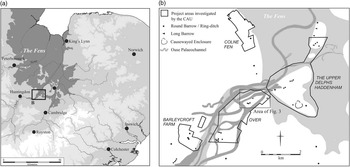
The Cambridge Archaeological Unit has been carrying out excavation in advance of gravel extraction (currently by Hanson Aggregates Ltd) in the Over landscape for almost 20 years, extending across an area of some 480 ha overall (Fig. 1). Detailed information about the first tranche of this work can be found within the first Over monograph, Twice-crossed River (Reference Evans, with Tabor and Vander LindenEvans et al. forthcoming – hereafter TCR; see also Evans & Knight Reference Evans and Knight2000; Evans Reference Evans2011; Evans et al. Reference Evans, Tabor and Vander Linden2014). The present paper focuses on a group of five EBA barrows excavated in an area of the quarry known as the ‘Low Grounds’ over a five-month period in the summer of 2008. The excavation was directed by Jonathan Tabor and project managed by Christopher Evans. It is important to note at the outset that the site will shortly be published in monograph form (TCR). This paper aims specifically to highlight the results of the NERC radiocarbon facility-funded dating programme for the site (see below) and to comment on its significance in terms of the broader discussions concerning the temporality of barrow cemeteries outlined above.
The Over landscape

The five Low Grounds barrows formed part of a densely populated burial landscape (Fig. 1); 11 other barrows are known within 2 km, three of which have been excavated. Two cremation burials were identified within the closest excavated barrow (visible in Fig. 3 as Site IIa); their dates overlapped with the latter phases of the Low Grounds cemetery. The other two excavated barrows have yet to be thoroughly dated (see TCR and Evans & Hodder Reference Evans and Hodder2006). Intriguingly, the barrows under discussion here were constructed on what would have been a fairly small island within a system of sinuous river channels (Boreham in TCR). The huge scale of excavations undertaken in the Over landscape over the years has resulted in the identification of numerous Beaker and EBA features (mostly small pits) in the vicinity. The radiocarbon dates from these suggest that they are likely to have been created while the barrows were being used – the barrow cemetery and the settlement-related features close to it were, as far as we can tell, directly contemporary (Meadows et al. in TCR).
Barrow architecture
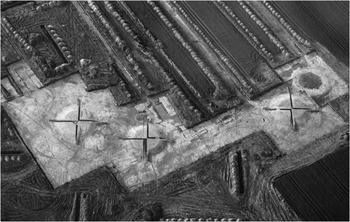
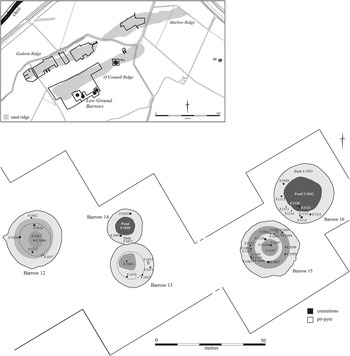
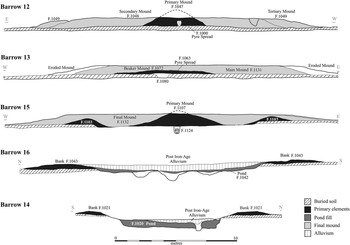
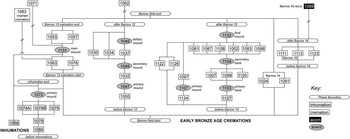
The Low Grounds barrow group consisted of three upstanding turf-mound barrows (which did not have ditches) and two pond barrows (Figs 2 & 3). As a result of the subsequent build-up of peat and alluvium in this fen-edge landscape, the upstanding architecture of the barrow mounds was protected to a considerable extent from later plough damage (if not completely – the tops of the turf-mound barrows had been somewhat truncated – see Fig. 4); when excavated the barrows stood up to a metre in height (Figs 2 & 4). All three of the turf-mound barrows had been subject to significant remodelling (mounds enlarged, new burials added, etc) over the course of their lives (Fig. 4). Due to the high quality of preservation overall, these different phases were fully visible on excavation and so a robust stratigraphic matrix (incorporating burials and architectural ‘events’) could be established for each one (see Figs 9 & 10). The stratigraphy within the pond barrows was simple, and so the burials within these could not be attributed to sequential phases in the same way. In plan, each of the two pond barrows appeared to be directly ‘paired’ with the immediately adjacent turf-mound barrow.
Aerial photo of the Low Ground barrows under excavation (photo: Ben Robinson)

Plan of the Low Grounds barrows, showing feature numbers of cremations (see Fig. 5 for inhumation locations)

Barrow sections, showing multiple remodelling episodes

The significance of the facts that three of the barrows were still upstanding, and that their mounds were extremely carefully excavated, cannot be emphasised enough. That it was possible to establish a stratigraphic sequence of burial within the mounds was absolutely vital to the success of the dating programme described below.
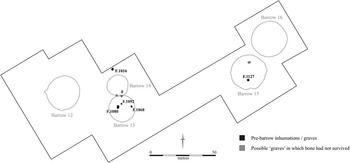
Significantly, the five barrows (associated with cremation burials and Collared Urns) were preceded by a series of inhumation burials (two of which were associated with Beakers). The latter were either simple ‘flat’ graves, or had perhaps been covered by insubstantial mounds (these were not generally clearly visible when the barrows were excavated, although one potential candidate (F1072) was identified underneath Barrow 13). There were five ‘flat’ graves in total, containing nine inhumations (Fig. 5). Four contained straightforward single burials. The fifth (F1080) had been recut multiple times (Fs 1074/1075/1079) and had ultimately come to include five individuals in what is best described as a ‘stack’ of intercutting graves. It is worth noting that a number of other grave-like features were found close to the main cluster of inhumation burials (shown in Fig. 5), but these did not contain any human remains; it is certainly possible that these were also graves in which any skeletons originally present had not survived (the gravel soils at Over do not always preserve bone very well).
Plan of the flat grave inhumation cemetery at Over (Fs 1074, 1075, and 1079 were cut directly into F1080). The positions of barrows subsequently constructed are also shown in outline

Burials
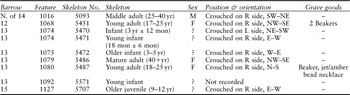
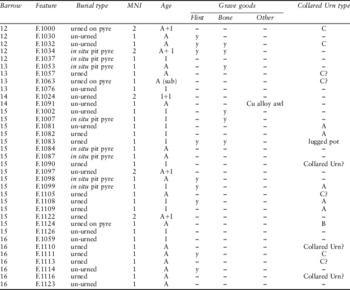
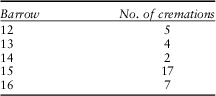
A wide variety of people were buried at the site (see Dodwell in TCR for a full discussion – all of the information about the human skeletal remains presented here is taken from her much more detailed report). The group of nine inhumed individuals included four adults (three female, one male), one juvenile, and four infants (Table 1). A total of 41 features contained cremated bone in varying amounts (Table 2). Of these, 35 were classed as formal EBA ‘burials’, within which 40 individuals (minimum) were identified. Overall, half of the 40 cremated individuals were identified as adults and half children (ie, <18 years old); at least 15 of the latter had died before they were 5 years old. It was possible to sex 14 of the adult cremation deposits: nine were female, five male. Five of the cremation burials contained the remains of more than one person. In four cases, this was an adult with an infant, and in the fifth two infants had been buried together. The number of burials within each barrow varied considerably (Table 3 and Fig. 3).
inhumation burials: summary

cremation burials: summary

number of eba cremations in each barrow

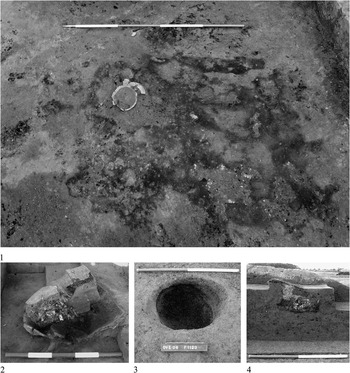
The cremation burials could be divided into four main ‘types’, according to the specific process(es) by which they had been cremated and buried in the ground (Fig. 6):
Photos of each of the four cremation types: (1) urned cremation on pyre (F.1063, Barrow 13); (2) urned cremation (F.1032, Barrow 12); (3) un-urned cremation (F.1123, Barrow 16); (4) in situ ‘pit-pyre’ cremation (F.1097, Barrow 15)

-
1. Urned cremation burials on pyres.
-
2. Urned cremation burials within pits.
-
3. Un-urned cremation burials within pits.
-
4. In situ ‘pit pyres’ (with and without urns).
In the case of Type 1, the cremated bones of the body were placed on or next to the remains of the in situ pyre on which it had been burnt, together with or inside an urn. Type 4 also perhaps requires further explanation (see also Evans Reference Evans1996; Evans & Hodder Reference Evans and Hodder2006, 27–30; Dodwell Reference Dodwell2012). ‘Pit pyre’ cremations comprise a pit – in this case, always cut into an existing barrow mound – with intensively scorched sides and base, suggestive of in situ burning. Within the pit are found layered deposits of burnt human bone and pyre material (including charred timbers). The degree of scorching and the presence of pyre remains indicate that the cremation took place on the spot, probably on pyres constructed directly over the pit.
Interestingly, no clear patterns were discernible to indicate what kind of person (in terms of their archaeologically visible traits at least) received what sort of cremation – adults and children were present in all four categories. Similarly, the four different types of cremation burial were, broadly speaking, found across the site rather than being clustered in particular barrows (see below for a more detailed discussion). Type 1 was represented by just three burials – the primary cremation burial in each of the three turf-mound monuments.
It is worth noting that three later cremation burials (one associated with a Deverel-Rimbury bucket urn) were subsequently inserted into Barrows 12 and 13. These burials have been discussed in full within the main monograph (TCR), but will not be considered in detail here. Their dates are too recent to affect the chronology of the EBA cremation burials within the Bayesian model; the earliest, a second interment attributed to F1063 at the time of excavation, was apparently inserted in the century after the end of the main period of EBA cremation burial (see online supplementary material, Difference F1063 reused).
Grave goods
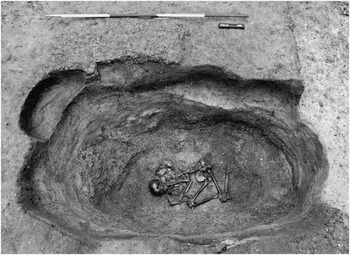
The sorts of object found within the burials at Over also varied considerably overall. The primary inhumation at the bottom of the stack of burials under Barrow 13 (F.1080 – a young adult female) was buried with one Beaker and a jet and amber disc bead necklace (Fig. 7; see Sheridan and Timberlake in TCR for details). One other inhumation, a few metres to the east underneath the same barrow (F.1068 – also a young adult female), had been buried with two Beakers. None of the other inhumation burials contained any grave goods. All three of the Beaker vessels had comb-zoned decoration, and could be assigned to Clarke's Southern British Beaker Series and Needham's Long-necked forms (Knight in TCR).
Primary inhumation F.1080. The accompanying Beaker vessel can be seen just behind the shoulders; the beads which made up the jet and amber necklace were recovered from the general head area. The cuts for the subsequent ‘stack’ of graves above F.1080 (Fs 1074, 1075, and 1079) can also be seen

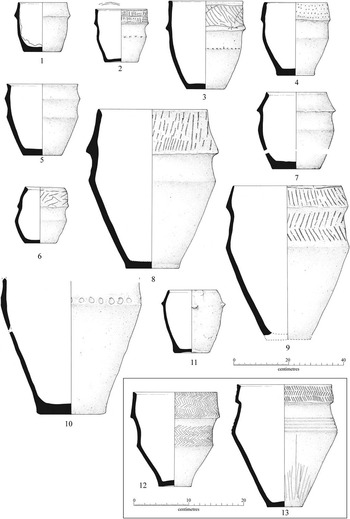
Twenty EBA urns were found in association with cremation burials (Fig. 8). Fifteen of these could be classed as Collared Urns (one an unusual Collared Urn/Food Vessel hybrid). Four of the remaining five may well also have been Collared Urns originally but were deemed unclassifiable because no diagnostic elements of the vessel remained; the fifth was an unusual lugged vessel. Other grave goods present across the site included: flint knives, barbed and tanged arrowheads and other flint implements; several bone or antler pins, a fine bone belt hook, and a bone or antler pommel (removed from any dagger prior to burial); and a copper alloy awl (see the various specialist reports in TCR for details of these).
A selection of vessels found at the Low Grounds site. Group A Urns: (1) F.1082, (2) F.1099, (3) F.1095, (4) F.1104, (5) F.1109, (6) F.1108, (7) F.1081; Group B Urns: (8) F.1124; Group C Urns: (9) F.1111, (10) F.1063, (12) F.1032, (13) F.1057; Misc lugged vessel: (11) F.1083

A certain degree of patterning was discernible in the way in which different sub-styles of Collared Urn were distributed across the site (see Fig. 18 below). In his specialist report on the urns, Law (in TCR) defined three styles of Collared Urn (based on height and base to mouth ratios) which he termed Groups A, B, and C (see Law Reference Law2008 for a detailed explanation of this scheme). Whilst Group C pots were found in all four of the barrows which contained pots (Pond Barrow 14 did not), Group A pots were found only in Barrow 15 (there was only one Group B vessel). Given that Group A had previously been defined as the latest style of the three (Law Reference Law2008), this represented an interesting pattern to explore in terms of the site's chronology (see also below). The relatively low total numbers of other grave goods make it difficult to define spatial patterning in those other categories, but no clear distributional trends were visible.
Summary, and a preliminary (pre-radiocarbon dating) site chronology
Overall, despite the fact that the Low Grounds site consisted only of five barrows, the character of its archaeology is nonetheless very complicated to describe. This complexity, and the variability seen across the site – in terms of the people buried there, the manner in which they were buried, and the objects they were buried with – make it especially important to understand in a chronological sense as well.
As is often the case with barrow cemeteries, prior to any independent chronological understanding of the site sequence through radiocarbon dating, it was still possible to gain glimpses of the site's temporality (see also TCR). In order to make the insights gleaned from the radiocarbon dating programme described below totally clear, these initial glimpses are summarised briefly here.
The locality apparently first came to represent a focal point for burial during the Beaker period, some time before the construction of the barrows. Although only two of the inhumations were actually buried with Beakers, it could be assumed that all nine of them had been buried there around this time. The inhumation burials were placed in flat graves (perhaps covered by very low mounds) in a fairly loose cluster extending over an area of c. 100 × 20 m (Fig. 5). As has often been the case on other sites as well, the ‘richest’ of these subsequently came to represent a significant focus for later burials, and ultimately a stack of five bodies was placed in sequence above it (Fig. 7).
Some time later, presumably a while after all of the inhumations had been interred, a barrow cemetery – associated with Collared Urn pottery as opposed to Beakers – came to be constructed on the site. Since two of the three turf-mound barrows (Barrows 13 & 15) were built directly over four of the five earlier flat inhumation graves, it could be assumed that there had been a relatively close temporal relationship between them, and/or that the earlier graves had been marked in some way. The three main turf-mound barrows are in a line, and so it could be assumed from their linear physical sequence that they may also have been constructed in temporal succession. It also seemed possible that, given their close pairing, the pond barrows had been used in tandem with adjacent turf-mound barrows. Equally, if Law's (Reference Law2008) sequential Collared Urn typology (which places his Group A urns last) was seen as valid on this site as well as elsewhere, it could also be assumed that Barrow 15 had been used for longer than the others.
The sequence within each individual barrow was perhaps the clearest temporal element of all. As discussed above, as a result of the fact that these upstanding monuments were excavated extremely carefully, different burials within each could be tied into the sequential renovations and remodelling episodes that the barrows had undergone (Figs 4, 9, & 10). In this case, very unusually for a modern excavation, an understanding of the relationship between the burials was based on three-dimensional stratigraphy, rather than being dependent on concepts of ‘primary’, ‘secondary’, and ‘satellite’ burials which have in the past been used to infer sequence where the third dimension is absent (see Evans et al. Reference Evans, Tabor and Vander Linden2014 for a detailed discussion of the fact that the third dimension of archaeology is arguably often overlooked in modern archaeological practice).
Frustratingly, however, while the sequence within each barrow could be fairly well understood, the temporal relationships between similar burials in different barrows could not. It was not possible to know for sure whether all five barrows had been in use at the same time or successively, for example. In terms of the site's overall development, and also in terms of broader discussions (of memory, time, ancestral relationships, etc) of EBA barrow groups more generally, this represents arguably the most important issue to understand. Only once the ebbs and flows of burial practice across the site were understood properly, in temporal sequence, would it really be possible to begin to approach a full understanding of the variability apparent there.
RADIOCARBON DATING THE LOW GROUNDS BARROWS
Given all of these issues, and the exciting possibility of being able to answer many of the questions raised if a good chronology for the site could be secured, an application was made to the NERC radiocarbon facility (NRCF) to date all of the burials within the Low Grounds site. Critical to that application, and to the subsequent success of the analysis, were the facts that (a) the site at Over had been excavated to very high standards, (b) the clear sequential, stratigraphic relationships observed between the burials (in the three turf-mound barrows at least – see Figs 9 & 10) made it possible to employ Bayesian modelling very effectively to tighten the date ranges obtained, and (c) developments in radiocarbon dating over the past decade or two have ensured that cremated bone can now be dated (although see Meadows et al. in TCR for a discussion of the technical issues concerned).
Matrix used to inform the Bayesian model

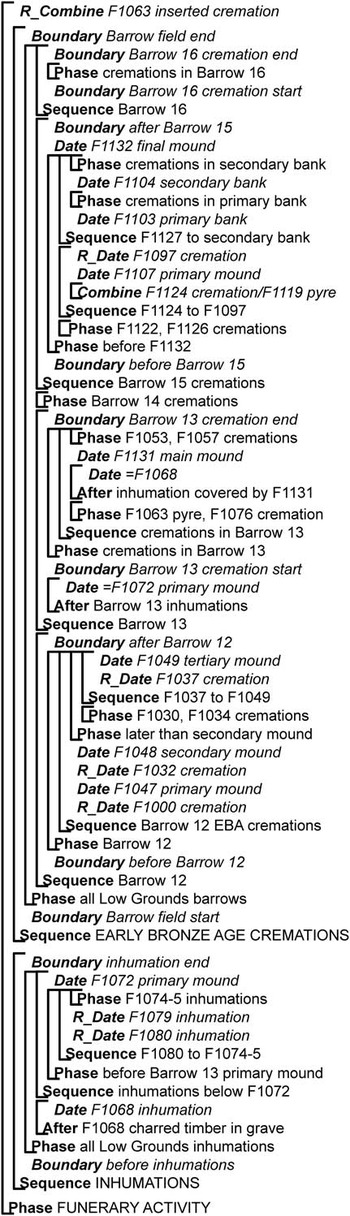
Schematic representation of the Bayesian model structure, defined by the square brackets and OxCal CQL keywords (bold). See online supplementary material for more information

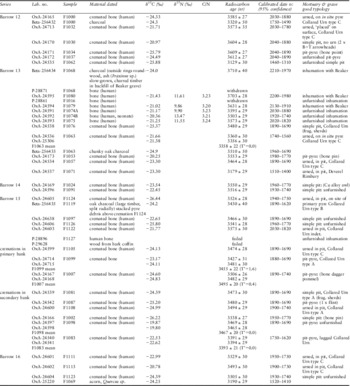
The NRCF application was successful, and a total of 39 dates awarded. Samples from all nine inhumations on the site were submitted to the Research Laboratory for Archaeology and the History of Art, University of Oxford. Three of these (F.1016, F.1068 and F.1127) were not extracted as they appeared to have insufficient collagen for dating; a fourth (F.1092) was extracted, but failed to date. Calcined bones from 30 cremation burials were also submitted; in five cases, two radiocarbon measurements were obtained on the same fragment. In addition to these NRCF-funded samples, dates obtained from charcoal samples previously submitted by the CAU (three from in situ cremation pyres, one from charred timber within a grave) were also included in the Bayesian model. Detailed information about sample selection procedures, laboratory measurements, taphonomic considerations, the use of OxCal, and the Bayesian chronological modelling process is provided in Meadows et al. in TCR.
Briefly, the Bayesian approach to chronological modelling aims to produce reliable statistical estimates of the dates of events of archaeological interest – such as the construction of a monument or the last instance of use of a particular type of pottery – on the basis of all the relevant evidence, including calibrated radiocarbon dates of samples directly or indirectly associated with these events, stratigraphic relationships between samples, and similarities in material culture and practice. These estimates (technically known as posterior density estimates) are usually given in italics, to emphasise that they are based on archaeological interpretations of the chronological relationships between samples, and may therefore change if new data are added or the relative dates of samples and events are reconsidered.
In addition to the relative dating constraints imposed by stratigraphic sequences within each barrow or series of inhumations, our model (Fig. 10 and online supplementary material) incorporates the assumption that within the EBA, each monument was used for a finite and relatively continuous period; we also assume that the burial practices of inhumation and cremation each continued for a limited and uninterrupted period. We make no assumptions about the order of construction or contemporaneity of the barrows, or about the relative dating of burial practices or grave goods. Our model also allows for the possibility that the radiocarbon dates of cremated bones are subject to wood-age offsets, as the carbon in cremated bones appears to be derived mainly from the pyre fuel, rather than the diet of the person concerned (eg, Hüls et al. Reference Hüls, Erlenkeuser, Nadeau, Grootes and Andersen2010).
RESULTS
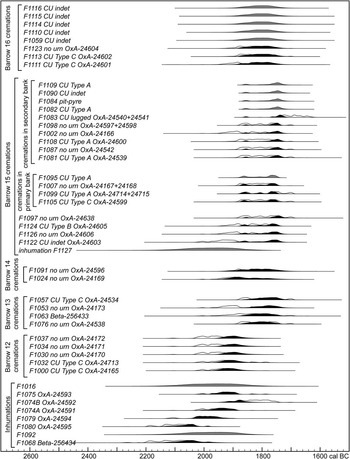
The results of the dating programme are detailed in full in Table 4 and presented visually in Figure 11. These results inform our understanding of both the site's architectural development and the temporality of the burial practices conducted there overall. In the next sections, we deal with these two elements in combination (at a series of different scales), before ultimately turning to consider the implications of this new site-specific understanding for broader interpretations about EBA funerary practice in general.
radiocarbon results, low grounds barrow field

Where more than one result for the same sample is available, we have taken their weighted mean as the best estimate of the sample's radiocarbon age, following Ward and Wilson (1978). The test statistic for statistical consistency, T’, is well below the critical value at the 5% significance level, 3.8 in each case
The development and use of a cemetery: overall chronology
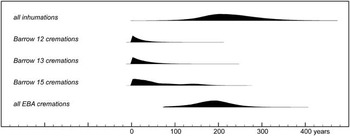
In overall terms, from the first Beaker burial to the last Collared Urn cremation burial, the barrow cemetery was in use for between 300 and 400 years (Fig. 12). The sequence of its development is arguably best appreciated visually (Figs 11–13), but is nonetheless outlined in words below.
Estimated dates of individual burials. White probability distributions are simple calibrations of the relevant radiocarbon results (Reimer et al. Reference Reimer, Baillie, Bard, Bayliss, Beck, Blackwell, Bronk Ramsey, Buck, Burr, Edwards, Friedrich, Grootes, Guilderson, Hajdas, Heaton, Hogg, Hughen, Kaiser, Kromer, McCormac, Manning, Reimer, Remmele, Richards, Southon, Talamo, Taylor, Turney, van der Plicht and Weyhenmeyer2009); black distributions are posterior density estimates of the dates of these burials, derived from the Bayesian chronological model (online supplementary material); grey distributions are posterior density estimates of the dates of burials for which no directly relevant radiocarbon results are available

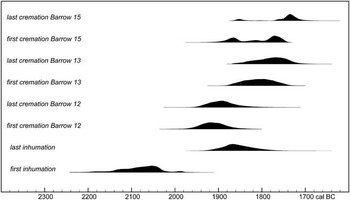
Estimated dates of the first and last inhumations, and the first and last EBA cremations in each of Barrows 12, 13, and 15, based on the posterior density estimates shown in Figure 10.

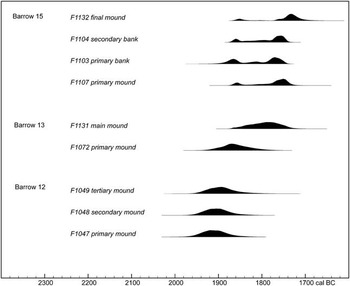
Estimated dates of construction events, derived from the Bayesian chronological model (online supplementary materials)

Inhumations
The earliest dated burial on the site was the ‘rich’ inhumation with Beaker and necklace (F.1080) that formed the primary burial within the ‘stack’, 2140–1970 cal bc (95% probability). Another inhumation with no grave goods (F.1079) was subsequently placed immediately above it, probably towards the latter part of this date range. The three final inhumations within the ‘stack’ (all infants without grave goods) were added possibly a century later, c. 1900–1850 cal bc. Frustratingly, only these five out of the total of nine inhumations on the site could be dated successfully; the four other samples from inhumations elsewhere either were not extracted as they appeared to have insufficient collagen for dating or failed.
Barrow 12
The first barrow to be constructed on the site, Barrow 12 was built and quickly refurbished (twice) in the decades around 1900 cal bc. All five of the cremation burials in Barrow 12 are likely to have been inserted during this fairly short period. Significantly in terms of the site's chronology overall, the cremation burials in Barrow 12 seem to have pre-dated the latest inhumations at the top of the ‘stack’ described above.
Barrow 13
In the decades around 1850 cal bc, the small primary mound for Barrow 13 was constructed over those infant inhumations. The primary in situ cremation (F.1063) was burnt and buried on top of this mound, and a second cremation burial (F.1076) probably also added to the monument shortly afterwards. Next, in the decades around 1800 cal bc, the main turf mound of Barrow 13 was built; two further cremation burials were subsequently added to this.
Barrow 15
Although it is possible that Barrow 15 dates to the mid-19th century cal bc, it is more likely that it was built after 1800 cal bc, immediately over the top of one of the outlying inhumations. It too saw several phases of remodelling, starting life as a ring-bank and central mound, but finishing up as a standard bowl-barrow (the ring-bank area having been infilled) by 1720 cal bc. Seventeen cremation burials in total were added during its life.
Pond Barrows 14 & 16
All of the dated cremation burials associated with the two pond barrows appear to have been deposited between c. 1900 and 1720 cal bc (Fig. 13). Due to the absence of clear stratigraphic relationships in these two monuments, it was not possible to constrain the calibrated dates as effectively as elsewhere. Their broad date ranges make it perfectly possible for them to have been in use at the same time as the turf-mound barrows they were physically ‘paired’ with.
The length of a monument's life
Alongside this construction of an overall site chronology, the Bayesian model also allows us to discuss the longevity of each different monument as an active place of burial. The ‘stack’ of inhumations under Barrow 13 appears to have accumulated over several generations, perhaps as much as 250 years (Figs 12 and 14). Although, frustratingly, it did not prove possible to date the other four inhumations on the site, it seems quite likely that these would have been buried in the same period. By way of a contrast, the use of each barrow for cremation burial seems to have been fairly brief. Figure 14 shows the posterior density estimates for the duration of cremation burial within the three turf-mound barrows. Barrow 12 was probably used for no more than a generation, and Barrow 13 for only one to two generations. The duration of cremation burial in Barrow 15 is relatively poorly constrained due to the shape of the relevant part of the calibration curve, but again it was probably not very long-lived (there is a 68% probability that it was in use for less than 80 years); the fact that it contained large numbers of cremation burials was not therefore necessarily a result of it having been used for longer. The pond barrow cremation burials do not necessarily represent lengthy periods of use either: statistically, the five dated cremation burials from Barrows 14 and 16 could all be the same date (although there is no reason to suppose that they are).
Estimated duration of different phases of burial activity, derived from the Bayesian chronological model (online supplementary materials)

Barrows built in sequence?
Altogether, the cremation burials associated with the barrows span about two centuries (110–260 years, 95% probability). Importantly, as can be seen in Figures 12 and 13, the modelling of their dates – in combination with those for the construction event sequence described above – suggest that the turf-mound barrows may have been built in sequence; that all of the cremation burials associated with each were deposited, and that each turf-mound saw all of its remodelling, before the next monument was constructed.
KEY FINDINGS AND INTERPRETIVE IMPLICATIONS
Inhumation to cremation: competing discourses?
In terms of burial rite, the shift from inhumation to cremation at the site is perhaps the most obvious. As discussed above, prior to the establishment of an independent chronology, this change appeared to provide a route into the chronology of the site (earlier Beaker inhumations underneath barrows containing later Collared Urn cremation burials). As it turns out, things were not quite so simple. Our model suggests that, in fact, the latest dated inhumations at the site (the infants buried under what was subsequently to become Barrow 13) are likely to have been placed in the ground after Barrow 12 had been built and possibly all of its associated cremation burials had been deposited (Fig. 12).
Chronological overlap between inhumation and cremation on a site is by no means unheard of (eg, Harding & Healy Reference Harding and Healy2007, 135 & 164). Equally, the fact that a new barrow was constructed, and used for cremation burial, in an area where inhumations (in probable flat graves) had been buried for generations is not unusual either (see Woodward Reference Woodward2000, chap. 2; Gardiner et al. Reference Gardiner, Allen, Powell, Harding, Lawson, Loader, McKinley, Sheridan and Stevens2007; Last Reference Last2007b; Appleby Reference Appleby2013). What is particularly interesting here in terms of the site's burial dynamics, however, is the fact that, after Barrow 12 had been constructed and used for cremation burial, three infant inhumations were then buried 30 m away (on top of two much older inhumations). Interestingly, unlike their predecessors, these later burials were not accompanied by Beakers. At this point, the cremation burials within Barrow 12 tell us that we had moved into the Collared Urn-using phase; it is thus potentially very interesting that these inhumations, which seem to be referring back to the earlier Beaker-using phase, did not themselves contain any pots at all (see Healy Reference Healy2012 for a discussion of the possibility that many 2nd millennium bc inhumations go unrecognised because they were unaccompanied by artefacts). Some time later, Barrow 13 was constructed above the final inhumations, and a series of cremation burials interred within it.
The basic sequence for this phase is thus likely to have been:
-
1. Use of site for inhumations.
-
2. Construction of Barrow 12 and burial of associated cremations.
-
3. Burial of three further inhumations on top of the much earlier ‘stack’ of two.
-
4. Construction of Barrow 13 over these inhumations and burial of associated cremations.
Given (2) the establishment of Barrow 12 and its novel use of cremation burial, in an area that had been long-associated with inhumation, (3) the continued deposition of inhumations on top of those much earlier burials, after and adjacent to this new, cremation-focused barrow, and (4) the subsequent construction of a separate barrow over these inhumations (and its use then for cremation burial), it might be tempting to speculate about whether what we are seeing here is ‘competing burial discourses’ (eg, Braithwaite Reference Braithwaite1984). Even if this was not the case – and given that Barrows 12 and 13 may well have been successive and thus not directly ‘competing’ in a straightforward sense, we should not perhaps assume too readily that it was – there is a sense that people were at least ‘working things out’ one way or another in terms of burial practice at this time. There certainly does not appear to have been a sudden or straightforward direct shift from inhumation to cremation.
Change over time: variability as a constant theme
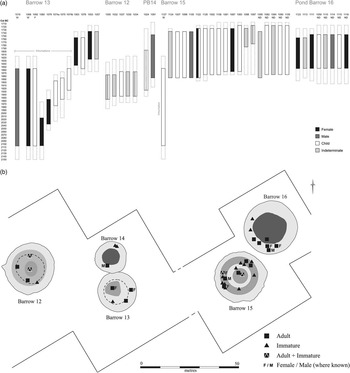
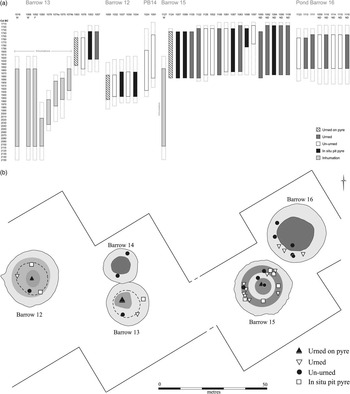
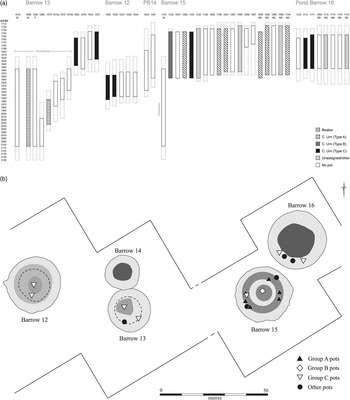
In order to represent the tremendous variability of burial practice seen at the site, we created a series of images (Figures 15, 16 & 18) which depict the prevalence of different elements of burial practice within all of the burials across all of the barrows. The burials within each barrow have been ordered chronologically within Figures 15a, 16a and 18a (informed primarily by site stratigraphy, and then by radiocarbon dates), with the approximate date span for each burial represented by the length of its bar. The date spans shown with solid bars correspond to the 68% probability posterior density estimate ranges given by the Bayesian model; the date spans shown with dashed lines correspond to the 95% probability posterior density estimate ranges. Figures 15a, 16a and 18a are most effectively read in combination with Figure 11, which shows how likely each burial is to fall within different part of those bars. To make sure that the full variability of burial practice is visible, those burials which were not actually dated have also been included in Figures 15a, 16a and 18a. These bars are based on the model's posterior density estimates of the dates of ‘not dated’ [ND], ‘withdrawn’ [W], or ‘failed’ [F] burials, which are constrained by their stratigraphic positions. It is important to note that these diagrams are very much a schematic representation of the site chronology; they are designed as interpretive aids to enable the significant variability of practice over time to be shown, not as a precise representation of sequence/time (which is better expressed in the posterior density estimate shown in Figure 11).
The (a) temporal and (b) spatial distribution of adults (female and male depicted where known) and children (see main text for details as to how the upper bar chart image was created)

The (a) temporal and (b) spatial distribution of cremation types (see main text for details as to how the upper bar chart image was created)

As discussed above, prior to the dating programme, very few clear spatial patterns were discernible in terms of burial practice, through which potential change over time could even begin to be inferred. As will become clear below, even once the temporal element is introduced, variability remains the key pattern. Throughout the use of the barrow cemetery, there was considerable diversity in burial practice. In the sections which follow, we summarise our main findings concerning who was buried, how they were buried and what they were buried with, where and when.
Who was buried?
As discussed above, half of the people buried at Over were adults and half were children (Fig. 15). This represents a high proportion of children compared to other sites (see discussion in TCR for details). It is difficult to ascertain why quite so many children came to be buried within the Low Grounds barrows. It is possible that there was simply a high incidence of child mortality amongst the population, or that some other social factor caused more children than usual to be represented here. It is worth noting one clear pattern, which interestingly is discernible within both pond barrows (14 and 16); in both cases, a clear spatial differentiation was drawn in terms of where adults and children were buried within the monuments (Fig. 15b).
Amongst those burials where it was possible to establish sex (often very difficult with cremations), the proportion of women to men was relatively high (3:1 among the inhumations, 9:5 among the cremations). Given the fairly low proportion of burials which could be sexed overall (this itself was affected by the high numbers of children, who could not be sexed), it proved difficult to discern any clear patterns across the site or through time in terms of male/female burial. The traditional story for EBA barrows has been one in which ‘rich’, male burials were more often than not the ‘primary’ ones (see Brück Reference Brück2009). At this site, however, this was far from the case – the first two inhumations within the successive ‘stack’ of burials were adult females, and both of those buried with Beakers were also female. Amongst the cremations, it is difficult to discuss any such patterning along these lines, as the many unsexed burials could theoretically have been male, and so we cannot be confident in the distributions we have.
How were people buried?
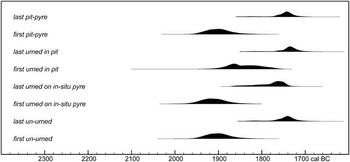
We have already discussed the fact that four types of cremation burial were prevalent at Over (Figs 6 and 16). A key finding to emerge from our Bayesian modelling of the radiocarbon dates was that all four ‘types’ appear to have been carried out contemporaneously, throughout the life of the site. Figure 17 shows the estimated first and last dates of each cremation type, derived from the Bayesian model: the dates for the first burial of each type and the last burial of each type are all very closely matched. This pattern is consistent with the fact that all four types occur in each of what we have suggested may well have been successively used barrows.
Estimated dates of each cremation type, derived from the Bayesian chronological model (online supplementary materials)

The (a) temporal and (b) spatial distribution of pot types (see main text for details as to how the upper bar chart image was created)

As mentioned above, at Over each of the three turf-mound barrows was started with a ‘primary’ in situ cremation (F.1063, F.1000 and F.1124) where the cremated bones of the body were placed on the remains of the pyre on which it had been burnt, in or with an urn (Fig. 16). There appears to have been a specific way to begin a (turf-mound) barrow, which persisted throughout the life of the site. The significance of the fact that neither of the pond barrows contained in situ cremations, or indeed any ‘pit pyre’ cremations either, is difficult to ascertain. On the one hand, it could be seen as adding weight to the suggestion that the pond barrows were somehow subsidiary to their turf-mound ‘pairs’; this certainly remains a possibility. On the other hand, it must be noted that the architecture of the pond barrows (a ring-shaped bank with a central wet pond) does not exactly lend itself to the in situ construction of pyres in the same way that turf-mounds would have done; the absence of in situ burning from the former could simply be a product of barrow architecture. Equally, it is quite possible that, as has been discussed in relation to pond barrows elsewhere (eg, Barrett et al. Reference Barrett, Bradley and Green1991, 136), these features had other ritual roles to play in addition to burial and so could for that reason have had different developmental histories.
Other than these discrepancies between turf-mound and pond barrows, it is difficult to make out any clear patterns in burial practice, either between the different barrows or through time. There are no signs at all, for instance, that one type of cremation burial prevailed at any one point, to be replaced by another. As discussed above, variability of practice appears to have been the key.
Given that (a) each turf-mound barrow contained all four types of cremation burial, (b) the cremation burial types do not map straightforwardly onto other (archaeologically visible) categories of person (ie, it was not the case that all adult females were buried with an urn, and all adult males without one, for example), and (c) the turf-mound barrows appear to have been built and used successively, it is possible to suggest that the different cremation burial types may have reflected another (archaeologically invisible) aspect of a person's identity. They could for example even have related to family (or some other social) groupings. Equally, it is worth considering the possibility that those who ‘married in’ may, in doing so, have introduced (or have been subjected to) a different cremation rite (see TCR for a more detailed discussion of ‘marrying in’). In contrast to what has often been argued for barrow cemeteries before, specific barrows do not seem to have related to ancestral lineages. They were not all used simultaneously by different groups, but probably rather successively perhaps by multiple groups. If indeed multiple groups did use each barrow for burial simultaneously, it is quite possible that each group buried their dead in (one of the four?) different ways.
What were people buried with?
The most common thing to be buried with/in was a Collared Urn (or related) pot, which accompanied/contained around half of the cremation burials (Fig. 18). As discussed above, the in situ cremation which initiated each of the three turf-mound barrows was always accompanied by or within an urn. Even despite the fairly high numbers of burials with pots, it is difficult to make out any other clear patterns in terms of who or when people were buried with them. Equally, the size of a vessel did not appear to correlate with the age of a person for example. Again, variability of practice was the key.
Shifting scales to focus on the different sub-styles of Collared Urn, one clear temporal trend does emerge. As discussed above, Law has suggested elsewhere (2008 and in TCR) that there was a shift over time from (larger) Group C to (smaller) Group A urns. This suggestion is certainly borne out by the evidence from Over: Group A urns are found exclusively in later phase cremation burials within the latest barrow. In this case, what we may be seeing, rather than necessarily a conscious decision to bury different people with/in different pots, is a gradual drift in the styles of urn being used from the 20th to the 18th century cal bc.
It is difficult to identify clear patterns amongst the other grave goods associated with cremation burials as well. Bone implements appear in all three turf-mound barrows, flint tools appear (as grave goods) in Barrows 12 and 15. The only items other than pots found in the pond barrows were a copper alloy awl in Barrow 14, and two instances of flint flakes accompanying burials in Barrow 16. The relative paucity of other grave goods in these contexts, again, may suggest that the pond barrows played a subsidiary role in relation to the turf-mound barrows they were paired with, or were simply associated with different kinds of burial practice.
THE WIDER IMPLICATIONS OF OVER: TIME, MEMORY, AND BURIAL PRACTICE IN THE EARLY BRONZE AGE
Having considered the temporality of the barrow cemetery at Over in some detail, it is now time to review the implications of these findings in relation to some of the broader issues highlighted at the beginning of the paper. It is worth emphasising again that many of the wider issues pertaining to the site have already been discussed within the main monograph (TCR). For obvious reasons, our focus here is exclusively on those associated with time. It is also important to stress that the Low Grounds site cannot in any way be taken as a model for all barrow cemetery sites – other superficially similar sites may well have seen completely different chronological developments. If one thing is clear about barrow cemeteries, it is that no two sites – or even barrows for that matter – ever seem to have developed in the same way (although, without accurate dating of these sites, it is often difficult to be absolutely confident about this). Nonetheless, the Low Grounds site can be held up as a (chronologically well-understood) mirror to reflect upon recent wider discussions of EBA barrows. Certainly the kinds of burial practice and site architecture seen there appear to fit fairly well with Garwood's (Reference Garwood2007) chronological model of wider developments across Britain. The analysis presented here has, we hope, illustrated the kind of chronological understanding it is possible to achieve, once radiocarbon dating is employed in the right way on the right kind of site. Having said this, our Barrow 15 results also highlight one of the limitations of radiocarbon dating these sites – the shape of the calibration curve for this period (c. 1850–1750 cal bc) means that it is difficult to avoid multiple probability peaks in posterior density estimates, and thus to identify unambiguously the date order of monuments that are not linked stratigraphically.
Time and memory
A key topic of discussion which runs through work carried out since the late 1980s has been memory. People have been keen to investigate the relationship between successive EBA burials, both within individual barrows and more widely across a given site, looking at how the mourners’ memories of a previous burial and/or the grave goods within it may have influenced or been ‘cited’ by the next (eg, Mizoguchi Reference Mizoguchi1993; Jones Reference Jones2001; Reference Jones2012). It has broadly been suggested that slightly mis-remembered burials often led cumulatively to gradual change or ‘drift’ in burial practice over time. As discussed above, one inherent problem infusing all of these discussions has been the fact that, ultimately, the distance in time over which such memories are said to have been sustained has remained almost completely unknown. The (necessary) vagueness about time which thus characterised this work has undeniably weakened the otherwise pertinent and interesting arguments being made.
At Over, it was possible to establish the length of time over which the cemetery was used, as well as the number of burials that occurred there. The site as a whole was used for 300–400 years (excluding the later MBA burials). During the first couple of centuries of this period, the site witnessed a minimum of two and a maximum of six inhumations (the fact that poor preservation meant that the four burials outside the ‘stack’ could not be dated is undeniably frustrating). Even if we allow for the maximum of six burials, this would mean, on average, a burial every 20–40 years (with potentially much longer gaps if burial was irregular). Once the barrow cemetery itself had begun, 35 cremation burials (containing 40 individuals) were deposited over roughly the same amount of time (110–260 years at 95% probability). This, by contrast, equates to a burial having been deposited, on average, every five or six years (although the actual time spans would probably have been more variable, given the different numbers of burials in each barrow). In these two main phases of burial at the Low Grounds site, therefore, we are talking about entirely different tempos of burial. We thus need to consider very different issues when it comes to discussions about how memories worked between each one: memories between inhumations would perhaps have to have been sustained over a generation or more, whilst people could potentially have witnessed cremation burials regularly every few years.
During the barrow cemetery phase, we see four types of cremation burial being employed from start to finish. Equally, each time a new turf-mound barrow was constructed – and only then – the same rite (in situ cremation and burial with an urn on top of or next to the pyre) was employed. Each of these three burials was probably separated from the previous one by 50–100 years. In this main phase of the site, therefore, what we seem to be seeing is not gradual drift or mis-remembering as has previously been implied elsewhere (eg, Mizoguchi Reference Mizoguchi1993), but actively maintained differences in burial practice (which we have suggested perhaps reflected social categories of some kind). Memory therefore actually appears to have functioned extremely well over the 200 or so years of the site's use for cremation burial; the variability observed appears to have been a deliberate creation of difference. Interestingly, the one area in which gradual ‘drift’ does appear to be visible is in the styles of Collared Urn used – people's ideas as to the form an urn should take appear to have changed gradually over that period (see also Law Reference Law2008, where this argument is made on the basis of a substantial database of dated Collared Urns).
The spatial representation of time
A second key topic of discussion – one which has pervaded temporal understandings of barrow cemeteries for decades – has been the idea that their chronology was directly reflected in the spatial arrangement of the mounds. Even in very recent discussions, given the absence of good independent chronologies, it has had to be assumed that spatial and temporal linearity can be equated (eg, Garwood Reference Garwood1999). Interestingly, at Over, it does indeed seem to have been the case that the three main turf-mound barrows were probably built in progression, from west to east, in an almost straight line (albeit that a line of only three does seem slightly tenuous); the pond barrows, of course, also disrupt this straightforward linearity to an extent. As mentioned above, as a result of the fact that discussions about the chronology of barrow cemeteries have usually been rather vague, it is actually very difficult to gauge how linear groups of barrows (which have more than one burial each) are ‘supposed’ to have built up. One possible option is that the line of primary central burials was created first under a series of mounds; and that later, secondary and satellite burials were added over time to each barrow. This was not what happened at Over, where each barrow was potentially ‘used up’ completely before the next was constructed.
The apparent focus of burial at Over on one barrow, and then the next, raises an important issue – why subsequent barrows were constructed at all. Even in Barrow 15, where the deposition of cremation burials was densest, there was still plenty of room for more burials. Once the idea that the different barrows served different (competing?) groups simultaneously is removed, any shift to a new barrow becomes somewhat harder to explain. It is certainly possible that when someone special or particular died, a new barrow was constructed. Equally, however, we have also seen that each turf-mound barrow underwent at least two phases of substantial renovation over the course of its life. It is possible that the creation of a completely new mound might actually be better understood as just one more phase in the remodelling of this burial site as a whole. While, sadly, it is ultimately impossible to say what provoked this, we have at least been able to show that it was something to do with the passage of time.
Summary: the benefits of three-dimensional, modelled, radiocarbon dated time
The implications of the substantial three-dimensional preservation of stratigraphy at the site, in terms of the temporal interpretations it is possible to make, have, we hope, become very clear. It is chastening to think just how much archaeology, and indeed quite how much of our understanding of the site, would have been lost if it had been ploughed flat like so many other similar sites (see also Evans et al. Reference Evans, Tabor and Vander Linden2014). The preservation of a clear, vertical spatial representation of time presented us with an almost unique opportunity to get to grips with the site's temporality. It is hoped that, throughout the course of this paper, the interpretive possibilities that a high-resolution radiocarbon chronology can offer have become clear. Assumptions about the chronology of these sites are fine. It is important to remind ourselves that the chronology we have built for the site is itself built upon ‘prior [stratigraphic] assumptions’ which were used to inform a statistical model that itself emerged out of a series of measurements turned into dates. Nonetheless, the ability to pin down the site's chronology to a generation or two for each of the three main barrows, and the understanding of site sequence that emerged from that detailed knowledge, really do help us to understand the site better. As a result, our interpretations stand on much more solid ground: the progression of time and the potential role played by memory can be considered in a much more meaningful way.
Acknowledgements
We would like to thank a wide spectrum of people without whose work and/or assistance we could not have carried out this study. It is important to acknowledge the input of the many different specialists on whose results we have drawn in our analysis (and whose work can be read in full within TCR): Grahame Appleby, Lawrence Billington, Steve Boreham, Natasha Dodwell, Mark Knight, Rob Law, Alison Sheridan, Maisie Taylor, and Simon Timberlake. We would also like to thank Natasha Dodwell for her invaluable help and advice when selecting the human bone samples; Jason Hawkes for his assistance in gaining access to the human bone at the CAU; Andy Hall for his customarily excellent work on many of the graphics (with the pottery drawn by Vicki Herring); Dave Webb for his superb site photos; Brian Chapman and Hilton Law of Hanson Aggregates Ltd (who funded the initial excavation); as well Andy Thomas and Kasia Gdaniec of Cambridgeshire County Council. The radiocarbon dates were generously funded by the NERC radiocarbon facility programme. We are very grateful to the staff of the Oxford Radiocarbon Accelerator Unit, University of Oxford, for their careful analytical work on the samples that were dated, especially Fiona Brock and Tom Higham who both offered specialist advice and encouragement at various different stages of the project. Finally, we would like to thank Anwen Cooper, Julie Gardiner, Frances Healy, Jonathan Last, John Roberts, and two anonymous reviewers for their helpful comments on earlier drafts of this paper.
ONLINE SUPPLEMENTARY MATERIAL
Model code for radiocarbon dates