

Introduction
While concluding a revision of the Old World species of Boehmeria Jacq. (Urticaceae) four new species have been recognised. This work is intended to follow a similar taxonomic study of the species of the New World by Wilmot-Dear & Friis (Reference Wilmot-Dear and Friis1996). However, the number of Boehmeria species in the Old World is considerably higher than in the New World. Due to the time it will take to finalise a monograph of such a large group we have decided to publish these new species separately.
The taxonomic history of the genus was discussed in Wilmot-Dear & Friis (Reference Wilmot-Dear and Friis1996), particularly with regard to the New World species. The taxonomic history which is specific to the Old World species will be discussed in the forthcoming revision. The discussion in Wilmot-Dear & Friis (Reference Wilmot-Dear and Friis1996) on the most useful characters for circumscribing taxa applies also to the Old World species.
No reliable formal infrageneric groupings can be established within Boehmeria until molecular work to clarify the relationships between the taxa has been carried out.
The relative responsibilities of the authors are as follows: C. M. Wilmot-Dear and I. Friis conducted the general taxonomic revision and took responsibility for writing this paper; Z. Thomas provided a conservation assessment of Boehmeria subintegra and the data for its distribution map. In spite of the not insignificant number of old collections available of several of the new species, only two of them, Boehmeria listeri and B. leptostachya, have previously been noted in some way as taxonomically distinct entities. Boehmeria subintegra confirms the presence of the genus on the island of New Guinea (most previously published records purporting to be of Boehmeria from New Guinea and the Solomon Islands relate in fact to the genus Cypholophus Wedd., as discussed by Wilmot-Dear & Friis (Reference Wilmot-Dear and Friis1998)).
Materials and Methods
The methods used have been those of classical herbarium taxonomy, with special attention given to minute morphological details of leaves, inflorescences, flowers, fruiting perianths and fruits. During the revision of the Old World species of Boehmeria more than 6000 specimens from the following institutions were examined (abbreviations according to Holmgren et al., Reference Holmgren, Holmgren and Barnett1990): A, AAU, ABD, B, BISH, BKF, BM, BO, BR, C, CAL, COI, E, FT, G, GB, GH, GLAM, IBSC, K, KUN, L, LE, M, MEL, MH, MO, NAS, NEB, NSW, NY, P, PE, S, TAI, TCD, TI, U, UC, UPS, US, W, WU, Z. All specimens below have been seen unless otherwise indicated. All new species would appear to be from relatively infrequent to very rare and we have, therefore, attempted to provide a conservation assessment for all new species in spite of the scarce data available. Specimens were geo-referenced using gazetteers. These were plotted in ArcView and the IUCN extent of occurrence (EOO) calculation was run using the CATS extension developed at the Royal Botanic Gardens, Kew (Moat, Reference Moat2007); data points were plotted on Google Earth after conversion to kml files using the ArcView Shape 2 Kml extension. Conservation ratings were given following the criteria set by IUCN (2001).
Descriptions and Formal Taxonomy
A ceteris speciebus combinatione characteribus, nempe planta ob pilos mixtos dimorphos alteros minutissimos patentes < 0.1 mm longos alteros curvatos 0.2–0.3 mm longos canescenti, foliis longis angustis asymmetricis plerumque ellipticis (nec ovatis) ad marginem denticulis multis ornatis et fructu lato atque modice tantum dorsiventraliter compresso non alato plerumque obconico-truncato distinguenda. – Type: India, Arunachal Pradesh, Duphla Hills, Harpili [Hapoli], 19 xii 1874, Lister 99 (holo CAL; iso K).
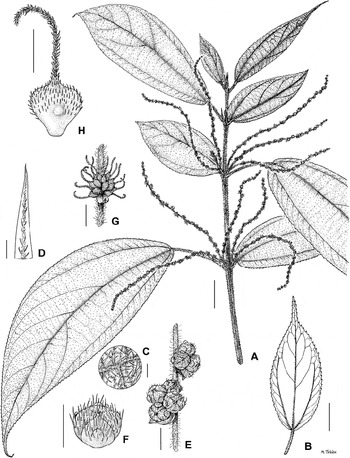
Boehmeria listeri Friis & Wilmot-Dear. A, habit of upper part of plant with bisexual inflorescences; B, leaf; C, detail of lower surface of lamina, showing two types of hair; D, stipule; E, detail of male part of inflorescence with two clusters and bracts, showing two types of hair; F, male bud; G, detail of female part of inflorescence with one cluster and bract; H, fruiting perianth. Scale bars: A, B = 2 cm; C, E–H = 1 mm; D = 2 mm. A, C–G from Stainton 6723 (K); B, H from King’s collector s.n. [1890] (CAL). Drawn by Margaret Tebbs.

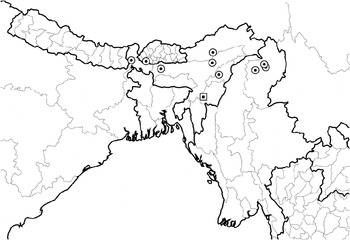
Distribution of Boehmeria listeri (bird eyes) and B. manipurensis (square). The unmapped record of Boehmeria listeri from ‘East Bengal’ would presumably have been made in the northeastern part of Bangladesh towards the Khasi Hills. The collections of Boehmeria listeri said to be from Assam (in the old and wider sense than currently) cannot be localised and mapped. Bottom left-hand corner of map at 15°N, 79°E. Top right-hand corner at 31°N, 103°E.

Tree or shrub 2–3 m tall, or rarely subshrub < 1 m tall; young branchlets 2 mm diameter, with abundant indumentum of curved, ± adpressed, relatively long hairs 0.2–0.3 mm long mixed with minute < 0.1 mm long sparse spreading hairs; branchlets later glabrescent. Stipules narrowly triangular, conspicuous, 9–11 × c.2.5 mm, chartaceous with long hairs c.0.5 mm long on midrib and abundant minute hairs < 0.1 mm long elsewhere. Leaves opposite, slightly or, more often, markedly dimorphic; petiole 2–5 cm, widely variable relative to lamina length, 0.2–almost 0.3 × lamina length, hairy (as on abaxial lamina surface); ‘larger’ lamina of each anisomorphic pair 1.25–2.5 × length of ‘smaller’ lamina and relatively broader with more distinctly acuminate apex; slightly asymmetrical (outline of two halves slightly dissimilar), narrowly elliptic-ovate to elliptic, 10–21 × 3.5–7.5 cm, (2.3–)2.8–3.1 × as long as wide; margin finely serrate with (40–)45–65 minute teeth, these up-curved, acute, 0.5–1(–1.5) × 1–3(–4) mm, width of tooth 1–2(–3) × depth of sinus; apex of lamina attenuate-acuminate, often slightly sideways-curved, base asymmetrically rounded or slightly cuneate; basal veins extending into upper third on narrow side, just reaching above middle on wide side, distal lateral veins usually dissimilar, on narrow side only 3, all arising in distal half, on wide side usually an additional (1–)2 arising near or below middle, all veins inconspicuous adaxially, finely prominent abaxially, coarser tertiary veins also finely prominent; very thin-chartaceous, drying grey-green or blackish, adaxial surface with minute bullation in centre of each areole, with single hair arising from it, otherwise glabrous, abaxial surface with sparse long (0.5–1 mm) curved hairs (as for stem) on veins and reticulation, and dense minute pale spreading hairs on veins and whole leaf surface, often giving greyish sheen. Inflorescences consisting of flower clusters arranged along ± pendulous leafless axes, 1–2 per axil, axes unbranched or more often with 1–2 long lateral branches very close to base, appearing as if several from each axil; axes (5–)7–13 cm long, with long and often also minute hairs (as for branchlets); both sexes often on same axis, mostly in unisexual clusters with male in basal part, female distally, but sometimes clusters mostly bisexual and rarely also a few male flowers present in mainly female clusters at apex; bracts subtending clusters broadly triangular, often conspicuous (especially when clusters are few-flowered), up to 1 × 1 mm; clusters spaced 1–10 mm apart or sometimes ± contiguous; male clusters 2–4 mm diameter with few–10(–15) flowers, female clusters 2–3 mm diameter with (10–)20–> 40 crowded flowers; bracts subtending flowers triangular, inconspicuous, < 0.3 mm long. Male flowers 4-merous, sessile, mature buds globose, c.1.5 mm diameter with apiculus and prominent dorsal appendages, abundantly long-hairy (as for axis). Female flowers obovoid (rarely ovoid) with indistinct beak, with dense long hairs (as for branchlets); stigma widely variable in length, 1–2(–2.5) mm long. Fruiting perianth obovoid to broadly obconical often broadly truncate at apex or sometimes with minute beak, 1–1.3 × 0.5–1 mm, slightly flattened laterally or indistinctly several-angled but without marginal rim or wing, abundantly long-hairy. Achene almost filling perianth.
Distribution. NE India (Sikkim, Arunachal Pradesh, Assam, Nagaland); Bangladesh [locality uncertain]; N Burma (Kachin).
Habitat. Forest understorey in partial shade, slopes of subtropical forest, river margins, recorded as occurring on limestone; 150–1000 m.
Conservation assessment. This species is known from 16 collections from approximately 11 locations (not all collections could be geo-referenced), with an EOO of 97,408 km2 and, therefore, falls into a possible Near Threatened (NT) category following IUCN (2001). Plotting the distributions onto Google Earth indicated that most of the localities were still in areas of low habitat disturbance, whilst a few were close to areas of agriculture. However, taking into account the existence of relatively recent collections (four since 1950), its varying habitats, ranging from forest to river margins, and its wide distribution, we will keep the species as NT, rather than placing it in a threat category.
Additional specimens examined. India.Sikkim: Mongpo [Mungpu in Burkill (Reference Burkill1965); now Mangpu], 5 x 1884, Clarke 35256E (G). Arunachal Pradesh: Subansiri Gorge, 24 i 1971, Stainton 6723 (K). Nagaland: Naga Hills, 14 x 1885, Clarke 40796 (K). Assam: Goalpara, 14 xi 1869, Hamilton 2006 (E, K); Goalpara, Chirang Duar, xii 1890, Mann s.n. (BM); Goalpara, Chirang Duar, xii 1890, King’s collector s.n. (CAL). Unlocalised ‘Assam’: Assam [in the broad sense], Jenkins s.n. (G, L908.186-1124, M); Masters s.n. (BO, L908.186-1111, M); Simons s.n. (BO, L908.186-183).
Bangladesh. ‘E Bengal’, 1863, Griffith 4555 (K mixed collection & possible hybrid, see discussion below).
Bhutan.Samchi: Torsa River, Phuntsholing, 17 ii 1982, Grierson & Long 2982 (BM, E).
Burma.Kachin: Mogowi River [?Mogwitang River], McMillan 48 (UC, US); W. Krok to Kanang, iii 1962, Keenan 3969 (K); Myitkina, Sumprabum, 2 iv 1953, Tha Hla & Chil-koko 3734 (K).
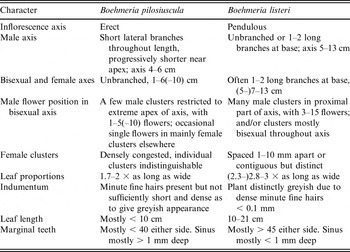
Species relationships. Boehmeria listeri is provisionally placed close to B. pilosiuscula (Blume) Hassk. (sympatric in India and Burma). For further details see Table 1.
Species relationships of Boehmeria listeri. Boehmeria listeri is provisionally placed close to B. pilosiuscula (sympatric in India and Burma) with which it shares the following characters: a mixture of two clearly different types of indumentum on many parts, asymmetric leaves and an obconical fruiting perianth; differences between the two species are tabulated below (most significant characters listed first)

Boehmeria listeri is somewhat similar to B. penduliflora Wedd. ex D.G.Long (sympatric and overlapping in altitudinal range) in leaf texture and indumentum on the abaxial lamina surface; B. penduliflora differs as follows: Leaves ovate, much narrower (5–7 × as long as wide), often much longer, glabrous above; stem hairs uniform; fruiting perianth with distinct broad wing.
Discussion. Boehmeria listeri is rather nondescript in general appearance. It resembles a number of different species in various characters and is thus recognisable on a combination of morphological characters. These are its long, narrow, somewhat asymmetric grey-green leaves (drying greyish brown), often elliptic (rather than ovate which is much more common in the genus) with many small teeth and rather asymmetrically arranged venation, its indumentum of mixed long and minute fine hairs (unusual in Boehmeria) which are usually present on most parts of the plant, the minute ones giving a slightly greyish appearance, its pendulous inflorescence axes, and its unwinged short, broad, usually obconical, fruiting perianth.
Boehmeria listeri is known from 16 collections, of which the one selected as the type was recognised and annotated as a new taxon at the rank of variety, Boehmeria macrophylla D.Don var. listeri, by George King, who was superintendent of the Royal Botanic Garden, Kolkata [Calcutta] (1871–1898), and organiser of the Botanical Survey of India. However, King never formally described this entity at any taxonomic level. We agree with King that the material represents a new taxon and have retained his epithet for our new species. King clearly considered Boehmeria listeri to be a variety of the sympatric but more widespread Boehmeria penduliflora (B. macrophylla D.Don, non Hornem.). Similarities and differences between the two taxa are indicated above.
The taxon was named by King after J. L. Lister, the little-documented collector of plants and animals in northern India. Presumably in the 1870s Lister was associated with British attempts to cultivate Cinchona at Mungpu in Sikkim. After leaving Sikkim he became manager of a tea estate in Teesta District of Darjeeling; his connection with plantations for the production of Cinchona and tea is mentioned in passing by Burkill (Reference Burkill1965). King validly published a few Himalayan taxa based on Lister’s collections, e.g. Quercus listeri King, but a number of nomina nuda referring to new species collected by Lister were taken up by others, e.g. Primula listeri King ex Hook.f., Machilus listeri King ex Hook.f. and Lepisanthes listeri King ex Radlk. Lister is not mentioned in standard works on British botanists, e.g. Desmond (Reference Desmond1994), but according to Chaudri et al. (1972) he collected in Sikkim and the Himalayas in 1877 (with specimens recorded in B and L), and in Assam in 1895 (specimens at CAL). Other Indian collections by Lister are held at E and LE. Lister 99 (CAL, K) from Duphla Hills (Arunachal Pradesh) was collected in December 1874, before the collections mentioned by Chaudri et al. (Reference Chaudri, Vegter and de Wal1972). Lister also collected specimens of Agapetes from the Duphla Hills, in late 1874 and early 1875; these have been cited as held at CAL (Banik & Sanjappa, Reference Banik and Sanjappa2007, Reference Banik and Sanjappa2008).
One of two duplicates at K of Griffith 4555 is somewhat intermediate between our new species, Boehmeria listeri, and B. penduliflora, having uniform stem indumentum and a flattened-obovoid fruiting perianth with a distinct marginal rim as in B. penduliflora but with leaf shape and proportions approaching those of B. listeri. This specimen appears to be part of a mixed collection since the second sheet of this collection number at K and a duplicate at G are of a clearly different plant which conforms in all respects to Boehmeria penduliflora, and it seems very likely the two entities were found growing together. We speculate that this aberrant specimen be considered a hybrid, hybridisation having been demonstrated in other Boehmeria taxa (Kitamura & Murata, Reference Kitamura and Murata1961; Yahara, Reference Yahara1983, Reference Yahara1984). No other intermediate collections have been seen. Molecular work would be particularly useful to clarify the relationship of Boehmeria listeri to B. penduliflora and other taxa.
N. Acharya & Yonekura have annotated a specimen of this taxon at E with a new varietal name which appears not to have been published. As argued here, we consider this taxonomic entity a good species.
Boehmeria manipurensis Friis & Wilmot-Dear, sp. nov.Figs 2,3.
Foliis alternis parvis coriaceis angustissimis valde dimorphis vix asymmetricis, glomerulis femineis sessilibus magnis 5–8 mm diam. flores densissime crebros ferentibus, floribus pedicellatis atque plerumque pedunculatis et stigmate longo distinguenda. Habitu Boehmeriae heterophyllae similis sed fructu alato non asymmetrico et foliis vix asymmetricis infra indumento denso adpresso (nec patenti) ornatis differt. – Type: India, Manipur, Irang River, xi 1907, Meebold 6253 (holo K).
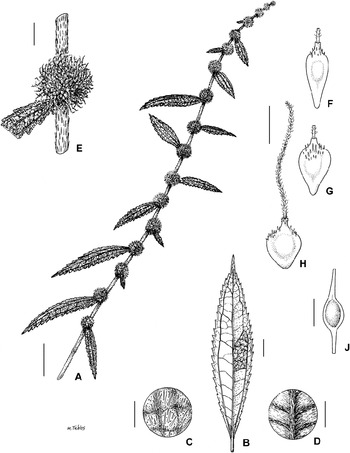
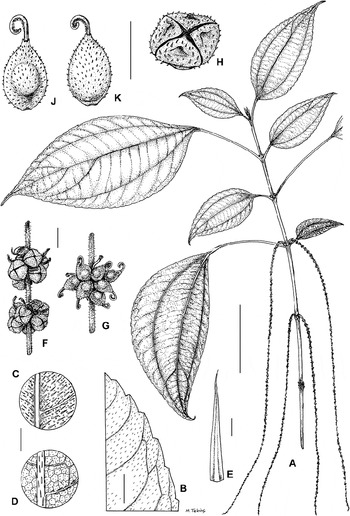
Boehmeria manipurensis Friis & Wilmot-Dear. A, habit of upper part of stem of female flowering plant; B, leaf; C, detail of upper surface of lamina; D, detail of lower surface of lamina; E, detail of stem with leaf and female cluster; F–H, fruiting perianths (F & G from same plant); J, achene with fruiting perianth removed. Scale bars: A = 2 cm; B = 5 mm; C, D, F–H = 1 mm; E = 2 mm; J = 0.5 mm. All from Meebold 6253 (K). Drawn by Margaret Tebbs.

?Subshrub; ultimate branches slender, c.0.7 mm diameter, with abundant short (0.2–0.3 mm), fine, adpressed hairs. Stipules not seen. Leaves alternate, subsessile, markedly dimorphic in size and moderately so in shape with ‘larger’ lamina of each anisomorphic pair (2–)5–10 × length of ‘smaller’ leaf, linear-elliptic and slightly sideways-curved, relatively small, c.5 × 1 cm, c.5 × as long as wide; margin sharply serrate with 15–20 up-curved teeth, c.1 × 3 mm; leaf apex gradually attenuate, base narrowly cuneate; basal veins extending into distal half and arching and joining distal lateral veins, distal lateral veins slightly dissimilar on two halves, 2–3 either side but scarcely distinct from coarser tertiary veins (especially on one half), lowest lateral veins arising near middle, lateral veins and coarser reticulation deeply impressed adaxially, fine but prominent abaxially; thin-coriaceous and slightly bullate, adaxial surface with a mixture of sparse or abundant coarse adpressed and sparser, longer and finer spreading hairs, 0.3–0.5 mm long, lower surface with dense adpressed hairs, 0.3–0.5 mm long, ± obscuring surface; ‘smaller’ leaves very variable in size relative to adjacent ‘larger’ leaves, sometimes resembling ‘larger’ ones but relatively broader, or sometimes reduced to almost bractiform, only 2–3 mm long. Inflorescences consisting of axillary flower clusters, only female seen, large, 5–8 mm diameter, with > 100 very tightly packed flowers forming almost a solid mass; flowers pedicellate and often borne on 2–3-branched peduncles; bracts inconspicuous, < 1/2 flower length. Stigma relatively long, 2–3 mm long. Fruiting perianth small and narrow, 1–1.2 × 0.3–0.5 mm, spindle-shaped or obovoid to ovoid (varying even on one plant) with short (c.0.1 mm long) apical beak, always greatly flattened laterally with central part thickened only in distal 1/2–1/3 and surrounded by broad, thin-textured, marginal wing, at base long-tapering, flattened and winged, running into a winged pedicel; with sparse adpressed hairs near apex. Achene narrowly obovoid, 0.5–0.7 × 0.3–0.4 mm, yellow-brown, glossy, not filling perianth.
Distribution. E Himalayas: India (SW Manipur).
Habitat. Based on the limited information available it can be inferred that the habitat is hill or montane forest on steep slopes; 2600–3350 m.
Conservation assessment. This species is only known from a single collection in 1907. It is presumed to be extremely rare and local and probably consists of small or restricted populations. This region of steep hills or mountains and narrow valleys, however, is under-collected. Although it may be appropriate to give this species a threat rating, we have examined the locality on Google Earth using Spot imagery and it appears that there are still large areas of undisturbed vegetation in this forested hill region of Manipur. Therefore, without further information we prefer for the moment to give the species a Data Deficient (DD) rating.
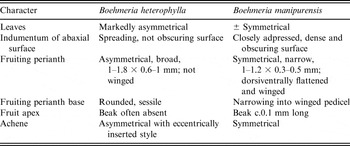
Species relationships. The relationships of this species are unclear. For further details see Table 2.
Species relationships of Boehmeria manipurensis. The relationship of Boehmeria manipurensis to other species is very unclear. Its habit is reminiscent of the Philippine Boehmeria heterophylla Wedd. (similar in dense sessile clusters and alternate, markedly dimorphic, sometimes thick-textured leaves). Significant differences are tabulated below

Discussion. Boehmeria manipurensis is known only from one old female collection but is considered sufficiently distinctive for formal description. This is based on its leaves which are alternate, small, narrow, thick-textured and markedly dimorphic with dense adpressed hairs abaxially, and its very large tightly packed axillary sessile female clusters with pedicellate (often also pedunculate) flowers and relatively long stigmas. Most Old World taxa have opposite leaves and flower clusters which are arranged along long leafless axes and are rarely so large or tightly packed. The material was hitherto misidentified as Pouzolzia sanguinea (Blume) Merr. var. fulgens (Wedd.) Hara, probably due to the distinctive leaf characters mentioned above, which are similar in both taxa. Pouzolzia sanguinea is easily distinguished by its loosely arranged female flowers with fruiting perianth conical and scarcely dorsiventrally flattened, the achene filling the perianth, and floral bracts conspicuous and often equalling flowers.
Boehmeria leptostachya Friis & Wilmot-Dear, sp. nov.Figs 4,5.
Planta rubrotincta foliis membranaceis nitentibus minute pilosis et glomerulis paucifloris secus axem longum gracillimum dispositis insignis; Boehmeriae zollingerianae persimilis sed foliis ellipticis (nec ovatis) supra sparse sed distincte pilosis (nec supra ± glabris), axe florifero graciliore glomerulos minores atque bisexuales ferenti (nec glomerulis masculis solitariis in axibus foliorum tantum dispositis) et floribus masculis 4-meris subsessilibus (nec 5–6-meris longissime pedicellatis) differt. Boehmeria hamiltonianae etiam similis sed foliis supra pilosis (nec glaberrimis) latioribus, indistincte vel breviore tantum acuminatis atque ad marginem magis distanter serratis in sicco rubro-brunneis nec viridis et glomerulis florum minoribus laxe tantum dispositis differt. – Type: Thailand (Peninsula), Ranong, Khao Pawta Luang Keow, 22 vi 1974, Geesink et al. 7428 (holo K; iso AAU, BKF, L, S).
Boehmeria erythropoda auct. non Miq.: Yahara, Acta Phytotax. Geobot. 32: 15 (1981).
Boehmeria leptostachya Friis & Wilmot-Dear. A, portion of stem with opposite leaf-pair and inflorescence-bearing axes with bisexual inflorescences; B, detail of leaf margin; C, detail of upper surface of lamina; D, detail of lower surface of lamina; E, stipule; F, detail of inflorescence showing two bisexual clusters in flowering stage (male flowers not opened, female flowers represented by protruding stigmas); G, detail of inflorescence showing one bisexual cluster in fruiting stage (with pedicels of fallen male flowers); H, male bud; J & K, fruiting perianths (from different plants). Scale bars: A = 5 cm; B = 5 mm; C–K = 1 mm. A–D, G from Geesink 7428 (K); E, F, H, J from Kerr 16899 (K); K from Class of 1958 no. 2437 (PE). Drawn by Margaret Tebbs.

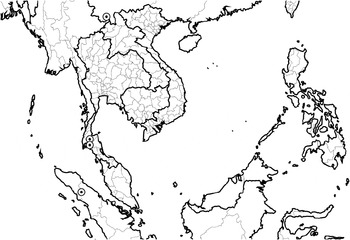
Distribution of Boehmeria leptostachya. The two records indicated from Thailand represent both localities near Khao Pawta Luang Keow. Bottom left-hand corner of map at 2°S, 89°E. Top right-hand corner at 24°N, 127°E.

Shrub 2–4 m tall; ultimate branches 1–15 mm diameter, glabrous, drying red-brown. Stipules lanceolate, 4–7 × 1–1.5 mm, rather thick-chartaceous, glabrous. Leaves opposite, very variable, slightly or moderately dimorphic in size only; petiole hairy (as for lamina), drying red tinged, relatively long, 0.3–0.5 × lamina length in ‘larger’ leaf of each anisomorphic pair, much shorter (often only 0.1 × lamina length) in ‘smaller’ leaf; ‘larger’ lamina 1.3–1.7(–2.7) × length of ‘smaller’ lamina, ± symmetrical or with one side slightly broader than other, mostly elliptic (on some plants also a few elliptic-ovate), medium to large, ‘larger’ leaf 13–18 × 5–7 cm, 2.1–2.8 × as long as wide; margin shallowly broadly crenate to bluntly serrate, with 30–35 teeth up to 0.7 mm deep and 5–8 mm broad, these either visible throughout length or progressively shallower towards base and only discernible in upper 2/3 of margin; leaf apex short-attenuate to indistinctly or abruptly short-acuminate, base slightly asymmetrically short-cuneate; basal veins extending to distal 1/3 of lamina or on one side almost to tip, distal lateral veins 2(–3), lowermost lateral vein on narrower side arising near middle, on other side in distal 1/3, veins slender, inconspicuous adaxially, fine-prominent abaxially, coarser tertiary venation ± scalariform, fine-prominent abaxially; membranous or very thin-chartaceous, both surfaces green when living but drying consistently dark brownish-black adaxially and lighter brown abaxially, with veins red tinged, adaxial surface ± shiny (said to be sticky when live – Yahara, Reference Yahara1981), sparsely hairy with hairs minute (< 0.2 mm long), adpressed; abaxial surface with sparse hairs which are even smaller, finer and often ± spreading. Inflorescences consisting of flower clusters borne along specialised, ± pendulous, very slender leafless axes, 10–50 cm long, axes unbranched; bracts subtending clusters minute, inconspicuous, 1–1.5 mm long and wide; clusters well spaced, 2–> 5 mm apart, most clusters with both sexes, clusters small, 1.5–2 mm diameter, with few–10(–15) flowers; bracts subtending flowers minute and inconspicuous, < 1 × 0.2 mm. Male flowers 4-merous with pedicels up to 0.5 mm long, mature buds depressed-globose, 1.2–1.5 mm diameter with conspicuous dorsal thickening on each lobe, with sparse fine hairs (as for leaves). Female flowers up to 0.5 mm long, stigma often minute down-curved, 0.3–1.5 mm. Fruiting perianth only 0.7–0.9 × 0.5–0.7 mm, very broadly ovoid or ellipsoid with minute beak, markedly dorsiventrally flattened with marginal ridge or narrow thick-textured wing, sparsely short-hairy, hairs ± spreading. Achene filling most of perianth, forming a central bulge when seen from the outside.
Distribution. S China (S Yunnan); Thailand (Peninsula); Indonesia (N Sumatra).
Habitat. Evergreen forest on clay or shale soils, often in damp places along stream banks; 500–900 m.
Conservation assessment. This species is known from only four collections from three widely scattered locations, with an EOO of 9800 km2 which places it within the Vulnerable (VU) threat category (IUCN, 2001). It was most recently collected in 1974 in Thailand and Sumatra, the Thai collection being from the same locality as a much earlier collection in 1929. It has been collected so seldom that we believe it to be uncommon and vulnerable to extinction if habitat conversion in the region continues (see, e.g., Wikramanayake et al., Reference Wikramanayake, Dinerstein, Loucks, Olson, Morrison, Lamoreux, McKnight and Hedao2001). We thus recommend an IUCN rating of VU B1ab(iii).
Additional specimens examined. China.Yunnan: Xishuangbanna Dist., Xiao Meng Yang near Jing Hong city, 21 v 1958, Class of 1958 no. 2437 (PE).
Thailand.Ranong: Khao Pawta Luang Keow, 30 i 1929, Kerr 16899 (K).
Indonesia.Sumatera Utara [North Sumatra]: Karo, Laubaleng, 4 ix 1974, S. Yoshida 1975 (L).
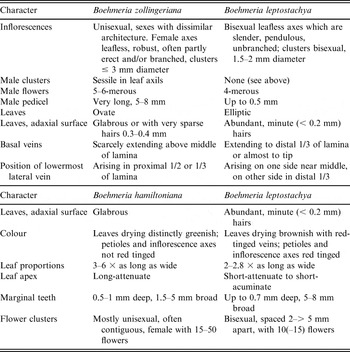
Species relationships. The relationships of this species are unclear. It is provisionally placed near Boehmeria zollingeriana Wedd. and B. hamiltoniana Wedd. For further details see Table 3.
Species relationships of Boehmeria leptostachya. The relationship of Boehmeria leptostachya to other species is unclear. It is provisionally placed near Boehmeria zollingeriana and B. hamiltoniana. Some duplicates of the only four collections known were previously identified as one or other of these two species. Boehmeria zollingeriana (common and widespread) is similar in red-tinged petioles, stems and inflorescence-bearing axis and in habit, fruiting perianth, leaf shape and texture. Boehmeria hamiltoniana (sympatric but slightly more widespread) is similar in leaf shape and texture and fruiting perianth. Differences are tabulated below (most significant characters listed first)

Discussion. Boehmeria leptostachya is distinctive in its relatively large membranous, shiny, elliptic leaves with minute indumentum and indistinct marginal teeth; its extremely slender inflorescence-bearing axes with small clusters; and the reddish tinge to the dried material. It appears to have a strangely disjunct distribution but this could be an artefact of patchy collecting. Although only four collections have been seen there is no doubt that this material belongs to the same species. The species might also be expected to occur elsewhere in Thailand.
Yahara (Reference Yahara1981: 15) recognised and mentioned the distinctive appearance of this taxon, but he applied the name Boehmeria erythropoda Miq. whose type (from Java) is clearly a different entity (leaves thick-textured, small and ovate with ± uniform and deeper teeth, lacking the shiny surface and the distinctive red tinge to the veins and stems, fruit winged).
Ob folia ad formam (non ad magnitudinem tantum) valde dimorpha insignis et ab omnibus ceteris speciebus foliis basin versus subintegris undulatisve atque apicem versus denticulos minutissimos indistinctos usque 0.2 mm tantum longos ferentibus (nec foliis uniformiter neque distincte serratis) differt. – Type: Papua New Guinea, Milne Bay, Gwariu R., Biniguni camp, 30 vii 1953, Brass 23704 (holo K; iso A).
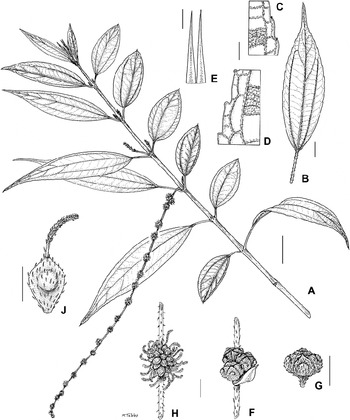
Boehmeria subintegra Friis & Wilmot-Dear. A, habit of upper part of stem with fruiting and young inflorescences; B, leaf; C & D, detail of lower surface of lamina with margin (from different plants); E, pair of stipules; F, detail of male inflorescence with one cluster and bract; G, male flower; H, detail of female inflorescence with one cluster; J, fruiting perianth. Scale bars: A = 2 cm; B = 1 cm; C–E = 2 mm; F–J = 1 mm. A, E, J from Brass 23704 (K); B, C, F, G from Hoogland 3988 (K); D from Stevens 58169 (K); H from Carr 15315 (K). Drawn by Margaret Tebbs.

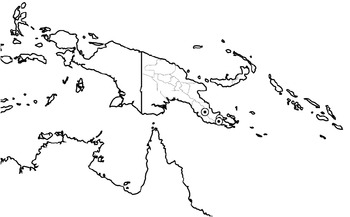
Distribution of Boehmeria subintegra. The known records fall into three geographically defined groups and have all been made from the areas indicated by the three bird eyes on the map. Bottom left-hand corner of map at 19°S, 127°E. Top right-hand corner at 3°N, 160°E.

Shrub or small tree 2–4 m high with erect branches; ultimate branchlets slender (soon becoming thick and woody), c.1 mm diameter, densely hairy, hairs short, < 0.2 mm long, fine, closely adpressed, white, later glabrescent. Stipules narrowly triangular, attenuate, ± free to base, fairly long and conspicuous, 7–8 × c.1 mm, thin-chartaceous, glabrous, very soon caducous. Leaves opposite; petiole short relative to lamina, 0.1–0.25 × lamina length; lamina dimorphic in size and shape, usually markedly so, with ‘larger’ lamina of each anisomorphic pair (1.5–)2–4 × length of smaller and relatively narrower, slightly sideways-curved, linear-ovate to narrowly elliptic-ovate, fairly small, (3.5–)5–12 × (1–)1.5–3 cm, 3.5–4 × as long as wide; margin often ± entire and slightly undulate throughout most of its length but towards apex indistinctly serrate, teeth 10–12(–15), sometimes up to 0.2 mm deep, often reduced to slight thickening or tiny mucro, very widely spaced, 2–5 mm apart; leaf apex gradually attenuate to ± long-acuminate, sometimes terminated by fine mucro; base narrowly cuneate; basal veins extending into upper third or nearly to tip, distal lateral veins similarly arranged on both sides of leaf, 2–4 but scarcely distinct from coarser tertiary veins, lowermost lateral veins arising slightly above middle; veins inconspicuous (rarely impressed) adaxially, finely prominulous abaxially; fairly thin-chartaceous to (dry habitat) very thinly coriaceous, glabrous and shiny above (dark green when live), paler with sparse or dense adpressed hairs < 0.2 mm long on veins beneath; ‘smaller’ lamina relatively broader, broadly elliptic or ovate, apex obtuse, broadly acute or rarely short-acuminate, extreme tip usually also distinctly mucronate with mucro 1–2 mm long, base broadly cuneate. Inflorescences consisting of flower clusters borne on specialised pendent leafless unbranched unisexual axes, 1 per axil, male axes up to 10 cm long, female axes very variable in length, 10–35 cm long; bracts subtending clusters narrowly triangular, c.2 × 0.5 mm, soon caducous; clusters spaced 2–5 mm apart, male clusters up to 2 mm diameter with 1–5 flowers, female clusters c.2.5 mm diameter with 10–30 flowers; bracts subtending flowers inconspicuous, linear-elliptic, 0.3–0.5 mm long. Male flowers 4-merous, pedicels 0.5–1 mm long, mature buds c.1 mm diameter with small dorsal appendages and sparse, coarse, stiff, ± spreading hairs < 0.2 mm long. Female flowers c.0.6 × 0.3 mm long, ellipsoid, hairy (as for male flowers); stigma 1–1.5(–2) mm long. Fruiting perianth obovate in outline and extremely laterally flattened with distinct marginal wing surrounding achene-bearing part, 1–1.5 × c.0.8 mm. Achene located in middle or distal part of perianth, not filling it, clearly visible from outside.
Distribution. Papua New Guinea (Northern and Milne Bay).
Habitat. Secondary forest, often part of successional shrubby or grassy (Arundinella) regrowth in ravines, on steep riverbanks, other steep slopes and in more open areas of ridge forests; 200–1760 m.
Conservation assessment. Boehmeria subintegra is only known from five localities and 11 collections, mostly made between 1935 and 1953 (only one being more recent, 1973). Habitat disturbance and fragmentation in the region is well documented (e.g. Wikramanayake et al., Reference Wikramanayake, Dinerstein, Loucks, Olson, Morrison, Lamoreux, McKnight and Hedao2001), with threats from logging, industrial timber production (Lamb, Reference Lamb1990) and the practice of slash and burn agriculture. The material collected in 1935 and 1936 was found (Van Steenis-Kruseman, Reference Van Steenis-Kruseman and van Steenis1974) in an area that has since been heavily logged. Other collections appear to be from localities close to areas of cultivation where vegetation remains fragmented.
This species is known from fewer than 10 locations and has a restricted range with an EOO of 17,604 km2 which places it in the Vulnerable (VU) category (IUCN, 2001). Evidence of an increased population fragmentation and a decline in habitat quality has been considered in the decision to recommend a rating of VU B1ab(iii). Although only one recent collection has been made the species is not placed in the category Endangered (EN) due to its recorded persistence in secondary forest and successional growth and the fact that the region is still under-collected.
Additional specimens examined. Papua New Guinea. Milne Bay: Gwariu River, 1953, Brass 23806 (A); Raba-raba, 5 vii 1969, Pullen 7726 (L) & 15 vii 1972, Stevens LAE 55564 (L, LAE n.v., NSW n.v.); Kapwari Gorge, 2 ii 1973, Stevens LAE 58169 (A, BRI n.v., K, L, NSW n.v.). Northern: Yodda River [near Isuarava], 21 xii 1935, Carr 13931 (A, BM, K, L); Isuarava, 1936, Carr 15046, 15315 & 15443 (A, BM, K, L); Isuarava, 1936, Carr 16100 (B, BM, L); Alola village [near Isuarava], 25 ix 1953, Hoogland 3988 (A, BM, BRI n.v., K).
Species relationships. This species is not similar to any other species.
Discussion. Boehmeria subintegra is an endemic of the Owen Stanley Range in the southeastern extremity of Papua New Guinea. This steep mountainous region is tectonically unstable, prone to earthquakes, landslips and consequent disturbance of the vegetation. It appears to be restricted to steep habitats and to form part of a successional regrowth after natural (or man-made) disturbance.
The leaves of Boehmeria subintegra differ markedly from those of all other species of Boehmeria in being so indistinctly toothed as to appear almost entire. The teeth become progressively more indistinct or absent near the leaf base. In the apex of the smaller leaf of each anisomorphic pair the teeth are usually conspicuously long-mucronate rather than acuminate or acute.
The long pendulous, unbranched, crowded inflorescence-bearing axes with broadly winged markedly flattened fruiting perianths of Boehmeria subintegra are reminiscent of those of three allopatric species (Himalaya–Thailand, China and/or Philippines), namely Boehmeria densiflora Hook. & Arn., B. multiflora C.B.Rob. and B. penduliflora, but all three species are easily distinguishable from it by their uniformly and distinctly toothed leaves.
Most records of Boehmeria from the island of New Guinea are actually due to misidentified material of the genus Cypholophus (as mentioned in the Introduction). Only a few other collections correctly identified to Boehmeria have been seen; these are referable to existing taxa and their taxonomic position will be discussed in the forthcoming revision of Old World Boehmeria. Besides the leaf characters mentioned above, Boehmeria subintegra is additionally distinguished from these particular New Guinean collections in the two leaves of each anisomorphic pair being markedly dimorphic in shape (not merely in size), with petioles often very short relative to lamina length, and in its entirely unbranched inflorescence axes.
Acknowledgements
The authors are indebted to the directors and curators of the herbaria in which the material used for this study was studied or from which it was borrowed (see list under Materials and Methods).