During Hurricane Sandy in October 2012, Mid-Atlantic hospitals sustained flooding and damage to their electrical systems and emergency generators, which placed patients and workers at risk of injury and illness, necessitated consideration or implementation of altered standards of care, and resulted in post-event evacuation. 1 Commentators later questioned why neighboring facilities made different decisions and called for integrated regional emergency response.Reference Hanfling, Powell and Gostin 2
Decisions to shelter-in-place or evacuate hospitals are complex and involve many stakeholders. Hurricane Sandy’s size provided a unique opportunity to study hospital evacuation and shelter-in-place decision-making at numerous hospitals. As part of a larger study, which examined the legal framework that governs evacuationReference McGinty, Burke and Resnick 3 and investigated how hospital evacuation and shelter-in-place decisions were made during Hurricane Sandy,Reference McGinty, Burke and Resnick 4 this brief report examines the perspectives of Mid-Atlantic government officials and hospital executives regarding authority and responsibility for these decisions.
METHODS
Semistructured interviews were conducted with key informants in Delaware (DE), Maryland (MD), New Jersey (NJ), and New York (NY). Interviewees were purposively sampled to include at least 1 hospital representative (eg, chief executive officer [CEO]) per state and a public health and emergency management official (eg, commissioner) from that hospital’s jurisdiction. Snowball sampling was used to identify additional participants. Interviewees were excluded if they lacked direct knowledge of decision-making during Hurricane Sandy. Each state’s health department and hospital association validated hospitals for inclusion except for NY, where the local health department and association did so.
We piloted and employed a semistructured interview guide with the following domains: authorities and responsibilities, decision processes, and lessons learned. Interviews were audiorecorded with participant permission and transcribed. To enhance analytic rigor and reliability, peer debriefing was conducted throughout data collection and analysis. Using a framework analytical approach, transcripts were thematically coded using QSR Nvivo for Mac v10.1.3 (Burlington, Massachusetts). A codebook was developed with a priori codes based on research questions and conceptual models of healthcare facility evacuation decision-making.Reference McGlown 5 , Reference Dobalian, Claver and Fickel 6 Other thematic codes were inductively identified and iteratively applied. Structural codes were applied to organize the data. Full study methods are described elsewhere.Reference McGinty, Burke and Resnick 4
The Johns Hopkins Bloomberg School of Public Health Institutional Review Board determined that this study was not human subjects research.
RESULTS
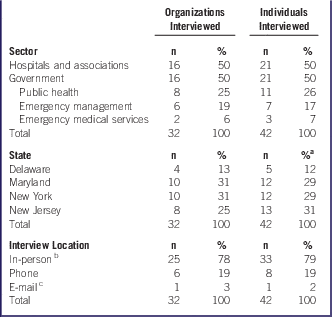
Between March 2014 and February 2015, semistructured interviews were conducted with key informants from 31 organizations. Of the 50 individuals meeting inclusion criteria, 84% (n=42) participated. One organization provided a written statement but could not be interviewed due to ongoing emergency response. Key informants worked in 5 sectors: hospital (45%), hospital association (5%), public health agency (26%), emergency management agency (17%), and emergency medical services agency (7%). Twelve percent were employed in DE, 29% in MD, 31% in NJ, and 29% in NY (Table 1). Key informants described their perceptions about authority and responsibility for hospital evacuation and shelter-in-place decision-making during Hurricane Sandy.
Organizations and Key Informants Interviewed by Sector, State, and Location of Interview.

aPercentages total more than 100 because of rounding.
bOne interview was a hybrid.
cOne organization provided a written statement but was unable to participate in an interview due to ongoing emergency response activities. In 6 instances, 2 key informants from the same organization were interviewed together. In 1 instance, key informants opted for a facilitated group discussion, which included 4 participants who worked for the same organization.
Hospital Perspectives
The perspectives of hospital key informants (n=21) were consistent across Mid-Atlantic states. Hospital informants perceived their institutions to have authority and responsibility to decide whether to shelter-in-place or evacuate hospitals during a disaster and ascribed decision-making authority to the CEO, other executive leaders, or the incident commander. One hospital executive stated, “I’m the CEO of the hospital, right, and the ultimate decision on whether to evacuate or not rests with me.” Another CEO said, “Quite frankly, it was my decision based on just input of a couple of hours with a lot of people, and I just used my instincts and my experience and made the decision [during Sandy].” There was one exception in which an informant from a public hospital perceived evacuation and shelter-in-place decision-making authority to rest not with the hospital but with leadership of the overarching hospital system in coordination with the senior-most local public health official.
Despite asserting their authority and responsibility, executives noted that emergency preparedness is often not a top priority for healthcare executives. One CEO stated,
"In the C-suite…[w]e have managing expenses, strategic development, electronic health records, what is ICD-10 coding, all that stuff. So where's community preparedness? And the answer is it's not there...usually the life safety stuff and the emergency preparedness stuff end up getting delegated to an assistant administrator or to the director of safety and security or...the chief engineer or something like that."
Emergency management officials confirmed the lack of prior executive engagement, noting that although hospitals participated in preparedness activities, they often assigned lower-level staff—who have no decision-making authority and may not even be consulted by senior hospital administrators during disasters—to collaborate with emergency management.
Hospital informants recognized that their facilities could be ordered to evacuate by the government, with the exception of Veterans Administration facilities, which are under federal jurisdiction. Yet, several hospital informants perceived the state government as unwilling or unable to provide guidance or exercise this authority. One informant described their hospital’s experience during Hurricane Irene, stating, “The state was not requiring or mandating any kind of evacuation, and they really left it up to the hospital to decide with truly very little guidance… The state was not willing to recommend a course of action.”
Other hospital informants perceived state government officials, who may be located a significant distance away, to be lacking the situational awareness necessary to provide relevant guidance. Despite knowledge of the government’s legal authority to mandate evacuation, the perceived inability of state government to provide useful guidance furthered the belief among hospital informants that they bore ultimate responsibility for evacuation and shelter-in-place decision-making.
Government Perspectives
In contrast to hospital key informants, government officials’ (n=21) perceptions varied by state and are therefore presented separately.
New York
NY government informants (n=3) identified a locality’s chief executive as having authority to order evacuation but noted that this authority did not infringe upon a hospital’s right to evacuate. One government informant explained, “[A] healthcare facility, if they feel that they need to evacuate, they can evacuate any time for any reason.” Another informant believed healthcare facilities had not only authorization but an obligation to evacuate when necessary. This informant stated, “[A] facility always has a right to evacuate themselves for patient safety, always, always. And it’s their responsibility…. At the end of the day, it’s not the government’s responsibility to evacuate you; it’s the facilities [that are] responsible for the patient.”
NY government informants perceived hospital evacuation and shelter-in-place decisions as complicated because the state department of health licenses and regulates healthcare facilities. While they recognized the local chief executive’s evacuation authority, they noted that only the state commissioner of health can permit healthcare facilities to shelter-in-place.
Due to the complexity of these regulatory and emergency authorities, NY government informants described healthcare facility evacuation and shelter-in-place decision-making in NY as a collaborative process involving the state commissioner of health, the city commissioner of health, and the mayor.
Maryland
In MD, government informants (n=8) described possessing “clear lines of authority” to mandate hospital evacuation and ascribed this authority to their governor or public health officials (ie, secretary of health). Most were in agreement with one respondent who reported “always attempt[ing] more of a collaborative approach with the folks who are in charge of these facilities” and noted that the government’s authority would only be exercised if a hospital failed or refused to evacuate and public health was endangered, as was done during Hurricane Irene in 2011.
New Jersey
NJ government informants (n=8) perceived evacuation and shelter-in-place decision-making as being ultimately a hospital decision. One informant stated, “[W]e can recommend an evacuation of a hospital, but really the decision to evacuate a hospital resides solely with the owner of that hospital, the CEO or the president.…” Some NJ government informants doubted whether laws granted them authority to order evacuation. Other government officials believed they could not mandate hospital evacuation because they lacked means of enforcement. One NJ government informant stated, “[T]he commissioner respectfully has broad powers. But the commissioner's broad powers are not going to be carried out by the quote/unquote health department police.”
Delaware
DE government informants (n=2) believed “mandatory” evacuation was a misnomer because the government lacks the capacity to enforce compliance. One DE government official explained, “There’s actually no mandatory evacuation law. In other words, it is a recommendation really. I mean, we can say it’s, ‘Hey, we’re ordering this evacuation by order of the governor,’ but a private entity or a private resident does not have to abide by that law because there is no enforcement leg or penalty.”
DE government informants also perceived the nature of their authority as incongruent with the urgency necessary to achieve evacuation before the arrival of a hurricane since some orders require the opportunity for a hearing to contest them.
DISCUSSION
The wide geographic area impacted by Hurricane Sandy provided a rare opportunity to examine hospital evacuation and shelter-in-place decision-making at numerous hospitals. This brief report centers on stakeholders’ perceptions of authority and responsibility for these decisions.
A key finding was that Mid-Atlantic hospital executives, consistent with those in other regions of the country, 7 perceive themselves to have authority and responsibility for decision-making. NY and MD government officials, too, perceived themselves as having authority to order evacuation. One concern this raises is that both hospital executives and government officials may assume that the other will act and neither will decide to evacuate despite the need to do so. This may explain why neither hospitals nor the government decided to evacuate several acute care hospitals before Hurricane Sandy. Future research should examine whether decision-making would be improved if a single party bears ultimate responsibility or if responsibility is shared through regional emergency response coalitions such as Region IV’s Unified Planning Coalition.
In 2012, when Hurricane Sandy was approaching the Mid-Atlantic, laws in DE, MD, NJ, and NY allowed their respective governments to order evacuation. While NY and MD exercised this authority during Hurricane Irene in 2011, despite possessing the authority, neither NJ nor DE ordered hospital evacuations during Hurricanes Irene or Sandy. Our finding that DE and NJ officials did not perceive themselves as able to enforce hospital evacuation suggests that confidence in one’s authority is likely requisite to the exercise of said authority. Public health legal researchers should educate government leadership about existing laws that enable them to order hospital evacuation when public safety is endangered. Further research should examine how to address concerns about compliance.
Our results confirm a distressing lack of hospital executive engagement in emergency preparedness, consistent with prior research.Reference Batts 8 Given their perceived authority and responsibility for evacuation and shelter-in-place decisions and likely future roles, more efforts should be made to engage hospital executives in emergency preparedness activities. It may be necessary to link emergency preparedness to hospital executives’ existing priorities to ensure engagement. For example, the Centers for Medicare and Medicaid Services has proposed a regulation that would tie disaster planning to conditions of participation in Medicare and Medicaid. 9 Additional steps could include providing emergency management training during graduate programs commonly completed by healthcare executives and incorporating emergency preparedness training into credentialing requirements for fellowship and continuing education.
Limitations
This research considered perspectives of hospital and government key informants from 4 Mid-Atlantic states. Generalizability of findings may be limited due to the density of healthcare facilities in NYC and NJ. It is likely, however, that study findings will be applicable to other big cities as well as during future hurricanes and other natural disasters. Selection and recall bias are other potential study limitations.
CONCLUSION
Decisions to shelter-in-place or evacuate hospitals during extreme weather events are complex and further complicated by the numerous stakeholders involved. This brief report examines stakeholders’ perceptions of authority and responsibility for decision-making during Hurricane Sandy. Among government officials, perception of authority for hospital evacuation and shelter-in-place decision-making was a prerequisite to ordering hospital evacuation. Given their perceived authority and responsibility for decision-making, increased efforts should be made to prepare hospital executives for their anticipated role in crisis decision-making. In jurisdictions where hospital executives and government officials both perceive themselves to possess authority for hospital evacuation and shelter-in-place decision-making, there is the potential for no decision to be made. Future research should examine whether having a single entity ultimately responsible or having integrated regional emergency response would improve decision-making.
Acknowledgements
This research was supported by the 2013-2014 Johns Hopkins Environment, Energy, Sustainability, and Health Institute (E2SHI) Fellowship and the 2013-2014 Lipitz Public Health Policy Award. M.D.M. was supported in part by funding from the National Institute for Occupational Safety and Health (NIOSH) Education and Research Center (ERC) for Occupational Safety and Health at the Johns Hopkins Bloomberg School of Public Health (#T42-OH 008428); the 2015 Johns Hopkins Health Resources and Services Administration (HRSA) Trainee Fellowship Program Agreement (#A03HP2750); the 2013-2014 E2SHI Fellowship; the 2013-2014 John C. Hume Award; and the 2014-2015 Victor Raymond Memorial Scholarship. The funders had no role in the design and conduct of the study, or collection, management, analysis, and interpretation of the data. The contents of this article are solely the responsibility of the authors and do not necessarily represent the official views of any of the funders.
Conflict of Interest
The authors have no conflicts of interest to report.