1. Introduction
The Early Cretaceous period (∼145–100.5 Ma; Ogg et al. Reference Ogg, Ogg, Gradstein, Ogg, Ogg and Gradstein2016) was characterized by major tectonic activity, climatic changes and global perturbations in the carbon cycle (e.g. Huber et al. Reference Huber, MacLeod, Watkins and Coffin2018). The break-up of the supercontinent Pangaea, which terminated around 175 Ma (e.g. Holden, Reference Holden1970; Rogers & Santosh, Reference Rogers and Santosh2004), led to the formation of two minor supercontinents: Laurasia to the north, and Gondwana to the south separated by the newly formed Tethys Ocean. The Barents Sea Shelf including Svalbard (palaeolatitude 60° N at 140 Ma; calculated after van Hinsbergen et al. Reference van Hinsbergen, de Groot, van Schaik, Spakman, Bijl, Sluijs, Langereis and Brinkhuis2015), Arctic Canada, Greenland and northern Russia were located on the northern flank of Laurasia as part of the large circum-Arctic, relatively cold Boreal Realm (Scotese, Reference Scotese2014). In the Tethys Ocean to the south, warm to tropical water conditions prevailed, leading to a bloom of calcareous nannoplankton and foraminifera. The Tethys and Boreal seas were connected by a shallow, narrow seaway between Greenland and Baltica. The seaway formed in response to rifting during the initial stage of the formation of the North Atlantic Ocean at that time (e.g. Gradstein et al. Reference Gradstein, Kaminski and Agterberg1999). The palaeogeographical configuration in the Early Cretaceous favoured a diversification of marine organisms and diachroneity of ammonite bio-events, which traditionally constitute the primary tool for Cretaceous biostratigraphy (e.g. Lehmann, Reference Lehmann, Klug, Korn, De Baets, Kruta and Mapes2015). This has led to the creation of two separate biozonation schemes: one for the Boreal and one for the Tethyan Realm. Both are still applicable across the Jurassic–Cretaceous transition (Ogg et al. Reference Ogg, Hinnov, Huang, Gradstein, Ogg, Schmitz and Ogg2012).
Temperature proxy data from Early Cretaceous high latitudes are limited (Ditchfield, Reference Ditchfield1997; Littler et al. Reference Littler, Robinson, Bown, Nederbragt and Pancost2011; Jenkyns et al. Reference Jenkyns, Schouten-Huibers, Schouten and Sinninghe Damsté2012; Price & Passey, Reference Price and Passey2013), but it is assumed that the global climate was generally warm and humid with low latitudinal temperature gradients (e.g. O’Brien et al. Reference O’Brien, Robinson, Pancost, Sinninghe Damsté, Schouten, Lunt, Alsenz, Bornemann, Bottini, Brassell, Farnsworth, Forster, Huber, Inglis, Jenkyns, Linnert, Littler, Markwick, McAnena, Mutterlose, Naafs, Püttmann, Sluijs, van Helmond, Vellekoop, Wagner and Wrobel2017). In contrast, some studies suggest that the polar regions during the Early Cretaceous were rather cold (e.g. De Lurio & Frakes, Reference De Lurio and Frakes1999; Smelror et al. Reference Smelror, Petrov, Larssen and Werner2009). Increased volcanic activity (including oceanic crust formation, formation of large igneous provinces and subduction-related arc volcanism) (e.g. Johnston et al. Reference Johnston, Turchyn and Edmonds2011; Koopmann et al. Reference Koopmann, Schreckenberger, Franke, Becker, Schnabel, Wright, Ayele, Ferguson, Kidane and Vye-Brown2014; Polteau et al. Reference Polteau, Hendriks, Planke, Ganerød, Corfu, Faleide, Midtkandal, Svensen and Myklebust2016) forced an increased concentration of atmospheric greenhouse gases (methane and CO2), and led to a gradual global warming (e.g. Huber et al. Reference Huber, MacLeod, Watkins and Coffin2018). A climatic maximum of this extreme global warmth, the so-called Cretaceous Hot Greenhouse climate, was reached between 95 and 80 Ma (Huber et al. Reference Huber, MacLeod, Watkins and Coffin2018). During the Cretaceous Period a number of oceanic anoxic events (OAEs) led to the deposition of organic carbon-rich sediments (Leckie et al. Reference Leckie, Bralower and Cashman2002; Trabucho Alexandre et al. Reference Trabucho Alexandre, Tuenter, Henstra, van der Zwan, van de Wal, Dijkstra and de Boer2010). At least four of these events took place during the Early Cretaceous: the OAE1a, OAE1b, OAE1c and OAE1d (Erbacher et al. Reference Erbacher, Thurow and Littke1996). The most widely recognized is the OAE1a, which occurred during the earliest Aptian (Leckie et al. Reference Leckie, Bralower and Cashman2002; Jenkyns, Reference Jenkyns2010; Herrle et al. Reference Herrle, Schröder-Adams, Davis, Pugh, Galloway and Fath2015; Midtkandal et al. Reference Midtkandal, Svensen, Planke, Corfu, Polteau, Torsvik, Faleide, Grundvåg, Selnes, Kürschner and Olaussen2016). The characteristic stable carbon isotope (δ13C) excursions related to OAEs can be used for the correlation of carbon isotope records (Herrle et al. Reference Herrle, Schröder-Adams, Davis, Pugh, Galloway and Fath2015; Midtkandal et al. Reference Midtkandal, Svensen, Planke, Corfu, Polteau, Torsvik, Faleide, Grundvåg, Selnes, Kürschner and Olaussen2016; Vickers et al. Reference Vickers, Price, Jerrett and Watkinson2016). However, while the climatic history of the Tethys (e.g. Hochuli et al. Reference Hochuli, Menegatti, Weissert, Riva, Erba and Premoli Silva1999; Bottini et al. Reference Bottini, Erba, Tiraboschi, Jenkyns, Schouten and Sinninghe Damsté2015; Bottini & Erba, Reference Bottini and Erba2018) and the European Boreal Realm (e.g. Mutterlose et al. Reference Mutterlose, Pauly and Steuber2009) are relatively well studied, the climate of the Early Cretaceous Arctic is relatively less understood. Many of the published palaeotemperature records contradict evidence for both warm and cool periods (e.g. Galloway et al. Reference Galloway, Tullius, Evenchick, Swindles, Hadlari and Embry2015; Hurum et al. Reference Hurum, Druckenmiller, Hammer, Nakrem, Olaussen, Kear, Lindren, Hurum, Milàn and Vajda2016a; discussion in Vickers et al. Reference Vickers, Price, Jerrett and Watkinson2016). Some of the contradictions may be owing to limited temperature data from the High Arctic and the lack of a concise biostratigraphic framework for the Cretaceous strata in this region.
On Spitsbergen (Svalbard, Arctic Norway) the Lower Cretaceous succession is divided into three formations: the Rurikfjellet, Helvetiafjellet and Carolinefjellet formations. The first biostratigraphic study of the Rurikfjellet Formation was based on macrofossils (bivalves and ammonites), and dated the formation as Berriasian – upper Hauterivian (for references see Grøsfjeld, Reference Grøsfjeld1991). The first dinocyst-based study of the Lower Cretaceous succession on Spitsbergen was provided by Bjærke & Thusu (Reference Bjærke and Thusu1976). The first comprehensive study of Lower Cretaceous dinocysts on Spitsbergen was carried out by Bjærke (Reference Bjærke1978), who observed that the dinocyst assemblages of the Berriasian, Valanginian and Hauterivian are similar to assemblages from NW Europe and Arctic Canada.
The aim of this paper is to provide a concise age model for the Lower Cretaceous Rurikfjellet and Helvetiafjellet formations on Spitsbergen. The study is primarily based on dinocysts from six onshore outcrop and sediment core sections. The new data are discussed in the context of existing literature dealing with the palynology of the Arctic and the European Boreal Province.
2. Regional setting
Spitsbergen is the largest island in the Svalbard archipelago, and is located today at c. 76–80° N. The Svalbard archipelago represents the uplifted and exposed northwestern corner of the Barents Sea Shelf. The Barents Sea Shelf is bounded to the west by the Western Barents Sea Margin, and to the south and east by the Baltic Shield and Novaya Zemlya archipelago (e.g. Henriksen et al. Reference Henriksen, Ryseth, Larssen, Heide, Rønning, Sollid, Stoupakova, Spencer, Embry, Gautier, Stoupakova and Sørensen2011). During the Early Cretaceous, the Svalbard platform was part of a shallow, epicontinental sag basin (e.g. Henriksen et al. Reference Henriksen, Ryseth, Larssen, Heide, Rønning, Sollid, Stoupakova, Spencer, Embry, Gautier, Stoupakova and Sørensen2011) on the northern margin of Pangaea (Torsvik et al. Reference Torsvik, Carlos, Mosar, Cocks, Malme and Eide2002). The Lower Cretaceous succession in Svalbard is over 1000 m thick and exhibits a large-scale regressive–transgressive stacking pattern. This depositional cycle was controlled by regional thermo-tectonic uplift in the north, followed by subsequent quiescence and subsidence (Gjelberg & Steel, Reference Gjelberg, Steel, Steel, Felt, Johannessen and Mathieu1995; Midtkandal et al. Reference Midtkandal, Nystuen and Nagy2007; Midtkandal & Nystuen, Reference Midtkandal and Nystuen2009). The magmatic activity in Svalbard and the surrounding areas related to the emplacement of the High Arctic Large Igneous Province (HALIP) peaked in Barremian to the early Aptian (Corfu et al. Reference Corfu, Polteau, Planke, Faleide, Svensen, Zayoncheck and Stolbov2013; Senger et al. Reference Senger, Tveranger, Ogata, Braathen and Planke2014; Polteau et al. Reference Polteau, Hendriks, Planke, Ganerød, Corfu, Faleide, Midtkandal, Svensen and Myklebust2016). An early Barremian uplift and associated southward tilting of the shelf caused the formation of a regionally extensive subaerial unconformity, which now forms the boundary between the Rurikfjellet and Helvetiafjellet formations (e.g. Gjelberg & Steel, Reference Gjelberg, Steel, Steel, Felt, Johannessen and Mathieu1995; Midtkandal & Nystuen, Reference Midtkandal and Nystuen2009; Grundvåg et al. Reference Grundvåg, Marin, Kairanov, Śliwińska, Nøhr-Hansen, Jelby, Escalona and Olaussen2017). This event was followed by a transgression related to a long-term relative global sea-level rise (Gjelberg & Steel, Reference Gjelberg, Steel, Steel, Felt, Johannessen and Mathieu1995; Midtkandal & Nystuen, Reference Midtkandal and Nystuen2009). In the Late Cretaceous, subaerial exposure of Svalbard resulted in a major hiatus spanning the entire Upper Cretaceous (Harland, Reference Harland1997; Dörr et al. Reference Dörr, Lisker, Clift, Carter, Gee, Tebenkov and Spiegel2012).
3. Lower Cretaceous lithostratigraphy of Spitsbergen
The Lower Cretaceous succession on Spitsbergen is subdivided into the Rurikfjellet, Helvetiafjellet and Carolinefjellet formations. The succession forms the upper part of the Adventdalen Group (which also includes the Upper Jurassic Agardhfjellet Formation; Parker, Reference Parker1967), and is primarily exposed along the margins of the Central Tertiary Basin. The Rurikfjellet Formation consists of a lower offshore shale-dominated succession (the Wimanfjellet Member), which is overlain by a storm-dominated shallow-marine succession (the Kikutodden Member) of interbedded shale, siltstone and sandstone (Fig. 1). The Rurikfjellet Formation unconformably overlies the Upper Jurassic – lowermost Cretaceous Agardhfjellet Formation (Dypvik et al. Reference Dypvik, Eikeland, Backer-Owe, Andresen, Johanen, Nagy, Haremo and Bjærke1991), and its base is marked either by (i) a condensed glauconitic clay unit (the Myklegardfjellet Bed; Dypvik et al. Reference Dypvik, Eikeland, Backer-Owe, Andresen, Johanen, Nagy, Haremo and Bjærke1991, Reference Dypvik, Nagy and Krinsley1992); (ii) a highly tectonized decollement zone; or (iii) by an abrupt change in the macrofossil fauna. In the central part of Spitsbergen, the Wimanfjellet Member is intersected by a thick succession of gravity flow deposits informally defined as the Adventpynten member (Grundvåg et al. Reference Grundvåg, Marin, Kairanov, Śliwińska, Nøhr-Hansen, Jelby, Escalona and Olaussen2017). The Kikutodden Member represents prodeltaic to shallow-marine deposits which were sourced from the northwest and exhibit progradation towards the southeast (Fig. 1; Dypvik et al. Reference Dypvik, Eikeland, Backer-Owe, Andresen, Johanen, Nagy, Haremo and Bjærke1991). The overall changes in the lithologies of the Rurikfjellet Formation reflect the shallowing development of the basin as a response to uplift in the north.
Stratigraphic cross-section showing the regional development of the Upper Jurassic to Lower Cretaceous Adventdalen Group on Spitsbergen. Modified after Alsen et al. (Reference Alsen, Jelby, Śliwińska and Mutterlose2019). White bars show the time span for each of the studied sites: three onshore cores DH1, DH2, DH5R; and three outcrop sections: Bohemanflya (BOH), Ullaberget (UL) and Myklegardfjellet (MYK).

The boundary between the Rurikfjellet and Helvetiafjellet formations is marked by a regionally extensive subaerial unconformity (e.g. Midtkandal & Nystuen, Reference Midtkandal and Nystuen2009; Grundvåg et al. Reference Grundvåg, Marin, Kairanov, Śliwińska, Nøhr-Hansen, Jelby, Escalona and Olaussen2017). The Helvetiafjellet Formation represents a fluvio-deltaic to paralic depositional system reflecting long-term relative sea-level rise (Gjelberg & Steel, Reference Gjelberg, Steel, Steel, Felt, Johannessen and Mathieu1995; Midtkandal & Nystuen, Reference Midtkandal and Nystuen2009). The Helvetiafjellet Formation represents the most proximally deposited strata within the Lower Cretaceous succession on Spitsbergen. The Helvetiafjellet Formation is overlain by storm-dominated open marine shelf deposits of the Carolinefjellet Formation (Gjelberg & Steel, Reference Gjelberg, Steel, Steel, Felt, Johannessen and Mathieu1995; Grundvåg et al. Reference Grundvåg, Marin, Kairanov, Śliwińska, Nøhr-Hansen, Jelby, Escalona and Olaussen2017) (Fig. 1.)
4. Previous studies of Lower Cretaceous boreal dinocyst assemblages
Dinocyst studies of Arctic Lower Cretaceous successions are relatively rare and scattered across the Canadian Arctic (Pocock, Reference Pocock1976; Brideaux, Reference Brideaux1977; McIntyre & Brideaux, Reference McIntyre and Brideaux1980; Davies, Reference Davies1983; Nøhr-Hansen & McIntyre, Reference Nøhr-Hansen and McIntyre1998), Greenland (Nøhr-Hansen Reference Nøhr-Hansen1993; Pedersen & Nøhr-Hansen, Reference Pedersen and Nøhr-Hansen2014; Piasecki et al. Reference Piasecki, Nøhr-Hansen and Dalhoff2018; Nøhr-Hansen et al. Reference Nøhr-Hansen, Piasecki and Alsen2019), the Barents Sea (Århus et al. Reference Århus, Kelly, Collins and Sandy1990; Smelror et al. Reference Smelror, Mørk, Monteil, Rutledge and Leereveld1998; Smelror & Dypvik, Reference Smelror and Dypvik2005; Smelror & Dypvik, Reference Smelror, Dypvik, Cockell, Koeberl and Gilmour2006; Kairanov et al. Reference Kairanov, Escalona, Mordasova, Śliwińska and Suslova2018), Arctic Norway (Løfaldi & Thusu, Reference Løfaldi and Thusu1976; Bjærke, Reference Bjærke1978; Thusu, Reference Thusu and Thusu1978; Århus et al. Reference Århus, Verdenius and Birkelund1986, Reference Århus, Kelly, Collins and Sandy1990; Århus, Reference Århus1991; Grøsfjeld, Reference Grøsfjeld1991; Hurum et al. Reference Hurum, Roberts, Dyke, Grundvåg, Nakrem, Midtkandal, Śliwińska and Olaussen2016b; Smelror & Larssen, Reference Smelror and Larssen2016; Smelror et al. Reference Smelror, Larssen, Olaussen, Rømuld and Williams2018; Hammer et al. Reference Hammer, Alsen, Grundvåg, Jelby, Nøhr-Hansen, Olaussen, Senger, Śliwińska and Smelror2018; Rakociński et al. Reference Rakociński, Zatoń, Marynowski, Gedl and Lehmann2018; Grundvåg et al. Reference Grundvåg, Jelby, Śliwińska, Nøhr-Hansen, Aadland, Sandvik, Tennvassås, Engen and Olaussen2019) and Arctic Russia (Smelror, Reference Smelror1986; Lebedeva & Nikitenko, Reference Lebedeva and Nikitenko1999; Riding et al. Reference Riding, Fedorova and Ilyina1999; Pestchevitskaya, Reference Pestchevitskaya2007; Nikitenko et al. Reference Nikitenko, Pestchevitskaya, Lebedeva and Ilyina2008; Pestchevitskaya et al. Reference Pestchevitskaya, Lebedeva and Ryabokon2011). Some early Canadian studies provided dinocyst zonations (e.g. Pocock, Reference Pocock1976; Davey, Reference Davey1982; Davies, Reference Davies1983), but the diversity of the studied material was limited, and ranges of specific taxa were poorly constrained compared to the more recent and robust dinocyst zonation established for NE Greenland (Nøhr-Hansen, Reference Nøhr-Hansen1993; Nøhr-Hansen et al. Reference Nøhr-Hansen, Piasecki and Alsen2019). A number of dinocyst studies from the North Sea Basin and NW Europe, often referred to as the European Boreal Province, provide well-constrained zonation schemes (Davey, Reference Davey1979a, Reference Davey1982; Heilmann-Clausen, Reference Heilmann-Clausen1987; Costa & Davey, Reference Costa, Davey and Powell1992; Duxbury, Reference Duxbury2001; Bailey, Reference Bailey2019).
The first chronostratigraphic framework for the Rurikfjellet Formation (at that time known as the Rurikfjellet Member) was based on ammonites and bivalves (for references see Grøsfjeld, Reference Grøsfjeld1991). An informally defined Lower Cretaceous palynological zonation of Spitsbergen was introduced in a confidential report by Århus (Reference Århus1988). Low dinocyst abundances and low diversities have been reported from studies of the Lower Cretaceous succession on Spitsbergen and in the Barents Sea (e.g. Århus et al. Reference Århus, Kelly, Collins and Sandy1990; Århus, Reference Århus1992). The dinocysts of the Rurikfjellet Formation have been investigated in less than a dozen peer-reviewed publications. Notable works include Bjærke & Thusu (Reference Bjærke and Thusu1976), Bjærke (Reference Bjærke1978), Århus et al. (Reference Århus, Kelly, Collins and Sandy1990), Århus (Reference Århus1991, Reference Århus1992), Grøsfjeld (Reference Grøsfjeld1991), and more recently Midtkandal et al. (Reference Midtkandal, Svensen, Planke, Corfu, Polteau, Torsvik, Faleide, Grundvåg, Selnes, Kürschner and Olaussen2016) and Grundvåg et al. (Reference Grundvåg, Marin, Kairanov, Śliwińska, Nøhr-Hansen, Jelby, Escalona and Olaussen2017). The palynology of the Helvetiafjellet Formation has been studied to an even lesser extent (Grøsfjeld, Reference Grøsfjeld1991; Midtkandal et al. Reference Midtkandal, Svensen, Planke, Corfu, Polteau, Torsvik, Faleide, Grundvåg, Selnes, Kürschner and Olaussen2016). A number of recent studies on the seismic stratigraphy of the Lower Cretaceous succession in the southwestern Barents Sea provide an updated preliminary age model based on dinocysts (Marín et al. Reference Marín, Escalona, Śliwińska, Nøhr-Hansen and Mordasova2017; Kairanov et al. Reference Kairanov, Escalona, Mordasova, Śliwińska and Suslova2018; Marín et al. Reference Marín, Escalona, Grundvåg, Nøhr-Hansen and Kairanov2018a,b).
5. Studied sections
5.a. The Bohemanflya outcrop section
The Bohemanflya outcrop section (78° 24′ 32.6″ N, 14° 41′ 18.9″ E) is the northernmost locality investigated in this study, exposing Lower Cretaceous strata in central Spitsbergen (Fig. 2). At this locality, the Wimanfjellet Member constitutes a measurable thickness of c. 45 m and consists of generally black shale with scattered siderite concretions and nodules or stratabound siderite layers. In certain intervals, the Wimanfjellet Member is tectonically disturbed. The overlying Kikutodden Member (Fig. 1) is c. 83 m thick, and is siltstone and sandstone dominated. The upper part of the succession exhibits gravel-rich hummocky cross-stratified sandstone, which is occasionally truncated by the subaerial unconformity constituting the base of the overlying Festningen Member of the Helvetiafjellet Formation. In this study, we collected samples from across the entire exposed length of the Rurikfjellet Formation (∼130 m; online Supplementary Material Fig. S1). The sedimentological profile of the outcrop is provided in Grundvåg et al. (Reference Grundvåg, Jelby, Śliwińska, Nøhr-Hansen, Aadland, Sandvik, Tennvassås, Engen and Olaussen2019) and Jelby et al. (Reference Jelby, Grundvåg, Helland-Hansen, Olaussen and Stemmerik2020).
(a) Black dots mark the positions of the studied sites: BOH – Bohemanflya; Ul – Ullaberget; Myk – Myklegardfjellet outcrop sections as well as DH1, DH2 and DH5R onshore cores. Palaeogeography of Spitsbergen from the Valanginian to early Aptian (after Grundvåg & Olaussen, Reference Grundvåg and Olaussen2017; Grundvåg et al. Reference Grundvåg, Marin, Kairanov, Śliwińska, Nøhr-Hansen, Jelby, Escalona and Olaussen2017). (b) Palaeogeography during the deposition of the Wimanfjellet Member. (c) Palaeogeography during the deposition of the Kikutodden Member. (d) Palaeogeography during the earliest Barremian deposition of the Helvetiafhellet Formation (the Festningen Member).

5.b. The Myklegardfjellet outcrop section
The Myklegardfjellet outcrop section (78° 03′ 18.8″ N, 18° 42′ 15.4″ E) is the easternmost locality investigated in this study, exposing Upper Jurassic – Lower Cretaceous strata at the northeastern side of Agardhbukta, east coast of Spitsbergen (Fig. 2). At this locality, the Rurikfjellet Formation is entirely composed of homogeneous shale of the Wimanfjellet Member (Fig. 1), reaching a thickness of 166 m. The shale is characterized by absent to low degrees of bioturbation as well as scattered siderite concretions, nodules and fossiliferous stratabound siderite layers with abundant bivalves. The Kikutodden Member is either not preserved in this locality, or it is covered by scree. This outcrop section is the type locality of the Myklegardfjellet Bed (Birkenmajer et al. Reference Birkenmajer, Pugaczewska and Wierzbowski1979; Dypvik et al. Reference Dypvik, Nagy and Krinsley1992), demarcating the base of the Rurikfjellet Formation by a well-exposed c. 3 m thick unit of glauconitic, plastic clays. The Rurikfjellet Formation is unconformably overlain by sandstones of the Festningen Member of the overlying Helvetiafjellet Formation. In this study we investigate c. 130 m of deposits from the Wimanfjellet Member (online Supplementary Material Fig. S2). The sedimentological profile of the outcrop is provided in Grundvåg et al. (Reference Grundvåg, Jelby, Śliwińska, Nøhr-Hansen, Aadland, Sandvik, Tennvassås, Engen and Olaussen2019) (https://dx.doi.org/10.17850/njg006).
5.c. The Ullaberget outcrop section
The Ullaberget outcrop section (77° 37′ 04.2″ N 15° 11′ 17.9″ E) is the southernmost locality investigated in this study, exposing Lower Cretaceous strata at the northwestern side of Van Keulenfjorden. At this locality, the Rurikfjellet Formation is c. 200 m thick (the base is not exposed) and dominated by homogeneous shale of the Wimanfjellet Member. For the purpose of this study, only three samples from the uppermost 2 m of the Rurikfjellet Formation were collected (online Supplementary Material Fig. S3). The shale is characterized by a lack of or low degree of bioturbation. Siderite concretions, nodules and fossiliferous stratabound layers occur. Thin- and lenticular-bedded sandstone occurs sporadically in the upper part of the unit, representing the distal part of the Kikutodden Member. The Rurikfjellet Formation is unconformably overlain by sandstones of the Helvetiafjellet Formation (Midtkandal et al. Reference Midtkandal, Nystuen, Nagy and Mørk2008). The remaining part of the Helvetiafjellet Formation displays a transgressive development, comprising various paralic deposits, including tidal channel fills, and coarsening-upwards bay fill sequences (Gjelberg & Steel, Reference Gjelberg, Steel, Steel, Felt, Johannessen and Mathieu1995; Midtkandal & Nystuen, Reference Midtkandal and Nystuen2009), which lithostratigraphically belong to the Glitrefjellet Member. At this locality, the Helvetiafjellet Formation is conformably overlain by a 20–30 m thick shale unit of the Carolinefjellet Formation.
5.d. The DH1 and DH2 cores
The DH1 (78° 23′ 60.8″ N, 15° 54′ 57.6″ E) and DH2 (78° 23′ 59.9″ N, 15° 54′ 68.4″ E) cores were drilled c. 3 km to the northwest of Longyearbyen close to the airport, in relation to CO2 sequestration studies (Braathen et al. Reference Braathen, Bælum, Christiansen, Dahl, Eiken, Elvebakk, Hansen, Hanssen, Jochmann, Johansen, Johnsen, Larsen, Lie, Mertes, Mørk, Mørk, Nemec, Olaussen, Oye, Rød, Titlestad, Tveranger and Vagle2012). The cores span the Rurikfjellet and Helvetiafjellet formations, and the lower part of the Carolinefjellet Formation (Fig. 1). In these wells, the Rurikfjellet Formation is c. 225 m thick (∼440–215 m) and conformably overlies shale of the Agardhfjellet Formation (e.g. Grundvåg et al. Reference Grundvåg, Marin, Kairanov, Śliwińska, Nøhr-Hansen, Jelby, Escalona and Olaussen2017). The boundary between the two units is tectonically disturbed, representing a decollement zone that formed during the Palaeogene shortening (Dietmar Müller & Spielhagen, Reference Dietmar Müller and Spielhagen1990). The lower part of the Rurikfjellet Formation consists of a ∼140 m thick succession of gravity flow deposits of the Adventpynten member. The upper part of the Rurikfjellet Formation consists of a 30–40 m thick mudstone-dominated unit which grades upwards into the sandstone-dominated Kikutodden Member. The Rurikfjellet Formation is unconformably overlain by a 12 m thick sandstone unit representing the Festningen Member of the Helvetiafjellet Formation (Grundvåg et al. Reference Grundvåg, Marin, Kairanov, Śliwińska, Nøhr-Hansen, Jelby, Escalona and Olaussen2017). The upper c. 60 m of the Helvetiafjellet Formation consists of interbedded sandstone, shale and thin coal layers of the Glitrefjellet Member, representing various alluvial to paralic depositional environments. The thicknesses of all lithostratigraphic units across the investigated interval in the two cores are shown in online Supplementary Material Figure S4 (DH1) and online Supplementary Material Figure S5 (DH2). The Helvetiafjellet Formation is unconformably overlain by a ∼10 m thick shale unit of the overlying Dalkjegla Member of the Carolinefjellet Formation. The sedimentological profile of both cores are provided in Grundvåg et al. (Reference Grundvåg, Jelby, Śliwińska, Nøhr-Hansen, Aadland, Sandvik, Tennvassås, Engen and Olaussen2019) (https://dx.doi.org/10.17850/njg006).
5.e. The DH5R core
The DH5R core (78° 12′ 13.1″ N 15° 49′ 08.6″ E) was drilled c. 4 km to the southeast of Longyearbyen in central Spitsbergen, also in relation to CO2 sequestration studies (Braathen et al. Reference Braathen, Bælum, Christiansen, Dahl, Eiken, Elvebakk, Hansen, Hanssen, Jochmann, Johansen, Johnsen, Larsen, Lie, Mertes, Mørk, Mørk, Nemec, Olaussen, Oye, Rød, Titlestad, Tveranger and Vagle2012). The studied part of the core spans from the uppermost Agardhfjellet Formation to the Carolinefjellet Formation. The Rurikfjellet Formation is c. 230 m thick (410–180 m) and overlies shale of the Agardhfjellet Formation (Koevoets et al. Reference Koevoets, Hammer, Olaussen, Senger and Smelror2018). The lithology of the Rurikfjellet Formation differs from that observed in the DH1 and DH2 cores. In the DH5R core, the formation displays homogeneous to sparsely bioturbated shale with scattered siderite concretions and bivalves of the Wimanfjellet Member, which coarsen into silty shale, heavily bioturbated siltstone and hummocky cross-stratified sandstone of the overlying Kikutodden Member. The Helvetiafjellet (180–120 m) and Carolinefjellet formations display the same stratigraphic development as in the DH1 and DH2 cores. The sedimentological profile of the coreis provided in Grundvåg et al. (Reference Grundvåg, Jelby, Śliwińska, Nøhr-Hansen, Aadland, Sandvik, Tennvassås, Engen and Olaussen2019) (https://dx.doi.org/10.17850/njg006).
6. Analytical methods
Sediment samples for palynological analysis were collected during fieldwork and core logging campaigns in 2013 to 2016. A total of 82 samples were collected, with 40 samples from Bohemanflya, Myklegardfjellet and Ullaberget, and 42 samples from the DH1, DH2 and DH5R cores. The majority of samples were collected from the Rurikfjellet Formation, including 8 samples from DH1, 14 samples from DH2, 15 samples from DH5R, 12 samples from Bohemanflya, 13 samples from Myklegardfjellet and 3 samples from Ullaberget. The Helvetiafjellet Formation was sampled only in the DH2 core (3 samples) and Ullaberget outcrop section (12 samples). Furthermore, in order to improve the age of the base of the Lower Cretaceous succession in our study area, we have analysed three samples from the upper part of the Agardhfjellet Formation from the DH5R core (at 458.0, 440.0 and 410.0 m).
Preparation of palynological slides was performed at the Geological Survey of Denmark and Greenland (GEUS). Between 20 and 45 g of sediment were dried in an oven for 24 hours at 30 °C and manually ground. Hydrochloric (HCl; 3.5 % and 18 %) and hydrofluoric (HF; 40 %) acids were used for dissolving carbonates and silicates, respectively. After each step, samples were neutralized with 0.5 % citric acid (C6H8O7) at 70 °C. The organic residuum from each sample was filtered using an 11 μm nylon mesh, and a first (kerogen) slide was prepared. Subsequently, the residua were oxidized with HNO3 for 8 min in order to remove amorphous kerogen particles. Samples with high concentrations of amorphous kerogen particles were oxidized for additional 1 to 5 min. After each oxidation step, residua were washed with a weak solution (5 %) of potassium hydroxide (KOH), and a fraction of the residue was taken for palynological slide preparation. Some of the residua were additionally briefly submerged in a boiling mixture of HNO3:KOH (1:1), and filtered using a 21 μm nylon mesh. The high concentration of coal and wood particles present in some of the samples was removed by swirling, and minerals were removed by heavy liquid separation (ZnBr; density 2.3 g/mL). After each of these steps, organic residua were filtered using a 21 μm nylon mesh. To concentrate palynomorphs, organic residua from some of the samples were filtered using a 30 μm nylon mesh. All palynological slides and (if available) organic residua are stored at GEUS.
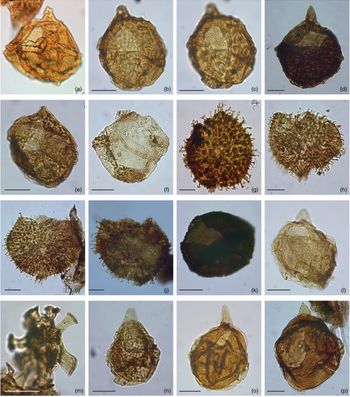
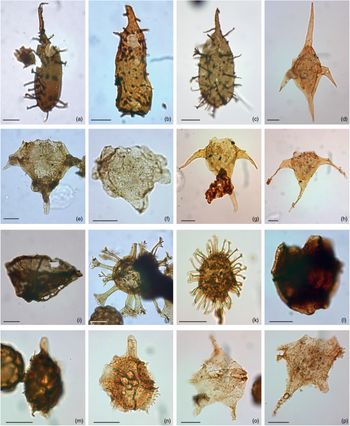
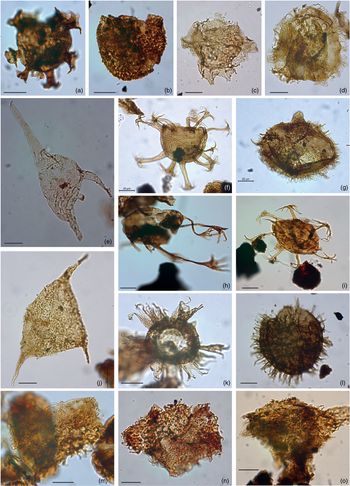
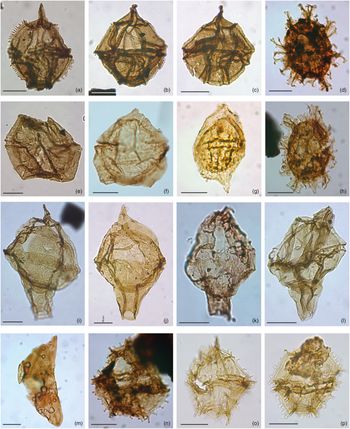
The palynological slides were analysed using a transmitted light microscope. When possible, a minimum of 300 dinocysts were counted in a single slide. In a few cases, when a single slide contained less than 300 dinocysts, it was necessary to count one or two additional slides. The dinocyst taxonomy follows Williams et al. (Reference Williams, Fensome and MacRae2017). All dinocysts recorded in this study are listed in Table 1. Selected dinocysts are presented in Figures 3–6. Coordinates of the photographed specimens are given following the method described by Śliwińska (Reference Śliwińska2019).

Photographs of the most characteristic dinoflagellate cysts observed in the Rurikfjellet and Helvetiafjellet formations in the present study. Scale bars on all photographs represent 20 μm. MC – microscope coordinates with the A-point of 0.4 × 90.3 (XM1 × YM1). For details, see Śliwińska (Reference Śliwińska2019). (a) A dinocyst, Bohemanflya outcrop section, level 99.29 m, sample 26291-7; MC 102 × 42.2. (b) Apteodinium spongiosum, high focus and (c) low focus, Bohemanflya outcrop section, level 25.00 m, sample 28450-9; MC 25 × 108.7. (d) Apteodinium spongiosum, very dark, Myklegardfjellet outcrop section, level 30.00 m, sample 27007-6; MC 32 × 109.1. (e) Apteodinium spongiosum, Myklegardfjellet outcrop section, level 120.00 m, sample 27013-9; MC 51.4 × 105.5. (f) Atopodinium haromense; Myklegardfjellet outcrop section, level 120.00 m, sample 27013-9; MC 42.7 × 102.3. (g) Circulodinium distinctum, Myklegardfjellet outcrop section, level 105.00 m, sample 27012-6; MC 29.3 × 91.6. (h) Circulodinium distinctum, Myklegardfjellet outcrop section, level 120.00 m, sample 27013-9; MC 21 × 104.5. (i) Circulodinium distinctum, Myklegardfjellet outcrop section, level 120.00 m, sample 27013-9; MC 17.5 × 105.5. (j) Circulodinium distinctum, Bohemanflya outcrop section, level 28.00 m, sample 28449-8; MC 44.7 × 96.7. (k) Dissiliodinium acmeum, Myklegardfjellet outcrop section, level 7.00 m, sample 27005-4; MC 37.2 × 99.4. (l) Endoscrinium sp. 1 Bohemanflya outcrop section, level 25.00 m, sample 28450-9; MC 25.5 × 110. (m) Discorsia nannus, Myklegardfjellet outcrop section, level 120.00 m, sample 27013-9; MC 49 × 103.3. (n) Dingodinium cerviculum, Myklegardfjellet outcrop section, level 75.00 m, sample 27010-4; MC 47 × 108.5. (o) Endoscrinium hauterivianum, Bohemanflya outcrop section, level 36.00 m, sample 28448-7; MC 33.8 × 102.2. (p) Endoscrinium hauterivianum, Myklegardfjellet outcrop section, level 120.00 m, sample 27013-9; MC 42 × 102.4.

Photographs of the most characteristic dinoflagellate cysts observed in the Rurikfjellet and Helvetiafjellet formations in the present study. Scale bars on all photographs represent 20 μm. MC – microscope coordinates with the A-point of 0.4 × 90.3 (XM1 × YM1). For details, see Śliwińska (Reference Śliwińska2019). (a) Gochteodinia villosa subsp. multifurcata, Myklegardfjellet outcrop section, level 15.00 m, sample 27006-5; MC 36.3 × 114. (b) Gochteodinia villosa, DH5R core, depth 350.00 m, sample 26197-6; MC 22.5 × 96.2. (c) Gochteodinia villosa subsp. multifurcata, Myklegardfjellet outcrop section, level 15.00 m, sample 27006-5; MC 36 × 107. (d) Muderongia tetracantha, Bohemanflya outcrop section, level 127.50 m, sample 26290-8; MC 44 × 110.6. (e) Muderongia australis, Myklegardfjellet outcrop section, level 120.00 m, sample 27013-9; MC 31.4 × 108.5. (f) Muderongia simplex, Myklegardfjellet outcrop section, level 105.00 m, sample 27012-6; MC 33 × 105.8. (g) A transitional form between Muderongia tetracantha and Muderongia extensiva, Bohemanflya outcrop section, level 46.00 m, sample 26293-5, MC 24.5 × 111. (h) Muderongia extensiva, Bohemanflya outcrop section, level 46.00 m, sample 26293-7; MC 18.5 × 108.4. (i) Isthmocystis distincta, Myklegardfjellet outcrop section, level 7.00 m, sample 27005-4; MC 28 × 102.3. (j) Kleithriasphaeridium eoinodes, Myklegardfjellet outcrop section, level 90.00 m, sample 27011-8; MC 25.2 × 10³. (k) Kiokansium unituberculatum, Bohemanflya outcrop section, level 127.50, sample 26290-6; MC 31 × 107.3. (l) Meiourogonyaulax stoveri, DH5R core, depth 258.00 m, sample 26194-5; MC 24 × 107.8. (m) Poorly preserved Nelchinopsis kostromiensis, Bohemanflya outcrop section, level 99.29 m, sample 26291-7; MC 52.4 × 10⁹. (n) Nelchinopsis kostromiensis, Bohemanflya outcrop section, level 55.25 m, sample 26292-7; MC 51.5 × 95.5. (o) Nyktericysta? pannosa, Bohemanflya outcrop section, level 99.29 m, sample 26291-7; MC 43 × 102.7. (p) Nyktericysta? pannosa, Bohemanflya outcrop section, level 127.50 m, sample 26290-8; MC 50.2 × 100.

Photographs of the most characteristic dinoflagellate cysts observed in the Rurikfjellet and Helvetiafjellet formations in the present study. Scale bars on all photographs represent 20 μm. MC – microscope coordinates with the A-point of 0.4 × 90.3 (XM1 × YM1). For details, see Śliwińska (Reference Śliwińska2019). (a) Oligosphaeridium poculum, DH5R core, depth 320.00 m, sample 26196-7; MC 58.2 × 97.1. (b) Questionable Escharisphaeridia rudis, DH5R core, depth 288.00 m, sample 26195-7; MC 36.7 × 112.5. (c) Phoberocysta neocomica, Myklegardfjellet outcrop section, level 90.00 m, sample 27009-6; MC 24.3 × 113.8. (d) Rhynchodiniopsis aptiana, Bohemanflya outcrop section, level 5.00 m, sample 28453-7; MC 31.7 × 101. (e) Odontochitina nuda, DH2 core, depth 141.80 m, sample 26510-9; MC 42 × 105.2. (f) Oligosphaeridium abaculum, Myklegardfjellet outcrop section, level 75.00 m, sample 27010-5; MC 48.5 × 105.5. (g) Rhynchodiniopsis aptiana, Myklegardfjellet outcrop section, level 105.00 m, sample 27012-6; MC 20.3 × 107.5. (h) Oligosphaeridium complex with ‘palm-like’ terminations of processes, DH1, depth 258.90 m, sample 26285-7; MC 32.8 × 97.1. (i) Oligosphaeridium asterigerum, Bohemanflya outcrop section, level 99.29 m, sample 26291-7; MC 44.7 × 94.3. (j) Pseudoceratium pelliferum, Bohemanflya outcrop section, level 36.00 m, sample 28448-7; MC 37 × 106.5. (k) Palaecysta palmula, Myklegardfjellet outcrop section, level 0.05 m, sample 27004-8; MC 53 × 107.5. (l) Cyclonephelium cuculliforme sensu Århus, Reference Århus, Kelly, Collins and Sandy1990, Myklegardfjellet outcrop section, level 15.00, sample 27006-3; MC 30.2 × 101. (m) Questionable Pseudoceratium anaphrissum Bohemanflya outcrop section, level 132.63 m, sample 26289-8; MC 37.8 × 95.5. Also shown in figure 15.P in Grundvåg et al. (Reference Grundvåg, Jelby, Śliwińska, Nøhr-Hansen, Aadland, Sandvik, Tennvassås, Engen and Olaussen2019). (n) Pseudoceratium anaphrissum, Ullaberget outcrop section, level 104.00 m, sample 28482-7; MC 40.6 × 111.8. (o) Questionable, poorly preserved Pseudoceratium anaphrissum, DH2 core, depth 149.50 m, sample 26511-11; MC 34.5 × 110.5. Also shown in figure 15.H in Grundvåg et al. (Reference Grundvåg, Jelby, Śliwińska, Nøhr-Hansen, Aadland, Sandvik, Tennvassås, Engen and Olaussen2019).

Photographs of the most characteristic dinoflagellate cysts observed in the Rurikfjellet and Helvetiafjellet formations in the present study. Scale bars on all photographs represent 20 μm. MC – microscope coordinates with the A-point of 0.4 × 90.3 (XM1 × YM1). For details, see Śliwińska (Reference Śliwińska2019). (a) Stanfordella fastigiata, Myklegardfjellet outcrop section, level 30.00 m, sample 27007-6; MC 50.4 × 103.5. (b) Stanfordella ordocava, Myklegardfjellet outcrop section, level 15.00 m, sample 27006-5; MC 31.6 × 111. (c) Stanfordella ordocava, DH5R core, depth 380.00 m, sample 26198-6; MC 55.5 × 102.4. (d) Spiniferites sp. 1, DH5R core, depth 194.00 m, sample 26192-7; MC 36.9 × 10². (e) Sirmiodinium grossii, Myklegardfjellet outcrop section, level 30.00 m, sample 27007-6; MC 30.3 × 104.2. (f) Sirmiodinium grossii, DH1, depth 258.90 m, sample 26285-7; MC 29.4 × 10⁹. (g) Subtilisphaera perlucida, DH2 core, depth 186.55 m, sample 26513-9; MC 36.7 × 92.6. Also shown in figure 15.G in Grundvåg et al. (Reference Grundvåg, Jelby, Śliwińska, Nøhr-Hansen, Aadland, Sandvik, Tennvassås, Engen and Olaussen2019). (h) Spiniferites? DH5R core, depth 194.00 m, sample 26192-7; MC 50.8 × 101.2. (i) Tubotuberella apatela, Myklegardfjellet outcrop section, level 30.00 m, sample 27007-6; MC 30.6 × 10⁵. (j) Tubotuberella apatela, Myklegardfjellet outcrop section, level 0.05 m, sample 27004-8; MC 34.5 × 109.4. (k) Tubotuberella apatela, DH2 core, depth 232.00 m, sample 26516-9; MC 19.4 × 93.3. (l) Tubotuberella sp. DH5R core, depth 380.0 m, sample 26198-6; MC 48 × 98.7. (m) Wallodinium luna, DH5R core, depth 350.0 m, sample 26197-6; MC 36.5 × 102.4. (n) Wrevittia perforobtusa, DH5R core, depth 194.00 m, sample 26192-7; MC 29.9 × 102.6. (o) Wrevittia perforobtusa, Bohemanflya outcrop section, level 55.25 m, sample 26292-8; MC 50.3 × 101.7. (p) Wrevittia perforobtusa, Bohemanflya outcrop section, level 36 m, sample 28448-7; MC 40.5 × 98.6.

7. Results and discussion
Two out of three samples from the Agardhfjellet Formation were barren with respect to dinocysts. Virtually all analysed samples from the Rurikfjellet Formation and the Helvetiafjellet Formation yielded dinocysts. The diversity, abundance and preservation are highly variable spatially and temporally. In samples where dinocysts were rare or absent, the assemblages are dominated by black and dark brown wood particles, as well as pollen grains.
In some levels, despite counting more than one palynological slide, there were less than 300 dinocysts in total (e.g. in the uppermost samples of the DH5R core). The dinocyst assemblages were particularly impoverished in the Ullaberget outcrop section, and in the DH1 and DH2 cores. In comparison, the dinocyst assemblages of the Myklegardfjellet outcrop section show the highest richness of species (online Supplementary Material Fig. S2).
Within the Rurikfjellet Formation we distinguish several age-diagnostic dinocysts: Endoscrinium hauterivianum (Fig. 3o, p; Appendix 1a), Gochteodinia villosa subsp. villosa (Fig. 4b; Appendix 1b), Muderongia australis (Fig. 4e; Appendix 1c), Muderongia tetracantha (Fig. 4d; Appendix 1d), Nelchinopsis kostromiensis (Fig. 4m, n; Appendix 1e), Oligosphaeridium complex (Fig. 5h; Appendix 1h), Palaecysta palmula (Fig. 5k; Appendix 1i), Subtilisphaera perlucida (Fig. 6g; Appendix 1l) and Tubotuberella apatela (Fig. 6i–k; Appendix 1m). Other typical dinocysts observed within the formation include Cyclonephelium cuculliforme sensu Århus, Reference Århus, Kelly, Collins and Sandy1990 (Fig. 5l), Discorsia nannus (Fig. 3m), Dissiliodinium acmeum (Fig. 3k), Nyktericysta? pannosa (Fig. 4o, p), Oligosphaeridium abaculum (Fig. 5f; Appendix 1g), Phoberocysta neocomica (Fig. 5c), Pseudoceratium pelliferum (Fig. 5j), Rhynchodiniopsis aptiana (Fig. 5d, g), Stanfordella fastigiata (Fig. 6a), Stanfordella ordocava (Fig. 6b, c) and Wrevittia perforobtusa (Fig. 6n–p). Notably, some of the well-known Lower Cretaceous markers, such as e.g. Batioladinium longicornutum, were not observed in the studied material.
The age-diagnostic taxa within the Helvetiafjellet Formation include Odontochitina nuda (Fig. 5e; Appendix 1f), Pseudoceratium anaphrissum (Fig. 5m–o; Appendix 1j), Sirmiodinium grossii (Fig. 6e, f; Appendix 1k) and Subtilisphaera perlucida (Fig. 6g; Appendix 1l). The Helvetiafjellet Formation is also characterized by low species richness, low relative abundance of dinocysts and a moderate reworking of Valanginian to Barremian dinocysts.
The age of the first (FOs) and last occurrences (LOs) as well as ranges of the key dinocysts in the context of existing literature are discussed in the Appendix.
7.a. Palynological framework for the Agardhfjellet Formation
The two lowermost samples from the DH5R core collected from the upper part of the Agardhfjellet Formation (at 458.0 and 440.0 m) are barren of dinocysts (online Supplementary Material Fig. S6). The sample at 410 m yields only a few, poorly preserved dinocysts (online Supplementary Material Fig. S6). In this sample, the co-occurrence of Sirmiodinium grossii and Tubotuberella apatela suggests a very broad Bathonian – early Valanginian age (e.g. Costa & Davey, Reference Costa, Davey and Powell1992). Our dinocyst-derived age constraint is therefore not as good as the age based, for example, on macrofossils, which dates this part of the Agardhfjellet Formation as Ryazanian (Wierzbowski et al. Reference Wierzbowski, Hryniewicz, Hammer, Nakrem and Little2011).
7.b. Palynological framework for the Rurikfjellet Formation
The distribution of dinocysts in the Rurikfjellet Formation (except the Myklegardfjellet Bed; Fig. 1) from the studied sites suggests that this formation is of early Valanginian to possibly earliest Barremian age (Fig. 8).
The stratigraphic ranges and/or first and last occurrences of the age-diagnostic dinoflagellate cysts (dinocysts) from the Boreal and European Boreal Realm, and the key events recognized in this study (to the right). Key dinocyst events in Spitsbergen: primary markers (black), secondary markers (grey). The figure shows a compilation of the most characteristic dinocysts from the Rurikfjellet and Helvetiafjellet formations discussed in the present study. Heilmann-Clausen (Reference Heilmann-Clausen1987), Costa & Davey (Reference Costa, Davey and Powell1992) and Duxbury (Reference Duxbury2001) plotted the dinocyst ranges against the ammonite zonation (marked with asterisk). All these authors considered the Simbirskites variabilis ammonite zone as earliest Barremian, whilst today it is considered to be Hauterivian (Ogg et al. Reference Ogg, Ogg, Gradstein, Ogg, Ogg and Gradstein2016). Nøhr-Hansen et al. (Reference Nøhr-Hansen, Piasecki and Alsen2019) updated the zonation proposed previously by Nøhr-Hansen (Reference Nøhr-Hansen1993), and provided ages in GTS2016. Note that the study by Davey (Reference Davey1982) does not cover sediments younger than lower–?upper Hauterivian, while the study by Davies (Reference Davies1983) does not cover sediments younger than upper Valanginian.

The spatial distribution of the age-diagnostic (colour coded) and secondary dinocyst events (black) within the Rurikfjellet Formation. The correlation between the Bohemanflya, DH5R core and Myklegardfjellet outcrop section, i.e. from NW to SE.

The dinocyst assemblages in the DH1 and DH2 cores are characterized by poor preservation, low diversity and low dinocyst abundance. Both cores penetrate the c.150 m thick gravity flow deposits of the Adventpynten member (Grundvåg et al. Reference Grundvåg, Marin, Kairanov, Śliwińska, Nøhr-Hansen, Jelby, Escalona and Olaussen2017) that yield a number of reworked taxa. In the DH2 core, the lowermost samples from the Rurikfjellet Formation yield only a single highly corroded Oligosphaeridium specimen (possibly O. complex or O. asterigerum). Thus, this interval is tentatively dated as Valanginian or younger (online Supplementary Material Fig. S5). The two lowermost samples from the DH1 well (corresponding to the base of the Rurikfjellet Formation according to Grundvåg et al. Reference Grundvåg, Marin, Kairanov, Śliwińska, Nøhr-Hansen, Jelby, Escalona and Olaussen2017) also yield O. complex (online Supplementary Material Fig. S4). Furthermore, the sample at 414.0 m yields Gochteodinia villosa subsp. multifurcata while the sample at 410.2 m yields Muderongia tetracantha (online Supplementary Material Fig. S4). Thus, this interval is of Valanginian–Hauterivian age. The presence of Endoscrinium hauterivianum between 270.0 and 221.0 m implies that this interval is of early Hauterivian to earliest late Hauterivian age (see below). In summary, in the DH1 core (i.e. 414.0 to 221.0 m depth) the Rurikfjellet Formation is dated as Valanginian – earliest late Hauterivian (online Supplementary Material Fig. S4).
We find the best-constrained age for the basal part of the Rurikfjellet Formation (early Valanginian) to be represented by the Myklegardfjellet outcrop section (the interval from the base of the section up to level 60.0 m; online Supplementary Material Fig. S2). This notion is based on the co-occurrence of Palaecysta palmula and O. complex in the lowermost sample at 0.05 m. The early Valanginian age for the base of the Rurikfjellet Formation confirms previous observations (Bjærke, Reference Bjærke1978; Århus, Reference Århus1992).
The LO of the stratigraphically persistent T. apatela at 60.0 m in the Myklegardfjellet outcrop section is used here as a marker for the top of the early Valanginian, since most records agree that this bio-event is close to the early–late Valanginian boundary (see below; Fig. 7). This age assignment is in agreement with the presence of a Tollia (Neocraspedites) aff. subtilis ammonite of middle early Valanginian age found at 47.30 m (P. Alsen & M. E. Jelby, unpub. data).
In the DH5R core, the top of the stratigraphically persistent Gochteodinia villosa subsp. villosa is at 320.0 m, and it co-occurs with O. complex in the interval from 380.0 to 320.0 m. Based on these occurrences, we date this interval as earliest Valanginian. Placing the early–late Valanginian boundary close to the top of the persistent occurrence of these two taxa is in agreement with the observations by Århus (cf. fig. 2 in Århus, Reference Århus1992, and enclosure 2 in Århus, Reference Århus1988).
We place the base of the Hauterivian at the FO of E. hauterivianum (Fig. 8). The FO of E. hauterivianum is followed by the FO of Muderongia tetracantha, another important marker for the Hauterivian (e.g. Costa & Davey, Reference Costa, Davey and Powell1992) (Fig. 7). The stratigraphic range of E. hauterivianum observed in five sites (DH1, DH2, DH5R, Bohemanflya and Myklegardfjellet) in the middle to upper part of the Rurikfjellet Formation dates this part of the unit to the early Hauterivian – earliest late Hauterivian (online Supplementary Material Figs S4, S5; Fig. 4). Grøsfjeld (Reference Grøsfjeld1991) noted that E. hauterivianum (as Apteodinium sp. A of Bjærke, Reference Bjærke1978; Appendix 1a) is also present in several other outcrop sections of the Rurikfjellet Formation including Janusfjellet, Forkastningsfjellet and Helvetiafjellet.
Many samples from the uppermost part of the Rurikfjellet Formation in the DH1, DH2 and DH5R cores are characterized by low dinocyst abundance and relatively low species richness. The best age constraint for the top of the formation is therefore based on outcrop sections. The upper part of the Rurikfjellet Formation is dated to the late Hauterivian – earliest Barremian. The youngest part of the formation dated to the early Barremian is observed at Ullaberget and Bohemanflya.
In the Ullaberget outcrop section, two samples at 0.0 and 2.0 m, collected from the top of the Rurikfjellet Formation, yield Pseudoceratium anaphrissum and Subtilisphaera perlucida. The sample at 0.0 m additionally yields Nelchinopsis kostromiensis, P. anaphrissum and S. perlucida, which have their FOs close to the Hauterivian – Barremian boundary (online Supplementary Material Fig. S3). In the North Sea Basin, the LO of N. kostromiensis and the FO of P. anaphrissum are two important bio-events for recognition of the Hauterivian–Barremian boundary. Typically, the LO of N. kostromiensis marks the top of the Hauterivian, while the FO of P. anaphrissum marks the base of the Barremian (e.g. Costa & Davey, Reference Costa, Davey and Powell1992). However, in some studies both bio-events are reported from the lowermost Barremian (Heilmann-Clausen, Reference Heilmann-Clausen1987; Århus et al. Reference Århus, Kelly, Collins and Sandy1990; Smelror et al. Reference Smelror, Mørk, Monteil, Rutledge and Leereveld1998; Bailey, Reference Bailey2019) or the upper Hauterivian (Nøhr-Hansen, Reference Nøhr-Hansen1993; Nøhr-Hansen et al. Reference Nøhr-Hansen, Piasecki and Alsen2019). In the North Sea, the ranges of these two species either overlap (Costa & Davey, Reference Costa, Davey and Powell1992) or do not (Bailey, Reference Bailey2019). Overlapping ranges of the two taxa have been observed in NE Greenland (Nøhr-Hansen, Reference Nøhr-Hansen1993; Nøhr-Hansen et al. Reference Nøhr-Hansen, Piasecki and Alsen2019). An overlap of the stratigraphic ranges of the two species was previously reported from the Barents Sea (well 7245/9-U-1) (fig. 5 in Århus et al. Reference Århus, Kelly, Collins and Sandy1990). Based primarily on the foraminifera assemblage, the overlap interval was dated as early Barremian (Århus et al. Reference Århus, Kelly, Collins and Sandy1990). However, these authors recognized that the presence of Buchia sublaevis bivalves within the same interval was problematic (p. 173 in Århus et al. Reference Århus, Kelly, Collins and Sandy1990), because Buchia extends only into the Hauterivian (Zakharov, Reference Zakharov1987). In summary, these observations give three possibilities for assigning an age to the LO of N. kostromiensis and the FO of P. anaphrissum: (i) In Spitsbergen, the Barents Sea and NE Greenland, P. anaphrissum appears in the upper Hauterivian; (ii) in Spitsbergen and the Barents Sea region, N. kostromiensis has a longer range reaching the lowermost Barremian; or (iii) N. kostromiensis occurring in the lower Barremian strata is reworked. We consider the first possibility to be the most plausible, since this is in agreement with other studies from the Arctic region (NE Greenland, Barents Sea and Arctic Canada; cf. Fig. 7).
In the three uppermost samples from the Bohemanflya outcrop section (99.29 m to 132.63 m), we found a common to abundant dinocyst taxon previously recorded as Nyktericysta? pannosa by Grøsfjeld (Reference Grøsfjeld1991). However, we observe that N.? pannosa from Bohemanflya (Fig. 4o, p) with its generally less pronounced lateral horns differs from the holotype, which was described from ‘middle Barremian’ strata from the Speeton Clay in England (Duxbury, Reference Duxbury1980). Nevertheless, Grøsfjeld (Reference Grøsfjeld1991) and this study show the only records of this taxon outside the type area. The restricted occurrence of N.? pannosa, limited to the Bohemanflya section on Spitsbergen (Grøsfjeld, Reference Grøsfjeld1991; this study) and to the Speeton Clay in England (Duxbury, Reference Duxbury1980), could suggest that the distribution of the taxon is controlled by some environmental factors. Oligosphaeridium abaculum is another taxon which has a significantly different range in Spitsbergen than in surrounding basins (Appendix 1g). In Spitsbergen the taxon appears in the Valanginian, i.e. much earlier than in the North Sea and North-East Greenland (Fig. 7). The diachroneity of the event may also be caused by the local environmental changes.
Based on the LO of N. kostromiensis at 127.58 m and the presence of N.? pannosa between 99.29 m and 132.63 m, the interval is dated as latest Hauterivian – early Barremian.
In the topmost sample of the Myklegardfjellet outcrop section at 150.0 m, we observed an acme of M. australis. We consider this acme to be time-equivalent to the M. australis acme observed in the Barents Sea by Århus et al. (Reference Århus, Kelly, Collins and Sandy1990). Thus, we date this level as late Hauterivian – early Barremian.
Our new age framework for the Rurikfjellet Formation based on the dinocyst stratigraphy is in agreement with previous studies from the study area (e.g. Bjærke, Reference Bjærke1978; Thusu, Reference Thusu and Thusu1978; Århus, Reference Århus1992; Midtkandal et al. Reference Midtkandal, Svensen, Planke, Corfu, Polteau, Torsvik, Faleide, Grundvåg, Selnes, Kürschner and Olaussen2016), which dated the majority of the Rurikfjellet Formation as Valanginian–Hauterivian. Specifically, the Rurikfjellet Formation at the Janusfjellet outcrop section was previously dated as early Valanginian – late Hauterivian (Århus, Reference Århus1992). We observe that our dinocyst distribution of the Myklegardfjellet outcrop section (online Supplementary Material Fig. S2) resembles the distribution of dinocysts from Janusfjellet (enclosure 2 in Århus, Reference Århus1988). Furthermore, our results confirm the observation by Grøsfjeld (Reference Grøsfjeld1991) that the topmost part of the Rurikfjellet Formation is most likely of early Barremian age. Some reworking is present, which is minor compared to the reworking in the Helvetiafjellet Formation (online Supplementary Material Figs S1–S6).
7.c. Palynological framework for the Helvetiafjellet Formation
We observe that the dinocyst assemblages of the Helvetiafjellet Formation are highly impoverished and yield a number of taxa reworked from the Rurikfjellet Formation. The reworking of Pliensbachian to early Oxfordian dinocysts within the Helvetiafjellet Formation was observed previously on Kong Karls Land (Smelror et al. Reference Smelror, Larssen, Olaussen, Rømuld and Williams2018). Redeposition is, however, not surprising, considering that the study area was uplifted and subaerially exposed in the Barremian with large parts of the Svalbard platform being subjected to erosion (Fig. 2).
Based on the presence of Odontochitina nuda, Pseudoceratium anaphrissum, Sirmiodinium grossii and Subtilisphaera perlucida, the Helvetiafjellet Formation is dated here as Barremian to possibly early Aptian (online Supplementary Material Figs S3, S5; Fig. 9). The boundary between the Rurikfjellet and Helvetiafjellet formations is dated as early Barremian. Owing to the low diversity of the assemblages and rarity of dinocysts, it is not possible to precisely place the Barremian–Aptian boundary.
The spatial distribution of the age-diagnostic dinocyst events within the Helvetiafjellet Formation. The correlation between the Ullaberget outcrop section and DH2 core.

Our age assignment of the Helvetiafjellet Formation is in agreement with a recent stable carbon isotope (δ13C) stratigraphic study of the Festningen outcrop section (Vickers et al. Reference Vickers, Price, Jerrett and Watkinson2016). These authors interpreted that the Helvetiafjellet Formation is of Barremian to earliest Aptian age. Another study, based on the U–Pb dating of a bentonite in the DH3 core (at 156.89 m in the middle part of the Helvetiafjellet Formation) suggested an age of 123.3 ± 0.2 Ma for this particular bed (Corfu et al. Reference Corfu, Polteau, Planke, Faleide, Svensen, Zayoncheck and Stolbov2013), corresponding to the late early Aptian (Ogg et al. Reference Ogg, Ogg, Gradstein, Ogg, Ogg and Gradstein2016). However, the biostratigraphic framework of this study and Midtkandal et al. (Reference Midtkandal, Svensen, Planke, Corfu, Polteau, Torsvik, Faleide, Grundvåg, Selnes, Kürschner and Olaussen2016) suggest that this part of the succession is rather of Barremian age. Nevertheless, the existing studies (e.g. Corfu et al. Reference Corfu, Polteau, Planke, Faleide, Svensen, Zayoncheck and Stolbov2013; Midtkandal et al. Reference Midtkandal, Svensen, Planke, Corfu, Polteau, Torsvik, Faleide, Grundvåg, Selnes, Kürschner and Olaussen2016; Vickers et al. Reference Vickers, Price, Jerrett and Watkinson2016) collectively agree that the Helvetiafjellet Formation is of Barremian – early Aptian age.
8. Conclusions
The Rurikfjellet and Helvetiafjellet formations on Spitsbergen, Svalbard, have been studied in the DH1, DH2 and DH5R onshore cores as well as in the Bohemanflya, Myklegardfjellet and Ullaberget outcrop sections. Our study suggests an early Valanginian – early Barremian age for the Rurikfjellet Formation and a Barremian–Aptian age for the overlying Helvetiafjellet Formation. We provide a number of age-diagnostic dinocyst bio-events for age determination of the Rurikfjellet and Helvetiafjellet formations. The preservation of dinocysts is better and the diversity of assemblages is significantly higher in the offshore to shallow-marine Rurikfjellet Formation than in the fluvio-deltaic to paralic Helvetiafjellet Formation.
We observe some reworked dinocysts within the Helvetiafjellet Formation, possibly from the Rurikfjellet Formation. The presence of reworked dinocysts implies that any proxy records performed on bulk sediments (e.g. δ13C, biomarkers) across the Barremian–Aptian transition on Spitsbergen should be interpreted with care, since the signal may be biased.
We further observe that the distribution of N.? pannosa and O. abaculum (Appendix 1g) is most likely controlled by local palaeoenvironmental variations. For a better understanding of these records, further palaeoenvironmental proxy data from the area are required.
The dinocyst assemblages in the three samples collected from the Agardhfjellet Formation are too impoverished to provide a reliable age constraint on the boundary between the Rurikfjellet and Agardhfjellet formations.
Our age model is in agreement with the existing stratigraphic studies carried out in the study area. Notably, our study provides the first comprehensive, semi-quantitative dataset of the distribution of dinocysts within the Lower Cretaceous (Valanginian–Aptian) succession on Spitsbergen.
Acknowledgements
This research was carried out within the LoCrA consortium (https://wp.ux.uis.no/locra), generously sponsored by 22 industry partners. Thanks are extended to Annette Ryge, Charlotte Olsen and Dorthe Samuelsen (GEUS) for preparation of palynological slides. S.-A. Grundvåg acknowledges funding from the ARCEx project (Research Centre for Arctic Petroleum Exploration), which is funded by the Research Council of Norway (grant number 228107). Figures 8 and 9, and S1–S6 were prepared using the StrataBugs v2.0 charts. We thank reviewers Wiesława Violka Radmacher and Kari Grøsfjeld as well as editor Jennifer Galloway for valuable comments and suggestions, which improved this manuscript.
Supplementary material
To view supplementary material for this article, please visit https://doi.org/10.1017/S0016756819001249
Appendix 1. Taxonomic notes on characteristic dinocyst taxa of the Rurikfjellet and Helvetiafjellet formations
Appendix 1a. Stratigraphic range of Endoscrinium hauterivianum (Duxbury, Reference Duxbury2001) Riding & Fensome, Reference Riding and Fensome2003
Figure 3o, p
1978 Apteodinium sp. A (Bjærke, Reference Bjærke1978)
1980? Apteodinium sp. A of Bjærke (Reference Bjærke1978) Bjærke plate X, figs 1, 2
1991 Apteodinium sp. A of Bjærke (Reference Bjærke1978) Grøsfjeld plate 4, figs D–F
2001 Scriniodinium hauterivianum Duxbury, Reference Duxbury2001
2003 Endoscrinium hauterivianum (Duxbury, Reference Duxbury2001) Riding & Fensome
The holotype of E. hauterivianum was described from the UK sector of the North Sea Basin (Duxbury, Reference Duxbury2001). The taxon was described as restricted to the Hauterivian with the LO within the lowermost upper Hauterivian (Duxbury, Reference Duxbury2001). We here suggest that Apteodinium sp. A of Bjærke (Reference Bjærke1978), which was recorded in the Valanginian to Hauterivian succession of the Rurikfjellet Formation (T. Bjærke, unpub. report, 1980), is a synonym of E. hauterivianum. Grøsfjeld (Reference Grøsfjeld1991) noted that the species was present in numerous locations on Spitsbergen and can be used as a Hauterivian marker in the region. However, she also pointed out that at Janusfjellet the LO of Apteodinium sp. A of Bjærke (Reference Bjærke1978) post-dates the LO of N. kostromiensis (for the stratigraphic range of N. kostromiensis see Appendix 1e) and thus it may range into the Barremian. Grøsfjeld (Reference Grøsfjeld1991) did not observe N. kostromiensis in the Bohemanflya outcrop section (see fig. 6 in Grøsfjeld, Reference Grøsfjeld1991), only N.? pannosa (see below) and Apteodinium sp. A of Bjærke (Reference Bjærke1978).
Spitsbergen – this study. In the present study E. hauterivianum is recorded in all studied sections. We apply the FO of E. hauterivianum as a marker for the base Hauterivian and the LO as the marker for the earliest late Hauterivian. In the two sections with the highest dinocyst diversity and the greatest assemblage abundance (Bohemanflya, online Supplementary Material Fig. S1, Myklegardfjellet, online Supplementary Material Fig. S2, and Fig. 8), the LO of E. hauterivianum pre-dates the LO of N. kostromiensis. This is in contrast to the observations by Grøsfjeld (Reference Grøsfjeld1991) from the Bohemanflya outcrop section. We speculate that the longer range of N. kostromiensis observed by us may be an effect of different sampling strategies carried out in both studies. In the studied material the taxon is rare to abundant (i.e. <1 % or >50 % of the total dinocyst assemblage).
Appendix 1b. LO of Gochteodinia villosa (Vozzhennikova, Reference Vozzhennikova1967) Norris, Reference Norris1978
Figure 4a–c
G. villosa is divided into two subspecies, G. villosa subsp. villosa (Vozzhennikova, Reference Vozzhennikova1967) and G. villosa subsp. multifurcata (Davey, Reference Davey1982). The stratigraphic ranges of these subspecies are different (Fig. 7). The FO of G. villosa multifurcata post-dates the FO of G. villosa villosa, and thus distinguishing the two subspecies is very useful for increasing the resolution of the age framework. In the North Sea Basin, G. villosa multifurcata ranges from the lower Valanginian (Heilmann-Clausen, Reference Heilmann-Clausen1987) to the lowermost Hauterivian (Heilmann-Clausen, Reference Heilmann-Clausen1987; Costa & Davey, Reference Costa, Davey and Powell1992) or to the Valanginian–Hauterivian boundary (Davey, Reference Davey1982; Bailey, Reference Bailey2019). The youngest LOs of G. villosa villosa are reported at the Ryazanian–Valanginian boundary (Heilmann-Clausen, Reference Heilmann-Clausen1987) or in the lowermost Valanginian (Costa & Davey, Reference Costa, Davey and Powell1992; Bailey, Reference Bailey2019). Davey (Reference Davey1982) and Nøhr-Hansen et al. (Reference Nøhr-Hansen, Piasecki and Alsen2019) reported the youngest occurrence of the taxon in the upper Ryazanian – upper Berriasian from Denmark and NE Greenland, respectively. In the Sverdrup Basin, Arctic Canada, G. villosa (not differentiated into subspecies, and possibly G. villosa multifurcata) was found in the Valanginian (Davies, Reference Davies1983). In the Barents Sea, (possibly reworked) specimens of G. villosa were reported in the assemblages referred to the Hauterivian – lower Barremian (Århus et al. Reference Århus, Kelly, Collins and Sandy1990). Århus (Reference Århus1991) shows that on central Spitsbergen G. villosa occurs in the Valanginian and Hauterivian strata, while G. villosa multifurcata has a slightly shorter range: Valanginian to lowermost Hauterivian. In the Valanginian part of the succession both taxa are present consistently. In post-Valanginian strata both taxa occur only sporadically (fig. 13 in Århus, Reference Århus1988), and thus their presence may be an effect of reworking.
Spitsbergen – this study. Specimens referred to G. villosa villosa and G. villosa multifurcata are slightly more elongate than the type material (cf. e.g. Davey, Reference Davey1982). The poor preservation of some of the specimens encountered in the present study sometimes precludes an unambiguous separation of the two subspecies. We distinguish subspecies only if the determination is possible. In a few samples G. villosa makes up 2–4 % of the total dinocyst assemblage. Otherwise, the species occurs persistently in the lower part of the Rurikfjellet Formation (Myklegardfjellet, DH5R), but is rather rare.
Appendix 1c. Stratigraphic range and abundance interval of Muderongia australis Helby, Reference Helby and Jell1987
Figure 4e
The youngest record on NE Greenland of the taxon is from the upper Hauterivian (Nøhr-Hansen, Reference Nøhr-Hansen1993; Nøhr-Hansen et al. Reference Nøhr-Hansen, Piasecki and Alsen2019). In the other few existing studies, M. australis is reported either from the Hauterivian (Århus et al. Reference Århus, Kelly, Collins and Sandy1990; Prössl, Reference Prössl1990) or from the Barremian (Helby, Reference Helby and Jell1987; Davey, Reference Davey1988). In Spitsbergen, M. australis is restricted to the upper part of the Rurikfjellet Formation (Århus et al. Reference Århus, Kelly, Collins and Sandy1990). Århus et al. (Reference Århus, Kelly, Collins and Sandy1990) also noted an acme of M. australis in the interval referred to the Hauterivian – lower Barremian and mentioned that the M. australis acme may be related to the early Barremian flooding event.
Spitsbergen – this study. We observe the persistent occurrence of M. australis in the upper part of the Rurikfjellet Formation within all the studied sites. Thus, we confirm the observations of Århus et al. (Reference Århus, Kelly, Collins and Sandy1990). In the topmost sample from the Rurikfjellet Formation at the Myklegardfjellet outcrop, M. australis occurs as a local acme, which we interpret to be synchronous with the acme observed in the Barents Sea (Århus et al. Reference Århus, Kelly, Collins and Sandy1990) and NE Greenland (Nøhr-Hansen, Reference Nøhr-Hansen1993).
Appendix 1d. Muderongia extensiva and Muderongia tetracantha
Figure 4d, g, h
In the North Sea Basin, the LO of M. extensiva is a well established earliest Hauterivian marker (Heilmann-Clausen, Reference Heilmann-Clausen1987; Costa & Davey, Reference Costa, Davey and Powell1992; Duxbury, Reference Duxbury2001). M. tetracantha has a slightly younger range, i.e. from the Hauterivian to the lowermost Barremian (Costa & Davey, Reference Costa, Davey and Powell1992; Duxbury, Reference Duxbury2001) or even Aptian (Heilmann-Clausen, Reference Heilmann-Clausen1987; Nøhr-Hansen, Reference Nøhr-Hansen1993; Nøhr-Hansen & McIntyre, Reference Nøhr-Hansen and McIntyre1998). Notably, some authors merge M. tetracantha with Muderongia crucis (Costa & Davey, Reference Costa, Davey and Powell1992; Bailey, Reference Bailey2019) or consider M. crucis as a junior synonym (e.g. Helby, Reference Helby and Jell1987). Nevertheless, M. tetracantha is considered the most typical taxon for Hauterivian – lower Barremian strata (see discussion in Heilmann-Clausen, Reference Heilmann-Clausen1987). More details concerning the stratigraphic ranges of these two taxa in the Boreal and the European Boreal realm is shown in Figure 7.
The differences in morphologies of M. tetracantha and M. extensiva are distinctive. The lateral horns of M. extensiva are long and extend almost at right angles from the tests (Duxbury, Reference Duxbury1977), while in M. tetracantha the horns bend downwards (Gocht, Reference Gocht1957). Furthermore, M. extensiva in contrast to M. tetracantha show a distinct plate differentiation at the lateral edge (Helby, Reference Helby and Jell1987).
Spitsbergen – this study. In the material encountered in the present study we observe transitional forms between M. extensiva and M. tetracantha. Some of these forms resemble M. tetracantha in their general outline, but on one or both lateral horns, we observe a distinct plate differentiation, a feature typical for M. extensiva (Fig. 4g). We observe the earliest record of M. tetracantha below the FO of E. hauterivianum (online Supplementary Material Fig. S1), but in sections with high dinocyst diversity and high relative abundance, the FO of M. tetracantha is observed within the range of E. hauterivianum (online Supplementary Material Figs S1, S2, S6, and Fig. 4)
Appendix 1e. Stratigraphic range of Nelchinopsis kostromiensis (Vozzhennikova, Reference Vozzhennikova1967) Wiggins, Reference Wiggins1972
Figure 4m, n
In the majority of existing studies of the North Sea Basin (Fig. 7), the range of this species is limited to the upper lower Valanginian – upper Hauterivian (Costa & Davey, Reference Costa, Davey and Powell1992; Duxbury, Reference Duxbury2001) or to the Hauterivian (Davey, Reference Davey1982; Heilmann-Clausen, Reference Heilmann-Clausen1987). In NE Greenland the taxon first occurs in the middle upper Valanginian and is not observed above the lower to upper Hauterivian N. kostromiensis Subzone (Nøhr-Hansen, Reference Nøhr-Hansen1993; Nøhr-Hansen et al. Reference Nøhr-Hansen, Piasecki and Alsen2019). Some studies report the FO of N. kostromiensis as early as at the lower–upper Valanginian boundary (Costa & Davey, Reference Costa, Davey and Powell1992) and its LO in the lowermost Barremian (Bailey, Reference Bailey2019). However, the Hauterivian–Barremian boundary in Bailey (Reference Bailey2019) is dated as 130 Ma, so it is slightly younger than in the Geological Time Scale 2016 where it is dated as 130.8 Ma (Ogg et al. Reference Ogg, Ogg, Gradstein, Ogg, Ogg and Gradstein2016). In the Svedrup Basin, Arctic Canada, N. kostromiensis was observed together with Gochteodinia villosa in the middle-upper upper Valanginian succession (Davies, Reference Davies1983). In some older studies N. kostromiensis was reported from the lowermost Barremian (Heilmann-Clausen, Reference Heilmann-Clausen1987; Smelror et al. Reference Smelror, Mørk, Monteil, Rutledge and Leereveld1998), from the Simbirskites variabilis ammonite zone. Today, the zone is considered to be Hauterivian (Ogg et al. Reference Ogg, Ogg, Gradstein, Ogg, Ogg and Gradstein2016).
Spitsbergen – this study. The FO and LO of N. kostromiensis are important stratigraphic events within the Rurikfjellet Formation. The range of N. kostromiensis virtually spans the entire unit at the three outcrops and in the DH5R core. Applying the age constrain based on the LOs of Tubotuberella apatela and Gochteodinia villosa villosa, the FO of Nelchinopsis kostromiensis in Spitsbergen is considered as an early Valanginian event, observed in the lower part of the Rurikfjellet Formation. The LO of N. kostromiensis is observed in the upper part of the Rurikfjellet Formation and is probably of latest Hauterivian – earliest Barremian age.
Appendix 1f. FO of Odontochitina nuda (Gocht, Reference Gocht1957) Dörhöfer & Davies, Reference Dörhöfer and Davies1980
Figure 5e
The holotype of O. nuda was described from the upper Hauterivian (Gocht, Reference Gocht1957). Other studies from Europe and Canada also suggest a Hauterivian to Barremian stratigraphic range for the taxon (see discussion in Nøhr-Hansen, Reference Nøhr-Hansen1993) (Fig. 7). In NE Greenland, O. nuda is restricted to the uppermost lower Barremian to lower Aptian (Nøhr-Hansen, Reference Nøhr-Hansen1993). In the Barents Sea, the taxon was reported from lower Barremian strata by Århus (in Århus et al. Reference Århus, Kelly, Collins and Sandy1990), but notably this study was carried out only on a Berriasian to lower Barremian succession. Therefore, the youngest occurrence of the taxon in the Barents Sea is unknown.
Spitsbergen – this study. O. nuda is restricted to the Helvetiafjellet Formation. The FO is observed within the middle (the DH2 core) or the upper (the Ullaberget outcrop section) part of the formation. The most probable time span for the taxon in Spitsbergen is Barremian to early Aptian.
Appendix 1g. FO of Oligosphaeridium abaculum Davey, Reference Davey1979b
Figure 5f
The holotype of O. abaculum was described by Davey (Reference Davey1979b) from a Barremian succession from the northern North Sea. In his study, Davey mentioned that abundant O. abaculum were found in the same sample as Odontochitina operculata, which has its first stratigraphic occurrence in the Barremian (e.g. Nøhr-Hansen, Reference Nøhr-Hansen1993; Bailey, Reference Bailey2019). The common occurrence of O. abaculum in the upper Hauterivian was reported in the UK and the Norwegian sectors of the North Sea Basin by Bailey (Reference Bailey2019). Notably, Costa & Davey (Reference Costa, Davey and Powell1992) reported that in the UK sector of the North Sea Basin, O. abaculum has a stratigraphic range from the upper Hauterivian to lower Barremian. However, the post-Hauterivian–Barremian? age was suggested by these authors because they considered the Simbirskites variabilis ammonite zone as Barremian. Recently the FO of O. abaculum was recorded from the uppermost lower Barremian in NE Greenland by Nøhr-Hansen et al. (Reference Nøhr-Hansen, Piasecki and Alsen2019).
Spitsbergen – this study. Rare to common (<1 % and 1–30 % of the total dinocyst assemblage) occurrences of O. abaculum are observed from all sites spanning the Rurikfjellet Formation. However, in contrast to the North Sea and NE Greenland, in Spitsbergen the taxon appears in the Valanginian, i.e. much earlier than in the two other regions (Fig. 7). We consider the FO of O. abaculum as an intra-late Valanginian event. The diachroneity in the event (Fig. 7) would suggest that the appearance of O. abaculum is dependent on the local environmental changes.
Appendix 1h. FO of Oligosphaeridium complex (White, Reference White1842) Davey & Williams, Reference Davey, Williams, Davey, Downie, Sarjeant and Williams1966
Figure 5h
The FO of O. complex is an important marker for the base Valanginian in the North Sea Basin and the Svedrup Basin, Arctic Canada (Davies, Reference Davies1983; Costa & Davey, Reference Costa, Davey and Powell1992; Duxbury, Reference Duxbury2001; Bailey, Reference Bailey2019). From NE Greenland, Nøhr-Hansen et al. (Reference Nøhr-Hansen, Piasecki and Alsen2019) recently recorded the FO of O. complex from the Peregrinus albidum ammonite zone, which is latest Berriasian in age (or early Valanginian according to Ogg et al. Reference Ogg, Ogg, Gradstein, Ogg, Ogg and Gradstein2016). On Andøya (Arctic Norway), the oldest record of O. complex is observed within beds assigned to the Buchia inflata – Buchia keyserlingi zones dated as early Valanginian (Århus et al. Reference Århus, Verdenius and Birkelund1986).
Spitsbergen – this study. In our material the taxon is present in virtually all samples. In the oldest part of the record, the taxon is often characterized by a small central body size and very tilted, long processes. The process terminations often have a ‘palm-like’ appearance (Fig. 5h). We consider the FO of O. complex as a marker for the base of the Valanginian. However, considering the recent study from NE Greenland it is possible that this event is slightly older (Nøhr-Hansen et al. Reference Nøhr-Hansen, Piasecki and Alsen2019).
Appendix 1i. LO of Palaecysta palmula (Davey, Reference Davey1982) Williams & Fensome, Reference Williams and Fensome2016
Figure 5k
In the UK sector of the Central North Sea Basin, the LO of P. palmula is observed in the middle lower Valanginian (Duxbury, Reference Duxbury2001; Bailey, Reference Bailey2019), while in the Danish sector, the LO is probably slightly younger, within the lower upper Valanginian (Davey, Reference Davey1982; Heilmann-Clausen, Reference Heilmann-Clausen1987) (Fig. 7).
Spitsbergen – this study. In the present study, P. palmula is observed in the basal part of the Rurikfjellet Formation in the Myklegardfjellet outcrop section.
Appendix 1j. Stratigraphic range of Pseudoceratium anaphrissum (Sarjeant, Reference Sarjeant, Davey, Downie, Sarjeant and Williams1966) Bint, Reference Bint1986
Figure 5m–o
The taxon has a remarkably short range, limited to the Barremian, primarily to the lower Barremian (Fig. 7). In the high Arctic the taxon has also been observed in the Hauterivian (Fig. 7). The Barremian record of P. anaphrissum is very well known from the Barents Sea (Århus et al. Reference Århus, Kelly, Collins and Sandy1990), Arctic Norway (Thusu, Reference Thusu and Thusu1978), offshore south Norway (Costa, Reference Costa and Ofstad1981), NE Greenland (Nøhr-Hansen, Reference Nøhr-Hansen1993), England (e.g. Sarjeant, Reference Sarjeant, Davey, Downie, Sarjeant and Williams1966; Duxbury, Reference Duxbury1980), Germany (Prössl, Reference Prössl1990) and the North Sea Basin (Heilmann-Clausen, Reference Heilmann-Clausen1987; Costa & Davey, Reference Costa, Davey and Powell1992; Bailey, Reference Bailey2019). Notably, in Arctic Norway a common occurrence of P. anaphrissum was found in a sample referred to the upper Hauterivian – lower Barremian (Århus et al. Reference Århus, Verdenius and Birkelund1986). In NE Greenland, and possibly also in the UK and the Norwegian sector of the North Sea Basin, the species is abundant in a narrow interval in the middle part of its range (Nøhr-Hansen, Reference Nøhr-Hansen1993; Bailey, Reference Bailey2019); see also summary in Figure 7.
Spitsbergen – this study. In the present study, P. anaphrissum is present in the uppermost part of the Rurikfjellet Formation (Ullaberget) and the Helvetiafjellet Formation (DH2 and Ullaberget). The taxon is rare (< 1%), badly preserved and incomplete (Fig. 5m–o). All observed specimens have clearly visible antapical lobes and lateral bulges, and with no operculum. Specimens observed in DH2 and Ullaberget are covered by short spines and processes (Fig. 5n, o). Owing to a poor preservational state, the ornamentation of the specimen observed in the topmost sample from the Bohemanflya outcrop section (Fig. 5m) is difficult to establish and therefore the specimen is questionably referred to P. anaphrissum.
In the middle and upper part of the Rurikfjellet Formation we found the common occurrence of dinocysts which we referred to Circulodinium distinctum (Fig. 3g, i). The ornamentation may resemble P. anaphrissum, but the outline is more typical for the genus Circulodinium.
Appendix 1k. LO of Sirmiodinium grossii Alberti, Reference Alberti1961
Figure 6e, f
In most of the study from the North Sea Basin the LO of S. grossii marks the top of the Barremian (e.g. Bailey, Reference Bailey2019). In NE Greenland the youngest record of the taxon is observed within the lowermost Aptian (Nøhr-Hansen, Reference Nøhr-Hansen1993). More details concerning the distribution of the taxon in the Boreal and the European Boreal Realm is shown in Figure 7.
Spitsbergen – this study. We observe S. grossii in both the Rurikfjellet and Helvetiafjellet formations. The taxon is present in virtually all samples analysed in this study.
Appendix 1l. FO of Subtilisphaera perlucida (Alberti, Reference Alberti1959) Jain & Millepied, Reference Jain and Millepied1973
Figure 6g
The majority of existing records from the Boreal and European Boreal Realm suggest that S. perlucida appeared in the early Barremian (e.g. Heilmann-Clausen, Reference Heilmann-Clausen1987; Nøhr-Hansen, Reference Nøhr-Hansen1993). In the DH1 core the FO of S. perlucida was observed within the Helvetiafjellet Formation and dated as Barremian – Aptian (Midtkandal et al. Reference Midtkandal, Svensen, Planke, Corfu, Polteau, Torsvik, Faleide, Grundvåg, Selnes, Kürschner and Olaussen2016). Some records suggest, however, that the taxon appeared in the late Hauterivian (Fig. 7).
Spitsbergen – this study. The taxon is observed in the uppermost part of the Rurikfjellet Formation (Ullaberget) and occurs consistently in the Helvetiafjellet Formation (Ullaberget and the DH2 core).
Appendix 1m. LO of Tubotuberella apatela (Cookson & Eisenack, Reference Cookson and Eisenack1960) Ioannides et al. Reference Ioannides, Stavrinos and Downie1977
Figure 6i–k
In the majority of studies on the North Sea, the LO of T. apatela occurs approximately within the middle lower Valanginian (Fig. 7) and is considered synchronous with (Bailey, Reference Bailey2019) or slightly younger than (Duxbury, Reference Duxbury2001) the LO of P. palmula. In the Barents Sea, T. apatela was not observed in the post-Ryazanian strata, but this may be biased by the fact that the Valanginian succession is devoid of palynomorphs (Århus et al. Reference Århus, Kelly, Collins and Sandy1990). Numerous studies report T. apatela from the upper Valanginian (Davies, Reference Davies1983; Århus, Reference Århus1988) or even Hauterivian (Piasecki, Reference Piasecki1979; Davey, Reference Davey1982; Heilmann-Clausen, Reference Heilmann-Clausen1987) deposits. These studies report that the last persistent occurrence of T. apatela occurs within the lower Valanginian. In Spitsbergen and NE Greenland the post-Valanginian occurrence of the taxon is considered as reworked (Århus, Reference Århus1988; Nøhr-Hansen, Reference Nøhr-Hansen1993).
Spitsbergen – this study. In the present study T. apatela is present within the lower to middle part of the Rurikfjellet Formation. We observe that the LO on Spitsbergen is diachronous. In the Myklegardfjellet outcrop section we apply the LO of persistent T. apatela as the marker for the top of the lower Valanginian (Fig. 8). T. apatela, in contrast to Tubotuberella rhombiformis, has a distinctive apical horn (on both epitheca and hypotheca) and lacks tabulation. These two features are clearly visible in virtually all specimens observed in this study.