Suicide is the 10th leading cause of death in the USA, resulting in over 40 000 deaths per year (Centers for Disease Control and Prevention, 2018). Although military personnel have historically had lower suicide rates relative to civilians, increases over the past decade have resulted in suicide rates among Servicemembers that match or exceed civilian rates (Kuehn, Reference Kuehn2009; Armed Forces Health Surveillance Center, 2012; Nock et al., Reference Nock, Deming, Fullerton, Gilman, Goldenberg, Kessler, McCarroll, McLaughlin, Peterson, Schoenbaum, Stanley and Ursano2013a, Reference Nock, Stein, Heeringa, Ursano, Colpe, Fullerton, Hwang, Naifeh, Sampson, Schoenbaum, Zaslavsky and Kessler2014). An important direction for suicide prevention is to identify US military personnel who are at high risk of attempting or dying by suicide, understand when and why they are at risk, and develop assessments and interventions that can effectively mitigate this danger (Nock, Reference Nock2016).
Non-suicidal self-injury (NSSI), defined as the deliberate, self-inflicted damage of any body tissue without suicidal intent and for purposes not socially or culturally sanctioned (International Society for the Study of Self-Injury, 2018), is a strong prospective predictor of suicide attempts (SA) in civilian populations (Asarnow et al., Reference Asarnow, Porta, Spirito, Emslie, Clarke, Wagner, Vitiello, Keller, Birmaher, McCracken, Mayes, Berk and Brent2011; Wilkinson et al., Reference Wilkinson, Kelvin, Roberts, Dubicka and Goodyer2011; Hamza et al., Reference Hamza, Stewart and Willoughby2012; Ribeiro et al., Reference Ribeiro, Franklin, Fox, Bentley, Kleiman, Chang and Nock2016). Yet, to our knowledge, only a handful of published studies have investigated the prevalence and characteristics of NSSI in military samples (Klonsky et al., Reference Klonsky, Oltmanns and Turkheimer2003; Bryan and Bryan, Reference Bryan and Bryan2014; Kimbrel et al., Reference Kimbrel, Johnson, Clancy, Hertzberg, Collie, Van Voorhees, Dennis, Calhoun and Beckham2014; Shelef et al., Reference Shelef, Fruchter, Spiegel, Shoval, Mann and Zalsman2014; Bryan et al., Reference Bryan, Rudd, Wertenberger, Young-McCaughon and Peterson2015a, Reference Bryan, Bryan, May and Klonsky2015b; Kimbrel et al., Reference Kimbrel, Gratz, Tull, Morissette, Meyer, DeBeer, Silvia, Calhoun and Beckham2015, Reference Kimbrel, DeBeer, Meyer, Gulliver and Morissette2016, Reference Kimbrel, Wilson, Mitchell, Meyer, DeBeer, Silvia, Gratz, Calhoun, Beckham and Morissette2017; Calhoun et al., Reference Calhoun, Van Voorhees, Elbogen, Dedert, Clancy, Hair, Hertzberg, Beckham and Kimbrel2017; Baer et al., Reference Baer, LaCroix, Browne, Hassen, Perera, Weaver, Soumoff and Ghahramanlou-Holloway2018). Like civilian samples, NSSI in military samples is more prevalent in women (Bryan and Bryan, Reference Bryan and Bryan2014; cf. Bresin and Schoenleber, Reference Bresin and Schoenleber2015), is typically enacted using multiple methods (Bryan and Bryan, Reference Bryan and Bryan2014; cf. Klonsky, Reference Klonsky2011), and is associated with elevated rates of suicidal ideation (SI) and SA (Kimbrel et al., Reference Kimbrel, Johnson, Clancy, Hertzberg, Collie, Van Voorhees, Dennis, Calhoun and Beckham2014; Bryan et al., Reference Bryan, Rudd, Wertenberger, Young-McCaughon and Peterson2015a, Reference Bryan, Bryan, May and Klonsky2015b; Kimbrel et al., Reference Kimbrel, Gratz, Tull, Morissette, Meyer, DeBeer, Silvia, Calhoun and Beckham2015; Baer et al., Reference Baer, LaCroix, Browne, Hassen, Perera, Weaver, Soumoff and Ghahramanlou-Holloway2018; cf. Hamza et al., Reference Hamza, Stewart and Willoughby2012). However, previous studies have also produced findings that diverge from civilian populations, including higher lifetime NSSI prevalence estimates (4–30% in military samples v. 3–6% in civilian samples; Klonsky et al., Reference Klonsky, Oltmanns and Turkheimer2003; Bryan et al., Reference Bryan, Bryan, May and Klonsky2015b; Kimbrel et al., Reference Kimbrel, DeBeer, Meyer, Gulliver and Morissette2016; cf. Klonsky Reference Klonsky2011; Plener et al., Reference Plener, Allroggen, Kapusta, Brähler, Fegert and Groschwitz2016) and later ages of onset (17 years in military samples v. 12–14 years in civilians; Bryan and Bryan, Reference Bryan and Bryan2014; cf. Whitlock and Selekman, Reference Whitlock, Selekman and Nock2014). Other important features, such as the typical course of NSSI following onset, have rarely been examined in military samples.
Previous studies are limited in several important ways. First, most studies have examined specialized samples [e.g. military personnel and veterans recruited from post-secondary institutions (Bryan and Bryan, Reference Bryan and Bryan2014; Bryan et al., Reference Bryan, Rudd, Wertenberger, Young-McCaughon and Peterson2015a) or mental health services (Kimbrel et al., Reference Kimbrel, Johnson, Clancy, Hertzberg, Collie, Van Voorhees, Dennis, Calhoun and Beckham2014; Bryan et al., Reference Bryan, Bryan, May and Klonsky2015b; Baer et al., Reference Baer, LaCroix, Browne, Hassen, Perera, Weaver, Soumoff and Ghahramanlou-Holloway2018), or who are serving in countries with conscription (Shelef et al., Reference Shelef, Fruchter, Spiegel, Shoval, Mann and Zalsman2014)] that could limit the generality of the findings. Only one previous study examined NSSI in a large, representative sample of military personnel (N = 1986 Air force recruits attending Basic Combat Training; Klonsky et al., Reference Klonsky, Oltmanns and Turkheimer2003). Moreover, about half of previous studies focus on veterans, with comparatively fewer studies examining active-duty personnel. Second, while studies support an association of NSSI with other self-injurious thoughts and behaviors (SITBs), such as SI and SA (Kimbrel et al., Reference Kimbrel, Gratz, Tull, Morissette, Meyer, DeBeer, Silvia, Calhoun and Beckham2015, Reference Kimbrel, DeBeer, Meyer, Gulliver and Morissette2016; Baer et al., Reference Baer, LaCroix, Browne, Hassen, Perera, Weaver, Soumoff and Ghahramanlou-Holloway2018), only a couple of studies have examined the sequencing and features of NSSI that are important for understanding trajectories among these behaviors (Bryan et al., Reference Bryan, Rudd, Wertenberger, Young-McCaughon and Peterson2015a, Reference Bryan, Bryan, May and Klonsky2015b). The current study uses two large, representative samples of US Army Soldiers to address these gaps in knowledge.
Method
This study presents secondary analyses of two publicly available datasets from the Army Study to Assess Risk and Resilience in Servicemembers (Army STARRS; Heeringa et al., Reference Heeringa, Gebler, Colpe, Fullerton, Hwang, Kessler, Naifeh, Nock, Sampson, Schoenbaum, Zaslavsky, Stein and Ursano2013; Kessler et al., Reference Kessler, Colpe, Fullerton, Gebler, Naifeh, Nock, Sampson, Schoenbaum, Zaslavsky AM, Stein, Ursano and Heeringa2013b; Ursano et al., Reference Ursano, Colpe, Heeringa, Kessler, Schoenbaum and Stein2014): the All Army Study (AAS) and the New Soldier Study (NSS). The data sources are the paper-and-pencil or computerized self-administered questionnaires (SAQs), which were completed in group sessions to assess demographics, psychiatric symptoms, as well as history and features of SITBs. The study designs, field procedures, and sample weightings are detailed elsewhere (Heeringa et al., Reference Heeringa, Gebler, Colpe, Fullerton, Hwang, Kessler, Naifeh, Nock, Sampson, Schoenbaum, Zaslavsky, Stein and Ursano2013; Kessler et al., Reference Kessler, Colpe, Fullerton, Gebler, Naifeh, Nock, Sampson, Schoenbaum, Zaslavsky AM, Stein, Ursano and Heeringa2013b, Reference Kessler, Heeringa, Colpe, Fullerton, Gebler, Hwang, Naifeh, Nock, Sampson, Schoenbaum, Zaslavsky, Stein and Ursano2013c). We provide a brief summary below.
AAS sample
The AAS uses a representative sample of the active-duty Army population across the deployment cycle and inclusive of three Army components (regular Army soldiers, activated Army National Guard, and Army Reserve soldiers). Data were collected between January 2011 and April 2013. A total of 47 744 soldiers attended study consent briefings, of whom 81% (n = 38 837) consented to participate and 73% (n = 34 813) returned completed SAQs. The final integrated sample includes 21 449 soldiers (n = 2504 female, n = 18 790 male) who completed the SAQ and consented to data linkage with their administrative records.
NSS sample
The NSS uses a representative sample of soldiers entering the Army, inclusive of regular Army, activated Army National Guard, and Army Reserve soldiers, who participated in the study during the Reception Battalion week, prior to the start of Basic Combat Training, at one of three Army installations. Data were collected between April 2011 and November 2012. A total of 58 276 new soldiers attended study consent briefings, of whom 1.2% (n = 698) were ineligible (due to age <18 yearsFootnote †Footnote 1), 95.8% (n = 55 814) consented to participate, and 87.1% (n = 50 765) returned completed SAQs. The final sample includes 38 507 soldiers (n = 6518 female, n = 31 445 male) who completed the SAQ and consented to data linkage with their administrative records.
Measures
Demographics
Respondents self-reported their gender (male/female), age in years, race-ethnicity, nativity, marital status, educational attainment, parental educational attainment, and Army service component. AAS participants reported on their number of deployments.
Non-suicidal self-injury
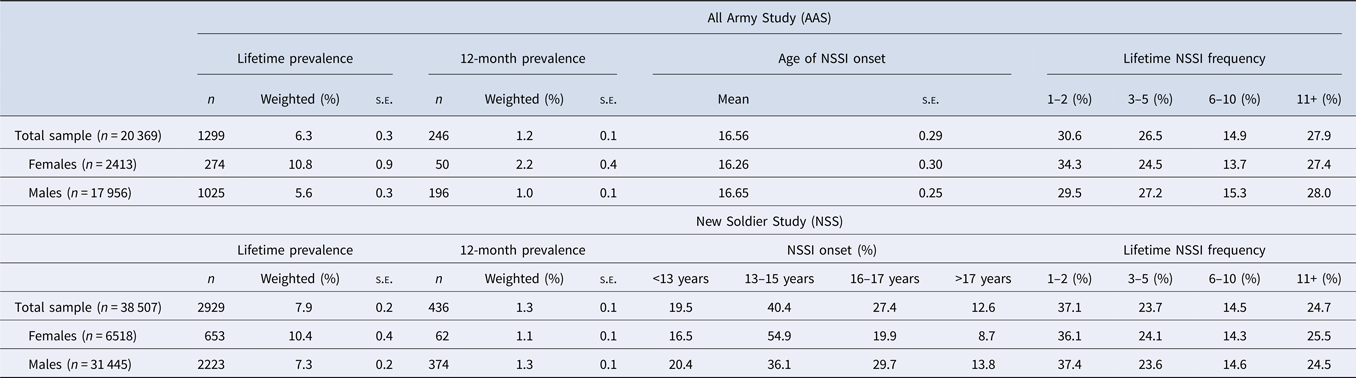
NSSI was assessed with the question ‘did you ever do something to hurt yourself on purpose, but without wanting to die (i.e. cutting yourself, hitting yourself, or burning yourself)?’ Respondents who answered in the affirmative completed follow-up questions regarding: (a) age of onset, (b) age of most recent engagement, and (c) number of lifetime NSSI episodes (with categorical response options, presented in Table 1). Ages of onset and recency were sometimes reported on a continuous scale (in years) and sometimes reported on a categorical scale for onsets under 18, depending upon the survey version. Categorically reported ages were recoded to a continuous scale (‘<13 years old’ = 12, ‘13–15 years old’ = 14, and ‘16–17 years old’ = 16). Given that engagement in 10 or more acts of NSSI is associated with greater psychopathology, distress, and impairment (Muehlenkamp and Brausch, Reference Muehlenkamp and Brausch2016), we used a cut-off of >10 lifetime episodes of NSSI to designate soldiers who engaged in chronic (v. episodic/infrequent) NSSI.
Lifetime and 12-month prevalence, age of onset and frequency of NSSI in the weighted AAS and NSS samples

NSSI, non-suicidal self-injury.
Mental disorders
Respondents completed an adapted version of the Composite International Diagnostic Interview Screening Scales (CIDI-SS; Kessler et al., Reference Kessler, Calabrese, Farley, Gruber, Jewell, Katon, Keck, Nierenberg, Sampson, Shear, Shillington, Stein, Thase and Wittchen2013a) to assess the lifetime presence and age of onset of several psychiatric disorders. The AAS assessed: major depression, bipolar disorder, panic disorder, agoraphobia, specific phobia, social phobia, generalized anxiety disorder, obsessive–compulsive disorder, intermittent explosive disorder, attention-deficit hyperactivity disorder (within the past 6 months), substance use disorders, and any other serious mental illness. The NSS assessed: major depression, bipolar disorder, panic disorder, generalized anxiety disorder, intermittent explosive disorder, attention-deficit hyperactivity disorder (within the past 6 months), oppositional defiant disorder, conduct disorder, and substance use disorders. In addition, respondents completed a screening version of the Posttraumatic Stress Disorder Checklist (PCL; Weathers et al., Reference Weathers, Litz, Keane, Palmieri, Marx and Schnurr2013). DSM-IV diagnostic hierarchies and organic exclusion rules were not considered in assigning diagnoses. Ages of onset that were reported on a categorical scale were recoded to a continuous scale (i.e. in years) using the median value (where the median fell between whole numbers, we used the smaller value). The CIDI-SS and PCL have good concordance with diagnoses derived from clinical interviews (area under the curve = 0.69–0.79; Kessler et al., Reference Kessler, Santiago, Colpe, Dempsey, First, Heeringa, Stein, Fullerton, Gruber, Naifeh, Nock, Sampson, Schoenbaum, Zaslavsky and Ursano2013d).
Suicidal thoughts and behaviors
Items assessing suicidal thoughts and behaviors were adapted from the Columbia Suicidal Severity Rating Scale (Posner et al., Reference Posner, Brown, Stanley, Brent, Yershova, Oquendo, Currier, Melvin, Greenhill, Shen and Mann2011). History of SI was assessed with the question ‘did you ever in your life have thoughts of killing yourself?’Footnote 2. History of SA was assessed with the question ‘did you ever make a suicide attempt (i.e. purposefully hurt yourself with at least some intention to die)?’ Respondents who endorsed SI or SA were asked follow-up questions regarding disclosure of suicidal thoughts, number of lifetime attempts, alcohol or drug use prior to attempts, and medical attention following the attempt (medically serious attempts were defined as any SA that required overnight hospitalization). Consistent with the NSSI items, ages of SI or SA onset that were reported on a categorical scale were recoded to a continuous scale.
Data analysis
Analyses were carried out using weighted data. Design effects, weighting, and clustering were handled using the design-based Taylor series linearization method to estimate standard errors. We used cross-tabulations to estimate the prevalence, frequency, and (for categorical response options) ages of onset ranges for NSSI. We used a Cox regression to derive the cumulative hazard function (without predictors) for NSSI onset in the AAS data only, which more often used continuous response scales for NSSI onset than the NSS sample. The associations of NSSI onset with time-invariant demographic and military service variables were estimated via Cox regressions. For time-varying predictors (i.e. psychiatric disorders predicting subsequent NSSI; NSSI predicting subsequent suicidal thoughts and behaviors), we used discrete-time survival models, with person-year as the unit of analysis and a logistic link function. The person-year file was adjusted so that only ages that captured the majority (>95%) of disorder onsets were included: in the AAS, this included years 5–50; in the NSS, this included years 12–34. The optimal model for time was evaluated by including effects across the ordered ladder of polynomials until reductions in model deviance were minimized (Singer and Willett, Reference Singer and Willett2003). Demographic covariates that were significantly associated with each outcome in a multivariate model were included in subsequent discrete-time survival models. To ensure that only temporally primary associations were considered, we used lagged predictor variables in the person-year file, such that changes in predictor statuses (present/absent) up to the year prior to the outcome were considered, but changes in the predictor that occurred during the same and subsequent years to the outcome were not included. Survival coefficients and their standard errors were exponentiated and reported as odds ratios (OR) with 95% confidence intervals (CI). Analyses were carried out in IBM SPSS Statistics version 24 using the Complex Samples module and SAS version 9.4 using the proc surveylogistic procedure.
Results
Lifetime and 12-month prevalence of NSSI
As shown in Table 1, the lifetime prevalence of NSSI is 6.3% in the AAS sample and 7.9% in the NSS sample. Stratifying by age reveals that lifetime prevalence declines with age in new soldiers (10.0% in 18–19 years old, 6.7% in 20–24 years old, 4.1% in 25+ years old), but not in active-duty soldiers (5.5% in 18–19 years old, 7.7% in 20–24 years old, and 5.8% in 25+ years old). In both samples, lifetime history of NSSI is more common in women than men (AAS: OR 2.04, 95% CI 1.64–2.53; NSS: OR 1.48, 95% CI 1.34–1.63).
The 12-month prevalence of NSSI is 1.2% (s.e. = 0.1%) in active-duty soldiers and 1.3% (s.e. = 0.1%) in new soldiers. Relative to soldiers with remote histories of NSSI, soldiers with past-year NSSI are more likely to have at least one lifetime psychiatric disorder (AAS: OR 2.16, 95% CI 1.11–4.20; NSS: OR 1.79, 95% CI 1.28–2.52) and receive mental health services in the past year (AAS: OR 2.08, 95% CI 1.18–3.67; NSS: OR 2.02, 95% CI 1.39–2.93). The average time since last NSSI episode in active-duty soldiers without past-year NSSI is 5.57 years (s.e. = 0.14) and is 3.81 years (s.e. = 0.07) in new soldiers. NSSI recency is stratified by age (mean years since last NSSI episode in AAS: 18–19 years old = 1.58, s.e. = 0.36; 20–24 years old = 3.45, s.e. = 0.16; 25+ years old = 5.32, s.e. = 0.20; in NSS: 18–19 years old = 2.34, s.e. = 0.08; 20–24 years old = 3.62, s.e. = 0.10; 25+ years old = 7.82, s.e. = 0.45), suggesting that average offset of NSSI occurs in early adulthood.
NSSI onset and course
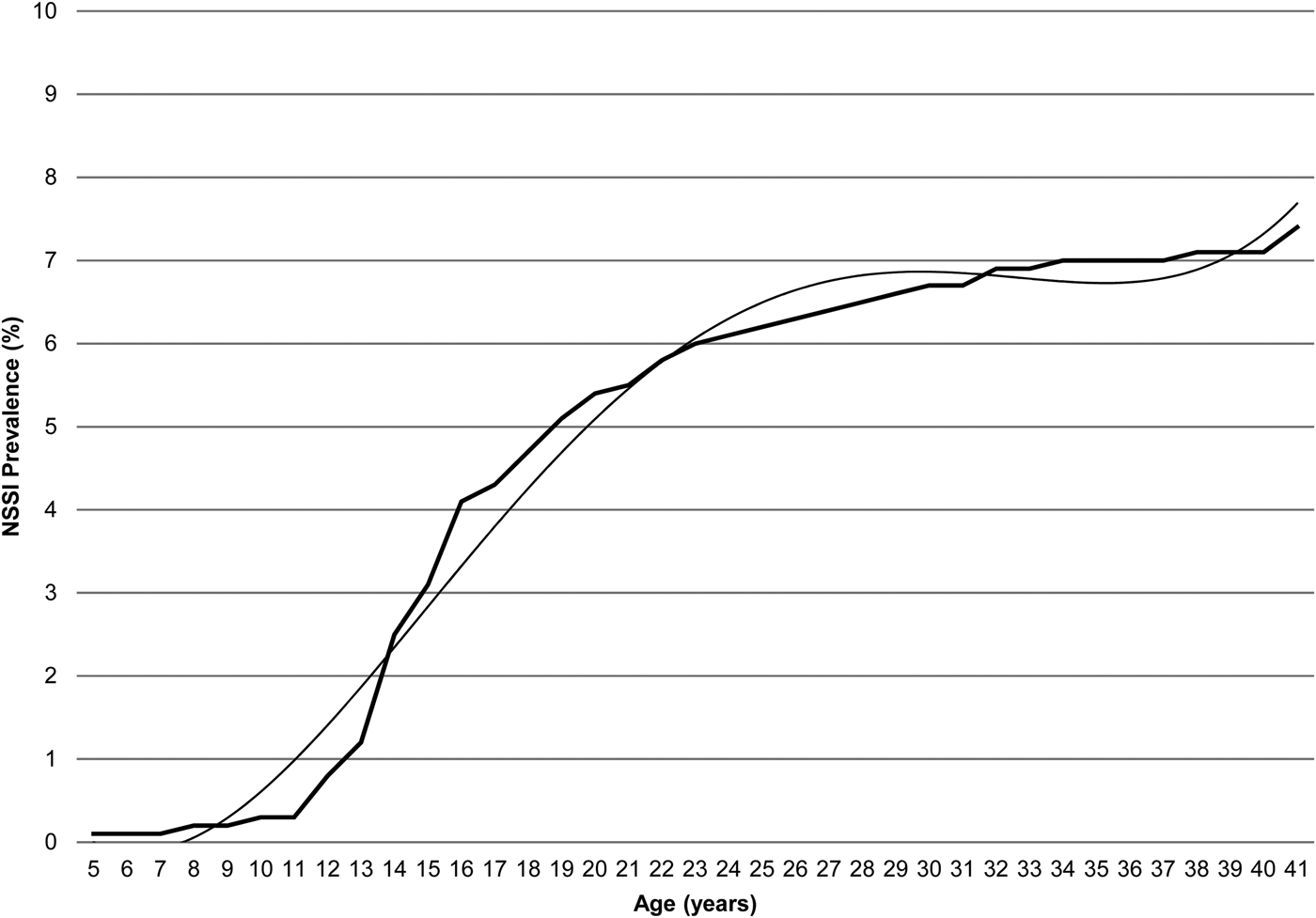
NSSI most often begins during adolescence, with 68% of onsets occurring before age 18 in the AAS sample and 87% of onsets occurring before age 18 in the NSS sample. Among female soldiers, NSSI onset between ages 13 and 15 is especially common, characterizing 43% and 55% of the self-injuring women in the AAS and NSS samples, respectively. The AAS data allow for a more fine-grained analysis of NSSI onset, owing to the expanded age range of the sample and use of continuous response scales. In the AAS, adult onset NSSI (after age 20) is reported by approximately 20% of respondents, whereas childhood onset (prior to age 12) is reported by 14%. Figure 1 plots the hazard function for NSSI in the AAS sample, revealing stable, low rates of NSSI until age 12, a sharply increasing prevalence from age 12 through age 20, and a more gradual increase through to age 30 when the prevalence levels off.
Cumulative hazard function (in bold) and fitted polynomial trend for NSSI onset in the AAS sample.

Following NSSI onset, more than half of soldiers report fewer than five lifetime episodes of NSSI, while approximately one-quarter endorse chronic NSSI (i.e. >10 lifetime episodes; see Table 1). Soldiers with chronic NSSI are more likely to be white (AAS: OR 1.48, 95% CI 1.00–2.02; NSS: OR 1.39, 95% CI 1.04–1.87), have a high school (v. some post-secondary) education (AAS: OR 1.40, 95% CI 1.07–1.83; NSS: OR 1.43, 95% CI 1.13–1.82) and report at least one lifetime psychiatric disorder (AAS: OR 2.50, 95% CI 1.03–6.07; NSS: OR 2.42, 95% CI 1.79–3.26), but do not differ with respect to gender (AAS: OR 0.97, 95% CI 0.66–1.43; NSS: OR 1.06, 95% CI 0.84–1.33) or marital status (AAS: OR 0.73, 95% CI 0.48–1.10; NSS: OR 1.00, 95% CI 0.73–1.35) compared with soldiers with ten or fewer NSSI episodes. New soldiers with chronic NSSI episodes are younger than those with ten or fewer lifetime NSSI episodes (NSS: OR 0.92, 95% CI 0.89–0.96), but this is not true of active-duty soldiers (AAS: OR 0.99, 95% CI 0.97–1.01). Whereas active-duty soldiers with chronic NSSI are more likely to have received mental health services in the past 12 months (AAS: OR 2.02, 95% CI 1.34–3.04), this was not true of new soldiers (NSS: OR 1.02, 95% CI 0.76–1.38).
Demographic risk factors for NSSI
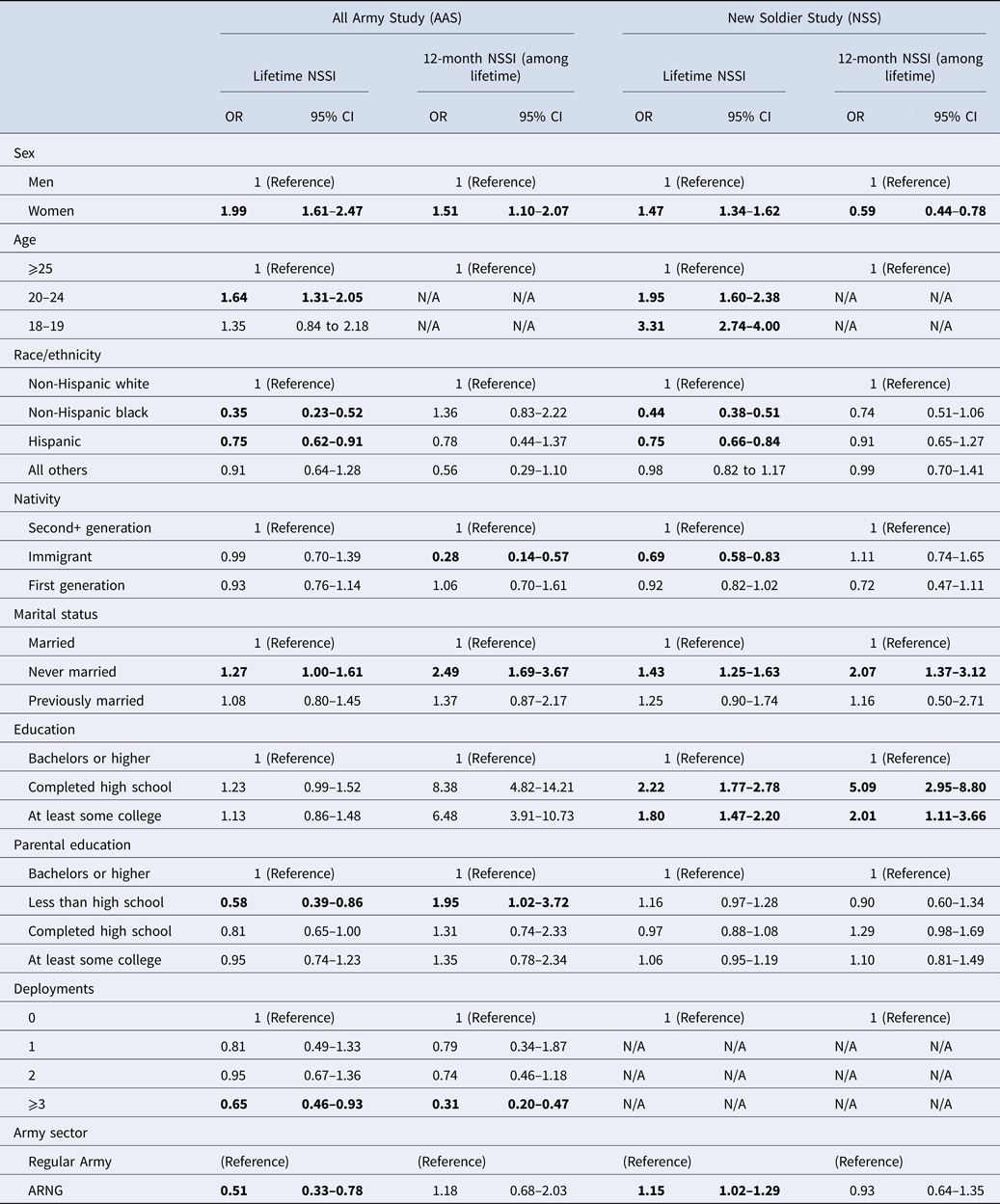
The odds of having a lifetime history of NSSI are elevated among women, soldiers who were <25 years old, and soldiers who had never been married (Table 2). Soldiers who self-identify as non-Hispanic black or Hispanic have lower odds of NSSI compared with soldiers who self-identify as non-Hispanic white. Among active-duty soldiers, those who have been deployed three or more times and those whose parents had not completed high school have lower odds of having engaged in NSSI. Among new soldiers, those who immigrated to the USA have lower odds of NSSI, whereas those with less educational attainment (<4 years post-secondary) have higher odds of NSSI. Whereas active-duty soldiers who are serving in the Army Reserves National Guard or Army Reserves have lower odds of engaging in NSSI, relative to regular Army soldiers, new soldiers who enlist in the Army Reserves National Guard or General Reserves have higher odds of NSSI than those who enlist in the regular Army.
Results of the weighted Cox proportional-hazards regressions assessing the associations of sociodemographic and military service characteristics with lifetime and 12-month NSSI

ARNG, Army Reserves/Army National Guard.
Bold text indicates statistically significant effect at p < 0.05.
Psychiatric risk factors for NSSI
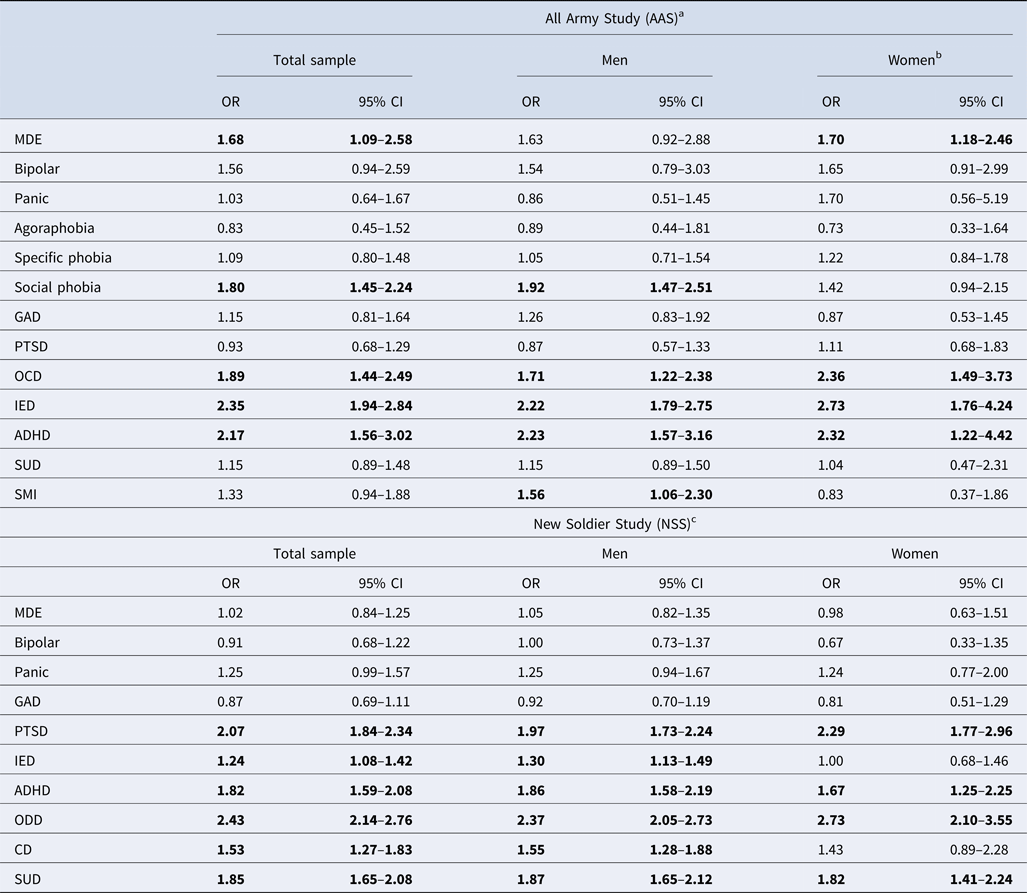
A number of psychiatric disorders are associated with elevated odds of subsequent NSSI onset (Table 3). Among active-duty soldiers, major depressive, social phobia, obsessive–compulsive, intermittent explosive, and attention-deficit hyperactivity disorders are each uniquely associated with subsequent NSSI onset in a multivariate model. Sensitivity analyses show that social phobia and serious mental illness are significantly associated with subsequent NSSI only in male active-duty soldiers, whereas major depression is significantly associated with subsequent NSSI only in female active-duty soldiers. Among new soldiers, post-traumatic stress, intermittent explosive, attention-deficit hyperactivity, oppositional defiant, conduct, and substance use disorders are each uniquely associated with subsequent NSSI in multivariate models. Sensitivity analyses show that intermittent explosive and conduct disorder are significantly associated with subsequent NSSI only in new male soldiers.
Results of the multivariate weighted discrete-time survival analyses assessing the associations of temporally primary psychiatric disorders with first onset of NSSI in the total samples, in men and in women

MDE, major depressive episode; GAD, generalized anxiety disorder; PTSD, post-traumatic stress disorder; OCD, obsessive–compulsive disorder; IED, intermittent explosive disorder; ADHD, attention-deficit hyperactivity disorder; ODD, oppositional defiant disorder; CD, conduct disorder; SUD, substance use disorder; SMI, serious mental illness.
Bold text indicates statistically significant effect at p < 0.05 in multivariate model.
a The AAS discrete-time survival model covaries for time (modeled via polynomial terms to the fourth power), sex, race, and service component (ARNG v. regular Army).
b The AAS discrete-time survival model for women removes the effect of the fourth power for time to improve model fit.
c The NSS discrete-time survival model covaries for time (modeled via polynomial terms to the third power), sex, age, and race.
NSSI as a risk factor for suicidal behavior
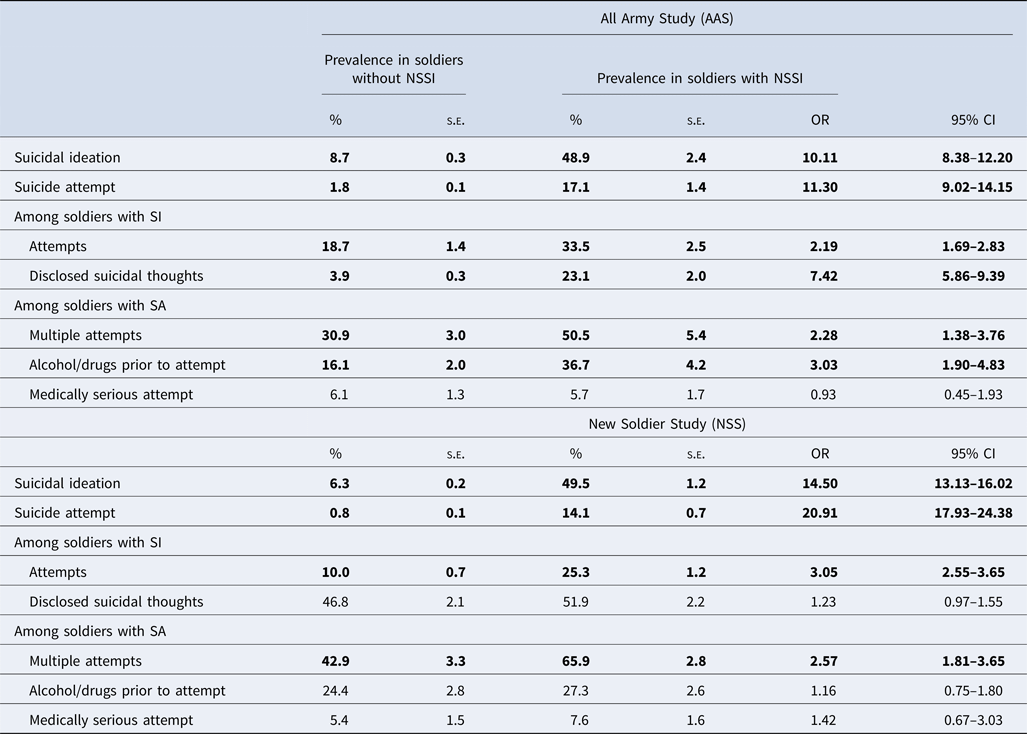
Nearly 50% of soldiers with a history of NSSI also report SI, and approximately one in six have attempted suicide, contrasting the much lower rates of ideation (8.7%) and attempt (1.8%) in soldiers without NSSI (Table 4). Lifetime NSSI is associated with significantly higher odds of a lifetime history of SI, SA, attempts among individuals with suicidal thoughts, and multiple attempts in bivariate cross-tabulations (Table 4). Among active-duty soldiers, a lifetime history of NSSI is also associated with greater odds of having used alcohol or drugs before a SA and having disclosed suicidal thoughts. Chronic NSSI (>10 episodes) is associated with elevated odds of SA (AAS: OR 2.75, 95% CI 1.86–4.06; NSS: OR 2.94, 95% CI 2.29–3.77), of making multiple attempts in new soldiers (NSS: OR 1.60, 95% CI 1.01–2.53), and of disclosing suicidal thoughts in active-duty soldiers (AAS: OR 1.61, 95% CI 1.02–2.56), relative to soldiers with infrequent/episodic NSSI. Earlier NSSI onset (before age 16) is not associated with odds of lifetime SI (AAS: OR 0.91, 95% CI 0.67–1.24; NSS: OR 0.98, 95% CI 0.83–1.17) nor with lifetime SA in active-duty soldiers (OR 0.92, 95% CI 0.65–1.29), but is associated with higher odds of lifetime attempt in new soldiers (OR 1.46, 95% CI 1.10–1.93).
Prevalence and bivariate associations of lifetime suicidal thoughts and behaviors in soldiers with and without lifetime history of NSSI

NSSI, non-suicidal self-injury; SI, suicidal ideation; SA, suicide attempt(s). Bold text indicates statistically significant effect at p < 0.05.
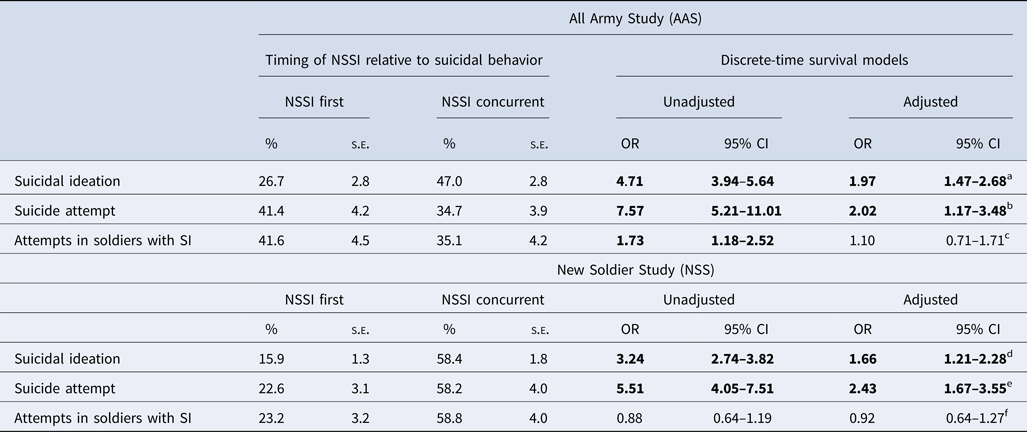
In terms of sequencing, retrospective reports show that NSSI precedes ideation in 15.9–26.7% of soldiers, and precedes attempts in 22.6–41.4% of soldiers (Table 5). More commonly, NSSI and suicidal thoughts or behaviors have an onset within the same year (47.0–58.4% of soldiers with both NSSI and ideation, 34.7–58.2% of soldiers with both NSSI and attempts). Discrete-time survival models, which considered only NSSI that occurred at least 1 year prior to the onset of SI or SA, show that NSSI is associated with elevated odds of subsequent SI (bivariate OR = 3.24–4.71, adjusted OR = 1.66–1.81) and SA (bivariate OR = 5.51–7.57, adjusted OR = 2.02–2.43), but not with attempts among soldiers with suicidal thoughts (bivariate OR = 0.88–1.73, adjusted OR = 0.92–1.10).
Results of the weighted discrete-time survival analyses assessing the associations of temporally primary NSSI and subsequent suicidal behaviors

NSSI, non-suicidal self-injury; SI, suicidal ideation.
a The AAS multivariate survival model for suicidal ideation covaries for time (modeled via polynomial terms to the fifth power), sex, race, service component (Army Reserve/National Guard v. regular Army), and all psychiatric disorders.
b The AAS multivariate survival model for suicide attempts in the total sample covaries for time (modeled via polynomial terms to the fourth power), sex, service component (Army Reserve/National Guard v. regular Army), and all psychiatric disorders.
c The AAS multivariate survival model for suicide attempts among soldiers with SI covaries for time (modelled via polynomial terms to the fourth power), sex, service component (Army Reserve/National Guard v. regular Army), and all psychiatric disorders.
d The NSS survival model for suicidal ideation covaries for time (modeled via polynomial terms to the fourth power), sex, age, enlisted service component (Army Reserve/National Guard v. regular Army), and all psychiatric disorders.
e The NSS survival model for suicidal attempts in the total sample covaries for time (modeled via polynomial terms to the third power), sex, age, educational attainment, and all psychiatric disorders.
f The NSS survival model for suicidal attempts in the total sample covaries for time (modeled via polynomial terms to the third power), sex, age, educational attainment, and all psychiatric disorders.
Discussion
To our knowledge, this study is the largest and most representative investigation of NSSI in US military personnel to date. There are four major findings from this study. First, approximately 6–8% of US Army soldiers have a lifetime history of NSSI, while about 1% have engaged in NSSI in the past year. Second, most NSSI begins in adolescence, occurs infrequently (i.e. ⩽10 lifetime episodes), and has resolved before soldiers enter military service. Nonetheless, any NSSI history is associated with elevated risk of suicidal thoughts and behaviors, and therefore merits clinical attention. Third, NSSI is over-represented in certain groups of soldiers, including those who identify as women, under 25 years old, non-Hispanic white, and never having married, as well as those with histories of internalizing or externalizing psychiatric disorders. Fourth, rates of SA are approximately 10 times higher in soldiers with a history of NSSI compared with those without this behavior. Moreover, NSSI significantly predicts subsequent onset of suicidal thoughts and behaviors, even after controlling for demographic and psychiatric risk factors. These findings underscore the importance of including NSSI in suicide risk assessments.
Results from this study align with what we know about NSSI in civilian populations in several important ways. Our results show a similar lifetime prevalence of NSSI (6–8%) as representative studies of civilian adults (3–6%; Klonsky, Reference Klonsky2011; Plener et al., Reference Plener, Allroggen, Kapusta, Brähler, Fegert and Groschwitz2016), suggesting that NSSI is at least as common in Servicemembers as in civilians, and deserving of expanded research and clinical attention. Also consistent with civilian studies, the estimated prevalence of NSSI is considerably lower in the general population than in samples recruited from post-secondary institutions (12–14%; Bryan and Bryan, Reference Bryan and Bryan2014; Bryan et al., Reference Bryan, Rudd, Wertenberger, Young-McCaughon and Peterson2015a) and clinical settings (30–56%; Kimbrel et al., Reference Kimbrel, Johnson, Clancy, Hertzberg, Collie, Van Voorhees, Dennis, Calhoun and Beckham2014; Bryan et al., Reference Bryan, Bryan, May and Klonsky2015b; cf. Whitlock et al., Reference Whitlock, Muehlenkamp, Purington, Eckenrode, Barreira, Baral Abrams, Marchell, Kress, Girard, Chin and Knox2011; Muehlenkamp et al., Reference Muehlenkamp, Claes, Havertape and Plener2012a). With respect to the onset, course, and topography of NSSI, our results converge with civilian studies showing that adolescence is a high-risk period for the onset of NSSI (Barrocas et al., Reference Barrocas, Hankin, Young and Abela2012), that NSSI often resolves in late adolescence and early adulthood (Whitlock and Selekman, 2014), and that most people who engaged in NSSI do so only a few times, while a clinically important minority of individuals engage in chronic, repetitive NSSI (Muehlenkamp and Gutierrez, Reference Muehlenkamp and Gutierrez2007; Zetterqvist et al., Reference Zetterqvist, Lundh, Dahlström and Svedin2013; Muehlenkamp and Brausch, Reference Muehlenkamp and Brausch2016). With respect to demographic factors, our results align with civilian studies showing that women are more likely to engage in NSSI compared with men (Bresin and Schoenleber, Reference Bresin and Schoenleber2015), that NSSI may be more prevalent in younger v. older cohorts (Klonsky, Reference Klonsky2011), and that NSSI is more common in unmarried adults compared with their married peers (Klonsky, Reference Klonsky2011). Moreover, our results also show that NSSI is associated with a range of internalizing and externalizing psychopathology, consistent with civilian samples (Nock et al., Reference Nock, Joiner, Gordon, Lloyd-Richardson and Prinstein2006, Reference Nock, Hwang, Sampson and Kessler2010). Finally, our results underscore strong associations between NSSI and range of SITBs, including SI, SA, and multiple attempts, particularly among individuals more than 10 lifetime episodes of NSSI, as in civilian samples (Whitlock et al., Reference Whitlock, Muehlenkamp and Eckenrode2008). It is worth noting that our models adopted a conservative approach by including only NSSI with an onset at least 1 year prior to suicidal behaviors, which restricted analyses to the 23–41% of SA. The lack of clear developmental sequencing of NSSI preceding SI and attempts is inconsistent with a previous military study (Bryan et al., Reference Bryan, Bryan, May and Klonsky2015b), and may be due in part to the forced-choice response options in several subsamples. Despite this limitation, our results suggest that NSSI is an important predictor of onset of later SI and attempts, but not of the ideation-to-attempt transition, in military personnel. Reconciling this finding with current theories of suicide risk (e.g. Joiner et al., Reference Joiner, Ribeiro and Silva2012) is an important direction for future work (see also Nock et al., Reference Nock, Millner, Joiner, Gutierrez, Han, Hwang, King, Naifeh, Sampson, Zaslavsky, Stein, Ursano and Kessler2018).
In addition to highlighting similarities in NSSI presentation in military and civilian populations, our results may have practical implications for the Army. For instance, our results show that, for most Servicemembers, NSSI has discontinued by the time of enlistment, and will present as an active area of clinical concern in a minority (~1%) of enlisted and active-duty soldiers. Nonetheless, soldiers with histories of chronic NSSI, defined here as more than 10 lifetime episodes, are at elevated risk for suicidal behaviors. Assessing history and frequency of NSSI behavior in routine mental health screenings, including in pre-enlistment and pre-deployment screenings, could identify soldiers who may benefit from additional support. However, policies restricting enlistment or service duties of individuals with mental health problems (e.g. the inclusion of ‘self-mutilation’ as a non-waiverable condition) may result in reticence to disclose NSSI in military settings. Given that NSSI has typically resolved by enlistment, permitting accession waivers for self-mutilation may increase disclosures and help to identify at-risk soldiers at the outset of their military careers. Previous studies suggest that waived pre-enlistment medical conditions were not associated with shorter deployment durations (Gubata et al., Reference Gubata, Oetting, Niebuhr and Cowan2013). Expanding predeployment screenings to include NSSI may be helpful in linking deployed soldiers to ongoing support while in-theatre (Warner et al., Reference Warner, Appenzeller, Parker, Warner and Hoge2011). Moreover, screening for NSSI in non-deployed personnel could help mitigate the high risk of suicide among soldiers who are never deployed (Schoenbaum et al., Reference Schoenbaum, Kessler, Gilman, Colpe, Heeringa, Stein, Ursano and Cox2014). Given the personal demands associated with military service, understanding the impact of NSSI on Servicemembers’ occupational and mental health functioning, as well as trainings or policies that could bolster resilience, is an important direction for future work.
Findings should be interpreted in light of several limitations. First, these data are cross-sectional and retrospective in nature, and are subject to recall biases. Prospective studies that focus on adolescence, when SITBs typically begin (Nock et al., Reference Nock, Hwang, Sampson, Kessler, Angermeyer, Beautrais, Borges, Bromet, Bruffaerts, de Girolamo, de Graaf, Florescu, Gureje, Haro, Hu, Huan, Karam, Kawakami, Kovess, Levinson, Posada-Villa, Sagar, Tomov, Viana and Williams2009, Reference Nock, Green, Hwang, McLaughlin, Sampson, Zaslavsky and Kessler2013b), and retrospective studies using structured interviews to reduce retrospective biases (e.g. the timeline follow-back; Sobell and Sobell, Reference Sobell, Sobell, Litten and Allen1992; see also Bagge et al., Reference Bagge, Glenn and Lee2013), can help to the temporal sequencing of SITB and the role of NSSI in subsequent SITB. Second, given the sensitive and potentially stigmatizing nature of SITBs, it is possible that soldiers under-reported their engagement in NSSI. The clarifying examples of NSSI provided in these surveys (‘cutting yourself, hitting yourself, or burning yourself’) may not represent the experiences of NSSI in men (Green and Jakupcak, Reference Green and Jakupcak2016) or military personnel (Kimbrel et al., Reference Kimbrel, Johnson, Clancy, Hertzberg, Collie, Van Voorhees, Dennis, Calhoun and Beckham2014), potentially resulting in further under-reporting. Third, while the CIDI-SS provides an efficient and accurate method for assessing a range of psychopathology (Kessler et al., Reference Kessler, Santiago, Colpe, Dempsey, First, Heeringa, Stein, Fullerton, Gruber, Naifeh, Nock, Sampson, Schoenbaum, Zaslavsky and Ursano2013d), limitations remain in using self-report methods to assess psychiatric diagnoses as items cannot be clarified and responses cannot be probed. Moreover, several diagnoses that were not assessed in the AAS and NSS studies (e.g. personality disorders, eating disorders) have established relationships to NSSI (Turner et al., Reference Turner, Yiu, Layden, Claes, Zaitsoff and Chapman2015; Muehlenkamp et al., Reference Muehlenkamp, Peat, Claes and Smits2012b), and should be included in future epidemiological studies of NSSI. The present estimates of the association between psychopathology and NSSI may be considered conservative as a result.
These limitations notwithstanding this study is the first to use multiple representative samples to investigate the prevalence, course, and consequences of NSSI in US military personnel. For the most part, results from the two samples converge, although a number of divergent findings require clarification in future studies (e.g. age and cohort effects in new v. active-duty soldiers; prevalence of NSSI in different service components of the Army; associations of NSSI with specific psychiatric disorders [post-traumatic stress disorder, substance use] and contextual SITB factors [alcohol/drug use]). Nonetheless, our results should increase attention to this clinically important behavior in military populations, and underscore the importance of including NSSI in comprehensive suicide risk assessments.
Acknowledgements
This publication is based on public use data from the Army Study to Assess Risk and Resilience in Servicemembers (Army STARRS). The data are available from the Inter-university Consortium for Political and Social Research (ICPSR) at the University of Michigan (http://doi.org/10.3886/ICPSR35197-v1). Army STARRS was funded by the US National Institute of Mental Health (grant number U01MH087981). The contents of this publication are solely the responsibility of the authors and do not necessarily represent the views of the Army STARRS investigators, funders, Department of the Army, or Department of Defense.