


Food insecurity is an important health concern worldwide and in Australia, with growing recognition that existing differentials in the availability, accessibility and affordability of nutritious food between and within nations are being intensified by environmental change( Reference McMichael 1 – Reference Coveney 4 ). The relationship between environmental change, food systems and food security is dynamic and bidirectional. The functioning of the food system, in terms of food yields, safety and nutritional quality, can be affected by environmental change( Reference Tapsell, Probst and Lawrence 5 ). At the same time, one of the major contributing factors to environmental change is the processes and outputs from the food system( Reference McMichael, Powles and Butler 6 ). Given the very real environmental constraints, there is a need for food supply and consumption strategies in all regions of the world that ensure food security without further jeopardizing the environment.
Conventionally, dietary guidelines have focused on providing information on the types and amounts of foods, food groups and dietary patterns that aim to promote health and well-being, as measured in terms of risk of diet-related conditions and chronic disease( 7 ). Around the world, including Australia, the importance of integrating environmental considerations into people's food choices is now recognized as an important component of a policy response concerned with health, food security and environmental sustainability( 8 – 19 ). Sustainable diets have been defined as: ‘those diets with low environmental impacts which contribute to food and nutrition security and to healthy life for present and future generations. Sustainable diets are protective and respectful of biodiversity and ecosystems, culturally acceptable, accessible, economically fair and affordable; nutritionally adequate, safe and healthy; while optimizing natural and human resources’( 11 ). As yet however there is no consensus in Australia, or elsewhere, as to what a healthy and sustainable (H&S) diet might look like and therefore no policy advice to support the implementation of actions to enable people and institutions make H&S food purchasing and consumption choices.
While the total environmental impacts of individual foods are often difficult to measure and the technical endeavours to do so are still relatively new, there is, we believe, sufficient evidence to begin to outline an H&S diet. The aim of the present paper is to use existing evidence to describe a hypothetical H&S diet and a methodological approach to assess its availability and affordability. The paper briefly outlines the relationship between environmental change and food systems. It lays out the argument for changing food consumption habits as one part of a policy response to promote health while at the same time reducing environmental damage. In the remainder of the paper we describe the methods to construct a hypothetical H&S diet.
The relationship between environmental change and the food system
Climate change-related drought-prone and long-term drying conditions in sub-tropical regions, higher temperatures, rising sea levels, increasing frequency of flooding and acidification of oceans are now beginning to contribute to impaired yield, quality and affordability of food in many countries( Reference Friel 3 , Reference McMichael, Powles and Butler 6 , 20 – 22 ). Fresh water supplies are shrinking, with half the world's rivers seriously depleted and polluted. Biodiversity, the basis of ecosystem services, has been more seriously harmed through human activities in the last 50 years than at any other period( 20 ).
The food system – from agricultural production, food processing and packaging, distribution and retail to consumption – produces not only food for consumption but also outputs that are returned to the natural environment, including greenhouse gases (GHG), packaging and food waste. Each of these outputs can contribute to environmental degradation( Reference McMichael, Powles and Butler 6 ), the extent of which depends on the inputs (land, water, energy) and processes used in production, the region of production and seasonal variations.
There is a growing body of life cycle analysis (LCA) research relating to GHG emissions, water use and biodiversity and the Australian food system. LCA is a method of quantifying the environmental impact of a product over its life cycle and is the most common tool for analysing the impact of a food system (or part thereof) on the environment.
Greenhouse gas emissions
In 2010, agricultural production contributed 18·8 % to Australia's overall GHG emissions( 23 ). The major contributor to agricultural emissions is livestock, due to the significant production of the highly potent GHG methane. GHG emissions also come from other agricultural sources, such as nitrogen fertilizer and energy use in irrigation and other on-farm inputs. GHG emissions also occur at other parts of the food supply chain, such as processing, distribution, packaging, storage, cooking and waste( Reference Wood, Lenzen and Dey 24 ).
Water use
In 2004–05, irrigated agriculture accounted for 65 % of Australia's water use, compared with 9 % from urban and industrial consumption( 25 ). According to the State of the Environment report (2011), large areas of Australia, both urban and rural, are using groundwater above a sustainable level( 26 ). High use of irrigation can lead to shallow water tables, salinity and water-logging( Reference Bethune and Armstrong 27 – Reference Khan, Abbas and Rana 29 ). Water is used in other parts of the food system, for example in cleaning and washing while processing the food product or as an input into the final product( Reference Biswas, Barton and Carter 30 , Reference Ridoutt, Eady and Sellahewa 31 ).
Biodiversity
Agriculture, by necessity, involves an altering of natural vegetation and as a result production in agriculture systems has an impact on land and water on and around the farm, with consequences for native biodiversity. The introduction of exotic species and land clearing lead to increased vulnerability to pests, changes in climate, habitat loss and destruction, and overall biodiversity decline( Reference Larsen, Ryan and Abraham 32 ).
The basis of a healthy and sustainable diet
The H&S diet presented herein is not being posed as the definitive diet but rather an attempt to introduce principles of environmental sustainability into research on food and health and thereby ultimately help integrate environmental considerations into food and health policy, especially dietary guideline advice. The H&S diet was developed first according to health principles and constructed around the conventional health focus of the Australian Dietary Guidelines (ADG), described in Box 1 ( 8 ).
Australian Dietary Guidelines (ADG)
ADG1. To achieve and maintain a healthy weight, be physically active and choose amounts of nutritious food and drinks to meet your energy needs.
ADG2. Enjoy a wide variety of nutritious foods from these five groups every day:
• Plenty of vegetables, including different types and colours, and legumes/beans.
• Fruit.
• Grain (cereal) foods, mostly wholegrain and/or high cereal fibre varieties, such as breads, cereals, rice, pasta, noodles, polenta, couscous, oats, quinoa and barley.
• Lean meats and poultry, fish, eggs, tofu, nuts and seeds, and legumes/beans.
• Milk, yoghurt, cheese and/or their alternatives, mostly reduced-fat (reduced-fat milks are not suitable for children under the age of 2 years).
And drink plenty of water.
ADG3. Limit intake of foods containing saturated fat, added salt, added sugars and alcohol.
a. Limit intake of foods high in saturated fat such as many biscuits, cakes, pastries, pies, processed meats, commercial burgers, pizza, fried foods, potato chips, crisps and other savoury snacks.
• Replace high-fat foods which contain predominantly saturated fats such as butter, cream, cooking margarine, coconut and palm oil with foods which contain predominantly polyunsaturated and monounsaturated fats such as oils, spreads, nut butters/pastes and avocado.
• Low-fat diets are not suitable for children under the age of 2 years.
b. Limit intake of foods and drinks containing added salt.
• Read labels to choose lower-sodium options among similar foods.
• Do not add salt to foods in cooking or at the table.
c. Limit intake of foods and drinks containing added sugars such as confectionery, sugar-sweetened soft drinks and cordials, fruit drinks, vitamin waters, energy and sports drinks.
ADG4. Encourage, support and promote breast-feeding.
ADG5. Care for your food; prepare and store it safely.
The sustainability of the H&S diet was informed using a review of publically available evidence from academic, government, industry and non-government sources describing the environmental impact of the food system on GHG emissions, water use and biodiversity in Australia( Reference Bradbear and Friel 33 ) plus other relevant international reports and peer-review publications( Reference Friel 3 , Reference McMichael, Powles and Butler 6 , Reference Lobell, Burke and Tebaldi 34 – 41 ). The published evidence focuses largely on particular foods and food groups and on the primary production phase of the food system. The activities around pre-farm processes (such as fertilizer and machinery production) and post-farm product processing were also identified, although not to the same extent as on-farm activities.
Overconsumption: not good for health, not good for the environment
Guideline 1 of the ADG recommends consumption of nutritious food and drinks (‘five food groups foods’) to meet a person's energy needs and is based on the evidence that overconsumption of food is associated with obesity and non-communicable diseases. In addition, any food that is consumed above a person's energy requirements represents avoidable GHG emissions, use of natural resources and pressure on biodiversity.
Guideline 3 of the ADG recommends limiting the intake of foods containing saturated fat, added salt and added sugars. Described as ‘discretionary’ food choices, where discretionary choices are foods and drinks not necessary to provide the nutrients the body needs( 7 ), these foods tend to be highly processed (e.g. biscuits, crisps, sugar-sweetened beverages)( Reference Monteiro, Levy and Claro 42 ). The adverse health and environmental outcomes described in the previous paragraph are especially pronounced when highly processed foods are overconsumed: these foods are generally energy-dense and nutrient-poor and can readily contribute not only to excessive energy intake, but also nutritional imbalances( Reference Monteiro 39 ). Although few discretionary food choices have been analysed for their environmental impact across the life cycle, as they are typically highly processed food products they are very likely to use relatively more environmental resources in their production than less-processed foods and have the risk of more environmental outputs. Therefore, their negligible contribution to nutrient intake means that the environmental cost of providing such foods is not offset by a positive compensatory health outcome.
Environmental impact of foods
A description of the evidence associated with the environmental impact within the five food groups recommended in Guideline 2 of the ADG is given below.
Vegetables, including different types and colours, and legumes/beans
Compared with animal foods, emissions from vegetables are lower, both overall and on a unit weight basis. Most emissions from vegetables come from electricity use in irrigation, soil fertilizer and post-harvest on-farm activities such as cooling, refrigerating, cleaning and packaging the product( Reference Maraseni, Cockfield and Maroulis 43 ). On a per tonne basis, potatoes, lettuce and tomatoes have relatively low emissions( Reference Maraseni, Cockfield and Maroulis 43 ). While 86 % of the area of Australia's vegetable crops is under irrigation, water use for production of vegetables is lower than that for animal-based foods, although there is great variation between crops( 44 ). Evidence indicates that asparagus, celery and garlic are among the least water efficient, while carrots, lettuce and tomatoes are among the most water efficient( Reference Ashcroft, Boland and Csaky 45 – Reference Top and Ashcroft 52 ). There was no Australian evidence available for the environmental impact of legumes/beans.
Fruit
Little Australian information is available on the environmental impact of fruit, with the analyses that exist focusing most on water use. Fruit crops in Australia are highly dependent on irrigation water, with 74 % of the area sown to fruit trees, nut trees and plantation of berry fruits under irrigation( 44 ). While not conclusive, studies suggest that pineapples are most water efficient, and avocadoes and mangoes are least water efficient( Reference Ridoutt, Juliano and Sanguansri 53 , 54 ). Other fruit crops, such as strawberries and pome fruit (apples and pears), are very similar in their water use efficiency. In the fruit (and vegetable) products sector, which includes processing of fruits and vegetables and produces a wide range of frozen, dried, canned and partly prepared products (fruit juices, frozen vegetables, preserved fruit, sauces and jams), GHG emissions are 5 % below the food sector average, land disturbance is 35 % below average and water use is over twice the average( Reference Foran, Lenzen and Dey 55 ).
Grain (cereal) foods, mostly wholegrain and/or high cereal fibre varieties, such as breads, cereals, rice, pasta, noodles, polenta, couscous, oats, quinoa and barley
An increasing number of LCA have considered Australian cereal crops( Reference Khan, Khan and Hanjra 56 , Reference Ridoutt and Poulton 57 ). Most analysis is focused on the primary production process. Of the GHG emissions from cereals, only those for wheat and rice are known, with emissions from one tonne of rice lower than emissions from one tonne of wheat and lower than emissions from meat and dairy( Reference Biswas, Graham and Kelly 58 ). Despite a lower reliance on irrigated water (about 1·4 % of the area planted to cereal crops for grain or seed is irrigated)( 44 ), the evidence suggests that water use for cereals is higher than for fruit and vegetables, while still being lower than for animal-source foods. Results vary for each crop depending on irrigation; however, using those studies that can be compared, on average rice was found to be the least water efficient. Wheat was the next least water efficient, followed by barley and oats( Reference Khan, Khan and Hanjra 56 , Reference Ridoutt and Poulton 57 ). Little information exists on biodiversity issues, with the exception of rice, which due to its highly irrigated nature( 44 ) has associated issues such as rising water tables, salinization and water-logging( Reference Humphreys, Lewin and Khan 59 ).
Lean meats and poultry, fish, eggs, tofu, nuts and seeds, and legumes/beans
Most evidence in this group is based on the primary production stage of the food system. Compared with other foods in this group, beef and lamb production has a relatively large negative impact on the environment through GHG emissions, water use and pressure on biodiversity. Together, beef cattle and sheep account for around 80 % of Australia's agricultural emissions( Reference Garnaut 60 ). The enteric fermentation process by ruminant animals is by far the biggest contributor to carbon dioxide equivalent emissions from the agriculture sector in Australia (57·6 Mt CO2-e in 2007)( Reference Garnaut 60 , Reference Peters, Rowley and Wiedemann 61 ). On a unit basis, the available evidence suggests that cattle, followed by sheep, have the highest level of emissions per unit weight( Reference Biswas, Graham and Kelly 58 , Reference Peters, Rowley and Wiedemann 61 , Reference Wiedemann, McGahan and Grist 62 ). Although little quantitative evidence exists, increasing consumption of kangaroos, being non-ruminant fore-stomach fermenters that produce negligible amounts of methane relative to cattle and sheep, may help lower Australia's GHG emissions( Reference Wilson and Edwards 63 ). Water use in the production of meat is highly dependent on the use of irrigated feed: water use of a supply chain that purchased irrigated feed was fifteen times higher than that of a supply chain not relying on irrigation( Reference Peters, Wiedemann and Rowley 64 ). Beef and lamb production is thought to exert greater pressure on biodiversity compared with other meats such as goat, kangaroo, pork and poultry. In particular, extensive beef and lamb production have a greater biodiversity impact than feedlot production( Reference Williams and Price 65 ). Aquaculture-produced fish is considered to have a greater negative impact on biodiversity than wild catch fish( Reference Williams and Price 65 ). A major environmental concern for the fishing industry is the overfishing of some species. Although there have been improvements, thirteen fish stocks were classified as overfished in 2009( Reference Wilson, Curtotti and Vieira 66 ).
Milk, yoghurt, cheese and/or their alternatives, mostly reduced-fat
The primary production stage accounts for about 85 % of emissions from the dairy food industry, uses large quantities of water in irrigation and exerts significant pressures on biodiversity( Reference Williams and Price 65 , 67 – 69 ). The majority of on-farm emissions from dairy production are enteric methane emissions, although the exact proportion varies depending on the study (from 48 % to 55 %( Reference Chen, Orphant and Kenman 70 , Reference Christie, Rawnsley and Donaghy 71 )). The dairy industry is the largest user of irrigation water in Australia, predominantly in the production of feed for dairy cattle which uses 40 % of water diverted for irrigation( Reference Bethune and Armstrong 27 , Reference Khan, Abbas and Rana 29 , 67 ). Overall, the dairy industry exerts a similar degree of pressure on the environment as feedlot beef: not as significant as extensive beef production, but greater than the production of meats such as lamb, kangaroo, pork and chicken( Reference Williams and Price 65 ). At the processing stage, one tonne of yoghurt and one tonne of cheese produce approximately 1·4 and 5·7 times the GHG emissions in one tonne of milk( 67 ). Water use is lower in the production of one tonne of milk, with one tonne of yoghurt requiring about twice as much water as milk and one tonne of cheese requiring 9·3 times more water than milk( Reference Feitz, Lundie and Dennien 72 ).
The balance of the evidence across the five food groups indicates that plant-based foods in general have a lower environmental footprint than animal-source foods. There is substantial variation in the environmental impact within each of the food groups, with not all foods having any or comparable environmental impact analysis.
Health and sustainability principles
Combining the health and environmental impact evidence, three guiding principles were applied when developing the H&S diet.
-
1. Any food that is consumed above a person's energy requirement represents an avoidable environmental burden in the form of GHG emissions, use of natural resources and pressure on biodiversity.
-
2. Reducing the consumption of discretionary food choices, which are energy-dense and highly processed and packaged, reduces both the risk of dietary imbalances and the use of environmental resources.
-
3. A diet comprising less animal- and more plant-derived foods delivers both health and ecological benefits.
Operationalizing a healthy and sustainable diet – a food basket approach
In the present study we expand the traditional ‘food basket’ approach to include environmental considerations – thereby creating an environmentally friendly and healthy food basket. The food basket approach is one of the most commonly used and recognized methods for assessing and monitoring food availability and cost, internationally( Reference Burns, Hubay and King 73 , Reference Friel, Walsh and McCarthy 74 ) and within Australia( 75 – 77 ). Two baskets were developed: one reflecting a typical diet and one that incorporated principles of health and environmental sustainability. Each food basket was constructed to reflect the weekly food purchasing of a hypothetical reference household, in this instance an adult male (aged 19–60 years), an adult female (aged 19–60 years), a boy aged 15 years and a girl aged 4 years. Foods included in the basket were selected in accordance with the three food choice categories listed in the Australian Guide to Healthy Eating: (i) the five food groups category; (ii) the allowance for unsaturated spreads and oils category; and (iii) the discretionary food choices category.
‘Typical diet’ basket
The reference household's habitual food consumption patterns were identified using the most recent national nutrition survey data (1995 National Nutrition Survey). The patterns observed in 1995 National Nutrition Survey were cross-checked using the most recent (at the time of study development) household expenditure data (Australian Bureau of Statistics 2003–04). Based on these typical consumption habits, 7 d meal plans were constructed to provide a framework for the selection of foodstuffs for inclusion in the weekly food basket. Meal plans consist of breakfast, lunch, dinner and snacks for Monday through to Sunday. The construction of meal plans helps estimate the quantities of foods that need to be purchased for the week (e.g. one litre of milk) and are based only on at-home consumption. All food items contained in the meal plans were aggregated into one list thereby constructing a typical weekly food basket.
‘Healthy and sustainable diet’ basket
The H&S food basket was constructed using an adapted version of the food items included in the meal plans of the typical food basket. The food items were replaced to reflect the health and environmental sustainability principles described previously, and foods were chosen that had a lower environmental impact as identified in the Australian evidence base( Reference Bradbear and Friel 33 ). The H&S meal plans were developed to be consistent with the minimum recommended servings for that food group in the ADG.
Table 1 summarizes the decision logic that was used to replace the ‘typical diet’ foods with healthy and sustainable foods. For example, in the ‘meat, fish, eggs, legumes, nuts’ food group, quantities of red meat and processed meats in the typical food basket were exchanged for quantities of lean, less environmentally harmful meat options (kangaroo, chicken), sustainable fish, nuts and eggs in the H&S food basket. In the ‘grain (cereals)’ group, foods made from white grains (rice, pasta, bread) were replaced with wholemeal-based options. Processed cereals (cornflakes, toasted muesli) were replaced with whole rolled oats and wheat-based cereals. In the ‘dairy’ food group, reduced-fat food items replaced full-fat food items. Orange juice drink is considered a discretionary food due to its high sugar and low juice content in the typical food basket, whereas in the H&S food basket 100 % orange juice is considered a ‘fruit’ food due to its 100 % juice content.
Summary of the decision-making logic used in the development of a healthy and sustainable (H&S) food basket
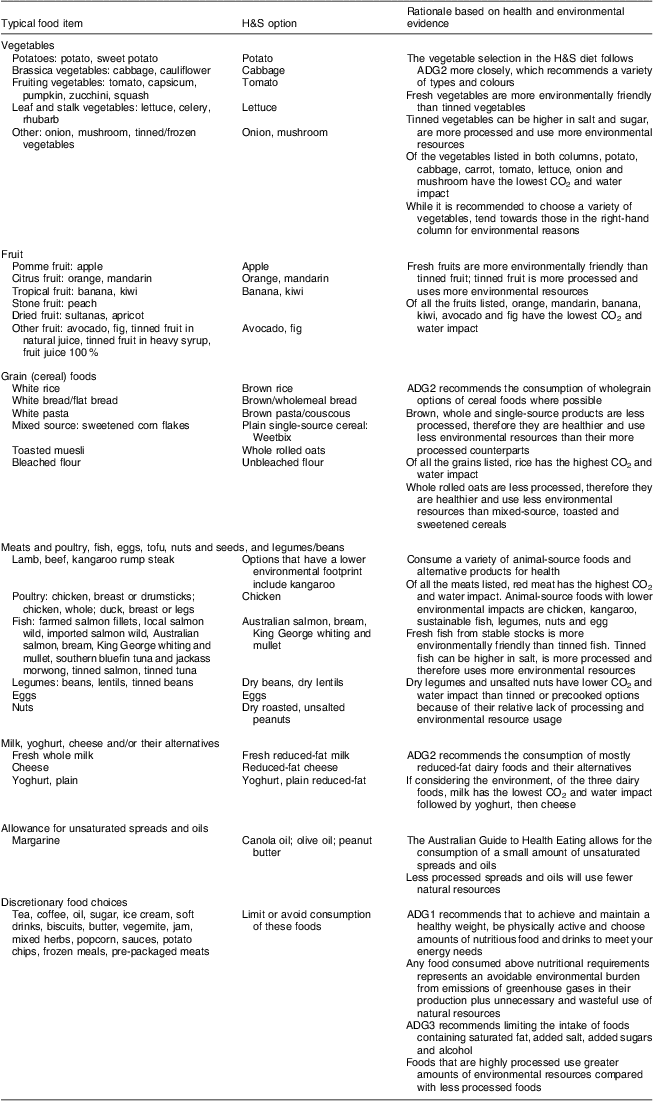
ADG, Australian Dietary Guidelines( 8 ).
The final list of foods for inclusion in the H&S food basket was created by aggregating all of the foods in the meal plan, resulting in a total of forty-eight foods. The list of foods, and associated quantities, in the typical and H&S food baskets are shown in Table 2.
A typical food basket and a healthy and sustainable (H&S) food basket
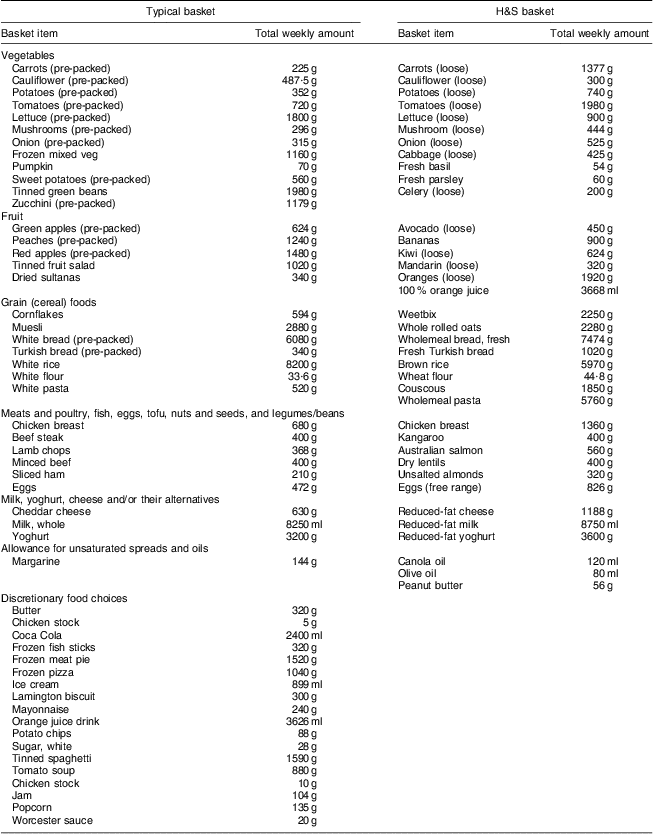
Based on the average weekly intake of a household of four: an adult male (aged 19–60 years), an adult female (aged 19–60 years), a boy aged 15 years and a girl aged 4 years.
Recommended daily servings based on the Australian Dietary Guidelines and the Australian Guide to Healthy Eating.
Discussion
The present study is a contribution to the international call to articulate a H&S diet( Reference Lang 78 ). We have outlined key health and environmental sustainability principles that can be applied in the selection of foods for inclusion in such a diet; articulated what a sustainable and healthy version of a typical Australian diet might look like; and described a methodology with which to assess the availability and affordability of a H&S food basket.
There are a small but growing number of analyses internationally that seek to incorporate environmental considerations into diets or dietary guidelines. For example, researchers in the UK have modelled different dietary scenarios, each of which meet nutritional requirements but with different GHG emissions( Reference Macdiarmid, Kyle and Horgan 79 ). They found that a diet that meets dietary requirements and has lower emissions can be achieved by reducing but not necessarily eliminating meat or dairy products. These dietary changes not only have significant environmental benefits, they can save human lives. Scarborough and colleagues modelled the actual impact on deaths averted as a result of changing diets in order to reduce GHG emissions in the UK( Reference Scarborough, Allender and Clarke 80 ).
In our study we used a simple replacement method to compile the H&S diet. Informed by the evidence (existing LCA) we replaced food items that were typically consumed by the Australian public in each of the five food groups with a comparable food item that had a lower environmental footprint as measured by GHG emissions, water use and biodiversity impact. We applied three overarching principles when developing the H&S diet: (i) any food that is consumed above a person's energy requirement represents an avoidable environmental burden in the form of GHG emissions, use of natural resources and pressure on biodiversity; (ii) reducing the consumption of discretionary foods that are energy-dense and highly processed and packaged reduces both the risk of dietary imbalances and the use of environmental resources; and (iii) a diet comprising less animal- and more plant-derived foods delivers both health and ecological benefits.
Limitations
Much of the environmental impact evidence is based on primary production and on-farm impacts, with less evidence available for other stages in the food supply chain. This can often mean that the interpretation is placed on primary foods in the absence of evidence for processed or highly processed foods. There are limitations to the comparability of findings for some studies, given the often small number of studies per food and the use of different methodological approaches. Despite many studies adopting an LCA approach, there was still a range of methodologies adopted within the LCA model. Some studies might incorporate the environmental impact of manufacturing on-farm machinery, as well as the production of all other on-farm inputs such as fertilizer, while others would only incorporate fertilizer production. As well as inconsistency in the activities of the food system that were assessed, there were also differences in aspects such as data source, units of measurement and definition of variables. The H&S diet may not be representative of actual eating patterns as the basket was constructed based on the limited numbers of food items where evidence was available.
Despite the difficulties regarding the completeness of the evidence and differing methodologies, clearly the types of food and beverage choices made by people play an important role in ensuring good health and environmental sustainability. We believe there is enough evidence to begin to articulate a H&S diet, thereby providing guidance to consumers and policy makers concerned for public health, nutrition and environmental sustainability.
However, it is important to emphasize that the whole food system, which involves agricultural production, food processing and packaging, distribution and retail as well as consumption, requires inputs such as land, water and energy and that the outputs along the supply chain contribute to environmental degradation. It is essential therefore that a comprehensive policy response is taken which includes individual responsibility but is not entirely focused on it – policy is needed that addresses the health and environmental aspects of all parts of the food system. We have articulated a H&S diet not to facilitate ‘policy drift’ to focus on lifestyle choices, but rather to provide a framework to support cross-sectoral food and health policy discussions, especially in relation to dietary guidelines in Australia.
A number of policy measures are frequently discussed with the aim of decreasing the impact of food production on the environment (including enhanced energy and resource efficiency, improved management approaches, technological improvements and improved productivity) and in order to restore degraded land and water resources( Reference Khan, Khan and Hanjra 56 , Reference Garnett 81 ). In the case of GHG emissions in particular, there is a large body of work addressing the mitigation of GHG emissions on-farm and governments around the world have introduced a range of policy measures in order to do this.
In addition to policies addressing the production side of food, there is a growing body of research suggesting that in order to reduce the environmental impacts of food we must also change our food consumption habits, specifically what we eat( Reference McMichael, Powles and Butler 6 , Reference Garnett 81 , Reference Deckers 82 ). In particular, a number of studies have focused on the need to reduce consumption of meat and dairy foods( Reference Garnett 81 ). Garnett (2011) considers that a context-specific approach to meat and dairy consumption is required – one that situates livestock farming within a policy framework that integrates agricultural, environmental and nutritional goals. Other approaches suggested, often controversially, for developed world populations include: (i) reducing food consumption in overweight populations; (ii) cutting food waste; (iii) consuming more seasonal food; (iv) reducing consumption of ‘unnecessary’ foods; (v) shopping for food on the Internet; and (vi) taking the time to plan when food shopping( Reference Garnett 81 ). The practicalities of enabling consumers to make different choices are complex, with research into how changes in behaviour might be achieved still being in its infancy( Reference Garnett 81 ).
Acknowledgements
Sources of funding: This research received support from the Climate and Health Cluster which is funded by the CSIRO (Commonwealth Scientific and Industrial Research Organization) Flagship Collaboration Fund. Conflicts of interest: The authors have no conflicts of interest. Ethics: Ethical approval was not required. Authors’ contributions: S.F. was responsible for the conceptual development of the study and did the first complete draft of the manuscript. L.J.B. and M.L. both contributed to the conceptual development of the study and inputted into each draft of the paper.



