Introduction
The genus Viburnum (Caprifoliaceae) comprises around 210 species distributed in temperate and subtropical regions in Europe, North Africa, Asia and America (Winkworth and Donoghue, Reference Winkworth and Donoghue2005; Ruiz-Téllez and Devesa, 2007). It has long been recognized that seeds of Viburnum may require long periods of time (sometimes up to 18 months) to complete germination (Barton, Reference Barton1958). Piotto and di Noi (Reference Piotto and Di Noi2003) stressed the difficulty of eliminating the deep dormancy in this genus. At dispersal, seeds of Viburnum have an underdeveloped embryo which, in addition, has a physiological inhibiting mechanism of germination, i.e. morphophysiological dormancy (MPD) (Baskin and Baskin, Reference Baskin and Baskin1998; Baskin et al., Reference Baskin, Chen, Chien and Baskin2009). That is, the embryo must grow for the radicle to emerge from the seed, but a physiological block must also be overcome before, during and/or after elongation of the embryo. There are nine levels of MPD, based on temperature requirements for embryo growth, breaking of physiological dormancy (PD) and emergence of the radicle and shoot, and response of seeds to gibberellic acid (GA3) (Baskin et al., Reference Baskin, Chien, Chen and Baskin2008).
Most of the Viburnum species in which germination ecology has been studied have deep simple epicotyl MPD: V. dentatum, V. dilatatum, V. lentago, V. prunifolium, V. rufidulum and V. pubescens (Giersbach, Reference Giersbach1937; Baskin et al., Reference Baskin, Chien, Chen and Baskin2008); V. acerifolium (Giersbach, Reference Giersbach1937; Hidayati et al., Reference Hidayati, Baskin and Baskin2005), V. betulifolium and V. parvifolium (Chien et al. Reference Chien, Chen, Tsai, Baskin, Baskin and Kuo-Huang2011a), and V. opulus (Walck et al., Reference Walck, Karlsson, Milberg, Hidayati and Kondo2012). This level of MPD requires warm stratification to break PD of the radicle, and cold stratification to break PD of the shoot (epicotyl). Thus, the radicle emerges in autumn and the shoot in spring (Baskin and Baskin, Reference Baskin and Baskin1998). Recently, a new level of MPD, called non-deep simple epicotyl MPD, was described in seeds of V. odoratissimum (Baskin et al., Reference Baskin, Chien, Chen and Baskin2008), and also detected in seeds of V. formosanum (Baskin et al., Reference Baskin, Chen, Chien and Baskin2009). At this level, a delay between root and shoot emergence also exists, but cold stratification is not required to break PD of the epicotyl. Furthermore, from the description of dormancy in seeds of V. tinus provided by Karlsson et al. (Reference Karlsson, Hidayati, Walck and Milberg2005), who found that high percentages of roots and shoots emerged from seeds kept continuously at 20/10°C, and Giersbach's (Reference Giersbach1937) results on V. nudum and V. scabrellum germination patterns, with shoot emergence delayed for 1–1.5 months in seeds with emerged radicles incubated at 21°C, Baskin et al. (Reference Baskin, Chien, Chen and Baskin2008) concluded that seeds of these species also have non-deep simple epicotyl MPD. Although all Viburnum species studied up to now have ‘epicotyl dormancy’, Baskin et al. (Reference Baskin, Chen, Chien and Baskin2009) suggested both the possibility of absence in some species and the presence of new dormancy levels. As a contribution to a better understanding of the diversity of dormancy in seeds of the large and geographically widespread genus Viburnum, we studied the germination ecology of V. lantana, in order to test ‘epicotyl dormancy’ in seeds, and the level of MPD.
Since V. lantana has a wide geographical range in Eurasia, being adapted to live at high altitude [up to 2100 m above sea level (a.s.l.)] under extreme continental inland environments in the Iberian Peninsula (Ruiz de la Torre, Reference Ruiz de la Torre2006; Ruiz-Téllez and Devesa, Reference Ruiz-Téllez, Devesa, Castroviejo, Benedí, Rico, Güemes and Herrero2007), we hypothesized that a cold stratification may be required to break the PD in the embryo. Embryo growth would occur either (a) during cold stratification (winter), if a complex level of MPD exists, or (b) during warm stratification (spring), after exposure to cold stratification, in which case seeds would have a simple form of MPD. Thus, the general objective of our research was to determine the level of MPD in seeds of V. lantana. Accordingly, we analysed: (1) the influence of different temperature and light conditions on embryo growth; (2) the effect of GA3 on breaking dormancy and embryo growth; (3) the effect of different stratification and incubation conditions on seed germination; and (4) the phenology of embryo growth, break of dormancy, and shoot and seedling emergence.
Knowledge of the temperature conditions promoting germination in V. lantana is crucial to develop ex situ plant-production programmes to reinforce natural populations (Herrero and Villar-Salvador, Reference Herrero, Villar-Salvador, Peman, Navarro, Nicolás, Prada and Serrada2013). In Andalucía (Southern Spain), V. lantana was catalogued as threatened (Herrera et al., Reference Herrera, Manzaneda, Benavente, Luque, Jordano, Blanca, Cabezudo, Hernández-Bermejo, Herrera, Muñoz and Valdés2000), and in Castilla-La Mancha (Central Spain) it is a key component in the Habitat of Special Protection ‘sub-Mediterranean deciduous thorny shrublands’ (Martín-Herrero et al., 2003).
Materials and methods
Plant material and source of seeds
Ripe, dark blue to blackish fruits of V. lantana were collected on 16 August 2008 (c. 3000 fruits), on 18 August 2009 (c. 10,000 fruits) and on 19 August 2010 (c. 3000 fruits), from a population growing in a deciduous thorny shrubland at 1010 m a.s.l. in Corduente (Alto Tajo, Guadalajara province, Central Spain, 30TWL8420). The dispersal unit is a drupe, and except for 1000 fruits collected in 2009, the exocarp and fresh mesocarp (the pulp) were removed, leaving the endocarp around the true seed. Hereafter, the germination unit, consisting of the endocarp plus the true seed, is called a seed. Seeds were washed with water and allowed to air dry at laboratory temperatures [22–24°C, 60–65% relative humidity (RH)] for 12–13 d before studies were initiated.
Laboratory experiments
General conditions for embryo growth and germination experiments
Experiments were conducted in chambers with controlled temperature and light regimes (Ibercex model F-4, Madrid, Spain) equipped with a digital temperature and light control system [ ± 0.1°C, cool white fluorescent light, 25 μmol m− 2s− 1 (1350 lux)]. Seeds were tested for embryo growth and radicle emergence in a 12 h daily photoperiod (hereafter light) and in continuous darkness (hereafter darkness), which was achieved by wrapping Petri dishes in a double layer of aluminium foil, at constant temperatures of 1.5 and 5°C, and at 12/12 h daily fluctuating temperature regimes of 15/4, 20/7, 25/10 and 28/14°C. In the 12/12 h alternating temperature treatments, the higher temperature coincided with the light phase, and the lower temperature with darkness. Seeds were incubated in 9-cm-diameter Petri dishes, on two layers of filter paper moistened with distilled water. Dishes were sealed with Parafilm to minimize the loss of water.
The alternating temperature regimes simulated mean maximum and mean minimum monthly temperatures, characterizing the annual climate cycle in the seed-source region (the mountainous Iberian System in the central Iberian Peninsula): 15/4°C corresponds to November and March; 20/7°C to October and April; 25/10°C to September and May; 28/14°C to June, July and August. The 5°C treatment simulated the mean temperature recorded during winter months: December, January and February (Elias and Ruiz, Reference Elias and Ruiz1981). The other low temperature (1.5°C) was chosen because it is within the effective temperature range for cold stratification, and it was used to simulate the coldest condition in winter in the MPD studies (Walck et al., Reference Walck, Baskin and Baskin1999; Walck and Hidayati, Reference Walck and Hidayati2004).
Percentage germination (radicles emerged ≥ 0.5 mm, clearly visible) was computed based on the number of apparently viable seeds. Non-germinated seeds were checked for viability on the basis of embryo appearance, paying special attention to the colour and turgidity. Seeds were considered as viable if the embryo showed a white colour and resistance to slight pressure with tweezers. These indicators of seed viability agreed closely with the results obtained when using a tetrazolium test.
Effect of temperature and illumination on embryo growth
The aim of this section was to determine the optimal temperature for embryo growth. First, we measured the mean length of embryos in freshly matured seeds. Thus, on 1 September 2008, 25 seeds were placed on two sheets of filter paper moistened with distilled water in a 9-cm Petri dish at room temperature for 24 h. Embryos from imbibed seeds were excised with a razor blade. Their lengths were measured using a dissecting microscope equipped with a micrometer. Also on 1 September 2008, six dishes with 30 seeds each were placed in light and in dark at 1.5, 5, 20/7, 25/10 and 28/14°C. After 4, 8, 12, 16, 20 and 24 weeks, embryos of 25 seeds from each incubation condition were measured. Mean length and standard error were calculated for each sample of 25 embryos. Further, on 1 September 2008, a move-along experiment (Baskin and Baskin, Reference Baskin, Baskin, Guerrant, Havens and Maunder2004) was initiated in which seeds were moved from low to high temperatures (increasing series) and from high to low temperatures (decreasing series), to simulate the temperatures to which the seeds are exposed in natural conditions. The temporal sequence of temperatures in each series was as follows:
-
(a) Increasing series:
5°C (12 weeks) → 15/4°C (4 weeks) → 20/7°C (4 weeks) → 25/10°C (4 weeks).
-
(b) Decreasing series:
25/10°C (4 weeks) → 20/7°C (4 weeks) → 15/4°C (4 weeks) → 5°C (12 weeks).
Each series was conducted in light and in darkness. Therefore, 24 batches of 30 seeds each were prepared, assigning six batches to each series × light treatment. After 4, 8, 12, 16, 20 and 24 weeks, 25 embryos per batch were excised from healthy seeds and measured, calculating mean length and standard error for each embryo sample. Embryos from seeds from which the radicle had emerged during the experiment were recorded as having a critical embryo length (i.e. assuming it to be the value for every seed that had germinated previously in the treatment studied; Hidayati et al., Reference Hidayati, Baskin and Baskin2005; Vandelook et al., Reference Vandelook, Bolle and Van Assche2009). That parameter corresponded to the mean embryo length of 40 seeds with split coats, but before radicles emerged (Phartyal et al., Reference Phartyal, Kondo, Hoshino, Baskin and Baskin2009; Vandelook et al., Reference Vandelook, Bolle and Van Assche2009). The E:S ratio is the quotient between embryo (E) and endosperm (S) lengths. The critical E:S ratio is the E:S ratio for seeds measured in the calculation of the critical embryo length. Thus, both critical length and critical E:S ratio are mean (n= 40) values. The minimum value in the range of those critical parameters corresponds to the minimal value required to germinate, thus being a reliable indicator that the morphological-dormancy component has been surpassed (Copete et al., Reference Copete, Herranz, Copete, Baskin and Baskin2011a, Reference Copete, Herranz, Copete, Baskin and Baskinb).
Effect of temperature and light conditions during stratification and incubation on germination
The goal of this section was to evaluate the effect of stratification conditions similar to those in the natural habitat on seed germination. For this purpose, seeds were exposed to the temperature sequences described above: increasing (a) and decreasing (b) series. On 1 September 2009 (seed age = 0 months), 1300 seeds were placed in each of four 16-cm Petri dishes on two sheets of filer paper moistened with distilled water and wrapped with Parafilm. Two dishes were stratified at the increasing series (a) and two dishes at the decreasing series (b), one dish being assigned to light and the other to darkness in each series. The stratification period was 24 weeks. Checks of hydration status and handling of seeds stratified in darkness were done under a green light (500–600 nm ≈ 0.5 μmol m− 2s− 1) (Vandelook et al., Reference Vandelook, Bolle and Van Assche2007). After 24 weeks of stratification, non-germinated seeds (c. 35% germinated during the move-along test at increasing temperatures) were incubated for 4 weeks at 5, 15/4, 20/7 and 25/10°C, both in light and in darkness, using four 25-seed replicates for each incubation temperature × light condition. In addition, on 1 September 2009, we started a control test, incubating four replicates of 25 seeds for 28 weeks at each of the eight incubation conditions described above. We checked seed germination once a week, except for seeds stratified and incubated in darkness, which were checked at the end of the incubation period, in order to minimize the risk of exposing seeds to light.
Effect of gibberellic acid on embryo growth and germination
On 1 September 2008, 25 seeds were placed on two sheets of filter paper moistened with a solution of 1000 mg l− 1 of GA3 in distilled water in each of 12 Petri dishes sealed with Parafilm (Herranz et al., Reference Herranz, Copete, Ferrandis and Copete2010). Six replicates were incubated at 25/10°C, assigning three to light and three to darkness. The test was also carried out at 20/7°C. After 4, 8 and 12 weeks, one replicate was recovered from each temperature and light condition and 25 embryos were measured and the germination percentage recorded. As controls, we used the seeds incubated at 20/7 and 25/10°C on filter paper moistened with distilled water in the test ‘Effect of temperature and illumination on embryo growth’ (see above).
Outdoor experiments
Phenology of embryo growth, dormancy break and radicle emergence
On 1 September 2009 we started an experiment with ripe fresh seeds (seed age = 0 months), distributed into 10 batches of 100 seeds each. Seeds were mixed with sterilized sand, put inside nylon bags and buried at depth 6 cm in pots with drainage holes. Pots were placed in a shadehouse without a temperature-control system, located 200 km from the collection site at an altitude of 686 m a.s.l. in Albacete (Castilla-La Mancha, Spain). To simulate humidity conditions of the soil in the natural habitat, the water control system was programmed to water once a week, but it was reduced to twice a month in July and August to simulate the summer drought that is common in the Mediterranean area. In addition, we did not water when the substrate was frozen during the winter.
Air temperature in the shadehouse was recorded continuously by a data logger, assessing monthly averages of maximum and minimum temperatures. A nylon bag was exhumed monthly, starting 1 month after the initial burial. We recorded percentages of seeds with emerged radicles and the mean embryo length, using a sample of 25 healthy seeds. In radicle-emerged seeds embryo length was recorded as the critical embryo length for germination.
Non-germinated exhumed seeds with a healthy appearance, but not used to measure embryo length, were incubated for 4 weeks at 20/7°C in darkness. After seed incubation, we were able to calculate the following seed-status percentages: (1) seeds whose radicle emerged within the bag; (2) viable non-dormant seeds (i.e. those germinating at incubation phase 20/7°C); (3) viable dormant seeds (i.e. those that did not germinate at 20/7°C, but which had healthy embryos); and (4) non-viable seeds (i.e. those having a rotten appearance or showing a dead embryo when excised).
On 1 December 2010, we repeated this experiment, but using seeds collected in August 2010. The goal of this test was to check if exposure of seeds to the temperatures of September, October and November was essential for embryo growth.
Phenology of seedling emergence
On 1 September 2009, 200 seeds (without pulp) collected in August 2009, were sown at a depth of 5 mm in each of three trays (20 cm × 30 cm × 8 cm) with drainage holes, which were filled with a cultivation medium composed of sterilized peat and sand (2:1 v/v). Also, on 1 September 2009, 200 fruits (seeds with pulp) were sown in each of three trays in the same conditions as those described for seeds (above). On 1 December 2010, 200 seeds collected in August 2010 were sown in each of three trays, in the same conditions described above. Seed and fruit trays were placed in the non-heated shadehouse, and were watered as described in the previous section.
Trays were inspected every week, and seedlings with expanded cotyledons (criterion for shoot emergence) were counted and removed. Emergence counts continued until July 2011 in the case of the test started in September 2009, and until June 2012 for the test started in December 2010.
Statistical analysis
Germination data were summarized as cumulative percentages. We calculated means and standard errors of both germination data (n= 4) and embryo growth data (n= 25). Using a multifactorial analysis of variance (ANOVA), we analysed: (1) the photoperiod effect; (2) the temperature effect during the stratification; and (3) the temperature effect during incubation, both on embryo growth and on germination percentage. In all cases, the factors responsible for the main effects were detected by a multiple comparison Tukey test (significance level = 0.05); significant interactions were studied, contrasting confidence intervals. Previously, the normality (Cochran test) and the homoscedasticity (David test) of data were checked.
Percentages were transformed by arcsine square root to adjust their distribution to normality. Graphic representations of these percentages are shown without transformation.
Results
Laboratory experiments
Effect of temperature and illumination on embryo growth
Mean embryo length in fresh seeds was 1.3 mm, and mean seed length was 6.38 mm. Critical embryo length for germination was 4.1 mm (E:S critical ratio: 0.64). The minimum length of embryo found in a germinated seed was 2.51 mm (threshold at which a seed could germinate) and the value of the minimum E:S ratio was equal to 0.39.
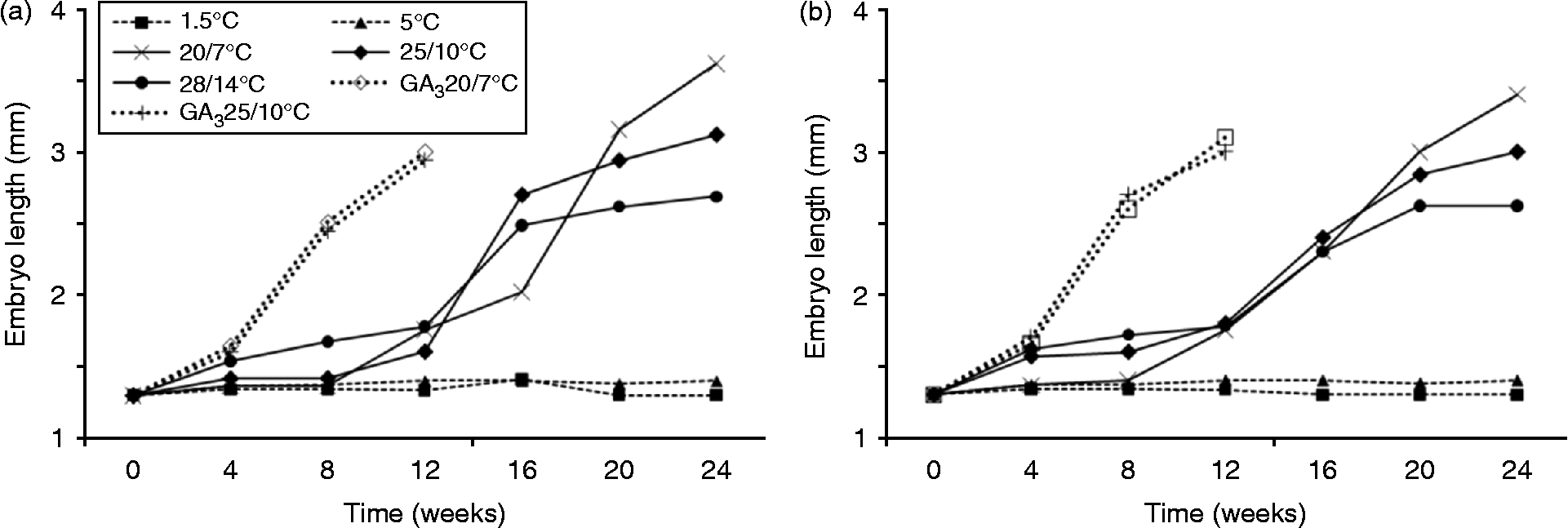
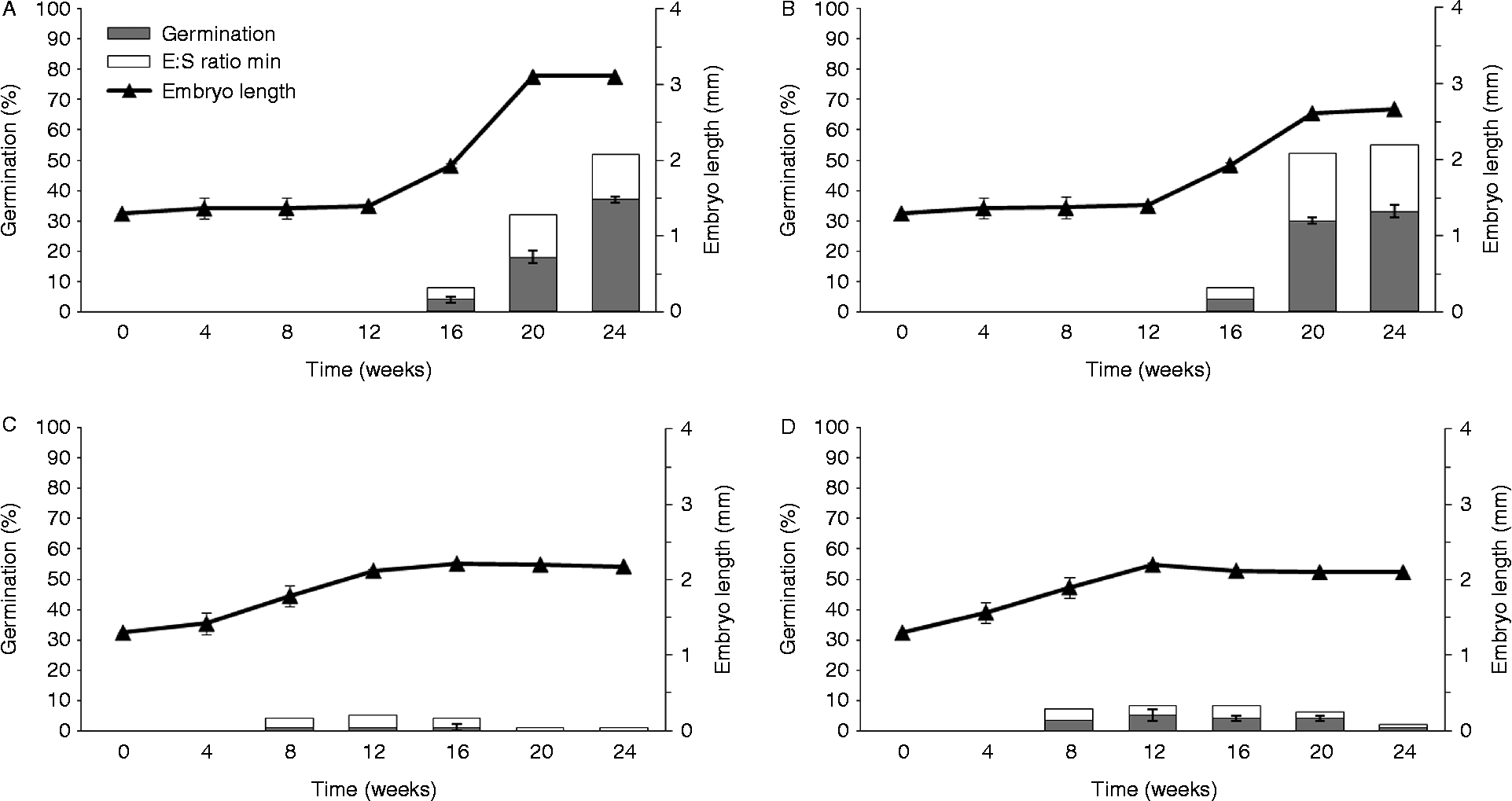
In fresh seeds of V. lantana incubated during 24 weeks at alternating temperature regimes (20/7, 25/10 and 28/14°C, both in light and in darkness), embryo length at the end of the test was higher than the minimum E:S ratio for germination. In light conditions, the embryo reached 3.7 mm at 20/7°C (Figs 1 and 2), 80% of embryos reached the minimum E:S ratio, and 46% of seeds germinated. In contrast, the embryos of seeds subjected to low constant temperatures (5°C and 1.5°C) did not grow during the test period (24 weeks) under either light condition (Fig. 2). ‘Move-along’ tests confirmed that embryo growth occurred in thermoperiods with higher temperatures, although higher germination (up to 37% in light conditions, and 33% in darkness conditions, at 24 weeks) and a higher percentage of embryos reaching the minimum E:S ratio were noted in the sequence of increasing thermoperiods than in the decreasing sequence (P < 0.05) (Fig. 3).
Embryo growth in Viburnum lantana. Embryo sizes correspond to the mean growth during incubation at 20/7°C in light conditions after 4, 16, 20 and 24 weeks. Embryos are outlined.

Embryo growth (mm) in freshly matured seeds of Viburnum lantana (mean ± SE; n= 25) incubated at 1.5°C, 5°C, 20/7°C, 25/10°C or 28/14°C for 24 weeks, or incubated at 20/7°C or 25/10°C with GA3 for 12 weeks. Incubations were carried out both in light (a) and darkness (b).

Embryo growth (mm) in fresh seeds of Viburnum lantana (mean ± SE; n= 25) subjected to (A, B) increasing stratification treatment [5°C (12 weeks) → 15/4°C (4 weeks) → 20/7°C (4 weeks) → 25/10°C (4 weeks)] and (C, D) decreasing stratification treatments [25/10°C (4 weeks) → 20/7°C (4 weeks) → 15/4°C (4 weeks) → 5°C (12 weeks)] in the light (A, C) and dark (B, D). The shaded part of the histograms shows the percentage of germinated seeds (mean ± SE). The white part shows the percentage of seeds with an E:S ratio higher than the minimum E:S ratio (0.39) above which germination is possible.

Effect of temperature and light conditions during stratification and incubation on germination
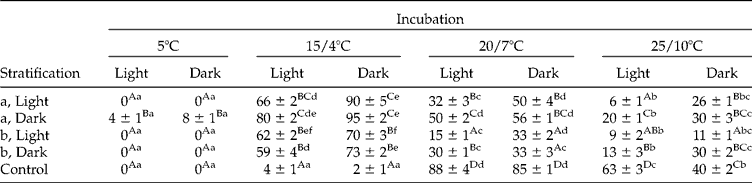
The sequence of increasing temperatures (a) promoted a significantly higher (P < 0.05) germination response than sequence (b) in seeds incubated at 15/4°C in darkness conditions (Table 1). The germination of seeds subjected to the treatment of decreasing stratification (b) was higher at 15/4°C than at the other temperatures. The response of seeds incubated continuously at the four temperature regimes increased with a rise in temperature and was highest at 20/7°C.
Germination percentages of Viburnum lantana fresh seeds (mean ± SE, n=4) incubated in light and dark at 5, 15/4, 20/7 and 25/10°C for 4 weeks following 24 weeks of incubation during which seeds were subjected to: (a) increasing stratification treatment [5°C (12 weeks) → 15/4°C (4 weeks) → 20/7°C (4 weeks) → 25/10°C (4 weeks)], and (b) decreasing stratification treatment [25/10°C (4 weeks) → 20/7°C (4 weeks) → 15/4°C (4 weeks) → 5°C (12 weeks)], in light and in darkness. Capital letters in columns and lower-case letters in rows show significant differences (α=0.05). Control: test duration was 28 weeks

Effects of gibberellic acid on embryo growth and germination
GA3 stimulated the rate (speed) of embryo growth in seeds incubated at 20/7°C and 25/10°C (Fig. 2), and significantly (P < 0.05) increased the germination percentage. When treated with GA3 in light and in dark conditions for 12 weeks, 35% of seeds germinated at 20/7°C in the light, and 40% at 25/10°C in the light. In contrast, the final germination percentage obtained in the control treatment was zero (data not shown in figures).
Outdoor experiments
Phenology of embryo growth, dormancy break and radicle emergence
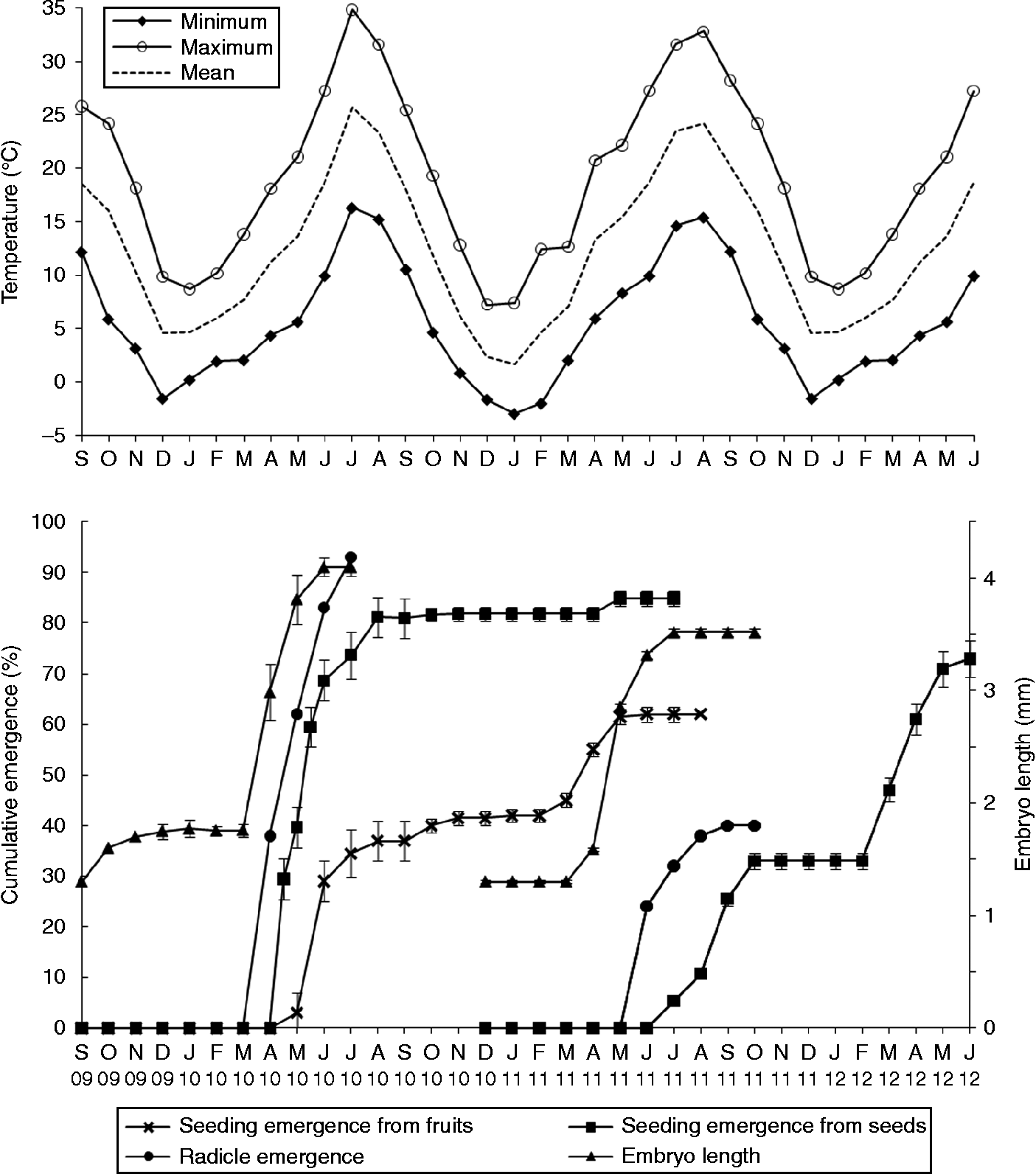
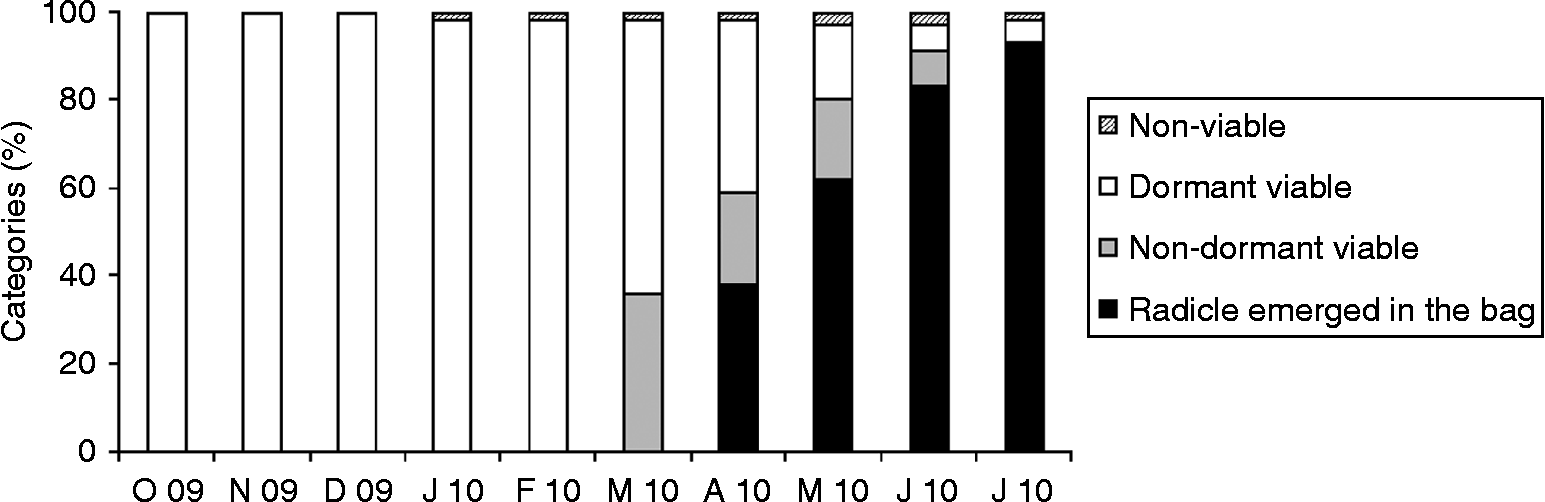
In the test carried out on 1 September 2009, embryos grew from 1.3 to 1.7 mm during September and October. During this period, the maximum and minimum mean temperatures were 25°C and 9°C, respectively (Fig. 4). Between 1 November 2009 and 1 March 2010, coinciding with the natural cold period, embryos hardly grew. In contrast, from 1 to 31 March 2010, embryo length increased from 1.7 to 2.98 mm, above the minimum threshold size of 2.51 mm; in addition, 36% of seeds reached the minimum E:S ratio. In that month, the mean maximum and minimum temperatures were 21°C and 6°C, respectively. During April and May, embryo growth continued, reaching the critical size of 4.1 mm at the end of May. All seeds exhumed between 1 October 2009 and 1 February 2010 were dormant (Fig. 5). In early March 2010, 36% of seeds had broken dormancy, and in early April, 38% of seeds had emerged radicles, and an additional seedlot fraction (21%) was non-dormant. Percentages of seeds with emerged radicles increased up to 62, 83 and 93% in early May, June and July, respectively (Figs 4 and 5).
Phenology of embryo growth (mean ± SE, if SE >0.1; n= 25), germination and seedling emergence (mean ± SE; n= 3) in Viburnum lantana seeds. Experiments were started in September 2009 and December 2010 (see Materials and methods). The upper graph shows changes in temperature (mean of maximum, mean of minimum and mean monthly temperatures) recorded in the shadehouse during the experiment.

Stage of Viburnum lantana seeds exhumed monthly from 1 October 2009. Seed classes were: radicle emerged in the bag, non-dormant viable, dormant viable and non-viable.

Phenology of seedling emergence
At the end of April 2010, 39.6% of seedlings had already emerged, with little delay (2–3 weeks) with respect to radicle emergence. Emergence continued during May, June and July, reaching 81.6% at the end of this period (Fig. 4). In the phenological experiment started on 1 September 2009 with seeds including pulp (fruits), only 41.5% of seedlings emerged in early November 2010, with a further increase in cumulative seedling emergence during the following spring, which reached up to 62% on 30 April 2011. Also, there was a delay in the seedling emergence from fruits, in relation to those without pulp, and in early May 2010 only the 3% of seedlings had emerged, compared to 55% of the seeds without pulp (Fig. 4).
In the phenological experiment started on 1 December 2010, little embryo growth occurred during December, January and February. However, embryo length increased from 1.3 to 2.8 mm between 1 March and 30 April 2011, when maximum and minimum mean temperatures were 16°C and 4°C, respectively. During May and June 2011, embryo growth continued up to 3.5 mm, but it stopped during July, August and September, so the critical size was not reached. Radicle emergence started in May, but during the following months until 1 October 2011 only 40% of radicles and 25.5% of seedlings emerged. The cumulative seedling emergence did not increase between 1 October 2011 and 1 February 2012. From that time to 1 June 2012 emergence increased to 70% (Fig. 4).
Discussion
In the test carried out in the laboratory, the highest embryo growth in V. lantana seeds occurred at 20/7°C, either when seeds were exposed to this temperature regime continuously for 24 weeks or during the 4-week period at this regime in the ‘move-along’ experiment with increasing temperatures. In contrast, embryos of seeds subjected to cold stratification (1.5°C or 5°C) for 24 weeks hardly grew, and none reached the minimum E:S ratio for germination (Figs 2 and 3). In the phenology experiment (Fig. 4), the highest embryo growth occurred in March and April for seeds sown in September or December. Seedling emergence was higher for seeds sown in September. These seeds were exposed to moderately warm temperatures during autumn and then to cold stratification. Furthermore, seedling emergence occurred immediately after radicle emergence, ruling out any kind of epicotyl dormancy in this species, a novel trait in the genus Viburnum (Baskin et al., Reference Baskin, Chen, Chien and Baskin2009).
Since embryo growth in V. lantana seeds occurs at warm temperatures (20/7°C, 25/10°C and 28/14°C), and is negligible at cold stratification, these seeds have one of the six simple levels of MPD, discarding the three levels of complex MPD. The levels of deep simple epicotyl, non-deep simple epicotyl, and deep simple double MPD, could also be discarded due to the lack of delay (2–3 weeks) in shoot emergence in relation to radicle emergence. Additionally, deep simple and intermediate simple MPD are discarded because once embryo growth occurs, a cold stratification period is not required to promote radicle emergence (Baskin and Baskin, Reference Baskin and Baskin1998, Reference Baskin, Baskin, Guerrant, Havens and Maunder2004). Thus, seeds of V. lantana have non-deep simple MPD. This MPD level is also confirmed by the GA3-mediated stimulation of embryo growth and germination in seeds incubated at 20/7°C or 25/10°C, and by the rapid radicle emergence in seeds with developed embryos. The presence of non-deep simple MPD in V. lantana is a novelty in the genus.
In Viburnum species with deep simple epicotyl MPD cited in the introduction, embryo growth and radicle emergence are completed when seeds are exposed to a sequence of temperatures typically recorded in late summer–early autumn, which is not the case for V. lantana (Fig. 4). In V. lantana, embryo growth commences at 25/10°C and continues when seeds are moved to 20/7°C, as also recorded in V. tinus. Furthermore, seeds of both species germinated ≥ 87% when incubated continuously at moderately warm temperatures: 20/7°C for V. lantana and 20/10°C for V. tinus. This may be because these alternating temperatures include warm and cold stratifications, being suitable for all parts of the germination process: dormancy break, embryo growth and radicle emergence (Karlsson et al., Reference Karlsson, Hidayati, Walck and Milberg2005). However, when seeds of V. tinus were exposed to the temperature sequence of summer–autumn–winter, radicles emerged at 15/5°C and even during the first weeks at 5°C (Karlsson et al., Reference Karlsson, Hidayati, Walck and Milberg2005), a period when radicle emergence in V. lantana was zero (Fig. 4). Shoots of V. tinus emerged 13–15 weeks after root protrusion, compared to 2–3 weeks in V. lantana. In radicle-emerged seeds of V. tinus, shoots also emerged after 6 weeks at 25/15°C (Karlsson et al., Reference Karlsson, Hidayati, Walck and Milberg2005), leading Baskin et al. (Reference Baskin, Chien, Chen and Baskin2008) to suggest that V. tinus may have non-deep simple epicotyl MPD.
In some species with non-deep simple MPD, the physiological dormancy (PD) part of MPD is overcome by a warm stratification, e.g. as in Chaerophyllum tainturieri (Baskin and Baskin, Reference Baskin and Baskin1990), Corydalis flavula (Baskin and Baskin, Reference Baskin and Baskin1994) and Papaver rhoeas (Baskin et al., Reference Baskin, Milberg, Andersson and Baskin2002). However, other species require a cold stratification (1.5°C or 5°C) to break PD, after which high ( ≥ 15°C) temperatures are required for embryo growth, i.e. PD is broken during winter and MD (embryo growth) occurs when temperatures increase in spring, as recorded in Thalictrum mirabile (Walck et al., Reference Walck, Baskin and Baskin1999) Chamaelirium luteum (Baskin et al., Reference Baskin, Baskin and Chester2001) and Selinum carvifolia (Vandelook et al., Reference Vandelook, Bolle and Van Assche2007).
In V. lantana, the overcoming of PD prior to embryo growth is promoted by a combination of warm and cold stratification (Figs 3 and 4). Although its seeds germinated up to 88% after a period of 28 weeks at 20/7°C in light conditions (Table 1), this period may be considered as equivalent to 14 weeks of warm stratification and 14 additional weeks of cold stratification (Baskin et al., Reference Baskin, Baskin and Chester2001). If V. lantana seeds only required a warm stratification to overcome the PD part of MPD, the highest percentage of embryo growth in the phenological experiment started on 1 September 2009 would have occurred during the next 3 months. During this period the mean maximum temperature was 23°C, and seeds would have received warm stratification ( ≥ 15°C) for 1.5 months. This is, in fact, what we recorded in Lonicera etrusca (Santiago et al., Reference Santiago, Herranz, Copete and Ferrandis2013), another member of the Caprifoliaceae with fruits dispersed in the second half of August, whose seeds have non-deep simple MPD requiring a warm stratification to overcome the PD. If V. lantana seeds only needed cold stratification to break PD, most of the embryo growth in the phenological experiment started on 1 December 2010 should have occurred during the following March, as recorded in Thalictrum mirabile (Walck et al., Reference Walck, Baskin and Baskin1999) and S. carvifolia (Vandelook et al., Reference Vandelook, Bolle and Van Assche2007). However, in V. lantana embryo length grew very little (i.e. from 1.3 to 1.6 mm).
Under laboratory conditions, the highest percentages of germination (95%) were obtained in the ‘move-along’ experiment with increasing stratification temperatures (5°C → 15/4°C → 20/7°C → 25/10°C) and subsequent seed incubation at 15/4°C (Table 1). However, this sequence does not occur completely under natural conditions, where 25/10°C must be followed by a higher temperature than 15/4°C. For this reason, in the phenological experiment started on 1 December 2010 (Fig. 4) a notable increment of the embryo length (from 1.30 to 3.32 mm) occurred during the following months of March, April and May. However, during June, with maximum and minimum mean temperatures of 27°C and 10°C, respectively, the embryo only grew up to 3.51 mm, failing to reach the critical size (4.1 mm). So during the following months (until 1 October 2011) radicle (40%) and seedling (25.5%) emergence were lower than those of the phenological experiment started on 1 September 2009 (93 and 81.6%, respectively). In the latter, seeds were exposed to a natural temperature sequence similar to the sequence in the ‘move-along’ experiment with decreasing temperature stratification. So, under natural conditions, higher germination values occur when the moderately warm temperatures associated with autumn months precede the cold winter temperatures. Under these conditions, seeds overcame dormancy in early March, 6 months from the beginning of the experiment (Figs 4 and 5). Bezdeckova et al. (Reference Bezdeckova, Reznickova and Prochazkova2009) also recommended 3 months at 20°C followed by 2 months at 4°C to promote germination of V. lantana, although these authors did not measure embryo growth during the process. In a test started in September, Adams (Reference Adams1927) recorded 57% of seedlings emerging 10 months later, when seeds of V. lantana were sown in boxes placed out-of-doors, but only 17% in boxes placed in a greenhouse, concluding that germination ‘is greatly accelerated by exposure for a time to low temperature’.
Our results confirm the initial hypothesis about the need for cold stratification to break physiological dormancy in V. lantana seeds. Although embryo growth occurred at moderately warm temperatures, it was only significant after exposure to cold (Figs 3 and 4). Moreover, for seeds incubated permanently at 20/7°C under light conditions (Fig. 2), the change in the curve of the slope of embryo growth took place after 16 weeks, when seeds had been exposed to a treatment which may be considered equivalent to 8 weeks of cold stratification at 7°C (Baskin et al., Reference Baskin, Baskin and Chester2001; Copete et al., Reference Copete, Herranz, Copete, Baskin and Baskin2011b). On the other hand, in the phenological experiment started on 1 December 2010 a considerable increment in seedling emergence occurred during spring 2012, after the second period of cold stratification.
Although in seeds with non-deep simple MPD, the need for a combination of warm and cold stratification to break PD is a little known phenomenon, there are some precedents. Thus, Ilex maximowicziana (Chien et al., Reference Chien, Chen, Chien, Baskin and Baskin2011b) requires a long period (16 weeks) of exposure to moderately warm temperatures (20/10°C or 25/10°C) to obtain 80% germination. However, after a cold stratification at 5°C for 4 weeks, this period is shortened to 8 weeks. This fact shows that although cold stratification is not essential for germination, it is beneficial. Something similar happens in S. carifolia (Vandelook et al., Reference Vandelook, Bolle and Van Assche2007) and Torilis japonica (Vandelook et al., Reference Vandelook, Bolle and Van Assche2008). In both species, PD is broken by moist chilling (5°C). However, higher germination percentages are achieved at 20/10°C in light when seeds are submitted to 4 weeks of warm stratification (23°C) followed by 12 weeks of cold stratification (5°C) than when seeds are exposed only to cold stratification for 16 weeks.
At the study site, most V. lantana seeds are dispersed actively during the second half of August by frugivorous birds that eat their fruits and excrete the seeds in their droppings (personal observation), confirming other records on the natural habitat of this species in the Iberian Peninsula (Ruiz-Téllez and Devesa, Reference Ruiz-Téllez, Devesa, Castroviejo, Benedí, Rico, Güemes and Herrero2007). Seeds, which are incorporated into the superficial soil horizons in early September, are exposed to cycles of warm, cold and again warm stratifications described in this work, so up to 80% of seeds may give rise to seedlings which emerge in the following late spring (Fig. 4). In contrast, in fruits (seeds with pulp) which fall directly to the ground after ripening, seedling emergence would be delayed considerably and reduced to less than a half (Fig. 4). The pulp surrounding the seeds complicates germination as a result of a waterproofing effect, the high osmotic pressure due to dissolved sugars, or the presence of germination inhibitors (Mayer and Poljakoff-Mayber, Reference Mayer and Poljakoff-Mayber1989). Additionally, in seeds dispersed in autumn and with pulp until early December, seedling emergence is delayed notably, occurring mostly during June, July and August of the following year (Fig. 4). This fact may substantially reduce seedling survival probability, due to summer water stress, in those localities of the natural habitat with a more pronounced Mediterranean climatic influence.
The results of this study strongly suggest that most seeds of a cohort require dispersal by frugivorous birds to produce emergent seedlings in the next vegetative period. This fact emphasizes the influence of symbiotic and co-evolutionary relationships between frugivorous birds and shrub species in the habitat of V. lantana, which provide berries and drupes during late summer, autumn and early winter (Herrera, Reference Herrera1982; Martín-Herrero et al., 2003). A previous study on several species of Lonicera genus cohabiting with V. lantana (Santiago et al., Reference Santiago, Herranz, Copete and Ferrandis2013) also confirmed the importance of dispersal by frugivorous birds on germination. V. lantana seedlings emerging during April and May (up to 69% in the phenological experiment started in September 2009) rely on a period of 6 months to grow and develop before the arrival of winter, providing an opportunity for them to acquire some resistance to cold. Summer storms characterizing the Euro-Siberian region, as well as the Mediterranean mountains above 1300 m a.s.l., result in environmental and soil moisture conditions in the natural habitat which promote the survival of new seedlings (Martín-Herrero et al., 2003; Ruiz de la Torre, Reference Ruiz de la Torre2006). In V. lantana, the main ecological consequence of needing a combination of warm and cold stratification to overcome the physiological dormancy component is that germination is concentrated in spring, offering young plants a long frost-free period in which to grow and develop before the outset of winter.
Acknowledgements
We thank two anonymous reviewers for their exhaustive revision of the manuscript which enhanced its quality.
Financial support
Funds were kindly provided by the local Government of Castilla-La Mancha (Plan Regional I+D+i, Consejería de Educación y Ciencia) project ‘Germination ecology of 12 species of singular or Threatened plants with morphophysiological dormancy’ [PEII10-0170-183].
Conflicts of interest
None.