Introduction
The bryozoan anascan-grade family Aspidostomatidae Jullien, Reference Jullien1888 consists of heavily calcified taxa whose frontal surfaces lack gymnocystal calcification but have an extensive cryptocyst underlying the entire frontal membrane; the opesia-orifice is scarcely larger than the operculum, spines are absent, and the aperture of the ovicell opens at some distance from the autozooidal orifice (Hayward, Reference Hayward1995). It has been pointed out that the wide range of zooidal and avicularian morphologies makes it particularly difficult to trace a clear boundary between the Aspidostomatidae and genera belonging to a closely allied family, Onychocellidae Jullien, Reference Jullien1882 (Gordon and Taylor, Reference Gordon and Taylor1999, Reference Gordon and Taylor2015).
Aspidostoma is exclusively distributed in the Southern Hemisphere and is better represented in the fossil record than in recent times. Its four extant species occur in South Africa (Hayward and Cook, Reference Hayward and Cook1979, Reference Hayward and Cook1983), Antarctica, and the Magellanic Region (South America) (Hayward, Reference Hayward1995). Fossil representatives of Aspidostoma range from the Late Cretaceous of Western Australia (personal communication, P.D. Taylor, 2017) to the Cenozoic of Australasia (Uttley, Reference Uttley1949; Brown, Reference Brown1952, Reference Brown1958; Gordon and Taylor, Reference Gordon and Taylor1999, Reference Gordon and Taylor2015), Antarctica (Hara, Reference Hara2001; Hara and Crame, Reference Hara and Crame2004), and southern South America (Ortmann, Reference Ortmann1900, Reference Ortmann1902; Canu, Reference Canu1904, Reference Canu1908, Reference Canu1911; Conti, Reference Conti1949).
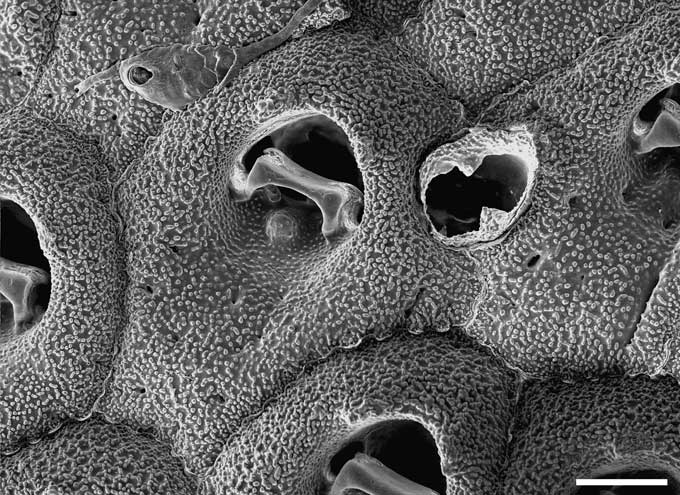
The type species of Aspidostoma Hincks, Reference Hincks1881 is Aspidostoma crassum Hincks, Reference Hincks1881, a subjective junior synonym of Eschara gigantea Busk, Reference Busk1854 (see Busk, Reference Busk1884), a rather common and abundant species on the continental shelf of the Magellanic Region of Chile, Argentina, and around the Malvinas/Falkland Islands (Jullien, Reference Jullien1888; López Gappa and Lichtschein, Reference López Gappa and Lichtschein1990; Hayward, Reference Hayward1995) (Fig. 1). This genus is characterized by the presence of interzooidal avicularia, a projecting cryptocystal hood raised distal to the opesia-orifice, and a conspicuous quadrangular process formed by the folded proximal lip of the opesia-orifice. In addition to its present distribution around the southern tip of South America, Busk’s species has been recorded by several authors from Oligocene (Ortmann, Reference Ortmann1900, Reference Ortmann1902) and Miocene (Canu, Reference Canu1908; Conti, Reference Conti1949) deposits of Patagonia. Other fossil species of Aspidostoma have been described from Paleogene and Neogene deposits from the same area (Canu, Reference Canu1904, Reference Canu1908, Reference Canu1911).
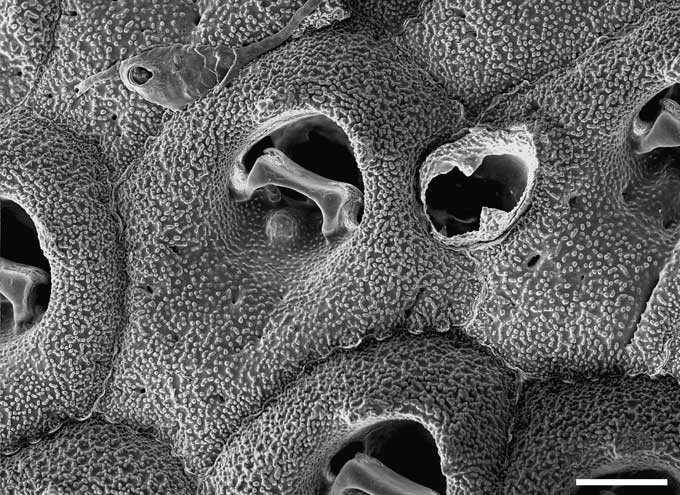
Aspidostoma giganteum (Busk, Reference Busk1854), autozooids and avicularium (MACN-In No. 32318, Burdwood Bank). Note the large size of A. giganteum zooids compared to those of its epibiont, the cheilostome Hippothoa flagellum. Scale bar = 200 µm.
The three species of Melychocella Gordon and Taylor, Reference Gordon and Taylor1999 known to date have been found in the Paleocene–Eocene (Thanetian to Ypresian) of the Chatham Islands (Southwest Pacific Ocean) (Gordon and Taylor, Reference Gordon and Taylor1999, Reference Gordon and Taylor2015). Melychocella was originally included in the Cellariidae due to its similarity to Melicerita Milne-Edwards, Reference Milne-Edwards1836 (Gordon and Taylor, Reference Gordon and Taylor1999), but was later transferred to the Aspidostomatidae (Gordon and Taylor, Reference Gordon and Taylor2015).
The aims of this study are: (1) to analyze the relationships between the fossil material assigned to Aspidostoma giganteum by Ortmann (Reference Ortmann1900, Reference Ortmann1902), Canu (Reference Canu1904, Reference Canu1908), and Conti (Reference Conti1949) and the species presently living in the Magellanic Region; (2) to redescribe A. incrustans Canu, Reference Canu1908; and (3) to record the presence of Melychocella in the Miocene of South America.
Geologic setting
Patagonian Cenozoic marine units outcrop from northern Río Negro Province to Tierra del Fuego Province, Argentina. They were formed by transgressive events generated by tectonic controls and cyclic eustatic changes. At least five cycles of increased mean sea level have occurred since the Maastrichtian stage (Malumián, Reference Malumián1999).
The San Julián Formation is a stratigraphic unit consisting of ~80 m of greenish-grey limestones, yellow and brownish sandstones, thin conglomerates, and fossil beds (Erdmann et al., Reference Erdmann, Bellosi and Morra2008). The depositional environment was a coastal plain to a sandy shallow platform (Náñez et al., Reference Náñez, Quattrocchio and Ruiz2009). This unit has been dated as late Oligocene using 87Sr/86Sr isotopic techniques (Parras and Casadío, Reference Parras and Casadío2002; Parras et al., Reference Parras, Dix and Griffin2012). The material analyzed by Ortmann (Reference Ortmann1900, Reference Ortmann1902) comes from Oven Point and the mouth of the Santa Cruz River.
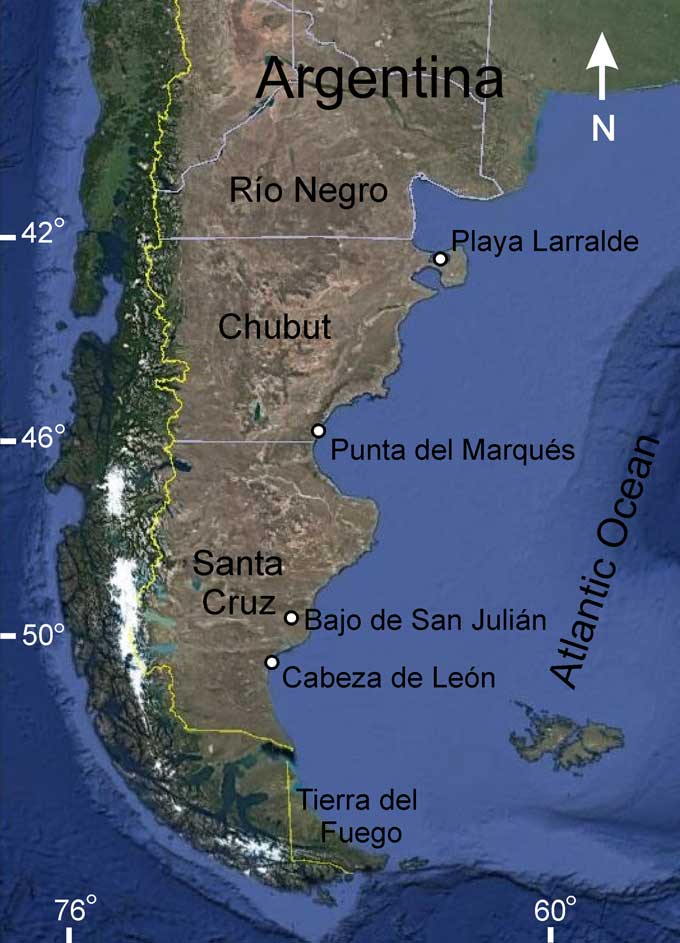
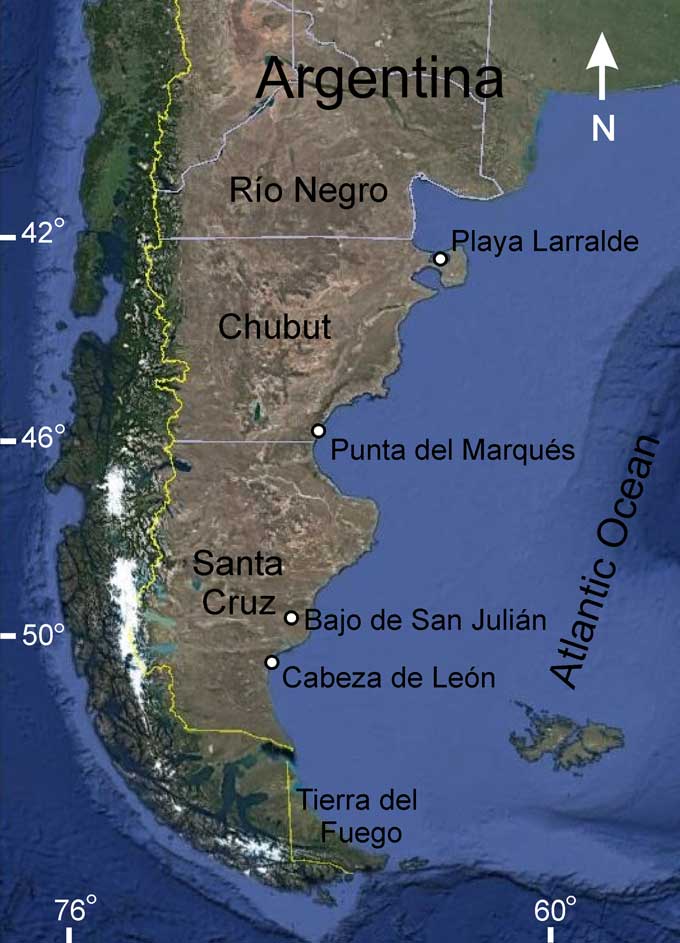
The Monte León Formation outcrops only in Santa Cruz Province. Its invertebrate biodiversity is very high, with the bryozoans being a common component of the fossil assemblages. All the material analyzed here comes from ‘Cabeza de León’ (Fig. 2). At this locality, this section includes almost 47 m of siliciclastic rocks in medium to fine sandy to silty beds. Most of the Monte León strata seems to have been deposited in a relatively low-energy shelf setting, with a gradual upward shallowing trend and an abundant supply of volcanic ash (Malumián, Reference Malumián1999). Isotopic studies by Parras et al. (Reference Parras, Dix and Griffin2012) yielded 87Sr/86Sr ages of 22.12 Ma at the base and 17.91 Ma at the top, which appears to be consistently early Miocene (Aquitanian to early Burdigalian).
Map of the localities mentioned in the text.
The Chenque Formation is well represented around the city of Comodoro Rivadavia, Chubut Province. It is composed of a siliciclastic succession of sandstones and mudstones, with layers of marine invertebrates and oyster reefs. This unit has a thickness of around 300 m (see Cuitiño et al., Reference Cuitiño, Scasso, Ventura Santos and Mancini2015) and represents a shoreface to inner foreshore setting (Paredes and Colombo, Reference Paredes and Colombo2001). The colonies of Aspidostoma were found at the lowest levels of the formation. The isotopic studies by Cuitiño et al. (Reference Cuitiño, Scasso, Ventura Santos and Mancini2015) yielded 87Sr/86Sr ages of 19.69 Ma at the base to 15.37 Ma at the top (Burdigalian to early Langhian).
Finally, the Puerto Madryn Formation is a siliciclastic succession consisting of bioturbated fine to medium sands with interspersed layers of mud and containing an abundant fauna of marine invertebrates and fragments of fish bones. Basal units have been interpreted as formed in an offshore low-sedimentation habitat, while the top of the sequence is regarded as a littoral environment characterized by tidal channels and tidal sand waves (Scasso and del Río, Reference Scasso and del Río1987; del Río et al., Reference del Río, Martínez and Scasso2001). The bryozoan material analyzed in this study comes from Playa Larralde on the Valdés Peninsula (Fig. 2). A diverse fauna of marine invertebrates, including bryozoans, is exposed in the uppermost levels at this site. Using 87Sr/86Sr, this stratigraphic unit has been dated as middle Tortonian (10 ± 0.3 Ma; Scasso et al., Reference Scasso, Mac Arthur, del Río, Martínez and Thirlwall2001). This isotopic age is close to the end of the Neogene climatic optimum (Casadío et al., Reference Casadío, Griffin and Parras2005), when warm waters occurred off the Atlantic coast of southern South America.
Materials and methods
The materials examined in this study were collected at: (1) Cabeza de León, 50.21533°S, 68.52967°W (Monte León Formation), Santa Cruz Province; (2) Playa Larralde, 42.24787°S, 64.19202°W (Puerto Madryn Formation), Chubut Province; and (3) Punta del Marqués, 45.56791°S, 67.33229°W (Chenque Formation). In addition, we examined material deposited in the Facultad de Ciencias Exactas y Naturales, Universidad de Buenos Aires, Colección Ciencias Geológicas, collected at three sites (Estancia Meseta Chica, Estancia Lobo, and Cañadón Lobo), all located in the Bajo de San Julián, San Julián Formation (Fig. 2). Material from the localities Bahía Sanguinetto and Cañadón al Deseado is housed in Museo de La Plata and lacks a precise geographic location in Santa Cruz Province.
Colonies were recovered under binocular microscopes and washed using an ultrasonic cleaner. Uncoated fragments of A. tehuelche new species were photographed in low vacuum with a scanning electron microscope (SEM) at the Servicio de Microscopía Electrónica de Barrido y Microanálisis of LIMF (Departamento de Mecánica, Facultad de Ingeniería—UNLP). Material of all other species was coated with gold-palladium and imaged with a Phillips series XL model 30 SEM at the Museo Argentino de Ciencias Naturales (MACN).
Repositories and Institutional abbreviations
CPBA, Facultad de Ciencias Exactas y Naturales, Colección Ciencias Geológicas. MACN-In, Colección Nacional de Invertebrados, Museo Argentino de Ciencias Naturales. MLP, División Paleozoología Invertebrados - Museo de La Plata. MPEF-PI, Colección Paleontología Invertebrados, Museo Paleontológico Egidio Feruglio, and MNHN, Muséum national d'Histoire naturelle.
Systematic paleontology
Phylum Bryozoa Ehrenberg, Reference Ehrenberg1831
Class Gymnolaemata Allman, Reference Allman1856
Order Cheilostomata Busk, Reference Busk1852
Superfamily Microporoidea Gray, Reference Gray1848
Family Aspidostomatidae Jullien, Reference Jullien1888
Genus Aspidostoma Hincks, Reference Hincks1881
Aspidostoma ortmanni Canu, Reference Canu1904
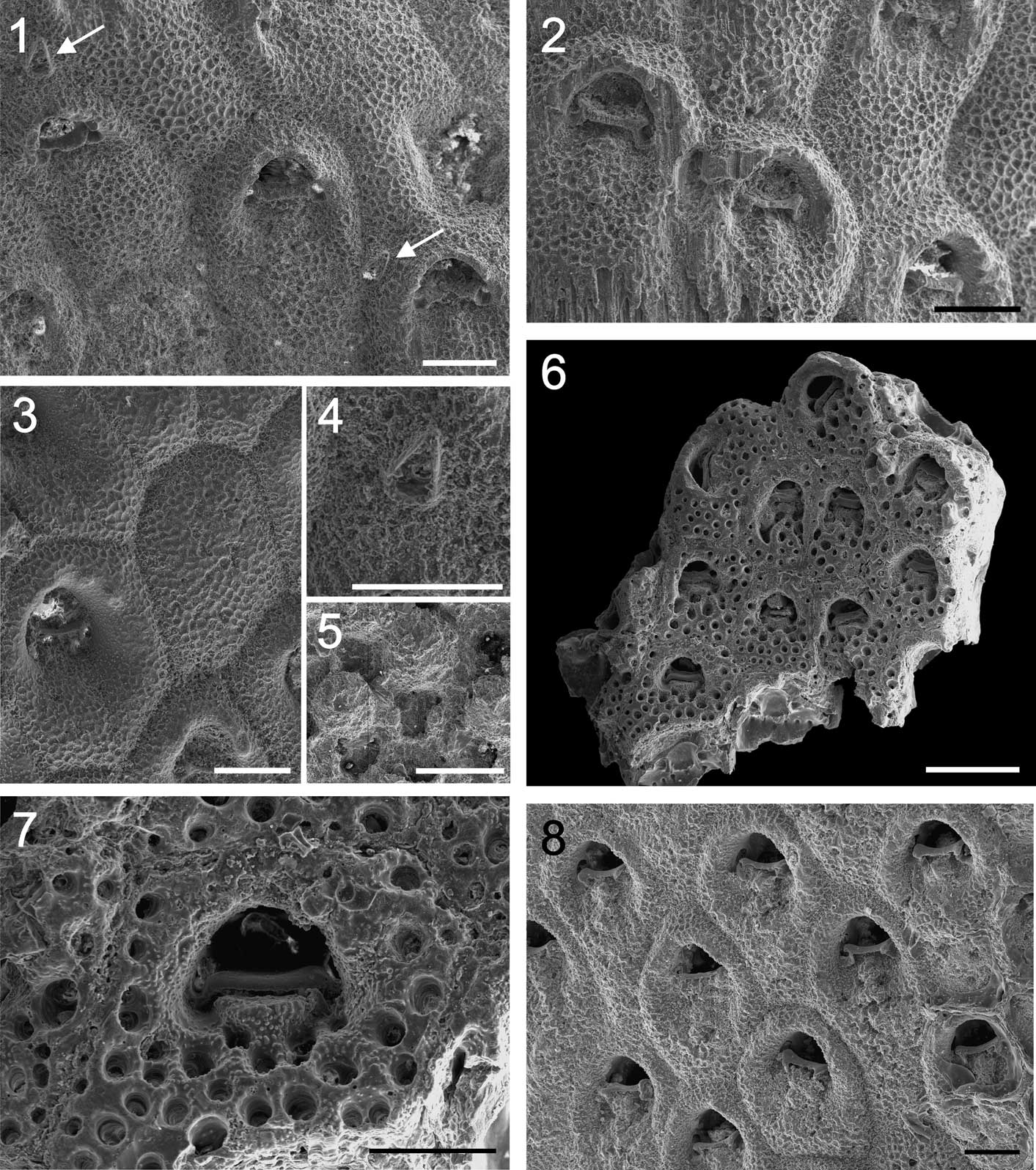
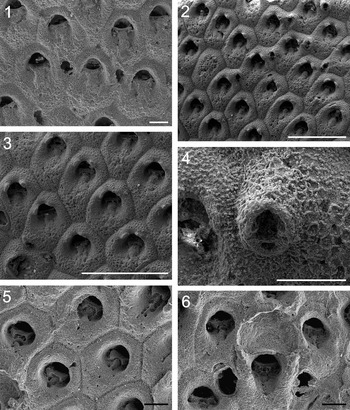
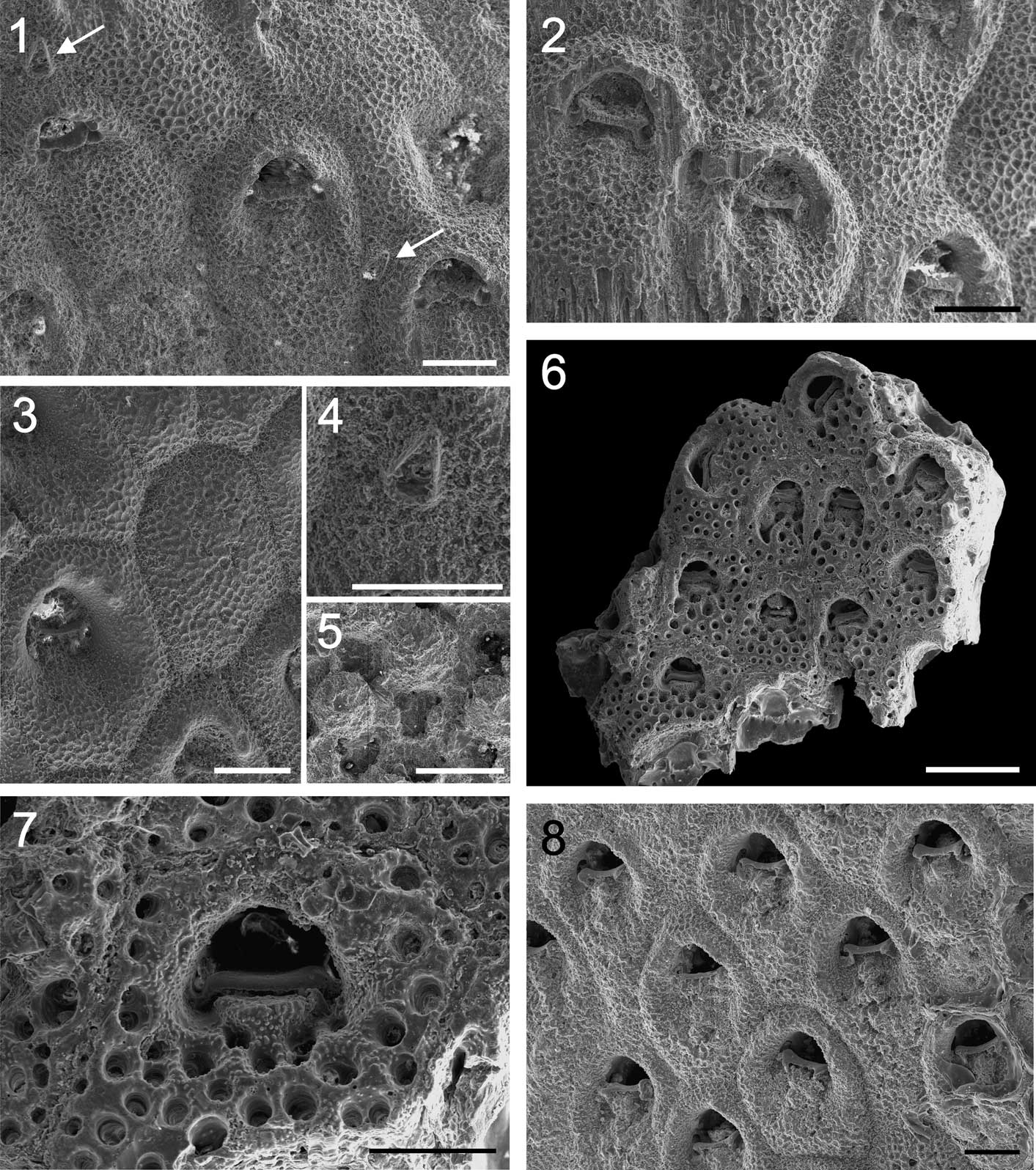
(1–5) Aspidostoma ortmanni Canu, Reference Canu1904. (1, 2) CPBA No. 23690a; (1) autozooids and avicularia (see arrows); (2) quadrangular processes in the proximal margin of the opesia-orifice. (3) CPBA No. 23690b, zooid obliterated by secondary calcification; (4) CPBA No. 23690a, detail of avicularium; (5) CPBA No. 23691, detail of three ovicells. (6, 7) Aspidostoma incrustans Canu, Reference Canu1908 (MLP No. 35701); (6) general aspect of autozooids; (7) detail of the opesia-orifice. (8) Aspidostoma armatum n. sp. holotype (MLP No. 35702), autozooids. (1–4, 7, 8) Scale bars = 200 μm; (5, 6) scale bars = 500 μm.
1900 Aspidostoma giganteum (Busk); Reference OrtmannOrtmann, p. 378 (non Eschara gigantea Busk, Reference Busk1854).
1902 Aspidostoma giganteum (Busk); Reference OrtmannOrtmann, p. 67, pl. 13, fig. 4 (non Eschara gigantea Busk, Reference Busk1854).
1904 Aspidostoma ortmanni nom. nov.; Reference CanuCanu , p. 14 (part, only Ortmann’s material from San Julián, Oven Point).
Type
Syntype. Aspidostoma ortmanni Canu, 1904. Collection Tournouër. MNHN-F-R53493. Argentina, Punta Borja.
Description
Colony erect, bilaminar, robust. Autozooids ordered in quincunx, subhexagonal. Autozooid length = 802 (673–911) µm; width = 459 (376–515) µm; length-to-width ratio = 1.7. Frontal surface consisting of a coarsely granular cryptocyst with protruding lateral margins and a slightly depressed central area, pierced by small, scarce, scattered pores. Cryptocyst distal to the opesia-orifice with a pair of distolateral spiniform processes that are eroded in most zooids. Cryptocyst proximal to the opesia-orifice with an inconspicuous median ridge, laterally depressed. Opesia-orifice wider than long, 100 µm long × 220 µm wide, D-shaped; proximal margin concave, everted, with a quadrangular process having a notch at each side for the passage of muscles depressing the frontal membrane. Interzooidal avicularia scarce, small, directed distally or more rarely proximally; avicularian cystide in contact with three autozooids, 131 µm long × 71 µm wide, the length about 16% of autozooid length, with triangular rostrum and an incomplete pivot bar. Autozooids in some parts of the colony with orifices obliterated by secondary calcification and perforated by small pores. Ovicells hyperstomial, globular.
Materials
UBA, Facultad de Ciencias Exactas y Naturales, Colección Ciencias Geológicas: Santa Cruz Province, Argentina. Estancia Meseta Chica (CPBA No. 23690a, b; 23691), Estancia Lobo (CPBA No. 23692), Cañadón Lobo (CPBA No. 23693, 23694).
Remarks
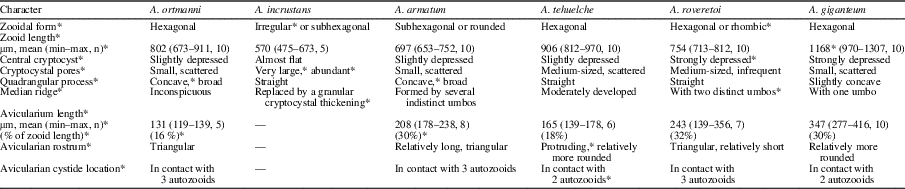
The fossil material found by Ortmann (Reference Ortmann1900, Reference Ortmann1902) at the ‘Mouth of Santa Cruz River’ and ‘San Julian Oven Point’ was assigned by him to Aspidostoma giganteum (Busk, Reference Busk1854), an extant species currently common and widely distributed in the Magellanic region. In his first study devoted to Patagonian fossil bryozoans, Canu (Reference Canu1904) was of the opinion that this material was not conspecific with the extant species and therefore introduced a new species, A. ortmanni. In a later study (Canu, Reference Canu1908), however, he reverted this decision and included A. ortmanni in the synonymy of A. giganteum. The most obvious difference between A. ortmanni and A. giganteum is the size of the autozooids, which are almost 50% larger in the Recent than in the Oligocene species. In addition, avicularia are relatively much smaller with respect to autozooids in A. ortmanni than in A. giganteum (Table 1).
Morphological differences among species of Aspidostoma discussed in the text.

*Diagnostic feature.
Aspidostoma incrustans Canu, Reference Canu1908
1908 Aspidostoma incrustans n. sp.; Reference CanuCanu, p. 279, pl. 7, fig. 13.
1946 Aspidostoma incrustans Canu Reference Canu1908; Reference BugeBuge, p. 207.
Type
Syntype. Aspidostoma incrustans Canu, 1908. Collection Tournouër. MNHN-F-R53494. Argentina, Punta Borja.
Occurrence
Early Miocene, Punta Borja (Canu, Reference Canu1908) and Monte León Formation (see Parras et al., Reference Parras, Dix and Griffin2012).
Description
Colony encrusting, the single fragment studied here consisting of 10 zooids. Zooids irregular or subhexagonal in shape, slightly longer than wide, delimited by indistinct sutures. Autozooid length = 570 (475–673) µm; width = 522 (436–614) µm; length-to-width ratio = 1.1. Cryptocyst elevated at the margin and almost flat toward the opesia-orifice, pierced by very large, abundant infundibuliform pores arranged in a quincuncial pattern. Opesia-orifice D-shaped, sunken, with a straight proximal border. Quadrangular process protruding, with a crenulated proximal margin and a notch at each side for the passage of muscles. There is a granular cryptocystal thickening separated from the quadrangular process by a slit. Distally to the opesia-orifice there may be distolateral peristomial processes with a variable degree of preservation. Avicularia and ovicells not seen.
Material
MLP 35701. ‘Cabeza de León,’ Santa Cruz Province, Argentina (Fig. 2).
Remarks
This species can be easily distinguished by its large and conspicuous pores. It had not been found again since the original description by Canu (Reference Canu1908). This author recorded the presence of small interzooidal avicularia.
Aspidostoma armatum new species
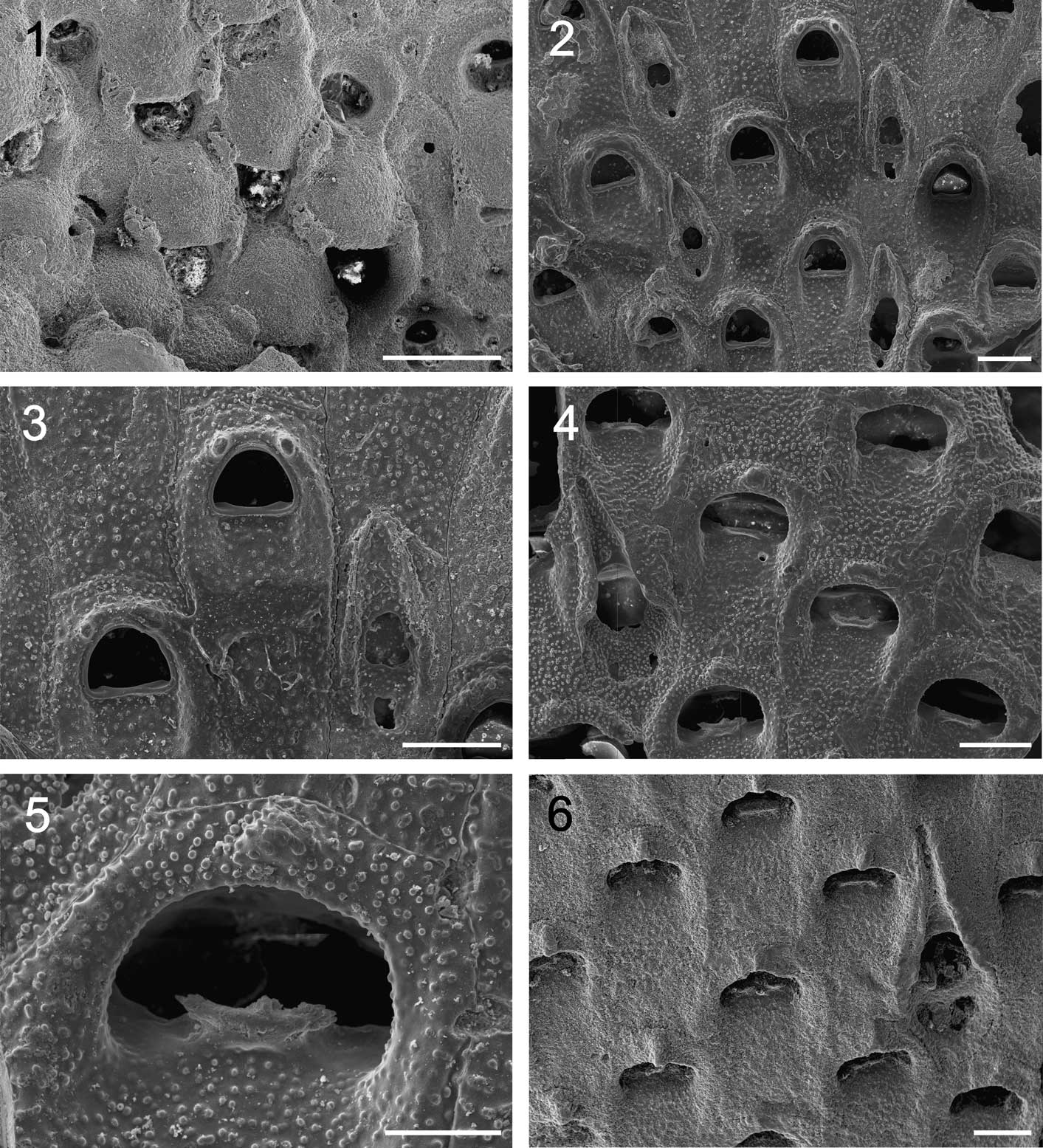
(1) Aspidostoma armatum n. sp. holotype (MLP No. 35702), interzooidal avicularia in different preservation states. (2–4) Aspidostoma tehuelche n. sp. holotype (MPEF No. 6348); (2) general aspect; (3) autozooids showing distolateral and quadrangular processes; (4) avicularium. (5, 6) Aspidostoma roveretoi n. sp. holotype (MPEF-PI No. 6511); (5) autozooids; (6) avicularia and an incomplete ovicell. (1, 4, 5) Scale bars = 200 μm; (2, 3) scale bar = 1,000 µm; (6) scale bar = 500 μm.

Type
Holotype, MLP 35702. Four paratypes, MLP 35703.
Diagnosis
Aspidostoma with a bilaminar colony, a concave quadrangular process on the proximal margin of the opesia-orifice, and frequent interzooidal avicularia of relatively large size (30% of zooid length).
Occurrence
Early Miocene, Monte León Formation (see Parras et al., Reference Parras, Dix and Griffin2012). Type locality. Cabeza de León (Fig. 2).
Description
Colony erect, bilaminar, robust. Autozooids ordered in quincunx, subhexagonal to rounded, limited by well-marked, slightly crenulated sutures. Autozooid length = 697 (653–752) µm; width = 523 (475–574) µm; length-to-width ratio = 1.3. Frontal surface consisting of a coarsely granular cryptocyst, convex, with protruding lateral margins, pierced by small, scattered pores. Cryptocyst distal to the opesia-orifice with a pair of inconspicuous distolateral processes that are eroded in most zooids. Cryptocyst proximal to the opesia-orifice with a median ridge formed by several indistinct umbos, depressed laterally. Opesia-orifice wider than long, 120–140 µm long × 140–180 µm wide, D-shaped; proximal margin concave, everted, with a broad quadrangular process having a notch at each side for the passage of muscles depressing the frontal membrane. Interzooidal avicularia frequent, 208 × 131 µm, the length attaining almost one-third of autozooid length, directed distolaterally, located at the level of the opesia-orifice of two adjoining autozooids, with triangular rostra, one pair of condyles, and a small transversely elliptical opesial foramen separated from the rostral foramen by a slender bridge. Avicularian cystide in contact with two lateral and one distal autozooids. Autozooids in some parts of the colony with orifices obliterated by secondary calcification. Ovicells not seen.
Etymology
From Latin, meaning armed, referring to the large size of the interzooidal avicularia.
Other materials
MLP 570, Bahía Sanguinetto. MLP 544, Cañadón al Deseado, Santa Cruz Province, Argentina.
Remarks
The distolateral processes of the cryptocyst are well preserved in the material from Bahía Sanguinetto. The colonies from Cañadón al Deseado are characterized by the good preservation of the avicularia. This species differs from A. ortmanni and A. tehuelche by the much larger size of its interzooidal avicularia (Table 1).
Aspidostoma tehuelche new species
1904 Aspidostoma ortmanni nom. nov.; Reference CanuCanu, p. 14 (part, only material from Punta Borja [‘Boya’ sic], Comodoro Rivadavia).
1908 Aspidostoma giganteum Busk, Reference Busk1854; Reference CanuCanu, p. 276, pl. 7, figs. 4–12 (non Eschara gigantea Busk, Reference Busk1854; part, only material from Punta Borja, Comodoro Rivadavia).
Type
Holotype MPEF-PI 6348. Three paratypes, MPEF-PI 6349.
Diagnosis
Aspidostoma with a bilaminar colony, a straight quadrangular process and avicularia attaining almost one-fifth of autozooid length, and avicularian cystide in contact with two autozooids.
Occurrence
Early Miocene, Chenque Formation (see Cuitiño et al., Reference Cuitiño, Scasso, Ventura Santos and Mancini2015). Type locality. Punta del Marqués (Fig. 2).
Description
Colony erect, bilaminar, robust. Autozooids ordered in quincunx, hexagonal, limited by well-marked, crenulated sutures. Autozooid length = 906 (812–970) µm; width = 647 (574–693) µm; length-to-width ratio = 1.4. Frontal surface consisting of a coarsely granular cryptocyst, convex, pierced by medium-sized, scattered pores. Cryptocyst distal to the opesia-orifice with a pair of conspicuous distolateral processes. Cryptocyst proximal to the opesia-orifice with a moderately developed median ridge, slightly depressed and perforated laterally. Opesia-orifice wider than long, 120–140 µm long × 140–180 µm wide, D-shaped; proximal margin everted, with a straight quadrangular process having a notch at each side for the passage of muscles depressing the frontal membrane. Interzooidal avicularia frequent, their length attaining almost one-fifth of autozooid length, directed distally, located at the level of the distolateral processes of the proximolateral zooid and adjacent to one proximolateral and one distolateral zooid, 165 × 122 µm, with protruding, relatively rounded triangular rostra, one pair of condyles, and an opesial foramen separated from the rostral foramen by a slender bridge. Some autozooids obliterated by secondary calcification with strongly perforated cryptocyst. Ovicells not seen.
Etymology
Honoring the memory of the Tehuelche people, original inhabitants of coastal Patagonia. Noun in apposition.
Remarks
A. tehuelche differs from A. armatum in the relatively smaller size of its interzooidal avicularia, which are in contact with two instead of with three autozooids as in the latter.
Aspidostoma roveretoi new species
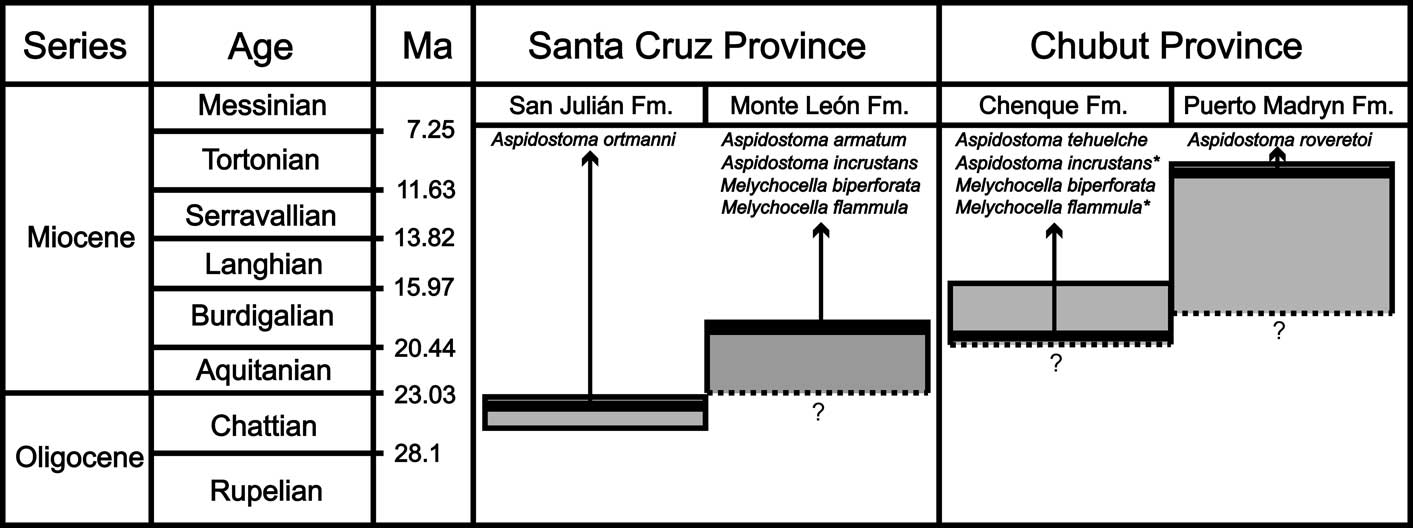
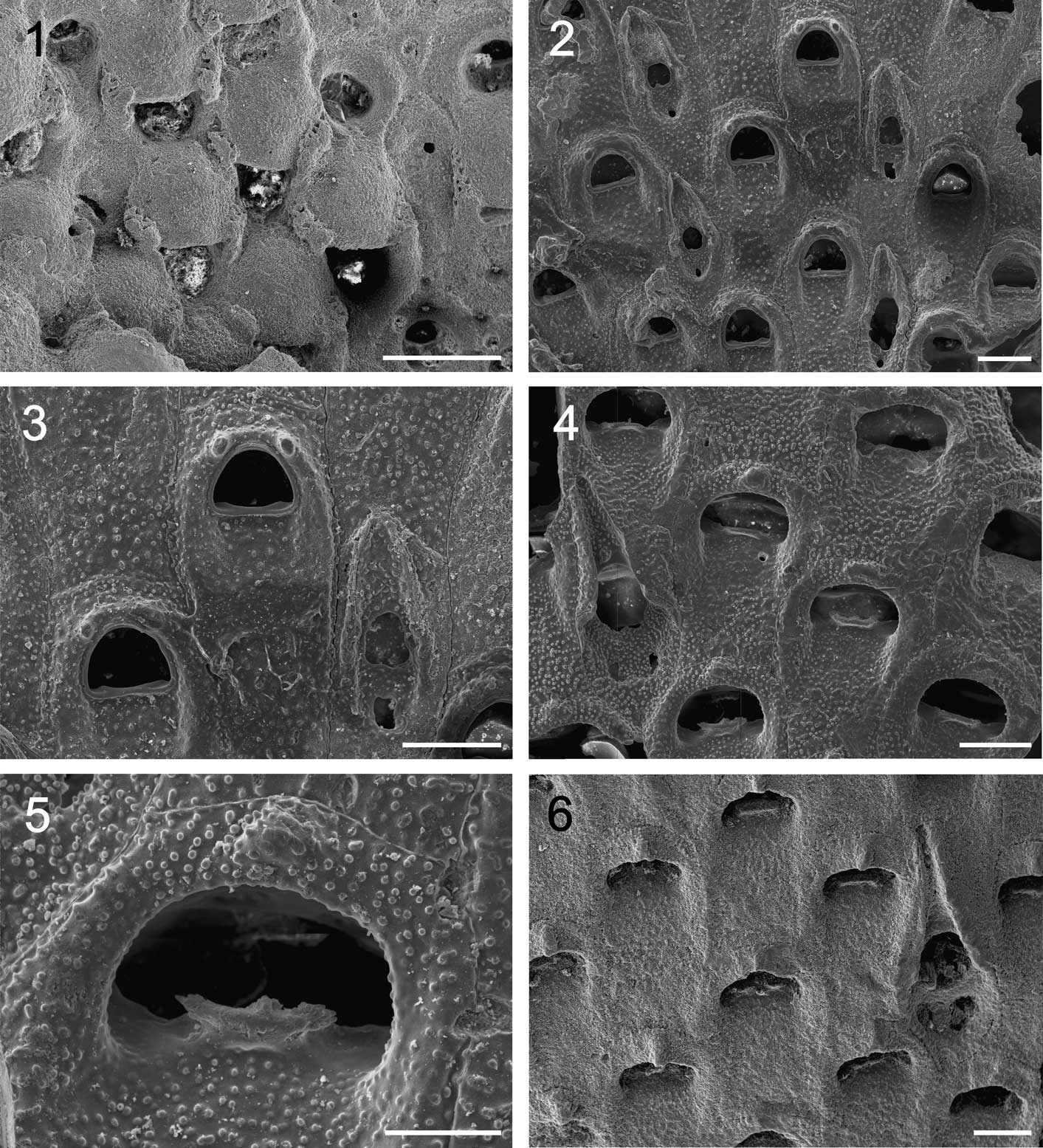
(1) Aspidostoma roveretoi n. sp. holotype (MPEF-PI No. 6511), ovicelled zooids. (2, 3) Melychocella flammula (Canu, Reference Canu1908) (MLP No. 35704); (2) general aspect showing several autozooids and avicularia; (3) autozooids and vicarious avicularium. (4, 5) Melychocella biperforata n. sp. holotype (MLP No. 35705, Monte León Formation); (4) general aspect showing autozooids and avicularium; (5) detail of opesia-orifice. (6) MPEF No. 6350, Chenque Formation, autozooids and avicularium. (1) Scale bar = 500 μm; (2–4, 6) scale bar = 200 μm; (5) scale bar = 100 μm.
1949 Aspidostoma giganteum Busk; Reference ContiConti, p. 289, pl. 3, fig. 5 (non Eschara gigantea Busk, Reference Busk1854).
Type
Holotype MPEF-PI 6511 HT, fragment of colony. Two paratypes MPEF-PI 6512 PT.
Diagnosis
Aspidostoma with a strongly depressed central cryptopcyst, a median ridge with two distinct umbos, and avicularia attaining around 32% of autozooid length.
Occurrence
Late Miocene, Puerto Madryn Formation (see Scasso et al., Reference Scasso, Mac Arthur, del Río, Martínez and Thirlwall2001). Type locality. Playa Larralde, San José Gulf, Valdés Peninsula (Fig. 2).
Description
Colony erect, bilaminar, robust. Autozooids arranged quincuncially, the shape mostly hexagonal but sometimes rhombic due to shortening of the proximal and distal sides, delimited by well-marked, slightly crenulated grooves. Autozooid length = 754 (713–812) µm; width = 628 (574–673) µm; length-to-width ratio = 1.2. Frontal surface relatively flat, with a pronounced central depression. Cryptocyst coarsely granular, pierced by relatively scarce, medium-sized pores, without processes distal to the opesia-orifice. Cryptocyst proximal to the opesia-orifice with a median ridge formed by two umbos, depressed and perforated at each side. Opesia-orifice wider than long, 60–80 µm long × 100–140 µm wide, D-shaped, with a slightly concave proximal margin, forming a straight quadrangular process with lateral notches for the passage of muscles. Interzooidal avicularia infrequent, distally directed, 243 × 181 µm, their length attaining almost one-third of autozooid length, with a short triangular rostrum, robust condyles, and an opesial foramen separated from the rostral foramen by a tuberculated bridge. Zooids with orifices concealed by thickened calcification are frequent. Ovicell hyperstomial, its distal margin reaching almost the opesia-orifice of the distal zooid, with straight proximal margin, clustered in certain areas of the colony, prominent, globular and imperforate, buttressed by lateral calcareous ridges. Ovicell aperture narrow, distant from the opesia-orifice of the maternal zooid.
Etymology
Honoring Prof. Gaetano Rovereto, who collected the material from Valdés Peninsula described by S. Conti in 1949.
Remarks
A. roveretoi differs from A. giganteum by the smaller size of its zooids and by possessing an opesial foramen in the interzooidal avicularia.
Genus Melychocella Gordon and Taylor, Reference Gordon and Taylor1999
Melychocella flammula (Canu, Reference Canu1908)
1908 Aspidostoma flammulum n. sp.; Reference CanuCanu, p. 278, pl. 7, figs. 1–3.
Type
Syntype. Aspidostoma flammulum Canu, 1908. Collection Tournouër. MNHN-F-R53511. Argentina, Punta Borja.
Occurrence
Early Miocene, Punta Borja (Canu, Reference Canu1908) and Monte León Formation (see Parras et al., Reference Parras, Dix and Griffin2012).
Description
Colony erect, bilaminar, robust. Autozooids arranged quincuncially, subhexagonal, delimited by crenulated sutures. Autozooid length = 638 (547–715) µm; width = 412 (338–484) µm. The whole frontal surface cryptocystal. Lateral margins prominent, much more protruding distally to the opesia-orifice, where they project as a pair of distolateral peristomial tubercles. Cryptocyst granular, centrally depressed. Opesia-orifice wider than long, 140 µm long × 180 µm wide, D-shaped, proximal margin almost straight, not protruding, the internal side of it bearing a slightly concave process and a pair of small lateral condyles. Vicarious avicularia smaller than autozooids, 547 × 202 µm, often located at the bifurcation of zooidal rows. Rostral palate initially wide, narrowing toward the apex; the acute avicularial rostrum is superimposed on the distal zooid, the boundary having the form of a ‘W.’ Avicularian cryptocyst granular, with one small opesial foramen of variable form, well separated from the rostral foramen. Rostral foramen subcircular, with a small, proximal, asymmetrical spine. Ovicells indistinct, placed beneath the frontal wall of the distal zooid.
Material
MLP 35704. ‘Cabeza de León,’ Santa Cruz Province, Argentina (Fig. 2).
Remarks
Our material agrees completely with the illustrations in Canu (Reference Canu1908). The opesial foramen of the avicularium is not mentioned in Canu’s description, but can be seen in his photographs.
Melychocella biperforata new species
Type
Holotype MLP 35705, fragment of colony. Six paratypes, MLP 35706.
Diagnosis
Melychocella with unilaminar colony, vicarious avicularia longer than the autozooids and characterized by having one pair of reniform opesial foramina.
Occurrence
Early Miocene, Monte León Formation (see Parras et al., Reference Parras, Dix and Griffin2012) and Chenque Formation (see Cuitiño et al., Reference Cuitiño, Scasso, Ventura Santos and Mancini2015). The type locality is Cabeza de León (Fig. 2).
Description
Several unilaminar, fragile fragments were recovered. Autozooids arranged in quincunx, proximal margin concave, distal convex, reaching maximum width at the level of the opesia-orifice, delimited by distinct sutures. Autozooid length = 513 (436–543) µm; width = 452 (396–541) µm. Entire frontal surface cryptocystal. Lateral margins prominent, converging distally in a single medial tubercle. The cryptocyst between zooidal margins is depressed, granular; granules small, not fused between each other around the opesia-orifice, but connected in the marginal and proximal zones of the zooid. Opesia-orifice wider than long, 120 µm long × 260 µm wide, its proximal margin bent upward as a lappet consisting of three acute projections that may be lost during preservation. At both sides of the proximal margin there is an indistinct lateral notch with a small projection sinking in distobasal direction. Vicarious avicularia longer than the autozooids, 751 × 322 µm, located at the bifurcation of zooid rows. The acute rostrum covers one of the proximal corners of the distal zooid, the boundary V-shaped. Avicularian cryptocyst with small isolated granules and a pair of subequal, large reniform opesial foramina. Rostral foramen subelliptical, with a medioproximal projection. Lateral and distal walls with rounded, multiporous pore plates. Ovicells not observed.
Etymology
From Latin bi, meaning two or double, and perforare, to bore; referring to the paired opesial foramina of the avicularium.
Other material
Two fragments, MPEF-PI 6350, Punta del Marqués, Chubut Province. Chenque Formation.
Remarks
We assigned this new species to Melychocella mainly due to the presence of vicarious avicularia with rostral and opesial foramina. It differs from M. cynura Gordon and Taylor, Reference Gordon and Taylor1999, the type species of this genus, by lacking the pair of distal condyles in the opesia-orifice. M. biperforata n. sp. differs from the other species of the genus by having a pair of reniform opesial foramina in the avicularia.
Discussion
Aspidostoma giganteum can be easily distinguished from the new fossil species described in this study by the greater size of the autozooids. At around 1170 × 820 µm, the zooids are considerably larger than in most species of cheilostome bryozoans. Its gigantism might be related to its present distribution in cold-temperate waters of the Magellanic Region. However, several cheilostome species, mainly distributed in Antarctica and in subpolar seas (Grischenko et al., Reference Grischenko, Taylor and Mawatari2002), are known with zooids that exceed the size of A. giganteum.
Aspidostoma incrustans can also be set clearly apart from other fossil species of Aspidostoma by the presence of huge pores piercing its cryptocyst. On the other hand, A. ortmanni, A. armatum, A. tehuelche, and A. roveretoi exhibit a common morphological pattern. Each is characteristic of a particular geological unit (Fig. 6) and can be distinguished by the morphological features summarized in Table 1. Aspidostoma ortmanni is characterized by having very small avicularia, A. armatum by its concave quadrangular process and its relatively large avicularia, A. tehuelche by its protruding avicularia and its avicularian cystides in contact with two autozooids, and A. roveretoi by its regularly hexagonal or rhombic zooids with strongly depressed central cryptocysts (Table 1).
Chronostratigraphic chart showing the age of the formations analyzed in this study and their species. The solid line within each rectangle indicates the approximate level of the bryozoan fossil associations. *Species recorded by Canu (Reference Canu1908) for Punta Borja, Chenque Formation.
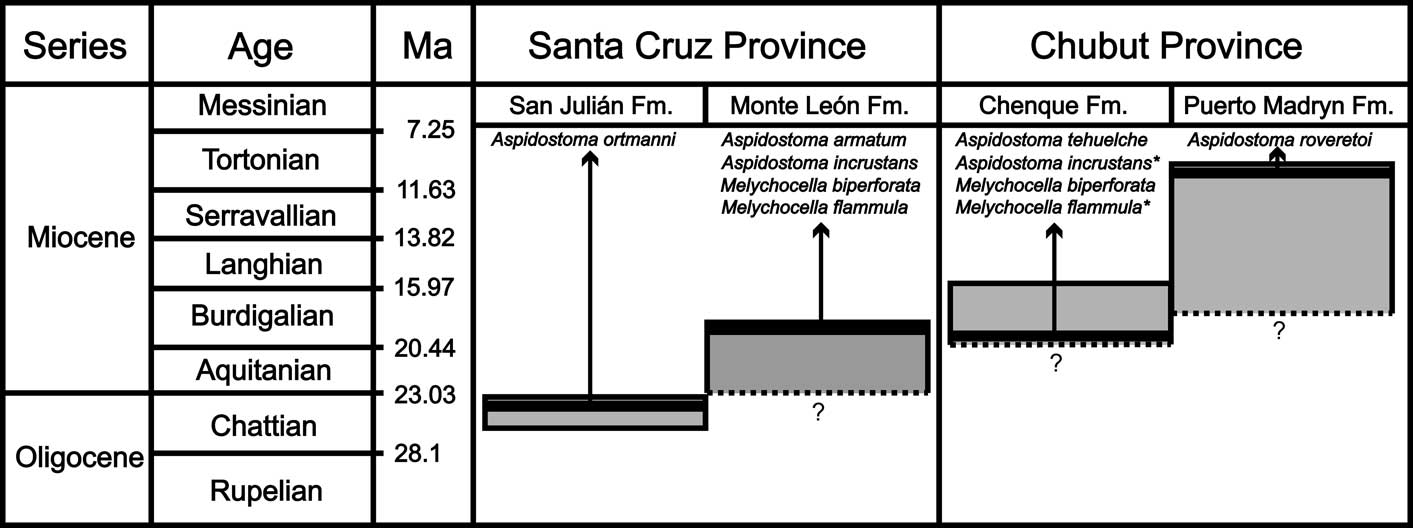
The fact that Melychocella biperforata was found by us in both the Monte León and the Chenque formations, and that M. flammula and Aspidostoma incrustans were originally described by Canu (Reference Canu1908) from the Punta Borja (Chenque Formation) and were found during the present study in the Monte León Formation (Fig. 6), suggests that the upper levels of the Monte León Formation might correlate with the lower levels of the Chenque Formation.
In addition to the species treated in this study, the Aspidostomatidae of the southern tip of South America are represented by four Paleogene taxa: A. onychocelliferum Canu, Reference Canu1911, A. globifera Canu, Reference Canu1911 (Roca Formation, early Paleocene, Río Negro Province), A. hexagonalis Canu, Reference Canu1904, and A. porifera Canu, Reference Canu1904 (San Julián Formation, late Oligocene, Santa Cruz Province).
Three species of Melychocella were already known from the Paleogene of the Chatham Islands, New Zealand (Southwest Pacific): M. cynura Gordon and Taylor, Reference Gordon and Taylor1999, M. obliqua Gordon and Taylor, Reference Gordon and Taylor2015, and M. bilamellata Gordon and Taylor, Reference Gordon and Taylor2015. No representatives of this genus had been recorded yet outside the Chatham Islands. The occurrence of two species of Melychocella in the Neogene of Patagonia expands the temporal range of the genus and lends further support to the hypothesis of a close link between the faunas of the southern tip of South America and the Australasian region during the early Miocene, as has been discussed in detail in previous studies (Casadío et al., Reference Casadío, Campbell, Taylor, Griffin and Gordon2010; Pérez et al., Reference Pérez, López-Gappa and Griffin2015; López-Gappa et al., Reference López-Gappa, Pérez and Griffin.2017).
Acknowledgments
We are grateful to D.U. Sauthier (Centro Nacional Patagónico, Puerto Madryn, Argentina) for help during field sampling, to M. Tanuz (Universidad de Buenos Aires, Buenos Aires, Argentina) for the loan of specimens, to G. Pastorino (MACN, Buenos Aires, Argentina) for collecting material from Monte León, to S. Miquel (MACN, Buenos Aires, Argentina) for advice on nomenclatural issues, and to A. Rico for support during our visit to the Chenque Formation. F. Tricárico (MACN, Buenos Aires, Argentina) operated the SEM at MACN. P.D. Taylor and H.-D. Sues made useful comments on an earlier version of the manuscript. Financial support was granted by ANPCyT (grants PICT-2012-1726 and PICT-2016-1319 to MG, PICT-2012-1403 to JLG) and CONICET (PIP 2013-0247 to JLG, PIP 2015-0523 CO to LMP).