Dengue fever is the most frequent arboviral disease in the world,Reference Bhatt, Gething and Brady 1 and its main vector is Aedes aegypti. From January to August 2015, 1,416,179 dengue cases were reported in Brazil, 2 with a 0.05% fatality rate. São Paulo was the most affected state, with 857,594 cases and 399 deaths,Reference Boulos 3 mostly from February to May. For unknown reasons, the city of São Paulo, a large city with 11 million inhabitants, was less affected than the rest of the state until 2014. However, in 2015 the number of autochthonous cases reported was 74,177, a 147% increase from 2014. 4
Nosocomial acquisition of dengue fever has been reported to occur by needle-stick injury,Reference Morgan, Paraskevopoulou, Ashley, Probst and Muir 5 mucocutaneous exposure to blood,Reference Chen and Wilson 6 blood transfusion,Reference Levi, Nishiya and Félix 7 and transplantation.Reference Chen and Wilson 6 In this study, we describe cases of hospital-acquired vector-transmitted dengue disease in a setting of high prevalence of the disease.
Hospital das Clínicas is a tertiary-care teaching hospital located in the city of São Paulo, with 2,200 beds in 7 buildings. We reviewed the medical records of patients with dengue fever; these records were retrieved from the Hospital Surveillance System database. The following tests were considered diagnostic of the disease in patients with symptoms: nonstructural protein 1 (NS1) antigen capture test (first 5 days of disease), IgM-capture enzyme-linked immunosorbent assay (≥6 days after onset of symptoms), and real-time reverse transcriptase polymerase chain reaction (RT-PCR). A case was considered hospital-acquired if the patient had been hospitalized for at least 10 days before the onset of symptoms.Reference Snow, Haaland, Ooi and Gubler 8
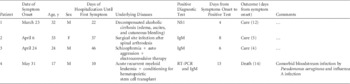
In March 2016, an investigation of potential foci of Aedes reproduction was undertaken. The identification of dengue patients who had received blood transfusions triggered a retrospective investigation of donors. In total, 4 cases of dengue were considered hospital-acquired infections (Table 1). All occurred from March to May 2015. Patient ages varied from 17 to 34 years, and 3 patients were male. All presented with fever, and 2 of these patients had a rash. Low lymphocyte counts were reported in 2 patients; 1 of these patients was undergoing conditioning for hematopoietic stem cell transplant. Another patient had asymptomatic hepatitis. Thrombocytopenia lasting 8–14 days occurred in 3 patients. The lowest number of platelets reported was 13,000/mm3. In addition, 1 patient had a hemorrhagic manifestation and died during the dengue infection; this patient also had 2 comorbidities: a bloodstream infection caused by Pseudomonas aeruginosa and influenza A infection.
Characteristics of 4 Patients with Hospital-Acquired Vector-Transmitted Dengue Fever (Hospital das Clínicas, University of São Paulo, Brazil, 2015)

NOTE. M, male; F, female; RT-PCR, real-time reverse-transcriptase polymerase chain reaction; …, not tested; NS1, non-structural protein 1 antigen capture test; IgM, IgM capture enzyme-linked immunosorbent assay.
Mosquitoes were found in the emergency room (ER). The entrance doors of the ER remain open at all times. Vector breeding sites were observed in many outdoor areas surrounding the hospital, and viable larvae were found in the outdoor area of the psychiatric department, where patients pursue leisure activities. Various external locations of the hospital where water accumulates (eg, street gutter, top of lamp posts, garbage, roofs, etc.) were also identified.
Of these 4 patients, 2 had received blood products during the 10 days prior to the onset of symptoms (patients 1 and 4): 1 patient received 4 units of fresh frozen plasma and 2 units of irradiated red blood cells concentrates from 6 different donors. Samples from the blood bank repository were tested using RT-PCR and were nonreactive for dengue. Patient 4 received 4 red blood cell concentrates and 8 platelet concentrates from 28 different donors between May 29 and June 12. Corresponding frozen samples from the blood bank repository or from the unused plasma bag were retrieved, and none was reactive. Moreover, 26 donors were contacted by phone and denied dengue symptoms.
Nosocomial transmission of dengue has been described by blood transfusion,Reference Levi, Nishiya and Félix 7 needle stick injury,Reference Morgan, Paraskevopoulou, Ashley, Probst and Muir 5 and mucocutaneous exposure to blood.Reference Chen and Wilson 6 However, the classical way to acquire dengue is through mosquito bite (Aedes aegypti or A. albopictus), which, in an endemic situation, is the most probable route of nosocomial transmission. The same vector is responsible for transmitting other diseases such as Zika and chikungunya, which are currently emerging problems in Brazil, as well as yellow fever.
In our endemic setting, vector-transmitted dengue should be suspected. Due to the complexity of our patients’ underlying clinical conditions and the relatively mild presentation of dengue in 3 of these 4 cases, dengue infection could easily have been overlooked.
Eliminating vector-breeding sites is the most efficient way to stop dengue transmission; however, this is a difficult task. A. aegypti is very well adapted to living and breeding in urban areas; its dispersal area may reach 1 kilometer.Reference Honório, Silva, Leite, Gonçalves, Lounibos and Lourenço-de-Oliveira 9 Our Hospital’s Committee for Preventing Accidents carried out inspections and found many sites of accumulated water, some with mosquito larvae. Thus, it is necessary to monitor and control water accumulation sites within at least 1 kilometer the hospital. Placing screens on windows could be a control measure, as air conditioning is not used routinely in our hospital and windows are left open; however, this approach would be very expensive. A study showed that the flight height of Aedes does not exceed 3 metersReference Lee, Seo, Shin, Burkett, Lee and Shin 10 ; thus, it might not be necessary to screen windows above the third floor. Nevertheless, 2 case patients, hospitalized on the eighth and ninth floors, became infected. These occurrences may be explained by the need to send patients to lower floors for radiology, etc., or by the possibility of mosquitoes traveling in the elevators or the stairwells to the upper floors.
In conclusion, vector-transmitted dengue can occur as a nosocomial-acquired infection in endemic countries and should be suspected as a differential diagnosis in febrile patients. Measures to avoid these infections include screening of windows and monitoring and controlling Aedes breeding sites.
ACKNOWLEDGMENTS
The authors received no specific funding for this study. None of the authors has a financial conflict of interest. We thank Marjorie Shafferman for her review of the English manuscript.