

Introduction
Inaccessible Island (14 km2) is an uninhabited island in the Tristan da Cunha archipelago, central South Atlantic Ocean. Although it is currently protected as a Nature Reserve, and forms part of the Gough/Inaccessible World Heritage Site, the island has been farmed in the past, and has had pigs, goats, sheep, cows and even a dog roaming the island (Wace and Holdgate Reference Wace and Holdgate1976). Fortunately, these populations have either been removed or died out and currently there are no introduced mammals and few introduced plants/invertebrates relative to the main island of Tristan da Cunha (Ryan Reference Ryan2007). These days Inaccessible Island is rarely visited. It supports three landbirds endemic to the Tristan archipelago, one endemic seabird, the Spectacled Petrel Procellaria conspicillata, and other globally important seabird populations (Ryan Reference Ryan2007, Ryan et al. Reference Ryan, Dilley and Ronconi2019).
The Inaccessible Island Rail Atlantisia rogersi is endemic to the island and does not occur on neighbouring Nightingale Island (19 km to the south-east) or Tristan da Cunha (33 km to the north-northeast, Fig. 1). It is considered to be the world’s smallest extant flightless bird (Lowe, Reference Lowe1923, Reference Lowe1928, Ryan et al. Reference Ryan, Watkins and Siegfried1989) and the second smallest rail, weighing only 34–49 g (Ryan et al. Reference Ryan, Watkins and Siegfried1989). First described in the 1920s, the Inaccessible Island Rail has soft brown plumage, black beak and feet, and red eyes (Lowe Reference Lowe1923) and is believed to have originated from vagrants that reached the island from South America, more than 3,500 km away. It diverged from its closest living relative, the Dot-winged Crake Porzana spiloptera, some 1.5 million years ago (Stervander et al. Reference Stervander, Ryan P, Melo and Hansson2019).
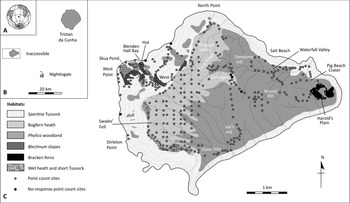
(A, B) The Tristan da Cunha archipelago in the South Atlantic Ocean; (C), Inaccessible Island, showing the main vegetation types in the distribution of 350 Inaccessible Island Rail point-count sites in October–November 2018.

Rail populations are tricky to survey (Olson Reference Olson1944) and at Inaccessible Island the dense ferns and tussock grass compound the task by concealing these cryptic birds. The first Inaccessible Island Rail population estimates ranged from 1,200 to 5,000 birds, but these were understandably crude estimates because they were based on short visits to only part of the island (Hagen Reference Hagen1952, Elliot Reference Elliott1957, Richardson Reference Richardson1984). The first detailed study in 1982/83 (Fraser et al. Reference Fraser, Dean and Best1992) estimated 8,400 birds based on rail densities in four habitats, but this estimate was largely based on extrapolations from a study area at Blenden Hall. In this paper we report the distribution of rails across Inaccessible Island using point counts and vocalisation playbacks in October–November 2018 and present a population estimate based on rail densities in six habitats.
Study Area and Methods
Habitats
Inaccessible Island (37.3°S, 12.7°W) is characterised by steep cliffs around the entire coastline, and an undulating plateau that rises from 150 m at the eastern end (Harold’s Plain) to over 500 m at the western end (Ryan Reference Ryan2005; Figure 1). Boulder beaches are found along much of the coastline, with a level coastal plain between Blenden Hall and West Point. Inaccessible Island Rails are found throughout the island (Fraser et al. Reference Fraser, Dean and Best1992, Ryan Reference Ryan2007) in six main habitats:
-
(1) Tussock grass: dense stands of Spartina arundinacea tussock 1–2.5 m tall. This habitat dominates most of the steep coastal slopes around the island as well as locally on inland valley walls (e.g. the lower part of Waterfall Valley and between Dune Hills and Joe’s Hill).
-
(2) Phylica arborea woodland: copses of ‘island trees’, which grow up to 4–7 m high, including dense patches of Ctenitis aquilina and other ferns (which form dense stands up to 1 m deep) and Tussock (which grows in large clumps up to 2 m high) in between and/or under Phylica copses. This habitat dominates much of the eastern plateau of the island (Figure 1). We included thickets of ‘dwarf’ Phylica trees (e.g. Long Ridge) in this habitat, but the sparse woodland of the ‘Serengeti’ (Figure 1) was included in ‘Bogfern heath’.
-
(3) Bogfern heath: dominated by Blechnum palmiforme (large, cycad-like ‘Bogferns’) which form dense stands mixed with a diversity of other ferns, mosses, sedges, and flowering plants, including isolated Tussock clumps. This habitat covers most of the western half of the central plateau (Figure 1).
-
(4) Wet heath and short Tussock: mixed with low Bogferns, scattered Ctenitis and other ferns and mosses. This habitat mainly occurs from Swales’ Fell to Dune Hills, and locally along the western plateau edge to above Blenden Hall (Figure 1).
-
(5) Bracken: Histiopteris incisa, a deciduous fern which occurs locally throughout the island, but forms dense stands up to 1.5 m tall on Harold’s Plain (Figure 1).
-
(6) Blechnum slopes: Blechnum penna-marina is a small, low fern which forms large sprawling stands, here often mixed with Empetrum rubrum (berry bush, a woody dwarf shrub) and isolated Tussocks. This habitat mainly occurs on open slopes along the northwest coastal scarp (Fig. 1).
Point count survey
We visited Inaccessible Island from 13 September to 26 November 2018, working from the field hut at Blenden Hall, or a camp site on the island plateau near Denstone Hill (Figure 1). During this visit we completed a number of surveys of the island’s seabirds as outlined in the Inaccessible Island Seabird Monitoring Manual (see Ryan Reference Ryan2005 for details). The most extensive was a survey of Spectacled Petrel burrows, where we walked a series of north-south transect lines every 0.1 minutes of longitude (which equates to 147 m between transects) throughout the species’ main breeding range (Ryan et al. Reference Ryan, Dilley and Ronconi2019).
The distribution and relative abundance of Inaccessible Island Rails were assessed across most of the island between 5 October and 15 November 2018. Given the dense vegetation and the rail’s secretive habits (Fraser et al. Reference Fraser, Dean and Best1992), we opted to use a point count survey (Bibby et al. Reference Bibby, Burgess and Hill1992) as the most efficient method to estimate the rail’s distribution. Survey points were not predetermined, but randomly chosen when in the field to broadly cover as much of the island as possible across the full range of habitat types.
Fraser et al. (Reference Fraser, Dean and Best1992) estimated rails had a home range of roughly 0.01—0.04 ha at Blenden Hall, and thus we spaced our survey points at a minimum distance of 50 m apart to reduce the risk of recording the same bird(s) at consecutive points. All point counts were done during daylight hours and in fair weather (i.e. we did not do counts on wet and very windy days). We played recordings of vocalisations using a smartphone and speaker (JBL IPX7 Bluetooth speaker at medium volume). The recordings (previously collected by PGR) included a mix of contact calls and twittering territorial songs, which typically elicited a response from rails in the vicinity. At each point, the number of rails calling was recorded in three time periods: Firstly, upon arrival we waited for one minute in silence; we then played the vocalisations for one minute (rotating the speaker to broadcast in all directions); and lastly another minute of silence.
Rails calling/responding were estimated as being either located close to (<30 m) or far away from (30–50 m) the survey point. The exact distance away was not recorded, since this was not required for analyses, and six totals were recorded at each point (i.e. the total number of close and far responses in three periods). Here the use of playback potentially created bias, since birds are presumably attracted to the call source and so a distant bird could move closer during the last two minutes. Further error may have occurred in estimating the distance to a bird, however two observers (BJD and PGR) completed all point counts, many of which were performed together, so this was at least a consistent bias. Both sexes responded to playback, but we could not account for the proportion of birds which where non-responsive. Calls in quick succession from the same general location were recorded as a single bird, unless two calls were heard simultaneously.
Data analysis
We could not quantify how frequently an individual bird was inadvertently counted in more than one of the sample periods (e.g. if a bird called from outside the radius during the first period of silence and in another period responded to the playback from within the radius). We thus opted to use only the highest count of the three periods (i.e. the other two counts were ignored). For each point count site, we thus used only the highest close count and the highest far count and these counts we took to represent the minimum number of rails calling from close/far at each sample point. We estimated rail densities in the six habitat types using the equation: density = log(e)(n/N) × n/m(πr2) (Bibby et al. Reference Bibby, Burgess and Hill1992), where n is the total number of birds recorded (i.e. highest close + highest far calls), N is the number of birds recorded beyond the radius (far), m is the total number of count points and r is the radius (30 m). To obtain 95% confidence intervals and standard errors for the density estimates in each habitat, we used hierarchical non-parametric bootstrapping of the point count data, run using library boot in R (R Core Team 2014) with 1,000 iterations. We used the overall habitat densities to estimate the total population of rails by simple extrapolation based on the total habitat area. We used Google Earth Pro to estimate the areas of each of the six main habitat types.
Results
A total of 1,341 rail responses were recorded at 350 point-count sites across the island (Figure 1). Mean distance to the nearest adjacent survey point was 124 ± 61 m (range 57–588 m). Of these responses, 15% (205 calls) were recorded during the first silent period, 46% (619) during the playback period and 38% (517) during the final silent period. The sum of the highest counts (of the three periods at each site) suggests a minimum of 780 rails (Table 1) responded at the 350 sites. The maximum number of responses were mostly in the second (45% of sites) and third (25%) periods; 20% of sites had an equal number of responses in the second and third period; 1.5% (five sites) had the maximum number of responses in the first period; and the remaining sites had a maximum number of calls in periods one and two/three. Rail calls were recorded at all but six of the 350 point counts sites: three sites at the Tussock edge along boulder beaches (where rails are known to be abundant), two in open woodland on the Serengeti, and one in Bogfern heath at Round Hill (Fig. 1).
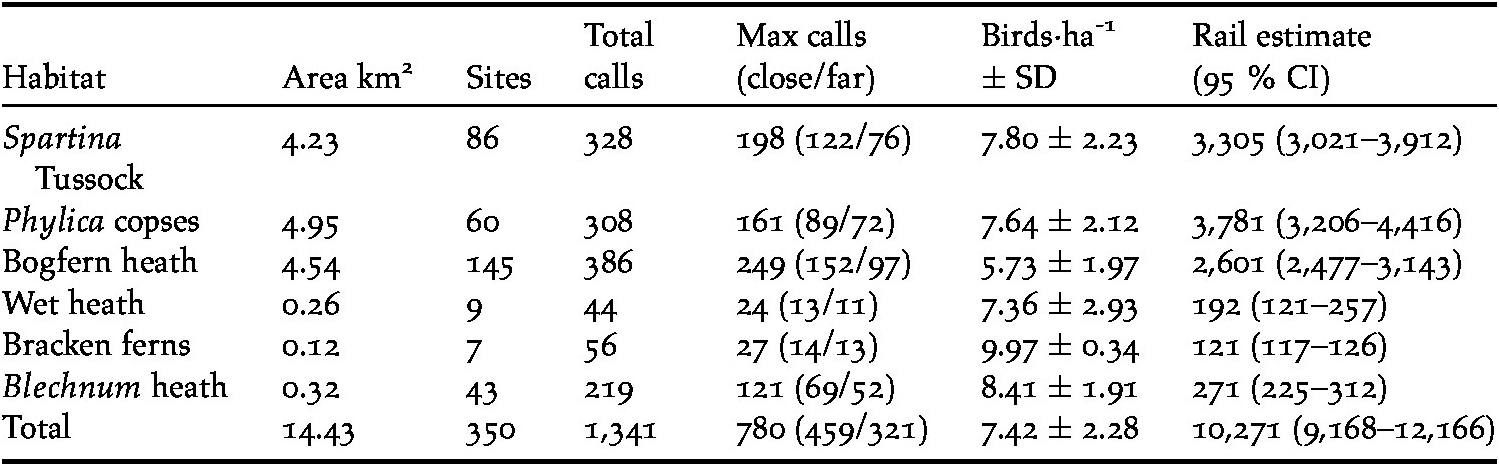
The density of Inaccessible Island Rails in six habitats in 2018, estimated from calls in response to playback at 350 point-counts.

Using only the highest count of the three periods, we estimated an island population of 10,300 (9,100–12,200) rails (Table 1). Rail densities were fairly uniform across all habitats, with the lowest density in Bogfern heath (6 birds∙ha-1, supporting an estimated 28% of the island population) and highest density in Bracken stands on Harold’s Plain (10 birds∙ha-1, 1% of the island population). These are conservative estimates because we only estimated the density of birds that responded vocally.
Discussion
Our results provide an index of relative abundance of the rail population at Inaccessible Island. The point count survey proved to be an efficient method to use in conjunction with other field surveys and confirmed that rails are still widely distributed across the island (Fraser et al. Reference Fraser, Dean and Best1992). Fraser et al. (Reference Fraser, Dean and Best1992) reported rails from all habitats except short Tussock on Dune Hills. We recorded rails in this area but failed to obtain responses to playback at three particularly open sites in Bogfern heath on the Serengeti and nearby Round Hill. It seems that the rails occur throughout the island provided there is adequate cover to provide protection from predatory Brown Skuas Catharacta antarcticus. The only other sites where we failed to get a response to playback were at the Tussock edge on boulder beaches (West Point to Dirlington Point, coastal of Skua Bog and at the Blenden Hall Bay Penguin colony) where it is possible the noise from the surf drowned out the playback. Rails are generally common in coastal Tussock around Blenden Hall.
Given the cryptic behaviour of these small birds, which are for the most part heard but rarely seen, it is difficult to gauge how representative our island estimates are. The point count technique using playback is widely accepted as an efficient method to survey birds in dense habitats where many individuals are only detected by their calls (e.g. Bibby et al. Reference Bibby, Burgess and Hill1992, Steadman and Franklin Reference Steadman and Franklin2000), including for rails (e.g. Evens and Nur Reference Evens and Nur2002, Dinesen et al. Reference Dinesen, Chamorro, Fjeldså and Aucca2017), but each survey has a number of factors that may bias the estimates. On Inaccessible Island, rails are very vocal and responsive to playback. Fraser et al. (Reference Fraser, Dean and Best1992) noted that they inhabit most of the island, so it was unsurprising to record rails calling at 98% of the 350 point-count sites. This suggests that a good proportion of the birds responded, but our estimates are based on the assumption that all birds respond to playback, which is unlikely to be the case. In addition, we had no way of knowing to what extent birds moved around during each three-minute survey – birds may have moved closer before their first call, or moved away without calling at all. Considering these factors, our population estimates are likely conservative.
Historical estimates of the Inaccessible Island Rail population are somewhat lower than our estimate, but were based on qualitative estimates and we cannot infer any population trends over the last few decades. In 1938, probably shortly after feral pigs died out on the island, Hagen (Reference Hagen1952) estimated that the population was in the order of 1,200 birds. Elliot (Reference Elliott1957) estimated 5,000–10,000 birds in 1952, similar to Richardson’s (Reference Richardson1984) estimate in 1972 of some 1,000–2,000 breeding pairs (~3,000–6,000 birds), although Richardson based his estimate on observations during a four-day visit to Salt Beach. The only previous comprehensive population estimate was by Fraser et al. (Reference Fraser, Dean and Best1992) who estimated 8,400 birds in 1982 based on rail densities in four main habitat types. Their estimates were broadly similar to those obtained in this study for three habitats: tussock (10∙ha-1, Fraser et al. Reference Fraser, Dean and Best1992, versus 5–12∙ha-1, this study), Blechnum penna-marina (15∙ha-1 versus 5–10∙ha-1), Bogfern (5∙ha-1 versus 4–11∙ha-1), but somewhat lower in Phylica woodland (2∙ha-1 versus 6–13∙ha-1). We found the highest densities of rails at Harold’s Plain in Bracken vegetation (average 10 ∙ha-1), which becomes especially thick with new growth each spring, providing good cover for rails.
The close agreement between our density estimates and those of Fraser et al. (Reference Fraser, Dean and Best1992) suggest that size of the population is restricted by the available habitat and is close to carrying capacity, and that there has been no change in the rail population over the last 3–4 decades. Although abundant, we recommend the species’ status remains as ‘Vulnerable’ (BirdLife International 2019) because the population is restricted to one small island and is at risk from the introduction of alien predators. The accidental introduction of predators such as rodents poses the greatest threat to the survival of the Inaccessible Island Rail. The wreck of a modern bulk carrier, the MS Oliva, on Nightingale Island in 2011 highlights the possibility of accidental introductions from shipwrecks, and illegal landings from yachts also poses a significant risk (Ryan and Glass Reference Ryan and Glass2001). However, the greatest risk remains accidental introduction from Tristan da Cunha, where both ship rats Rattus rattus and house mice Mus musculus occur. Biosecurity measures need to be strictly enforced for visiting tourists, scientists, and islanders to avoid such a catastrophe (Ryan and Glass Reference Ryan and Glass2001). Removal of rodents from Tristan da Cunha would greatly reduce the risk of accidental introductions to Inaccessible and Nightingale Islands and these challenging eradication initiatives are very worthy of support.
Acknowledgements
We thank Trevor Glass, Tristan Conservation, the Island Council, and Administrator for approving our visit to Inaccessible Island. Leo Glass provided assistance in the field. Funding for land bird surveys at Tristan was received from Darwin Plus. The South African National Antarctic Programme provided transport to the island, including invaluable helicopter support. We are especially grateful to the captain and crew of the Geo Searcher for getting us safely off the island.