Introduction
Relationships of trust are both important and complex in the provision of public services, such as health, education or childcare. In such fields, quality can be difficult to monitor or measure, thus creating information asymmetries between service providers and users (Arrow, Reference Arrow1963). The vulnerability of users is also high, since the costs of poor provision may be severe. In such a context, assessment of the trustworthiness of a provider is a central dilemma. There are, however, concerns that institutional change in the delivery of public services in England – for instance, market-based approaches or the growth of top–down audit and inspection – may disrupt embedded trust relations (O'Neill, Reference O'Neill2002; Marquand, Reference Marquand2004). Such concerns are situated within a wider societal context of uncertainty in which trust in professionals, expert systems and government is seen to be declining (Taylor-Gooby, Reference Taylor-Gooby2006).
Research into the impact of public service reforms on trust has been located at, on the one hand, the institutional level and, on the other, the interpersonal level. Thus there has been consideration of public trust in the pensions system or the National Health Service (Hyde et al., Reference Hyde, Dixon and Drover2007; Taylor-Gooby, Reference Taylor-Gooby2007), and of individual transactions between professionals and users (Alaszewski, Reference Alaszewski2003). Empirical research has not adequately addressed the intermediary level between institutional and interpersonal trust – namely, users’ trust in organisations. This is a significant omission for two reasons. First, organisations have been an important focus of public sector reform. A cross-sectoral mix of state, for-profit and third sector organisations has been encouraged to provide services across fields such as social care and health. Second, organisational form is theoretically relevant to trust; there are in particular diverse propositions about the perceived trustworthiness of state, for-profit and third sector organisations.
This paper reports findings from an empirical study which has explored users’ trust in organisations which provide preschool childcare. Preschool childcare is a rich arena in which to explore such relationships. In common with other public services, the evaluation of quality by the purchaser is held to be difficult (Krashinsky, Reference Krashinsky and Rose-Ackerman1986); further, there are few transactions in which vulnerability is so pronounced as in the entrusting of a child to the care of a stranger. In such circumstances, trust, as a positive expectation of others’ reliability, is likely to be both fundamental and challenging. In addition policy initiatives in England have favoured provision by a variety of organisations. The first section of the paper describes this mixed economy of childcare; it is followed by an overview of theoretical propositions about the relationship between users’ trust and organisational form. The paper then presents findings from the empirical study. It considers to what extent organisational form or sector is perceived to be a significant indicator of trustworthiness, examines the role of for-profit firms’ organisational reputation as a basis for trust, and investigates organisational behaviours which may support or hinder a trusting relationship. A discussion explores these findings and considers policy implications.
The mixed economy of childcare
There has been sustained policy interest and substantial investment in preschool childcare in England since 1997, founded upon twin objectives: improved early learning opportunities, particularly for disadvantaged children; and increased labour market participation by mothers to improve children's material wellbeing (Lewis, Reference Lewis2003). Notwithstanding this interest, the level of state funding and the availability of affordable, high-quality early years provision have remained low in the UK compared to many EU countries (West et al., Reference West, Roberts and Noden2010).
Recent policy initiatives in this area have been characteristic of contemporary public sector reform. There has been a strengthening of top–down regulation through a detailed curriculum (Childcare Act, 2006) and through inspection by the Office for Standards in Education (Ofsted). The dominant institutional mechanism for the delivery of childcare has been the market and parental choice of preschool provider within a mixed economy of organisations (Lewis, Reference Lewis2003; DCSF, 2009a). The government's early years education programme, for instance, offers free part-time places for children aged three and four years: it is enacted through a quasi-voucher system whereby parents select between providers from state, third or for-profit sectors (West, Reference West2006). Local authorities must ensure a ‘diverse range of providers in line with parental choice’ (SureStart, 2006: 16). Thus, in 2009 over half the three-year old population attended private, voluntary or independent (PVI) organisations; other provision was offered by state nursery schools or state nursery classes attached to primary or infant schools (DCSF, 2009b). A second key initiative, the childcare element of the Working Tax Credit, is again market-based: demand-side subsidies are used by low-income parents to make their choice of provider in the childcare market. Even within policies that are not explicitly market-based, there is emphasis on PVI provision. The government's high profile Sure Start children's centres initiative is an example. Children's centres bring together health, social services and other support for parents and young children; in the 30 per cent most disadvantaged communities, such centres must offer full day childcare (although not for free). Where supply of childcare is insufficient, local authorities are again required to favour PVI providers (DfES, 2006).
The mixed economy of organisations, however, does not imply direct competition: despite the rhetoric of choice, there may be few possibilities for parents to choose between sectors. There is little state provision for children younger than three years, and state provision for three- and four-year-old children is generally limited to term time only, thus often compelling parents to use PVI provision. Further, choice of PVI providers may itself be constrained because the level of fees can be unaffordable (West, Reference West2006); thus users of private daycare have a higher socio-economic profile than users at other settings (Bryson et al., Reference Bryson, Kazimirski and Southwood2006).
The delivery of childcare through a market-based mixed economy has been challenged. There is concern that the parent/provider relationship has been reduced to financial exchange (Ball and Vincent, Reference Ball and Vincent2005). The quality of provision, the level of qualifications and the extent of funding in PVI settings have also been questioned (Sylva et al., Reference Sylva, Melhuish, Sammons, Siraj-Blatchford and Taggart2004; West, Reference West2006; West et al., Reference West, Roberts and Noden2010). Particular challenges face low-income parents, who may be forced to interact with formalised childcare with which they are uncomfortable (Dean, Reference Dean2007), and who simultaneously experience constraints on choice because of a lack of affordable care (Ball and Vincent, Reference Ball and Vincent2005). There has, however, been little consideration of the dynamics of trust within this mixed economy of organisations.
Trust and organisational form
There are diverse theoretical propositions about the trust advantages of organisational forms or sectors; cutting across these propositions are contrasting understandings of the nature of trust. This brief overview identifies two groups of propositions: first, rational actor approaches to trust, and, second, normative and institutional perspectives. Both share a view of trust as, fundamentally, an a priori construction: a decision to trust rests upon pre-existing organisational signals, rather than upon users’ first-hand observation of organisational behaviours.
Rational actor perspectives
Rational actor accounts focus on reputation, which is held to be especially central to consumers’ decision-making when the characteristics of a good are hard to measure (Ortmann, Reference Ortmann1996). It is ‘reputational enforcement’ within a market which underpins the perceived trustworthiness of for-profit firms (Ortmann, Reference Ortmann1996: 475). If a profit-making firm is discovered to be skimping on quality or otherwise profiteering, its reputation will be damaged: consumers will be less likely to enter into future transactions, and profits will be diminished. There is, then, an incentive for firms to protect their reputation by acting in a trustworthy manner; a good reputation therefore becomes, for the consumer, an indicator of likely trustworthiness. Protection of reputation may be especially urgent for profit-making chains, since damage to a chain's reputation could be extremely costly (Hansmann, Reference Hansmann1996). For Hardin (Reference Hardin2006: 19), the incentive to protect reputation through trustworthy action is an example of trust as ‘encapsulated interest’ – the interests of provider and consumer are aligned. Such trust is fundamentally calculative, being a probability estimate of the constraints and incentives which will influence the future action of the organisation in which trust may be invested.
Alternatively, it is argued that, where quality is hard to measure, organisations which do not seek profit may seem more trustworthy: it is, after all, the goal of profit-maximisation which creates incentives to skimp on promised quality. Thus non-profit organisations, on account of a legal constraint on the distribution of profits, may seem to have less incentive to act opportunistically (Hansmann, Reference Hansmann1996). There are doubts, however, whether such legal constraints are either meaningful to users or perceived to be effectively enforced by the state (Anheier and Kendall, Reference Anheier and Kendall2002). Ben-Ner and Van Hoomissen (Reference Ben-Ner, Van Hoomissen, Ben-Ner and 1993) instead focus upon control of the non-profit organisation by stakeholders who themselves use the organisation's services. Such user control becomes a signal of trustworthiness, since any reduction in quality harms the controlling stakeholders as well as other consumers; it is not simply a protection against exploitation, but also a powerful incentive to supply high-quality provision.
In conditions of information asymmetry, state providers should share the same advantages as non-profit organisations, except where the latter boast meaningful user control (Rose-Ackerman, Reference Rose-Ackerman1996). Again, government providers have no profit-maximising incentive to exploit information asymmetries. On the other hand, in the absence of competitive forces, there may appear to be little incentive for state services to be effective or responsive.
Social and institutional perspectives
A second group of approaches regards perceptions of organisational trustworthiness not as a calculation of constraints and incentives, but as attributions which are situated within a social and institutional environment of norms, taken-for-granted meanings and rules. Such approaches broadly fit with the understanding of trust presented by Möllering (Reference Möllering2005). Organisational characteristics may act as signals of trustworthiness or untrustworthiness through their resonance or dissonance with normative or taken-for-granted beliefs.
The profit motive, for instance, may be considered normatively untrustworthy. Such a response, characterised by feelings of discomfort or suspicion, is conceptually distinct from a calculative assessment of the risk of exploitation. Thus Arrow (Reference Arrow1963: 950) proposes that profit-making in medical services may cause patients to experience ‘suspicion and antagonism’. As a corollary, organisations which appear motivated by non-pecuniary values may seem a priori trustworthy. Non-profit organisations may have a particular advantage: for Jeavons (Reference Jeavons and Herman1994: 186) ‘trustworthiness goes to the core of the reason for the existence of these organizations’. Value-based orientations can be conveyed through ethical or religious missions, rootedness in the community or a generalised notion that non-profit organisations exist to fulfil caring functions or as an institutional expression of altruism (James, Reference James and Powell1987; Jeavons, Reference Jeavons and Herman1994). Policy documents indeed argue that third sector providers are well-positioned to build trust, particularly with vulnerable or hard-to-reach users (HM Treasury/Cabinet Office, 2007; HM Treasury/DCSF 2007). In Mauser's (Reference Mauser, Powell and Clemens1998) US study of childcare, only 14 per cent of parents identified organisational form as an important determinant in choosing a provider – but of these parents almost all favoured non-profit provision. The state too may be perceived to embody values of altruism or benevolence. Marquand (Reference Marquand2004: 135) proposes that ‘the public domain is . . . the domain of trust’; it is the state's ‘service ethic’ which guarantees quality and which is seen to contrast with the processes and language of the market.
Research questions
Given these propositions, this paper explores three research questions:
• Is sector or organisational form perceived to be a significant a priori signal of trustworthiness? Research must not only record users’ opinions, but also reveal whether such opinions influence behaviour (Malani and David, Reference Malani and David2008).
• Is reputation important as an a priori indication of the incentives and constraints which will regulate future organisational behaviour – particularly the behaviour of for-profit chains?
• Are there other behaviours or characteristics of organisations which support trust?
The study
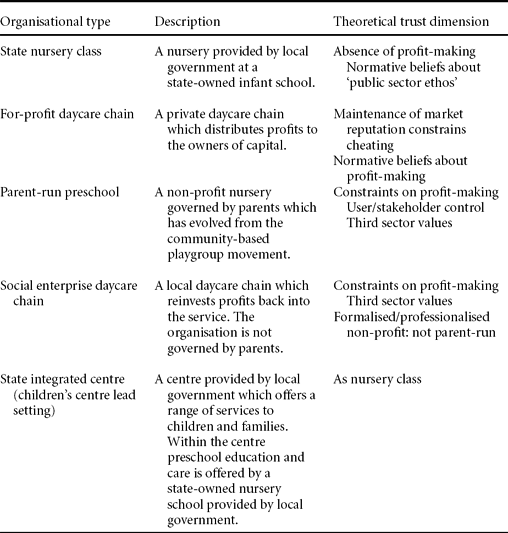
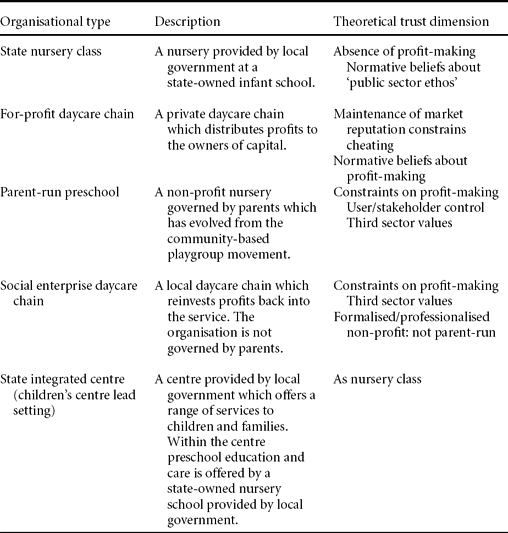
An empirical study explored how and to what extent parents trusted preschool childcare provision. Research was undertaken across five organisations in inner London (Table 1): a state nursery class attached to an infant school; a large for-profit daycare chain; a parent-run third sector preschool; a non-profit social enterprise daycare chain, which was not parent-run; and a state integrated centre in which early education was offered through a state nursery school. The selection of organisations was informed by propositions about trust and organisational form (as listed in Table 1), and also by organisations’ policy relevance. Daycare nurseries, preschools, nursery classes and nursery schools lie at the heart of the childcare mixed economy: excluding state reception classes,Footnote 1 these are the forms of preschool group childcare most commonly used by parents (Bryson et al., Reference Bryson, Kazimirski and Southwood2006). In addition, the state integrated centre was the lead setting of a children's centre, which enabled the study to consider this policy initiative.
Selection of organisations
Twenty-seven semi-structured in-depth interviews were undertaken with parents whose children were attending the settings. Approaches to parents were made with the assistance of nursery managers. Five or six parents were interviewed at each organisation. Where possible, parents of children aged three or four years were selected: at this age parents have, in principle, the fullest choice of organisational forms. The study sought to include parents from a variety of backgrounds. Using household occupational status, twelve parents were categorised as working class (the majority of whom were from Black or Minority Ethnic backgrounds); within this group, five households did not have employment. Fifteen parents were categorised as middle class, of whom one was unemployed (the majority of this group were from white backgrounds).Footnote 2 Eight participants were lone parents, of whom three had been allocated childcare by state social services, and therefore had no effective choice of provision. Twenty-two mothers and five fathers participated: this imbalance was not unexpected, given evidence that it is overwhelmingly mothers who arrange childcare (see, for instance, Vincent and Ball, Reference Vincent and Ball2001).
The selection of parents, finally, was not consistent across organisations. Parents at the parent-run preschool and the for-profit chain had a generally high socio-economic profile; by contrast a number of parents at the state integrated centre and at the social enterprise daycare chain faced disadvantage. Such a contrast was also not unexpected, given socio-economic segregation in the childcare market (Ball and Vincent, Reference Ball and Vincent2005; Bryson et al., Reference Bryson, Kazimirski and Southwood2006).
Interviews explored parents’ trust in providers, both at the moment of choice and as the relationship developed. Bases of trust were considered broadly and not limited to organisational form and behaviour; such an approach permitted understanding of the relative importance of organisations. The interview process also enabled investigation of the association between parents’ opinions of organisational form and their actual behaviours.
Findings
Findings are presented in two sections. First, a priori beliefs about the trustworthiness of sectors, ownership forms and organisational reputation are discussed; such beliefs are found to have little relevance to parents’ decision-making about the trustworthiness of childcare. Instead, as described in the second section, evaluations of trustworthiness were actively constructed by parents; from an organisational perspective, attention therefore switches from a priori consideration of structures to observed organisational behaviours which were perceived to be more or less trustworthy. Such active construction of trust had a distinctive dynamic for a number of parents who used the integrated centre; these parents, through experience of services at the centre prior to childcare use, developed trust through familiarity over time, rather than within a brief choice process.
Before considering these findings, it is worth noting that the very concept of an ‘organisation’ was a fundamental basis of trust for some parents. This is a relevant finding in the context of childcare in England, in which provision is often offered in a domestic setting through individual actors, such as childminders and nannies. An organised group setting was considered to be a public space in which wrongdoing or incompetence was difficult to conceal:
a nursery is a public place . . . there is more control . . . people who have problems or they're sick or they do nasty things, they tend to do it in private rather than in public. (preschool parent 5)
There were perceived to be multiple actors who supervised behaviours, and an organisational structure which controlled and monitored:
The big choice . . . was whether to use a childminder or a nursery . . . I felt I trusted a nursery more, trusted . . . the organisation more . . . You've got the nursery nurses and you've got the supervisory nurses and you've got a structure that's checking and you've got other parents . . . (private chain parent 2)
The public space of the nursery was contrasted with the uncontrollable and unsupervised domestic setting, which created the opportunity to skimp on quality or to commit abuse:
I wouldn't use a nanny in my home . . . having two girls . . . I'm very untrusting of people I don't know looking after my kids . . . the opportunity's not there for nasty things to happen [in a group setting], whereas, one on one in a home . . . the opportunity is there. (preschool parent 3)
Previous research has found that working-class parents are particularly likely to disapprove of childminding (Vincent et al., Reference Vincent, Braun and Ball2008); here, however, fears of individual childcarers were equally reported by working-class and middle-class parents.
Such views were not universal. Several parents had successfully used childminding in the past. Some had rejected childminding, not on the grounds of trust, but because a group setting would be beneficial for children's social development. Nonetheless the organisation, as public space, was a pertinent basis of trust for a number of parents.
Sectors and organisational form as signals of trustworthiness
The study found little evidence that organisational form or sector was a significant basis of parents’ decisions to trust. For a number of working-class parents in particular, the concept of sector or ownership was meaningless or confusing. There was incomprehension of third sector provision among parents from all backgrounds – even some parents who were using such provision mistakenly believed that the setting was state-owned. For other parents, sector was simply not relevant:
Taking my child to a private school doesn't necessarily make me more trusting . . . you can get a mad teacher in a private school that will . . . stress your child out. And you can have the same in the state school. (private chain 5)
didn't really worry us whether it was private or public. (preschool parent 3)
A minority of parents, however, did hold opinions about the predicted reliability of state and for-profit organisations. Yet there was little evidence that such beliefs played a central role in parents’ perceptions of trustworthiness. These findings are considered in turn.
Opinions and beliefs
A number of parents held strong, often contrasting beliefs about the trustworthiness of different organisations. There were, for instance, opposing views of state provision. For one working-class parent who used the state integrated centre, state provision brought ‘peace of mind’:
I thought, well, there mustn't be anything dodgy going on here because this is a council nursery. It's not a private nursery where it might be more difficult to keep an eye on what . . . [it is] doing. (integrated centre parent 4)
By contrast a middle-class parent at the private chain believed that state employees would be poorly motivated because of low salaries and a certain ethos – ‘government employees set in a certain way’. Similar views were expressed by a working-class parent who used the social enterprise daycare chain and who, perhaps because her child had been allocated a place through social services, mistook the organisation for a government agency. Strong negative opinions were therefore applied by her to the social enterprise as if it were a state provider. State provision was perceived to be inadequately funded; as a result staff:child ratios would be poor and children would receive insufficient attention. This parent's expectations were low:
I knew it from day one that . . . I'm not going to expect the highest, the best quality . . . it's not that they don't want to do it, they can't because there's not enough staff . . . (social enterprise parent 1)
There were similarly contrasting views on the reliability of for-profit provision. Some parents expressed concern that profit-seeking might affect behaviours, and that providers would renege on promised quality behind closed doors:
there are some problems with . . . the profit-related drive . . . where they are cutting costs to maintain a profit and . . . they're employing cheap labour . . . I'll . . . be watching out for it. (private chain parent 5)
you pay money in some nursery . . . when you . . . visit them, they say, ‘oh we do this, we do this . . .’, but when you leave them and go home, they don't do nothing. (integrated centre parent 2)
A parent's disturbing previous experience at a large profit-making chain was also attributed to the profit motive:
you have all these entrepreneurs think, ‘let's make the money’ . . . opening these awful . . . unfriendly, unloved child-caring places. (nursery class parent 3)
Alternatively some parents who used the for-profit chain believed that the interests of a profit-making provider were aligned with parents’ desire for high quality. These beliefs in principle were consistent with preservation of reputation as an incentive for trustworthy behaviour among for-profit firms:
it is about satisfying . . . parents . . . [If] a parent is unhappy with the nursery, the child is obviously not getting on . . . ultimately the nursery will go out of business. (private chain parent 5)
A flourishing for-profit chain was generally considered, by the parents who used it, to be a reassuring signal that the organisation had historically met parent demand.
There was, however, little support for the proposition that a chain's behaviour is in practice constrained by the need to protect its reputation. Poor performance in one nursery was unlikely to contaminate other settings in the chain: information about such poor performance would probably not reach parents elsewhere; even if information did filter through, nurseries were stand-alone entities, each of which must be judged on its own merits:
the people are different . . . not because it's a [name of chain] nursery you have to blame all of them . . . You cannot put the blame one nursery to another one. (private chain parent 1)
There was, finally, little comment about third sector organisations. A middle-class parent at the for-profit chain was ‘a great believer in the voluntary sector doing stuff like this’: nonetheless he did not believe that the third sector was more trustworthy than the private. By contrast, for a working-class parent who used the nursery class, non-profit provision carried a stigma: she would not choose for her child a ‘charity place’. None of the parents who used the parent-run preschool identified parent control as a meaningful signal of trustworthiness.
Beliefs and behaviours
There were thus diverse opinions about the quality and reliability implied by different sectors. The study sought to understand how far such beliefs were enacted. Significantly, parents’ opinions about sectors, no matter how strong, had little influence upon behaviours. Thus two parents at the for-profit provider supported the idea of a chain – but for neither was it a significant part of their choice process. Another parent was enthusiastic about third sector provision, but made no attempt to seek it out – he was, indeed, unaware that such provision was available locally. Such patterns were repeated by other parents. Beliefs in this context became post facto sources of reassurance: knowledge that a nursery was part of a profit-making chain, or conversely that it was state-owned, was a further comfort that choices had been correct rather than an intrinsic dimension within a decision to trust.
To an extent, parents’ choices were constrained by availability and affordability of provision. Only four middle-class parents had a genuine choice across all three sectors; another four parents limited their own choice set by seeking only provision attached to state schools. Nonetheless, while such barriers to choice were of concern to parents, there was generally no expressed resentment about an inability to access any organisational sector. There was one clear exception. Social enterprise parent 1, because she received her child's place through social services, had no choice of organisation. Her preference was strongly for private provision, and her mistaken belief that the social enterprise was state-run informed her lack of trust in the quality of care which her children would receive.
There were no other cases in which a priori beliefs about sector or organisational form were a primary or essential reason for trusting or distrusting a nursery – whether because the majority of parents did not hold such beliefs, or because such beliefs were not central to decisions around trust. Instead, parents overwhelmingly focused on the characteristics of individual nurseries and their staff:
I didn't really worry about whether they're a chain or not. I was worried about this nursery and . . . the care my child's going to get here. (private chain parent 3)
Active construction of trust and organisational behaviours
Thus propositions that organisational form or sector are an essential a priori signal of trustworthiness are not supported here. Therefore we move to the third research question – do organisational characteristics or behaviour otherwise contribute to trust? It is necessary first to consider how parents approached the issue of trust. Instead of relying on a priori signals, parents gave prominence to their own critical assessments of the quality of provision. Such assessments were underpinned by confidence that information asymmetries were not insurmountable:
if you're relatively astute, you can. . . work out for yourself if it's a good one or a bad one. (preschool parent 4)
Critical assessment took place across numerous dimensions. First, parents directly observed task performance – for instance, the interaction between staff and children. Such observations were possible even during an initial visit to a nursery. As the relationship developed, iterative interactions created frequent opportunities for parents to assess the nursery's performance and reliability. Second, the motivations and dispositions of staff were assessed. Settings were rejected because staff were ‘gloomy’; staff impressed because ‘you can see when someone really enjoys their job and actually takes care in what they're doing’ (preschool parent 4). Third, recommendation from acquaintances was combined with parents’ own observations to paint a picture of the nursery:
I came here, I talked to my friends, and I had a feel for the place . . . and at the beginning the mums are allowed to stay with the children. So I knew . . . what they are doing, what kind of place it is. (preschool parent 2)
Fourth, children's feedback was a valued resource. Whether through report, stories or simple willingness or unwillingness to attend, children communicated the extent of their happiness, a key aspect of quality for all parents. Parents were confident too in their ability to monitor child development, and to attribute such development (whether good or bad) to attendance at preschool.
The focus and extent of such critical assessments varied within parents’ accounts. Some parents were significantly more active in observing and assessing staff: such parents were predominantly, but not exclusively, middle class. Nonetheless for all participants trust in preschool provision was not a passive process, based on a priori assumptions. It was instead an active construction, drawing upon parents’ observations and interpretations of providers’ behaviours and children's responses. The objects of such observations were typically individual staff members. However, the process was also situated within the context of the organisation. A number of organisational behaviours can be identified which contributed to or confounded the active construction of trust.
The problem of money and business
Several parents reported that organisations exhibited a certain emphasis on business behaviours and money-making. Such behaviour might be sufficient reason not to use a provider. One middle-class parent, during an initial visit, was taken aback by the immediate and detailed reference to payment:
you had to pay way ahead . . . it was almost like a money-making machine . . . you had to give . . . a whole term notice otherwise they wouldn't give you anything back. I felt that they were really keen on making as much money as they could. (nursery class parent 4)
Such a focus on money undermined trust:
I felt it . . . had a certain purpose . . . I don't want to say that I thought that maybe I would be taken advantage of, but I didn't like it.
More subtly, a parent rejected a nursery in the social enterprise chain because she was treated as a customer in a business transaction. The private chain nursery was different: here she ‘was treated like a mum who was looking for a place for her child’. In this case the success of the private chain (and failure of the social enterprise) indicates that it is not profit-making per se that is problematic; rather, parents are disturbed by observed behaviours or representations which imply the prioritisation of money within the childcare relationship.
Transparency
Organisational transparency supported parents’ trust in two ways. First, it enabled direct observation of the preschool's task performance and a child's contentment:
I came from time to time to sit . . . to see what's going on, to see how she's playing . . . how the staff look at her. (integrated centre parent 1)
[I] visited . . . without warning . . . to see what was going on. I was able to look through the window . . . he seemed to be absolutely having a whale of a time. (private chain parent 5)
Such observation was facilitated by ‘settling-in’ periods, offered across all settings, during which a parent stayed at a nursery while the child became familiar with the environment. On an ongoing basis, parents observed the nursery when they dropped off or picked up their children.
Of course, trust would not flourish if parents observed poor performance. One decision to exit a nursery was informed by what parents saw when they sat in on sessions:
the way they reacted with the children wasn't terribly good. They did tend to shout. There was a couple of situations where they were ignoring children who were distressed . . . that's always worrying . . . (preschool parent 4)
Second, transparency indicated that an organisation was confident in its own competence. For one parent, the for-profit chain's willingness for him to visit without warning ‘made me feel reassured’. For another:
it gives you trust because you know what they're doing and they're not afraid of anything and they don't want to hide anything. (preschool parent 5)
All organisations sought to be transparent: the private chain and social enterprise used the same terminology of an ‘open-door policy’, by which parents, in principle, might visit the nursery at any time. The nursery class and social enterprise preferred parents to give warning of a visit, in order to prevent disruption. But transparency was especially meaningful if warning was not given, so that the possibility of manufactured performance was excluded.
The significance of transparency was emphasised by situations in which it was absent. One parent had used a nursery in Spain where ‘they wouldn't open the door for you’. She felt compelled to undertake covert monitoring, a behaviour which implied strong distrust:
I had to do some spying . . . I found a little hole in the wall . . . I did my best to check any time I could. (preschool parent 5)
For one parent, the structure of the private chain inherently lacked transparency. Parents were not kept informed during a period of managerial instability:
the fact that there's a chain . . . things . . . go on obviously we don't know about, that mean that the turnover of managers has been too high. (private chain parent 2)
Communication
All organisations sought to communicate with parents through mechanisms such as parent visits, record books of children's achievements, or conversations at the beginning and end of sessions. Frequent communication created a sense of openness, and also gave parents confidence that problems would be resolved:
[the manager's] communication impressed me . . . she was very open . . . and told me what's what, which I liked. (private chain parent 3)
[I] have almost a day-to-day catch-up . . . if I've got a concern, it . . . gets dealt with immediately. (ibid.)
Frequent communicative interactions developed the relationships between parents and staff:
There's always the words for you, not like strangers bringing your child up . . . I feel like I'm coming in to see my friends. (private chain parent 1)
I've got to know some of the people who work here and chat to them when I come to pick up my son . . . I feel I've got an understanding of the place just through my knowledge of them. (private chain parent 5)
Two factors appeared key to effective communication. First, the accessibility of staff was important – for some parents communication was ideally a daily process. Second, formal reporting – such as parents’ evenings or record books – did not have strong significance. It was the rich information provided through informal interactions at the beginning and end of sessions which was valued. The meaningfulness and benefit of these interactions contrasts with findings in previous studies (Vincent et al., Reference Vincent, Braun and Ball2008). Middle-class parents in particular were developing strategies to facilitate such informal interactions; in turn, organisations were seeking to enable frequent communicative opportunities.
Turnover of staff
Turnover of staff was unsettling for parents of all backgrounds. It was particularly problematic at the private chain, where management instability and staff turnover had occurred simultaneously. Such turnover disrupted relationships and the familiarity which had built over time:
you are entrusting your child to a group of people . . . once you get to know the people who are looking after your child, it's unsettling if they then go. (private chain parent 5)
For another parent, the departure of the manager had still more impact. The strong emotional bond, established by the manager's support when the parent first left her child at the nursery, was irreplaceable.
Turnover also brought new staff into the setting. If such staff were not appropriately introduced to parents, the appearance of strangers was threatening:
every day there was a new person . . . my point was whether that carer was in my child's class or not, that person is in this nursery and I don't know him. (private chain 3)
Two parents at the private chain were explicit: the combination of staff and management turnover, poor communication and lack of transparency substantially reduced their trust.
Trust through familiarity: the integrated centre
Often the active construction of trust implied swift assessments of trustworthiness, based on observation during a single visit. A different dynamic was apparent among those who used the state integrated centre. Parents, through experience of other services provided by the centre at the same physical site, built up knowledge and trust over a period prior to use of childcare. Relationships with the centre were typically initiated through use of the drop-in (a play session at which parents stay with their children), before extending to services, such as toy library, adult learning and crèche.
The extended use of services had several effects. First, parents became familiar with the centre and its competence. Second, they were specifically able to observe the nursery over time, making multiple in-depth visits before choosing to use it:
You could . . . bring your child downstairs and have a feel for the nursery . . . it wasn't just the once because obviously we were using the facility . . . you could come down . . . and speak to the staff . . . (integrated centre parent 4)
Third, parents became familiar with nursery staff. Such familiarity was facilitated by the centre's rotation of staff between drop-in, crèche and nursery:
I get used to staff in the crèche . . . some of the staff . . . now . . . work in the nursery. So that's easier to help me settle her in. (integrated centre parent 2)
Finally, parents became familiar with each other. Such interaction brought access to information and recommendation from existing users. Because parents were familiar with the centre, the decision to use the nursery was untroubled:
I didn't really want him to go to another nursery . . . I had built up a rapport . . . it was a comfort to know that I knew where I was going to leave him. (integrated centre parent 4)
Such straightforward decision-making implies a level of trust in the provision. Parents indeed identified as a basis for trust their familiarity with the centre and its staff:
I used to do the computer course – the crèche worker who was looking after my daughter . . . they brought her downstairs in the nursery and she's . . . my daughter's keyworker. That's more for me to trust her. (integrated centre parent 2)
Discussion
The generalisability of findings from an exploratory study of this kind is necessarily limited. With this caveat, the study uncovered a range of perspectives and perceptions which carry implications for theory and practice. The concept of a childcare ‘organisation’ was a source of trust for some parents. It was a public space in which the presence of multiple actors and organisational structures was perceived to protect against opportunism or abuse. However, the form or sector of such organisation received limited consideration as a signal of trustworthiness. For many parents these dimensions were not relevant or even comprehensible. Others expressed a miscellany of opinions, ranging from suspicion of the profit motive and trust in public sector processes to belief in the market and critiques of state sector motivations. The study highlights, however, that these perceptions did not constitute the basis of parents’ behaviour or, except in a single case, a primary foundation of attributions of trustworthiness. Nor was there support for rational actor propositions that organisational reputation is perceived as a significant incentive which encourages trustworthy behaviour. A small number of parents expressed views consistent with this position – but again there was no evidence that such beliefs informed behaviour. Further, parents’ approaches to the for-profit chain confounded theoretical propositions: evidence of poor quality at one nursery was not seen to affect trust in other settings in the chain. The absence of association between opinion and action may be partly attributable to limited opportunities for parents to choose between organisational sectors. It may also be that, just as a priori trust in professional status is predicted to decline in an age of scepticism, so too does trust in certain organisational forms. Alternatively, the childcare market may be of sufficient maturity to enable crude a priori signals to be discarded (Anheier and Ben-Ner, Reference Anheier and Ben-Ner1997).
Parents instead assessed organisations’ trustworthiness through their own observations and judgements. Trust was actively constructed (or undermined) within the interactions between parents and nurseries, a finding consistent with Giddens’ (Reference Giddens, Beck, Giddens and Lash1994) notion of ‘active trust’. Such dynamic trust construction creates practical challenges for organisations, since, as Giddens (Reference Giddens, Beck, Giddens and Lash1994: 186) suggests, such trust must be ‘energetically treated and sustained’. There appear to be isomorphic pressures which push providers to respond to this challenge in similar ways. Such isomorphism is partly imposed: the state has introduced compulsory mechanisms in an attempt to ensure quality, such as a curriculum, staff:child ratios and safety regulations. Organisations in the study also exhibited similar non-coerced behaviours, such as transparency, regular communication and settling-in periods. Additionally, PVI providers face a specific representational challenge in order to gain trust. In contrast to state provision, which is free at the point of delivery, PVI providers, as trading organisations, must manage the collection of fees. In common with the findings of Vincent and Ball (Reference Vincent and Ball2001), parents were disturbed when an organisation placed apparent emphasis on business and money. Such an emphasis implied inappropriate motivations.
The notion of familiarity infused parents’ accounts of trust. There is resonance here with the proposition of ‘knowledge-based trust’ (Lewicki and Bunker, Reference Lewicki, Bunker, Kramer and Tyler1996: 121; Möllering, Reference Möllering2005), whereby trust develops with the knowledge created through experience. Trust is again actively constructed, but over time – a process which Luhmann (Reference Luhmann1979: 41) describes as the ‘principle of gradualness’. Staff turnover undermined trust precisely because it disrupted familiar relationships, the known staff member being replaced by a stranger. Here the structure of the state integrated centre offered a specific advantage. Through parents’ various interactions with staff, with the centre's other services and with the nursery itself, trust was developed through experience even before the nursery was used. In contrast to the abrupt leap into childcare characteristic of market choice, parents progressed to nursery use through a series of unthreatening steps. Parents at the centre were generally disadvantaged; some had previously been reluctant to engage with services or were nervous about childcare. A gradual process of trust construction may be particularly beneficial in such contexts. Disadvantaged parents can also be isolated from ‘hot knowledge’ about childcare which flows through middle-class networks (Vincent and Ball, Reference Vincent and Ball2001): the community of parents at the centre's drop-in provided a partial remedy to such isolation by enabling access to ‘hot’ information about childcare at the nursery.
A number of policy challenges arise from these findings. Given the political emphasis on the benefits of third sector organisations, there is a striking lack of awareness among parents of both the idea and the availability of such provision. To an extent, this finding may be attributable to the research selection. The parent-run preschool provided services to a mobile group of parents, many of whom were from overseas. It is therefore not necessarily an exemplar of a parent-run community-based service; propositions that third sector organisations may incubate trust through community involvement in the co-production of services remain tenable (Laville and Nyssens, Reference Laville, Nyssens, Borzaga and Defourny2001). Nonetheless the idea of third sector childcare provision seems to have little institutional embeddedness. Third sector organisations’ contractual relationships with the state may also be problematic. In the current study, the social enterprise provided places for vulnerable children under contract to state social services. This relationship confused the boundaries of state and third sector; for one parent who received such a place, some kind of distrust was created – a certain barrier in the relationship between parent and setting – which potentially undermined any trust advantage which the social enterprise might possess. Such a dynamic recalls warnings about the dangers for third sector organisations if they become close to the state (Dahrendorf, Reference Dahrendorf and Anheier2000).
There is some support for the policy emphasis on market-based processes. Many parents appeared comfortable in the role of proactive consumer: they were sufficiently confident to make their own assessments of trustworthiness within a mixed economy of childcare providers. Discomfort, however, was created by explicit money-making behaviours; given policy focus on demand-side subsidy and PVI provision rather than on a free universal service, such tensions seem inevitable. There is also confusion among parents about the reach of regulation, so that there is distrust of apparently under-regulated private providers.
Most importantly, the understanding that trust is constructed through familiarity creates two significant challenges. First, there is the issue of staff turnover, which disrupts familiarity and therefore trust. Daycare settings exhibit markedly higher turnover rates than state schools and nursery classes (Phillips et al., Reference Phillips, Norden, McGinigal and Cooper2009); in the current study, it was indeed the for-profit daycare nursery which experienced disruptive turnover. High staff turnover thus becomes – in common with quality, levels of qualifications and levels of funding – a matter of concern in relation to provision through market-based daycare settings. Second, those characteristics of the integrated centre which encouraged the gradual acquisition of trust – namely, provision of multiple services at a single site by a single organisation, so that staff and setting become familiar prior to childcare use – are not prioritised in current policy. They are unlikely to be produced within a fragmented market, nor are they inevitably achieved through the Sure Start children's centres programme. This initiative favours PVI childcare provision, with the result that childcare may be disconnected from other services within a centre; in addition, services in children's centres, especially in urban areas, are not necessarily contained at a single site, but may be dispersed across a local area. Such ‘virtual’ integration of services is unlikely to support trust production.
In conclusion, this exploratory study finds little evidence that organisational ownership or sector strongly inform parents’ decisions to trust childcare providers. Instead, trust is actively constructed within interactions between parents and providers. For organisations, the necessary response is transparency, communication and exhibited expertise. Trust, moreover, is constructed with less trauma where familiarity can grow over time. The incorporation of such a ‘principle of gradualness’ into childcare policy implies – especially where parents are unconfident consumers – a move away from fragmented market-based mechanisms to more holistic service provision. In particular, there may be some benefit in the provision of integrated services at a single site by a cohesive organisation, by which means trust may be constructed even before childcare is used.
Acknowledgements
I am very grateful to Anne West for her comments on various versions of this paper, and to Julian Le Grand for his observations on the final draft. I am also very grateful to the editors and anonymous referees for their valuable suggestions.