1. Introduction
Taking Bogen and Woodward's (Reference Bogen and Woodward1988) discussion of data and phenomena as his starting point, McAllister (Reference Glymour1997, Reference Hoefer2007, Reference Suppes, Nagel, Suppes and Tarski2010) presents a challenge to scientific realism. Our symposium revisited this distinction, 20 years on, and here I discuss the challenge raised by McAllister and offer a suggestion for how the scientific realist could respond to both its epistemic and ontological aspects. In so doing, I urge that the scientific realist should not reject ontological pluralism from the start, but should seek to explore versions of scientific realism that leave open the possibility of certain kinds of pluralist ontology.
Following some scene setting (sec. 2), I focus first on the epistemic aspect of McAllister's challenge to scientific realism (sec. 3). If we then ask what ontological conclusions are warranted in the face of this epistemic challenge, we arrive at a particular form of ontological pluralism. This is not the “radical polymorphousness” that McAllister advocates, but along with other recent arguments in favor of ontological pluralism, it raises a methodological issue for philosophy of science. We have an unresolved dispute between the fundamentalists and the pluralists (of various stripes), and the pluralists have at least this much on their side: current empirical evidence does not warrant a commitment to foundationalism. With respect to other important issues in philosophy of science (pick your favorite), how much hangs on the prior resolution of this dispute? One way to find out would be to formulate an approach to the ontology of physics that is neutral with respect to fundamentalism versus pluralism and to see how far we can get in tackling other important issues. For example, it would be helpful to separate discussions of fundamentalism/pluralism from those of realism/antirealism, and the latter from reductionism/antireductionism, where possible. I offer an approach to the ontology of physics that is neutral with respect to these disputes in current philosophy of science in the hope that it may prove a useful tool. Section 4 discusses these issues in the context of McAllister's ontological challenge.
2. Data and Phenomena in the Semantic View of Theories
According to one of the fathers of the semantic view of theories, Pat Suppes, scientific theorizing consists of “a hierarchy of theories and their models” (Suppes Reference Schindler1962, 255; see also Suppes Reference Morrison and Morgan1960) that bridge the gap between the high-level theory and the lower-level phenomena. I will situate McAllister's challenge to scientific realism within the semantic view of theories. Let us begin, then, with some version of the semantic view of theories, part of which is a hierarchy of models (oversimplified, but the gist will do for current purposes):Footnote 1

At the top we have theoretical models; further down we have data models, with perhaps the “mediating models” of Morrison and Morgan (Reference McAllister1999) in between, and we assert that there is some appropriate relationship of similarity between these levels of the hierarchy. We then proceed on down from data models, data, and appearances and wind up, if you are a realist, with “the world.” Everything from (and including) the data up is part of the theoretical structure. The “appearances” and “the world” are ontological.
The realist claim is that the theoretical models represent the way the world is. The structural realist claim is that the structure of the world is captured by the structure of the models. A structural empiricist, by contrast, might claim that the theoretical models capture the structure of the appearances.Footnote 2 What is important here, for realist purposes, is that we have a hierarchy with theoretical models at the top, data models further down, some data underneath those, and then some kind of relationship to the physical stuff that is the subject matter of the high-level theory (associated with the theoretical models occurring at the top of the hierarchy).
Let us suppose that a good scientific theory should, among other things, “save the phenomena.” Then, one issue is this: what are the phenomena, and where are they located in this hierarchy? One suggestion might be that we should have a theory that recovers the world as we experience it, in all its rich and complicated detail: we should save the appearances. On this view, the phenomena are the appearances:

But the world as we experience it is rich and complicated, and so we do as Galileo did, and we try to isolate some part of the complicated appearances and provide a theory that describes just this aspect: for example, the rate of fall of a stone dropped from a tower when the complications due to the medium through which the stone is falling—the air—are ignored. The upshot is that now we are not trying to save the appearances—since these are too complex—and the phenomena are distinct from the appearances, as Bogen and Woodward (Reference Bogen and Woodward1988) argued.
The question then arises as to where we should locate phenomena (i.e., that which a theory saves) in the hierarchy. This is an issue that Teller (Reference Teller2010) discusses in the opening paper of the symposium. Teller distinguishes between “phenomena tokens” (here “data models”) and “phenomena types” (here “phenomena”). Following his lead, we might locate phenomena above data models in the hierarchy (see the diagram below), as a theoretical generalization over data models. The literature after Bogen and Woodward includes disagreement over the status of phenomena (in addition to the contributors to this symposium, see especially Glymour [Reference Cartwright2000], Massimi [Reference Massimi2007], and Schindler [Reference McAllister2007]). But if we accept the distinction between phenomena and appearances and locate the phenomena above the data models in the hierarchy, we have a gap between the phenomena and the appearances:

This gap poses a prima facie problem. If we locate phenomena above data models in the hierarchy, then they are theoretical. As a result, the claim that a theory saves the phenomena no longer addresses the connection between the theoretical levels of the hierarchy and either “the world” (for the realist) or appearances (for the empiricist). What is needed is an account of the relationship of the phenomena to their ontological counterpart (if any such exists). One can assert the existence of this ontological counterpart by asserting that the phenomena are a part of “the world” (following Bogen and Woodward), but a terminological blurring of the distinction (between the theoretical phenomena and their ontological counterpart) does not get rid of the gap. The empiricist might retreat from the appearances to the phenomena, and I think that is fine, as long as it is acknowledged. The realist is in a tougher spot, I think.
3. McAllister's Challenge to the Scientific Realist: Epistemological Lessons
3.1. McAllister's Challenge: The Logical Point
McAllister makes his point in terms of structure. Here is the structural realist version of the above problem: what justifies the claim that the theory that saves the structure of the phenomena thereby captures the structure of the world? Clearly, this claim goes through only if we can establish a link between the structure of the phenomena and the structure of the world. McAllister argues that there is no such link.
McAllister's point is, in the first place, a logical one. He says that there is always an element of freedom in how we separate the data into pattern versus noise (in the sense in which he uses these terms). We can illustrate the claim as follows. Suppose that we have got as far as making measurements with outcomes plotted as dots on a graph. There is always an element of freedom in how we draw a line through those dots—in what counts as a pattern in the dots and what counts as noise. Thus, McAllister's claim is that the relationship between the data and the phenomena is not one to one but one to indefinitely many. From this observation, he argues as follows: if the very same data set gives equal support to indefinitely many differently structured phenomena, then the choice of how to structure the phenomena is not driven bottom-up, by how the world is, at all. We are therefore in stark need of a justification for the claim that the structure of the phenomena represents the structure of the world.
3.2. The Scientific Realist Responds
The standard move of the realist here is to appeal to the “no-miracles” intuition: if the theory had not latched onto the structure of the world, then the success of that theory would be a miracle. But it seems to me that there is an equally powerful no-miracles argument that pulls in exactly the opposing direction: if all possible structures are equally compatible with the data, then it would be a miracle if we happened to have picked the one that the world “really has.” The miracle is on the other foot, so to speak.
I think that the scientific realist has a much better response available. First of all, she should insist that if “McAllister's challenge” is to be worthy of her attention, it should amount to more than general skepticism. If it is just skepticism in fancy clothes, then it is not very interesting (or not to me, at least). So the question is, if we put general skeptical worries aside, are we still faced with McAllister's challenge, or have we swept that away too under the general umbrella of skepticism?
Let us think about the logical point that McAllister makes a little more, by means of an analogy. The analogy that I want to draw is with Newtonian mechanics, as follows.
It is a logical point that I can choose any body to define the standard of inertial motion and then find “force functions” that will account for the motions of the remaining noninertially moving bodies. But this does not render Newton's first law void of content. It is highly nontrivial that I can find a set of inertial frames combined with a self-consistent way of attributing forces, such that bodies moving uniformly are deemed force free, and the rest of the bodies move in accordance with simple force laws of mutual interaction (where the bodies themselves are the loci of the forces) depending on a few parameters taken to characterize the bodies. Of course, giving Newton's first law content in this way has an element of circularity about it, but the fact that we can do it at all is highly nontrivial, and it is a highly nontrivial fact about the world: the world might have been such that we could not pull off any such feat after all. So the logical point loses its force, and the empirical content of Newton's first law can be recognized.
The analogue of McAllister's claim in this Newtonian example is the claim that there are no possible worlds in which attempting such a feat is doomed to failure: with sufficient ingenuity we will always succeed. The consequence of this claim is that Newton's first law is, after all, void of empirical content: there are no possible worlds in which it is false. If McAllister believes this about Newton's first law, then I would like to see the argument that yields this conclusion without triggering a collapse into general skepticism.
Returning to the pattern/noise case, the scientific realist has available a response to McAllister's logical point that is analogous to that in the case of Newton's first law: while all patterns are equally compatible with a given set of data (and this is trivial), not all are equally “robust” (where “robustness” is highly nontrivial). This “robustness” of phenomena is part of what Bogen and Woodward made vivid and is further discussed in Woodward (Reference Teller2010). It includes such features as reproducibility and multiple access. Thus, we can use the same procedures to repeatedly reproduce the same pattern under specified constraints concerning allowable noise levels, and by appeal to background knowledge and theory we can find different ways of producing the same patterns, again with specified constraints concerning allowable noise levels. The robustness of some patterns is, I contend, evidence of a bottom-up (i.e., from world to theory) restriction on which patterns in a given data set it is legitimate to elevate to the status of phenomena. The point is that phenomena are robust patterns. McAllister's claim seems to be that there is no noncircular account of robustness. But, say I, the onus is on him to show that the circularity is different in kind from that in the case of Newton's first law and that it is vicious. My conjecture is that in the end “robust phenomena” will be robust against everything except general skepticism. McAllister's logical point is, by itself, powerless against this claim.Footnote 3
An alternative response considered by McAllister is to accept the existence of robust patterns but to reject the claim that these are evidence of bottom-up constraints on which patterns count as phenomena. His alternative proposal is that it is the human mind, rather than “the world,” that is responsible for the salience and robustness of certain patterns; he continues to insist that all patterns are equally present “in the world,” using this claim to press his ontological claim of radical polymorphousness. Presented in this way, his argument offers a route to a form of idealism, perhaps of a neo-Kantian variety, and then the polymorphousness of the “noumena” seems a great deal less “radical.”
In sum, it seems to me that the case against the scientific realist, and in favor of radical ontological polymorphousness, has not been made. I think that there are good grounds for asserting that, despite the logical point, not all patterns have an equal ontological status: some are robust, and we are warranted in elevating these and only these to the status of phenomena.
So the scientific realist is all smiles: idealist considerations to one side, robustness shows that there is a bottom-up constraint that delivers “the structure of the phenomena,” and from here we can infer the structure of the world via no-miracles considerations. But that will not do either; it is too quick.
3.3. McAllister's Challenge: The Substantive Epistemological Point
McAllister's logical point gains substantive force when we recognize that different phenomena are robust in different contexts and relative to different interests (see also Teller Reference Teller2010). This means that the no-miracles consideration (insofar as it succeeds at all) gets us to the claim that the success of our theory in the domain in which it has been applied and in the context of the way we apply it would be a miracle if our theory were not approximately right about the relevant aspects of the world that generate those empirical results. It does not get us to the unique (context-independent) structure of the world. Neither robustness nor the no-miracles consideration, nor the two taken together, provides justification for the uniqueness claim. The observation that uniqueness is a further substantive claim not warranted by robustness plus no miracles is, I take it, the epistemological lesson that we should draw from the partial autonomy of the phenomena from the data.
4. McAllister's Challenge to the Scientific Realist: Ontological Lessons
McAllister wants to go beyond this epistemic conclusion to draw an ontological conclusion too, inferring some kind of radical polymorphousness of the world. The thesis is that all patterns are equally present everywhere at all times. We have already reined in the epistemic thesis to admitting only those patterns that are robust, and the related ontological thesis is therefore similarly restricted. It may be that a plurality of equally present patterns is the best ontological fit for this epistemic position, but it is not obvious to me that this is right. I do think, however, that it is interesting to see what ontological commitments are consistent with giving up the realists’ uniqueness claim. I will say something about this in the remainder of the paper.
4.1. The Scientific Realist Responds
The message of the paper thus far has been the following modest claim. Our account of the epistemology and ontology of scientific theories should allow for the possibility that a uniqueness claim (concerning, e.g., the structure of the world) is not justified. That is, we should allow for (i) phenomena (that a given theory saves) being partially autonomous from the data and (ii) the salient patterns relative to one context (where context includes our interests) being partially autonomous from the salient patterns in other contexts.
What I want to do now is to make use of an approach to the ontology of physics that is consistent with the uniqueness claim failing (while leaving open that it could be true), such an approach therefore being neutral with respect to the issue of ontological pluralism, in order to explore McAllister's challenge to the scientific realist.
The approach I have in mind is “law-constitutive,” according to which the necessary and sufficient conditions for something to be a physical object (say) are that it satisfy the laws of some physical theory.Footnote 4 On this approach, there is no general concept of physical object that can be given prior to specification of the laws of a specific theory. It is not merely that being a physical object of a given kind depends on satisfying the laws of some physical theory (e.g., that a given physical object is an electron depends on that object satisfying the laws of electron theory): rather, what it is to be a physical object at all is to be something that satisfies the laws. This briefest sketch is not sufficient to spell out the view.Footnote 5 What is important for our purposes here is the use to which it can be put.
McAllister's challenge, in its ontological form, is that the plurality of robust patterns corresponds to a plurality of ontologies. Insofar as plurality of ontologies is in conflict with scientific realism, this is a challenge to scientific realism. One way to think about this pluralism is as a failure of ontological reduction. There are many ways to formulate a reductionist thesis, and so putting the issue in terms of reduction may seem to muddy the waters unnecessarily rather than clarifying the situation. However, adopting the law-constitutive approach to the objects of physics leads to a new formulation of the thesis of ontological reduction that is, I think, both powerful and helpful.
The law-constitutive approach makes evident that we must distinguish between two claims: (A) every macro object is a collection of micro particles, and (B) every macro object is a composite system of micro particles, where the term “composite system” is being used to mean a collection of micro particles that, in and of itself, satisfies the laws of the micro theory and therefore counts as an object according to the micro theory. This is really important. Typically, the first is thought to be sufficient for the second to be true. But it is not the case that any old collection of micro objects constitutes a system to which the laws of the micro objects can be applied. The criteria of effective isolation and so forth vary from theory to theory, and if these criteria are not satisfied by a given collection of micro particles, then the laws of the theory of micro particles cannot be directly applied to that macro-level object, even in principle. The objects of some macro theory, though made of micro particles, may not be among the composite systems that serve as the subject matter of the micro theory. Let me be clear about exactly what is being denied here. First of all, this is a denial of type-type reduction. It is important to mention this because, though type-type reduction is currently unpopular, we have to remember that theories deal first off in types, not in tokens. (For example, we may have a theory of “the electron,” the type, which we can then apply to “this electron,” a token.) Second, I am denying token-token reduction as a general principle, but I am doing it while endorsing the claim that macro objects are made of micro objects. Token-token reductionism proceeds by assuming that we can somehow neutrally pick out our tokens and then ask (e.g., by appeal to our theories) whether they are to be identified. On the law-constitutive approach we cannot proceed in this way because what counts as a token is a theory-dependent matter. Thus, token-token reductionism is to be denied as a general principle, even though claim A—the claim that every macro object is a collection of micro particles—is endorsed. In this way, the law-constitutive approach to the objects of physics opens up a third, and more sophisticated, general approach to reductionism, not cashed out in terms of type-type or token-token, which includes the possibility of a version of antireductionism that endorses A yet denies B.
This approach to reductionism is helpful in thinking about scientific realism and pluralism. As it seems to me, merely denying that A entails B does not commit one to scientific antirealism, even though it does open the possibility of pluralist ontologies. If we wish to explore scientific realism without the uniqueness claim, we have here one avenue down which a plurality of robust ontologies, resisting ontological reduction (in the sense of B), need not give the scientific realist cause for concern.
4.2. Fundamentalism, Pluralism, and Scientific Realism
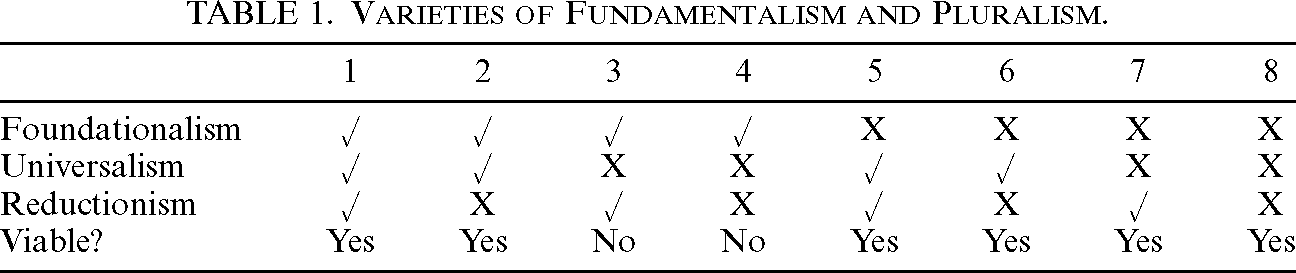
Typically the pluralists are opposed by the “fundamentalists” who believe that there is a single “fundamental” ontology underlying all phenomena. Very often this approach sees the role of “fundamental physics” as being to discover the fundamental ontology. We can distinguish three relevant notions within fundamentalist positions: foundationalism, universalism, and reductionism. I have described above a version of ontological reductionism that I think is substantive (endorsing B as well as A). By “foundationalism” I mean the claim that there is a “bottom-level,” or foundational, ontology, out of which everything is made. By “universalism” I mean the claim that a given theory is applicable to any region of the world. A range of viable positions is available, as set out in table 1. Options 1–8 list all combinations of foundationalism, universalism, and reductionism (endorsement is indicated by a check mark). The final row of the table indicates whether the combination in that column is a viable option, as will be discussed below.

| 1 | 2 | 3 | 4 | 5 | 6 | 7 | 8 | |
| Foundationalism | ✓ | ✓ | ✓ | ✓ | X | X | X | X |
| Universalism | ✓ | ✓ | X | X | ✓ | ✓ | X | X |
| Reductionism | ✓ | X | ✓ | X | ✓ | X | ✓ | X |
| Viable? | Yes | Yes | No | No | Yes | Yes | Yes | Yes |
Recent papers rejecting ontological pluralism have focused on Cartwright's “dappled world.” For example, Sklar (Reference McAllister2003; see also Hoefer Reference Castellani2003; Teller Reference Sklar2004) rejects the inference in Cartwright from plurality of predictive and explanatory schemes to plurality of ontology. He writes, “The claim is, rather, that the concepts of fundamental theory are still applicable ‘in principle’ to complex, compound objects and that the laws of the fundamental theory are as true of these objects as they are of the carefully isolated systems of small numbers of particles constructed in the laboratory” (433).
Cartwright (Reference Brading, Janiak and Schliesser1999) offers a “horizontal” patchwork in which we commit ourselves to the applicability of a theory only where we have, in practice, theoretical models of the physical situation. As she is at pains to stress, typically these situations arise only in the lab or in carefully contrived and shielded “miniature labs” (i.e., manufactured devices that we take out into the wider world). This is a denial of universalism. (And, since one cannot be a foundationalist while denying universalism, both these aspects of fundamentalism are denied, leaving positions 7 and 8 in table 1 open for consideration.) If Sklar's claim is directed against Cartwright's rejection of universalism, it seeks to rule out 7 and 8. However, there would then remain available an ontologically pluralist position that accepts universalism but rejects foundationalism along with reductionism: position 6. Sklar's claim challenges antireductionists who deny both A and B, where A is the claim that every macro object is a collection of micro particles and B is the claim that every macro object is a composite system of micro particles. However, my preferred version of position 6 endorses A while denying B, and I would like to see the argument that takes us from A to B. Until that is given, a version of 6, and therefore of pluralism, remains on the table.Footnote 6
There are good reasons, I think, to explore what a scientific realist version of 6 would look like. One motivation for considering a view that relinquishes foundationalism while maintaining universalism comes from the current widespread use of effective theories in physics. For example, we have effective quantum field theories for different energy regimes (or, equivalently, different length scales) in which we ignore effects arising at higher energies. In other words, we find that, within the constraints of various consistency conditions, we can develop a successful theory of the phenomena in a given energy regime that nevertheless exhibits a high degree of autonomy from whatever theory we develop for higher-energy regimes. Nevertheless, the theories are universal in the sense given above.
The foundationalist will claim that what we are after is the final theory, a theory with no high-energy cutoffs. Indeed, the standard interpretation of effective field theories is foundationalist: the effective theories are understood as approximations to some underlying “true” theory in which the suppressed degrees of freedom are treated (see Castellani Reference Brading and Skiles2002). However—and this is an important point—the existence of some such underlying theory is a matter of faith, a belief for which current physics offers us no good reason. It is a hope, a program, a stance about what the relationship is between theory and the world. What we see in fact when we look at physics—as it currently exists—is that we have different theories appropriate for different energy regimes, and there is nothing within physics itself that offers good reason for supposing that it is not effective field theories “all the way down.” This does not refute the existence of a foundational level, but I do think it suggests that it is worthwhile investigating what account of physics, and of the ontology of physics, we get if we give up foundationalist commitments while retaining universalism.
5. Conclusions
My claim is that this is an approach that preserves scientific realism while also taking seriously what is right about McAllister's challenge. The appearances/phenomena separation impressed on us by Bogen and Woodward leads to a clear challenge to the scientific realist: what is the relationship between the phenomena and the world? McAllister's development of this challenge goes too far, I think, but does push us to consider the place of ontological uniqueness in the commitments of the scientific realist. The right way for the realist to respond is not to insist on a unitary account of the ontology, I think, but to leave open the possibility of a form of pluralism. One way to do this, I suggest, is to adopt a law-constitutive approach while leaving open the possibility of rejecting ontological reductionism (as I have characterized it) and also foundationalism. As long as we retain claim A and possibly also universalism, we have, it seems to me, a viable form of scientific realism that allows for (a particular version of) ontological pluralism.