“Creative visual narratives of the past are shaped by the present,” pronounces Syrian musalsalāt (dramatic series) screenwriter and film director Ghassan Zakariyya. He continues, “History has the answer to the present's questions, especially in the context of a region that is struggling with questions regarding political and religious models.” For decades, according to Zakariyya, there has been a market in the Gulf Cooperation Council countries for historical series. Producers have recognized and wanted to capitalize on this viewing market, which seeks answers for current problems in historical accounts.Footnote 1 Syrian screenwriter Najib Nusayr elaborates on that point, asserting that historical musalsalat aim not to accurately depict the past but to interpret folkloric traditions as instruction for the present. According to Nusayr, particularly for late 19th-century and Mandate era Syria, known popularly as “al-Bi'a al-Shamīyya” (Old Damascus), as well as for depictions of Andalusia and the ‘Abbasid caliphate, accuracy is deemphasized. In this highly interpretative constellation, Nusayr contends that anything is possible when drama creators compose history.Footnote 2
Globally, amid these creative visual projects of nation building, the question of whether dramatic historical narration can be faithful to the sources we have from the past has been a continued subject of debate.Footnote 3 Some directors are known to alter events to entice audiences. Others assert that creative manipulation should be acknowledged and that purposeful falsification is unacceptable. Natalie Zemon Davis, a leading historian of the early modern period, contends that, although history should be open to embracing new interpretations and findings, historical films should not mold the past to reflect present realities.Footnote 4 Yet the context of Middle Eastern historical musalsalat, in which drama creators have actively reinvented the past to elucidate the present, serves as a point of contrast to this perspective.
Furthermore, the above discussion must be examined in the context of the wave of historical series, often broadcast during the Ramadan season, that has swept the Middle East in the past three decades. Led by the Egyptian television industry, which has used dubbing, translations, and subtitles to reach wider audiences, the most popular shows swept across Latin America, Southeast Asia, Europe, and the United States. Although these historical series have had a global impact, they have for the most part served the project of nation building in each particular local context. As examined by Joel Gordon, Egyptian television during the 1990s focused more and more on historical drama to reinterpret modern Egyptian history. During this time, drama creators rewrote public history to generate historical drama that contrasted a secular state with rising Islamic extremism.Footnote 5
When the Egyptian drama industry declined in the following decade, these drama creators passed the torch to their Syrian and then Turkish counterparts.Footnote 6 Syrian director Bassam al-Malla led the "al-Bi'a al-Shamīyya" genre that is characterized by a wistful appreciation for a time when life seemed simpler, in the years before the Ba‘th party dictatorship arose, yet with the avowed intent of creating a detailed, historically accurate version of the past.Footnote 7 Christa Salamandra's fieldwork on al-Malla's Ayyam Shamiyya (Damascene Days), a folkloric reconstruction of social life in Old Damascus in the late Ottoman period, documented debates about the drama's fantasized world. Criticism of screenwriter Akram Sharim pointed to historical flaws in the narrative. Many agreed that the nostalgic golden age atmosphere of the series was in fact a rewriting of history used to critique the present time.Footnote 8 Bab al-Hara (The Neighborhood Gate), which became popular with its first installment in 2006 and 2007, depicted Old Damascus during the French Mandate and was notable for its reliance upon qabaḍāt (masculine tough men) and submissive women, in addition to its nostalgic and, some argued, revisionist tendencies.Footnote 9 Screenwriters such as Nusayr, in particular, underscored the corrective nature of the storylines.Footnote 10 Given that the French Mandate symbolized the Ba‘th party regime, the show's framework allowed a subtle critique of dictatorship, revealing the method by which historical fact can be manipulated for contemporary agendas.Footnote 11 Bab al-Hara was one of many series to employ a combination of nostalgia, imagination, and historical rewriting in generating material.Footnote 12 In 2007, following the wave of Egyptian and Syrian series, the Saudi-owned MBC (Middle East Broadcasting Center) introduced Turkish series on Arabic-language satellite television, which allowed these series to reach global audiences.Footnote 13
A particularly interesting case of the influence of present political context on representations of the past appears in the depiction of al-Amin and queer spaces in the Abbasid caliphate in musalsalat from Egypt and Syria. According to Zakariyya, many television network executives who strive to compile collective memory revisit the Abbasid period in particular because it is considered the golden age of the region. Whatever the time period in question, however, he attributes difficulties in this collective memory construction as symptomatic of the fragmentation of societies in the region.Footnote 14
In this article I will look at three television drama representations of al-Amin and Abbasid court life, which at times reclaim and other times erase nonheteronormative relationships in recording the sacred history of the Islamic court. Indeed, the sixth Abbasid caliph, Muhammad al-Amin (r. 809–13 A.D.), has grown to exemplify the multiplicity of representations possible in historical scholarship, as his contested queerness is at times brought to light and at times ignored. In exploring multiple contemporary visual portrayals of Muhammad al-Amin in the Egyptian series Harun al-Rashid (1997) and two Syrian series, Abna’ al-Rashid: al-Amin wa-l-Ma'mun (2006) and Harun al-Rashid (2018), this article uncovers the process of historical revision and self-censorship that accompanies anxiety over queer spaces in collective memory construction.
I argue that the omission of queer spaces is as notable as their portrayal, because this decision is not arbitrary. Indeed, it is worth noting that scholars and creators make conscious decisions to gloss over or eliminate contested histories of queer historical figures by defaulting to an assumption of straight heteronormativity or pointing to uncertainties within the historical record as rationale for their choices. Recently, Gregory Rosenthal has pointed to the destructive erasure of queer history in urban space, critiquing the way that “queer history is made illegible and thereby erased from public consciousness.”Footnote 15 Similarly, Jamie Scot documents the critical work by American historians to archive records of queer history as a necessary step toward the valuing of queer communities in the present.Footnote 16
Alongside the anxieties and accompanying self-censorship (some of which arises from marketing concerns) of Arab historians when it comes to depicting queerness in historical figures such as Muhammad al-Amin, a growing body of work by scholars examines homoerotic love in medieval Arabic literature. Hanadi al-Samman examines how instrumentalist portryals of same-sex desire in contemporary Arabic literature differ from the adab (high lilterary) medieval tradition that engaged with gender fluidity, homoerotic desire, and queer spaces.Footnote 17 Yet Hanadi al-Samman and Tarek El-Ariss argue that contemporary Middle East queer studies are often locked in a binary, premodern East and modern West lens, whereby the East is viewed as bound by tradition and the West is seen as the opposite.Footnote 18 Sahar Amer has explored the ostracizing of same-sex sexual practices in the medieval West in contrast to the medieval Middle East. Her study reveals the debt the old French tradition owes to the Arabic literary homoerotic tradition.Footnote 19 In Desiring Arabs, Joseph Massad poignantly manifests the irony of the current colonial gaze judging the Arab world as oppressive toward homosexuality, whereas the Orientalist fantasy once viewed the Arab world as degenerate due precisely to its fluid gender spaces. Thus, many Arab historians erased queer spaces and reinvented the past.Footnote 20
I commence this article by establishing a basic discourse of institutionalized queer spaces in the Abbasid court in Baghdad (750–1258 A.D.) to reveal the interpretive diversity of certain narrative threads that morph according to the agenda of their teller. Early historical accounts were generally passed down orally through a chain of transmission called isnad, the veracity of which in itself has to be carefully considered. The embellishment of source material adds another layer of fiction to oral accounts already subject to the frailty of memory.Footnote 21 Indeed, as Tayeb el-Hibri has argued, it is nearly impossible to separate fact from fiction in the chronicles; he elaborates how the Abbasid chronicles did purport to be factual but actively sought to comment on political, religious, social, or cultural issues that were embroiled in polemical historical events.Footnote 22 Thus historical fiction and translations that allowed imagination to speckle source material are absorbed into the discourse on al-Amin, queer spaces, and the Abbasid court in general. Reflecting this tradition, my study relies on early historical accounts and their translations, secondary historical sources, and literature, all of which contradict each other to form a fluid canon of the social and cultural history of the period.
I contend that a historical discourse on queer spaces in the Abbasid caliphate and on the figure of Muhammad al-Amin in particular can be brought to light in the same way it can be canceled out. Given that fundamental instability, I ask why the default response to the historical possibility of queerness tends toward a denial rather than engagement of its existence. The discourse in question stitches its way through a wide variety of historical narratives that often conflict with one another just as contemporary historical narratives conflict in terms of the information they provide or censure. These conflicts gesture at once to the subjectivity of history and, equally importantly, to the vulnerability of figures whose queerness can readily be wiped from the narrative at hand. Whereas other identity issues also can be suppressed in historical accounts, the centrality of an individual's sexual orientation makes it an especially conspicuous omission and begs the question of why the teller of that history has made the choice to leave it out of the construction of collective memory. Michael Cooperson has examined how many chroniclers portrayed al-Amin as an intemperate drunkard and pederast. Some of these anecdotes may have been based on fact, yet Cooperson underscores how such chroniclers defended al-Ma'mun's (r. 813–33) rebellion and deposition of his half-brother. Cooperson points to the Iranian television series Gharib Tus (The Stranger of Tus, 2000) that was dubbed in Arabic and portrayed al-Amin in an entirely negative light, reflecting anti–al-Amin medieval chroniclers.Footnote 23
Indeed, the Iranian series commences with a written statement asserting that the caliph Harun al-Rashid has just died and that his legitimate heir is al-Ma'mun. From episode 1, al-Amin, who has usurped the throne, is depicted as violent, vicious, power hungry, and irresponsible. The series also casts aspersions toward his homosexuality. For example, in episode 5, we see al-Amin walking into a room of waiting people to sit on the throne of power. As he enters, he flirts with a male friend while buttoning his shirt suggestively. Al-Amin also commands people to obey his friend, whom the viewer presumes to be his lover, as absolutely as they would obey him. Al-Amin is portrayed as a lascivious, cruel, and irresponsible buffoon to the degree that even his mother, Zaynab, also portrayed as violent, is taken aback by her son's terrible behavior.Footnote 24
Screenwriter Ghassan Zakariyya states that it is possible but highly unlikely that references to al-Amin's queerness were invented by officials loyal to al-Ma'mun, since, in his opinion, mentions of al-Amin's queerness by his early chroniclers were not attempts to discredit him as a person. Indeed, these chroniclers attribute personal virtues to al-Amin such as generosity, handsomeness, and kindness. At the same time, they describe him as a reckless ruler. The harshest critic is al-Mas‘udi, who writes that al-Amin was bloodthirsty. As for al-Tabari, Zakariyya contends that he was a serious scholar and that there is no reason to believe these stories had no foundation in truth.Footnote 25 In this article, I nod to multiple independent accounts indicating that there is some degree of truth to al-Amin's rumored queerness. However, although the question of how to assess historical accuracy is in itself interesting, I am far more interested in the discomfort that certain contemporary creators have with any whiff of non-heteronormativity, as well as the notion that being represented as queer is a tarnishing rather than an enhancing of an individual's reputation. That queerness alone would serve to impugn a historical figure underscores the liability and risks involved in being queer or representing queerness. Finally, even if queerness was a variable in anti–al-Amin chronicles used to slander his character, the fact of this variability testifies to the subjectivity and interpretability of this non-normative identity category. Examining how contemporary screenwriters selectively suppress or feature al-Amin's queerness speaks to the vulnerability of queerness in historical discourse.
QUEER SPACES AND A QUEER CALIPH
In addition to producing such family sagas, the Abbasid caliphate represents a golden age in which the caliphs towered in the arts, sciences, and philosophy.Footnote 26 André Clot recounts how the first Abbasid caliph, al-Saffah (r. 750–54 A.D.), summoned talented men to court and spoke with them from behind a curtain. His successor, al-Mansur (r. 754–75), copied this custom, but al-Mahdi (r. 775–85) was the first caliph to mix with his people, although he forbade his sons from socializing with commoners. Once Musa al-Hadi (r. 785–86) became caliph, he chose from among the talented to be his drinking companions, and Harun al-Rashid (r. 786–809), by calling upon the nadīm (whose sole responsibility was to entertain the caliph) exemplary in poetry, Arabic lore, Persian and Greek wisdom traditions, and table manners, institutionalized this practice. He gave rank and salary to these nadim, who gathered with the caliph to tell stories, recite verses, and drink wine. Abu al-‘Atahiya (748–825) and Abu Nuwas (756–814) were among the poets who frequented these gatherings. Ja‘far al-Barmaki (767–803) also often attended these events, which tended to end in drunkenness; some sources have alluded to more than friendship between these men, although the evidence does not corroborate this claim.Footnote 27 Another scholar of the period asserts that al-Rashid only drank authorized wine from dates and that the stories of drunken revelry are due to fantasies portrayed in Alf Layla wa Layla (One Thousand and One Nights).Footnote 28
Although the segregation of men and women in the medieval urban elite is acknowledged, the tolerance for fluid gender spaces that is reflected in some of the literature has been much less publicized. Indeed, according to some well-known recent studies, nonheteronormative sexual identities that flouted binary models, as well as positive expressions of homoeroticism, flourished in the high Islamic culture of 9th-century Baghdad. According to these more contemporary chroniclers of the era, these identities and expressions formed an integral part of the Abbasid court, the various queer spaces of which reveal that al-Amin's gender nonconformity was not an isolated case. During this time, a wide range of oppositional practices, including the exhibition through style and mannerisms of nonsexual aspects of gender construction, were accepted. Same-sex relations performed a socially accepted function; cross-dressing and cross-gender behavior was institutionalized as professional entertainment. The mukhannathun (effeminates), who were musicians and court entertainers, existed during the time of the Prophet, thriving in the early Umayyad period but becoming subject to censure in 717 A.D. Ensuing sources say very little about the mukhannathun until the fall of the Umayyad caliphate and the dawn of the Abbasids; then, they are reestablished as court entertainers in the radiant court of Harun al-Rashid. Indeed, the first caliph al-Saffah's half-brother Yahya, who became governor of Mosul, was renowned for his love of drinking and mukhannathūn.Footnote 29 The position of the male slave (ghulām), used for sexual purposes, was considered a Persian institution commonly practiced among the Arabs in the late 8th century.Footnote 30 Additionally, the eunuch, a male who had been castrated and thus exhibited gender nonconformity, was referred to as a third-gender male (or, in today's parlance, gender-fluid), a pre-Islamic status that was later integrated into the Islamic courts.
The early chronicles establish some anecdotes about Muhammad al-Amin, and his queerness is at times referred to indirectly. In other words, although historians did not use the word that would translate to “queer,” the references to queer behavior are obvious to some. As argued by Ghassan Zakariyya, both al-Tabari in Tarikh al-Umam wa-l-Muluk (known as the History of al-Tabari) and Ibn al-‘Athir in al-Kamil fi-l-Tarikh (The Full History) wrote that al-Amin bought eunuchs to court, expressed fondness for them, and spent not just days but nights with them. In Tarikh al-Khulafa (History of the Caliphs), al-Suyuti quotes al-Tabari on this in his chapter dedicated to al-Amin.Footnote 31 In Maruj al-Dhahab (The Meadows of Gold), the chronicler al-Mas‘udi describes al-Amin as handsome, although not smart, reflective, or wise. An indirect reference to al-Amin's queerness appears when al-Mas‘udi describes how after al-Amin was killed and beheaded, a servant known as Kawthar, “who was his favorite,” carries with him al-Amin's ring, cloak, sword, and staff.Footnote 32
Contemporary secondary sources have elaborated on the early chronicles I have discussed above by supplying additional details and anecdotes that point to al-Amin's queerness and gender-bending in the Abbasid caliphate in general. Indeed, these sources provide a fascinating study of the malleability of history in the hands of contemporary historians. According to Everett K. Rowson, al-Amin was known in medieval chronicles for his attraction to eunuchs and for falling madly in love with one of them. Although sources do not show that al-Amin was inclined to take on a mukhannath identity, one short account tells the story of a candlelight party in the caliph's courtyard in which he summoned mukhannathūn to provide entertainment and al-Amin himself strutted on a hobbyhorse (a practice associated with mukhannathūn) as the mukhannathūn and slave girls danced around him. Although Rowson emphasizes that mukhannathūn benefited from a lack of respect because that freedom allowed them to flourish as court performers, other scholars such as Amer and al-Samman argue that during the early ‘Abbasid period homosexuality was one of the fashionable misdemeanors of the time—along with wine drinking, gambling, and cockfights.Footnote 33
According to Rowson and Scott Kugle, early historians of the chronicles have written about the presence of female cross-dressers known as ghulāmiyyāt (ghulāmīyya, sing.; a girl dressed as a boy) who appeared at court at the beginning of al-Amin's reign. Al-Mas‘udi wrote that when al-Amin became caliph he advanced the standing of eunuchs. Although Kawthar was his favorite, he loved others as well. As sodomy became more prevalent, al-Rashid's wife Zubayda feared her son would not marry and produce an heir. Upon seeing al-Amin's attraction to eunuchs, she compelled beautiful slave girls to wear turbans, arrange their hair in bangs and side curls, and dress in close fitting robes, tunics, and sashes. Shortly afterward, the slave girls of both elite and common people began to bob their hair and be referred to as ghulāmiyyāt.Footnote 34 In a formidable work of historical fiction, al-‘Abbasa Ukht al-Rashid (al-‘Abbasa, Sister of al-Rashid, originally published in 1906), Jurji Zaidan recounts a scene in which al-Amin visits his mother's quarters and is surprised to see slave girls wearing turbans and loose tunics. Zubayda states that she is merely imitating his practice of dressing slave boys up as slave girls and is presenting them to him as a gift.Footnote 35 According to the screenwriter Ghassan Zakariyya, these stories of the ghulāmiyyāt may very likely have been made up, since they stemmed from a common passion for exotic stories, orientalization, and dramatization of the life of the elites. Zakariyya argues that this possibility may be an indication of the way that collective imagination expresses people's understanding of certain figures of periods of history.Footnote 36
In a similar vein to the above stories, the court poet Abu Nuwas was known for writing homoerotic love poems during the reign of both al-Rashid and al-Amin. According to Philip Kennedy, the poetry of Abu Nuwas provided continuity between the courts of the two caliphs.Footnote 37 Other sources contend that tales of Abu Nuwas frequenting both courts are merely fantasies portrayed in Alf Layla wa Layla. These sources instead claim that al-Rashid put Abu Nuwas in prison twice; only al-Amin encouraged his enthusiasm toward boys, wine, and hunting.Footnote 38 The poems of Abu Nuwas describe these ghulāmiyyāt as captivating, short-haired boy-girls in tunics.Footnote 39 The khamrīya (wine poetry) of Abu Nuwas is a central part of the adab medieval tradition; his homoerotic representations reveal that cultural attitudes at that time period embraced non-heteronormativity.Footnote 40 Kennedy argues that the fact that Abu Nuwas elegized al-Rashid upon his death demonstrates that the poet was recognized in al-Rashid's court. Furthermore, some of the panegyric poems may reveal amorous affection between al-Amin and Abu Nuwas.Footnote 41 As we see in the above descriptions, stories about the Abbasid caliphate found in later secondary sources, including those from the contemporary period, contradict each other. Following this pattern, recent historical drama screenwriters imaginatively apply both medieval narratives and contemporary historical accounts to accent their own versions of al-Amin and the Abbasid court.
HARUN AL-RASHID (1997)
In 1960, President Gamal ‘Abd al-Nasser introduced television to Egypt, and it quickly became a tool for national development and political mobilization.Footnote 42 In the 1990s, the second decade of Hosni Mubarak's rule, Egyptian television drama reigned supreme. The decade also heralded a significant transition in Egyptian television drama, which now looked to revise and reinterpret modern history against the context of extremist religious forces that engaged in marked aggression against tourists and important government officials. During this period, considered the golden age of Egyptian historical series, the state's engagement in cultural wars with religious extremists was reflected in the negative portrayals of Muslim characters by drama creators. More complex and nuanced depictions of Islamic piety were rare.Footnote 43
An example of a musalsal that presents Muslim characters more positively (although it lacks nuance) is the forty-one-episode Egyptian Harun al-Rashid, written by ‘Abd al-Salam Amin and starring Nur al-Sharif as al-Rashid. Featuring Harun al-Rashid's sons, al-Amin and al-Ma'mun, the narrative is influenced by the fantasy of Islamic unity and a peaceful and reasonable caliphate. The Egyptian series dovetails with the edifying tales of Alf Layla wa Layla, mixing fantasy with history to idealize al-Rashid, shown mesmerized by stories and disguising himself to blend in with his people and learn more directly of their needs. This romanticized depiction of him as the devoted and selfless caliph raises questions about the drama's claims to historicity. Raising further questions is the reliance of the series on certain medieval chronicles that blur the polarized dichotomy between the personalities of al-Amin and al-Ma'mun. According to Najib Nusayr, this series revisits the past in an attempt to address and repair the present and succeeds in creating a viable but imaginary world that is peaceful instead of riven with the present divisions, conflicts, and religious extremism.Footnote 44
Harun al-Rashid, which makes no reference to the queer spaces institutionalized in the Abbasid caliphate, commences during the reign of al-Hadi and references close-ups of the throne of power. Although according to historical records al-Hadi's reign lasted just over a year, the series depicts his reign stretching over a longer time period (he is caliph until he is poisoned in episode 17, and the series continues through episode 41). Although the named focus of this musalsal is al-Rashid, the malleable character of al-Amin absorbs the series’ didactic message about the family's relative harmony, disinterestedness in power, and faithfulness. The seeds of this representation of al-Amin can be seen in the preceding generation, comprised of his uncle, al-Hadi, and his father, al-Rashid, whose historical rivalry is glossed over. In the first episode, for example, al-Rashid reprimands someone who calls him the caliph during a meeting, failing to recognize al-Hadi. This illusion that al-Rashid altruistically desired only his brother's success is mirrored later in the fantasy of harmony between al-Amin and Ma'mun. Similarly, al-Rashid's “true love” (the unnamed Asma’, who is the mother of al-Rashid's first son, Ahmad, and whose purity of heart informed generations of legends) serves as another moralizing thread in this series. Al-Rashid's love story with Asma’ grows out of a legend recounting that when al-Rashid was a youth he wished to meet a woman who would love him for himself and not for his position and power. And so he wandered the streets of Baghdad until he found Asma’, a woman whom he secretly married.Footnote 45
The dramatic intrigue of al-Rashid's court can be located, to some degree, in the ongoing saga of births and successions exacerbated by the influential Barmaki family. In this series, the Barmaki thread arises from a combination of conflicting stories from the historical chronicles and the imagination of the screenwriter. Early on, after al-Rashid's Persian slave Marajil gives birth to a son, ‘Abdallah al-Ma'mun, she dies, leaving the Barmaki family as the staunchest advocate for al-Ma'mun to inherit the throne. Later, Zubayda gives birth to a son, Muhammad al-Amin, and maneuvers for him to become heir (walī al-‘ahd). Meanwhile, al-Hadi designates his own son Ja‘far as his heir, and Umm al-Fadl al-Barmaki is devastated. In one scene, as al-Hadi sits with his half-sister al-‘Abbasa and drinks a poisoned beverage, al-‘Abbasa screams for help, but al-Hadi falls down dead. In this fictitious version of the story, it appears that Umm al-Fadl al-Barmaki had planned for him to be poisoned to protect al-Ma'mun's potential as future caliph.
When al-Rashid becomes caliph, he raises al-Amin and al-Ma'mun to work together, emphasizing the values of collaboration and filial peace. Despite Zubayda's wish for al-Amin to become caliph and her anger when Harun gives Khurasan over to al-Ma'mun, who is to serve as governor (in accordance with the account in al-Tabari's chronicles), the two brothers remain dedicated to each other. Concurring with certain medieval chronicles whose veracity is not certain, al-Amin always appears at al-Rashid's left and al-Ma'mun sits at his right.Footnote 46 And although the series hints at the civil war that will one day be ignited between the brothers, that discord is blamed on evil outside influences. At the same time, despite the interjection of fantasy and embellishment, this series delivers direct anecdotes from the time period, even featuring al-Rashid staring out into the audience and reciting the words of medieval chroniclers. The series portrays al-Rashid as the head of a moderate Islam and a wise leader who engages in promotion of the arts. The idea, too, of the importance of remaining true to one's roots is central to the storyline's moralizing message. Al-Amin's character is thus adapted to the context of Egypt's rising religious fervor and a campaign to showcase a temperate Islam.
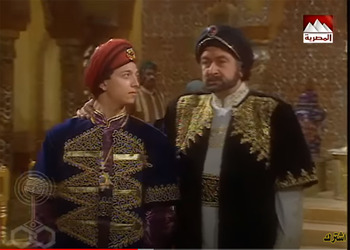
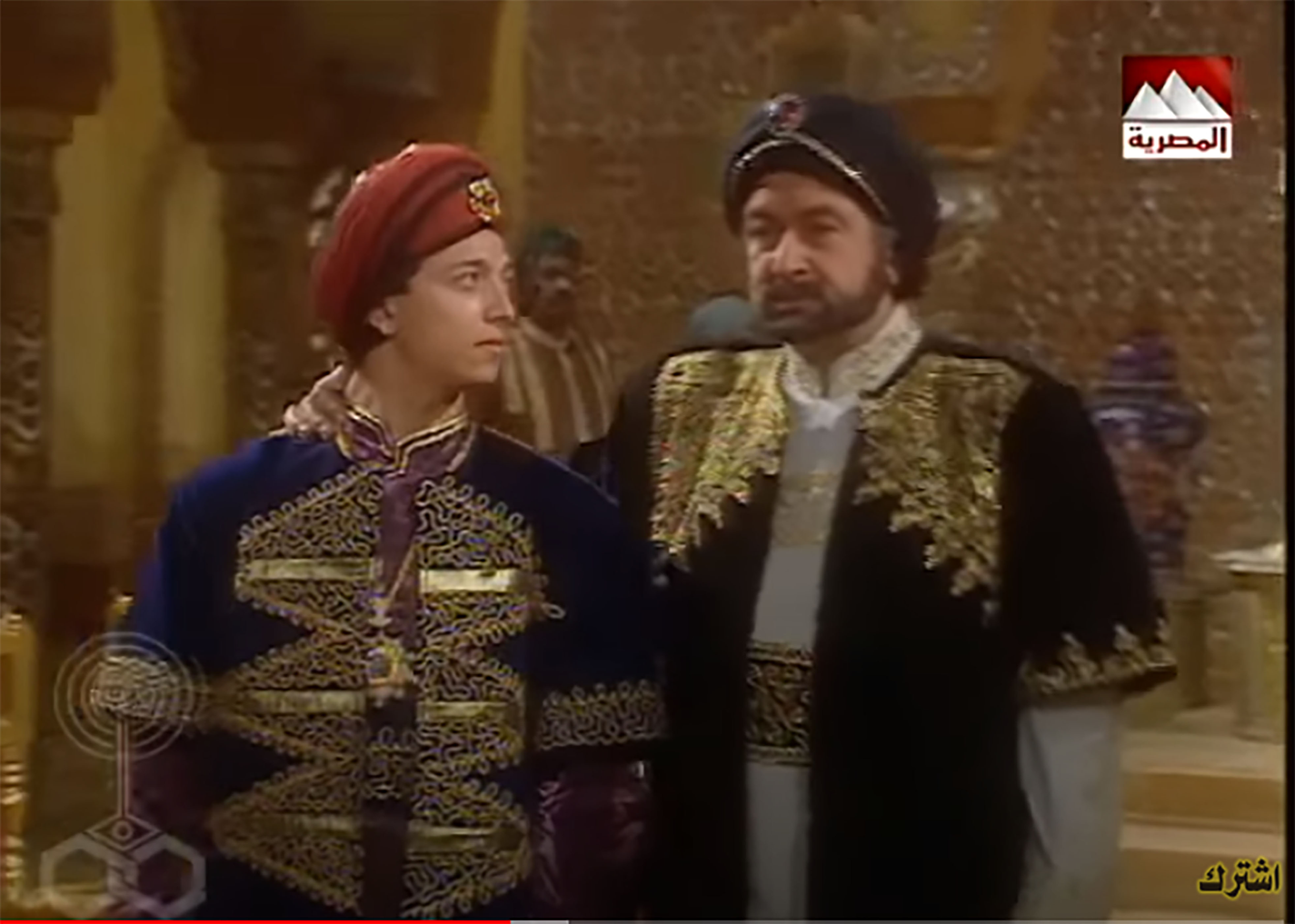
Time passes and, in keeping with the prioritizing of the study of the Qur'an, philosophy, and law by the Abbasids, al-Amin and al-Ma'mun take part in prayer sessions. Of utmost importance is that the series, rather than following chronicles that portray the boys as polar opposites, depicts them both as wise beyond their years. Al-Rashid beseeches his sons to rise above different camps of influence, foreshadowing a conflicted future (Fig. 1).
Harun al-Rashid (Egypt): The caliph (Nur al-Sharif) counseling al-Amin (Hussam ‘Adil) to be wary of enemies disguised as friends (episode 40).
The type of embellishment and fabrication caused by the variations and retellings to which el-Hibri has referred is evidenced in a scene in which men gossip and record stories while in the process of writing chronicles, providing viewers with a window into the historical chronicles on which this very tale is based. One man tells a story about the two brothers, ten years old, with cups of wine in their hands and in the presence of women. The second man asks, “How will people believe this when they are only ten years old?” He insists that he and his fellow writers supplement the story with a more believable element. Accordingly, the first man suggests that they add: “And when Harun heard such things, he brought a teacher for both boys and ordered him to raise them properly.” Shortly thereafter, we see another chronicler, one associated with Umm al-Fadl al-Barmaki, snickering while he tells his scribes to add invented details about al-Amin's mother Zubayda buying one thousand slave girls for her son, cutting their hair, forcing them to wear men's clothes, and telling them to make her son polite again. The chronicler, who is pro–al-Ma'mun, continues to chortle, dictating further, “But Ma'mun surprised his teacher with his good memory and commitment to learning” (episode 21). This scene is important, insinuating that reports of nonheteronormative sexuality and queer spaces are fictitious, the fabricated results of medieval chroniclers’ political agendas. Here, queerness is effectively canceled out, since al-Amin's nonheteronormative sexuality becomes a lie invented to ruin his reputation. Although scholars such as Cooperson have asserted the possibility that al-Amin's queerness was indeed a lie deployed by pro–al-Ma'mun/anti–al-Amin sources, my interest is less in proving or disproving the veracity of the original accounts than exploring the divergent ways contemporary screenwriters assess and make use of sources. Specifically, Cooperson's assertion that rumors of al-Amin's queerness are lies speaks to the taboo nature of queerness and the editorial desire to undermine any intimation of deviance.Footnote 47
Of central importance is the depiction in the series of al-Amin as non-conspicuous in his gendered identity. Likewise, al-Rashid does not appear hypermasculine. In a similar move to neutralize potential conflict or controversy, al-Amin and al-Ma'mun are always shown together, equally intelligent and mature. Al-Rashid offers attentive guidance to their behavior and assigns them heavy responsibilities, including battle strategies, to strengthen their mettle. This series exhibits a religious, Qur'anic inflection, too, in that al-Rashid frequently calls upon God's blessings. When al-Amin speaks to his mother, he calls her “Mother of the waliīal-‘ahd.” He is portrayed as pious and respectful. Likewise, after Charlemagne seeks to create an alliance with the Abbasids against the Umayyads in al-Andalus, al-Amin consults with his father about how to approach “an enemy coming in a friend's clothing” (episode 40). His father counsels his son to be wary and asks al-Amin what he would do in the situation; al-Amin answers that he would rather side with Muslim Arabs who share his faith, even if they oppose the Abbasids.
In the meantime, the demise of the Barmakis is shown as a gradual process of falling out of favor due to transgression of the boundaries of the family's role in the court and disruption of the otherwise tranquil dynamics within the family. In the end, al-Rashid finds Asma’ (who had been kidnapped by the Barmakis) and the series comes full circle. In keeping with humanistic Islamic mores, even Zubayda eventually shows generosity toward Asma’. When al-Rashid is dying and al-Amin prepares to assume the title of caliph, Ahmad hugs his father. Ahmad then embraces al-Amin, a resolution that reinforces the message of peace. Ultimately, this revisionist miniseries portrays a unified period in Islamic history, and it does so through ample use of historical exaggeration and inaccuracy, downplaying the feud between the brothers and softening Zubayda. Thus, as argued by Nusayr and Abu-Lughod, the series confronts prevailing violence by disregarding historical accuracy to depict a more unified time.Footnote 48 Director Youssef Chahine's film al-Masir (Destiny) also was released in 1997 and also starred Nur al-Sharif, as the philosopher Ibn Rushd (1126–98 A.D.), the film's hero. It, too, depicted a golden age of Islam in which characters harmonize with each other despite religious differences. When Chahine was questioned about this portrayal, he explained that his goal was to show a unified time rather than focusing on historical accuracy.Footnote 49
Harun al-Rashid nods deliberately to al-Rashid's support of art, music, and literature, and despite scenes in which he oversees soldiers going off to war the caliph's patronage of music and poetry defines him more profoundly than his military heroism. In episode 18, for example, he sits on his throne listening to poets and musicians, entranced in particular by one musician, al-Mawsali, who plays the oud and sings. Al-Rashid tells the musician that he sounds like a nightingale, and al-Mawsali says that the poem is by Abu Nuwas. When al-Rashid asks if he knows the poet, al-Mawsali responds that he lives in Basra. The caliph tells one of his assistants to go to Basra and find all the poets. In another of al-Rashid's poetry and music sessions, Abu Nuwas recites a poem and the caliph instructs his assistant to give him one thousand dinars, leading yet another poet to share his own book with al-Rashid. The series, then, chooses to emphasize the artistic and literary quality of the court, bypassing the institutionalized queerness of the space. Social interactions, including the court's dance scenes, present strictly heteronormative dynamics; for instance, as the ladies dance, the men, including Abu Nuwas, sit and watch.
Whereas the musalsal attributes accounts of queer spaces in the court to malicious gossip from chroniclers inventing sources to smear al-Amin's reputation, the queer spaces that remain and are featured occur quite literally on enemy ground. Throughout the story of his reign, al-Rashid is at war with the Byzantine Empire, headed by a powerful empress (I interpret this to be Irene Sarantapechaina, who ruled from 797–802 A.D. Sarantapechaina's chief minister was the eunuch Stauracius, who in his introductory scene (episode 27) is referred to as a military officer but in later scenes has risen to the rank of “king” (mālik) (episode 37).Footnote 50 This aligns with a historical reading that Stauracius exerted increasing power over the empire and eventually ruled alongside Irene. We are first introduced to these two characters as al-Rashid is entering Asia Minor at the gates of Ankara, and Byzantium is suffering a military loss. A flamboyant and angry Stauracius storms into a room decorated with crosses (underscoring his Christianity) to ask what else can be expected when a woman is ruling the troops. Irene was known for relying on eunuchs to support her rule, and, indeed, Stauracius reflects this third gender space. Dressed in tight clothes and wearing makeup on his shaved face, his appearance accords with traditional constructions of femininity. Even so, during his conversations with the powerful queen, she places her hands suggestively on his shoulders, implying an intimate relationship. Of significance here is not so much the gender queerness of Stauracius as the linking of his queerness to his status as outsider to the Abbasid court and enemy of al-Rashid—especially since, again, eunuchs are not shown in scenes set in the Abbasid court.
As Irene and Stauracius plot against al-Rashid, Charlemagne, Emperor of the Holy Roman Empire, and the Franks engage in diplomatic overtures. Toward the end of the series, Charlemagne sends a group of young men to see al-Rashid. They bow and throw themselves at his feet. Al-Rashid is uncomfortable with this custom, particularly as these young men appear feminine, with long hair, colorful costumes, and makeup. Even as it incorporates negative stereotypes of foreigners to emasculate them, the portrayal effectively queers Charlemagne's court. Historically, this episode could allude to the visits of the Franks to al-Rashid, at which time the caliph sent many gifts back for Charlemagne. Correspondingly, al-Rashid tells al-Amin that he will deal with this enemy cloaked as a friend by sending gifts, including scientific inventions, to demonstrate the compatibility of Islam and science.Footnote 51
ABNA’ AL-RASHID: AL-AMIN WA-L-MA'MUN (2006)
In “Homosexuality and Epistemic Closure in Modern Arabic Literature” Khalid Hadeed has argued that representations of homosexuality in modern Arabic literature have sought to contain its menace through what he coins “epistemic closure,” which aligns homosexuality, caused by a perceived deficiency in development, with passivity and inferiority to a sexually dominant masculinity.”Footnote 52 Although homosexuality as “weak, effeminate” masculinity resulting from “bad mothers” and “absent fathers” is a dominant trope in the majority of pre-uprising Syrian musalsalāt, Abna’ al-Rashid: al-Amin wa-l-Ma'mun stands out as an innovative series that explores the homosexuality of Muhammad al-Amin without resorting to epistemic closure.Footnote 53 This series tells the story of a strong mother who tries to suppress her son's nonheteronormative sexuality because of her own political ambitions; it is clear, however, that it is not the mother's aggressive nature that caused his homosexuality or nonconformity.
In The Politics of Love I suggested that Syrian television dramas have used the lens of love, sexuality, and marriage as a major trope to prompt critique and change. Engrained within these dramas since their inception is the word qabaḍāy, which means a “real man.” Connected to this idea is the increasing emphasis in Syrian drama on protecting a woman's sexuality and repressing a woman's desire, used by screenwriters to symbolize the vicious cycle of state violence toward its citizens. Specifically, as men lose power vis-à-vis the state, they are depicted asserting power over women. In more avant-garde drama, the qabaḍāy attains true manhood only after he allows for a woman's sexual freedom. Likewise, in these dramas, men must shed their roles as protectors of women's sexuality to enable truly egalitarian relationships. This relationship, then, serves as a metaphor for citizens regaining their rights and dignity from an authoritarian order.Footnote 54 I argue that Abna’ al-Rashid was the first Syrian series to present a nonheteronormative love story as a metaphoric political critique of a dictator.Footnote 55 Although during the early stages of research Ghassan Zakariyya thought that the internal, turbulent Asad family dynamics could present an interesting angle, he felt increasingly that this screenplay was an opportunity to explore the structure of the family dictatorship to show how absolutist power works.Footnote 56
Zakariyya, a young and rising screenwriter, is known for his historical dramas, a genre toward which he is naturally drawn. His first series emerged during the time of a growing market for these dramas, when few screenwriters were focusing on them. The success of this series, al-Zahir Baybars (Sultan Baybars, 2005), led production companies to extend many offers and commissions to write further historical dramas.Footnote 57 The series he opted for was Abna’ al-Rashid. Zakariyya wrote twenty-seven of the thirty episodes before a conflict arose with the producer over removal of the original director, Haytham Haqqi, from the project. Zakariyya and Haqqi subsequently intended to pursue the project on their own, but the production company brought in a Jordanian screenwriter to complete the last few episodes. Although the director, Shawqi al-Majiri, was Tunisian and the production company was Jordanian, the series is considered Syrian as Zakariyya wrote the majority of episodes and all of the actors were Syrian. Although broadcast once or twice on MBC, a highly watched Arab satellite network based in Dubai, the series ran during a weak time slot. Additionally, Zakariyya had the sense that few people in Syria actually watched the show, as opposed to al-Zahir Baybars, which seemed to have a large viewership. Zakariyya lamented that there were no statistics to record viewership, and he relied on impressions from acquaintances as to its success. Among the sources Zakariyya relied upon for Abna’ al-Rashid were al-Tabari, al- Mas‘udi, ibn al-Athir, al-‘Aqd Farid (The Unique Necklace)by Ibn ‘Abd Rubbih al-Andalusi, as well as studies on the Abbasid period such as ‘Abd al-‘Aziz al-Dawri and al-Milal wa-l-Nihal (The Book of Sects and Creeds) by Muhammad al-Shahristani (1086-1153).Footnote 58
Zakariyya had read about al-Amin's attraction to his male concubines and eunuchs and acknowledged the option of sidestepping that attraction in the screenplay. Still, he saw the series as an opportunity to explore the topic of homosexuality, taboo in Syria, from a nonjudgmental place and to bring queer figures hidden in the historical record back to the collective memory. Although he contends that it would have been possible to avoid the censors by alluding to sex through body language, he chose, in this case, to make the male-male love story between al-Amin and his preferred slave, ‘Arif, explicit.Footnote 59 Significantly, Zakariyya chose to replace the name present in historical sources, Kawthar, with the name ‘Arif, indicating his preference for imagination over historical accuracy and allowing him to create a love story with fewer factual encumbrances.Footnote 60 Zakariyya recalled that some descendants of the Abbasids tried to stop the series because of his portrayal of Harun al-Rashid by telephoning him with death threats. Ultimately, however, the production company used the media attention to attract more sponsors.Footnote 61 According to Zakariyya, his production avoided most censorship issues since the series was broadcast only a few times on minor channels and not in Syria.Footnote 62
Still, due to censorship, Zakariyya was not able to fully portray the gender ambiguity that some accounts and legends claim dominated the Abbasid court. Although he suspects many of the stories were invented to satiate people's passion for the exotic, he included scenes with the ghulāmiyyāt as well as gender-bending at court. Those scenes were effectively censored from his miniseries for religious sensibility and marketing reasons. Because he had not mentioned the specific term in the dialogue, there was no reference at all to the ghulāmiyyāt.Footnote 63 The result of this heavy censorship was the stripping of meaningful layers from al-Amin's sexuality: his attraction to male slaves, eunuchs, and cross-dressed slave girls (as well as the fact that al-Amin married two women; the series only showed one marriage). Consequently, it appeared as if Zakariyya had viewed al-Amin's behavior through a modern heteronormative lens and had projected an anachronistic modern homosexual identity onto al-Amin, although he was not exclusively homosexual. In this way, censorship resulted in a depiction of al-Amin as an isolated, easy-to-categorize deviant rather than a participant in the more widespread environment of gender and sexual fluidity that Zakariyya initially hoped to portray. At the same time, Zakariyya's unabashed depiction of al-Amin's queerness, which he did manage to exhibit despite censorship, was unprecedented in Syrian drama. Even as the overt gender-bending was removed, ‘Arif's gender-fluid presence allows a window into Zakariyya's original intention in the series. He says, “I did not feel much pushback over al-Amin being homosexual since even the most conservative sources mentioned al-Amin's preference for eunuchs over women, so that the existence of his queerness could not be refuted even by those who objected to it. I was also very careful in depicting the relationship between al-Amin and ‘Arif as more romantic than sexual. And perhaps one thing that aided the fact that no one contested this is that no one really ever directly said in the series that he was homosexual.”Footnote 64
In one of the opening scenes of the series, we are introduced to the sensual al-Amin in his lavish bedroom quarters while two beautiful slave boys quietly put flowers in steaming water (Fig. 2). Al-Amin is portrayed as sexually attractive and virile, exhibiting physical strength and aggression. Next, ‘Arif, appears in a third-gender role. Despite his long black hair, makeup, and ungendered outfit, his gender nonconformism is not fetishized, nor is he shown as a mukhannath with effeminate gestures. ‘Arif gently puts an overcoat on al-Amin's shoulders, delicately lifting his long hair out from under the garment. As ‘Arif clasps his master's hand and slides a ring along his finger, Zubayda enters the room. Al-Amin signals to the slave boys that they may leave, and ‘Arif stands still until al-Amin dismisses him, as well. Zubayda looks at her son's lover with disdain, hinting to the viewer that this is a recurring scene that causes her uneasiness. She sternly reminds al-Amin that he will be the next caliph. Her ambition for her son to attain political power, more than prejudice, drives her resistance to this homoerotic pairing with ‘Arif, because he must marry and bear a son to fulfill his duty as the next Abbasid caliph.
Abna ‘ al-Rashid: al-Amin wa-l-Ma'mun (Syria): al-Amin (Mundhar Rayhana, left) and his companion (right) in an opening scene (Episode 1).
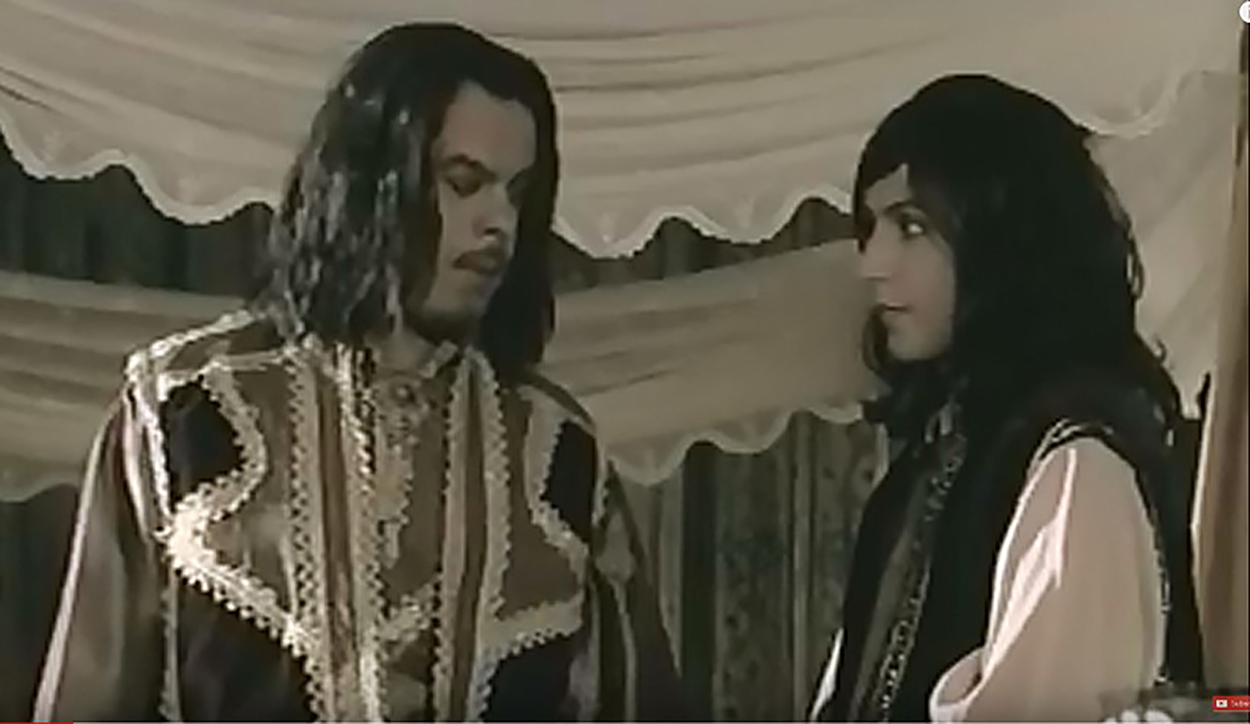
Al-Amin's queer desire is portrayed tenderly in the visual storytelling. From the outset, his relationship with ‘Arif appears without judgment or political or social explanation. This rendition marks a transition from previous depictions in Syrian series in which strong or passive mothers receive blame for their sons’ predilections. Furthermore, as recounted in Abbasid sources, al-Amin is portrayed as conventionally masculine and strong rather than stereotypically effeminate as seen in traditional homosexual tropes. Zakariyya highlights al-Amin's love for alternately gendered ‘Arif, who is often with him when al-Amin's mother interrupts. Zubayda's ambition for al-Amin to become caliph results in her insistence that he marry, since “this is how men do it” (episode 9). Al-Amin insists that his half-brother al-Ma'mun can marry and have a son instead. We see that this political ambition is not merely imposed on al-Amin; he is struggling to be true to himself. Ultimately, he decides to abandon his love for ‘Arif to enter the domain of power.
After al-Amin makes this decision to marry, a devastated ‘Arif goes to see him. Al-Amin tells him not to leave, saying that he does not want to be alone. The fact that this love exists between a master and a slave does not detract from the credibility of their mutual affection. At first, al-Amin's relationship with ‘Arif appears within the pederast model, maintaining an active-passive dichotomy. ‘Arif often has his head down in his presence, listens, and obeys his master's orders. Yet this power dynamic is subverted when we see how al-Amin truly loves and needs ‘Arif. Zakariyya reveals their reciprocal recognition, empathy, and emotional as well as sexual fulfillment.
Once al-Amin has agreed to marry, his psychological and physical health deteriorates. He becomes depressed and inebriated as he marries a woman he does not love. His situation parallels that of al-Ma'mun, who loves a young slave woman named Shams but realizes that if he becomes caliph he will need a legitimate wife to bear a rightful heir. Both relationships are depicted as affectionate and predicated on mutual respect, yet homosexual and heterosexual love are equally denied. The series indicates that al-Rashid knows that his son is engaged in romantic love with men when he tells al-Ma'mun that he wants to protect al-Amin's reputation. After the wedding, al-Ma'mun asks how al-Amin is feeling (episode 11). Al-Ma'mun's question arises from sincere concern, knowing the sacrifice his brother has made.
The storyline unfolds against the background of other injustices. Al-Rashid asks his sister, al-‘Abbasa, to marry Ja‘far, but he does not allow them to consummate their marriage and produce an heir. When he learns through Zubayda that al-‘Abbasa is pregnant, he kills Ja‘far and banishes his pregnant sister. Zubayda's desire to ensure that her son faces no competitors thus precipitates a crisis between the families. The differences between al-Amin and al-Ma'mun are exacerbated by Zubayda, who intentionally provokes rivalry between the brothers. The series presents these intense human emotions and family dynamics in its interpretation of the original medieval chronicles.Footnote 65 Previous studies have shown that heterosexual love, marriage, and sexuality in Syrian drama often serve as metaphors to critique politics.Footnote 66 Here, al-Amin's struggle with his sexuality and its repression by his mother allows for nonheteronormative love and marriage metaphors to be woven into the political critiques presented earlier. Furthermore, the storyline of the relationship between al-‘Abbasa and Ja‘far follows the pattern of the storyline of al-Amin and his eunuch's ill-fated love: both suppressed love relations symbolize dictatorship within society.
Zubayda tells al-Amin's wife ‘Azza on their wedding night that she will at times feel as if he has no desire for her, but that if she possesses his heart she will stay close to him. On their wedding night, while he drowns himself in alcohol, she attempts to seduce him. The day following al-Amin's marriage, ‘Arif sits, depressed, in the courtyard; al-Amin assures him that his place in his heart is always preserved. Al-Amin puts his hands on ‘Arif's shoulders and they hold hands. Then al-Amin strokes his hair and embraces him. His mother reprimands him for these actions, reminding him that now that he has married he will need to produce a child to establish his manhood and consolidate his political position.
However much he avoided moralizing, due to censorship Zakariyya was unable to represent the establishment of queer spaces in court, specifically the introduction of ghulāmiyyāt. Even within this context, the screenwriter was able to suggest elements of gender nonconformity. In one scene, al-Rashid speaks quickly to al-Ma‘mun, admiring his progress and contrasting it to the fact that Zubayda had to cut off girls’ hair to make them more attractive to his unruly son, al-Amin. Zakariyya included this quick and subtle scene for dramatic impact, since it conveys al-Rashid's awareness of his son's queerness and would shock the contemporary Syrian public.Footnote 67
The next part of the storyline is comprised of ‘Azza's struggle to seduce al-Amin and his struggle to stay true to himself. In a touching scene, ‘Azza washes his feet with rose petals while he exhibits insecurity, putting his head on her chest as if she were his mother. She holds him in her arms, underscoring her dominance and his passivity. However, once al-Amin has consummated his marriage, his gradual demise follows. He storms through a low fountain with candles floating in it, angrily blowing out the flames. At times he resists power, and at other times he craves it. He continues to drink to excess; he struggles and cries as his mother looks on.
In one scene, al-Rashid tells al-Ma'mun that he does not trust al-Amin to lead the state, but that he has already placed him first in succession since al-Amin's mother is a descendant of the Abbasids, whereas al-Ma'mun's mother has Persian origins, and he cannot rescind his decision without risking war. He also begs al-Ma'mun to offer guidance to his brother, which al-Ma'mun promises to do. He tells al-Ma'mun that he does not trust al-Amin because of his "ḥāla" (condition) and laments that although al-Amin married he remains in this state. Significantly, even though Zakariyya places al-Amin in the singular category of homosexual, al-Rashid does not use the word mithlī (homosexual), a category that did not exist at that time.Footnote 68
Furthermore, in the musalsal, the court and party scenes of both caliphs are entirely heteronormative. It is true that during al-Amin's party in the middle of civil war with his brother Abu Nuwas recites a love poem to the masculine gender and al-Amin pays him, showing he is the patron.Footnote 69 Nonetheless, multiple scenes show al-Amin, al-Rashid, and Abu Nuwas drinking and looking at female dancers, with slave girls dancing and serving them fruit in the midst of romantic candlelight. This, too, represents a missed opportunity. The scenes might have pointed to ambiguous gender norms through portrayals of the ghulāmiyyāt, for example. Historically, the poetry of Abu Nuwas flourished during both Harun al-Rashid and al-Amin's reigns. However, the series inaccurately represents a dichotomy between the orderly dynamics of the reign of al-Rashid and the debauchery of the reign of al-Amin. When Abu Nuwas appears in al-Rashid's court, the scene is sophisticated and orderly; his appearance, however, is accompanied by chaos and inebriation during al-Amin's time. This substantiates the notion that al-Amin's madness, and demise reveal a struggle with his sexuality.
We see al-Amin break down when al-Rashid dies and he becomes caliph. At the prompting of his mother, al-Amin names his son Musa next in line for succession, which causes a civil war. Al-Amin then behaves self-destructively, throwing lavish parties and drinking to excess, since he is angry about what he has done to his brother. His love affair with ‘Arif is more open, and there are scenes of them sleeping together in the courtyard, ‘Arif's head on al-Amin's shoulders. Meanwhile, gossip spreads that al-Amin's actiivites run counter to the faith and that he is corrupt, as if he has been branded uniquely by his same-sex desire. Yet, historically, these nonheteronormative spaces imbue the atmosphere of the Abbasid court more broadly: al-Amin was not an exemplary case.
As the war intensifies, al-Amin throws candles into the fountain in his room and stomps through its water, refusing to face the crisis. His emotional breakdown leads him further into alcoholism and the free expression of his sexuality. Even so, he appears to speak truth to power, subverting the disciplining forces of both his mother and the minister al-Rabi‘. In one scene, al-Amin gives al-Rabi‘ the ring of the caliphate so that the minister can act on his behalf if necessary. Those present leave in shock and al-Amin continues to hold ‘Arif's hand. This demonstrates “the homosexual as mad and flamboyant—transgressor of social norms.”Footnote 70 The power of Zakariyya's tale is his presentation of an alternative history in which al-Amin struggles with the nuances and complexities of his sexuality.
Utterly destroyed, al-Amin apologizes to ‘Arif for how he has treated him. ‘Arif assures al-Amin that he is happy being his companion. Once his army has been vanquished, al-Amin's wife, mother, and son prepare to leave. He hugs his son and says, “Live as you want” (episode 20). Here, Zakariyya employs a modern lens to present issues related to love, authentic self-expression, and self-fulfillment. While waiting outside, al-Amin orders ‘Arif to leave. Soon afterward, al-Amin is surrounded and killed, finally bringing his self-destructive actions to an end. ‘Arif later goes to Zubayda to tell her that her son is dead. She asks ‘Arif his name iand tells him that al-Amin really loved him. She then holds him, saying she “feels the scent of al-Amin on him” (episode 21). This statement parallels what al-Ma'mun's mother (who did not die in childbirth in this series) says to the slave woman, Shams, when her son leaves for battle.
Ultimately, the disintegration of al-Amin's rule results from the constant struggle between his desire for power and his desire to live as he wishes. Zakariyya's storyline accommodates contemporary sensibilities by refusing to judge al-Amin's homosexuality and distances itself from a model that blames degeneracy on an absent father or dominant mother. But at times Zakariyya emphasizes debauchery and self-destruction that can be read as the unhealthy acting out of repressed intrinsic desires, rather than an expression of art or music that can provide an explicit outlet for those desires. Nevertheless, as al-Samman has made clear, same-sex desires and practices accompanied heterosexual desires and practices in medieval homoerotic literature. Furthermore, nonheteronormative expression did not then symbolize moral and political depravity or emasculation as it does in modern and postmodern periods of Arabic literature. Indeed, in modern literature, homoerotic desire is portrayed not only as aberrant but as symbolic of societal and moral degeneracy, signaling an impoverished Arab masculinity.Footnote 71
Although it misses an opportunity to reveal the nonheteronormative atmosphere of the time period, the series succeeds in placing queer love and desire alongside heteronormative tropes of love to critique dictatorship. Despite this accomplishment, Zakariyya was dismayed by the story's end (by this time, as noted earlier, it had been taken out of his hands). He had hoped the conclusion would involve al-Amin's rededication to the Qur'an and his faith. He also felt that the philosophical stance of the series was increasingly anti–al-Ma‘mun, a slant he had tried to avoid. Ultimately, according to Zakariyya, the series did not have much impact, since it was not even broadcast in Syria and was not widely viewed in the Arab world. Most of the feedback he received was from people in the industry in Syria and Egypt, and although positive it was scant. Zakariyya believed that the recent 2018 series would sidestep addressing al-Amin's queerness to avoid controversy and marketing issues. He stated, “Generally, most of those who work in the industry have internalized censorship. It was not easy for me to fight this internalized censorship myself. But I have always worked on the belief that if there was to be censorship, let it be by media and the security officials and not myself. Because drama is often a money-making venture, series are mostly by commissions and with the least possible controversy.” Afterward, he wrote the historical series `Antar (2007), the contemporary series Ra'ihat al-Matar (Scent of Rain, 2008), and Ba‘ad al-Suqut (After the Fall, 2010).Footnote 72 Since the uprising, he has been involved in the YouTube documentary Under 35 with Inas Haqqi, which gives youth an uncensored platform for expression. He has written one of the storylines, “Madinat al-Dhahab” (City of Gold), for the three-part miniseries Wuju’ waAmakan (Faces and Places), which narrates the collective memory of the 2011 Syrian uprising from an oppositional perspective. He has directed other short documentary films.Footnote 73
HARUN AL-RASHID (2018)
The revolutionary nature of Ghassan Zakariyya's 2006 series contrasts starkly with the later Syrian series Harun al-Rashid (2018).Footnote 74 Written by ‘Uthman Jaha and directed by ‘Abd al-Bari Abu al-Khayr, the series erases queer space, foregrounds an exaggerated masculinity, features a hypermasculine al-Rashid, portrays al-Amin as power hungry, and sexualizes the seat of power.Footnote 75 Although there is less overt focus on al-Amin at the start of this series, the values that mark his family and his upbringing (bellicose masculinity and varying degrees of obsession over control) carry their own political insinuations about his developing identity. When a member of the production team asked Zakariyya to write this new screenplay of Harun al-Rashid, he opted out, arguing that he had already expressed his interpretation of the caliph and this historical time period in his previous musalsal.Footnote 76 Jaha's new storyline was the subject of much criticism due to blatant historical inaccuracies.Footnote 77 According to Najib Nusayr, the screenwriter of this series only skimmed al-Tabari and did not really pay attention to conflicting sources and nuances of interpretation.Footnote 78
This representation must be viewed against the recent context of an aborted revolution turned civil war in which the Syrian regime has gained the upper hand. The sexualizing of the throne, the emphasis on machismo, and the contention over the throne all point back to the current political morass. Along these lines, less emphasis is placed on either religion or art, although poems and music are occasional scenic features.Footnote 79 The series also must be placed in the context of an increase in Turkish historical dramas. The luxurious Muhtesem Yuzyil (Magnificent Century, 2011–14) about the conflicted reign of Sultan Suleyman I reached global audiences during the initial years of the uprising.Footnote 80 Critics challenged the authenticity of the history depicted in the episodes. Even Turkish president Recep Tayyip Erdogan criticized the series for portraying the sultan as a lascivious man who spent most of his time in the royal harem.Footnote 81 The Egyptian Saraya ‘Abdin (‘Abdin Palace, 2014) was inspired by the lush costumes, royalty, palace intrigue, and the nostalgically traditional women's roles of Magnificent Century.Footnote 82
The screenwriter ‘Uthman Jaha, who has authored historical miniseries such as Rabi‘a al-‘Adawiyya (2012) and Sadaqa Wa‘adahu (His Promise was Fulfilled, 2009) as well as the contemporary social dramas Qalbi Ma‘i (My Heart is with Me, 2017) and Zawal (Disappearance, 2016), observed that it was precisely the popularity of dramas involving palace intrigue that demanded another musalsal on Harun al-Rashid.Footnote 83 Jaha felt he could provide a different perspective, one involving the effects of inner-castle conflicts and love affairs of the caliph. As he stated, “Harim al-Sultan [referring to Magnificent Century] had shown the inside of the castle and it was embarrassing, but people accepted it. So we courageously created our own story. We have to show the human side of our leaders rather than being ashamed by history.” Jaha acknowledged that dealing with a production company during wartime was challenging but asserted that compromise was necessary.Footnote 84 He also claimed, “I used historical sources about him and then added my own narrative, and I think I was as historically accurate as possible.”Footnote 85
The introduction to the series contains a dramatic musical score, with an eagle flying overhead, horses running through the desert, and battle scenes; it ends by zooming in on the throne of the caliph, setting the stage for a storyline involving power struggles. The story begins when al-Hadi has just become caliph. In a tense conversation between the two brothers, al-Hadi weightily informs al-Rashid that he wishes to make his son, Ja‘far, successor rather than al-Rashid, but al-Rashid is undisturbed by this decision, insisting that he is just a soldier in the service of the state, and he wishes for Zubayda to love him for who he is and not for his power. Soon after, al-Hadi and al-Rashid engage in sword fight, displaying hostility and aggression although the combat is technically sport. This episode clearly reflects visual imagination rather than being based on any verifiable source material. Indeed, it could be inspired by a similar scene in the earlier Abna’ al-Rashid.
Throughout this series, the issue of enslavement to the seat of power is of paramount importance to all characters, from al-Hadi to al-Rashid to, later, al-Amin. When al-Rashid agrees to become caliph after his brother al-Hadi has apparently been poisoned, he stares at the throne, his nervousness exacerbated by tense background music. He sits and says: “What is this world to which I've come? I would expect it to bring me happiness, but I am numb. In a world without peace, I can't rule without killing. I feel sure that things will happen in this palace that will transform me into someone else, into someone I don't like. I was happy when I was a military leader in the army. . . . Now I'm no longer my own master” (episode 5). He clutches the throne anxiously.
The conflict embroiling al-Amin's family also is shown in this series to be intrinsically linked to the Barmaki family. Jaha adopts the historical perspective that the Persian family overstepped the bounds of adviser to the royal court. Certainly, in the context of the Syrian uprising turned civil war, the vituperative portrayal of the Iranian Barmakis can be seen as a critique of the Bashar al-Asad regime, since Iran has allied itself with Asad throughout the bloodshed.Footnote 86 Screenwriter Nusayr, however, does not see the idea of these negative images of Iranians as a way to overcome censorship; rather, he points to a long-standing anti-Iranian stance, in addition to the common idea that Arabs are more pure without Iranian influence. Likewise, Saudi production companies who provide funding tend to possess historical bias against Iran.Footnote 87
From early on, the Barmaki family schemes for al-Ma'mun to become the next caliph. When Zubayda gives birth to al-Amin (episode 8), the Baramkis are agitated, realizing that her son will take precedence over Marajil's son al-Ma'mun. Furthermore, when al-Rashid announces that he intends his missing firstborn son, Ahmad, to be heir to the throne if he is located, the Barmaki family sets fire to the house of Asma’ to ensure that Ahmad, who has escaped with his mother, is never found. Al-Rashid's legendary search for Asma’ is embellished and located at the heart of this story of a caliph who reluctantly took power, discovered that he was valued for that power, and yearned for the pure love he had felt with her. Indeed, when his mother, Khayzuran, dies, al-Rashid finds a secret compartment in her ring and realizes that his mother poisoned al-Hadi. Subsequently, he himself sits on the throne that has now been feminized both through male possessiveness toward its “body” and by his mother's complicity in the murder (just one of the possible explanations for al-Hadi's murder offered in al-Tabari's chronicles) that allowed him to attain it; he asks himself if the power he now possesses is worth the sacrifice of his brother and his freedom. Even as he is subjugated by his plotting mother, he is subjugated by the ensnaring reach of the throne. Throughout these first episodes, although the focus has remained on al-Rashid, the context has been carefully laid for the development of the character of al-Amin.
Fifteen years pass, and al-Rashid announces that al-Amin is the next walī al-‘ahd. Zubayda does not like the idea that her son has to share power with al-Ma'mun. In turn, al-Rashid is angry with Zubayda for not accepting his decision, and with Yahya al-Barmaki, who wants al-Ma'mun to be heir. In the next scene (episode 9), we are introduced to the two young princes as they sword fight for sport, neither of them displaying the hypersexualized masculinity of their father. Al-Rashid watches, glad to see the young men jousting and remembering his antagonistic fights with al-Hadi. The caliph enters the fray, underscoring the masculinity of the scene. Al-Rashid pushes al-Amin to the ground. His dominant message to the brothers is to never let their desire for the throne turn them against each other. In addition to lessons emphasizing physical strength and filial unity in fight scenes, al-Rashid hosts poetry sessions that communicate to his sons his commitment to the arts. These scenes which feature poetry, music, and dance appear heteronormative, yet the gendered styles of the time do not correspond to contemporary norms: men have long hair; wear jewelry and makeup such as eyes darkened with kohl; and—contrary to ‘Abbasid source material that states explicitly that they wore black—sport colorful clothes like bright, loose-fitting dress pants. Here, despite the visually expressive examples of gender-bending, Jaha has chosen neither to refer verbally to queer spaces nor to present any of the accompanying behaviors. This problematic representation of queer spaces refuses to seriously engage the questions of queer identity while using exoticized images as window dressing for its social scenes.
The series also soon offers the first judgment of al-Amin's character (aside from the suggestion via his fighting): that he is aggressive. This judgment is implied through relatively indirect representations of him as unfocused and disrespectful, so that, although his queerness has been erased from the storyline, his objectionability is displaced onto other areas. Specifically, Ja‘far, the son of al-Hadi, reports that al-Amin is involved in illicit activities, and that he knows nothing of governing. These illicit activities are not specified, leaving his precise transgressions undefined: they might be sexual or some other problematic behavior. In episode 9, while Harun listens to Abu al-‘Atahiya recite poetry and then asks that one thousand dinars be paid for each stanza, a nonchalant and disengaged al-Amin sits eating nuts. When al-Rashid turns to al-Amin and requests that he recite a poem, his son replies that he is unable to. In another scene, al-Amin looks slovenly while being fed fruit by two slave girls. His mother enters the room and asks why he is not in his father's majlis (court). Al-Amin retorts that if his father needs him he will summon him. Zubayda reminds her son that it is he who needs his father: “In the majlis you will learn about the laws of governing. In the majlis, you'll learn all the small and important things. You're the next caliph of Baghdad.” Al-Amin admits that he fears that his behavior has upset his father. Zubayda responds, “Your father loves you. Don't let your fear enslave you and push you away from the majlis. Be strong. Only the strong will attain the throne of power” (episode 14).
Ultimately, whether it focuses on al-Rashid or al-Amin, the story revolves around the contest for the throne. As al-Rashid searches for the poor woman he loves, he feels the power struggle around him, one that has cast its irrevocable net around the young al-Amin. When al-Rashid is poisoned, he is confined to his bed; while he recovers, he discerns troubling dynamics. A disrespectful al-Amin sits on the throne of the caliphate even as his father lies gravely ill. When Ja'far, son of al-Hadi, inquires as to why he is sitting on the throne, al-Amin says it is because “Harun” is sick (episode 15), referring to his father informally. Yet, when the Barmakis inform him that he will be the next caliph, al-Ma'mun responds that he supports al-Amin and just wants to see “my father the caliph.”
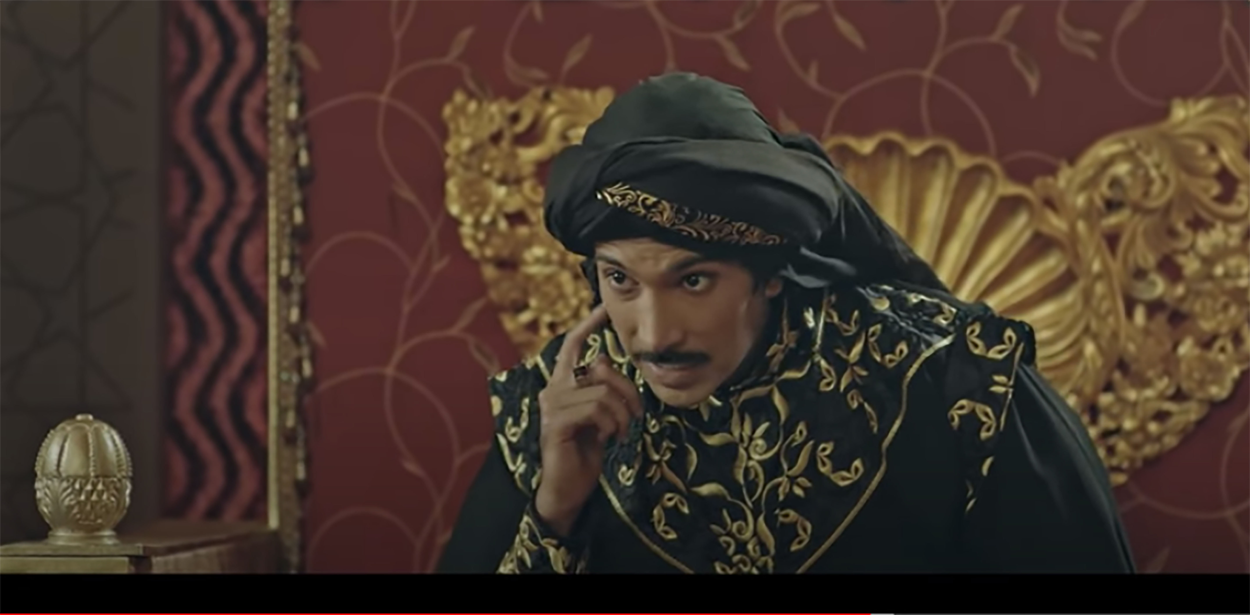
Meanwhile, Yahya al-Baramki writes a letter on behalf of al-Ma'mun that asserts he is the heir. A loyal servant informs the caliph of what is transpiring. In the next scene, al-Rashid rises from his bed. Al-Amin, perched on the throne, is issuing orders (Fig. 3). The men in the room disagree loudly about al-Amin's power as al-Rashid is announced and takes his seat. He asks his sons how their studies are going and summons the poets. In an aside, al-Rashid tells himself that everyone who surrounds him wanted him to die and that he is fundamentally alone (episode 15). This take on al-Rashid's vulnerability accentuates the degree to which he is surrounded by vultures, including his son al-Amin, who is just one more power-hungry force in his life. Unlike the earlier series in which al-Amin is depicted sympathetically, in this musalasal, the indirect and thirdhand product of pro–al-Ma'mun historiography, al-Amin is cast in an avaricious role precisely because the construction of al-Rashid as lonely and forlorn relies upon an environment in which even his family consists of competitors and sycophants.
Harun al-Rashid(Syria): al-Amin (Ta'if Ibrahim) sits on the throne giving orders while his father, the caliph, is gravely ill (Episode 15).
Indeed, this characterization of al-Amin recurs repeatedly. When al-Rashid embarks on a military campaign, al-Amin asks angrily why he is not waliīal-‘ahd in Baghdad during his father's absence. Zubayda replies that al-Rashid will only be gone for two days and reassures him that his father knows what he is doing. In another scene, al-Amin complains that he feels his father is favoring al-Ma'mun. Zubayda hugs al-Amin, but in truth, even as she comforts her son, she is angry that all responsibilities seem to be going to al-Ma'mun and tells her husband that his decisions will cause a fitna (chaos, discord) (episode 17).
Although al-Amin occasionally shows signs of maturity as the series progresses, on the whole he remains rash and power hungry. He laments that his father excludes him and complains that his father has given the Barmakis too much authority. Throughout, he is presented as resentful and competitive, thinking less about the good of the caliphate than his own ascent to the throne.
The conclusion of the storyline centers on al-Amin's ascendance alongside the downfall of the Barmaki family. When the Barmakis bring an army to the gates of Baghdad, al-Amin helps his father handle the situation, while al-Ma'mun is nowhere to be seen. In one of the final scenes, Zubayda crowns al-Amin as waliīal-`ahd, announcing, “All I killed and fought for was for you to be the crown prince, the next caliph of the Muslims, without everyone contesting it” (episode 32). Al-Amin seems nonchalant, despite the fact that this is what he wanted. Meanwhile, a disguised al-Rashid sadly wanders the market. In the end, it is clear that neither wealth nor power is worth the trouble each entails, since both result in the corrosion of the soul, as demonstrated by al-Amin. Al-Rashid believes his seat of power was destructive and left him, ultimately, alone. This approach to the study of al-Amin reveals the degree to which queerness is particularly vulnerable to effacement and leads to questions about why queerness, specifically, seems to destabilize the work of historians in establishing collective memory.
CONCLUSION
This article demonstrates the discomfort of contemporary historians with depicting queer spaces and their tendency to self-censor to appease production companies and state officials. It highlights the fact that the source material from this early historical period is subject to embellishment, contradictory accounts, and apprehension about depicting queer spaces. Indeed, according to Tayeb el-Hibri, Abbasid narratives did not necessarily aim to recount facts; rather, narrators often expressed moral, social, or politically edifying purposes.Footnote 88 Given these nonobjective purposes, I ask why, in the case of contradiction and uncertainty, the assumption so frequently falls on the side of heteronormativity, without acknowledgment of the bias inherent in that choice. Michael Cooperson has claimed that anti–al-Amin chronicles probably sought to discredit al-Amin by emphasizing his interest in eunuchs. In this article, I argue that, even in the unlikely event that all accounts of al-Amin as nonheteronormative were fabrications, we should still ask why queerness becomes a tool for sullying the caliph's reputation. This question is especially important given that these kinds of tactics are not unique to the case of al-Amin, but indeed recur throughout history. Furthermore, whether or not his queerness arose due to historical revision, its very possibility exists in the historical record. Given that reality, it is imperative to examine how contemporary screenwriters have either brought to light or effaced al-Amin's rumored fluidity. Accordingly, this article has shown how contemporary visual renditions adapt elusive chronicles according to the edifying and subjectively hued messages and intentional characterizations of al-Amin present in the storylines. This article also has pointed to the way the caliph's queerness is a variable that surfaces and then sinks below the surface of the narrative, according to the subjective positions of the writers and directors. That his queerness serves as such a negotiable aspect of his life speaks to the tendency of our historians, media, and leaders to airbrush queerness out of the picture, as if sexual orientation and preference were not fundamental and critical aspects of a person's identity.
As such, both queer spaces and al-Amin are subject to a twofold historical revision process in these historical dramas. Predicated on medieval chronicles that differ in their interpretations of al-Amin, contemporary series pick and choose from the range of narrative options to mold his character according to the overarching theme of each musalsal. And so, the multifarious lives of al-Amin tell us just as much about his place in medieval times as about the philosophical viewpoints presented in current dramas. At the same time, his many presentations illustrate the degree to which subjectivity influences both knowledge and the construction of that knowledge. Although we cannot know precisely what his life was like, we can use his many representations as a mirror for our contemporary subjectivities, interests, and agendas. Indeed, he demonstrates, beyond the frame of his own narrative, the vulnerability of many queer figures in history who are erased from historical visions due to the maker's anxiety or self-censorship.
This process of historically revising the collective memory continues to this day. Indeed, in a recent Syrian television miniseries, Turjuman al-Ashwaq (Interpreter of Desires, 2019), three elderly men gather in a bookstore to discuss the current war in Syria. Although Zuhayr acknowledges that the current war in Syria is often referred to as a conspiracy or revolution, he prefers to label it a fitna. He reflects that, “When the third caliph was killed, we called it a fitna, we called the war between al-Amin and al-Ma'mun a fitna. So why can't we call our current situation a fitna?” (episode 6). Even in the current moment, al-Amin returns to reflect such contemporary concerns as the Syrian war. Tellingly, this new storyline, with its urgent civil war–related objectives, drops queerness from the discussion, revealing once again the particular and significant vulnerability of this subject area to erasure.
ACKNOWLEDGMENTS
I am grateful for the incisive critique offered by the anonymous peer reviewers, which enabled me to enhance the article. My colleague Christine Marshall provided invaluable feedback on earlier drafts and Inas Haqqi, Ghassan Zakariyya, and Najib Nusayr have generously answered my many questions on Syrian television drama through the years. In particular, I would like to thank Joel Gordon for his patience, guidance, and mentorship throughout the editorial review.