There is a wide gap between the rapidly changing agricultural and environmental practices of indigenous farmers in the highlands of Papua New Guinea (PNG) and the knowledge required to safely, effectively, and sustainably implement such practices. This gap is evidenced through a response provided during field work for this study: ‘. . . sometimes I use Karate [pesticide] to go fishing, I pour it in the water and the fish die and I pick them out for eating, is this okay?’
Such gaps in understanding are not necessarily the fault of the extension workers teaching the agricultural and environmental curriculum, but of the andragogical philosophies that extension workers utilise. Current methods of agricultural knowledge transfer between extension workers and indigenous farmers in PNG are through instructionism. Instructionism is the foundational teaching practice that underpins the ‘transfer of technology’ movement, a widely used model through which extension workers transmit scientific knowledge to farmers. The transfer of technology approach replaces the emotive relationship between education and society with an overt concern for education with economic thinking (Odora Hoppers, Reference Odora Hoppers2001). It is argued here that although transfer of technology helped create industrial agriculture, it is unlikely to cure the environmental problems that have resulted from the subsequent ‘green revolution’ (Roling & Wagemakers, Reference Roling and Wagemakers1998). Literature broadly recognises the value indigenous knowledge (IK) can bring to environmental management (e.g., Afreen, Reference Afreen2007; Barrios & Trejo, Reference Barrios and Trejo2003; Cullen-Unsworth et al., Reference Cullen-Unsworth, Hill, Butler and Wallaces2012; Kola-Olusanya, Reference Kola-Olusanya2012), but a greater emphasis on understanding is needed before it disappears and its value lost. In business, organisations use knowledge management processes to realise the value of its knowledge assets by creating, capturing, and understanding the expertise of its employees (Bollinger & Smith, Reference Bollinger and Smith2001). In order to utilise knowledge management to further understand IK, the contradistinctions between knowledge management and IK must be recognised. Knowledge management employs technical and systematic processes, viewing knowledge as a product that can be digitised and transmitted (Bode, Reference Bode2007), rarely considering context (Thompson & Walsham, Reference Thompson and Walsham2004). In contrast, IK is deeply entrenched within the society in which it has been developed (Barrera-Bassols & Zinck, Reference Barrera-Bassols and Zinck2003) and expressed in the form of songs, stories, beliefs, rituals, and community law (Rao, Reference Rao2006). The SECI model proposed by Nonaka and Tekeuchi (Reference Nonaka and Takeuchi1995) reduces the disparity between IK and knowledge management by recognising and valuing the implicit nature of IK and its cultural context, thereby enhancing the capacity to understand IK. This article reviews a constructivist approach to the SECI model, going beyond the management of knowledge and attempting to facilitate new knowledge. This article suggests that: (1) agricultural and environmental IK may be further understood when viewed through the lens of a knowledge management model; and (2) if IK is valued, there may be a shift from the techno-centric style of education to a learning framework for the whole self. This, in turn, will be relevant to cultural identity and heritage, which values indigenous knowledge and retains the needs of the community in context.
Research Background
This study grew out of previous research (Radcliffe, Reference Radcliffe2012) that explored community knowledge as indicators for economic, social and environmental development. The strong theme that emerged from that research was the potential for engaging with the knowledge from those living in the community to significantly contribute to development, and to gain positively from that engagement. The theme has been further supported though my 6 years of living and working in remote indigenous communities in Northern Australia as a science educator. I viewed with interest the constant arrival of government officials to announce a new strategy that ‘will provide education, jobs and create wealth for the community’, yet they inevitably became a sidelined consultative processes due, in part, to an insufficient understanding of the indigenous knowledge, culture, and social context.
As an educator of indigenous people, I continually debate whether the current educational paradigms and pedagogies are appropriate for indigenous education. These questions, experiences and influences led to the focus of my doctoral studies, with the overarching question, ‘Can an educational framework, which integrates indigenous knowledge and culture, be developed to promote deeper learning and enhance agricultural and environmental sustainability?’
The following comes from an empirical study undertaken in the highlands of Papua New Guinea, developed as a part of my doctoral study. It explores the potential for a knowledge management model to transform tacit indigenous knowledge into explicit knowledge for the purpose of integration into an agricultural and environmental curriculum.
This article seeks to expand on the limited body of literature on agricultural and environmental education in Papua New Guinea. It highlights the importance of cultural context, as well as the inherent contraints associated with knowledge sharing in the highlands of Papua New Guinea.
The Value of Knowledge Management Models
Knowledge comes as two varying states, explicit and tacit. Explicit knowledge consists of rules, facts, policies, and relationships, which are codified electronically or on paper (Wyatt, Reference Wyatt2001). In contrast, tacit knowledge, as Polanyi (Reference Polanyi1966) describes, cannot be captured through language or mathematics, and can only be perceived through action. Tacit knowledge is the most difficult to capture and requires the use of knowledge management.
Knowledge management has been used in organisations worldwide to improve business performance through creation and diffusion of knowledge, thus value-adding to organisational knowledge (Dalkir, 2013). Although there are various models of knowledge management, key elements generally overlap, as they all describe processes of acquiring, storing, converting, sharing, and applying knowledge (see, e.g., Bukowitz & Williams, Reference Bukowitz and Williams2000; Meyer & Zack, Reference Meyer and Zack1996; Nonaka & Tekeuchi, Reference Nonaka and Takeuchi1995; Rollet, Reference Rollett2003; von Krogh & Roos, Reference Von Krogh and Roos1995; Wiig, Reference Wiig1993). These models are powerful and contribute significantly to knowledge management theory, as they share a holistic approach. However, for the purpose of this study, the Japanese business knowledge management model proposed by Nonaka and Tekeuchi (Reference Nonaka and Takeuchi1995) was selected to understand indigenous agricultural and environmental knowledge in PNG, for three reasons:
-
1. It has a focus on transforming tacit knowledge into explicit knowledge and then back again for learning, ideal for agricultural and environmental education.
-
2. It is one of the most influential models in the field (Ray, Reference Ray, Clegg and Bailey2008; Von Krogh, Ichijo, & Nonaka, Reference Von Krogh, Ichijo and Nonaka2000).
-
3. It has parallels with the constructivist theory and, as suggested by Guizazardi (Reference Guizzardi2006), knowledge management is more effective when viewed through a constructivist lens.
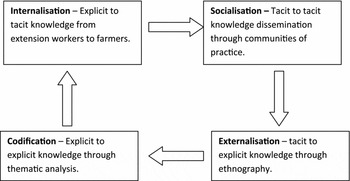
The Nonaka and Takeuchi (Reference Nonaka and Takeuchi1995) model comprises four modes: socialisation, externalisation, combination, and internalisation (SECI). This article attempts to take an enhanced constructivist approach utilising the first three modes: socialisation, externalisation, and combination (see Figure 1), in an attempt to reduce the reliance of extension workers on transfer of technology in the highlands of Papua New Guinea.
Constructivist enhancement of the SECI model.
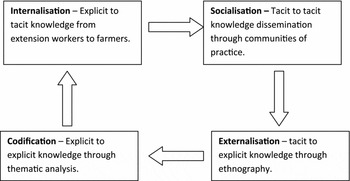
The first mode, socialisation, focuses on tacit-to-tacit knowledge transfer; it occurs when people share experiences and stories. Nonaka and Tekeuchi (Reference Nonaka and Takeuchi1995) suggest that the socialisation mode is designed to transfer knowledge from an individual to a group. This, however, does not promote learning, nor does it allow for knowledge creation, two critical components in resolving local agricultural and environmental issues. Thus, here it is proposed that an enhanced format of the socialisation mode incorporate a community of practice. Communities of practice are designed to encourage people to create, share, and leverage their knowledge and experiences (Lave & Wenger, Reference Lave and Wenger1991), thereby not only challenging, but also enriching the prior knowledge of participants.
The second mode, externalisation, is the process of transforming tacit knowledge into explicit knowledge. Boateng (Reference Boateng2006, p. 25) suggests that in the context of indigenous farmers, externalisation is achievable ‘through enhanced communication between extension experts and farmers’. This statement lacks direction and detail. Barriers such as language, culture, social status, and education impede communication (Klimova & Semradova, Reference Klimova and Semradova2012). This article therefore explores the idea that the externalisation mode be undertaken in the form of ethnographic research. Ethnographic research does not necessary reduce these barriers, but it can take the researcher ‘outside’ of the research context more than direct communication allows, and because of this, communication barriers are reduced. Ethnographic research has recently been adopted by researchers attempting to document tacit knowledge (see, e.g., Hunter, Spence, McKenna, & Iedema, Reference Hunter, Spence, McKenna and Iedema2008; Stadler, Reid, & Fullagar, Reference Stadler, Reid and Fullagar2013; Wu, Lin, & Lin, Reference Wu, Lin and Lin2013). Ethnographic research provides a scope for understanding ways in which farmers interpret, resist, or accept competing ways to care for their land (Glenna, 1996), as well as the social complexities of land use (Driessen, Reference Driessen2012).
The third mode of the SECI model is what Nonaka and Takeuchi (Reference Nonaka and Takeuchi1995) explain as the combination mode. The focus here is the explicit knowledge to explicit transfer of knowledge, formalising a knowledge repository. Data collected must allow the researcher to identify patterns and make inferences. This paper explores one such method of achieving this as being thematic analysis. Once themes are constructed they form the basis of a codebook, which is then constructed in a knowledge repository. Boateng (Reference Boateng2006) reterms this mode ‘codification’.
The Value of Indigenous Knowledge
Literature defines ‘indigenous knowledge’ (IK) variously, ranging from descriptions of relationships with land and spirits through to colonial and imperial impositions. Kanki and Mphahele (Reference Kanki and Mphahele2002, p. 3) define IK as:
a cumulative body of knowledge generated and evolved over time, representing generations of creative thought and actions within individual societies in an ecosystem of continuous residence, in an effort to cope with an ever-changing agro-ecological and socio-economic environment.
Durning (Reference Durning1992, p. 7) made an assessment of the value of IK in terms of ecological value and surmised that indigenous people:
. . . possess, in their ecological knowledge, an asset of incalculable value: a map to the biological diversity of the earth on which all life depends. Encoded in indigenous languages, customs, and practices may be as much understanding of nature as is stored in the libraries of modern science.
Assessments such as Durning's suggest a positive shift toward valuing indigenous knowledge; however, more often than not, such assessments remain within the discourse of development, a new word for what Marxists call imperialism and what we now know as colonialism (Goldsmith, Reference Goldsmith1997). Many texts suggest that development is a mechanism to create wealth (Reynar, Reference Reynar, Semali and Kincheloe1999); however, once prosperous territories often become far less prosperous after colonialism (Lange, Mahoney, & vom Hau, Reference Lange, Mahoney and vom Hau2006).
Critics describe IK as situational knowledge, that is, it cannot be separated from culture and therefore has little use outside of cultural contexts (Swartley, Reference Swartley2002). On the flip side, critics of Western knowledge argue that this type of knowledge promotes the interest of the elitists (DeWalt, Reference DeWalt, Pichon, Uquillas and Frechione1999), where knowledge is perceived and measured as a commodity (Amudhavalli, Reference Amudhavalli2007) and those holding knowledge would prefer to control it and disseminate knowledge at their will and pleasure. Undoubtedly, a loss of IK will impoverish many developing countries; however, IK in itself is not enough to provide the required development opportunities. It is therefore necessary to explore an agricultural and environmental education curriculum that integrates, rather than isolates, IK with Western knowledge. However, such a curriculum must recognise the importance of contextual education for indigenous farmers. Without considering the socio-cultural and economic contexts, education programs become disconnected from the spirit and sentiments of communities (Briggs, Reference Briggs2005), resulting in alienation, a lack of relevance of projects (Williams & Muchena, Reference Williams and Muchena1991) and low adoption rates of many improved agricultural and environmental practices and technologies (Verlinden & Daycot, Reference Verlinden and Daycot2005).
This study attempts to counter the colonist power relationship of the ‘Western knowledge giver’ by the inclusion of tacit knowledge and giving it a value that it is not typically given in a colonist situation.
A Framework for Indigenous Education Research
When undertaking research with indigenous communities, researchers must consider the colonising potential of the project. Smith (Reference Smith1999, p. 1) states that ‘the term “research” is inextricably linked to European imperialism and colonialism . . . it is probably one of the dirtiest words in the indigenous world's vocabulary’; in fact, research ‘serves as a metaphor for colonial knowledge, for power and for truth’ (Denzin & Lincoln, Reference Denzin, Lincoln, Denzin and Lincoln2005, p. 1). It is with this in mind that the research should limit the potential to have ‘power over’ indigenous peoples by ensuring research is by, with and for indigenous people (Lowan-Trudeau, Reference Lowan-Trudeau2012).
The cultural framework established for this doctoral research study was based on the Kaupapa Maori Research (KMR) principles. Initially developed by Smith (Reference Smith1999), the KMR provides a reliable working framework for non-indigenous researchers conducting research in indigenous communities. There were four key questions, adapted from Hill and May (Reference Hill and May2013), that this research project needed to satisfy under KMR principles:
-
1. What difference is this research going to make for the studied community?
-
2. What significant interventions are going to result?
-
3. How does the research support cultural and agricultural aspirations of the studied community?
-
4. Is the researcher merely telling the community studied what they already know?
Research Context and Problem
Agriculture in PNG dates back almost 10,000 years (Bourke, Reference Bourke, Bourke and Harwood2009b), and although agriculture in PNG contributes to only 28% of the GDP (Omot, Reference Omot2011), it remains the backbone of the nation, providing 83% of the food energy consumed in PNG (Bourke, Reference Bourke2009a). The highlands of PNG significantly contribute to PNG's food bowl, with an estimated 20% of PNG's cultivated land, most of which is under a high or very high land use intensity (Allen & Bourke, Reference Allen, Bourke, Bourke and Harwood2009).
Traditional agricultural and environmental practices are now being heavily influenced by external and internal factors (Sowei, Reference Sowei2000), such as the devaluation of the PNG Kina (PGK) against the US dollar, an increase in population and land intensification (Omot, Reference Omot2011; Fox, Reference Fox2013), and an ever-increasing demand for European cash crops. Such influences have the potential to negatively impact natural resources and, as such, it is imperative that education, through extension workers, becomes a priority of current and future PNG governments. Currently, however, PNG extension programs have a number of inherent issues, such as:
-
(a) It is ‘in disarray, poorly resourced and lacks leadership and direction’ (Sitapai, Reference Sitapai2012, p. 14).
-
(b) It is based on a transfer-of-technology method (Consultative Implementation and Monitoring Council, 2012).
-
(c) It does not value indigenous knowledge; in fact, to most, IK is primitive and unscientific and it is seen as the role of extension workers to transform and develop practices based on IK (Roling & Pretty, Reference Roling, Pretty, Swanson, Bentz and Sofranko1998).
-
(d) The termination of district extension centres is resulting in a reduced effectiveness of extension efforts (Consultative Implementation and Monitoring Council, 2012).
There is an obvious need for reform of extension programs in PNG. The purpose of this paper was to explore the concept of constructing a repository of IK for the purpose of integrating IK into agricultural and environmental extension programs. Thus, the following research objectives guided the study:
-
1. apply enhanced mechanisms for sharing agricultural and environmental knowledge within the village;
-
2. assess the application of a knowledge management model in understanding indigenous knowledge to enhance agricultural and environmental education;
-
2. examine variations of IK between villages; and
-
4. identify cultural implications and constraints for knowledge sharing and knowledge dissemination.
Methodology
Indigenous Farmer Profile
Indigenous farmers identified for the research were from the Kukan and Kudgip Ownim village, approximately 40 km south east of Mt Hagen, in the Western Highlands province of PNG. The study used qualitative and quantitative data collection methods in order to triangulate the various research instruments, with the intention that they will converge to support the research objectives. The study used purposive sampling of indigenous farmers (n = 28) and incorporated semi-structured interviews, communities of practice, participant observations and apprentice observations.Footnote 1 Interviews with the Fresh Produce Development Agency (n = 2) were also undertaken. Interviews were conducted with the assistance of an interpreter. Data analysis software packages NVivo 10© and SPSS V.23 were used to analyse the qualitative and quantitative data respectively. All participants were de-identified and provided a study ID.
The mean age of the participants was 43 and were small-holding farmers. Of the participants, 93% had a farm size below 5 acres and 7% participants had a farm size between 50 and 60 acres. Although landholders refer to themselves as farmers, the land on which they work is known as a ‘garden’, a term stemming from the colonial period, as the farms were generally small and high yielding, similar to European vegetable gardens.
Although education is highly valued, many farmers (54%) had no formal education and only a small number had attended either primary school (14%) or a secondary school (10%). Such low levels of formal education stem from several reasons; primarily, it was due to long distances to schools and the need to stay at home and work in the garden. With low levels of formal education, there is a great reliance on knowledge transfers within the family, often through socialisation.
Socialisation
The socialisation mode of the knowledge management model focuses on tacit-to-tacit knowledge through social interactions. The first research objective of this study was to apply enhanced mechanisms for knowledge sharing within the village. Implementing a model to improve tacit-to-tacit knowledge sharing must extend to outside the family groups (Lwoga, Ngulube, & Stilwell, Reference Lwoga, Ngulube and Stilwell2010). Such peer-to-peer networks will enable knowledge from extension workers to flow through villages at a far more rapid pace than if extension workers were required to share knowledge to individual family groups. To meet this objective, a community of practice was established (Figure 1). Over the course of the study, three community of practice meetings were undertaken.
Externalisation
Externalisation is the process of converting tacit knowledge into explicit knowledge. The second research objective was to examine a more constructivist approach to knowledge management. To meet this objective the externalisation mode was enhanced by ethnographic research (Figure 1). Qualitative and quantitative data were collected using semi-structured interviews, participant observations, and apprentice observations. The ethnographic research focused on three areas of indigenous agricultural and environmental knowledge: soil, crops, and pests. The fourth area of the ethnographic research focused on indigenous culture.
Data collected from the ethnographic research were in the form of interviews, photos, audio and video recordings, sketches, and notes.
Codification
Codification is the transformation of explicit-to-explicit knowledge for the purpose of constructing a knowledge repository, in this case for agricultural and environmental education by extension workers. The data captured through the socialisation and externalisation modes were in the form of interviews, photos, audio and video recordings, sketches, and notes. The data was codified through thematic analysis supported by NVivo 10 and SPSS V.23.
Findings and Discussion
This section of the article is presented in three parts. The first part explores the application of a knowledge management model in understanding indigenous knowledge to enhance agricultural and environmental education along with the variations of IK between villages. In order to do this, examples of codified IK are investigated within the four themes of the research: soil, crops, pests, and culture. The second part of this section identifies the cultural implications and constraints for knowledge sharing and dissemination, explored under the theme of cultural constraints. The final part offers an assessment of the constructivist principles of the knowledge management model.
Soil
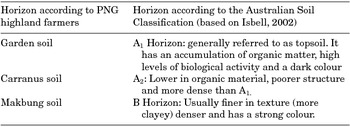
All indigenous farmers interviewed were able to identify and name at least two soil horizons, 82% were able to describe more than two soil horizons, and 18% were able to describe four or more soil horizons. The soil horizons identified by farmers were able to be aligned with scientific soil horizons, as outlined in Table 1. Participants were also able to describe the soil in terms of its colour, texture, and structure. This supports recent research that suggests that there is a significant correspondence between indigenous knowledge of soils and scientific understanding (Saito et al., Reference Saito, Linquist, Keobualapha, Shiraiwa and Horie2006).
Soil Horizons of Highland Farmers Compared to Western Classification

Table 1 suggests that soil extension may align with Western transfer of technology methods. However, soil was also viewed holistically, and indigenous farmers generally referred to the soil as ‘mother’. This term stems from the concept that, like a mother feeds and nourishes an infant, the soil feeds and nourishes farmers, their families, and the surrounding villages. Such a holistic view of the soil is significant for extension workers as it provides opportunities to link the impact of soil degradation issues, such as nutrition exhaustion, erosion control and fallow rotations, to family and village health, and wellbeing.
Extension around sustainable soil management is of particular importance, as 73% of participants stated that they have faced lowering yields and declining soil fertility over the past 10 years. Over 70% of participants felt this stemmed from climate change. While temperatures have increased at an average rate of 0.11ºC since 1950, there are no clear trends in changed rainfall patterns (Pacific Climate Change Science Program, 2011) and no evidence linking climate change to soil fertility or lowering yields in the highlands of Papua New Guinea. An educational program must provide farmers with a clear understanding of climate change implications as climate models do predict that seasonal patterns of coffee will be disturbed and incidences of malaria will increase in the highlands (Pacific Climate Change Science Program, 2011). An agricultural and environmental education must provide knowledge that enables indigenous farmers to respond to such climatic and environmental changes.
Cropping
The planting schedule differs significantly between villages; for example, of the participants from Kukan village, 92% based activities around the calendar year, while 72% of participants from the Kudjip Ownim village based cropping activities on the position of the sun against the peaks of the mountains during sunrise. There was one particular peak that could be seen by Kudjip Ownim villagers, and it was stated that when the sun rose over this peak they would begin to sow the kaukau/sweet potato (Ipomoea batatas), the major staple of the highlands. This example further demonstrates that indigenous knowledge is reliant on a holistic understanding of one's context. An educational program that can incorporate variances in the natural and social setting of individual villages will provide deeper learning, as opposed to the passive receiving of information from an instructionist transfer of technology program (Turcsanyi-Szabo, Reference Turcsanyi-Szabo, Marshall and Ruohonen1998).
Crop-sowing practices varied between villages. Farmers in the Kukan village primarily planted the kaukau in straight beds. Farmers in the Kudgip Ownim village incorporated several planting strategies for kaukau, dependent on what they wanted to do with the kaukau, as Participant 012 explained:
The large mounds [compost-containing soil moundsFootnote 2 ] are used to make the kaukau large, we sell at the market for a high prices, and the long beds make them [the kaukau] smaller but more, this is for the pigs and to sell at the market for people to buy to feed their pigs, these smaller ones are at a lower price.
Practices such as this have been passed through generations, as explained by Participant 026:
We have been doing this for generations, our ancestors taught us this, we use only soft grass, we call it pitpit, we also use kunai grass [to fill the compost mounds] . . . we do shifting cultivation, we leave the mounds in and move on to a new area.
The varying practices between villages reinforce the need for agricultural and environmental education programs to be contextual. Educational programs must also allow for varying practices within a village; for example, a farmer who has his garden on a slope will have different practices to a farmer whose garden is on the floor of a valley.
Pest Management
When participants were asked of crop failures from pests, 92% responded that they had lost at least one cash crop in the past 10 years, where only 8% had lost a traditional crop. Ethnographic observations identified the prevalent use of agricultural chemicals for pest management for European cash crops such as capsicum, but little or no use of agricultural chemicals for traditional crops. Ethnographic observations highlighted an obvious lack of understanding of agricultural chemical concentrations when mixing chemicals and the associated health issues. Farmers were often seen applying chemicals dressed only in shorts, while their children played with the drums of chemicals. Indigenous farmers hold a wealth of IK regarding traditional methods of pest management, including diagnostics, cultural controls, and companion planting, as could be seen across gardens of the more traditional crops. Agricultural and environmental education should play a more pivotal role in providing indigenous farmers in the highlands with the knowledge and skills for pest management. Although transfer of technology practices would provide an understanding of chemical concentration, application and safety, it does not allow for a flexible and holistic system and the integration of IK.
Spirits and Ceremonies
Cultural ties to the land, family and spirits are vitally important to the farmers of the PNG highland. It is the intent of the following examples to not only demonstrate the connection between farmers and their culture but also to highlight inherent issues associated with a reductionist transfer of technology method of education.
There continues to be strong beliefs in spirits among highlander farmers, and spirits are often believed to regulate social and ecological activities. Some farmers (n = 4) interviewed would not allow themselves to have sex with females before entering the garden as they feared this may bring on spirits that spoil the crops. Other participants (n = 3) said that women menstruating were not permitted to enter the garden for the same reason.
Spirits also guide traditional celebrations such as harvest ceremonies, as Participant 019 explains:
Many years ago we have a place called Kumbruk, this place produces people — all the people they came from this place. It looks like big trees and a swamp, it is a forbidden area. Our belief is that [after harvest] we must sacrifice pigs, the men go to Kumbruk and kill the pigs for their blood. Only the men go to this place, when they come back they have big power and strength.
Many families have shifted cultural requirements of harvest ceremonies to a simple feast to thank the spirits for their harvest, although 51% of participants required meat as the basis of the feast, and this is generally pig. The pig has traditionally been, and continues to be, a significant part of the highlands culture; however, raising pigs comes at a cost, explains Participant 019: ‘The pigs are a lot of work, we feed them a lot of our kaukau, but they are important, it is like having a bank account, it is our security.’
Pigs also have other important socio-cultural significance within the highlands. Pigs are used to resolve clan or social disputes, maintain social status, or pay dowries for brides. The number of pigs used in any of these agreements varies significantly and includes a broad range of factors. Participant 014 provides an example: ‘How much dowry depends on if that family can pay enough; my family gave 15 pigs to my wife's parents, her parents gave some to their sons and then gave some back to us.’
These examples provide a small insight into both the synchronic and diachronic nature of PNG highlands culture. While transfer of technology methods may incorporate some synchronic aspects of culture such as using local dialects, it has limited capacity to integrate the diachronic components; for example, an understanding of the connection between spirits and agricultural practices. Such disconnect from culture has an impact on learning as learning must be contextual (Falk, Reference Falk2005) and context requires an understanding of culture (Cobern, Reference Cobern1993).
Cultural Shifts to a Cash Economy
Families have traditionally worked together during harvest; however, since the introduction of cash crops there has been a shift in employment agreements. During harvest, 95% of participants employed family to assist with the work; of these, 43% are paid through foodstuffs, 35% are paid wages, and 22% volunteered to assist, providing the offer was returned. Implications for extension workers include an expectation by some communities that monetary wages should be paid for assistance with development projects. Such additional costs may have an impact on project models and funding.
The cultural shift to cash and cash crops is recognised by farmers as the way forward to a strong future, a future described by participant 007 as:
We have dreams that after 20 years we want to be living in some kind of permanent houses rather than the bush house, having some good water supply system, electricity, nice sealed road, some kind of life like this — and a private vehicle.
The shift toward cash crops and the uptake of Western practices diminishes the need for IK; as such, it is being devalued and in some cases lost entirely. In fact, farmers still reliant on IK are referred to by others as a kanaka, a derogatory term meaning one who follows the traditional rather than modern way.
Constraints of Knowledge Sharing
Data from the semi-structured interview found that 78% of participants acquired their agricultural and environmental knowledge through stories and songs told within family groups; however, very rarely was it shared with those outside the family. Accessing IK from within PNG highland communities was based on trust and status. Community leaders — generally men who have previously worked within the government or NGOs, or church pastors — are generally the only external parties who are trusted outside of the family. Farmers distrust their neighbours, believing their advice will result in poor harvests, hence less competition at local markets. Farmers are often jealous of any assistance received by their neighbours, and this jealousy can lead to violence. Communities of practice based on farmer cooperatives may provide a platform for trust building as a cooperative relies on all farmers having successful practices, particularly when the success of the cooperative depends on meeting contractual requirements.
The culture of distrust is a powerful one, yet not without reason. Constant ‘white man’ promises from government, NGOs and business, with little follow-through, has left an engrained cultural contempt towards external organisations, which unfortunately includes the educational institutions (Baldwin, Johnson, & Benally, Reference Baldwin, Johnson and Benally2009).
Interviews with the Fresh Produce Development Agency of PNG, which focused on identifying strategies to improve trust between PNG highland farmers and extension workers, highlighted several key elements.
Timeliness
An NGO, researcher or extension workers who has set up to meet or share information at a certain time, will lose all trust if they are not on time.
Culture and language
A willingness to learn and understand the culture and language will enhance trust and knowledge exchange; Bissett (Reference Bissett2012) calls this ‘meeting halfway’.
Patience
Trust will be quickly lost if people are not given time to hunt, attend ceremonies, and prepare food.
Immersion
Trust would be gained far sooner if an extension worker was to spend time being ‘part’ of the community. Immersion requires one to work in the gardens, go hunting, and live in the village.
Relationships
Arguably the most important facet of extension is the relationship between the extension workers and the village. Extension workers should ensure that education is undertaken with rather than for indigenous farmers.
Assessment of the Knowledge Management Model
A constructivist approach to knowledge management provided some understanding of IK soil, crops, pests, and culture; however, there were limitations to each mode of knowledge management.
The socialisation mode utilised a community of practice to enhance knowledge sharing. Three communities of practice were undertaken, a range of relevant topics were discussed, and there was some sharing of knowledge; however, most discussions were superficial and involved knowledge already known. A range of issues occurred in recreating a social knowledge sharing network, including that:
-
1. people felt pressured to talk, therefore much of the knowledge sharing was superficial;
-
2. those confident were vocal;
-
3. guiding questions were often required;
-
4. highland villages were complementary to communities of practice, as they offer natural ‘managers’ in the form of community leaders; however, these leaders lacked the skills to facilitate the community of practice;
-
5. participants looked to the researcher for answers to questions regarding agricultural or environmental issues;
-
6. there was a distrust of other knowledge, particularly if it was different to what participants themselves would do. There was a fear that other farmers would give false information or purposefully share information that would cause detriment to their farm.
Although the community of practice failed to recreate the natural social environment for knowledge sharing, it is strongly felt that with time, they may develop a strong, trusting knowledge sharing environment.
The externalisation mode utilised ethnography for tacit-to-explicit knowledge transfer. Although externalisation was enhanced, the ethnographic research process was time consuming and costly. For ethnographic research to be valued in extension programs, it is recommended that costs should not outweigh the benefits, and a balance between costs and the ethnographic study should be clearly established.
The codification mode provided a tool for explicit-to-explicit knowledge transfer. Thematic analysis provided an appropriate mechanism for understanding IK. As this was a small-scale study, themes were broad enough to capture the data without having too many themes. A large-scale study would require themes to be more specific, hence with more themes created. This may lead to more extensive and time-consuming research.
Conclusion and Recommendations
Highland farmers are becoming increasingly reliant on European cash crops and agricultural chemical inputs. IK is being devalued, pressure is being placed on the local environment, and there is a vital need for agricultural and environmental education. However, it is suggested that agricultural and environmental education must first understand and value IK. This study found that a constructivist approach to the Nonaka and Takeuchi knowledge management model was effective in understanding IK.
The article identifies that knowledge acquisition was predominantly from families, highlighting the weakness of community knowledge networks. It is suggested that a community of practice may enhance agricultural and environmental knowledge sharing; however, there are inherent difficulties associated with a community of practice, including distrust between participants and a lack a facilitation skills among community of practice leaders.
The study highlights that although ethnographic research was ideal for tacit knowledge to explicit knowledge transfer, it was time consuming, and the costs associated with it may limit its use.
The study also found that although some IK was transferrable between villages, there were significant variations of IK and culture, highlighting the need for extension to be village specific. The knowledge management model provides opportunities for extension workers to identify the variations between villages. It is suggested that if extension workers were to utilise the knowledge management model, IK may be valued and promoted, providing more contextual, relevant, and farmer-centric education.
There are several factors that limit understanding of IK, including trust, cultural, and social barriers. Understanding these factors and implementing strategies to improve or overcome these limitations, such as building relationships and speaking some local language and meeting halfway (Bissett, Reference Bissett2012), will significantly enhance an extension workers understanding of IK.
To enhance agricultural and environmental education among PNG highland farmers, the following recommendations are made:
-
• Communities of practice should be encouraged and be rewarded by development organisations for innovative practices, through inducements such as training and establishing sales contracts.
-
• The value of IK promoted by incorporating IK into extension programs.
-
• There should be a policy focus on improving farmer access to extension workers.
-
• Establish knowledge management practices to develop a repository of local knowledge and as a means of understanding cultural intricacies of individual villages.
-
• To enhance farmer learning, extension programs must become contextual, authentic and farmer-centric.
Author Biographies
Chris Radcliffe is a PhD candidate at Charles Sturt University, Orange, NSW, Australia.
Dr Cesidio Parissi is a lecturer in Problem Based Learning at Charles Sturt University, and Program Leader for the Bachelor of Clinical Science in the School of Biomedical Sciences.
Dr Anantanarayanan Raman is a Senior Lecturer in Ecological Agriculture and Sustainable Land Management at Charles Sturt University, Orange, NSW 2800, Australia.