Few events left such deep marks on eighteenth-century history as the rise to power of Frederick II of Prussia (1712–86), on 31 May 1740. While Frederick's territorial agenda transformed Brandenburg-Prussia from a vassal state into the nemesis of the Holy Roman Empire, his internal policies engendered some of the most radical reforms carried out in the entire Enlightenment. Within a month of his accession, for instance, the new king announced the upgrade of the Prussian army to the battle-force Maria Theresa would learn to dread in the Silesian War (1740–42). In addition, he declared the re-establishment of Leibniz's Royal Academy of Sciences and the ‘acquisition’ of such acclaimed scholars as Christian Wolff, Pierre Louis Moreau de Maupertuis and Francesco Algarotti, the foundation of an institute for commerce and manufacture, and the appointment of new court painters and sculptors. Frederick furthermore devised a plan to salute his subjects on a trip through Prussia, yet staunchly refused undergoing the religious coronation rites, which he spurned as ‘useless and frivolous ceremonies’ established by custom, ignorance and superstition.Footnote 2 In contrast to his father and predecessor, Frederick William I, Frederick II fostered the ambition to be a thoroughly secular monarch who acted as prime citizen among his citizens, rather than as their divinely ordained idol. The addressee of his announcements, François-Marie Arouet dit Voltaire (1694–1778), must have wept tears of joy over such decisiveness. Having foretold that Frederick's Berlin would resemble Athens, Voltaire at once saw his bold prediction accomplished.Footnote 3
Friderician Prussia would of course never fully realise Voltaire's utopia of the enlightened state, much less remain immune to the despotic excesses of absolutism. Nevertheless, it waved the flag of Reason in ostensible fashion, proclaiming religious equality in the spirit of tolerance and raising a Catholic church (the Hedwigskirche) in the heart of Protestant Berlin. As a corollary to its intellectual aspirations, Frederick's reign sparked an opulent artistic programme that endeavoured to make Berlin and Potsdam the peers of Paris and Versailles. One of its hallmarks, next to an impressive literary and architectural legacy, was of course its operatic repertory, which was composed in great part by court Kapellmeister Carl Heinrich Graun (1703/4–59) and staged at the newly built Königliches Opernhaus in Berlin.
While there is not exactly a dearth of studies on the Opernhaus,Footnote 4 surprisingly few scholars have tackled the remarkable evolution of its subject matter and dramaturgy between its inauguration in 1742 and its temporary closure at the outbreak of the Seven Years' War (1756). And yet, the 27 opere serie and eight minor works (ignoring revivals) mounted in its first fifteen seasons allow themselves to be grouped into three distinct phases (see Table): a ‘Metastasian’ period (1742–6), monopolised by heroic librettos with historical plots; an experimental phase (1747–52), featuring new adaptations from Racine's tragedies (whether with a tragic ending or not) in alternation with Italian versions of Louis quatorzien opéras-ballets and tragédies en musique on mythological and chivalric subjects; and a third, ‘syncretic’ period (1753–6), which saw Metastasio's warhorses share the stage with both ‘operatified’ versions of Racine and Voltaire, and with new scenarios, many of which represented mythical themes (e.g., the Temple of Love, the Thebaid or Merope).
The repertory of the Königliches Opernhaus in 1742–56 arranged according to seasons and phases. Titles involving the marvellous are given in bold.

*=new libretto; dc=drammatico componimento; dpm=dramma per musica; fp=favola pastorale; ft=festa teatrale; ppm=pastorale per musica; tpm=tragedia per musica
† This work is designated a ‘Serenate’ in Friedrich Wilhelm Marpurg, Historisch-kritische Beyträge zur Aufnahme der Musik, 5 vols. (Berlin, 1754–60), I, 81.
‡ Algarotti may have borrowed the subject of Coriolano from a homonymous libretto by Zaccaria Seriman (Venice, 1746); see his discussion of the latter work in Lettere di Giammaria Ortes veneziano a Francesco Algarotti (Venice, 1840), 13 (28 January 1746).
§ This work is incorrectly listed in Mayer-Reinach, ‘Carl Heinrich Graun als Opernkomponist’, 465 (no. 20) as a ‘Dramma per musica’.
¶ Marpurg, Historisch-kritische Beyträge, I, 84, states the work to be ‘von Villatis eigener Poesie’, yet the great number of Jugements de Paris created before this opera does not rule out a French model.
This division, contrived as it may seem, corresponds with a significant evolution of a narratological and phenomenological nature. For whereas the librettos of the first period cling to the verisimilitude of late seventeenth- and early eighteenth-century dramma per musica, unfolding their fact-based narratives in exclusively earthly surroundings (such as gardens, harbours, palaces, squares and temples), a substantial number of works from the second and third periods disrupt the framework of neo-Aristotelian poetics in their marked dependence on the supernatural in terms of plot, character and staging.Footnote 5 On a musico-dramatic level, moreover, the operas of the later periods present various anomalies vis-à-vis the standard recitative-cum-exit aria fabric of Metastasian opera, which is largely obeyed in the first period.
That Friderician opera did undergo some degree of ‘reform’ during its first decade and a half of existence has been well established,Footnote 6 yet the agents and factors accounting for the changes, and most notably for the expansion in subject matter, remain to be identified. In keeping with earlier scholarship on reformist experiments in London,Footnote 7 Rome,Footnote 8 Parma,Footnote 9 Stuttgart-Ludwigsburg,Footnote 10 Vienna,Footnote 11 TurinFootnote 12 and Mannheim-Munich,Footnote 13 one could ascribe Berlin's shift to myth and magic to a renewed interest in Lullian tragédie en musique, which in turn bespeaks Frederick the Great's cultural horizon. Indeed, Frederick's orientation in literary and philosophical matters was exclusively French, as shall be noted, yet how did deities, sorcerers and Louis quatorzien imports chime with Frederick's worldview, and more particularly with his manifest hostility to superstition and the concept of divine ordination? On what particular grounds could relics of pagan religion and French absolutism enter the operatic sanctuary of an avowed atheist, who would lash out against clergymen throughout his reign?
To answer these questions and thus provide a context for the upsurge of the marvellous at the Königliches Opernhaus, we must dig deeper into Friderician discourse and chart the intricate relationship between enlightened philosophy and opera with greater precision than has hitherto been the case.Footnote 14 This article does so by focusing on the first decade (1742–52) of the Opernhaus. First, we shall conjure the barren landscape in which Frederick had to build his theatre and its repertory from the ground up. Since Frederick William I had annihilated opera in Prussia, Frederick's decision to give new prominence to this very cultural manifestation was most radical in its rupture with the past. Operas involving the marvellous, we shall further explain, helped articulate and implement Frederick's religious agenda vis-à-vis his father's. Apart from this, the marvellous also constituted a conditio sine qua non for opera seria reform, as the writings of two Friderician theorists, Christian Gottfried Krause (1719–70) and Francesco Algarotti (1712–64), bear out. To demonstrate the intersection of religious philosophy and operatic dramaturgy, we shall conclude with a discussion of the oracle in Graun's Ifigenia in Aulide (1748). More than any other episode from the Opernhaus legacy, this innovative scene illustrates Frederick's most enduring contribution to operatic history: the creation of a breach in opera seria's logocentric wall.
Apollo's return
If Berlin became an eighteenth-century Athens, it could not do so overnight. The liberal arts had fared anything but well under Frederick's predecessor, Frederick William I (r. 1713–40). Save for the performance of chorales, Handelian excerpts and instrumental Tafel- und Jagdmusik, little honour had been bestowed by the ‘Soldier King’ on music, let alone on opera, which remained all but absent from Berlin between 1714 and 1741.Footnote 15 Apart from economic considerations,Footnote 16 it was a religious factor that kept opera away: Pietism.
Pietism emerged from the sixteenth- and seventeenth-century Reformed Churches of England and the United Provinces, achieving its greatest diffusion in the Lutheran and Calvinist Länder of the German-speaking region. Seeking to promote personal devotion in daily life, the movement professed moral sternness and ascetism in vociferous sermons, a number of which appeared in print. In their aversion to the worldly pleasures, Pietists denounced opera as the work of Satan (opera diabolica),Footnote 17 calling upon various arguments to do so: the allegedly decadent lifestyle of its performers, and above all the female singers; the sensuality and ‘effeminacy’ of operatic music; and the ‘unchristian’ nature of operatic librettos, in particular those deriving from or alluding to ‘heathen’ antiquity.Footnote 18 Pietistic literature truly abounds with anti-operatic utterances. In 1728, for instance, Berlin witnessed the publication of a flamboyant tract by Martin Heinrich Fuhrmann that inveighed against the ‘languishing’ state of Christianity and the ‘victory’ of paganism in the theatres and opera houses of the German region: Das in unsern Opern-Theatris und Comœdien-Bühnen siechende Christenthum und siegende Heidenthum. Another of Fuhrmann's pamphlets sought to imbue dread of the ‘whore-devil Cupid, the booze-devil Bacchus and the other uncouth spirits’ appearing in productions at the Hamburger Gänsemarkt-Oper, which were allegedly preaching the ‘pagan theology from Greek and Latin fable’, instilling carnal voluptuousness and tempting the credulous into ‘Persian’ idolatry.Footnote 19
Although the anti-sensualist doctrines of Plato and the Church Fathers to which it adhered were old, Pietism had a ravaging impact on the German stage, often causing German librettists great pains – ten pages of preface, in the case of Christian Heinrich Postel's Der geliebte Adonis (Hamburg, 1697) – to convince spectators and censors of the idea that ‘fine gold and silver’ was to be refined from the ‘raw piece of ore’ that was mythology.Footnote 20 All to no avail, it seems, for as Barthold Feind reported in his Gedancken von der Opera (1708), spectators in Hamburg grew ‘totally disgusted by the pagan fables of deities’.Footnote 21
Like other German rulers of his era,Footnote 22 Frederick William I was heavily indoctrinated in Pietism, the lifestyle of which he tried to impose on his subjects, and most of all on his own son. In 1718, he issued a public Instruktion to Frederick to spend not a Thaler on ‘operas, comedies and other follies of the laity’.Footnote 23 On the rare occasion that Frederick William authorised a theatrical performance, the piece had to serve a moral cause, as Andreas Weidner's comedy Der verliebte Frantzoss in Sachsen (1734) did by mocking the pompousness of French court culture as represented in Berlin by Louis XV's ambassador, the Marquis de la Chétardie.Footnote 24
Quite naturally, however, Frederick William's orthodox teachings had totally the opposite effect on his son, driving Frederick straight ‘into the arms of the French Enlightenment’Footnote 25 and turning him into a talented writer, a musician and a maecenas, the founder of Masonic lodges, and a professed Francophile who would never neglect an opportunity to rebut his father's views and subvert his regulations. On 14 February 1745, Frederick thus reacted to the expulsion of actors from the University of Halle, a centre of Pietistic education:
This [expulsion] is the fault of the spiritual, sanctimonious rabble. They [actors] must play, and Herr Franke [Gotthilf August, 1696–1769, the University's General-Director since 1727], or whatever the villain's name may be, will be present to publicly rectify his foolish action to the students, and the commander will provide me with the attestation of his [Franke's] attendance!Footnote 26
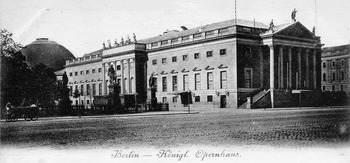
Frederick took his most drastic measure against Pietistic rigour in July 1740 by having the architect Georg Wenceslaus Knobelsdorff (1699–1753) lay out the plans for a building that would bring opera right to the heart of Berlin: the Königliches Opernhaus at boulevard Unter den Linden (see Fig. 1).
Late nineteenth-century photograph by S. Williams showing the western and southern façades of the Königliches Opernhaus prior to its extension with a high fly tower. On the left is seen the cupola of the Hedwigskirche, to the right the Königliche Bibliothek which also formed part of the Forum Fridericianum. Postcard in the author's collection.

The freestanding Opernhaus, which many would consider the most sumptuous of the era,Footnote 27 formed part of a vast, unfinished project called the Forum Fridericianum, consisting of the Catholic Hedwigskirche, a royal palace, an academy of the sciences and a ballroom, all of which were erected on the vestiges of Berlin's fortifications as physical statements of the city's elevation from militaristic bulwark to capital of the arts.Footnote 28 The theatre boasted no fewer than four monumental façades, the principal (southern) of which constituted a ‘grand Corinthian Portico in the style of an antique temple dedicated to Apollo’.Footnote 29 Its sculptural programme read as a homage to Ovid:
On top stand the statues of Apollo, Melpomene and Thalia by Nahl [Johann August, 1710–81, Frederick's Directeur des ornements]; on the pediment is a sacrifice to Apollo, represented in bas-relief by the same; the frieze bears the inscription ‘King Frederick to Apollo and the Muses’ [Fridericus Rex Apollini et Musis]. At the top of the portico wall are four bas-reliefs which depict the legend of Apollo [the pursuit of Daphne, Apollo instructing the shepherds, and Apollo's competitions with Marsyas and Midas] … The side facing the Library [eastern front] … is adorned with ribbed Corinthian pilasters on which stand six statues of Muses [Euterpe, Terpsichore, Calliope, Clio, Erato and Polyhymnia]. Bas-reliefs [representing Pan in pursuit of Syrinx and playing the flute, the competition between the Muses and the Pierians, and the metamorphoses of Echo] are seen in frames between the pilasters and below the statues. The corresponding side near the canal [i.e., western front] is embellished in an identical way. The rear [northern façade] … has statues of the three Graces and … a bas-relief of Orpheus, moving the animals and stones with his lyre. Between the pilasters are four bas-reliefs representing the legend of Orpheus.Footnote 30
The Opernhaus's interior, too, was suffused with the marvellous: while deities and satyrs supported the ceiling of the foyer (nicknamed Apollosaal), the stage curtain depicted Apollo and the Muses in Watteauesque poses and brush strokes.Footnote 31
Frederick's preoccupation with Apollo and Ovid emerged from a significant episode in his biography: his secluded existence as crown prince in Neuruppin (1732–40), the garrison town 80 kilometres north of Berlin to which his father had banished him after his failed attempt to escape Prussia. At this residence, Frederick spent his days dabbling with the very pleasures his father had forbidden: music and French literature. In 1735, he commissioned a picturesque garden from Knobelsdorff which was baptised Amalthea, recalling the Oceanide who had given birth to Zeus and after whom Cicero's friend Atticus had named his estate (Amaltheum). The ‘English’ garden would eventually be nicknamed Tempelgarten on account of its architectural eye-catcher: a circular temple (monopteros) that was topped by a statue of Apollo to indicate its function as sacrificial shrine to the arts.Footnote 32
Additional projects in the Brandenburg region would represent Frederick's Apollonian interests: in 1742 Apollo and the Muses were the subject of a ceiling by Pesne in Frederick's music room in Charlottenburg Palace; in 1745 they surfaced on Johann Gottlieb Heymüller's temple front of the new playhouse installed in the eastern wing of the Potsdamer Stadtschloss; and in 1750 they graced Charles-Amédée-Philippe van Loo's ceiling of the aforesaid venue. By the mid-eighteenth century Apollo was so readily seen as equivalent to Frederick's intellectual and artistic endeavours that Francesco Algarotti, the inventor of the Opernhaus's motto, began to invoke Frederick himself as the sun god, in spite of the latter's aversion to absolutist deification:
Come to my aid, God of the Helicon [mountain believed to be home of the Muses], lend me your lyre, inspire me to your sweetest sounds. I do not want to sing the victorious charms of a beautiful dark eye or the lovely disorder of tangled locks. It is you I celebrate, mighty Apollo, you who has descended from the celestial realm to appear under the guise of the young hero that gives laws to Prussia and provides happiness to the world. It is not on account of your flowing hair or golden garland that I recognise thee, but on account of the holy delight that your presence inspires, of the lovely traits, noble conduct and new verses you perform on your sonorous lyre for the instruction and pleasure of man.Footnote 33
Negotiating myth
The combined rehabilitation of myth and opera provided Frederick with an ideal outlet to overturn his father's Pietism, which he regarded as typical of what Voltaire and he constantly referred to as l'infâme (infamy). It was indeed Voltaire who furnished the philosophical soil for Frederick's ideas and actions by constantly calling upon him to conquer the ‘monster of superstition and fanaticism, that true enemy of divinity and reason’.Footnote 34 In September 1740, Frederick had Voltaire come from Paris to discover in him the peer of Cicero, Plinius and Agrippa.Footnote 35 Frederick repeated the invitation in 1743 and 1750, on which later occasion he named Voltaire court chamberlain – a position the philosopher left in anger in March 1753.Footnote 36
What is important to underline here is that mythology constituted an ambiguous trope in Voltaire's – and, by extension, Frederick's – discourse against superstition. On the one hand, it was cast as an intellectually inane artefact of pre-enlightened civilisations; on the other, it helped validate the deist concept of ‘natural religion’, that is, a faith unhindered by theological disputes. On pursuing the former strategy, Voltaire paid lip-service to Bernard Le Bovier Fontenelle's De l'origine des fables (1689–99) and Pierre Bayle's Dictionnaire historique et critique (1697), two pioneering tracts of enlightened philosophy that had decried mythology as a lapse of reason and summoned up repulsive visions of priestly impostors indoctrinating the masses with fables.Footnote 37 Whereas Fontenelle considered mythology as belonging to an irrational stage in the history of mankind, the universal path of which led from ignorance to enlightenment via (Christian) faith, Bayle unequivocally dismissed the pagan gods as anthropomorphic fetishes indulging in parricide, rape, cannibalism, sodomy and incest. According to Bayle, the literal – rather than allegorical – sense of myths had been imposed on superstitious savages through sermons, intimidation and drug-induced hallucinations. It is Fontenelle's and Bayle's views that we find paraphrased in one of Voltaire's earliest letters to Frederick, dated September 1737:
The authority of the priests of paganism originated from their treacherous oracles, ridiculous sacrifices and impertinent mythology. It was truly an alarming story, that of Daphne changed into laurel; of the virgins who got pregnant by Jupiter and gave birth to gods [e.g., Perseus by Danaë]; of Jupiter, a god who leaves heaven, his thunder and lightning, to descend to earth, under the guise of a bull, in order to rape Europa; the resurrection of Orpheus who triumphs over hell [in his endeavour to release Eurydice from the underworld]; and finally, an infinity of other absurdities and puerile tales, capable, at the very most, of amusing children. However, men, charmed by the marvellous, have surrendered to those chimaeras at all times and revered their advocates.Footnote 38
On the other hand, Voltaire refused to rule out the existence of ‘natural’, monotheistic cults among the gentiles. Thus, in the Philosophie de l'histoire (1765), he argued that the ancient Romans had worshipped Jupiter as their dieu maître, while in the Dictionnaire philosophique (1764), he refused to condemn the entirety of mythological lore: while some fables epitomised the ‘corruption of the ancient histories’ and ‘caprice of the imagination’, Voltaire argued, others imparted valuable lessons and by so doing represented the ‘living picture of entire nature’.Footnote 39 In other words, myths, irrational though they might be, represented the complexity of man's civilisation and for this reason alone merited toleration.
It was this fundamentally dual stance on myth that Frederick appropriated in formulating his own attacks on l'infâme and, as shall be seen, in restoring the marvellous in opera seria. Unlike Bayle, whose Dictionnaire he recognised as a revolutionary work,Footnote 40 Frederick was not totally averse to the beliefs of remote civilisations; after all, he opined in his Political testament of 1752, ‘all religions [my emphasis] are founded on a system of more or less absurd myths’.Footnote 41 The Reformation, for instance,
while opening the eyes of the People to an infinity of superstitions, had retained many others – so much of an inclination of the human spirit towards error is inconceivable. Luther, who did not at all believe in Purgatory, admitted ghosts and demons to his doctrine; he [Luther] even maintained that Satan had appeared to him in Wittenberg and that he had exorcised himself by throwing a mug of ink at his [Satan's] head.Footnote 42
No religion could, according to him, claim to have brought enlightenment; on the contrary, each new doctrine brought about the destruction of its predecessor. Ancient culture, for example, had all but disappeared under the rod of Christianity:
In their zealousness, the Christians destroyed the Idols of Paganism, not a single vestige of which has consequently survived; their [idols'] empty niches were replenished with Saints of all kinds, and new errors succeeded the old ones.Footnote 43
Though he never mentioned his father and the Pietists by name, Frederick made little effort to conceal his true opinion about their excoriation of art and mythology. In De l'utilité des sciences et des arts dans un état (1772), we read that,
[i]n the philosophical [i.e., eighteenth] century we are living in, some have not only wanted to denigrate the superior sciences, there have also been persons of sufficiently bad character, or rather [men] depraved of emotions and taste, to declare themselves enemies of literature … They proscribed the ancient fictions, those ingenious and allegorical fables that contained so many truths.Footnote 44
The only option worthy of pursuit for a self-declared man of reason and enlighted monarch was to rehabilitate the ‘ancient fictions’ as relics from a distant, pre-Christian past.
Frederick was not alone in disseminating Voltaire's viewpoints on myth. One of the Prussian writers who openly adhered to the enlightened creed on natural religion was Johann Philipp Heinius (1688–1775), whose Sur les idoles d'Épicure (1745), a paper for the Royal Academy of Berlin, opened with the following statement:
Those who reject Pagan Philosophy for the sole reason of it originating from the Pagans, and under the pretext of it being as incompatible with Christianity as the light with the dark, reason with but little accuracy. Reason, the principle of all light, has been imparted to the Gentile just as it has been to the Christian . . .Footnote 45
It was pointless, Heinius explained, to either condemn or apologise for the ‘false and bizarre opinions’ of the ancients given that these mistakes emerged not from a lack of rationality, but rather from unfavourable working conditions.Footnote 46 Eighteenth-century citizens, who prospered economically and intellectually, could not be harmed by exposure to mythological imagery in art, literature or theatre; quite the contrary, given their utter irrationality, myths could furnish the soil for enlightened optimism and bolster perceptions of intellectual progress. In what follows, we shall observe how this somewhat paradoxical appreciation of ancient myth pervaded the repertory of Frederick's anti-Pietistic project par excellence: the Königliches Opernhaus.
Crushing superstition
In an oft-cited letter from October 1753, Frederick reinvited Francesco Algarotti to his ‘heretic land, where even the opera can serve to reform morals and destroy superstitions’.Footnote 47 As this comment suggests, operatic activity was not just reinstated in Prussia; it served the so-called philosophe de Sans-Souci as an audiovisual outlet for his philosophical agenda with regard to religion. If one opera constituted a manifesto of his aversion to religious dogmatism, it is of course Montezuma (1755). Versified by Giampietro Tagliazucchi (fl. 1749–63) after a French prose drama by Frederick, which in turn displaced the gist of Voltaire's Alzire, ou Les Américains (1736) from Peru to Mexico,Footnote 48Montezuma recounted the Christianisation of Latin America in such flagrantly anti-clerical terms that it must have provoked Catholics and Protestants alike. In stark contrast to Alvise Giusti's libretto Motezuma, which was set by Antonio Vivaldi (Venice, 1733),Footnote 49 Frederick's version did not stage Hernando Cortés as a herald of salvation, but instead had the Aztec Emperor Montezuma teach the conquistador a lesson in natural religion and tolerance. In Act II scene 7, the protagonists exchange the following words:
[Cortés We by law abhor the wicked idolatry that offers human victims to barbaric gods. More than to conquer, we aim to make our God known, and establish among you the perfect religion, acceptable to this God. Montezuma Ah, what idea shall one have to form of a deity whom crime imposes? Of a religion that forces you to detest everyone who is ignorant of it, or who does not accord with its opinions? [A religion] that can legitimate in you the perfidy you use with me? Cortés You are not worthy of knowing the religion you offend. Montezuma Ours [religion] is equally sacred and entirely perfect. For it compels one to love and to serve every mortal being; it teaches to sympathise with whomever thinks differently from us.]
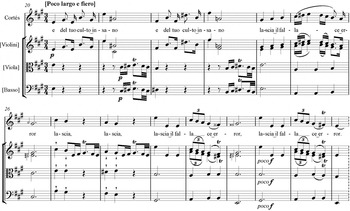
The aria ensuing from the quarrel, Cortés's ‘Benchè superbo e vano’ (Ex. 1), gives an idea as to how the conquistador's religious zealousness could be rendered in galant music. The fiero indication, dotted rhythms, rests and staccatos (on ‘lascia’, bars 27–8) work together to portray Cortés as a man who demands to be heard and obeyed;Footnote 50 the ‘harsh’ key of E major with insistent f𝄪 appoggiaturas on ‘error’ (bars 26 and 31–2) seem to suggest that it is Cortés, not Montezuma, who embodies the savage Other.Footnote 51
Carl Heinrich Graun and Giampietro Tagliazucchi, Montezuma (Berlin, 1755), Act II scene 7: Cortés ‘Benchè superbo e vano’, bars 20–34. After the printed edition in Denkmäler Deutscher Tonkunst, 65 vols., ed. Rochus Freiherr von Liliencron et al. (Leipzig, 1904), XV, 114–15.
[… and abandon the deceptive error of your insane cult.]

In settling an account with religious dogmatism, Montezuma proves the culmination of a longer evolution that had started in the 1740s, and more particularly in Cleopatra e Cesare, the opera that inaugurated the Opernhaus on 7 December 1742. Although Giovan Gualberto Bottarelli culled its libretto from Pierre Corneille's La mort de Pompée (1638) and Giacomo Francesco Bussani's Giulio Cesare in Egitto (Venice, 1677), the sources of Handel's eponymous opera, the six scenes closing the second act do not appear in either Corneille's or Bussani's model, and were thus probably sketched by Frederick.Footnote 52 The dramatic situation is this: in a magnificent temple devoted to the Egyptian god Serapis, the wedding ceremony between Caesar and Cleopatra is suddenly interrupted by Caesar's enemies, the Arabian prince Arsaces (Arsace), Cleopatra's brother Ptolemy (Tolomeo) and her lieutenant Achillas (Achilla). While the latter begins to chafe at the deity and his priests, soldiers wreck religious paraphernalia. I shall cite both the original drama in Italian and the extensive German translation since spectators in Berlin had both versions before them:

[What, buffoonish god of Egypt? He beholds the statue of Serapis with contempt. Do you assist a Roman? with resolution. Ah, how foolish it is to confide in the gods! You, criminal priests, you belong to those who subvert the minds of the ignorant with the dreams and chimaeras of religion. Lo, comrades, [standing] between Arab and Roman soldiers [the troops of Arsaces and Julius Caesar], follow this burning dagger straight to the entrance hall, chase this profane crowd of vile people outside, extinguish this incense, this pyre, tear down this imagined deity, this altar. Frightened, the priests flee. The soldiers throw down and smash the statue of the god, wreck the pyre, overturn the vases, extinguish the fire, throw everyone into confusion and carry them outside. And may the high priest eventually perish too, together with his criminal servants and temple, to set an unprecedented, indeed, but righteous example.Footnote 53]
The lion's share of the recitative in question and the aria ensuing from it, ‘Nulla importa a me vedere’, were probably never set, as virgole indicate: was it to avoid delaying the plot, or because the creator of Achillas, the Brescian – and presumably Catholic – bass Gaetano Pinetti, refused to utter such potentially blasphemous words? Whatever the motivation for the omission, the episode must have reminded readers of another of Pierre Corneille's famous tragedies, Polyeucte (martyr) (1643), whose eponymous, Christian hero overturns the idols of the Romans in Act V scene 4 for representing the very crimes Bayle had enumerated in his Dictionnaire historique et critique: ‘prostitution, adultery, incest, theft, murder and everything that one detests’.Footnote 54 However, whereas Corneille's work chanted the Counter-Reformation war cry for ‘true religion’ (that is, for Roman Catholicism), Achillas's assault against the ‘dreams and chimaeras’ of the Egyptians must have been construed by Frederick in the same way as Cortés's attack on Mexican tradition: Achillas, not Cleopatra, is the villain in Cleopatra e Cesare, and so his disruption of a sacred ceremony must itself read as an allegory of religious zeal.
In both Montezuma and Cleopatra e Cesare, pagan culture is deployed as a positive inverse of religious orthodoxy, the zealous exponents of which, Cortés and Achillas, have trodden down too many precious civilisations to be apologised for any longer. Indeed, irrational and ludicrous as such beliefs might have seemed to Frederick, he sympathised with Montezuma's and Cleopatra's idolatry, if only for the sake of endorsing exemplars of mankind's arduous journey towards enlightenment and natural religion. This is not to say that the pagan gods themselves had any role of note to play in the opere serie performed in the earliest years of the Opernhaus. Bar some exceptions (to be discussed below), divine bodies and practitioners of the magic arts were not allowed to enter Frederick's stage to give vocal or gestural proof of the supernatural at work during this period.
Resuscitating the marvellous
Unlike the tragédie en musique under Louis XIV and XV, and unlike Frederick's endeavours in architecture, painting and literature, early Friderician opera maintained opera seria's focus on history, thus making continuous bows to the classicist verisimilitude that was the stock in trade of the Dresden Hofoper. The latter institution had enraptured Frederick while still a prince under his father's severe tutelage, in the winter of 1727–8. Vying to outdo the Saxon-Polish Elector August III, Frederick sought to acquire copies of Johann Adolf Hasse's scores for Dresden and had many of them revived, if not with Hasse's original music (La Clemenza di Tito, 1738 and Arminio, 1745), then at least with their librettos clothed in new tunes by Graun (Cajo Fabrizio, 1734 and Lucio Papirio dittatore, 1742). Original productions, too, remained strictly within the Metastasian mould and avoided forays into myth or chivalric romance.Footnote 55 A mere two exceptions prove the rule.
First, mythology made a modest appearance at the Opernhaus by way of two cantatas: Venere e Cupido, the encomiastic prologue to Graun's Rodelinda, as revived for the wedding of Prince August William and Louise Amalia of Brunswick (6 January 1742), and the Festa del Imeneo, which preceded the performance of Catone in Utica during the festivities for Princess Ulrike's marriage to Adolph Frederick of Sweden (18 July 1744). Neither work made a significant contribution to the evening, the former being comprised of a mere two arias and a duet, the latter of two arias and a chorus. Fables also played a secondary role in the entr'acte ballets choreographed by Jean-Barthélémy Lany and danced by the latter's corps, one of whose members was the young Jean-Georges Noverre.Footnote 56 Thus, the assassination of Orpheus was danced in Alessandro e Poro (1744), presumably using an early form of ballet d'action, while ‘Greek sculptors, who represent the fable of Pygmalion’ (Tantz von Griechischen Bildhauern, welche die Fabel vom Pygmalion vorstellen) appeared in the first act of Adriano in Siria (1746).Footnote 57 However, these ballets aside, the gods of antiquity and sorcerers of chivalric romance were absent from Berlin's operatic stage. It was only from 1748 onwards that the supernatural assumed an active role in Frederick's theatre.
One year earlier, substantial modifications were made to Berlin's theatrical personnel. January 1747 saw the appointment of the court librettist who would author all fourteen librettos staged between 1747 and 1752: Leopoldo de Villati (1701–52).Footnote 58 That very month, two further additions were made to the Opernhaus crew: the prima donna Giovanna AstruaFootnote 59 and the decorator Innocente Bellavite (also ‘Bellavita’) – the latter of whom would be supported by an engineer, Girolamo Bon (in 1749), and by the celebrated designer Giuseppe Galli Bibiena (in 1750).Footnote 60
The combined presence of these new creative forces appears to have provided conditions congenial for far-reaching innovations. In generic terms, the traditional diet of heroic opera with a lieto fine was expanded, with the addition of pastorals, spectacular feste teatrali and tragedie per musica with genuinely ‘tragic’ endings. In narrative terms, new types of subject matter began to be explored, some of which had not yet been considered in Italian opera. Le feste galanti (1747) was adapted from Joseph-François Duché de Vancy's and Henri Desmarets's pioneering opéra-ballet, Les fêtes galantes (Paris, 1698), while L'Europa galante (1748) was derived from Antoine Houdar de La Motte's and André Campra's L'Europe galante (Paris, 1697). The former opera enacted the festivities organised by three princes to win the hand of a Neapolitan queen; the latter, Venus's triumph over Discordia in dances in French, Spanish, Venetian and Turkish attire. The sheer novelty of both opéra-ballet remakes in Italian can be inferred from the French author, Josse de Villeneuve's reformist Lettre sur le méchanisme de l'opéra italien of 1756, which advocated, some eight years after the Berlin production, that a stylistic reconciliation of French and Italian opera be commenced with an adaptation of L'Europe galante before turning to the librettos of Philippe Quinault.Footnote 61
As if further presaging the Lettre, court librettist Villati elaborated three of Quinault's tragédies en musique that were considered the staple of the Louis quatorzien repertory: Roland (1685), Phaëton (1683) and Armide (1686). The first, which Villati reworked into Angelica e Medoro (1749), dealt with the capture of Medoro by the sorceress Alcina and the pursuit of Angelica by a deranged Orlando. While a host of opere serie had already embroidered this Ariostan trope,Footnote 62 the Friderician adaptation of Roland was significant in at least two respects: in a letter to Algarotti (December 1759), Voltaire would single out Quinault's fourth act as a model for operatic reform,Footnote 63 while Algarotti would for his part praise its skilful integration of the ballet into the action.Footnote 64 The average Opernhaus spectator, on the other hand, must have been particularly impressed by the unusually lavish spectacle that Angelica e Medoro brought onto the stage. In the opening scene, a ship was thrown onto the coast by the stormy sea; in Act II scene 5, Furies danced in a mysterious wood; and the third act rushed towards a feast of extraordinary events, such as the killing of an orca by means of a magic shield, Alcina's suicidal plunge into the sea, and the apparition of Venus and her followers ex machina.
Still more visually enthralling was Fetonte (1750), the remake of Phaëton. With one exception,Footnote 65 no opera seria had hitherto staged this Ovidian tale; even decades afterwards, composers and critics considered Phaethon's fall from Apollo's chariot incompatible with the rationalistic ambitions of Italian serious opera.Footnote 66 Yet, Lully's opéra du peuple Footnote 67 had successfully projected the myth of le Roi Soleil onto the stage of the Académie Royale de Musique, and so the Prussians must have deemed it suitable to project their king's Apollonian image onto the scene of the Opernhaus – tellingly, it was Frederick himself who furnished its scenario and supervised its versification.Footnote 68 The triumvirate of scenographers then active at the Opernhaus (Bellavite, Bon and Bibiena) must have shed blood, sweat and tears over the engineering necessary to turn the Lullian pomp and circumstance into working stagecraft.Footnote 69 In Act I scene 7, Proteus rises from the sea escorted by Tritons; two scenes later, a Triton appears to the sound of a ‘gay symphony’, Proteus transforms into a lion, tree, sea monster, fountain and flame, after which sea gods and nymphs join in a dance. Act II scene 8 calls for a temple of Isis in ‘glass’ with doors that magically close and reopen to reveal a flame-vomiting abyss, from which Furies and phantoms then emerge to chase all present on stage – a tableau reminiscent of the temple scene in Cleopatra e Cesare if it were not for the supernatural identity of its instigator, the Egyptian goddess Isis. The opera furthermore features a divertissement of Seasons and Hours who dance their way from the second into the third act, a chorus that extolls the healing powers of the sun in Apollo's palace, the goddess of dawn, Aurora, appearing against the cloudy sky of a countryside scene, and of course Phaeton's fall from the burning sky.
The Quinault cycle at the Opernhaus was rounded off on 27 March 1751 with an adaptation of the libretto that would constitute a point of departure for operatic reform in Vienna: Quinault's Armide.Footnote 70 Graun's and Villati's Armida resembles Angelica e Medoro (see above) in its chivalric inspiration and concomitant dependence on the supernatural – sleeping Rinaldo is enchanted by demons in pastoral disguise (Act I scene 6), while Hatred (Odio) and other personifications of Armida's passions appear and disappear in explicable fashion (Act II scene 2). Yet, Armida is far less atypical of opera seria in light of the numerous operatic homages to Tasso's Gerusalemme liberata preceding it.Footnote 71
Orfeo (1752), which followed after Armida, is more unusual in its coverage of the complete Orpheus legend, from the marriage with Eurydice to the assassination by the Bacchants. Modelled after Michel Du Boullay's and Louis Lully's Orphée (Paris, 1690),Footnote 72 which itself recalls Francesco Buti's Orfeo for Luigi Rossi (Paris, 1647), the opera involves a host of subsidiary characters alongside Orpheus, Eurydice and Pluto: there is a Thracian queen, Aspasia, together with her confidante, Ismene; Orpheus is seconded by his brother, Aristœus (Aristeo), and friend, Cleon (Cleone); and Pluto has a judge named Radamanthus (Radamanto). Matters are complicated by the love triangles emerging from Aspasia's infatuation with Orpheus, Aristœus's with Eurydice, and Ismene's with Aristœus, but the core of the Ovidian myth remains, since the extra characters fill in the plot like pieces of a jigsaw – Aspasia directly causes the deaths of both Eurydice and Orpheus, as it is she who puts the fatal serpent in the grass and leads the murderous Bacchants.
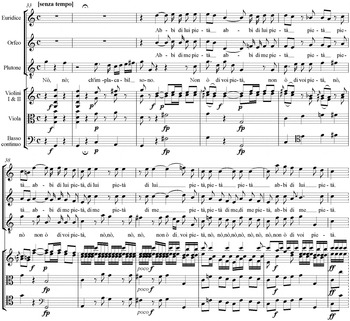
Graun's score for Orfeo may not overshadow Gluck's Orfeo ed Euridice; still, his choruses (e.g., the Fauns' ‘A i campi’ in Act I scene 7) and ensembles (e.g., Orpheus and Eurydice's ‘Sì, mio ben, bell'idol mio / Sì, mio nume, anch'io desio’ in Act II scene 1) have intricate textures and are tightly locked into the action – some of Graun's ensembles were praised in their day as the ‘honour of the German nation’Footnote 73 and issued in a four-volume anthology edited by Johann Philipp Kirnberger (Duetti, terzetti, quintetti, sestetti ed alcuni chori delle opere del Signore Carlo Enrico Graun già mastro di Cappella di Sua Maestà il Rè di Prussia, 1773–4). In Orfeo, ‘Fuggi da questo lido’ (Act II scene 8), for instance, is performed by the main characters after Orpheus's violation of Pluto's order not to look Eurydice in the face.Footnote 74 To be sure, the trio's obligatory da capo mould elongates it more than is necessary, yet the vocal texture adds considerable individuality to each of the participating voices, portraying Pluto as an implacable tyrant who counters Orpheus's and Eurydice's mellifluous pleas with the piqued exclamations (‘Nò, nò, nò…’) for which opera buffa was noted (Ex. 2).
Carl Heinrich Graun and Leopoldo de' Villati, Orfeo (Berlin, 1752), Act II scene 8: trio ‘Fuggi da questo lido’ (II,8), bars 33–43. After Johann Philipp Kirnberger, ed., Duetti, terzetti, quintetti, sestetti ed alcuni chori delle opere del Signore Carlo Enrico Graun…, 4 vols. (Berlin, 1773–4), III, 481–2.
[Pluto No, no; I am implacable. Eurydice & Orpheus Have mercy on him/me. Pluto I do not have mercy on you.]

Reform's hypothetical instigators
With Orfeo, Friderician opera produced an Italian equivalent to the tragédie en musique, turning the bas-reliefs on the Opernhaus's northern façade into a musical tableau vivant. Who could have instigated that unlikely rapprochement between Italian and French opera? The librettist Leopoldo de' Villati? Probably not, since the meagre evidence surrounding Villati's career testifies against his abilities.Footnote 75 In comparison with contemporary court poets, Villati fulfilled a rather insignificant role in Berlin, earning a mere 400 Thaler a year and enjoying a posthumous reputation that was close to non-existent – his demise at 51 (1752) was not commemorated in any way. In 1749, moreover, Gotthold Ephraim Lessing availed himself of Villati's name to sign Tarantula, a ‘mock opera in the newest Italian taste’ (PotzenOper, im neusten italienischen Gusto oder Geschmack); one year later, Lessing remarked in his Nachricht von dem gegenwärtigen Zustande des Theaters in Berlin that there was little ‘invention, structure or verisimilitude’ in Villati's efforts, which were ‘lumped together from tragedies’, seasoned with ‘hackneyed ideas’ and ‘similes’, and conceived in a ‘totally unpoetic style’.Footnote 76 Lessing's opinion was confirmed by Voltaire, who, on the occasion of Fetonte, debunked Villati as an alcoholic in want of talent:
The King has an Italian poet named Villati at a wage of four hundred ecus [Thaler]. For this money, he [Villati] gives verses that do not cost a lot either to the poet or the King. In the morning, our Orpheus drinks a bottle of brandy instead of Hippocrene's water [i.e., inspiration], and from the moment he is a little drunk, the bad verses flow from the source. I have never seen such a coarse thing [as Fetonte] in so beautiful an auditorium. The latter resembles a Greek temple, and Tartarian works are performed in it.Footnote 77
Presuming, on the basis of Lessing's and Voltaire's judgements, that Villati was a mere lackey who happened to be at hand to versify prefabricated scenarios, we should shift our attention towards the poet's direct employer at the Opernhaus: impresario Ernest Maximilian von Sveerts (also ‘Schwerts’ or ‘Swerts’, 1710–57). Unlike Villati, Sveerts was remembered in an Éloge (1757) by Samuel Formey, from which we learn that the man was a deputy of Flemish descent who originally worked in the service of Austria until Frederick annexed him along with the Silesians, in autumn 1740. Sveerts quickly made a career for himself as Frederick's factotum, combining the duties of impresario, building contractor, architect and doorkeeper – in fact, it was Sveerts who distributed tickets for the Opernhaus and who could decide who entered.Footnote 78 In addition to Sveerts being added to Frederick's legion of court chamberlains and Frederick accepting the role of godfather to Sveerts's son,Footnote 79 other elements testify to the impresario's importance as aesthetic arbiter. Lessing, for instance, credited Sveerts with the artistic directorship and programming of Berlin's French-spoken theatre,Footnote 80 while Algarotti dedicated the first edition of the Saggio sopra l'opera (1755, see also below) to Sveerts, thus praising the latter's artistic acumen:
Who more than you will be able to decide whether in these thoughts of mine I have shown understanding about the true form of opera? To you one has already entrusted the direction of the theatre in a country that in almost every way has become a model that other countries strive to imitate. In fact, you will notice that the lion's share of what I demand be done [in opera], is exactly what is being done at the theatre in Berlin.Footnote 81
Hyperbole aside, it is noteworthy that Voltaire, who had witnessed several productions at the Opernhaus, warned Algarotti, on inviting the latter to Geneva, that it would be difficult to encounter ‘an impresario, or a Swerts [sic]’ in Switzerland ‘who can represent an opera in accordance with your beautiful rules’, that is, according to the precepts of the Saggio sopra l'opera in musica.Footnote 82 In addition, Frederick addressed an epistle to Sveerts, Sur les plaisirs (1748), which opened thus:
[Beloved Director of our brilliant entertainments, you who rule, at the spectator's behest, over the games of Terpsichore [Muse of dance and lyric poetry] and Polyhymnia [mime], over Melpomene's tears [tragedy] and Thalia's laughter [comedy]: which of these pleasures [dance, poetry, mime, tragedy or comedy] could, according to our wishes, contribute most to making people happy?]
Sveerts's imaginary response, which was included in the same epistle, paraphrased the same quatrain from Voltaire's Le mondain (1736) that Jean-François Marmontel would quote in his reformist Poétique françoise (1763). It read:
[Go seek, you tell me, a new spectacle, go to that enchanting and magic palace where Optics (i.e., stagecraft), Dance and the art of Music form one pleasure out of a hundred different ones; of all spectacles, that is the one you must choose.]
The demand for artistic unity central to Sveerts's answer – for ‘one pleasure formed out of a hundred different ones’ – would stand central to operatic reform, and not least to the Opernhaus's repertory. In fact, the proto-Wagnerian ideal of poetry, music, dance, ballet and scenography having an equal share in the Gesamtkunstwerk of opera would ring as a principal idea throughout the treatises associated with the Opernhaus.
A new sensibility for the marvellous
In his Dissertation sur la tragédie ancienne et moderne (1748), Voltaire remarked that even mediocre tragédies en musique found more favour among the Parisians than the best spoken comedies and tragedies, due to their ‘fortunate mixture of scenes, choruses, ballets, orchestral music and varied stage settings’, which subjugated criticism and exerted an enchanting power over the beholder.Footnote 84 Despite their overwhelming reliance on the senses rather than the brain, he argued, Lullian operas emulated Greek tragedy through their incorporation of ‘melopœia [rhythmic song, i.e. recitatives and arias], choruses, machines and divinities’ (my emphasis).Footnote 85
Voltaire's acceptance of le merveilleux was not unheard of in French theatrical discourse: already in his critique of Jean-Baptiste Lully's Alceste (1674), Charles Perrault had asserted that ‘nothing [was] more beautiful in opera than … miracles and appearances of divinities, provided there being some argument to introduce them’.Footnote 86 What was new, by contrast, was Voltaire's denunciation of logocentrism in favour of scenic magnificence in the tragedy that the Dissertation sur la tragédie ancienne et moderne prefaced, Sémiramis. No longer did he see literary-dramatic codes, such as verisimilitude (vraisemblance) and the three unities, as the sole criteria for critical evaluation; henceforth, the subjective experience of the staged performance would increasingly set the new standard for judgement.
In its indebtedness to Racinian tragedy,Footnote 87 the eighteenth-century dramma per musica had traditionally (since the ‘Arcadian’ reform in the 1690s) obeyed neo-Aristotelian doctrine rather than generated its inverse, as the tragédie en musique and secondary forms of Italian opera, such as the azione teatrale and componimento drammatico, had done.Footnote 88 Apostolo Zeno, Pietro Metastasio and their contemporaries, furthermore, had upheld an aura of classical decorum by pursuing an ascetic course in terms of stagecraft (few or no machines), dance (no integrated ballets) and musical dramaturgy (no choruses and few ensembles).Footnote 89 Even Ranieri de' Calzabigi maintained in his Dissertazione su le poesie drammatiche del Signore Abate Pietro Metastasio (1755) that ‘not only the verisimilar, but also the true’ prevailed in Apostolo Zeno's and Pietro Metastasio's drammi, due to their representation of ‘celebrated names, historical events and familiar actions’,Footnote 90 whereas Quinault's tragédies went ‘beyond the fabulous’ in their preoccupation with
magicians, geni and sylphs, mixed with deities and demons, streams, winds, nymphs, flying dragons, Pegasuses, hippogriffs, all of which are nowadays being derided even by children … In so strange a concoction the poet wearies himself in vain to insinuate interest, and if he has a brain, he is the first to laugh about such monstrous creations.Footnote 91
Subjects drawn from mythical epic, Calzabigi added, precisely gained interest when being drawn closer to reality: thus, the Dido episode from the Aeneid was far more attractive than Aeneas's descent into hell – a disconcerting view when we recall his future authorship of the underworld episodes in Orfeo ed Euridice (1762) and Alceste (1767).Footnote 92
Around 1740, however, spectators and critics alike grew tired of the monotonous regime of historical rulers and princesses performing mere recitatives and arias. In his Lettres familières (1739–40), for instance, Charles de Brosses contended that the historical subject matter of opera seria could only guarantee a ‘first appearance of truth’ that failed to rescue the musical drama from its principal ‘inconvenience’, namely of being sung.Footnote 93 Josse de Villeneuve for his part argued in the Lettre sur le méchanisme de l'opéra italien that historicism had cast off Italian opera's visual attractions to the extent that a ‘fiction amusante’ had become a ‘vraisemblance ennuyeuse’.Footnote 94
Frederick and the members of his intellectual coterie, too, appreciated the marvellous, either as an antidote to religious orthodoxy or as a welcome means to overcome the monotony of Italian opera, or both. Next to Voltaire (Dissertation sur la tragédie ancienne et moderne, 1748) and Frederick himself (Épître sur les plaisirs, 1748), two other Opernhaus aficionados fostered the return of deities and sorcerers to the Italian operatic stage on such grounds: Christian Gottfried Krause and Francesco Algarotti.
Krause was a successful lawyer and host of musico-literary salons who became a figurehead of the early German Lied on account of his co-editorship, with Karl Wilhelm Ramler, of several volumes of Oden and Lieder (1753–68).Footnote 95 In 1752, Krause dedicated a voluminous treatise, Von der musikalischen Poesie (1752), to one ‘Herr G.’ who happens to be none other than Carl Heinrich Graun.Footnote 96 Although Krause's treatise is principally concerned with the art of the libretto, it, too, upholds the ideal of the musical drama as Gesamtkunstwerk complying with a poetics distinct from that of spoken tragedy.Footnote 97 The debate on historical versus mythological subjects missed an essential point according to Krause: that song was implanted in humankind just as much as acting was, because of which opera could mimic any event or passion, factual or fictitious:
With regard to verisimilitude … the operatic poet is less compelled [by rules] than the tragic. [In fact,] it has already become the custom [in Berlin, 1752] to take more liberty in operas than in spoken spectacles. The great magnificence of operas and their beguiling, moving music so dazzle the listener that he is less severe towards such a piece [opera]. To be sure, we love verisimilitude, but we like still more that our senses be titillated and our hearts moved. For that reason, they [librettists] offend verisimilitude a little … to excite our imagination with the marvellous, show us a divinity, an enchantment, a beautiful new theatre decoration, add an unusual and beguiling harmony to it; and thus we allow verisimilitude to be put aside a little …Footnote 98
Krause held that the Aristotelian concept of mimesis, on which verisimilitude rested, was simply too narrow for operatic purposes, because of which librettists had to decide for themselves what type of subject matter suited their endeavours best. Given that the make-believe of operatic representation depended less upon cognitive corroboration than on sensory-emotional transport (Rührung), machines could make as good an impression on the spectator as historical characters:
At times, the theatrical characters end up in such confused circumstances that only a divinity can resolve them. Euripides [in Iphigenia in Tauris], for instance, had Iphigenia carried off from the sacrifice through Diana's divine assistance. Such things must be applied with utter poetic and mechanical probability, and yet one can transport oneself, or the scene, by a mere stroke of the imagination, to ancient, superstitious times, and so the same [things] may appear just as credible to us as many of our miraculous tales that are transmitted through common legend.Footnote 99
‘Appropriate machines and well-made paintings’, Krause concluded in a sensualist vein, exerted ‘far more persuasive power than verses’.Footnote 100
For all its justified and meticulous observations, Von der musikalischen Poesie was never translated and as such made little impact on opera on the other side of the Alps. Luckily, another intellectual who had witnessed – and contributed to – the very productions Krause commented on would paraphrase the Berliner's ideas in Italian and thus deeply affect the fate of opera seria in Italy and elsewhere – Francesco Algarotti. Algarotti might have acquired an even greater status in eighteenth-century history had he not tried his hand at so many different topics of enquiry.Footnote 101 Already considered a polymath during his years as a student at the University of Bologna, Algarotti further broadened his knowledge by embarking upon a Grand Tour that led him from his native city of Venice to London, where he frequented Newton's Royal Society, and then to Cirey, where he visited Voltaire. The proceeds of his best-selling debut, Il Newtonianismo per le dame ovvero Dialoghi sopra la luce e i colori (1737), allowed the young Venetian to continue his travels through the Low Countries, Scandinavia and Russia. In September 1739, Algarotti paid Frederick a visit at his residence in Rheinsberg, where he penned the lyrics for a (lost) cantata.Footnote 102 He returned to Prussia in June 1740 to be made a count but left again in 1742 to take up the position of advisor to Frederick's operatic rival, the Saxon-Polish Elector; this five-year stint would allow him to keep Frederick thoroughly updated about Hasse's new compositions.Footnote 103 On his second return to Berlin, in March 1747, Algarotti gained the titles of court chamberlain (like Sveerts and Voltaire) and Chevalier de l'Ordre Pour le Mérite. Unfortunately, in 1753 tuberculosis forced him to exchange Berlin for the milder temperatures of the Veneto, where he died eleven years later.
Although Algarotti is known to have made only two contributions to the Opernhaus's repertory by way of the scenarios for Coriolano (1749) and Fetonte (1750), Domenico Michelessi argued in his Memorie intorno alla vita ed agli scritti del Conte Francesco Algarotti (1770) that the Venetian was specifically hired by Frederick the Great to add ‘plus de noblesse à son spectacle’.Footnote 104 Not by chance, it was the legacy of the Königliches Opernhaus that Algarotti had in mind when he wrote – and dedicated (as noted above) – the essay that would spread operatic reform around Europe: the Saggio sopra l'opera in musica.Footnote 105
In keeping with Frederick's Épître sur les plaisirs, Voltaire's Dissertation and Krause's Von der musikalischen Poesie, Algarotti defined opera in his Saggio as a total art that caused a ‘sweet deceit of the mind’ (un dolce inganno alla mente) through its clever amalgamation of poetry, music, gesture and painting. As regards subject matter, both fable and history suited opera, each of the two narrative lexica producing its own inconveniences. Myths, he wrote,
on account of the great number of machines and magnificent apparatus, which they require, often distress the poet into limits too narrow for him, to carry on and unravel his plot with propriety; because he is not allowed either sufficient time or space to display the passions of each character, so absolutely necessary to the compleating of an opera … it has happened that a great number of the French Operas, as well as the first of the Italian are nothing better than entertainments for the eye …Footnote 106
Historical heroes, on the other hand, failed to ‘furnish so striking a variety’ while also losing their believability by singing: ‘For who can be brought to think, that the trillings of an air flow so justifiably from the mouth of a Julius Cæsar or a Cato, as from the lips of Venus or Apollo?’Footnote 107 Still, at the time of writing the Saggio in Venice,Footnote 108 Algarotti was so strongly aware of the defects of historical opera seria that he steered a course quite different to that of Calzabigi, advising poets not to restrict themselves to historical names and events, but to rather source their plots from the early Florentine favola in musica:
At the first institution of Operas, the poets imagined the heathen mythology to be the best source from which they could derive subjects for their dramas … And thus by the intervention of superiour beings, he [the poet] gave an air of probability to most surprizing and wonderful events. Every circumstance being thus elevated above the sphere of mortal existence, it necessarily followed, that the singing of actors in an Opera appeared a true imitation of the language made use of by the deities they represented … To superadd a greater diversity, and thereby give a new animation to the whole, a crowded chorus of singers were admitted, as well as dances of various contrivance, with a special attention that the execution of the ballet should coincide, and be combined with the choral song: all which pleasing effects were made to spring naturally from the subject of the drama.Footnote 109
Unfortunately, the exorbitant demands of virtuosos had trimmed the budgets of impresarios on the Italian peninsula to the extent that the marvellous had become unaffordable: ‘Through such saving, the Opera may be said to have fallen from heaven upon the earth, and being divorced from an intercourse with gods, to have humbly resigned itself to that of mortals’.Footnote 110
Though Algarotti's financial explanation does not render the full story of mythology's demise, it is significant that he, too, considered the shift to history detrimental to the scenic appearance of serious Italian opera. Quite logically, the subjects he singled out for future operatic treatment are mostly non-historical. First, he named the epic story of Metastasio's Didone abbandonata (staged in Berlin in 1752), which according to him was ‘simple, being taken from very remote antiquity, without being too far fetched’, and which provided plenty of excuses for ‘splendid banquets, magnificent embassies, embarkations, chorusses, battles, conflagrations &c.’ The exotic story of Montezuma's resistance to the Spanish colonisers (Montezuma, 1755), furthermore, found favour on account of its ‘greatness’, ‘novelty’, ‘barbaric magnificence of America’, and the engrossing discrepancy between ‘Mexican and Spanish customs’. Plots drawn from Ariosto's Orlando furioso (Angelica e Medoro, 1749) and Tasso's La Gerusalemme liberata (Armida, 1751), Algarotti continued, were not just ‘universally known’ but also procured a ‘fine field for exercising the passions’ and for ‘introducing all the surprizing illusions of the magic art’. Arguments derived from Euripides's Iphigenia in Aulis (Ifigenia in Aulide, 1748), finally, called for a ‘great variety of scenes and machinery’.Footnote 111 Indeed, Algarotti's enumeration reads like a checklist of the Opernhaus repertory.
Voltaire's Dissertation sur la tragédie ancienne et moderne, Krause's Von der musicalischen Poesie and Algarotti's Saggio sopra l'opera in musica all make clear that the operatic rehabilitation of non-historical subjects in Berlin responded to a widely felt need to establish a ‘new and close relationship between the sonic and the scenic’, as Daniel Heartz put it, summarising reform in light of Gluck's Viennese contributions.Footnote 112 With myth and magic no longer being seen as hazardous, irrational or unchristian areas for theatrical exploitation, Frederick and his artists re-embraced the plaisirs opera seria had abstained from for decades – machines, divinities, ballets, choruses and fantastic subjects. Even within fairly traditional subjects, miracles were reinserted in their ‘audiovisual’ completeness, if only to be critiqued from the enlightened point of view. Let us illustrate Friderician opera's ambiguous appropriation of the marvellous through a peculiar example: the oracle in Ifigenia in Aulide.
‘Qual oracol tremendo!’
On 13 December 1748, a privileged group of spectators – those selected by Sveerts – welcomed the première of Ifigenia in Aulide at the Königliches Opernhaus with considerable applause.Footnote 113 The Italian verses had, as usual, been furnished – or ‘lumped together’ (dixit Lessing) – by Leopoldo de' Villati, whose prime source of inspiration was, not surprisingly, Jean Racine's Iphigénie (1674).Footnote 114 Although the Greco-Trojan story may have had few surprises to offer Graun in view of his earlier Iphigenia in Aulis (1728) for Brunswick, the new scenario, which Frederick may have prepared with Algarotti, contained exciting dramaturgical innovations. In contrast to Racinian tradition, for instance, Ifigenia in Aulide had the goddess Diana snatch Iphigenia from the sacrifice and address the Greeks in an obbligato recitative accompanied by thunder and lightning (Act III scene 9).
In addition, Graun's and Villati's opera included the priest-prophet Calchas (Calcante), a viper who, more than any of his namesakes in operas on the Euripidean legend (with the exception of Gluck's and Du Roullet's Iphigénie en Aulide, Paris, 1774), embodied l'infâme. Just as Achillas and Cortés incarnated religious zealousness in Cleopatra e Cesare and Montezuma, respectively, so did Calchas exemplify the hazards of superstition, capitalising on the Greeks' superstition to subvert the state, contriving Iphigenia's sacrifice in person and even disclosing Agamemnon's secret plan to rescue his daughter. Algarotti would give a perfect description of his character in the third act of Iphigénie en Aulide, the French prose drama appended to the Saggio sopra l'opera in musica:Footnote 115 a ‘sinister prophet, who has never announced a good omen or done the least praiseworthy thing’.Footnote 116 Voltaire would for his part refer to Calchas on discussing the dangers and excesses of theocracy in the Histoire de la philosophie (1765). ‘Such priests’, he noted,
dominate the spirit of the nation [but] can only dominate it in the name of their God. To do so, they make [God] talk all the time, recite his oracles, and it is by God's express order that everything happens. Thence come the sacrifices of human blood that have stained almost the entire world. What parents would have brought themselves to renounce nature to the extent of presenting their own son or daughter to a priest to be slaughtered on an altar, if it were not certain that the God of the country had ordained the sacrifice?Footnote 117
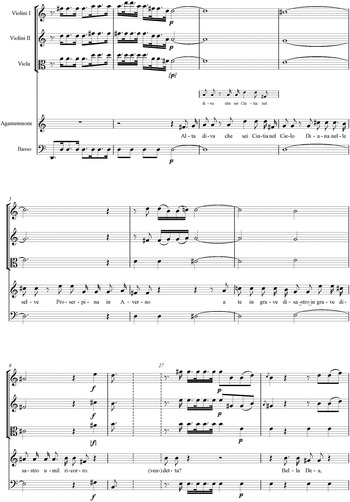
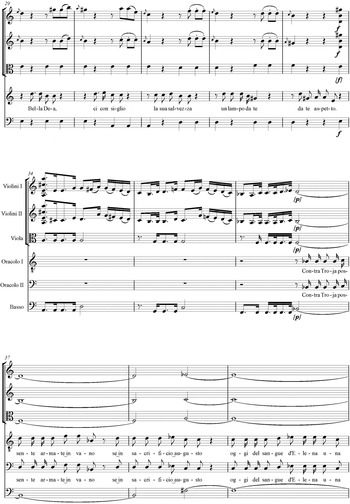
Calchas's prime instrument of deception, the oracle, challenged the limits of rationalism to no small degree. For while oracles had been common ingredients of the French lyric repertory since Lully and Molière's Psyché (1671),Footnote 118 they were regarded with suspicion by neo-Aristotelians and as a rule remained absent from spoken tragedies and opere serie, both to comply with verisimilitude and to save room for the distress of the characters falling victim to their pronouncements. In Iphigénie, Racine had notoriously reduced the oracle to six lines of récit narrated by Agamemnon and printed in italics.Footnote 119 This option was adopted by, among others, Apostolo Zeno in his first dramma for the Viennese court, Ifigenia in Aulide (1718).Footnote 120 In the Friderician version, by contrast, this imaginative event could no longer be entrusted to words; after all, ‘what is narrated’, Krause would argue in Von der musikalischen Poesie, ‘does not make such an impression as what is staged’.Footnote 121 Let us take a look at the relevant episode, the opening scene of Ifigenia in Aulide (see Ex. 3).
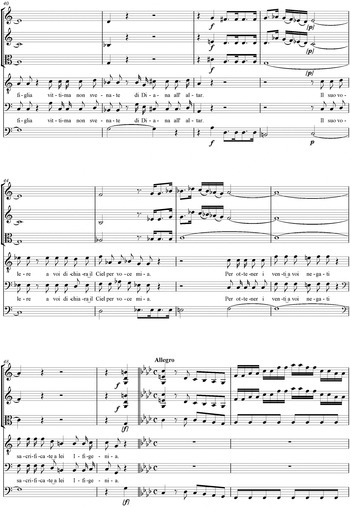
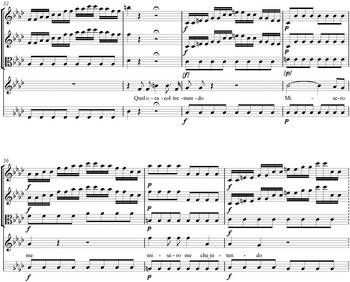
Carl Heinrich Graun and Leopoldo de' Villati, Ifigenia in Aulide (Berlin, 1748), Act I scene 1 (recitative, oracle and aria), bars 1–9 and 27–58. Transcribed from the conducting manuscript in the library of the Koninklijke Conservatorium Brussel/Conservatoire Royal de Bruxelles, MS 2115.
[Agamemnon Lofty goddess, who art Cynthia in heaven, Diana in the woods, Proserpina in Avernus [i.e., the underworld], to you I humbly turn in this grave disaster … [Shall we never be able to] revenge [Helen]? Beautiful goddess, I implore your salvation and wait for a flash of inspiration from you. Oracle Against mighty Troy you arm in vain if you do not kill a girl of Helen's blood on Diana's altar. Heaven discloses its will to you through my voice. To obtain the winds negated to you, sacrifice Iphigenia to her [Diana]. Agamemnon What a horrific oracle I, miserable one, hear.]


In the first section (bars 1–33), Agamemnon implores Diana's help in an accompanied recitative presenting a host of effective motifs: dotted rhythms evoking the majesty of the ‘lofty goddess’, Diana; ribattuti conveying the ‘happy shouts’ (lieti gridi) of the Greeks threatening the Trojans; long values reflecting the sudden calm that thwarts the Greeks' embarkation; and appoggiaturas expressing Agamemnon's desperate, repeated calls to Diana. At bar 34, a new martial intervention by the strings preludes an event few if any contemporary spectators would have anticipated: heaven's response to Agamemnon's invocation in words adapted from Racine,Footnote 122 but voiced, rather than narrated or cited, by an off-stage tenor and bass singing (mostly) in octave unison (bars 36–49).Footnote 123 This male chanting, which anticipates the Zwei Schwarz Geharnischte Männer in Wolfgang Amadé Mozart's Zauberflöte (1791; Act II scene 18), audibly affects Agamemnon on stage, who responds with a brief aria that ranks among Graun's most memorable music (bars 49–74).Footnote 124
Seldom has an artefact of pagan superstition occasioned such sublime music as in this gem of early reformist dramaturgy. Krause, who never tired of praising the ‘beautiful, simple and moving contents’ of Ifigenia in Aulide in his ten-page summary of the opera's incidents, stage designs and music,Footnote 125 held that the opportunity for listeners to actually ‘hear Agamemnon … receive such a horrendous answer from the Oracle’ contributed immensely to the opera's emotional impact.Footnote 126 Algarotti, who singled out Ifigenia's extraordinary success,Footnote 127 tellingly also adopted the supernatural solution in the third act of his Iphigénie en Aulide. While remaining close to Racine's example in its opening scene (Agamemnon communicates the oracular message in a dialogue with his confidant Arcas),Footnote 128 Algarotti had the marvellous intrude in sonic fashion in the third act of his scenario:
[a noise is heard sounding like very remote thunder, which increases little by little. Calchas The goddess will speak. The Oracle, in the back of the Theatre Greeks, if you want to embark for Troy, shed Iphigenia's blood in Aulis. Agamemnon Alas!]
Conclusion: Athens revived?
Apart from epitomising Frederick's philosophical agenda and mid-eighteenth-century theatrical aesthetic, the revival of the marvellous, and in particular of ancient mythology, may perhaps be seen as heralding a renewed interest in Greco-Roman culture. Indeed, Frederick was a fervent collector of antiquities: in 1738, he dispatched Georg Wenceslaus Knobelsdorff to Italy to examine Roman art; on his return, the architect seems to have cultivated a Winckelmannian sensitivity to the ‘noble simplicité des Grecs’ (according to Frederick in his Éloge on the deceased artist).Footnote 130 In 1753, Algarotti was summoned to send a block of marble from the excavations at Herculaneum; on failing to do so, he was severely reproached by the king:
Aren't you going to Herculanum [sic] at all? I am angry about this, [for] it is the phenomenon of our century, and if strong hindrances hadn't kept me here, I would travel five hundred miles to see an ancient city resuscitated from below the ashes of Vesuvius.Footnote 131
Frederick's anticomania should not, however, lead to the hasty and erroneous idea that his rehabilitation of the marvellous instantiates neoclassicism. As Watkin and Mellinghoff have shown, it was nearly impossible ‘for the austere doctrines of Neo-classicism to take root’ in eighteenth-century Prussia, antique accents arriving instead ‘sporadically as importations from France and England, two countries where Baroque architecture had never been adopted so enthusiastically as in Germany’.Footnote 132 Like contemporary brands of Rococo, Friderician style absorbed an eclectic range of influences, such as the gôut à la grecque, Palladianism, chinoiserie and occasionally even some gothic inspirations.Footnote 133 Just as the Neuruppin Apollo Temple toyed with Hellenism and the picturesque, and the Opernhaus paid homage to the Pantheon and Palladio as well as to the classicist masterpieces Knobelsdorff had admired in Paris,Footnote 134 Friderician opera blended divergent traditions and met wide-ranging demands.
Its achievements would not escape attention. Despite their demanding musical and scenic requirements, a number of Frederick's operatic commissions achieved success outside Berlin. Thus, Orfeo, apart from enjoying four repeat runs at the Opernhaus (in 1769, 1776, 1785 and 1788), resurfaced in Mainz (1757) and Hamburg (1764). Though it was the last of Graun's operas to be modelled on a tragédie en musique, its legacy lived on elsewhere in Europe. In January 1752, for instance, the Dresden Hofoper – of all places! – mounted Giacomo Casanova's adaptation of Louis de Cahusac's and Jean-Philippe Rameau's Zoroastre (Paris, 1749) with a score which partly retained Rameau's original music, partly presented new music composed by Johann Adam.Footnote 135 Despite the immense budget lavished on its staging and depictions of ancient Persian ritual, the result, entitled Zoroastro, was a total fiasco.Footnote 136 New reformist projects did succeed, by contrast. In 1753, Frederick's cousin by marriage (the husband of Frederick's niece Elisabeth Friederike of Bayreuth) and former courtier, Duke Carl Eugen of Württemberg, commissioned Ignaz Holzbauer and Niccolò Jommelli to set Villati's Fetonte afresh. Two years later, Jommelli and court poet Mattia Verazi rehearsed the Friderician experiment with Pelope and Enea nel Lazio, both of which involved the marvellous to a remarkable degree.Footnote 137 In 1759, furthermore, Philip of Bourbon, Duke of Parma, planned a remake of Rameau's Hippolyte et Aricie (Paris, 1733) that aimed at blending the ‘chant italien’ with ‘ce qu'il y a de bon dans l'opéra français’ and ‘spectacles dans le goût de ceux qui ont fait tant de plaisir dans le théâtre de Berlin’, according to Algarotti's report to Frederick.Footnote 138 To ensure that Berlin's standards were met, Duke Philip invited Algarotti to oversee the production.Footnote 139 What is more important, Ippolito ed Aricia made an explicit plea for mythology's role in opera (seria). In the preface to the libretto, Carlo Innocenzo Frugoni stated that
Myth can be a field for the lyric theatre as fertile as history. Indeed myth greatly suits a genre in which everything is clothed in a sweet illusion, and in which heroes, speaking only the language of harmony, appear before us to enchant our senses and our spirit with the magic of pleasure and of music. The misfortunes of Phaedra and of Daphne can move us to tears as easily as those of Merope [actually a mythical character] and of Dircea [in Metastasio's Demofoonte]. Does it matter whether the tears and the joys of mankind, in which so often we can see the weaknesses of our own humanity, are stirred in us by history rather than by myth in a theatre dedicated [to] our amusement? We must take up Euripides and the most famous authors who applied themselves to fabulous subjects in their tragedies, invented in order to render nature in all her truth, without the fascination of harmony. Euripides was right; the illustrious Metastasio no less so. We do not wish to be mistaken on this point.Footnote 140
After Parma, the reformist interest in mythology was brought to full fruition in Vienna, Mannheim and Munich through such productions as Tommaso Traetta's Ifigenia in Tauride (1763), Christoph Gluck's Alceste (1767) and Wolfgang Amadé Mozart's Idomeneo, Re di Creta (1781), to name but three examples. The remainder of the story is too well known to be repeated here, yet what has been all too often overlooked is that it sprang from a unique combination of philosophical and dramaturgical concerns that coalesced in the repertory of the Königliches Opernhaus, Berlin.