Introduction
In societies deeply divided by ethnic tensions, interethnic political competition is often conceptualized as a zero-sum game: population gains by one group translate to political gains, with corresponding losses for the other group, especially when there is little to no in-migration. However, it is not always clear if political gains for an ethnic group are necessarily a negative for the opposing group. Within ethnic groups in divided societies that are democracies, one frequently sees both moderate and radical political parties on ethnic issues. When will changes in the population distribution of an ethnically divided society lead to changes in the voting distribution for ethnically moderate and ethnically radical political parties? Might members of the ethnic group that is in demographic decline react differently than members of the ethnic group on the ascent?
A broad range of scholars have wrestled with these questions in a variety of social and political contexts, including the American South (Key, Reference Key1949; Giles and Buckner, Reference Giles and Buckner1993), Czechoslovakia (Kopstein and Wittenberg, Reference Kopstein and Wittenberg2009) and India (Varshney, Reference Varshney2001, Reference Varshney2002). Out of this research, two major competing hypotheses have emerged. The first, known as the group threat or racial threat hypothesis, argues that voters from an ethnic or religious group in more ethnically or racially heterogeneous districts will exhibit stronger preferences for ethnically radical political candidates. Conversely, the contact hypothesis (Darby, Reference Darby1986; Varshney, Reference Varshney2001) predicts that ethnically-mixed districts will produce less support for ethnically radical candidates. While previous studies have found support for both hypotheses, in different time periods and among different ethnic groups, most of the work in this area has focused on changes in electoral district-level settlement patterns, largely ignoring the possible, and, we argue, theoretically significant linkage between these local patterns and broader, nationwide demographic and political trends. By accounting for the interaction between local and national changes in the demographic balance of power, we are able to offer a plausible explanation for the frequent appearance of contradictory findings in the existing research on this subject. Specifically, we argue that voter responses to district-level ethnic settlement patterns are conditioned by changes in national-level demographic patterns when those changes are zero-sum. In this paper, we test our theoretical predictions using data on electoral competition in Northern Ireland from 1983 to 2010. In keeping with our expectations, we find that with two diametrically opposed ethnic groups in Northern Ireland, one, Catholics, exhibits behavior consistent with the contact hypothesis, while the other, Protestants, exhibits behavior consistent with the group threat hypothesis.
Group threat/contact hypotheses in history
V.O. Key’s landmark 1949 study Southern Politics in State and Nation outlines the first iteration of the group threat hypothesis, which has been examined numerous times in the American context over the succeeding 5 decades: whites have been found to be more likely to vote for racially radical candidates as the number of African-Americans in their community increases, due to the sense of threat whites feel when faced with larger numbers of minorities (Key, Reference Key1949).
Why would one ethnic group feel threatened by another? Groups holding political power frequently object to increases in minority power not out of prejudice, but out of a defense of group privilege (Bobo, Reference Bobo2004; Gay, Reference Gay2006). According to this line of scholarship, which has its origins in the social psychology literature on racial conflict in the United States, politics is best understood as a zero-sum game and therefore subject to the same rules of competition as intergroup conflict over land. When more than one group competes over resources, such competition leads to preferences for in-group members, stereotyping of in-group and out-group, and over-valuation of in-group products. In extreme cases, such as Northern Ireland, it leads to political violence, which can manifest into even greater hatred for out-groups (Blalock, Reference Blalock1967; Sidanius, Reference Sidanius1993; Bar-Tal, Reference Bar-Tal2011). The zero sum conceptualization of politics is also central to so-called ‘ethnic outbidding’ models of party competition in divided societies. In these models (Rabushka and Shepsle, Reference Rabushka and Shepsle1972, Horowitz, Reference Horowitz1985; Gormley-Heenan and McGinty, 2008) the dynamics of intraethnic party competition push ethnically based political parties toward increasingly extreme positions on issues ranging from language and education policy to social welfare. The net effect of these in-group dynamics is to make intergroup conflict more likely.
Although several studies have corroborated the predictions of ‘racial threat,’ others have found evidence of a contradictory relationship between intergroup contact and intergroup conflict. In particular, Allport (Reference Allport1954) noted that, over time, regular interaction between members of different groups can actually decrease the level of perceived intergroup conflict. This is known as the ‘contact hypothesis’ (Bochner, Reference Bochner1982; Voss, Reference Voss1996, Reference Voss2001; Hughes and Knox, Reference Hughes and Knox1997; Pettigrew, Reference Pettigrew1998; Rubin and Hewstone, Reference Rubin and Hewstone1998). Allport notes that contact can both lessen and increase prejudice. Casual contact may increase prejudices by affirming negative stereotypes about the other group. ‘True acquaintance,’ on the other hand, as achieved through intermarriage (Lloyd and Robinson, Reference Lloyd and Robinson2011), integrated housing patterns, integrated schools (Hayes et al., Reference Hayes, McAllister and Dowds2007) or occupational integration, can remove barriers to effective communication and decrease tension. The contact must be regular, institutionalized (Varshney, Reference Varshney2001, 2002), among group members with equal status, and endorsed by the ethnic groups at large. As Paolini et al. (Reference Paolini, Hewstone, Cairns and Voci2004) put it, ‘The contact situation must provide the participants with the opportunity to become friends.’
In Northern Ireland, contact theory has been embraced by the government as a way to reduce tensions (Hayes et al., Reference Hayes, McAllister and Dowds2007, Reference Hayes, McAllister and Dowds2013; Hayes and McAllister, Reference Hayes and McAllister2009). It is not clear how well this strategy has worked, however, due to a fifth condition: it must take place within an atmosphere of public support for the contact itself. In mixed communities in Northern Ireland, there is some evidence of groups practicing avoidance strategies: going out of their way to attend a different community center even if it is difficult to reach, for example (Knox and Hughes, Reference Knox and Hughes.1996). This is crucial, because if residents self-segregate, prejudices and the perception of group threat will be strengthened (Stein, Post et al., Reference Stein, Post and Rinden2000, Tropp and Pettigrew, Reference Tropp and Pettigrew2005).
Several studies in Europe confirm the group threat effect. Case studies of France (Husbands, Reference Husbands1991), Amsterdam (DeVos and Deurloo, Reference De Vos and Deurloo1999) and Flanders (Coffe et al., Reference Coffe, Heyndels and Vermeir2007) all find correlations between the number of immigrants in a given district and support by native-born voters for radical right parties, though this may be conditioned on the level of unemployment (Golder, Reference Golder2003), the electoral power of the immigrant group (Dancygier, Reference Dancygier2010), or the salience of the issue nationwide (Hopkins, Reference Hopkins2011). In a study of support for the radical-right Republikaner in Germany, increases in the number of immigrants or foreigners in a district matter more than the raw number of immigrants or foreigners in the district (Lubbers and Scheepers, Reference Lubbers and Scheepers2000; Hopkins, Reference Hopkins2010).
In contrast, other cases of voter behavior confirm the contact effect. Francophone support for sovereignty in Quebecois elections in the 1990s actually decreased with the number of English speakers in a given riding (Lublin and Voss, Reference Lublin and Voss2002). Evidence from interwar Czechoslovakia offers somewhat less support; interethnic contact’s effect may be conditioned on ethnicity itself: Czechs and Hungarians living in Czechoslovakia exhibited signs of the group threat effect, voting in greater numbers for radical parties when living near other groups, but Slovaks were less supportive of such parties when in regular contact with other groups. (Kopstein and Wittenberg, Reference Kopstein and Wittenberg2009).
Based on the findings of existing studies, it is possible to derive two hypotheses from previous work on this subject. The first exemplifies the ‘group threat’ or ‘ethnic outbidding’ dynamic (Key, Reference Key1949; Giles and Buckner, Reference Giles and Buckner1993; Oliver and Wong, Reference Oliver and Wong2003; Campbell, Reference Campbell2006; Gormley-Heenan and McGinty, 2008). It predicts that more ethnically-heterogeneous districts will produce a greater number of votes for ethnically radical political parties and candidates. Thus:
Hypothesis 1 As the ethnic heterogeneity of a parliamentary district increases, votes for ethnically-radical parties will increase.
The second reflects the findings of the ‘contact’ school (Darby, Reference Darby1986; Varshney, Reference Varshney2001, 2002). It predicts that an increase in interethnic integration will lead to a corresponding increase in feelings of ethnic amity, and will ultimately produce fewer votes for ethnically-radical political parties. Thus:
Hypothesis 2 As the ethnic heterogeneity of a parliamentary district increases, votes for ethnically-radical parties will decrease.Footnote 1
While scholars have learned a great deal about how varying patterns of residential integration might influence ethnic political competition, we are still left with a significant unanswered question: What explains the seemingly contradictory findings of these studies?
Theory
Previous research has offered a variety of specifications to both the group/racial threat hypothesis and the contact hypotheses, and these theories have advanced our understanding of ethnic and racial politics. However, despite the advances made, previous work has not yet produced a fully satisfying theoretical explanation for why different studies of the same phenomenon in different contexts produce such divergent results. In what follows we produce an empirically testable answer to this quandary. Specifically, we argue that local patterns of ethnic integration/segregation interact with broader changes in the demographic makeup of a society to affect how the political preferences of members of one ethnic group will be influenced by the residential proximity of members of the ‘other’ group.
Politicians and citizens in deeply divided societies often conceptualize interethnic political competition as a zero-sum game (Horowitz, Reference Horowitz1985; O’Leary and McGarry, Reference O’Leary and McGarry1993, Reference McAllister and Rose1995; Offe, Reference Offe1993). Indeed, many of the proposed ‘solutions’ to interethnic conflict – and particularly those based on Lijphart’s consociational model of democracy – incorporate this perception as a fundamental tenet of their proposed institutional design (Lijphart, Reference Lijphart1971; Lustick, 1979; Bew, Reference Bew2001; Chandra, Reference Chandra2004, Reference Chandra2005). This same perception is the key factor connecting national-level demographic shifts with district-level patterns of residential integration or segregation. As a group’s share of the national population is on the decline, then members of that group will be more likely to feel anxiety or even frustration at the decreasing political influence of their group. As a result, members of a group in demographic decline on the national level will be more likely to perceive members of the ‘other’ ethnic group as threatening. As a result, they will be more likely to vote for an ethnically radical candidate if and when they feel surrounded by the ethnic other. This is because the changing national picture effectively raises the stakes for every individual electoral contest. All else equal, as a group’s share of the national population decreases, so does its ability to produce national electoral majorities. Assuming that parliamentary seats are likely to be lost to the ethnic other, it therefore becomes rational for a group member to support the party that will most doggedly defend the interests of the group in the legislature. In addition, the smaller the group size, the more likely it is that splitting the ethnic vote causes the constituency to be lost to the ‘outgroup’ candidate.
Conversely, when a group’s share of the national population is on the increase, members of that group will feel less threatened by the presence of large numbers of the other group in their district. We can see this in the fact that Catholics more frequently ‘cross over’ to attend Protestant schools in Northern Ireland than vice-versa (Hayes et al., Reference Hayes, McAllister and Dowds2007). The same basic logic applies in this scenario. All else equal, as a group’s share of the national population increases, so does the likelihood that the group will produce a national electoral and parliamentary majority. As a result, members of the ascendant group will be less likely to be concerned about the outcome of any individual electoral contest, because they expect that their group will elect enough representatives, regardless of their particular party identification, to advance the group’s ethno-political agenda.
Based on these theoretical expectations, we can derive two distinct hypotheses about the effect of ethnic segregation on local electoral outcomes, conditional on whether a group’s share of the national population is increasing or decreasing. Thus:
Hypothesis 3 When a group’s share of the national population is decreasing, members of that group residing in more ethnically heterogeneous districts will be more likely to vote for ethnically radical political parties.
Hypothesis 4 When a group’s share of the national population is increasing, members of that group residing in more ethnically heterogeneous districts will be less likely to vote for ethnically radical parties.
We can see anecdotal evidence of exactly this type of ethnic political competition in the political rhetoric and position-taking of politicians in Northern Ireland. For instance, the Democratic Unionist Party’s official 2011 electoral broadcast emphasized that
…If you don’t vote or vote for another unionist party on May 5th our strength would be divided and weakened and unionists would no longer be able to take the lead at Stormont. So, we’d be right back where we started. Let’s not go back…(Clarke 2011)
These statements, and their apparent acceptance by the unionist and nationalist electorates in Northern Ireland, provide preliminary evidence supporting our theory. What follows is a rigorous, quantitative assessment, using data on electoral competition in Northern Ireland from 1983 to 2010.
Research design
In order to test our hypotheses, as well as those derived from the existing literature, we utilize data on the demographic composition of Westminster parliamentary constituencies in Northern Ireland, as well as data on the ethnic and socioeconomic makeup of those same districts. Northern Ireland is an excellent empirical domain in which to test the predictions of our theory because it provides us with what is essentially a useful natural experiment. In Northern Ireland, there are two diametrically opposed ethnic groups, each of which has its own internal party system within which there exists an ethnic ‘flagbearer’ party (Evans and Duffy, Reference Evans and Duffy1997). On one side of Ulster’s sectarian divide is Northern Ireland’s Catholic population, who are generally referred to as nationalists, and who typically desire an end to the province’s association with the United Kingdom in favor of full reunification with the Republic of Ireland. The two main parties that contest for votes within the Catholic/nationalist community are the Social Democratic and Labor Party (SDLP) and Sinn Féin, with the former generally being seen as the more moderate of the two. On the other side of the divide is Northern Ireland’s Protestant or unionist community. Members of this group typically support a continuation of the province’s political connection with Great Britain, and they typically vote for either the Ulster Unionist Party (UUP) or the more bombastic Democratic Unionist Party (DUP).Footnote 2 Northern Ireland Catholics vote largely for Catholic parties and Protestants vote largely for Protestant parties; this can be demonstrated through both anecdotal evidence and the statistical technique of ecological inference.Footnote 3 As a result, we are able to independently analyze data on electoral competition within each of these two communities.
The fact that Northern Ireland’s two party systems can effectively be analyzed independently from each other is significant, because it allows us to draw empirical conclusions about how the interaction between national-level demographic changes in Northern Ireland as a whole and shifting patterns of segregation and integration at the local level influence the voting behavior of members of these two communities. Throughout the entire period of our analysis, and, in fact, from the time of Northern Ireland’s creation in the early 1920s, the Protestant share of Northern Ireland’s population has declined. What’s more, this decline has been largely a result of an equal and opposite trend in the Catholic share of the population, rather than in-migration. Figures produced by Compton, and made available by the Conflict Archive on the Internet,Footnote 4 demonstrate that in 1971 Catholics comprised ~36.8% of the overall population of Northern Ireland. After steadily increasing for at least 3 decades, by 2011 this figure had risen to more than 45%, representing a 22.7% increase in the Catholic share of the population. As the moderately unionist leaning Belfast Telegraph argued at the time, ‘many unionists are also likely to be privately concerned at the long term implications of a steady Catholic rise’ (Thornton, Reference Thornton2002).
Given these two unique features of Northern Ireland’s demographic and political environment, we are able to estimate separate statistical models of the determinants of voting behavior within Ulster’s two communities. This allows us to separately assess how changing patterns of local segregation influence the voting behavior of members of a nationally ascendant group on the one hand – Northern Ireland’s Catholic community – and members of a formerly dominant, but nationally declining community on the other. If the theory presented above is correct, then we would expect the Protestant model to demonstrate a positive relationship between support for radical parties among the Protestant population and the primary variable of interest – the percentage of Catholics in a district, while the Catholic model should demonstrate a negative relationship between support for radical parties among the Catholic population and the primary variable of interest, the percentage of Protestants in a district.
Empirical domain
Northern Ireland has 18 parliamentary constituencies: four borough constituencies in Belfast and 14 county constituencies. Redistricting took place between the 1992 and 1997 elections and again between the 2005 and 2010 elections. These constituencies are not monolithic in their confessional makeup. For example, Belfast East, a Unionist stronghold, has seen a slow rise in the Catholic share of its population, from a low of ~4.63% in 1983 to ~9.1% in 2010. Mid-Ulster saw its estimated proportion of Catholics go from 41.9% to 62.5%. In Belfast North, the proportion of Protestants dropped from 54.9% to 38.4% over the same time period.Footnote 5 Nor can it be argued that these districts are uniformly homogenous or heterogenous. The most Catholic district is Belfast West in 1997, with 77.5%, while the most Protestant is Belfast East in the 1980s, with 79.6%.
The increase in the electoral fortunes of the DUP and Sinn Féin cannot be completely explained by a moderation in the political positions of the two parties. While SF has certainly done an about-face in terms of its support of political violence, the party has remained relatively more radical than the SDLP on cultural and constitutional issues, as evidenced by SF’s continued participation in ceremonies celebrating pivotal moments in the history of militant Irish nationalism. Indeed, as Rooduijn et al. (Reference Rooduijn, de Lange and van der Brug2014) point out, the causal arrow may point in the other direction: electoral success may cause populist/radical parties to moderate their positions in an effort to sustain that success.
Data sources and descriptive statistics
Our dependent variable is the percentage of the vote in each ethnic community accruing to ethnically radical parties during Westminster electionsFootnote 6 between 1983 and 2010. Data for our dependent variable was obtained through the Conflict Archive on the Internet. See Appendix I for a discussion of how parties were coded.
To test the above hypotheses, we utilize several data sources, with observations aggregated at the parliamentary constituency level. For our main independent variable of interest – the ethnic composition of each constituency – we rely primarily on UK census data from 1981 to 2011.Footnote 7 The census provides a true measure of the religious composition of a given parliamentary constituency. This is a significant improvement over existing studies on radical party support in Northern Ireland, which rely heavily on survey data to determine both district composition and party support. Of course, one shortcoming of using the census as a source for population data is that election years do not necessarily correspond with census years.
We also are able to derive a number of control variables from the census data. These include socio-economic status and percentage of the voting age population born since 1969. The age variable is used to control for a potential cohort effect in which radical parties in Northern Ireland receive higher levels of support from citizens who have come of age during the Troubles. Without the memory of peaceful relations between the two communities, these individuals could be more likely to see politics as a zero-sum game between Protestants and Catholics. As a result, they could be more likely to support radical parties as ethnic guardians. In the literature on group threat, socioeconomic status is correlated with votes for radical candidates/ parties; therefore, we expect that as the number of manual laborers, semiskilled workers, and unskilled workers increases, the vote for radical parties will increase. Socioeconomic status data comes from the UK Census; unemployment data (operationalized as number of benefit seekers in any given year) comes from the UK Department of Employment Gazette.
In addition, we also control for the number of Troubles-related deaths occurring in a constituency in the 12 months before the date of a general election. Since direct experience of loss or suffering as a result of political violence may significantly undermine the civic networks both within and between Northern Ireland’s two main groups, we expect that higher levels of conflict-related casualties will result in higher levels of support for radical parties. In the Protestant model, this variable is operationalized as the number of Protestants, regardless of their personal combatant status, killed by the Provisional IRA within the constituency during the time period specified above. In the Catholic model, we operationalize the experience of violence as the number of Catholics, regardless of their combatant status, killed by Loyalist paramilitaries, the Royal Ulster Constabulary or the British Army in the twelve months preceding the date of a general election. Data on fatalities was derived from the Sutton Index of Deaths, available via the Conflict Archive on the Internet and geocoded to match parliamentary constituency boundaries by the authors.
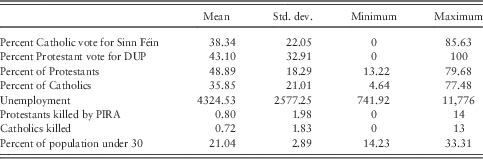
Finally, we control for the possibility that the dynamics of intergroup contact operate differently in urban and rural environments (Darby, Reference Darby1986; Varshney, Reference Varshney2002; Putnam, Reference Putnam2007), by including a dummy variable equal to one for parliamentary constituencies in Northern Ireland’s two major cities and zero otherwise. We would expect this variable to be positively correlated with vote shares for ethnically radical parties in both communities, as the relative anonymity of passing strangers in large urban centers makes it more difficult to establish the types of intergroup relationships necessary to create ‘bridging’ social capital and alleviate interethnic tension. Table 1 presents descriptive statistics for all variables.
Descriptive statistics (non-dummy variables)

N=112, election years: 1983, 1987, 1992, 1997, 2001, 2005, 2010.
DUP=Democratic Unionist Party.
Statistical model
Using the data described above, we estimate a linear regression with panel-corrected standard errors. This is an effort to deal with typical complications of time-series cross-sectional data.Footnote 8
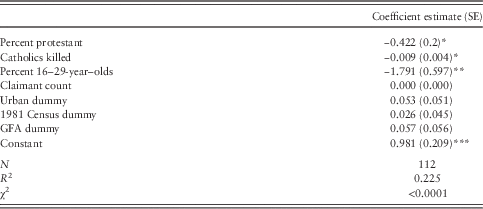
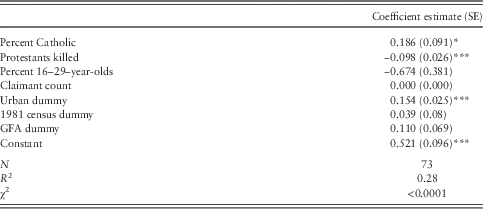
We run two models. In the Catholic model, the dependent variable is the percentage of the nationalist vote won by Sinn Féin. In the Protestant model, the dependent variable is the percentage of the unionist vote won by the DUP or any other challenger party candidate with a clear unionist identity. Table 2 presents the results of the Catholic model. Table 3 presents the results of the Protestant model. In both the Catholic and Protestant models, we choose to look at cases in which Sinn Féin or the DUP actually contested the election.Footnote 9 Prima facie it is obvious that we cannot adequately test our theory in constituencies in which voters are not presented with the option of voting for a DUP or Sinn Féin candidate. While this may raise some concerns regarding selection-induced bias in our results, this should not be a major problem, especially because the DUP often faced competition from independent unionists in those constituencies vacated by the UUP. In all models, the unit of analysis is the constituency-year. Results are presented in Table 2, below.
Impact of Protestant proximity on Catholic voting for Sinn Féin

GFA=Good Friday Agreement.
***P⩽0.001; **P⩽0.01; *P⩽0.05.
Impact of Catholic proximity on Protestant voting for DUP

DUP=Democratic Unionist Party; GFA=Good Friday Agreement.
***P⩽0.01; **P⩽0.05; *P⩽0.10.
The results of our statistical analysis largely confirm the theoretical argument proposed above, offering systematic evidence supporting Hypothesis 3 and Hypothesis 4. The Catholic model shows that, as predicted by our theory, all else equal, an increase in constituency-level integration between Catholics and Protestants leads to a decrease in Sinn Féin’s share of the nationalist vote. This result confirms the predictions based on the ‘contact hypothesis’ (Hypothesis 2). More significantly, it also validates the first proposition of our theoretical argument, demonstrating that nationally ascendant ethnic groups will be less likely to feel threatened by proximity to the ethnic ‘other.’
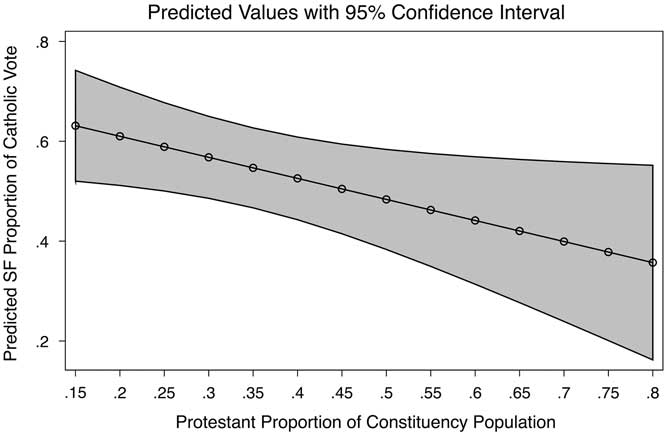
Statistical simulations and anecdotal evidence from Northern Ireland demonstrate the substantive impact of these findings. We generated point predictions and 95% confidence intervals of how changes in the composition of a district’s population might influence SF’s electoral fortunes. The results of the simulations – for which see Figure 1, below – indicate that a one-standard-deviation increase in the Protestant share of a district’s population would produce a 7.71% drop in SF’s share of the Catholic vote, all else equal.
Predicted Sinn Féin (SF) share of the Catholic vote conditional on Protestant share of constituency population.

The magnitude of this prediction is best demonstrated in the context of electoral competition in the Catholic voting bloc more generally, where Sinn Féin averaged slightly less than one third of the total vote between 1983 and 2001. We can see the real-world impact of these demographic changes in SF’s increasing dominance among the Catholic population in constituencies like Belfast North, where the party has steadily increased its share of the Catholic vote as the Catholic share of the constituency’s population has increased since the 1990s. At the same time, the DUP has also enjoyed steadily increasing electoral support in Belfast North, mostly at the expense of the UUP, who captured <8% of the total vote in the constituency in 2010. Both developments confirm our theoretical predictions.
On a more general level, the results produced by our Catholic models are likely to be viewed with some optimism by those who see intergroup contact as a potential cure for violence and conflict that have plagued Northern Ireland since its creation in the early 1920s. In political and demographic terms, however, these findings are more likely to encourage members and supporters of Sinn Féin. According to Shuttleworth and Lloyd (Reference Shuttleworth and Lloyd2009), the residential concentration of Catholics, in particular, increased dramatically between 1971 and 1991, and this emerging pattern of religious segregation showed little sign of reversal after the Good Friday Agreement. Our analysis indicates that continued residential separation between Catholics and Protestants in Northern Ireland will only benefit SF, as the increasing isolation of the two communities minimizes opportunities for inter-group contact and reinforces incentives for SF to commit to its role as an ethnic ‘tribune party,’ non-violent but still radical, acting as the strongest voice for the Catholic community (Evans and Tonge, Reference Evans and Tonge2009, Mitchell, Evans and O’Leary, Reference Mitchell, Evans and O’Leary2009).
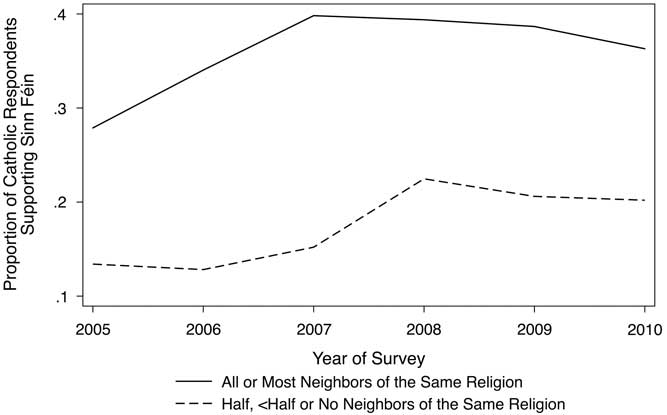
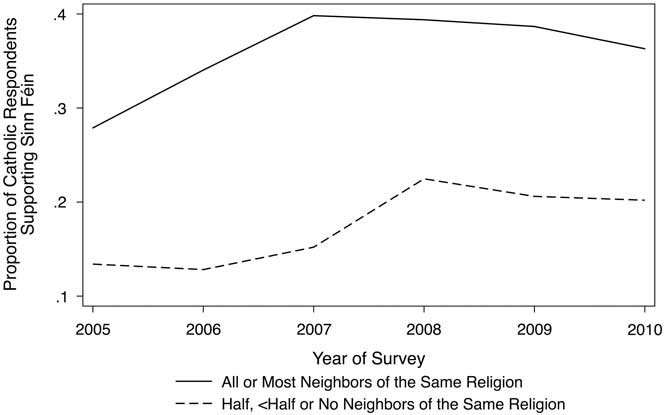
The potential political consequences of continued Catholic residential segregation for SF are underlined by results from the Northern Ireland Life and Times Survey (NILT). From 2005 to 2010, and again in 2012, the NILT asked respondents to assess how many of their neighbors were the same religion as them, as well as asking questions about the respondent’s political party affiliation. From 2005 to 2010, Catholics who reported that either ‘most’ or ‘all’ of their neighbors were of the same religion were more than twice as likely to identify with SF as Catholics who claimed to live in neighborhoods in which one-half or fewer of their neighbors were of the same religion.Footnote 10 Figure 2, below, utilizes NILT data from 2005 to 2010 to plot the average proportion of Catholic survey respondents supporting SF and further demonstrates the substantive political significance of continued religious segregation in Northern Ireland. These data corroborate the results of our statistical model, indicating that continued separation of the two communities is likely to benefit SF electorally.
Catholic support for Sinn Féin as a function of self-reported residential segregation.
However, other results indicate that, despite SF’s apparent electoral benefits from segregation, the maintenance of interethnic peace is also vital to the party’s continued success. The statistically significant negative coefficient on the Catholics-killed variable indicates that even a small uptick in anti-Catholic political violence could have serious consequences, not only for the people of Northern Ireland as a whole, but also for SF’s position within the nationalist electorate. All else equal, every Catholic killed by the British Army, the police or Loyalist paramilitaries is predicted to cost Sinn Féin roughly 0.94% of the Catholic vote. Based on these results, a return to the pitched levels of sectarian violence experienced in the late 1980s and early 1990s would likely lead to a serious reduction in Catholic support for SF. One possible explanation for this finding is that Catholics might blame SF for either inciting Loyalist violence against their communities or, at a minimum, for the IRA’s perceived failure to protect them from Loyalist retaliation. This logic was reflected in prominent South Belfast SDLP member Alasdair McDonnell’s reaction to a Loyalist shooting that targeted Catholics at a betting shop on the Ormeau Road. McDonnell placed the blame for the incident squarely at the feet of Sinn Féin and the IRA, telling journalists that ‘The Provisional IRA had been conducting a campaign to provoke retaliation, to provoke internment. The Provos [the IRA] have been looking for loyalist reaction. They have got it’ (Bowcott, Reference Bowcott1992). The timing of this statement is telling, coming only months before an anticipated general election in which McDonnell expected to stand as the SDLP’s candidate for Belfast South. As a result, SF might have a strategic interest in working to keep a lid on simmering interethnic tensions in Northern Ireland, in order to avoid any potential political fallout for retaliatory Loyalist violence targeting Catholic communities.
One possible concern with the results presented above is that they do not, in fact, reflect a pivot toward SF on the part of the Catholic electorate because of residential population shifts, but rather result from the party’s increasing moderation. In particular, it could easily be argued that the most significant fact behind SF’s rise to electoral supremacy was the abandonment of the IRA’s armed campaign and the party’s subsequent engagement with the institutions created by the Good Friday Agreement in 1998. Tilley and Evans (Reference Tilley and Evans2011) have argued that this change in the perception of SF is likely to be particularly common in voters socialized in the environment of post-Good Friday Agreement politics, with SF partisanship being particularly strong in this cohort of voters entering the electorate from 1998 onward. This possibility is of particular concern for our analysis, since our operationalization of the age variable might not be sufficiently sensitive to capture this type of cohort effect. This alternative is controlled for in our statistical analysis using a dummy variable equal to one for all years after the implementation of the Good Friday Agreement and zero otherwise. The variable is not statistically significant, indicating that SF’s improving fortunes in Westminster elections are not a residual function of the party’s involvement in and commitment to the peace settlement.Footnote 11
Furthermore, although SF and the IRA moderated their positions on the use of armed struggle in determining Northern Ireland’s political future, SF was still the most radical party available to Catholic voters in most districts. It is difficult to say that SF moved from being an anti-system party all the way to being a pro-system party, especially in light of its continued abstentionism toward Westminster and its emphasis on reunification. For instance, in its most recent Westminster manifesto, the party continued to claim that its primary political goal was ‘an end to partition’ and the manifesto relied on the same anti-system vocabulary that the party had used prior to the implementation of the Good Friday Agreement, referring to Northern Ireland as the ‘six counties’ more than 20 times (Sinn Féin, 2010).
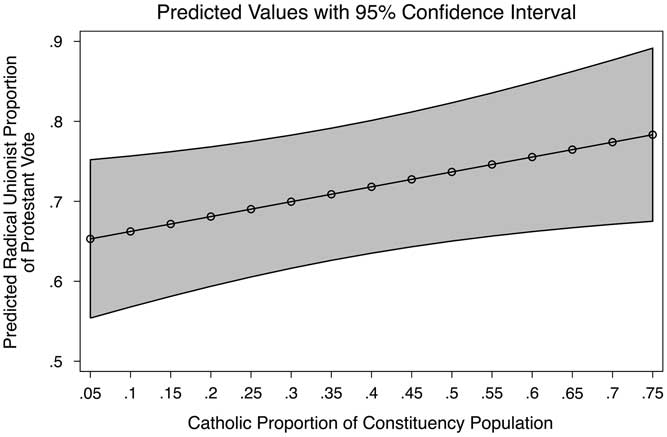
The Protestant models also produce strong support for our theory, and for the initial prediction based on the ‘group threat’ model (Hypothesis 1). All else equal, an increase in the Catholic population of a district leads to an increase in the share of the unionist vote going to radical parties like the DUP. This result again demonstrates that the effect of ethnic intermingling on voting behavior is mediated by changes in national demographic patterns, with members of nationally declining groups – in this case Ulster Protestants – being more likely to feel threatened by proximity to members of the other, demographically ascendant group – in this case Catholics in Northern Ireland. Figure 3 demonstrates the substantive importance of this ‘group threat’ dynamic among Northern Ireland’s unionist electorate.Footnote 12 All else equal, increasing the percentage of Catholics in a district by one standard deviation produces a 3.80% rise in the percentage of Protestants voting for the DUP and similar parties. This finding takes on greater significance in light of the slight majority of ~5.12% of the unionist vote won by extreme unionist candidates in the constituencies they contested.Footnote 13
Predicted radical unionist share of the Protestant vote conditional on Catholic share of constituency population.

As a robustness check, we also ran the models presented in Table 1 using the Catholic and Protestant Isolation Index. From a technical perspective, the Isolation Index measures the probability that a randomly selected member of a given ethnic group in a given constituency resides in a ward within that constituency in which co-ethnics constitute the majority of the population. Substantively, in the context of our data, the index indicates the extent to which Catholic and Protestant residents of Northern Ireland’s parliamentary constituencies have tended to cluster into ethnically homogeneous wards within the boundaries of each constituency. This metric accounts for ward-level patterns of residential segregation and allows us to test for the possibility of aggregation bias in our constituency level data.
The isolation index was constructed using ward-level data from the 1991, 2001 and 2011 census files, although data availability limitations prevented us from constructing the metric from the 1981 census.Footnote 14 Nevertheless, in the Catholic model, although several of our control variables lose significance, our central result, namely that increasing Catholic isolation and decreasing the likelihood of intergroup contact with Protestants will produce an increase in SF’s share of the Catholic vote, is confirmed under this alternative specification (P<0.05). The reduction in the sample size prevents us from making similar inferences using this technique for the Protestant model.
Discussion and implications
In keeping with the findings of previous work, this study demonstrates that district-level settlement patterns certainly have an impact on ethnic voting behavior. However, it also demonstrates, both theoretically and empirically, how these district-level effects are influenced by national-level demographic changes. When a group’s share of the national population is decreasing – as is the case for Protestants in Northern Ireland – members of that group are more likely to exhibit the behavior predicted by the group threat hypothesis. Contrastingly, when a group’s share of the national population is increasing – as is the case for Catholics in Northern Ireland – members of that group are more likely to exhibit the behavior predicted by the contact hypothesis.
This paper offers a theoretical explanation for the frequent appearance of seemingly contradictory results in the empirical work on ethnic residential segregation and ethnic conflict. By providing a theoretical and empirical connection between the ‘contact’ and ‘group threat’ hypotheses, this paper makes a contribution to our understanding of ethnic politics, and highlights a theoretically and empirically important interaction between national demographic trends and local patterns of ethnic residential segregation. This analysis lays the groundwork for future research applying the theory developed here to different empirical and institutional contexts.
Future research should seek to expand on these results by unpacking the individual-level causal mechanisms that produce different political responses to contact with the ethnic ‘other’ among members of nationally ascendant and nationally declining ethnic groups. In particular, further research might usefully adopt experimental opinion polling methods to assess directly how individual attitudes are influenced toward extreme ethnic political parties by awareness of changing national demographic patterns. The insights gleaned from this model regarding the interaction between ethnic violence and ethnic political competition, although preliminary, are also suggestive of future research in this area. In particular, scholars should reconsider popular models of ethnic outbidding in light of our findings and develop an explicitly strategic model to explore how an ethnic group’s perceived military capabilities, as compared with those of its ethnic rival, might influence the tone of ethnic political competition and the types of pro-group policies pursued by leaders of both ascendant and declining groups.
Acknowledgments
Thanks to Clifford J. Carrubba, Carolyn Forestiere, Cynthia Irvin, Jeff Kucik, Cas Mudde, and Roger MacGinty for their comments on earlier drafts, and Jesse Hamner and Nigel Lo for assistance with data. Earlier versions of this paper were presented at the meetings of the American Political Science Association, the International Studies Association and the Conference on Democracy and Extremism, Georgia State University.
APPENDIX TABLE: HOW PARTIES ARE CODED