The term “CHD” involves congenital structural or functional anomalies that can be identified at birth or later in the cardiovascular system. The incidence of CHD is about 0.5–0.8% in all live births.Reference Ferencz, Rubin and McCarter 1 The illness can affect the quality of life and mental state of patients and their families, as well as many systems of the body, all of which can be alleviated through supportive approaches. The responsibility of child care, psychological reactions such as anxiety, fear, anger, depression, and guilt, economic burden from unanticipated medical costs, and uncertainties about the future of the child place a heavy responsibility on the family.Reference Fritts 2 Childhood chronic diseases differ in terms of symptoms, causes, treatment methods, course, daily activity restriction, and long-term effects. However, in all chronic diseases there are common factors that cause a stress response in children and families.Reference Cieurzo 3
The increased need for cardiac surgery and continuous medical treatment in children with CHD, and the parental feeling of loss of control over their children, may increase family stress levels in the long term and affect family compatibility because of community attitudes. Many parents become stressed when their children are first diagnosed. They feel helpless and frightened, which in turn can cause overprotection of and extreme devotion to the child, limiting his/her activities. This reduces the quality of life for both the child and the family. Extreme anxiety can prevent parents from correctly understanding any information given about the medical condition of their child, as well as advice on their management, as well as in taking appropriate decisions to overcome the situation, participating in child care, and remembering the effective coping methods they used until then.Reference Byrn and Hunsberger 4 Shuper et alReference Shuper, Gabbay and Mimouni 5 reported that inadequate information had a significant impact on parental anxiety. Also, Melnyk et alReference Melnyk, Alpert-Gillis, Hensel, Coble-Beiling and Rubenstein 6 noted that parents need information and support on how to help their children understand their reactions and how to cope with stress.
It is a fact that adverse events happening within or outside the family can lead to deteriorations in family functions temporarily or permanently, which will first affect mothers as they are the primary caregivers. The aim of this study was to determine anxiety and depression levels, family functions, child-rearing attitudes, and quality of life of mothers of CHD children.
Materials and methods
The patient group of the study consisted of 80 children between the ages of 6 and 16 years, along with their mothers, who had a diagnosis of CHD and were consecutively referred to Celal Bayar University Faculty of Medicine, Pediatric Cardiology Department, between January, 2015 and June, 2015. The 80 children constituted two categories: 40 cases with cyanotic CHD in the form of tetralogy of Fallot (n=27), large artery transposition (n=9), Ebstein abnormality (n=1), and total anomalous pulmonary venous connection abnormality (n=3) and 40 with non-cyanotic CHD in the form of mild–moderate aortic stenosis (n=3), mild aortic coarctation (n=1), mild–moderate pulmonary stenosis (n=4), patent ductus arteriosus (n=2), atrial septal defect (n=12), and ventricular septal defect (n=18). The control group consisted of mothers of 40 age- and sex-matched healthy children who had no cardiac or chronic diseases and had come only for a routine check-up to the healthy-child polyclinic. The research assistant apprised all three groups about the study, and the approval of the included mothers and children was obtained. The socio-demographic form was filled in by the mothers and families of all groups. Short Form-36, Hospital Anxiety and Depression Scale, Family Assessment Device, and Parental Attitude Research Instrument forms were filled in by mothers. For this study, permission was obtained from the ethical committee of Celal Bayar University Medical Faculty. The survey was conducted in accordance with the Helsinki Declaration criteria.
Data collection tools
Short Form-36
Rand Corporation developed the Short Form-36in 1992.Reference Ware and Sherbourne 7 Koçyiğit et alReference Koçyiğit, Aydemir and Fisek 8 evaluated the reliability and validity of the Turkish version of the Short Form-36. It was used to assess the quality of life perception of mothers and is a self-appreciation scale. The scale consists of 36 items and measures the following eight states: physical functioning, social functioning, role limitations due to physical functioning, role limitations due to emotional problems, mental health, energy/vitality, and general perception of pain and health. The scale gives a total score for each sub-scale separately. The sub-scales assess health using scores between 0 and 100, with 0 indicating poor health and 100 indicating good health.
Hospital Anxiety and Depression Scale
Originally developed by Zigmond and SnaithReference Zigmond and Snaith 9 , Aydemir et alReference Aydemir, Güvenir, Küey and Kültür 10 tested the validity and reliability of the Turkish version. It is a self-assessment scale used to identify the severity of anxiety and depression in healthy individuals and other patients, except in psychiatric patients, and to evaluate the changes of severity. The cut-off scores for the anxiety and depression sub-scales were found to be 10/11 and 7/8, respectively, in Turkish studies. Individuals with scores higher than these were regarded as being at risk.
Family Assessment Device
It is a measurement tool that determines satisfaction or dissatisfaction of family members with their family functioning. The scale was developed by Epstein et alReference Epstein, Bolwin and Bishop 11 , and Bulut et alReference Bulut 12 tested the validity and reliability for Turkish studies. The scores range from 1 (healthy) to 4 (unhealthy). It consists of seven sub-scales including 60 questions focussing on each problem area in the family function and one focussing on general functions. These sub-scales are about problem solving, communication, roles, affective responsiveness, affective involvement, behaviour control, and general functions.
Parental Attitude Research Instrument
Schaefer and Bell developed the test in 1958Reference Schaefer and Bell 13 , and Le Compte et al adapted it for Turkish studies in 1978. The test was revised in accordance with Turkish conditions and has 60 items and five sub-scales. Answers of mothers were evaluated in five different categories: over-parenting, democratic attitude and equality recognition state, attitude of hostility and rejection, husband and wife incompatibility, and authoritarian attitude. Higher score points were for negative parental attitudes, except for the “democratic attitude and recognition of equality” state.Reference Öner 14
Data analysis
For statistical analyses, the Statistical Package for Social Sciences for Windows 15.0 program was used. The Student’s t test was used for comparing independent variables – namely, socio-demographic and disease variables – and dependent variables – namely, sub-scales of the questionnaire that assesses quality of life, anxiety, and depression – followed by baseline and descriptive statistical analyses – namely, numbers and distributional percentages for categorical variables, and arithmetic means and standard deviations for continuous variables – for the comparison of two mean values in parametric cases; the Mann–Whitney U test was used in non-parametric conditions; the one-way analysis of variance (ANOVA) test was used in parametric cases where the mean of three or more groups was compared. The Kruskall–Wallis ANOVA test was used in non-parametric cases. The Tukey b test was used in post hoc comparisons. The χ2 test was used when two categorical variables were compared, and the Pearson correlation was used when two continuous variables were compared. Type 1 error – that is, p-value – was considered significant at <0.05.
Results
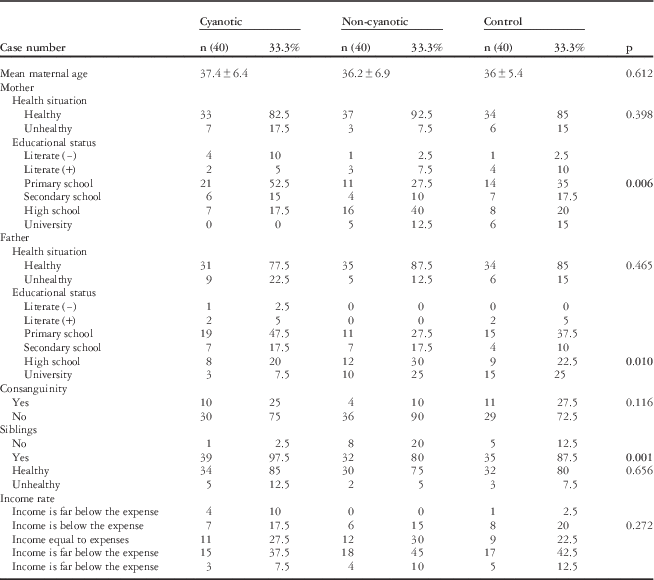
The sample consisted of 120 children and their mothers; 80 children were ill, with half of them having cyanotic CHD and the other half having non-cyanotic CHD, and 40 children were healthy. There were 26 (65%) boys and 14 (35%) girls in the cyanotic CHD group, 19 (47.5%) boys and 21 (52.5%) girls in the non-cyanotic CHD group, and 18 (45%) boys and 22 (55%) girls in the control group. There was no significant difference between the sexes. The mean age of the children was 10.2±2.69 years in the cyanotic group, 9.6±3.1 years in the non-cyanotic group, and 10.0±3.1 years in the control group, without any statistically significant difference between the three. There was no significant difference in the mean age of mothers and fathers between the groups. The educational level of the parents was significantly lower in the cyanotic group (p=0.006 and p=0.010). With respect to the health status of parents and siblings, consanguinity, and income levels, there were no significant differences between the groups. The presence and number of siblings were found to be significantly higher in the cyanotic group (p=0.001). The socio-demographic characteristics of the patient and control groups are shown in Table 1. Surgical history and receiving medical treatment were found to be significantly higher in the cyanotic group (p<0.001).
Distribution by demographic characteristics

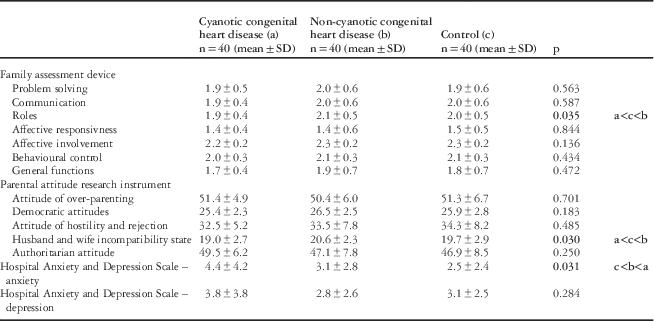
The results of Family Assessment Device, Parental Attitude Research Instrument, and Hospital Anxiety and Depression Scale, which were filled in by the parents, are given in Table 2. There was a statistically significant difference between the groups in terms of the mean score in the role sub-scale of Family Assessment Device (p=0.035). There was no statistically significant difference between the groups in terms of mean scores of the other sub-scales (p>0.05). The mean score of the husband and wife incompatibility sub-scale of Parental Attitude Research Instrument was found to be significantly different (p=0.030). There was no statistically significant difference between the groups in terms of the mean scores of the other sub-scales of Parental Attitude Research Instrument (p>0.05). The mean scores of the Hospital Anxiety and Depression Scale anxiety sub-scale were significantly different (p=0.031), whereas no significant difference was found between the groups in terms of the mean scores of the Hospital Anxiety and Depression Scale depression sub-scale (p=0.284).
Scores of mothers in hospital anxiety and depression scale, family assessment device, and parental attitude research instrument.

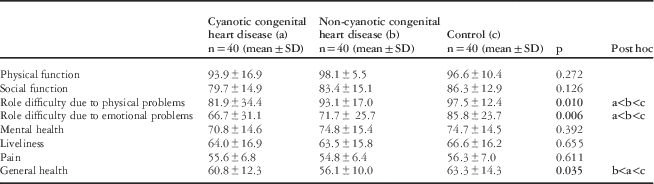
When the sub-scale scores of the Short Form-36 were compared between the parents of the patients with cyanotic and non-cyanotic CHD and the parents of the control group, scores of the sub-scales role difficulty due to physical problems (p=0.010), role difficulty due to emotional problems (p=0.006), and general health (p=0.035), were found to be significantly different (Table 3). The social function, physical function, and mental health scores were significantly lower in those who had a surgical history (p=0.006, p=0.030, p=0.036, respectively). There was no significant difference in the quality-of-life perceptions of parents of children being followed up with only medical treatment.
Short Form-36 scores of the mothers.

Discussion
It is a fact that negative events occurring within or outside the family can lead to a certain level of deterioration in family functions temporarily or permanently. The quality of life of parents of children with chronic disease is becoming increasingly important because mortality rates associated with these diseases have reduced and survival rates have increased. The family faces many problems with the initial diagnosis of the child. These problems affect the quality of life and emotional state of other members of the family, as well as the patient.Reference Goldbeck 15 , Reference Er 16
In this study, mothers were preferred for assessing the quality of life as they allocate more time to the child, they are more responsible for medication and treatment decisions, and they had an increased likelihood of hospitalisation with the child. The number of studies evaluating the quality of life in families of children with CHD is limited compared with similar studies in families of healthy children and children with other chronic illnesses. In our study, we evaluated the life quality perceptions of mothers. It was found that mothers of cyanotic children with a surgical history, intense medical treatment, and severe clinical symptoms had a lower perception of quality of life in their social and physical functioning, role difficulty due to physical and emotional problems, and mental health sub-scales. Statistically significant decreases were found either in the general health sub-scale in the mothers of non-cyanotic children or in the physical and emotional role difficulty sub-scale in the cyanotic group. Mothers of children with CHD reported that they were not able to perform their daily activities due to their physical and emotional difficulties, and that they perceived their health negatively. These findings were similar to the findings of the research carried out by Lawoko et al that assessed the life quality of parents of children with heart disease. They noted that parents of children with heart disease had a significantly worse quality of life than did parents of other patients and parents of healthy children, and that stress, hopelessness, and financial distress affected the quality of life more than did the severity of the illness.Reference Lawoko and Soares 17 Arafa et al compared the quality-of-life perceptions of the parents of children with heart disease with those of parents of children without chronic disease. They evaluated the quality of life using SF-36, and found that parents of children with heart disease had a significantly worse quality of life in all sub-scales except in the pain sub-scale. The severity of the disease, age of the child, type of heart disease, having more than one child, financial opportunities, and co-morbid conditions are all important factors that significantly affect the quality of life.Reference Arafa, Zaher, El-Dowaty and Moneeb 18 Our results were also compatible with these findings.
The role and parental incompatibility sub-scales were found to be significantly lower in the cyanotic group in the evaluation with Family Assessment Device and Parental Attitude Research Instrument. It has been determined that role distribution among family members was more successful, and that parental incompetence is less. The role sub-scale includes supporting the needs of family members, such as providing food and clothing, protecting the limits of the family system, and maintaining the standards of the family system, such as house work, bills, and health issues; the parental incompatibility sub-scale identifies parents who work together on issues related to children. Findings indicate that families in this group had a more successful familial structure and that their level of acceptance of the disease and its impact on their lives was higher because of having lived with the condition for a longer period of time. Results of both scales are parallel to each other. During the chronic illness process, as the severity of illness increases, familial adaptation increases. Wray and MaynardReference Wray and Maynard 19 reported that 43% of families became closer to each other after their child had been diagnosed with CHD, whereas 8% stated that they were drifting apart. In a different study, it was reported that parents received support from their older family members who also performed parenting roles when necessary.Reference Ravindran and Rempel 20
Daily stress levels and ability to cope with stress were assessed in the families of children with CHD, and the stress level was found to be more associated with maternal compliance skills rather than with the severity of illness.Reference Davis, Brown, Bakeman and Campbell 21 , Reference Kirschenbaum Cohn 22 In a study of parental responses towards CHD, the parents of infants with CHD had more fear, anger, and sadness in comparison with parents of healthy infants. Compared with parents of healthy children, excessive parenting stress has been reported more frequently by parents of children with heart diseases.Reference Uzark and Jones 23 In a similar study, Goldberg et al examined the relationship between chronically ill children and parenting stress, and assessed the parental effects of chronic childhood diseases. It was found that parents of CHD children had more stress than parents of healthy infants or parents of children with cystic fibrosis.Reference Goldberg, Morris, Simmons, Fowler and Levison 24 In our study, the anxiety and depression levels of mothers in the cyanotic group – which has higher surgery ratios, more intensive medical treatment, and clinical symptoms – were found to be higher, similar to the literature.
A study conducted by Gupta et alReference Gupta, Giuffre, Crawford and Waters 25 on children with CHD showed that cyanotic children were at more risk for anxiety, medical fear, depression, and behavioural disorders than were non-cyanotic children and control children, and that this situation could worsen with increasing maternal anxiety. Cohen et alReference Cohen, Mansoor, Gagin and Lorber 26 reported that self-esteem was associated with parental attitudes; thus, higher self-perceptions and less depressive symptoms were seen in adolescents with higher perceived parental acceptance in their study on adolescents with cardiac disease. Majnemer et alReference Majnemer, Limperopoulos, Shevell, Rohlicek, Rosenblatt and Tchervenkov 27 reported that the behavioural problems of children with CHD correlated with the stress levels of their mothers. The inclusion of parental mental status, parental attitudes, and family functioning assessments in the treatment protocols of children with CHD is crucial to avoiding any future adverse events.
In conclusion, when chronic childhood diseases were considered, families were found to be as much affected as children. In our study, there were significant differences in parental attitudes, family functioning, and parental perceptions of life quality. A multidisciplinary approach and an evaluation of the whole family is important. The fact that psychosocial problems have not been seen in all families of children with chronic illness suggests the existence of protective factors related to the individual, family, or social environment that prevent the development of these problems. Determining the factors that prevent the development of psychosocial problems may be important to plan support strategies for these children and their families in future research studies.
Acknowledgements
None.
Authors’ Contributions: F.A. study conception, study design, material and data collection, literature search; T.S. study conception, resource; S.Y.S. supervision, critical reviews; E.E. supervision, critical reviews; S.C. study design, data analysis, and interpretation.
Financial Support
The study has received no financial support.
Conflicts of Interest
The submission is with the full knowledge and approval of the listed authors. None of the authors have any disclosures or conflicts of interest to report.
Ethical Standards
For this study, permission was obtained from the ethical committee of Celal Bayar University Medical Faculty. The survey was conducted in accordance with the Helsinki Declaration criteria.
Supplementary Material
To view supplementary material for this article, please visit https://doi.org/10.1017/S1047951117001184