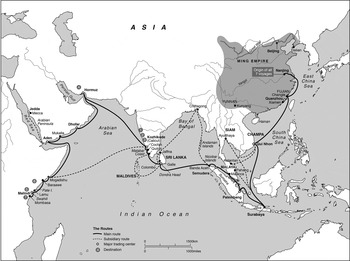
A major restructuring of long-standing Indian Ocean networks and exchanges is attributed to the European colonial enterprises and their hegemonic ambitions in the region during the sixteenth and seventeenth centuries. Meanwhile, the seven maritime expeditions of the Ming (1368–1644) admiral Zheng He 鄭和 (1371–1433) between 1405 and 1433 that covered almost the entirety of the Indian Ocean realm (Figure 1) are somehow considered irrelevant or worthy only of a cursory note. The role of these Ming voyages in the creation of new ports and chokepoints is only rarely examined (Beaujard Reference Beaujard2012: 2, 394–808; Ptak Reference Ptak1991), as is their role in asserting naval supremacy over a vast maritime space, the reordering of long-distance commercial and diplomatic relationships, and the circulation of people, animals, ideas and cultural objects across the Indian Ocean. While traders and ships had previously sailed between the Persian Gulf and the Chinese coast, no polity exerted naval dominance over all sectors of the Indian Ocean prior to the expeditions led by Zheng He.
The expeditions of Zheng He, 1405–33. Map drawn by Inspiration Design House, Hong Kong. © Tansen Sen

Despite studies of several facets of the Zheng He expeditions undertaken during the past century (including Pelliot Reference Pelliot1933; Duyvendak Reference Duyvendak1939; Levathes Reference Levathes1994; Dreyer Reference Dreyer2007; Zhou Reference Yunzhong 周運中2013; for a comprehensive bibliography on Zheng He, see Liu et al. Reference Liu, Zhongping and Blue2014), a number of critical issues remain unresolved and contentious. The paucity of primary sources, especially from the foreign polities the Chinese admiral visited, makes it difficult to ascertain the validity of Chinese records. The Chinese sources themselves are not exhaustive and offer partial and often biased perspectives on the expeditions. Thus, the unresolved issues range from the size of the so-called “treasure ships” that spearheaded the Ming armada (Church Reference Church2005) to the reasons for the military actions Zheng He took at several sites he visited (Wade Reference Wade2005a). Also having an adverse impact on the study of these expeditions is the nationalistic and celebratory fervour Zheng He has attained in China from the beginning of the twentieth century. These have all prevented a detailed examination of the impact of the Zheng He expeditions on Indian Ocean interactions.
This essay will argue that the Zheng He expeditions had a significant effect on diplomatic exchanges, commercial patterns, and the circulation of ideas and objects in the Indian Ocean. For the first time in the history of the Indian Ocean, the maritime space from coastal China to eastern Africa came under the dominance of a single imperial power, which intervened in local politics, instituted regime changes, and tried to monopolize all commercial activities related to China. These Ming expeditions may even have facilitated the spread of European colonial enterprises into the Indian Ocean region during the sixteenth century. Indeed, the colonial enterprises followed and eventually occupied many of the same conduits and the nodes that the Zheng He expeditions utilized or created. It is thus important to consider whether a new age in the history of the Indian Ocean should be recognized – if imperial control and the creation of cosmopolitan spaces are the main criteria for periodization – as beginning in the early 1400s (rather than in the 1500s), when the Ming armadas made repeated voyages across the full extent of the oceanic realm and dictated many of the interactions and exchanges within that space.
Zheng He and the control of the Indian Ocean nodes
In 1402, Zhu Di 朱棣 (r. 1402–24), Prince of Yan 燕王 and son of the founding Ming ruler Zhu Yuanzhang 朱元璋 (also known as the Hongwu 洪武 emperor, r. 1368–98), usurped the throne and became the third emperor of the dynasty. Known commonly by the designation of his reign period Yongle 永樂, within a year of his accession the emperor ordered the construction of a large number of ocean-going ships and picked a close aid, the Muslim eunuch named Zheng He, to command these vessels on voyages far beyond the coasts of Ming China. The first expedition, which commenced in 1405, may have consisted of over 250 ships, including 60 large “treasure ships”, and over 27,000 personnel, of whom 26,000 were soldiers (Dreyer Reference Dreyer2007: 51). The destination of the first three voyages was Calicut (Guli 古里, now Kozhikode) on the Malabar coast of India. It was during the fourth expedition, which left Ming China in late 1412 or early 1413, that the Zheng He-led armada sailed beyond South Asia into the port of Hormuz in the Persian Gulf. The fifth, sixth and seventh voyages travelled even further, reaching the Swahili coast of Africa.
The seventh voyage, which set sail in 1431, came after a hiatus of almost a decade, a period that witnessed a temporary cessation of the maritime expeditions and the death of the Yongle emperor. In 1421, about a year before Zheng He returned from his sixth expedition, the imperial palace that was being constructed in Beijing, the new Ming capital, was partially destroyed by a fire. This event was interpreted as a bad omen and especially a potent sign against the expensive, eunuch-led maritime ventures. Influenced by these views, the Yongle emperor decided to discontinue the Indian Ocean expeditions. It was the Xuande 宣德 emperor (r. 1425–35), the grandson of Yongle and the fifth emperor of the Ming dynasty, who resumed the maritime voyages. He did so only after the death of Xia Yuanji 夏原吉 (1366–1430), a prominent minister in charge of finance and the leading critic of the maritime expeditions. This seventh expedition turned out to be the last trip for Zheng He, who died during the voyage, and also one that marked the end of the Ming court's active engagement with the Indian Ocean world. It must be pointed out, however, that imperial ships dispatched by the Ming court continued to visit polities in the South China Sea region during the 1450s (Wade Reference Wade2008: 593).
Several facets of the Zheng He expeditions were rooted in the policies and strategies pursued by the Yuan dynasty (1271–1368) under Qubilai Khan (r. 1260–94). The demand for tributary missions from maritime polities was one of these aspects. Qubilai devised this policy, which was enforced through the dispatch of court officials and the use of naval forces, in order to portray himself as the legitimate “khan” in the fragmented Mongol Empire (Sen Reference Sen2006a). The Yongle emperor also needed to legitimize his usurpation of the Ming throne, and the tributary missions from foreign lands to some extent served this purpose. Similar to Qubilai Khan, the Yongle emperor used court officials, especially eunuchs loyal to him, to demand submission by maritime polities and the sending of tribute missions to the court. While Qubilai was unsuccessful in his attempts to occupy regions in the South China Sea, the Yongle emperor tactfully used his armada to install local allies or strengthen friendly regimes at several key nodes of the Indian Ocean world. Instead of committing troops to the foreign maritime polities, something his father, the Hongwu emperor, had warned against (Wang Reference Wang and Fairbank1968), the Yongle emperor frequently sent his powerful naval fleets under the command of Zheng He and other eunuchs to assert Ming authority in the maritime realm. Many of the tribute missions that arrived at the Ming court during the reign of the Yongle emperor resulted from this flexing of naval power that no other polity in the Indian Ocean possessed. In other words, the Ming during the Zheng He expeditions was able to exert what some contemporary maritime strategists call haiquan 海權, or “a state's capacity to realize its goals (strategic, security, military and economic) at sea” (Dong and Xin Reference Dong, Xin, Ho and Bateman2012: 184).
Zheng He's first expedition most likely made a significant impression on various polities, merchant groups, and pirates in the South China Sea and the Bay of Bengal region. In addition to the 26,000 soldiers, the ships led by Zheng He carried the most advanced weapons of the day, including cannons and other gunpowder-based firearms (Sun Reference Sun2003). The arrival of the powerful Zheng He-led armada at foreign ports generated intense competition among contending local polities and rivals, each seeking alliance with the Ming court. This is evident, for instance, from the situation at Jiugang 舊港 (i.e. Palembang, in present-day Indonesia), where several groups of Chinese merchants lived and wielded considerable influence over the maritime networks linking coastal China to the Indian Ocean world.
Ming sources record several “chieftains” in Palembang, all of Chinese origin, who seem to have migrated there after the Hongwu emperor instituted a maritime ban in 1371 (Li Reference Li2010). The three chieftains mentioned prominently at the time of Zheng He's first expedition were Liang Daoming 梁道明, who is described as an “absconder” in the Ming shilu (10: 646; Wade Reference Wade2005b, Entry 360); Chen Zuyi 陳祖義, noted as a “pirate” (Ming shilu 11: 834, 11: 987; Wade 2005b, Entry 460, 536); and Shi Jinqing 施進卿, a person whom the Ming court would eventually install as its representative in Palembang. In February 1405, several months before Zheng He embarked on this maiden voyage, officials were dispatched to bring Liang Daoming to the Ming court to negotiate the “pacification” of the region. When Liang appeared at the Ming court, he offered tribute of horses to the Yongle emperor and was given in return paper money and silk products as gratitude (Ming shilu 10: 734; Wade Reference Wade2005b, Entry 400). It seems that any issues the Ming court may have had with Liang were resolved through this mission.
In August 1406, however, after Zheng He's armada had passed through Palembang on its way to South Asia, two people from Palembang arrived at the Ming court to offer tribute: a representative of Liang Daoming and the son of another “chieftain” of Palembang named Chen Zuyi. This was followed by the arrival of Shi Jinqing, who alleged that Chen Zuyi had committed “acts of savagery” at the Sumatran port (Mills [Reference Mills1970] 1997: 100). On his way back to Ming China in October 1407, Zheng He stopped at Palembang and tried to negotiate the “pacification” of the region with Chen, who, according to Ming sources, not only refused the admiral's terms, but also “secretly plotted to attack the Imperial army” (Ming shilu 11: 987; Wade Reference Wade2005b, Entry 536). Zheng He then led his troops against the “attacking” forces of the “pirate”, killing 5,000 of them and capturing Chen Zuyi. When the prisoner was presented at the Ming court, the Yongle emperor promptly ordered his execution. Shi Jinqing, who seems to have been at the Ming capital at the time of Chen's execution, was appointed the pacification superintendent of the Pacification Superintendency of Palembang. After Shi Jinqing's death, the Ming court appointed his son to the same post. This selection and installation of an ally at Palembang gave the Ming court access to an important port in South-East Asia that was intimately linked to the wider Indian Ocean networks.
During this first expedition, Zheng He also secured submission from a Javanese ruler. Like Palembang, Java, which at this time was divided and had various contending factions, was closely integrated with the Indian Ocean commercial networks. It was a hub for the export of commodities such as sapan-wood, nutmeg, and sandalwood that originated in various eastern Indonesian islands. A record dated 23 October 1407 in the Ming shilu (11: 997–8; Wade Reference Wade2005b, Entry 553) states that the “Western king of Java” sent an envoy to the Ming court to “admit guilt” for mistakenly killing 170 Ming soldiers who accompanied Zheng He to the island. According to the report, these soldiers had gone “ashore to trade”. The Ming court demanded compensation of 60,000 liang of gold as atonement for this offence. It also warned the Javanese ruler that if he failed to comply, there would not be any option “but to dispatch an army to punish your crime. What happened in Annam can serve as an example”. The Annam reference was to Ming China's successful invasion of Vietnam earlier that year (Wade Reference Wade2005a: 49).
The news of the Ming court's intervention in Palembang and the warning communicated to Java seems to have quickly spread throughout the South China Sea region. In 1408, Boni 浡泥 (Brunei) sought help from the Ming court to end the Javanese demand for an annual tribute of 40 jin (about 44 pounds) of camphor. In response, the Yongle emperor ordered the king of Java to cease such demands immediately. A month later, the Western king of Java, who still had not paid the initial compensation for killing Zheng He's men, sent an envoy with 10,000 liang of gold as offering to the Ming court (Ming shilu 11: 1137–8; Wade Reference Wade2005b, Entry 648).
The above pattern of installing friendly regimes in foreign lands, capturing or executing rivals, and threatening menacing rulers became common features of the subsequent Zheng He expeditions. In 1415, for example, Zheng He is credited with capturing the “leader” of a “bandit” group in Samudera called Suganla 蘇幹剌 (Sekandar?). While Fei Xin 費信 (Mills Reference Mills1996: 58), who accompanied Zheng He on several of the expeditions, describes Suganla as a “false king” who “robbed stole and usurped” the throne of Samudera, Ma Huan 馬歡 (Mills [Reference Mills1970] 1997: 116–7), who also accompanied some of the Ming voyages, portrays him as someone who attempted to overthrow the reigning ruler. The Ming shilu (13: 1869–70; Wade Reference Wade2005b, Entry 914) notes that he was the younger brother of the former king who was plotting to kill the ruler. When Zheng He arrived in Samudera to bestow gifts upon the reigning ruler, Suganla reportedly attacked the admiral's contingent with “tens of thousands” of soldiers. Suganla was defeated, taken to the Ming capital, and publicly decapitated. Scholars (Mills Reference Mills1996: 58, n.132; Wade Reference Wade2005a: 50) have pointed out that this was clearly a case of Ming intervention in the internal affairs of Samudera, most likely intended to exert influence over another key node in the maritime world.
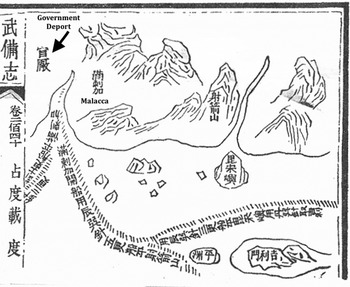
Promoting alternative nodes was also a strategy that Zheng He and the Ming court used to establish control over the maritime networks. This is apparent from the way in which the Ming court transformed Malacca into an important commercial hub and a base for Zheng He's maritime activities further across the Indian Ocean. Both Ma Huan and Fei Xin point out that Malacca did not qualify as a polity prior to the Zheng He expeditions; it had no “king”, and existed only as a vassal region of Xianluo 暹羅 (Siam, present-day Thailand). In 1403, the Ming court dispatched a eunuch envoy named Yin Qing 尹慶 (active early fifteenth century) with an imperial proclamation to Malacca. The aim was perhaps to collect information about the region. Two years later, the court sent through Zheng He a stone tablet enfeoffing the Western mountain of Malacca as well as an imperial order elevating the status of the port to that of a “country”. Through the erection of this inscribed tablet and subsequently establishing a guanchang 官廠 (government depot) (Figure 2), which served as a fortified cantonment for Chinese soldiers, the Ming court asserted its claim over the port (Wade Reference Wade, Singh and Dhar2014: 31).
Ming government depot, Malacca

“Thereafter”, Ma Huan reports (Mills [Reference Mills1970] 1997: 109), Siam “did not dare to invade it (i.e. Malacca)”. In fact, in 1431, when a representative from Malacca complained that Siam was obstructing tribute missions to the Ming court, the Xuande emperor dispatched Zheng He carrying a threatening message for the Siamese king saying, “You, king should respect my orders, develop good relations with your neighbours, examine and instruct your subordinates and not act recklessly or aggressively” (Ming shilu 20: 1762–3; Wade Reference Wade2005b, Entry 1548). Obligated to the Ming court, the rulers of Malacca paid tribute to the Chinese emperor in person. In 1411, for example, king Bailimisula 白里迷蘇剌 (Paramesvara?), with his wife and more than 540 persons, visited the Ming court to express his gratitude (Ming shilu 12: 1490–91; Wade Reference Wade2005b, Entry 774). After Bailimisula, his son and grandson were also recognized as the kings of Malacca by the Ming court.
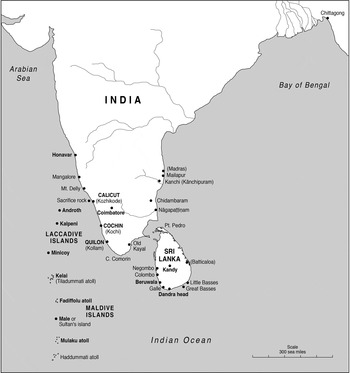
Political and military interventions by the Ming court extended to maritime polities beyond the South China Sea region. The terminus of Zheng He's first three expeditions was Calicut, the leading centre for intra-Indian Ocean commerce and the main exporter of pepper from the Malabar coast (Figure 3). Prior to Zheng He's arrival at the Malabar coast, Yin Qing, who went to Malacca, was also tasked to visit Cochin (Kezhi 柯枝, now Kochi) and confer various items, including “‘spangled-gold’ silk gauze drapes and parasols together with patterned fine silks and coloured silks as appropriate” (Ming shilu 10: 440; trans. Wade Reference Wade2005b, Entry 311). Like Malacca, Cochin was still not a major port or commercial site when Yin Qing was sent. It is possible that, like Malacca, the Ming court had already identified Cochin as an alternative site for its future activities in the Indian Ocean.
Coastal regions of south India and Ceylon. Map drawn by Inspiration Design House, Hong Kong. © Tansen Sen

In 1405, when Yin Qing returned to the Ming court, the Cochin representative was conspicuously missing and instead the “ruler” of Calicut accompanied the Ming envoy. This seems to be an indication of the existing conflict between Calicut and Cochin in the early fifteenth century. Ming sources make it clear that Calicut was not only a leading trading hub in the Indian Ocean, but was also a place where Muslim merchants (some perhaps of Arab and Persian origin) exerted significant political and economic power (Sen Reference Sen2011; Ptak Reference Ptak1989). Some of these merchants, especially those invested in foreign trade, funded the expansionist policies of the Zamorin, the ruler of Calicut. They may in fact have lobbied the Zamorin to invade Cochin, which was quickly emerging as the main rival port on the Malabar coast. Sometime in the late fifteenth century, the Zamorin did in fact occupy Cochin and install his representative as the king of the port-city (Menon [Reference Menon1967] 1970; Malekandathil Reference Malekandathil2001: 35). Through the missions of Yin Qing and Zheng He the Ming court was probably aware of this rivalry between Calicut and Cochin and decided to intervene in 1416–17 by granting special status to Cochin and its ruler Keyili 可亦里 (Sen Reference Sen2011: 80, n. 96).
As part of his fifth expedition, which sailed from China in 1417, Zheng He was instructed to confer a seal upon Keyili and enfeoff a mountain in his kingdom as the zhenguo zhi shan 鎮國之山 (“Mountain which protects the country”). The Yongle emperor composed a proclamation that was inscribed on a stone tablet and carried to Cochin by Zheng He. Both of these were rare acts by the Ming court. Only three other polities, Malacca (in 1405), Japan (in 1406) and Brunei (in 1408), received similar privilege. This exceptional status must have been granted to Cochin because the Ming court decided to support an emerging port (i.e. Cochin) over Calicut, where Muslim officials seem to have developed a strong power base and monopolized foreign trade (Sen Reference Sen2011). For the Ming court and the Zheng He expeditions, the Malabar coast was extremely important as a source for pepper and also as a staging point for westward exploration of the maritime world. It is also possible that the rulers of Cochin and the three other polities proactively requested the exceptional status from the Ming court as a means to defend themselves from local rivals. By conferring seals and proclamation tablets, the Ming may have offered what Roderich Ptak (Reference Ptak1991: 27) has called “protection services” to the rulers of these polities against third parties.
The alliance between Cochin and Ming seems to have averted a military offensive by the Zamorin of Calicut. After the cessation of the Zheng He expeditions, however, the Zamorin not only invaded Cochin, but also seem to have banned Chinese merchants from trading at the Malabar coast. The Christian traveller Joseph of Cranganore provides the following report about the absence of Chinese merchants in Calicut in the early sixteenth century:
These people of Cathay are men of remarkable energy, and formerly drove a first-rate trade at the city of Calicut. But the King of Calicut having treated them badly, they quitted that city, and returning shortly after inflicted no small slaughter on the people of Calicut, and after that returned no more. After that they began to frequent Mailapetam, a city subject to the king of Narsingha; a region towards the East, … and there they now drive their trade. (Yule Reference Yule1875: 2. 391; Vallavanthara Reference Vallavanthara2001: 249)
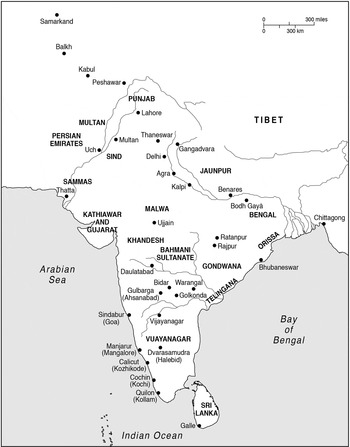
The Ming court and members of the Zheng He expeditions also became involved in a local conflict between Bengal and the neighbouring Jaunpur Sultanate (Figure 4). In 1420, the king of Bengal complained to the Yongle emperor that Jaunpur forces had carried out several military raids on his territories. In response to the complaint, the Ming court dispatched the eunuch Hou Xian 侯顯 (active 1403–27) and others “with Imperial orders of instruction for them [i.e. Bengal and Jaunpur], so that they would both cultivate good relations with their neighbors and would each protect their own territory” (Ming shilu 14: 2226; trans. Wade Reference Wade2005b, Entry 1092). The entourage led by Hou Xian arrived in Bengal in August or September 1420 and was welcomed with a grand reception. It was Hou Xian's second visit to the region and this time he brought along several hundred Chinese soldiers, who were all presented with silver coins by the ruler of Bengal. The entourage then proceeded to Jaunpur to convey the Yongle emperor's message and tried to resolve the territorial dispute peacefully (Sen Reference Sen2006b).
Jaunpur and Bengal. Map drawn by Inspiration Design House, Hong Kong. © Tansen Sen

The ruler of Bengal evidently knew about the Ming court's naval capabilities and was aware of the interventions the Zheng He expeditions had already made in other maritime regions. In fact, Bengal had sent at least eight embassies to the Ming court before 1420, and traders from the region were actively engaged in Indian Ocean commerce (Bagchi [1945] Reference Bagchi, Wang and Sen2012; Ray Reference Ray1993). Hou Xian himself visited the region in 1415. Thus, by 1420, the rulers, officials and traders in Bengal must have been familiar with the Ming court's willingness and capacity to intervene in local disputes. Some scholars (Zhou Reference Yunzhong 周運中2013: 241–9), albeit based on much later evidence, even believe that the Ming court had established a guanchang at the Chittagong port in Bengal. If true, it, as well as the Yongle emperor's swift response to the request from the ruler in Bengal, demonstrates how the voyages associated with the Zheng He expeditions were used to patrol the maritime realm, including those regions that were not directly located at the chokepoints of the Indian Ocean.
Although the possibilities of a reconnaissance mission on the expanding forces of Tamerlane (1336–1405) or an effort to establish a Ming–Timurid collaboration have been considered as reasons for the launch of the Zheng He expeditions (Xu Reference Yuhu 徐玉虎1958; Rossabi Reference Rossabi1973; Hsiao Reference Hsiao2006), the Ming entourage does not seem to have employed its naval prowess in the Persian Gulf or at the east coast of Africa in the same way as it did in South and South-East Asia. However, the impact of its visits to these sites is apparent from Yemeni sources. An untitled manuscript composed sometime in 1439 or 1440 and dealing with the Rasūlid dynasty of Yemen reports the arrival of Chinese junks (“zank”) in 1418–19, 1423, and 1432 (Yajima Reference Yajima1976: 21). The episode in 1418–19, is described as follows:
Arrival of Dragon-ships (marākib al-zank) in the protected harbour city (Aden) and with them the messengers of the ruler of China with brilliant gifts for his Majesty, the Sultan al-Malik al-Nāṣir in the month of l’Ḥijja in the year 821 (January 1419). His Majesty, the Sultan al-Malik al-Nāṣir's in the Protected Dār al-Jund send the victorious al-Maḥaṭṭa to accept the brilliant gifts of the ruler of China. It was a splendid present consisting of all manner of rarities (tuḥaf), splendid Chinese silk cloth woven with gold (al-thiyāb al-kamkhāt al-mudhahhabah), top quality musk, storax (al-ʾūd al-raṭb) and many kinds of chinaware vessels, the present being valued at twenty thousand Chinese mithqāl (93.6 kg gold). It was accompanied by the Qāḍi Wajīh al-Dīn ʿAbd al-Raḥman b. Jumay. And this was on 26 Muḥarram in the year 822 (March 19, 1419). His majesty, the Sultan al-Malik al-Nāṣir ordered that the Envoy of the ruler of China (rusul ṣāḥib al-Ṣīn) returned with gifts of his own, including many rare, with frankincense wrapped coral trees, wild animals such as Oryx, wild ass, thousands of wild lion and tamed cheetahs. And they travelled in the company of Qāḍi Wajīh al-Dīn ʿAbd al-Raḥman b. Jumay out of the sheltered harbour of Aden in the month of Safar of the year 822 (March 1419). (Yajima Reference Yajima1974: 139–41; Yajima Reference Yajima1976: 105–6; Serjeant [1996] 2000: 68).
The Ming envoys on this mission, and that of 1423, are reported to have travelled from Aden to Taizz to meet the Yemeni sultan. The third Ming mission which, according to this Rasūlid chronicle arrived in 1432, went to Lahej to have an audience with the reigning sultan (Yajima Reference Yajima1974: 141–2; Serjeant [1996] 2000: 69).
A later Yemeni source reports a Ming embassy in 1420, perhaps the same one mentioned in the Rasūlid chronicle as arriving in 1419, on three “great vessels containing precious gifts, the value of which was twenty lacs of gold” (Serjeant [1996] 2000: 68). The Chinese envoy, according the Yemeni record:
had an audience with al-Malik al-Nāṣir without kissing the ground in front of him, and said: “Your Master the Lord of China greets you and counsels you to act justly to your subjects.” And he [al-Malik al-Nāṣir] said to him: “Marḥaban [welcome], and how nice of you to come!” And he entertained him and settled him in the guesthouse. The al-Nāṣir wrote a letter to the Lord of China: “Yours it is to command and [my] country is your country.” He despatched to him wild animals and splendid sultanic robes, an abundant quality, and ordered him to be escorted to the city of Aden. (Sergeant Reference Sergeant, Lombard and Aubin[1996] 2000: 68).
Mills ([Reference Mills1970] 1997: 155, n. 5) has suggested that al-Nāṣir's expression of humility towards the Ming representatives was connected to the sultan's “desire to acquire an ally who might prove useful in the event of further Egyptian expansion”. Indeed, such desires for alliances with the powerful Ming court were, as outlined above, also common among polities in South and South-East Asia. The diplomatic exchanges between Yemen and Ming China are confirmed by Chinese sources. The Ming shilu reports the arrival of embassies from Aden in 1416, 1421, 1423, 1430, 1433 and 1436.
During their fifth, sixth and seventh voyages, ships from the Zheng He expeditions visited the Swahili coast. No direct evidence of either military interventions or political alliances in the region is found in the existing Ming sources. However, the fictional work composed in 1597 and attributed to Luo Maodeng 羅懋登 called Sanbao taijian xiyang ji 三寶太監西洋記 (Records of the Expeditions of the Three Treasures Eunuch to the Western Oceans), which grew out of the reports of Zheng He's accomplishments and the imagination of the exotic places he visited, has a story about a military action by Ming troops at a place called Lasa 剌撒, which has been identified variously as Muscat (Duyvendak Reference Duyvendak1939; Reference Duyvendak1953), in the vicinity of Mukalla in the Arabian peninsula (Mills [Reference Mills1970] 1997: 347–8), and near Mogadishu (Levathes Reference Levathes1994: 150). The Ming soldiers, according to the story, used “Huihuipao” 回回砲 or “Muslim cannons/catapults” to destroy the city walls. Believing that the Ming emperor had sent these soldiers to invade his kingdom, the king of Mogadishu prepared for a counter-attack. However, after prolonged deliberations about the consequences of a fully-fledged war, the African king decided to surrender to the “superior forces of the treasure fleet” (Levathes Reference Levathes1994: 150; Wade Reference Wade2005a).
While a military conflict may not actually have taken place on the Swahili coast, the impact of the Ming expeditions on the region cannot be discounted. It is possible that the arrival and the subsequent commercial activities carried out by the Ming representatives at Malindi in 1417–18 elevated the port's standing on the Swahili coast. Mombasa, rather than Malindi, was the main centre of commerce in the region prior to the arrival of the Ming armada. Nonetheless, it was a place known to the Ming court because a giraffe offered by the polity had reached China in 1415. Ming-period porcelain shards, including those with marking from the Yongle emperor's imperial kilns, found in Malindi and its vicinity are indicative of extensive commercial exchanges between Ming officials and local representatives (Qin Reference Dashu, Dashu and Jian2015). Similar to Malacca and Cochin, Zheng He might have identified Malindi as an alternative node on the Indian Ocean and the Ming fleet's activities there transformed it into an important centre of commerce by the time Vasco da Gama reached the port in 1498.
The Zheng He expeditions may thus have been crucial for the emergence of at least three key nodes in the Indian Ocean: Malacca, Cochin and Malindi. These expeditions were also instrumental in installing friendly regimes at several chokepoints in the Indian Ocean through military actions or the display of naval prowess. The fact that various polities, such as Bengal, requested assistance in resolving local disputes or, as in the case of Aden, contemplated military alliances with the Ming court, indicates that the Zheng He expeditions had successfully asserted Ming supremacy throughout the Indian Ocean. It was to acknowledge this naval supremacy, as well as to pursue the potential profits from commercial engagement with the Ming court, that polities from all regions of the Indian Ocean sent tributary missions to Ming China. The fact that the expeditions had a profound impact on various polities is reflected not only in the Yemeni sources mentioned above, but also from the remarks made by a representative from Hormuz in 1442, some nine years after the Zheng He-led voyages had ceased. Conveying his ruler's dismay over the absence of Chinese missions, the envoy said that he “humbly hoped that the Court would show great kindness and would, like before, send envoys in order to keep the avenues open” (Ming shilu 26: 1755–56; trans. Wade Reference Wade2005b, Entry 1853).
Maritime trade under court supervision
The melancholy tone of the envoy from Hormuz reflected the polity's disappointment with the absence of the strong naval ally with which the Middle Eastern rulers may have nurtured cordial relations for over a decade. In fact, Hsiao Hung-te (Reference Hsiao2006: 187–92) has argued that Hormuz was a key link in Ming China's diplomatic contacts with the Timurid Empire through the Zheng He missions. Hsiao, however, incorrectly states that Zheng He went to Hormuz during his third expedition and seems to exaggerate the importance of the Timurid connection and the strategic role of Hormuz. It is possible the above lamentation by the envoy from Hormuz was over the loss of revenue from the trade it conducted with the Ming armada (on Hormuz in Chinese sources, see also Kauz and Ptak Reference Kauz and Ptak2001). The Zheng He expeditions had instituted a new system of commercial exchange at several Indian Ocean ports; this was apparently controlled and overseen by Ming officials. These officials negotiated the price of Chinese goods and exchanged them for local products. Some of these foreign goods were brought back to China and others carried to different locations in the Indian Ocean for sale. The impact of this new system of court-supervised trade on pricing mechanisms, product demand and supply, and state–private commerce relations is not clear. However, as is evident from the discussion below, the commercial exchanges between the Ming officials and local representatives were voluminous and lucrative at least as far as court revenues were concerned.
The ban on maritime trade instituted by the Hongwu emperor triggered, as mentioned above, an outflow of Chinese traders from the coastal regions of Ming China to locations in South-East Asia. These groups of Chinese settled in places such as Sumatra and Java and not only traded with the Ming as representatives of these polities, but also started operating networks that extended to the Bay of Bengal and the Arabian Sea regions. By the time Zheng He embarked on his first expedition, the Chinese merchants based in South-East Asia may already have made significant inroads into the maritime trading activities between Ming China and ports in the South China Sea and the Bay of Bengal.
The commercial interactions between Ming China and the polities in the South China Sea were more complex because of the presence of a large number of Chinese diasporic communities than those with polities in other regions of the Indian Ocean. Trade was conducted at the South-East Asian ports during the visits of Ming ships and through the sale of tributary cargo by representatives from South-East Asian polities at Chinese markets under the supervision of Ming officials. Siam, for example, engaged in trade with the Ming representatives travelling with Zheng He, and would, at the same time, send representatives to China carrying “valuable” goods to offer tribute and sell part of their cargo in local markets (Mills [Reference Mills1970] 1997: 106–7). Unlike the polities located in the distant regions of the Indian Ocean, the South-East Asian representatives frequently offered commercial commodities rather than exotic items as tribute to the Ming court. Shi-shan Henry Tsai (Reference Tsai1996: 141–2) has noted that the tribute goods presented to the Ming court during the late fourteenth and early fifteenth centuries:
generally consisted of both “official tribute” and “private cargo”, the former to be sent to the emperor while a portion of the latter, after paying a 6 per cent commission, could be sold or bartered at the port entry. The eunuch superintendent always bartered the best 60 per cent of the cargo on behalf of the Ming government and let the foreigners sell the rest to licensed Chinese merchants.
Chinese merchants based in South-East Asia are also known to have smuggled foreign goods into the coastal regions of Ming China in order to bypass the strict court supervision.
The Hongwu emperor's ban on maritime trade and the state monopoly of overseas commerce did not, however, prevent foreign merchants from conducting business in Ming China. This can be discerned from an entry for 1403 in the Ming shilu. When a Muslim named Hazhi Mahamo Qilanni 哈只馬哈沒奇剌泥 (Haji Mohammad Jilani) and others came from the polity called Lani 剌泥 (most likely on the Malabar coast) to offer tribute of local products, court officials pointed out that the group had also brought pepper to trade in China. They requested that a tax be levied on the sale of the commodity by these foreign merchants. The Yongle emperor objected, saying, “Commercial taxes are levied by the state in order to restrain those engaging in the inferior occupation (commerce). How can we use taxes for our benefit! The yi are now inclining towards virtue and coming from distant places, and you wish to appropriate their profits. The resulting loss and disgrace to the propriety of the country will outweigh by 10,000 times the amount received from them! This is not to be permitted!” (Ming shilu 10: 447–8; trans. Wade Reference Wade2005b, Entry 1403).
T'ien Ju-Kang (Reference T'ien1981: 187) has argued that as a result of Zheng He's expeditions, the significance of pepper in Ming China changed “from being a precious commodity to one in common use”. The use of pepper as payment to court officials and military personnel during the later years of the Yongle emperor, T'ien argues, was the main reason for this change. The sale of pepper in China was monopolized and regulated by the state. It was also used by the state to address the issue of inflation caused by the drop in the value of paper money. Given the growing interest in acquiring pepper, it is not surprising that Calicut was the main destination of Zheng He's first three voyages. The backing of Cochin as an alternative hub on the Malabar coast could also have resulted from this increasing Chinese demand for pepper.
The Ming court's interest in procuring pepper from South Asia is evident from the records of Ma Huan and Fei Xin, both of whom offer detailed descriptions on the availability of pepper, its cultivation, and its price at various South Asian ports they visited. In Calicut, for example, Ma Huan (Mills [Reference Mills1970] 1997: 143) notes that pepper was grown “extensively” in the gardens established by people living in the mountainous region of the polity. After it ripened, it was dried and sold to “big pepper-collectors”, who transported the commodity to an official storehouse. Both the local sale of pepper from this official storehouse and its supply to foreign traders were monitored and taxed by local authorities. In Cochin, on the other hand, there was no state monopoly on the production, transportation and sale of pepper, which was, according to Ma Huan (Mills [Reference Mills1970] 1997: 135), the only local product that the emerging port traded. There were private warehouses in Cochin, owned by wealthy families, Fei Xin (Mills Reference Mills1996: 67) reports, where pepper was stored. It was then sold directly to foreign merchants, without state supervision. Perhaps because of the lack of state monopoly, the price of pepper was about 34 per cent cheaper in Cochin than in Calicut. But, still it was 25 per cent more expensive than the pepper available in Samudera. Unlike Calicut and Samudera, however, Cochin in the early fifteenth century perhaps did not yet have entrenched commercial agreements with foreign merchant groups for the sale of pepper.
The Malabar coast was also a place for Zheng He and his entourage to procure goods that arrived from various other regions of the Indian Ocean. In Cochin, the Chetty merchants collected gemstones, pearls and aromatic goods for resale to the Ming representatives (Mills [Reference Mills1970] 1997: 136). Similarly, in Calicut, horses, coral, pearls, frankincense, putchuck and amber were brought from other regions for entrepot trade. Horses were perhaps the most important of these transit goods destined for China. According to Fei Xin (Mills Reference Mills1996: 69) horses were brought to the Malabar coast from West Asia, bred locally, and “transferred” for hundreds or thousands of coins for onward sale. To purchase these transit goods and local products such as pepper, the Ming officials offered gold, silver, silk, porcelain, pearls, musk, quicksilver and camphor. While some of these products came from China, others, such as camphor, originated in South-East Asia.
Ma Huan (Mills [Reference Mills1970] 1997: 140–3) has described in detail the procedure through which trading activity took place between the representatives of the Ming court and local traders in Calicut. While the two Muslim chiefs of Calicut oversaw the commercial transactions, a Chetty trader and a local broker participated in the purchase of goods from the Ming officials. One of the commanders from the Ming fleet was responsible for fixing the date for trade. On that designated date, commodities were displayed, prices agreed upon, and a written agreement executed. After the sale of goods by the Chinese, the locals exhibited their merchandise. The prices were negotiated and paid with silk, the price of which was also fixed in the written agreement.
For Fei Xin (Mills Reference Mills1996: 63), Ceylon was inferior only to Java with regard to its importance in maritime trade. The fact that the island produced several types of precious stones and gems, as well as pearls, is noted by both Fei Xin and Ma Huan. Musk, hemp-silk, blue-and-white porcelain, copper coins, gold and silver objects, and camphor were used by the Ming representatives to purchase goods from Ceylon. The trilingual inscription, written in Chinese, Tamil and Persian, set up by Zheng He on the island suggests that the Ming representatives conducted trade with Tamil and Persian merchant guilds in addition to other local traders (Sen Reference Sen, Craig, Harrison-Hall and Yu-Ping2016).
Bengal seems to have been a leading trading partner of the Ming court and of the Chinese traders settled in South-East Asia. Cotton, textiles, precious stones and gems, mostly acquired from other regions of the Indian Ocean, and kingfisher feathers, were some of the commodities sold to the Chinese. In return, the local merchants received gold and silver objects, silk fabrics, blue-and-white porcelain, copper money, musk, vermilion, quicksilver, and pepper (Ray Reference Ray1993). Ma Huan (Mills [Reference Mills1970] 1997: 165) mentions that the ruler of Bengal owned ships that were sent to trade with foreign polities. It was perhaps through such shipping networks that the giraffes presented to the Yongle emperor reached Bengal.
This animal most likely originated from the Swahili coast, where, as argued above, the Ming officials may have been engaged in extensive commercial interactions. In addition to luxury goods, such as gold, silver, silk and porcelain, the Ming representatives also offered bulk products like rice and cereals to the local representatives (Mills Reference Mills1996: 101–2). Sandalwood and pepper originating in South and South-East Asia were not only sold to the buyers on the Swahili coast, but also traded in Hormuz and Aden. In Dhufar, a similar pattern of court-supervised transactions as mentioned in the case of Calicut took place. “When the treasure-ships of the Central Country arrived there”, writes Ma Huan (Mills [Reference Mills1970] 1997: 152–3), “after the reading of the imperial will and the conferment of presents was finished, the king sent chiefs everywhere to issue instructions to the people of the country [and] they all took such things as frankincense, dragon's-blood (i.e. red resin), aloes, myrrh, benzoin, liquid storax, mu-pieh-tzu, and came to barter them for hemp-silk, porcelain ware, and other such articles”.
It can be concluded based on the above discussion that the impact of the Zheng He expeditions on Indian Ocean commerce was far-reaching and at multiple levels. First, the Zheng He voyages came with the backdrop of the Ming ban on foreign trade, which essentially prevented Chinese merchants from trading in foreign regions. This resulted in the migration of Chinese merchants to various parts of South-East Asia, from where they operated their private commercial networks. The episode leading to the execution of Chen Zuyi suggests that in addition to exercising authority over Palembang, the Ming court might have also wanted to bring under imperial control the private networks of the Chinese merchants based in South-East Asia. The institution of the court-supervised trading system at foreign ports, many of which were frequented by the South-East Asia-based Chinese traders, could likewise have been intended to limit the reach of these private commercial networks.
Second, the Zheng He expeditions clearly expanded the list of Indian Ocean polities engaged in tributary relations with the Ming court. The aims and pattern of tributary interaction during the reign of the Yongle emperor differed from earlier practices in several ways. The ships belonging to the Zheng He armadas often ferried foreign representatives and, in some cases, the rulers themselves. These tribute carriers offered various gifts to the Ming emperor and also engaged in bartering and trading a part of their cargo under strict state supervision and with designated local merchants. Through this system, the Ming court not only received exotic animals and objects, but also procured at discount prices commodities such as pepper, frankincense and sandalwood that were in high demand in China. To induce more such tributary missions that legitimized the Yongle reign and fulfilled the demands for foreign goods, the Ming court conferred silk, gold and other objects to the tribute carriers and foreign rulers. Most of these aspects of tributary interactions with the Indian Ocean polities were co-ordinated with and executed through the Zheng He expeditions.
Third, the court-supervised trade at foreign ports may have resulted in substantial state revenue, both for the Ming court and the Indian Ocean polities that participated in these transactions. Archaeological and textual evidence suggests that these court-supervised transactions happened frequently and entailed considerable volume. These transactions also contributed to the creation of new nodes of interactions in the Indian Ocean. Malindi on the Swahili coast of Africa, Cochin in South Asia, and Malacca in South-East Asia were three such locations whose rapid rise can be linked to the Zheng He expeditions. Some of the established ports that allied with the Ming court, such as Hormuz, Galle and Palembang, also benefitted from the revenue court-supervised transactions would have generated. The following record from Egypt underscores the eagerness of foreign rulers in establishing trading with the Ming representatives:
Shawwāl 22 [21 June A.D. 1432]. A report came from Mecca the Honored that a number of junks had come from China to the seaports of India, and two of them had anchored in the port of Aden, but their goods, chinaware, silk, musk, and the like, were not disposed of there because of the disorder of the state of Yemen. The captains of these two junks wrote to the Sharīf Barakāt ibn Ḥasan ibn ʿAjlān, emir of Mecca, and to Saʾd al-Dīn Ibrāhīm ibn al-Marra, controller of Judda, asking permission to come to Judda. The two wrote to the Sultan about this, and made him eager for the large amount that would result if they came. The Sultan wrote to them to let them come to Judda, and to show them honor. (Chaudhuri Reference Chaudhuri1989: 112).
Finally, the Zheng He expeditions had a significant impact on the production and circulation of commodities across the Indian Ocean realm. These expeditions carried large amounts of gold, silver, silk and porcelain that were used for trade at foreign ports. All these entailed increases in the mining of gold and silver, the construction and funding of kilns that produced blue-and-white porcelain ware, and the hiring of large number of labourers within Ming China. Similarly, the production of local goods, such as pepper and sandalwood in South and South-East Asia and frankincense in the Middle East, would have witnessed substantial growth due to the purchases made by the Ming armada and because of the tributary demands of the Ming court. The hunting of exotic animals, the taming of horses and camels, and the procurement of animal parts all probably increased as a result of the Ming court's engagement with the maritime world.
The circulation of people, cultural objects and animals
The extraordinary movement of people, animals and cultural artefacts that the Zheng He expeditions provoked is one of the less appreciated aspects of Indian Ocean history. The Ming armadas were themselves a remarkable representation of the Indian Ocean on the move, a depiction perhaps of “floating cosmopolitanism”. The crew on the Ming ships consisted of several thousand people from different regions of China. There were interpreters, seamen, doctors, judges, soldiers of various ranks, and eunuch commanders. There were also foreign navigators, guides, guardsmen, diplomats and captives. There is a record, for example, about an immigrant from Calicut named Shaban 沙班, a resident of the Ming capital Nanjing, who accompanied Zheng He on his seventh expedition. Shaban was a member of the imperial bodyguard battalion based in the capital city. After returning to China, Shaban was promoted to the post of battalion vice commander (fu qianhu 副千戶). The next seven generations of his family continued to live in Nanjing and served as government officials (Lin Reference Meicun 林梅村2005: 15–8). Trying to come to terms with such cosmopolitan encounters, the Ming court established an office in charge of translation (and interpretation) activities. Known as the Siyi guan 四夷館 (Office of the Barbarians of Four [Quarters]), the office was set up in 1407 and employed translators with expertise in several foreign languages, including Javanese and Persian.
The armada carried provisions from China when the ship departed, replenished them at foreign ports and, as noted above, carried out extensive trading activity at several regions of the Indian Ocean. Starting from the first expedition in 1405, the transportation of foreign envoys and other court representatives between their countries and Ming China was an important task assigned to Zheng He. The king of Quilon and a representative from Malacca returned with Zheng He during this first expedition. The king of Nanboli 南浡里 (Lambri, on Sumatra island of present-day Indonesia) is noted to have “constantly” travelled with Zheng He to offer tributes to the Ming court (Mills [Reference Mills1970] 1997: 124). Representatives from Ceylon, Cochin, Calicut and Dhufar also accompanied Zheng He on various trips. Ma Huan (Mills [Reference Mills1970] 1997: 114) reports that during one of these expeditions, the king of Malacca collected various local products, “conducted his wife and son, brought his chiefs, boarded a ship and followed the treasure-ships; and attended at court [and] presented tribute”. Similarly, the king of Hormuz, also according to Ma Huan, “took a ship and loaded it with lions, ch'i-lin (qilin 麒麟), horses, pearls, precious stones, and other such things, also a memorial to the throne [written on] a golden leaf; [and] sent his chiefs and other men, who accompanied the treasure-ships dispatched by the Emperor, which were returning from the Western Ocean [and] they went to the capital and presented tribute”.
There were interpreters accompanying the foreign envoys on these ships who would have made communication among the diverse people travelling on the Ming ships possible. Some of these interpreters could have been traders or brokers responsible for arranging the tribute missions. They were rewarded by the Ming court with precious objects and treated to state banquets organized for the foreign representatives. On the ships also were foreigners perceived to be a threat to the Ming court's maritime strategy or those who allegedly attacked Zheng He were captured and brought to the Ming court for punishment. This group included the so-called pirate Chen Zuyi from Palembang, the “fake” king of Samudera Suganla, and the “ungrateful” ruler of Ceylon Yaliekunaier/Aliekunaier 亞烈苦柰兒/阿烈苦柰兒 (Alagakkonara or Alakéswara) who plotted to “injure the imperial fleet” (Mills Reference Mills1996: 64). While the Ming court publicly executed Chen Zuyi and Suganla, the Ceylonese was pardoned and allowed to return to his country on the Ming armada.
This exoneration of Alagakkonara may have been connected to the Yongle emperor's interest in acquiring an important cultural artefact from Ceylon, which Zheng He successfully procured and brought to the Ming capital in 1411. A note added to the Ming-dynasty edition of the Buddhist monk Xuanzang's 玄奘 (602?–664) Da Tang Xiyu ji 大唐西域記 (Records of the Western Regions [Visited During] the Great Tang Dynasty) and a letter written by the Yongle emperor to the Tibetan Lama Tsong-kha-pa in March 1413 suggest that the military action undertaken by Zheng He in Ceylon in 1410–11 was related to obtaining the famous Tooth Relic of the Buddha housed in Kandy. The note on the Tooth Relic is appended to the section where the Tang dynasty (618–907) monk Xuanzang describes Ceylon (Li Reference Li1996: 353–5). It now appears in the Jiaxing zang 嘉興藏 (“Jiaxing Tripiṭaka”) composed in 1676, but most likely originated from Ming beiben 明北本 (“Ming Northern Edition”) or the Yongle beizang 永樂北藏 (“Yongle Northern Tripiṭaka”) edition compiled between 1421 and 1440 (Ji et al. Reference Xianlin 季羨林1985: 880, n. 5). Yongle's letter was, on the other hand, found at the Potala Palace in Lhasa in the late 1950s. They both state that Zheng He, after defeating the “heretic” and “tyrannical ruler” Alagokkonara of Ceylon, took the Tooth Relic on board his ship and, returning to China, presented it to the emperor. The Yongle emperor subsequently made offerings to the relic and had a “precious diamond seat” built to house it (Sen Reference Sen, Singh and Dhar2014).
The Tooth Relic from Ceylon, which was an important symbol of territorial sovereignty and kingship (Strong Reference Strong2004: 196), may have been acquired as part of the Yongle emperor's attempt to legitimize his usurpation of the Ming throne, to demonstrate a shared interest in Buddhism with his deceased father, the Hongwu emperor, and also to assert symbolic control over Ceylon. Once this mission was accomplished, Alagakkonara was freed, although the Ming court picked another Ceylonese to replace him as the “ruler” of the island. The Tooth Relic from Ceylon was not the only artefact with religious symbolism that the Yongle emperor acquired through the Zheng He expeditions. The Ming envoys who visited Mecca are reported to have brought back with them a painting with “accurate representation” of the Kaʿaba (Mills [Reference Mills1970] 1997: 177–8). The Yongle emperor, who engaged in several other similar endeavours to obtain cultural artefacts, clearly knew the value of religious symbolism and the role such symbols played in political legitimization.
The acquisition of exotic animals was also intended to serve the political goals of an emperor obsessed with proclaiming his mandate to rule China. The Ming shilu reported the following reactions from the court officials and the emperor in 1415, when exotic animals from Malindi and other places reached the Ming capital:
The country of Ma-lin and other various fan countries presented a giraffe (麒麟), “heavenly horses” (天馬) and “spirit deer” (神鹿). The Emperor held an audience at Feng-tian Gate to receive them. The assembled civil and military officials all kowtowed and offered felicitations to the Emperor, saying: “Your Majesty's virtuous power (德) has extended to even the most distant yi, resulting in this auspicious portent”. The Emperor said: “How could it be my virtuous power which brought this about? It is all due to my Imperial father's great benevolence and deep concern. You ministers have also assisted through your efforts. It is thus that the distant peoples have all come. In future, you should make increased efforts to be virtuous and worthy so that you can further assist me. When the distant peoples come to Court we must not become conceited”. (Ming shilu 13: 1898–99; trans. Wade Reference Wade2005b, Entry 926)
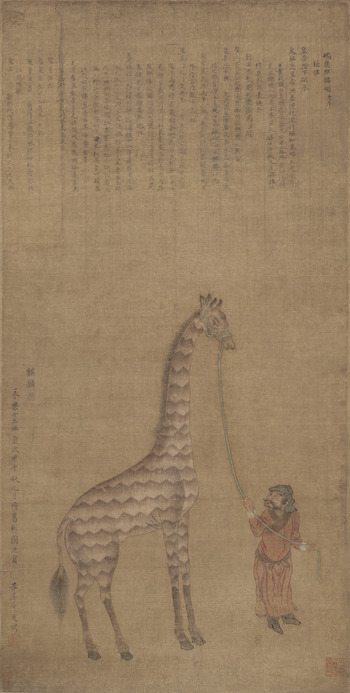
A giraffe was also presented to the Ming court by the ruler of Bengal in 1414, which the South Asian seems to have received as a gift from East Africa the previous year (van der Geer Reference van der Geer2008: 282). The arrival of the giraffe from Bengal caused a sensation throughout the Ming capital as the locals had never seen such an animal before. Although lukewarm in his reaction at that time, the Yongle emperor ordered an artist named Shen Du 沈度 (1357–1434) to draw a painting of the animal (Figure 5).
(Colour online) Tribute Giraffe with Attendant. Philadelphia Museum of Art: Gift of John T. Dorrance, 1977.

The gifting of animals, including giraffes, was a fairly widespread aspect of long-distance commercial and diplomatic interactions during the early fifteenth century (Roşu Reference Roşu1982; van der Geer Reference van der Geer2008). Also common were the images of exotic animals and their presentations by gift carriers. The motif found in the Ming painting drawn by Shen Du, mentioned above, for example, is also found on a stone relief at the Sun temple in Konarak, Orissa, in Persian paintings, as well as Egyptian and European drawings (van der Geer Reference van der Geer2008; Laufer Reference Laufer1928).
The painting by Shen Du included a laudatory note about the emperor saying:
When a sage possesses the virtue of utmost benevolence so that he illuminates the darkest places, a qilin appears. This shows that Your Majesty's virtue equals that of Heaven; and its merciful blessings have spread far and wide and from its harmonious vapors there has emanated a qilin, which will be an endless bliss to the state for a myriad, myriad years. (Duyvendak Reference Duyvendak1939: 403; Church Reference Church2004: 34)
Several other writers and poets made similar comments and affirmed the arrival of the giraffe as an auspicious sign. “Thus it happened that the giraffe from the African wilds”, explains Duyvendak (Reference Duyvendak1939: 410), “as it strode into the Emperor's Court, became the emblem of Perfect Virtue, Perfect Government and Perfect Harmony in the Universe, – everything the fabulous ‘unicorn’ had ever stood for”.
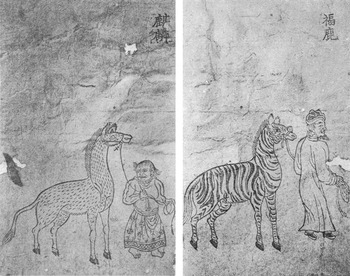
It was perhaps because of such interpretations about the appearance of giraffes at the Ming court that the presentation of other exotic animals (and birds) by foreign polities became a common practice. Lions, elephants, zebras, camels, rhinoceroses, tapirs, the nilgai antelope, ostriches, cockatoos, and parrots were some of the tributes offered to the Yongle emperor. Illustrations of several of these animals (Figure 6) have survived in a manuscript entitled Yiyu tuzhi 異域圖志 (Illustrations and Descriptions of Strange Regions – Moule Reference Moule1925; Reference Moule1930). Additionally, both Ma Huan and Fei Xin kept detailed notes on the animals available in the various polities Zheng He's fleet visited. All of these undertakings were aimed at promoting the symbolism of the Ming emperor as the rightful and legitimate ruler of everything and everywhere under the heaven.
Drawings of foreign animals in Yiyu tuzhi. Cambridge University Library

The ships in the Zheng He armada facilitated the transportation of giraffes and other exotic animals. These ships were not only able to accommodate large animals, but also sail the entire distance across the Indian Ocean. Earlier shipment of animals usually entailed changing vessels at transit locations and the use of distinct mercantile networks. Indeed, as Roderich Ptak (Reference Ptak2011: 36) has pointed out, the movement of these animals required advances in shipping technologies, logistical preparations, well-trained veterinarians, as well as navigational and geographical knowledge. These advances seem to have all been achieved during the three decades of criss-crossing the Indian Ocean by the Zheng He-led ships.
Concluding remarks
The renowned Chinese intellectual and scholar Liang Qichao 梁啟超 (1873–1929) was one of the first to highlight the importance of the Zheng He expeditions in Chinese maritime history. Liang wrote in the first decade of the twentieth century against the backdrop of European colonialism and a few years after the Japanese navy roundly defeated the Qing (1644–1911) forces. He underscored the naval achievements of Zheng He that were, in his opinion, no less noteworthy than those of Christopher Columbus (Liang [Reference Liang, Tianyou 王天有 and Ming1904] 2004). The subsequent decades witnessed a plethora of Chinese scholarship, several of which argued for the peaceful nature of Zheng He's voyages, which, they believed, stood in stark contrast to the use of naval power by the Europeans to colonize Asia and Africa. This narrative became widespread and has shaped the popular perception of the Zheng He expeditions.
Employing M.N. Pearson's (Reference Pearson and Tracy1991) description of the Portuguese expansion into Asia during the fifteenth and sixteenth centuries, Geoff Wade has outlined several similarities between the early European and Ming techniques of asserting power over maritime polities. These included the “tight connection between the Crown and trade”, the use of “military coercion”, and demand for tribute in exchange for protection. Wade argues that the Zheng He expeditions were intended to “obtain control of ports and shipping lanes” and explains (Wade Reference Wade2005a: 18–9):
It was not control of territory which was sought – this came with later colonialism. Rather, it was political and economic control across space – control of economic lifelines, nodal points and networks. By controlling ports and trade routes, one controlled trade, an essential element for missions’ treasure-collecting tasks. The colonial armies which manned these ships were the tools necessary to ensure that the control was maintained. In their method, the Ming, through these maritime missions, were engaged in what might be called proto-maritime colonialism. That is, they were engaged in that early form of maritime colonialism by which a dominant maritime power took control (either through force or the threat thereof) of the main port polities along the major East–West maritime trade network, as well as the seas between, thereby gaining economic and political benefits.
Zheng He's military interventions in Palembang, Samudera and Ceylon, discussed above, support Geoff Wade's arguments. Roderich Ptak (Reference Ptak1991) and Robert Finlay (Reference Finlay1992) have also drawn comparisons between the Zheng He missions and the early Portuguese activities in the Indian Ocean. Finlay perceives the Zheng He expeditions as hegemonic and indicative of Ming “maritime imperialism”. Finlay (Reference Finlay1992: 230) points out that the Ming court “did not attempt to conquer overseas territories or to blockade key sea routes, it did not have to maintain a costly, permanent force of men and ships at enormous distance. On the face of it, then, China was in all respects far better suited than Portugal to pursue hegemony in the seas of Asia”.
Finlay (Reference Finlay2008) has further underscored the Yongle emperor's goal of controlling all aspects of maritime trade and exchanges. “The voyages of Zheng He”, he writes (Reference Finlay2008: 336), “may be regarded as Yongle's forceful attempt to reconcile China's need for maritime trade with the government's suppression of private foreign contact; or, to put it differently, they represented a deployment of state power to bring into line the reality of seaborne commerce with an expansive conception of Chinese hegemony”. This state power was not only employed in coastal regions of Ming China and at the nearby polities in the South China Sea region, but also at foreign ports as far as the Swahili coast. In other words, the Ming court through the Zheng He expeditions exercised hegemonic power over the entire Indian Ocean realm.
Like the European colonial powers, the Ming court tried to control key cultural artefacts and procure exotic animals as evidence of its expansive power both within China and beyond its shores. Unlike the European powers, however, the Ming did not launch large-scale occupation of foreign territories in the maritime realm. With its superior naval force the Ming court could intervene in the diplomatic, commercial and cultural activities of foreign polities and also assert itself in the long-distance connections across the Indian Ocean without committing troops on alien territories. As Roderich Ptak (Reference Ptak1991: 25) has pointed out, the Ming naval superiority was a determinant factor in how foreign politics interacted with the Chinese court. “Some of the other maritime countries’ ground troops probably would have outnumbered the Chinese marines in the battle field”, he writes, “but foreign navies were definitely inferior to the Ming fleets, both in terms of quantity and quality; hence, in many parts of maritime Asia, Ming superiority was real and for a small and weak country it was certainly advisable to send tribute and acknowledge this superiority, rather than to risk a Chinese punitive campaign”.
Several of the foreign ports that the Zheng He expeditions visited would have provided food and other supplies to the large number of people (and animals) on board Ming ships. How these expeditions affected the local natural resources in foreign polities is not clear. But it is evident that the Zheng He expeditions, by integrating the entire span of the Indian Ocean, created new opportunities for political leaders as well as aspirant usurpers, stimulated the movement of people and goods, and fostered nodes of communications well before the Europeans. Indeed, the Zheng He expeditions must be recognized for the quantitative as well as qualitative changes that they induced to Indian Ocean interactions. While the demands of the Ming court for tribute missions and the procurements of commodities by the officials accompanying Zheng He resulted in a tremendous increase in the circulation of people, goods and animals, the seven maritime expeditions also created unique platforms for cosmopolitan discourse. These took place on the Ming armadas, in the Ming capitals (Nanjing and subsequently Beijing), and at the banquet receptions organized by the court for foreign representatives. Present sources do not allow us to reconstruct the conversations and discussions or the exchange of knowledge and information that might have ensued among the diverse groups of people meeting for the first time on the Ming ships. Nor has an attempt been made to detail the varied cuisines and the attires of the people on board these ships. It is apparent, nonetheless, that the integration of the Indian Ocean took place not only through the multiple visits of the Zheng He-led armada to all major ports in the region, but also through the fact that people from across the maritime realm congregated and travelled together from their native lands to Ming China.
Acknowledgements
I would like to thank Tim Brook, Victor Mair, Roderich Ptak, Wenyuan Xin and the two anonymous reviewers for their detailed comments and suggestions. The suggestion to examine the Zheng He expeditions more broadly came from Tony Reid. I greatly benefitted from my conversations with and frequent feedback from Geoff Wade, with whom I worked at a unique institution in Singapore called Nalanda-Sriwijaya Center. A preliminary draft of this essay was presented at a workshop entitled “Cosmopolitan currents in the Indian Ocean” organized by New York University Abu Dhabi. The comments by Thomas Metcalf and others at the workshop were most helpful in revising the paper.