




No CrossRef data available.
Article contents
Severe Acute Respiratory Syndrome Coronavirus 2 and Dengue Virus Co-infection: Indian Perspectives
Published online by Cambridge University Press: 04 August 2021
Abstract
Severe acute respiratory syndrome Coronavirus 2 (SARS CoV-2) and Dengue virus (DENV) Coinfection can be a pertinent issue in a country like India, where Dengue is endemic, and Coronavirus disease 19 (COVID-19) is also reported from all states of the country. The coinfection of these viruses has already been reported in different dengue‐endemic countries like Singapore, Thailand, and Bangladesh. The outcome and the dynamics of each of the diseases may be altered in the presence of coinfection. We highlighted the critical characteristic similarities and differences between COVID-19 and Dengue infection & the specific point, which may challenge diagnosing and managing these coinfections. COVID-19 and Dengue coinfection can be deadly in combination with an atypical presentation, providing diagnostic and therapeutic challenges. A high index of suspicion, early recognition of symptoms, and warning signs are vital to prevent double jeopardy.
Information
- Type
- Commentary
- Information
- Disaster Medicine and Public Health Preparedness , Volume 16 , Issue 5 , October 2022, pp. 1769 - 1771
- Copyright
- © The Author(s), 2021. Published by Cambridge University Press on behalf of Society for Disaster Medicine and Public Health, Inc.
References
Radisic, MV, Piro, MA, Mori, I, et al. SARS-CoV-2 and dengue virus co-infection. A case report. Hemoglobin. 2020;28(3):416-419.Google ScholarPubMed
Henrina, J, Putra, ICS, Lawrensia, S, et al. Coronavirus disease of 2019: a mimicker of dengue infection? SN Compr Clin Med. 2020. doi: 10.1007/s42399-020-00364-3
CrossRefGoogle ScholarPubMed
Yan, G, Lee, CK, Lam, LT, et al. Covert COVID-19 and false-positive dengue serology in Singapore. Lancet Infect Dis. 2020;20(5):536.CrossRefGoogle Scholar
Blanco-Melo, D, Nilsson-Payant, B, Liu, W-C, et al. SARS-CoV-2 launches a unique transcriptional signature from in vitro, ex vivo, and in vivo systems. BioRxiv. 2020. doi: 10.1016/j.cell.2020.04.026
Google Scholar
Butthep, P, Chunhakan, S, Yoksan, S, et al. Alteration of cytokines and chemokines during febrile episodes associated with endothelial cell damage and plasma leakage in dengue hemorrhagic fever. Pediatr Infect Dis J. 2012;31(12):e232-e238.Google ScholarPubMed
Miah, MA, Husna, A. Coinfection, coepidemics of COVID-19, and dengue in dengue-endemic countries: a serious health concern. J Med Virol. 2021;93(1):161-162.CrossRefGoogle ScholarPubMed
Joob, B, Wiwanitkit, V. COVID-19 can present with a rash and be mistaken for dengue. J Am Acad Dermatol. 2020;82(5):e177.CrossRefGoogle ScholarPubMed
Ludtke, JR, Narayan, R, Matariyeh, A, et al. Willingness to respond for radiologic incidents: a hands-on approach. Am J Disaster Med. 2014;9(4):259-272.CrossRefGoogle ScholarPubMed
Brannen, DE, Alhammad, A, Branum, M, et al. International air travel to Ohio, USA, and the impact on malaria, influenza, and hepatitis A. Scientifica (Cairo). 2016;2016:8258946.Google ScholarPubMed
Sultana, R, Alam, MS. Natural disasters and the dengue epidemic during COVID-19 outbreak are a deadly combination for public health threats in Bangladesh. Disaster Med Public Health Prep. 2020. doi: 10.1017/dmp.2020.493
Google ScholarPubMed
da Silva, SJR, de Magalhães, JJ, Pena, L. Simultaneous circulation of DENV, CHIKV, ZIKV and SARS-CoV-2 in Brazil: an inconvenient truth. One Health. 2020;12:100205.CrossRefGoogle Scholar
Iyengar, KP, Jain, VK, Ish, P. COVID-19 reinfection-an enigmatic public health threat. Monaldi Arch Chest Dis. 2020;90(4). doi: 10.4081/monaldi.2020.1596
CrossRefGoogle ScholarPubMed
Ministry of Health & Family Welfare, Government of India. Home :: National Vector Borne Disease Control Programme (NVBDCP). https://nvbdcp.gov.in. Accessed April 29, 2021.Google Scholar
Singh, N, Shukla, M, Chand, G, et al. Vector-borne diseases in central India, with reference to malaria, filaria, dengue and chikungunya. WHO South East Asia J Public Health. 2014;3(1):28-35.CrossRefGoogle ScholarPubMed
Desai, AN, Aronoff, DM. Masks and coronavirus disease 2019 (COVID-19). JAMA. 2020;323(20):2103.Google Scholar
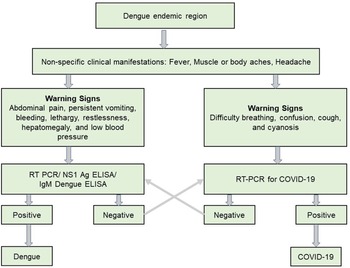
Figure 1.COVID-19 and dengue diagnostic algorithm in dengue-endemic settings.

Venkatesh et al. supplementary material
Venkatesh et al. supplementary material

File 17.3 KB
 You have Access
Severe acute respiratory syndrome coronavirus 2 (SARS-CoV-2) and dengue virus (DENV) co-infection Reference Radisic, Piro and Mori1 can be a pertinent issue in a country like India where dengue is endemic. The emergence of co-infection of coronavirus disease 2019 (COVID-19) and Dengue is expected to be a serious public health challenge. The outcome and the dynamics of each of the diseases may be altered in the presence of co-infection. At the same time, there are certain challenges in the diagnosis and management of these co-infections. The key characteristic similarities and differences between COVID-19 and Dengue are summarized Reference Henrina, Putra and Lawrensia2–Reference Joob and Wiwanitkit8 in Supplementary Materials Table 1.
The response of medical and public health staff to disasters increases when they have more medical knowledge and are prepared to respond. Reference Ludtke, Narayan and Matariyeh9 While travelers from India are not a significant source of diagnosed dengue infections in the Western Hemisphere compared with endemic cases, dengue is periodically epidemic in the Western hemisphere, with thousands of cases diagnosed. Travellers are always at risk when visiting endemic countries. The issue of co-infections is pertinent to countries with nonendemic dengue as international travel recovers from pandemic lows. It poses a significant risk of establishing autochthonous transmission in nonendemic areas. Reference Brannen, Alhammad and Branum10 In nonendemic areas, early identification of dengue is essential to start vector control investigations to stop dengue from becoming established in Aedes albopictus mosquitoes.
DENV and SARS-CoV-2 virus infection may have similar manifestations, such as fever, headache, myalgia, fatigue, diarrhea, abdominal pain, and vomiting, making it hard to differentiate the 2. Moreover, similar initial laboratory findings, including leukopenia, lymphopenia, thrombocytopenia, and increased transaminase, make differential diagnosis challenging. Reference Henrina, Putra and Lawrensia2 As management strategies differ for both diseases, it is imperative to identify the disease, even co-infection, correctly. Concurrent reverse transcriptase polymerases chain reaction (RT-PCR) for COVID-19 and RT-PCR or NS1Ag or IgM test for dengue is necessary to confirm either individual infection or co-infection as shown in Figure 1.
COVID-19 and dengue diagnostic algorithm in dengue-endemic settings.
In addition, there is a risk of misdiagnosis, delayed diagnosis, and even wrong diagnosis due to the similar manifestation of SARS-CoV-2 and DENV infection. Reference Blanco-Melo, Nilsson-Payant and Liu4 Cytokine storm seems to play a pivotal role in the severe form of both dengue and COVID-19. A co-infection may compound the altered antiviral response leading to an unfavorable clinical outcome. Reference Butthep, Chunhakan and Yoksan5 The warning signs of the severity of both infections are eventually divergent and should be recognized early. For example, warning signs of Dengue include abdominal pain, persistent vomiting, bleeding, lethargy, restlessness, hepatomegaly, and low blood pressure; however, the warning sign of COVID-19 has difficulty breathing confusion, pressure feeling in the chest, and cyanosis. In addition, age (>64 y), shortness of breath, past histories of diabetes and heart disease, raised Lactate dehydrogenase, procalcitonin are early warning indicators of severe COVID-19. Reference Miah and Husna6–Reference Joob and Wiwanitkit8
In Asian countries, this is especially important to clearly identify because initial signs and symptoms of the disease are common. Reference Joob and Wiwanitkit8,Reference Sultana and Alam11 This is further confounded by false-positive dengue antibodies that were found in COVID-19 cases. Reference da Silva, de Magalhães and Pena12,Reference Iyengar, Jain and Ish13 Clearly, there are difficult days for countries facing these epidemics together because of overlapping clinical presentation. To prevent mis-identification, measures should be taken to differentiate them clearly. Dengue cases have put pressure on already stretched and limited health resources in India. Dengue cases usually begin in July, peak in October, and may stretch until mid-December. The total cases of dengue across India in 2020 were over 30 thousand. 14 Due to the initial lockdown and decreased mobility of patients, it is possible that the detected cases of dengue are a gross under-representation of the true magnitude. The focus on COVID-19 testing can lead to ignorance of dengue, which usually peaks in these months in India.
In addition, misdiagnosis of COVID-19 as dengue and more often vice-versa is a deterrent to appropriate management. Prevention of dengue with aggressive anti-vector campaign consists of avoiding artificial water collection, appropriate clothing, nets to protect against mosquitos, and appropriate integrated vector management. Reference Singh, Shukla and Chand15 COVID-19 transmission needs to be controlled with social distancing and infection prevention strategies, including wearing proper face coverings and hand sanitization until an effective vaccine coverage is introduced in the population. Reference Desai and Aronoff16 COVID-19 and dengue co-infection can be a deadly combination with an atypical presentation, providing diagnostic and therapeutic challenges. A high index of suspicion, early recognition of symptoms, and warning signs are vital to prevent double jeopardy.
Conflict(s) of interest
There are no conflicts of interest.
Supplementary material
To view supplementary material for this article, please visit https://doi.org/10.1017/dmp.2021.254