Highlights
-
• Foslevodopa-foscarbidopa is clinically efficacious and improves quality of life in patients with advanced Parkinson’s disease.
-
• Infusion site reactions and infections are major causes of treatment discontinuation.
-
• Appropriate hygienic measures at the cannula site can reduce the need for oral antibiotics.
Introduction
Parkinson’s disease is the fastest-growing neurodegenerative disorder, affecting more than 6 million people worldwide in 2015 and projected to exceed 12 million by 2040. Reference Dorsey, Sherer, Okun and Bloem1 According to the 2022 Ontario Roundtable Report by Parkinson Canada, over 100,000 Canadians were living with Parkinson’s disease in 2021, increasing the number by about 30 new cases per day. 2 Pathologically, Parkinson’s disease is characterized by alpha-synuclein aggregates and loss of dopaminergic cells in the substantia nigra pars compacta. The core motor symptoms (bradykinesia in combination with rest tremor, rigidity, and postural instability) are attributed mostly to nigral cell loss, while non-motor symptoms involve other neurotransmitter pathways. Reference Bloem, Okun and Klein3 Given the pathophysiology, which underlines a dopaminergic deficit in the striatum, supplementation with oral levodopa combined with carbidopa (to prevent peripheral decarboxylation) remains the logical first step in treatment. However, as the disease progresses, patients begin to experience fluctuations (on-off states), wearing off, and dyskinesias, which can be both predictable and unpredictable. In the initial phase, fluctuations and dyskinesias are medically managed by adjusting levodopa doses, altering the inter-dose interval or adding drugs such as catechol-O-methyltransferase inhibitors, monoamine oxidase B inhibitors, dopamine agonists, amantadine, and adenosine A2A receptor antagonists. Reference Fox, Katzenschlager and Lim4 These measures, however, become less effective as neurodegeneration advances. Device-aided therapies (DATs) such as deep brain stimulation (DBS), apomorphine pump, and levodopa-carbidopa intestinal gel may be helpful in managing medically refractory fluctuations and dyskinesias. Reference Deuschl, Antonini and Costa5
Foslevodopa-foscarbidopa (LDp/CDp) is a soluble formulation of levodopa/carbidopa prodrug delivered as a 24 h/day continuous subcutaneous infusion for the treatment of motor fluctuations in people with Parkinson’s disease. Reference Fung, Aldred and Arroyo6 It was approved by Health Canada in 2023 for the management of advanced Parkinson’s disease. Two follow-up multicenter studies showing real-world safety and efficacy have been published in the literature. Reference Fung, Bergquist and Dhanani7,Reference Aldred, Freire-Alvarez and Amelin8 However, no real-world use data exists from a Canadian center with a large patient experience.
With a provincially driven, fully supported reimbursement program, a physician-prescribed and pharmacy-delivered drug model and scarce availability of initial appointment and follow-up with movement disorder specialists, the health system context of Canada is unique. A real-world scenario highlighting the experience of using this new subcutaneous injection of levodopa in a tertiary care center in Canada will be helpful to both the scientific community as a whole and to other neurologists in Canada. The objective of this study was to evaluate the efficacy and record the side-effect profile of LDp/CDp infusion in a Canadian cohort.
Methods
This was an ambispective longitudinal study. The retrospective data was collected from April 2024 to June 2025, while the prospective patients were recruited from June 2025 to August 2025. The study was approved by the Health Sciences Research Ethics Board (HSREB approval number: R-25-338). The patients were enrolled after signing written informed consent.
The prospective patients were initially seen at the Movement Disorder Centre in London, Ontario, Canada, and deemed eligible to be started on LDp/CDp based on uncontrolled motor fluctuations and dyskinesias despite optimum treatment with maximal tolerated doses of levodopa in combination with carbidopa, COMT inhibitor, dopamine agonist, MAO-B inhibitor and amantadine. Severe disability was rated as at least 25% of the waking period in off state with or without bothersome levodopa-induced dyskinesias, despite having tried levodopa in at least 5 doses/day (>400 mg of LD equivalents/day). Patients with severe psychosis, dementia, no caregiver support, a significant skin condition around the proposed infusion site that interfered with therapy/assessment or those who did not provide consent were excluded from the study. Patients with DBS therapy receiving LDp/CDp as part of their disease management were included in the study.
The patient/caregiver demonstrated proper understanding and received comprehensive protocol training from ABBVIE Care (an independent outpatient training program) on the use of the delivery system before titration at the center. The LDp/CDp dose was titrated over 2 days on an outpatient basis. On the first day, the patients were started on LDp/CDp infusion from a practically defined off state with a record of their baseline MDS UPDRS III, meaning they had not received levodopa or COMT inhibitors for at least 12 hours before LDp/CDp initiation. However, dopamine agonists, amantadine and monoamine oxidase B inhibitors were continued. An oral dose corresponding to the patient’s typical first dose was given, followed by the LDp/CDp infusion. The initial hourly base infusion rate of LDp/CDp was calculated by the formula: [(Levodopa equivalent dose × 0.92 × 1.41)/240]/X where X is the number of the patient’s awake hours. At 1.5–2 hours into the study, the movement disorder nurse re-scored the MDS UPDRS III, and further modifications to the rates were made based on the optimal clinical response for the individual patient. If needed, further dose adjustments were made until the patient was discharged for the day. The low-dose nighttime infusion rate was calculated at 50% of the baseline rate. Each patient was followed up the next day for any recalibration of the rates based on clinical symptoms in the home environment and nighttime mobility. Three rates were provided at discharge on the second day: a daytime base rate, a high rate during periods of intense activity (10% above the base rate) and a nighttime low rate. An extra bolus dose of 0.3 ml was also provided. Instructions were given on the first day for appropriate infusion site rotation (maximum of three days at a particular site and more frequently in case of infusion site reactions, avoiding the area directly below the umbilicus between 5 and 7 o’clock on the clock face) and adequate aseptic techniques (hand-washing and cleaning the infusion site with soap water followed by an alcohol wipe). The instructions were reinforced on the second hospital titration visit. Baseline hematological work-up, including vitamin B12 and B6 levels, methylmalonic acid and homocysteine, was performed on the second day before discharge. Patients were prescribed betamethasone cream 0.05% for local application and cetirizine for potential local allergic reaction on a PRN basis.
All patients were telephonically monitored by the clinical team at 1 week and 2 weeks after the initial titration day for minor additional recalibrations of infusion rates and adjustment to oral medications. The members of the movement disorders team performed the monitoring. Future in-clinic appointments were scheduled at 1 month (±7 days) and 6 months according to the convenience of the patients. Depending on the hematological results, the patients were prescribed vitamin B12 and B6 supplements. Repeat blood work-up was done at the 6-month visit to see the change of B12, B6, homocysteine and methylmalonic acid levels.
For the prospective part of the study, one of the two designated fellows clinically examined the patient on the day of titration and administered three questionnaires/clinical scales (MDS UPDRS III, PDQ-39 and EURO Q 5D–5L). The questionnaires were repeated by the same team member at the 1-month clinic visit, along with recording of the side-effect profile to minimize observation bias. Demographic details and PD diary parameters were also recorded in the approved case report form. For the retrospective part of the study, demographic parameters, MDS UPDRS III, PD diary and side-effect profile were extracted from the patient chart. Quality-of-life scales were not administered to the retrospective group to minimize recall bias. The average daily on/off periods and dyskinesias were calculated from the PD diaries completed by all patients during their visits to the center.
The primary objective of the study was to examine the efficacy of LDp/CDp in managing patients with advanced Parkinson’s disease as measured by [i] difference in MDS UPDRS III from baseline to 1 month of LDp/CDp, [ii] difference in OFF time, ON time without dyskinesias and ON time with troublesome dyskinesias from baseline to 1 month of LDp/CDp, [iii] difference in pre- and post-LDp/CDp PDQ-39 scores (in the prospective group) and [iv] difference in pre- and post-LDp/CDp EURO Q 5D–5L scores (in the prospective group). The secondary objectives of the study were to record the [i] incidence of serious adverse events in the LDp/CDp treated patients and [ii] incidence of discontinuation in the LDp/CDp treated patients.
For the primary objectives of the study, the patients had to complete a 1-month follow-up. For analysis of the secondary objectives, patients had to receive at least a day of LDp/CDp subcutaneous infusion.
Statistical analysis
Data were analyzed by using SPSS version 18 (SPSS Inc., Chicago, Ill, USA).
Sample size calculation was done using mean difference in off time of 1.79 hours (between oral levodopa and LDp/CDp) and standard deviation of 2.49 hours, with 99% confidence level and 80% power. The sample size was calculated as 38, with 19 in each of oral levodopa-carbidopa and subcutaneous infusion group. Since it was a longitudinal study with no control group, all patients fulfilling inclusion and exclusion criteria from April 2024 (the day of first infusion) to August 2025 were included. The period prior to obtaining HSREB approval was marked as the retrospective part of the study.
Descriptive statistics were used to summarize continuous data, whereas frequency and percentages were used to characterize categorical variables. For all the outcome variables, descriptive statistics were computed and represented as mean ± SD or median/range, as applicable. The effects of LDp/CDp were compared using an independent t-test (for variables with a normal distribution) and Wilcoxon signed-rank test (for variables without a normal distribution). The normalcy of the data was confirmed using the Shapiro–Wilk test. P-values of less than 0.05 were considered statistically significant. Bonferroni correction was applied for multiple primary objectives. Multiple imputation by chained equations was used to handle missing data when missingness was <40%. When >40% of the data were missing for any parameter, only the complete-case analysis set was used.
Results
A total of 64 patients with advanced Parkinson’s disease were included in the analysis. The prospective group comprised 11 patients, while 53 patients were recruited retrospectively. The distribution of age, MDS UPDRS III, pre-LDp/CDp Off and pre-LDp/CDp on time without dyskinesias were normal, while pre-LDp/CDp on time with troublesome dyskinesias was not normally distributed.
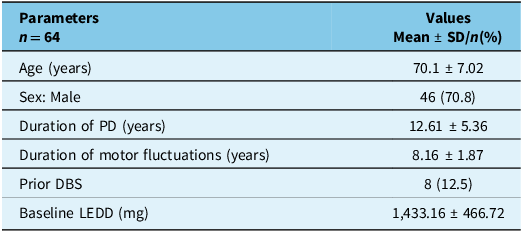
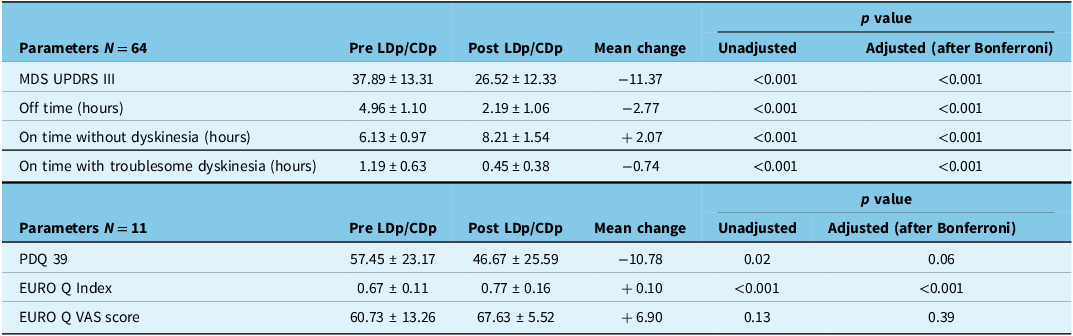
Figure 1 shows the participant flow throughout the study. The baseline demographic parameters are tabulated in Table 1. Table 2 describes the comparison between pre- and post-LDp/CDp changes in MDS UPDRS III, quality-of-life scores (PDQ-39, EURO Q Index, EURO Q VAS), off time, on time without dyskinesias and on time with troublesome dyskinesias. There was a significant improvement in clinical efficacy parameters, including MDS UPDRS III, PDQ-39, EURO Q Index, OFF hours, ON time without dyskinesias, and ON time with troublesome dyskinesias. One notable finding in our study was that levodopa equivalent daily dose (LEDD) changed from 1441.62 (± 45.49)mg/day to 1970.14 (± 580.21) mg/day in patients when switched from oral to LDp/CDp therapy, which was statistically significant (p < 0.001).
Flowchart of the study.

Baseline demographics

DBS = deep brain stimulation; LEDD, levodopa equivalent daily dose.
Primary objective measures in the complete analysis set

MDS UPDRS III = Movement Disorder Society- Unified Parkinson’s Disease Rating Scale part III; PDQ-39 = Parkinson’s Disease Questionary-39; EURO Q Index = European Quality of life index ; EURO Q VAS = European Quality of Life Visual Analog Scale.
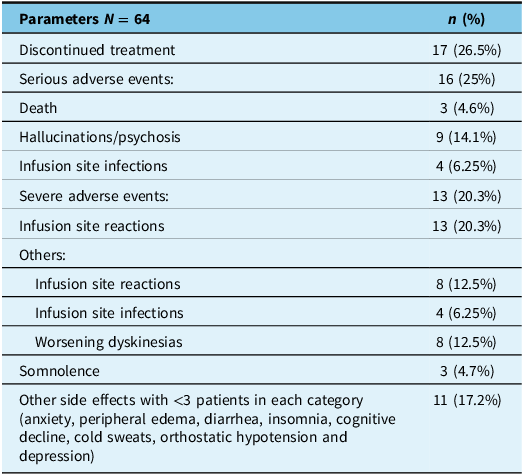
Table 3 summarizes safety and tolerability of LDp/CDp in our study. About one-fourth of the patients discontinued treatment due to various issues, mostly related to infusion-site reactions. Only one patient discontinued therapy after moving to another province. Serious adverse events were considered in those where therapy had to be discontinued, or the patient had died or required hospitalization for an adverse event. Severe adverse events were marked in those in whom adverse events fell in the category of severe (among categories of mild, moderate and severe). Among 16 serious adverse events, 3 deaths, 9 patients with hallucinations/psychosis and 4 infusion infections required hospitalization. Thirteen of the total 21 infusion site reactions were categorized as severe by an independent skin specialist. None of the patients having other side effects were considered severe by independent neurologists, not involved in the study.
Safety and tolerability of LDp/CDp

Figure 2 shows the incidence of infusion-site complications over the study period. During months 1–8, 19 patients experienced complications, whereas the number decreased to 10 in months 9–17.
Figure showing incidence of infusion site reactions and infections.

Table 4 shows changes in blood parameters after 6 months following the introduction of LDp/CDp. Vitamin B6 and B12 levels increased while methylmalonic acid levels dropped significantly.
Change in blood parameters after introduction of LDp/CDp

Discussion
Our study provides important insights into the clinical effectiveness, impact on health-related quality of life, metabolic biomarker profile and tolerability of LDp/CDp in advanced Parkinson’s disease patients. These results highlight the outpatient model of treatment for LDp/CDp in a single, high-volume Movement Disorders center in Canada.
Education in the community, followed by a 2-day outpatient schedule using a standardized assessment method (clinical and hematological), resulted in high patient throughput, with 64 patients treated in just over a year. Subsequent follow-up at 1 month, 3 months (if required) and 6 months with interspersed (as needed) home visits by a clinical care nurse allowed constant supervision over therapy. The retention of about three-fourths of patients despite the complexity of their disease may have been the result of our standardized intake, education and titration schedule.
LDp/CDp significantly reduced motor fluctuations. The magnitude of change in baseline off time in our study was by a mean of 2.77 hours which was almost similar [3.0 (3.5) hours in the combination therapy (LDp/CDp+ continued oral drugs)] in the 12-week RCT. Reference Soileau, Aldred and Budur10,Reference Aldred, Bouchard and Martínez-Castrillo11 This change was also comparable in the two other published studies, a 52-week open-label trial and its 96-week extension study. Reference Aldred, Freire-Alvarez and Amelin8,Reference Aldred, Bouchard and Martínez-Castrillo11,Reference Fung, Aldred and Bergquist12 However, on time without dyskinesias in our study, increased by a modest 2.07 hours as compared to 4.0 (3.9) hours in the trial. Reference Aldred, Freire-Alvarez and Amelin8 This difference might be due to a difference in the population characteristics. Notwithstanding, significant improvement in motor fluctuations was seen in patients who had otherwise fully maximized their oral therapies. LDp/CDp infusion offers several pharmacokinetic advantages, including bypassing gastrointestinal absorption and achieving more stable plasma concentrations than oral therapy. These benefits are aligned with the long-standing rationale for continuous dopaminergic stimulation as a strategy to reduce pulsatile stimulation of dopamine receptors, which is strongly implicated in the pathophysiology of motor fluctuations and dyskinesias.Reference Olanow, Obeso and Stocchi 9
Improvements in motor scores further strengthen these findings. MDS UPDRS part III decreased by approximately 11 points, representing a 29% improvement compared with baseline. This is a substantial effect size, exceeding the threshold generally considered clinically important. As expected, these motor benefits were accompanied by an increase in total LEDD, reflecting the pharmacological strategy of delivering higher, steady levodopa exposure through infusion. While dose escalation may raise concern for side effects, the associated functional gains suggest that the trade-off was favorable for many patients.
Health-related quality-of-life outcomes were more nuanced. These assessments were conducted only in the prospective cohort with a smaller number of patients. The unadjusted EQ-5D index and PDQ-39 improved significantly, with a mean increase of 0.10 and a decrease of 10.78, respectively, consistent with a moderate health gain in utility terms. PDQ-39 score, which lost significance on Bonferroni correction, continued to show a trend towards significance. EQ-VAS also showed a numerical improvement but did not reach statistical significance, likely due to variability and limited paired data, underscoring the limitations of patient-reported outcomes in small and heterogeneous samples. Nonetheless, the overall direction of change across measures in this study supports the conclusion that LDp/CDp meaningfully enhanced quality of life for a substantial subset of patients. This has also been demonstrated in the 52-week trial, where improvement of 4.3[13.8] (p < 0.001) in PDQ-39 scores was observed with combination therapy. Reference Aldred, Freire-Alvarez and Amelin8,Reference Aldred, Bouchard and Martínez-Castrillo11 PDQ-39 scores, however, did not show significant improvement in the 12 weeks RCT and 96 weeks open-label extension of the 52-week trial. Reference Fung, Bergquist and Dhanani7,Reference Soileau, Aldred and Budur10,Reference Aldred, Bouchard and Martínez-Castrillo11
Infusion-site reactions, including erythema, pain, edema, nodules, and bruising, as well as infusion-site infections such as cellulitis and abscess, were the most common adverse events, affecting a total of 39% of patients. This was substantially lower than the 84% in the trial data. Reference Soileau, Aldred and Budur10 Infusion site complications constituted the single largest reason for discontinuation. Histopathologic analyses from previous studies have demonstrated no significant abnormalities in the epidermis, but rather a patchy inflammatory infiltrate in the deep dermis extending into the subcutaneous tissue. The infiltrate typically consists of a mixed population of lymphocytes, neutrophils and eosinophils, although some variability has been reported in the predominance of the lymphocytes versus neutrophils. Reference Weise and Haferkamp13,Reference Yoshihara, Nishikawa, Watanabe and Hattori14 Notably, in our study, the incidence of infusion-site complications declined substantially in the latter group of 34 patients (Figure 2), following the implementation of a series of preventive strategies. These included shaving the abdominal area (if hairy) at least 24 hours prior to cannula insertion, daily cannula replacement, using the shorter cannula (reduction from 9 to 6 mm), gentle massage of the site after cannula removal, application of cold compresses for irritation or inflammation, or warm compresses for nodules, use of topical corticosteroids (betamethasone 0.05%) or antihistamines for erythema, edema, pruritus, or inflammation and oral antibiotic therapy with cephalexin (500 mg every 6 hours for 5–7 days) in case of infection without methicillin-resistant staphylococcus aureus risk.
Serious adverse events were reported in 25% of patients, and severe adverse events in 20.3%. Importantly, nearly one-fourth of the cohort discontinued treatment, underscoring the practical challenges of maintaining therapy. This was almost similar to the trial data discontinuation rate of 22%. Reference Soileau, Aldred and Budur10 From a comparative perspective, the tolerability and discontinuation profile of LDp/CDp differ somewhat from other device-aided therapies. For example, discontinuation rate with LCIG was reported at a similar magnitude in the GLORIA registry, but complications tended to be broader and more severe (e.g., device occlusion, post-operative wound infections, peritonitis, device dislocation). Reference Poewe, Bergmann, Kukreja, Robieson and Antonini15 DBS carries a distinct risk profile related to surgery and hardware complications and may have lower rates of discontinuation once implanted successfully.Reference Doshi, Rai and Das 16 The present results support LDp/CDp as a less invasive and more effective option, though infusion-site reactions remain its Achilles’ heel.
Neuropsychiatric side effects, particularly hallucinations and psychosis, occurred in 14% of patients and contributed to morbidity. Mortality was observed in three patients (4.6%), though attribution to treatment versus disease progression remains uncertain in this observational context. These safety results highlight the necessity for close monitoring and individualized patient selection.
Biochemical monitoring revealed interesting patterns. Homocysteine levels increased (though not significantly) after 6 months, consistent with increased levodopa metabolism via methylation pathways. However, both vitamin B12 and B6 levels rose, and methylmalonic acid (MMA) levels decreased. This mismatch between various findings may be because of the small sample size for analyzing these parameters. High levels of vitamin B12 and B6, though, suggest that ongoing vitamin supplementation was effective in mitigating levodopa-associated deficiencies. Regular monitoring and targeted supplementation, therefore, should remain as prudent clinical practices in patients receiving continuous levodopa infusion.
This study had several limitations. The sample size was relatively modest, which limits statistical power, particularly in biomarker analysis, where data were incomplete. The observational design also limits causal inference. The prospective part of the study included only 11 patients, limiting the plausibility of interpreting the quality-of-life outcomes. However, in order to minimize the possible recall bias, quality of life scales were not retrospectively administered. Finally, the follow-up period for most analyses was limited to 1 month, and the longer-term durability of both efficacy and tolerability remains uncertain. Despite these limitations, the study has several strengths. It represents one of the larger real-world cohorts of patients treated with LDp/CDp, providing valuable insights beyond a controlled trial setting. In Canada, device-aided therapies are not uniformly available across provinces, and reimbursement pathways differ, potentially impacting access. LDp/CDp provides a non-surgical alternative that may be particularly relevant for patients who are either poor surgical candidates or unwilling to undergo DBS. This real-world data, from a Canadian movement disorders center, therefore provides essential guidance for clinical decision-making and health policy in Canada. Biochemical data is often underreported in clinical practice despite its clinical relevance. Outcomes were assessed across multiple domains, including objective motor measures, patient-reported quality-of-life measures, and biochemical monitoring, providing a comprehensive view of treatment impact.
Taken together, this study reinforces the role of LDp/CDp as an effective treatment option for patients with advanced Parkinson’s disease and disabling motor complications. It delivers substantial motor and functional gains, with improvements in both OFF time reduction and dyskinesia control, and confers a measurable quality-of-life benefit. However, high discontinuation rates due to local tolerability issues, along with notable rates of serious adverse events, emphasize that the therapy is not universally sustainable. Future work should focus on refining patient selection criteria, improving device and infusion-site management, and integrating systematic vitamin supplementation to minimize metabolic risks.
Author contributions
AD and GTR: Data collection, writing the initial draft review of the draft.
HR: Clinical assessment in telephonic follow-up and entry.
MJ: Review, critique and editing
Funding statement
Nil.
Competing interests
No.
Ethical standard
The study was started after approval from the Institutional Ethics Committee approval with approval number :R-25-338.
Declaration of patient consent
The authors certify that appropriate patient consent was obtained.