


Postnatal depression is a common and potentially serious health problem, with adverse consequences not only for the mother's mental health and functioning, but also for the psychological health of the partner and, significantly, for the cognitive and social development of the infant (Reference Murray and CooperMurray & Cooper, 1997). The prevalence of major depressive disorder in the weeks following delivery approximates to one in ten mothers, with symptoms typically enduring for 2-6 months (Reference Cooper, Campbell and DayCooper et al, 1988; Reference O'Hara, Murray and CooperO'Hara, 1997). As is the case for all depressive disorders, the combination of a high prevalence rate, extended duration of symptoms and a marked adverse effect on health status means that postnatal depression imposes a considerable clinical, social and economic burden at the population level, which is further exacerbated by low levels of case recognition, treatment and public awareness. Research into treatments that might reduce the burden of postnatal depression remains modest, although controlled studies suggest that both pharmacological and psychological interventions can have a discernible impact on clinical outcome (Reference Appleby, Warner and WhittonAppleby et al, 1997; Reference Cooper, Murray, Murray and CooperCooper & Murray, 1997; Reference O'Hara, Stuart and GormanO'Hara et al, 2000). There is a shortage of data on the costs and cost-effectiveness of these different treatment approaches, although this situation is beginning to change in some countries such as the UK (Reference Morrell, Spiby and StewartMorrell et al, 2000; Reference Petrou, Cooper and MurrayPetrou et al, 2002).
It was within this context that a health services research component was incorporated into a cross-cultural study of postnatal depression. The main intent of the health services research was to complement the work on diagnosis and the assessment of motherhood experience by developing and applying qualitative and quantitative research tools for assessing the availability of and access to appropriate care, as well as the actual uptake of services by mothers with postnatal depression. In the absence of comparable international data on service provision or use for women with postnatal depression, our working hypothesis- informed by other international epidemiological studies of depression, such as the World Health Organization studies on pathways to care (Reference Gater, de Almeida e Sousa and BarrientosGater et al, 1991) and psychological problems in general health care (Reference Üstün and SartoriusÜstün & Sartorius, 1995) - was that the provision of services for depressed mothers and recognition of their needs would vary across study sites, but take-up of such services would be universally low.
Transcultural Study of Postnatal Depression
The primary aim of the Transcultural Study of Postnatal Depression (TCS-PND) was to develop (or modify), translate and validate research instruments that could be used for future studies in the field of perinatal psychiatry in different countries and cultures. The instruments were chosen to assess key aspects of the maternity experience, namely clinical diagnosis, the psychosocial context of pregnancy and motherhood, mother-infant interaction, the child's environment, and health service structure, use and its associated costs. The modified and translated research tools were then piloted in order to assess their validity in a range of diverse perinatal population settings. This paper specifically reports on the adaptation and piloting of a health service utilisation measure, the Client Service Receipt Inventory (CSRI; Beecham & Knapp, 2000), for use in studies of postnatal depression.
METHOD
Study sites
Seven European centres participated in the health service research aspects of the study: Bordeaux (France), Dublin (Ireland), London (UK), Paris (France), Porto (Portugal), Vienna (Austria) and Zurich (Switzerland).
Sample
Eligible women were recruited in antenatal clinics or classes by a researcher who obtained informed consent from those who agreed to take part. Sample sizes in each centre varied from 20 to 60, with a total of 296 for the study as a whole. An adapted version of the CSRI was administered to a sub-sample of 136 women postnatally. Demographic characteristics of the centre samples are described by Asten et al (Reference Asten, Marks and Oates2004, this supplement).
Health services research component
An innovative aspect of this cross-cultural study was an interest in developing methods for quantitative health services research, in particular access and/or barriers to appropriate care and the actual uptake and cost of service provision for women with postnatal depression. Data were collected at both the population level of study sites and at the individual level of sampled participants. At the level of the study site, we collated relevant health-system data relating to health expenditures, the availability of mental health resources and maternity leave arrangements.
At the level of the individual, we built on previous work relating to the economic evaluation of mental health care by adapting and developing the CSRI for use with postnatal women. The Client Service Receipt Inventory- Postnatal Depression (CSRI-PND) version is a derivation of the Client Socio-demographic and Service Receipt Inventory- European version (Reference Chisholm, Knapp and KnudsenChisholm et al, 2000), which in turn is an adaptation of the CSRI (Reference Beecham, Knapp, Thornicroft, Brewin and WingBeecham & Knapp, 2001). We sought to bring together questions that would enable the comprehensive costing of care packages for women who are about to have or who have recently had a child, with a view to determining the excess need and service uptake of women with postnatal depression. Accordingly, we collected information on the current living arrangements and expenses of each participant (including income, employment and accommodation), and details of any use she might have made of a range of health care, social care and other services over a 6-month retrospective period (see Appendix). Unit costs for each of these services could then be calculated (although this was not undertaken in this study) and subsequently applied to the resource use data from the CSRI-PND, to give the total cost associated with each individual's use of services. The instrument also attempts to estimate some of the main economic ‘knock-on’ effects of postnatal depression, in particular the impact on the income or productivity of the woman or household, and the extra inputs of informal caregivers. A final set of (more qualitative) self-report questions relate to potential barriers to accessing services. The modified instrument was translated into the language of each European centre and administered to a pilot sample at the postnatal assessment.
Other measures
The Structured Clinical Interview for DSM-IV Axis I Disorders (SCID-I; Reference First, Spitzer and GibbonFirst et al, 1994) is a semi-structured interview for making the major DSM-IV diagnoses (American Psychiatric Association, 1994). A research version designed for use with non-patient populations (SCID-I/NP; Reference First, Gibbon and SpitzerFirst et al, 1996), was modified to produce an instrument for assessing postnatal interviews, thus providing a continuous assessment of depressive disorder from the beginning of pregnancy up to 6 months postnatally. A combined variable of either major or minor depression with an onset date within 6 months of delivery was used in this study. Rates of postnatal depression differed between centres, from 2% (n=1) in Zurich to 37% (n=5) in Paris. Rates in the other five centres were all between 20% and 29%.
The Contextual Assessment of Maternity Experience (CAME) was developed to assess the psychosocial context of the maternity experience in different cultural settings (Reference Bernazzani, Conroy and MarksBernazzani et al, 2004, this supplement). The CAME includes assessment of recent life adversity in eight domains (marital, social, parental, health, housing and financial, work, criminal and legal, and geopolitical) and of emotional support from partners and others in the woman's social network. Severe and non-severe levels of adversity occurring in any domain between the antenatal and postnatal interviews were distinguished. Levels of severe adversity varied from 30% in Vienna to 56% in Paris. A composite variable identifying poor support in the postnatal period given by the woman's partner, one ‘very close other’ and all others in the woman's social network, was also used. Rates of poor support varied from 18% in Dublin to 70% in Porto.
RESULTS
Health system profiles
Tables 1, 2, 3 show comparative national data on maternity leave and pay, health expenditure and service provision. There are some striking differences in service provision: for example, comparatively low numbers of physicians in the UK and Ireland, and midwives in Portugal, and comparatively high numbers of midwives in the UK and Ireland, psychiatric hospital beds in France, Ireland and Switzerland, psychiatrists in France and Switzerland, psychiatric nurses in the UK, psychologists in Austria and Switzerland, and social workers in Austria. Full descriptions of maternity and mental health service provision in the study centres are given by Asten et al (Reference Asten, Marks and Oates2004, this supplement).
Maternity leave arrangements

| Duration of maternity leave (weeks) | Maternity payment (% of pay) | |
|---|---|---|
| France | 16-261 | 84 |
| Ireland | 14 | 70 |
| Austria | 16 | 100 |
| Portugal | 13 | 100 |
| UK | 18 | 902 |
| Switzerland | 8 | 100 |
Health expenditure and service provision

| Health expenditure1 | Health personnel (per 100 000 population)2 | |||
|---|---|---|---|---|
| Proportion of GDP (%) | Per head ($)3 | Physicians (n) | Midwives (n) | |
| France | 9.3 | 2387 | 303 | 22 |
| Ireland | 6.4 | 1793 | 219 | 41 |
| Austria | 7.7 | 2350 | 302 | 19 |
| Portugal | 9.0 | 1519 | 312 | 8 |
| UK | 7.3 | 1813 | 164 | 43 |
| Switzerland | 10.7 | 3160 | 323 | 26 |
Psychiatric services per 100 000 population1

| Psychiatric beds (n) | Psychiatrists (n) | Psychiatric nurses (n) | Psychologists2 (n) | Social workers2 (n) | |
|---|---|---|---|---|---|
| France | 121 | 20 | 85 | -3 | -3 |
| Ireland | 115 | 5 | 86 | 10 | 37 |
| Austria | 52 | 10 | 39 | 37 | 103 |
| Portugal | 77 | 5 | 5 | 3 | 7 |
| UK | 58 | 11 | 104 | 9 | 58 |
| Switzerland | 132 | 22 | -3 | 41 | -3 |
In each of the centres, women and infants are entitled to a certain amount of free postnatal care, although there is variation in the form of provision. In all centres a medical check-up is routinely offered to newly delivered women 4-8 weeks post-partum. In Dublin and London this would usually be done by a general practitioner, in Bordeaux, Paris, Porto and Vienna by either a general practitioner or an obstetrician/gynaecologist, and in Zurich by an obstetrician/gynaecologist. Midwives routinely make home visits during the first 7-10 days post-partum in Dublin, London and Zurich, whereas in Vienna midwives only visit women who leave hospital immediately after delivery. In some areas of France systematic home visits by midwives are routinely offered to every woman, but in other areas only to women at high risk. Porto has no home midwifery service.
A number of centres have distinctive services which appear to be unique to that country. In France all women are entitled to a prescription for a series of abdominal and/or perineal re-education sessions, conducted by a physiotherapist or a midwife. Also distinctive to France are mother and child protection centres which offer paediatric checks and vaccinations, as well as family planning consultation, and preventive and educational health services for families of children under 6 years old. In London a health visitor routinely visits at around 10-14 days post-partum and subsequently maintains a supportive and preventive role with the family through a child health clinic, general practice surgery or at home. In Zurich a network of advice centres provide guidance on babycare and emotional and psychological problems. In addition to a range of adult mental health services in each centre, there are perinatal liaison services in Dublin and London, and psychiatric in-patient facilities for mothers and babies in London, Bordeaux and Paris.
Socio-economic characteristics of sampled households
A series of socio-economic indicators elicited from the CSRI-PND are provided in Table 4, including home ownership, receipt of state benefits (including maternity leave) and working status of sampled mothers and their partners. The proportion of respondents primarily responsible for looking after the home ranged from 18-29% in Bordeaux, Dublin and Paris, to 75-95% in the other sites. There are evident welfare system differences between participating centres, for example over 80% of sampled mothers in Bordeaux, Dublin and Vienna were in receipt of state benefits at the post-partum assessment, compared with less than 10% in Porto and Zurich. Except in France, weekday childcare was most commonly undertaken by the mothers themselves in their own homes; in Bordeaux and Paris, babies were more commonly looked after by childminders in the mother's home or at a local crèche nursery (Fig. 1).
Socio-economic characteristics of sampled households

| Characteristic | Bordeaux (n=18) | Dublin (n=11) | London (n=14) | Paris (n=16) | Porto (n=20) | Vienna (n=18) | Zurich (n=39) |
|---|---|---|---|---|---|---|---|
| Home owned, not rented (%) | 28 | 82 | 57 | 100 | 95 | 12 | 39 |
| Household receiving state benefits (%) | 83 | 91 | 64 | 56 | 5 | 89 | 3 |
| Currently on maternity leave (%) | 0 | 0 | 14 | 0 | 0 | 89 | 20 |
| Primary homemaker (%) | 29 | 18 | 79 | 25 | 90 | 89 | 87 |
| Normally employed (%) | 72 | 91 | 79 | 75 | 85 | 89 | 64 |
| Non-manual worker (of those employed) (%) | 79 | 100 | 91 | 85 | 25 | 88 | 68 |
| Partner normally employed (%) | 94 | 100 | 79 | 100 | 95 | 94 | 95 |
| Partner a non-manual worker (%) | 72 | 82 | 69 | 81 | 35 | 83 | 60 |
Childcare arrangements. (Data not available for Porto.)

The majority of mothers in the European centres (64-91%) described themselves as usually employed. At least 80% of their partners were working at the time of the assessment. Except in Porto, the majority of women classified their own (as well as their partners') type of work as non-manual or professional.
Service use among mothers
In-patient care
The average length of admission to a maternity ward was similar (4-5 days) in the European centres. However, not all childbirth admissions were picked up by the CSRI-PND, as some interviews were conducted beyond the service use period of 6 months post-partum. Admission to a general psychiatric ward or to a mother and baby unit was uncommon in these small sampled populations, and was reported for only one woman in Zurich.
Out-patient care
Use of out-patient health and social care services by the sampled populations in each of the participating centres is reported in Table 5. Contacts with individual providers were grouped into the following service categories: mother and child health; primary health and social care; and mental health. Although not subjected to formal tests of statistical difference on account of the small number of observations available, there are notable variations between centres in the proportion of women receiving care, as well as in the frequency of contact. For the proportion of women having a service contact with an obstetrician or midwife, the wide variation may be largely attributed to the fact that some interviews were carried out more than 6 months post-partum (the service use period specified in the CSRI-PND). In all other cases, observed variations in the uptake of services reflect the diverse care practices or opportunities offered within the local health systems of the participating centres. For example, there are marked differences in the proportion of women in receipt of specialist postnatal nursing care (ranging from none in Dublin to 100% in London, where all women had contact with a health visitor), or contacts with a primary care nurse or worker (ranging from none in London to almost 90% in Paris).
Use of out-patient health and social care services (mothers)

| Bordeaux (n=18) | Dublin (n=11) | London (n=14) | Paris (n=16) | Porto (n=20) | Vienna (n=18) | Zurich (n=39) | |||||||||||||||
|---|---|---|---|---|---|---|---|---|---|---|---|---|---|---|---|---|---|---|---|---|---|
| % | Mean1 | s.d. | % | Mean1 | s.d. | % | Mean1 | s.d. | % | Mean1 | s.d. | % | Mean1 | s.d. | % | Mean1 | s.d. | % | Mean1 | s.d. | |
| Obstetrician | 89 | 1.50 | 0.99 | 55 | 0.55 | 0.52 | 7 | 0.43 | 1.60 | 94 | 2.38 | 2.34 | 30 | 0.45 | 0.83 | 44 | 0.56 | 0.71 | 0 | 0 | |
| Midwife | 44 | 3.44 | 4.78 | 46 | 1.09 | 1.30 | 100 | 4.79 | 2.01 | 63 | 2.69 | 3.14 | 25 | 0.35 | 0.75 | 11 | 0.67 | 2.20 | 51 | 1.69 | 2.97 |
| Specialist nurse | 6 | 1.00 | 4.24 | 0 | 0 | 100 | 7.29 | 3.12 | 81 | 2.56 | 2.03 | 10 | 0.20 | 0.62 | 6 | 0.06 | 0.24 | 51 | 1.64 | 2.05 | |
| Mother/child centre | 17 | 0.44 | 1.25 | 0 | 0 | 0 | 0 | 38 | 2.00 | 3.33 | 0 | 0.00 | 0.00 | 6 | 0.33 | 1.41 | 10 | 0.18 | 0.60 | ||
| Primary care doctor | 72 | 2.67 | 3.88 | 64 | 1.82 | 2.40 | 100 | 5.21 | 3.51 | 56 | 1.31 | 1.49 | 70 | 1.30 | 1.66 | 56 | 1.06 | 1.26 | 69 | 1.64 | 1.69 |
| Primary care worker | 6 | 1.00 | 4.24 | 0 | 0 | 0 | 0 | 87 | 3.00 | 2.25 | 35 | 0.95 | 2.06 | 6 | 0.06 | 0.24 | 3 | 1.62 | 2.06 | ||
| Social worker | 17 | 0.39 | 0.92 | 0 | 0 | 21 | 0.50 | 1.34 | 0 | 0 | 0 | 0 | 6 | 0.06 | 0.24 | 0 | 0 | ||||
| Home help | 6 | 0.67 | 2.83 | 9 | 2.18 | 7.24 | 0 | 0 | 31 | 11.25 | 18.57 | 0 | 0 | 0 | 0 | 0 | 0 | ||||
| Psychiatrist | 11 | 0.78 | 2.84 | 36 | 1.09 | 2.39 | 7 | 1.86 | 6.95 | 0 | 0 | 5 | 0.10 | 0.45 | 0 | 0 | 0 | 0 | |||
| Psychologist | 6 | 0.33 | 1.41 | 0 | 0 | 14 | 0.86 | 2.18 | 6 | 0.06 | 0.25 | 0 | 0 | 0 | 0 | 0 | 0 | ||||
| Mental health worker | 0 | 0 | 9 | 0.64 | 2.11 | 21 | 0.71 | 1.86 | 0 | 0 | 0 | 0 | 0 | 0 | 0 | 0 | |||||
| Group support activities | 0 | 0 | 18 | 1.91 | 6.01 | 0 | 0 | 0 | 0 | 0 | 0 | 0 | 0 | 0 | 0 | ||||||
| Other contacts | 72 | 4.44 | 4.66 | 9 | 0.91 | 3.02 | 14 | 2.14 | 5.57 | 81 | 5.88 | 5.54 | 5 | 0.05 | 0.22 | 22 | 0.67 | 1.50 | 0 | 0 | |
Among those who did use a particular service, there are notable differences between centres, such as number of primary care doctor contacts (ranging from 1.1 visits per person over 6 months in Vienna to 5.2 visits per person in London). Contacts with a psychiatrist ranged from 0.8 consultations in Bordeaux to 1.9 in London. In a number of other centres (Paris, Porto, Vienna and Zurich), contact with any mental health service provider (psychiatrist, psychologist, other mental health worker) was essentially absent. The only centres in which there was an appreciable use of mental health services were Dublin and London, each with a different pattern (psychiatrist and group support activities in Dublin, and a mix of psychiatrist, psychologist and other mental health worker contacts in London). Finally, a high rate of ‘other’ care contacts was observed in the two French centres (mainly kinesiology).
Given the variety of services available in each centre, contacts with professionals were collapsed into two broad categories of primary care (which included maternal and infant health and social care) and mental health care (Table 6). In univariate analyses, contact with any primary care professional ranged from around 60% of women in Vienna and Dublin to 100% in London and Paris (χ2(6)=14.50, P=0.02), and contact with any mental health professional ranged from none in Vienna and Zurich to 45% of women in Dublin (χ2(6)=29.49, P<0.0001). In the case of mental health professionals, centre differences appeared to be partly attributable to differences in rates of postnatal depression, since contacts with a mental health professional were more likely for women with a diagnosis of depression (χ2(1)=10.37, P=0.001). There were also large differences between centres in mean number of contacts with both primary care and mental health professionals (Kruskal-Wallis test: χ2(6)=48.21, P<0.0001, χ2(6)=27.59, P<0.0001, respectively). Again, in the case of mental health professionals, differences seemed to be partly attributable to varying rates of postnatal depression, since women with depression had a higher mean number of contacts with mental health professionals (z=2.88, P=0.004). Women with severe adversity also had more contacts with mental health professionals (z=3.01, P=0.003). Contacts with primary care professionals, on the other hand, were not related overall to either postnatal depression or adversity, but women with poor social support had more contacts with primary care professionals (z=2.70, P=0.007).
Use of primary care and mental health services

| Bordeaux (n=18) | Dublin (n=11) | London (n=14) | Paris (n=16) | Porto (n=20) | Vienna (n=18) | Zurich (n=39) | |||||||||||||||
|---|---|---|---|---|---|---|---|---|---|---|---|---|---|---|---|---|---|---|---|---|---|
| % | Mean | s.d. | % | Mean | s.d. | % | Mean | s.d. | % | Mean | s.d. | % | Mean | s.d. | % | Mean | s.d. | % | Mean | s.d. | |
| Mental health care contacts1 | 17 | 1.1 | 3.08 | 45 | 3.64 | 7.19 | 36 | 3.69 | 7.48 | 7 | 0.06 | 0.25 | 5 | 1.0 | 0.4 | 0 | 0 | 0 | 0 | ||
| Primary care contacts2 | 78 | 4.50 | 5.63 | 64 | 1.81 | 2.40 | 100 | 13.0 | 4.79 | 100 | 6.64 | 4.09 | 85 | 2.25 | 2.47 | 61 | 1.50 | 1.72 | 82 | 3.50 | 3.07 |
As a further indication of the potential of the CSRI-PND to distinguish different levels of service use according to particular characteristics of users, comparisons were made of contacts with the two categories of professionals (primary care and mental health) while controlling for centre effects. Mean numbers of contacts were compared for those with and without depression, those with and without marked or moderate adversity, and those with and without poor social support. For mental health services only the differences between centres remained significant. However, for primary care services, in addition to significant main effects of centre, there were significant main effects of both severe adversity (F (1)=6.69, P=0.01) and poor social support (F (1)=9.2, P=0.003) and an almost significant main effect of depression (F (1)=3.60, P=0.06). These preliminary results seem to indicate that whatever the type and level of services offered within a country, women with adversity, poor social support and depression use primary care services more intensively than women without such problems.
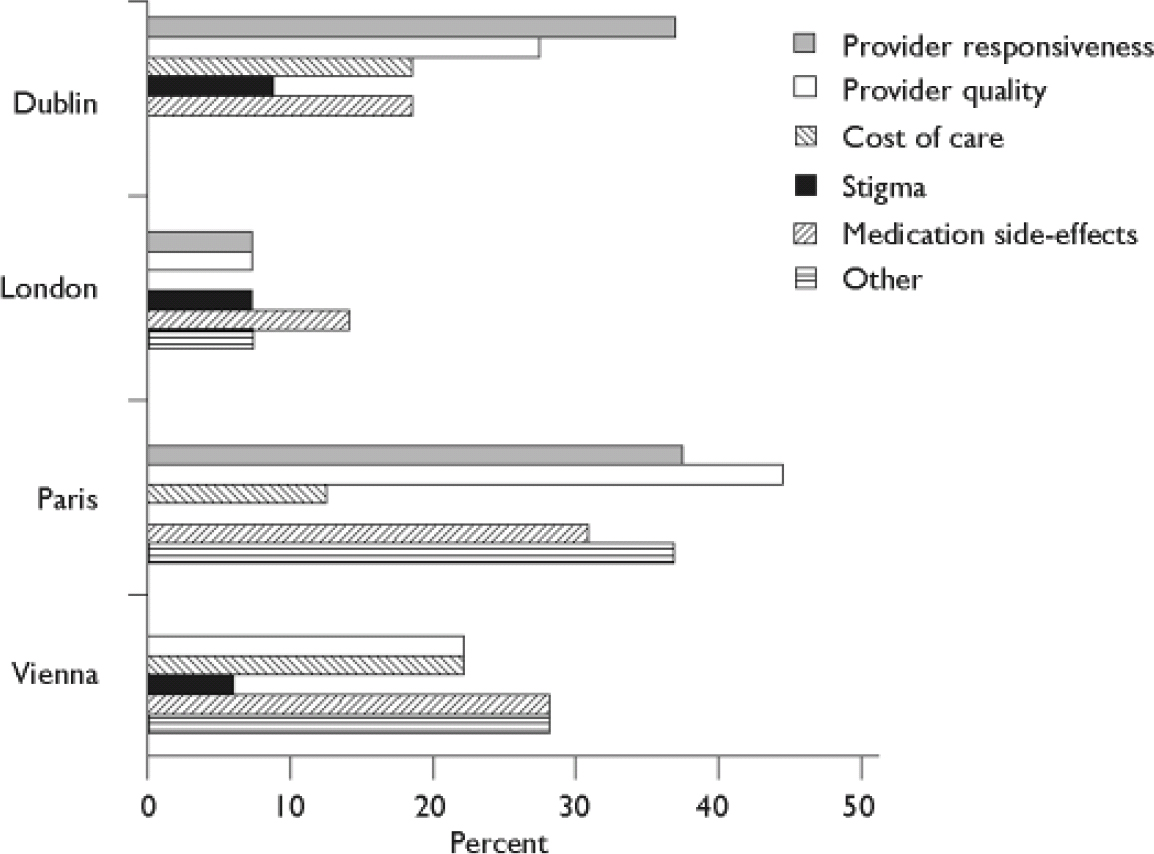
In four of the participating centres (Dublin, London, Paris and Vienna), an additional set of qualitative questions was included in the interview, which aimed to elicit perceived barriers to appropriate care (Fig. 2). Commonly expressed constraints to accessing services included the perceived lack of quality or responsiveness of health care providers to their needs; a concern about medication side-effects, should anti-depressant pharmacotherapy be prescribed; and other reasons, in particular lack of time or inability to find a childminder.
Barriers to access to care perceived by participants
Service use among newly born children
Health care services used by the infants of sampled mothers are reported in Table 7. In all but one centre (Paris), admission to a paediatric ward was seen in no more than one in ten babies. Visits to a paediatrician, however, were common, ranging from 55% to 95%, except in London (14%). The number of visits was notably higher in Bordeaux, Paris and Vienna (a mean of more than one visit per month) than in other centres. Finally, a noteworthy finding was that in all centres, an appreciable proportion of babies had been taken to the emergency department of the local hospital (as high as about 40-50% in Vienna and Porto, and close to 15% elsewhere).
Use of health and social care services (newly born children)

| Bordeaux (n=18) | Dublin (n=11) | London (n=14) | Paris (n=16) | Porto (n=20) | Vienna (n=18) | Zurich (n=39) | |||||||||||||||
|---|---|---|---|---|---|---|---|---|---|---|---|---|---|---|---|---|---|---|---|---|---|
| % | Mean1 | s.d. | % | Mean1 | s.d. | % | Mean1 | s.d. | % | Mean1 | s.d. | % | Mean1 | s.d. | % | Mean1 | s.d. | % | Mean1 | s.d. | |
| Paediatric ward | 11.1 | 0.67 | 2.06 | 18 | 0.18 | 0.40 | 7 | 0.07 | 0.27 | 31.3 | 1.69 | 3.18 | 5 | 0.05 | 0.22 | 11.1 | 0.22 | 0.73 | 3 | 0.10 | 0.45 |
| Paediatrician (visits) | 94.4 | 6.00 | 3.12 | 55 | 0.91 | 1.30 | 14.3 | 0.50 | 1.40 | 93.8 | 7.25 | 4.78 | 60 | 0.65 | 0.49 | 88.9 | 6.56 | 2.22 | 56.4 | 1.38 | 1.66 |
| Emergency department | 16.7 | 0.22 | 0.55 | 18 | 0.09 | 0.30 | 14.3 | 0.14 | 0.36 | 18.8 | 0.25 | 0.58 | 50 | 0.55 | 0.51 | 38.9 | 0.83 | 1.54 | 15.4 | 0.44 | 1.68 |
| Other (e.g. primary care visits) | 66.7 | 5.22 | 6.54 | 10 | 0.18 | 0.60 | 0 | 0 | 80 | 3.50 | 3.89 | 5 | 0.05 | 0.22 | 46.2 | 1.39 | 3.22 | 0 | 0 | ||
DISCUSSION
Health services research methods in postnatal depression
The health services research component of this transcultural study set out to pilot methods for the future generation of evidence on the cost inputs, care processes and treatment outcomes of different service responses to postnatal depression in a cross-cultural context. Given the known diversity of health care systems in Europe (and beyond), a preliminary set of quantitative indicators were obtained and compared, together with a set of more qualitative questions relating to services available to women experiencing post-partum depression in different countries. A third set of questions was prepared for use among postnatally depressed mothers, in order to give a first insight into the services that these women actually or could potentially use. The final product- the CSRI-PND- is the result of extensive multi-site development, piloting and refinement, and provides an important methodological tool for estimating the economic burden of postnatal depression as well as the cost-effectiveness of existing or emerging interventions for reducing this burden. Similar instrumentation has been developed for other specific mental health conditions such as schizophrenia, for which the potential service use categories clearly differ from those indicated for postnatal depression- see Chisholm et al (Reference Chisholm, Knapp and Knudsen2000) for a detailed consideration of the service receipt schedule developed for the European Psychiatric Services: Inputs Linked to Outcome Domains and Needs (EPSILON) study of schizophrenia in Europe. What is clearly apparent from these studies is that a detailed process of instrument development is required if all relevant categories of potential service receipt and cost are to be covered, particularly in the context of studies with an international scope.
Cross-cultural differences in service access, provision and use
There are widespread differences between the participating centres of this study in the availability and utilisation of services for new mothers and their babies. Concerning service availability, we still have only rudimentary quantitative data on specific care components relevant to the needs of women with postnatal depression, with most national data specified by expenditure or occupational category rather than by disease or health condition. Even so, it is apparent from Table 3 that there are considerable differences at the national level in the availability of health professionals such as psychiatrists, psychiatric nurses and social workers, who might care for women with postnatal depression.
With respect to the uptake of services, the sample sizes for each centre were small and therefore potentially unrepresentative of the wider population, but on the basis of these preliminary data there do appear to be diverse care practices or opportunities offered within the local health systems of the participating centres, in terms of both general medical services and more specialist postnatal or mental health care. Among these small samples, there appears to be differential uptake of primary care services by women with severe adversity, by those with poor support and, to a lesser extent, by those with postnatal depression. Further use of the instruments described in this supplement in future observational and experimental studies of postnatal depression can be expected to enable such comparisons to be made in larger, more representative samples.
Implications for health services research and policy
This preliminary study has demonstrated the methodological feasibility of describing and quantifying service use, highlighted the varied and often limited use of care in this population, and indicated the need for improved assessment of the resource needs and implications of postnatal depression. However, this is only a first step towards a more comprehensive understanding of the full range of service components that require consideration. Using the matrix model developed by Thornicroft & Tansella (Reference Thornicroft and Tansella1999) to conceptualise the wider mental health service framework (Table 8 relates this model to postnatal depression), it is apparent that there remain a number of outstanding issues or service components which fall beyond the scope of this study yet which merit greater attention by researchers and policy-makers alike. In particular, there is a requirement at the province/district level to undertake population-level needs assessment, develop operational policies and undertake treatment outcome studies of postnatal depression. Integration of these activities with the methods proposed in this paper offers the prospect of improving the visibility and availability of appropriate services, while also generating an evidence based on the relative cost-effectiveness of interventions for effectiveness postnatal depression.
The matrix model of mental health services: application to postnatal depression

| Geographical dimension | Temporal dimension1 | ||
|---|---|---|---|
| Inputs | Processes | Outcomes | |
| Country level | Expenditure on mental health Maternity leave legislation | Performance/activity indicators (e.g. service uptake rates) | Rates of postnatal depression |
| Province/district level | Population-level needs assessment for postnatal depression Specialist staff (including training) | Pathways to care Patterns of service use Contact rates | Group-level outcome studies Secondary prevention of postnatal depression Improved access to services |
| Patient level | Assessment of mothers' needs Service demands/expectations of depressed mothers | Service quality Frequency of treatment Income support | Reduced symptoms of depression Disability (including work disability) Satisfaction with services |
APPENDIX
Client Service Receipt Inventory - Postnatal Depression
Background information
Name and number of participating study centre/subject; dates of interview and new child's birth.
Housing
Usual place of residence, size and occupancy of household, adequacy of accommodation for raising a small child.
Employment and income
Assessment of any periods of maternity (and paternity) leave taken or permitted, employment situation and income level of both the mother and her partner, and number of days the mother, her partner and two closest relatives/friends have been absent from/unable to work or carry out usual activities owing to postnatal illness. Key outputs from this section are estimates of overall household income and forgone work/productivity.
Use of services
Checklist of key out-patient (and in-patient) services that the mother may have had contact with over a retrospective period of 6 months, including contacts with obstetricians, midwives, primary health care workers, social workers and specialist mental health service professionals. The total number of contacts (or in-patient days) in the previous 6 months is elicited, together with the usual location and average duration of contacts. A corollary to these questions concerning actual rates of use concerns potential barriers to service access or use, such as geographical distance, financial cost, service quality, provider responsiveness and stigma. Different levels of access to care across the participating sites may have an important bearing on the uptake of services.
Child care and paediatric services
The final section documents the normal care arrangements for the new child, together with any use of paediatric services over the 6-month retrospective period.
Clinical Implications and Limitations
CLINICAL IMPLICATIONS
-
▪ There are marked differences across Europe in the provision of general and specialist health and social care services for women with postnatal depression.
-
▪ Access to and uptake of these services across seven study sites is correspondingly varied and often limited.
-
▪ Health services research methods developed and tested in this study are feasible and can be usefully employed alongside diagnostic and other health status measures.
LIMITATIONS
-
▪ The sample size for each centre was small and unrepresentative of the wider population.
-
▪ The pilot study did not place monetary costs on services received, thereby excluding the opportunity to assess the cost-effectiveness of different service configurations.
-
▪ For the comprehensive profiling of service inputs, processes and outcomes relating to postnatal depression, more information about population-level needs, demands and outcomes is required.




eLetters
No eLetters have been published for this article.