To the editor,
Advances in diagnosis, surgical correction, and long-term care have markedly improved survival among children born with CHD, resulting in a rapidly expanding population of adolescents and adults living with repaired or palliated defects. Consequently, research priorities have shifted from short-term survival to long-term morbidity, quality of life, and premature onset of age-related complications. In this context, telomere length represents a largely unexplored yet potentially informative biomarker of biological ageing in CHD. Reference Tournoy, Moons, Daelman and De Backer1,Reference Schellnegger, Hofmann, Carnieletto and Kamolz2 Unlike conventional biomarkers reflecting current physiological state, telomere length integrates cumulative biological stress across the lifespan and may therefore be uniquely suited to capture the lifelong exposure burden characteristic of CHD.
Human telomeres are conserved hexanucleotide (TTAGGG)n repeats that cap chromosomal ends and, together with the shelterin complex, preserve chromosomal integrity by preventing degradation, aberrant DNA repair, and end-to-end fusion. Telomere length varies across tissues according to proliferative demand and progressively shortens with successive cell divisions due to the end-replication problem and insufficient telomerase activity accelerates attrition. Critically short telomeres activate a DNA damage response, forming telomere-induced foci that trigger replicative senescence (the Hayflick limit). Accordingly, telomere length functions as a biological “mitotic clock” and an integrative marker of accelerating ageing. Reference Schellnegger, Hofmann, Carnieletto and Kamolz2 Robust evidence links telomere shortening to acquired cardiovascular disorders. A meta-analysis demonstrated a linear inverse association between telomere length and coronary heart disease risk (p non-linearity = 0.930), with each 1-kb increase in length conferring a 23% risk reduction. Reference Su, Yin and Zhao3 In addition, Mendelian randomisation analyses have reported that genetically predicted longer telomere length is associated with a significantly lower risk of coronary heart disease (odds ratio range: 0.72–0.87, p < 0.010), supporting a causal relationship. Reference Deng, Li and Zhou4 In contrast, evidence in CHD remains strikingly sparse (Table 1).
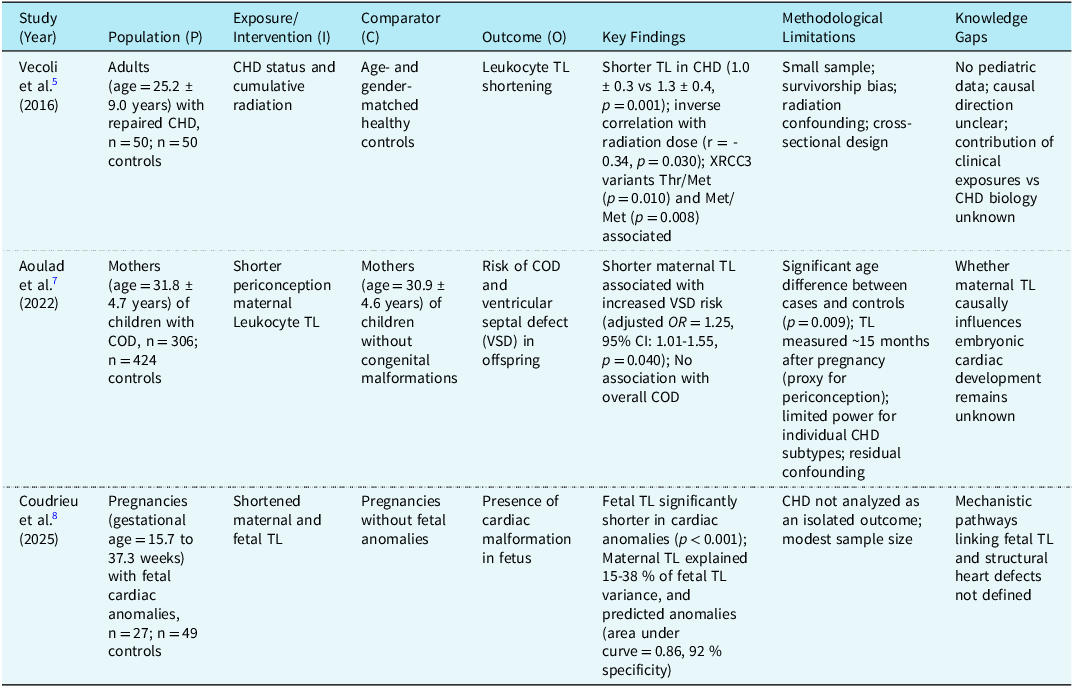
Direct and indirect evidence on telomere biology in congenital heart disease: Methodological limitations and knowledge gaps

CHD = congenital heart disease, COD = congenital cardiac outflow defect; TL = telomere length; XRCC3 = X-ray repair cross-complementing-3.
Published CHD-specific evidence remains limited, with only one small cross-sectional study that has examined leukocyte telomere length in adults with CHD, reporting significantly shorter telomere length compared with age-matched controls (p = 0.001). Leukocyte telomere length was inversely correlated with cumulative radiological exposure (r = −0.34, p = 0.030), and the X-ray repair cross complementing-3 Thr241Met polymorphism was a significant contributor (p < 0.010). Reference Vecoli, Borghini, Foffa, Ait-Ali, Picano and Andreassi5 To our knowledge, no studies have evaluated telomere length in paediatric CHD populations, nor are longitudinal data available tracking telomere dynamics from infancy through adulthood. Indirect evidence suggests early-life physiological stress influences telomere biology; critically ill children exhibited ∼6% shorter leukocyte telomere length than healthy peers (p < 0.001), supporting early adversity as a trigger for accelerated ageing. Reference Verstraete, Vanhorebeek and van Puffelen6
Emerging prenatal data also suggest relevance of parental telomere biology. Shorter periconceptional maternal telomere length has been associated with increased risk of non-syndromic ventricular septal defects in offspring (adjusted odds ratio = 1.25, 95% confidence interval: 1.01–1.55, p = 0.04), potentially mediated by hyperhomocysteinemia-related oxidative stress and reduced telomerase activity. Reference Aoulad Fares, Wiegel, Eggink, Willemsen, van Meurs and Steegers-Theunissen7 Another recent study reported significantly shorter telomere length in amniotic fluid from fetuses with cardiac malformations (p < 0.001), although limited sample size constrains generalisability. Reference Coudrieu, Ouedraogo and Gallot8 A registered prospective study (NCT05667870) proposing telomere length assessment in newborns and adults with and without CHD, with planned longitudinal follow-up to assess temporal dynamics and clinical correlates further underscores emerging interest, although results are pending.
Importantly, CHD differs fundamentally from acquired cardiovascular diseases in both timing and exposure profile. Patients experience chronic hypoxia, inflammation, cardiopulmonary bypass, repeated interventions, and altered haemodynamics beginning early in life—critical periods for establishing lifelong telomere trajectories. Reference Su, Yin and Zhao3,Reference Vecoli, Borghini, Foffa, Ait-Ali, Picano and Andreassi5 Several CHD-specific factors may confound telomere length measurements and must be accounted for in study design, including syndromic diagnoses, prematurity or fetal growth restriction, cyanosis, recurrent infections, cumulative procedures, and socio-economic stress. Large population analyses confirm that genetic determinants, environmental exposures, and inflammatory states substantially influence telomere length variation, underscoring the need for careful adjustment. Reference Demanelis, Jasmine and Chen9
Future investigations should therefore adopt phenotype-specific, longitudinal designs incorporating pre-and post-intervention leukocyte telomere length assessment, parental telomere length correlations, and telomerase activity. Methodological rigour will be essential, including control for assay variability, leucocyte subset composition, batch effects, inter-laboratory calibration, and standardised quantification of cumulative clinical exposures known to influence telomere dynamics. Reference Yu, Byun and Park10
If validated in adequately powered longitudinal studies, telomere length may have potential as a clinically informative biomarker to refine risk stratification in CHD. Children with markedly shortened telomeres could represent a biologically vulnerable subgroup warranting closer surveillance for organ dysfunction, earlier cardiometabolic screening, or tailored perioperative planning to mitigate oxidative and inflammatory stress. However, given the limited CHD-specific evidence base, such applications should currently be considered hypothesis-generating. Future work is required to establish clinically meaningful thresholds, reproducibility, and incremental prognostic value beyond established risk markers before translation into routine practice.
Acknowledgements
None.
Author contribution
SA: Conceptualisation, Investigation, Writing – Original Draft. PK: Writing – Review & Editing, Supervision. Both authors approved the final version of the manuscript.
Financial support
This research received no specific grant from any funding agency, commercial, or not-for-profit sectors.
Competing interests
The authors declare none.
Ethical standard
Not applicable.