Introduction
Current IVF practice suggests that embryos of optimal development reach a fully expanded blastocyst stage 116 ± 2 h post insemination (hpi), in which a prominent inner cell mass (ICM) and a cohesive trophectoderm (TE) can be clearly identified (ALPHA Scientists In Reproductive Medicine and ESHRE Special Interest Group Embryology, 2011). This embryo development stage correlates well with D5 blastocysts and deviations from this paradigm, such as embryos achieving blastocyst stage on D6 or D7 (≥ 140 ± 2 hpi) (ESHRE Special Interest Group of Embryology and Alpha Scientists in Reproductive Medicine, 2017), are considered to have a delayed growth with a questionable embryonic developmental competence (Desai et al., Reference Desai, Ploskonka, Goodman, Attaran, Goldberg, Austin and Falcone2016; Kaing et al., Reference Kaing, Kroener, Tassin, Li, Liu, Buyalos, Hubert and Shamonki2018; Corti et al., Reference Corti, Cermisoni, Alteri, Pagliardini, Ambrosini, Andrisani, Papaleo, Viganò and Noventa2022; Lane et al., Reference Lane, Reed, Schoolcraft and Katz-Jaffe2022).
Culturing embryos until the blastocyst stage presents an advantage for embryo selection (ESHRE Special Interest Group Embryology, 2011). It must be acknowledged that morphology assessment per se has its limitations such as the inter-observer variability and the suboptimal correlation between morphology and ploidy (Minasi et al., Reference Minasi, Colasante, Riccio, Ruberti, Casciani, Scarselli, Spinella, Fiorentino, Varricchio and Greco2016; Martínez-Granados et al., Reference Martínez-Granados, Serrano, González-Utor, Ortíz, Badajoz, Olaya, Prados, Boada and Castilla2017). Therefore, clinical outcomes per embryo transfer are improved if blastocysts are selected by combining embryo morphology and preimplantation genetic testing for aneuploidy (PGT-A); a strategy implemented in FET cycles. Although D5 euploid blastocysts are commonly the first choice in FET cycles, evidence supporting comparable clinical outcomes for D6 and D7 blastocysts is emerging, however results are still controversial (Whitney et al., Reference Whitney, Balloch, Anderson, Nugent and Schiewe2019, Tiegs et al., Reference Tiegs, Sun, Patounakis and Scott2019; Hernandez-Nieto et al., Reference Hernandez-Nieto, Lee, Slifkin, Sandler, Copperman and Flisser2019; Niu et al., Reference Niu, Wang, Li, Haddad and Wang2020; Abdala et al., Reference Abdala, Elkhatib, Bayram, Arnanz, El-Damen, Melado, Lawrenz, Fatemi and De Munck2022).
While D7 blastocysts experience delayed development, euploidy rates range between 20% and 45% (Hammond et al., Reference Hammond, Cree and Morbeck2018) therefore, delayed blastulation is not necessarily correlated with aneuploidy. Although the usable rate of D7 blastocysts is less than 10%, substantial pregnancy and live birth outcomes have been reported (Hammond et al., Reference Hammond, Cree and Morbeck2018; Whitney et al., Reference Whitney, Balloch, Anderson, Nugent and Schiewe2019; Corti et al., Reference Corti, Cermisoni, Alteri, Pagliardini, Ambrosini, Andrisani, Papaleo, Viganò and Noventa2022).
Published data on D7 euploid blastocyst FET cycles are limited and present controversial results, leading to inconsistent conclusions about the benefit of extending in vitro culture until D7 and which patient population would benefit from this approach. Therefore, the present study aimed to evaluate OPR outcomes of delayed blastocyst development on D7 compared with D5 and D6 blastocysts in single euploid FET cycles.
Materials and methods
Study design
All single FET cycles performed between March 2017 and March 2022 with euploid blastocyst were included in the study. The inclusion criteria were patients with autologous fresh or frozen sperm, fresh or vitrified oocytes and blastocysts graded ≥ BL3CC (Gardner grading system; Gardner and Schoolcraft, Reference Gardner, Schoolcraft, Jansen and Mortimer1999) who had undergone TE biopsy on D5, D6 or D7 for PGT-A by next generation sequencing (NGS). This retrospective study was approved by the Internal Review Board (REFA041d) of ART Fertility Clinic, Abu Dhabi, United Arab Emirates.
Blastocysts culture conditions
Normally fertilized oocytes with two pronuclei (2PN) were cultured individually in 30-μl drops of continuous culture medium (Global®Total®LP, CooperSurgical® Inc.) or sequential (Quinn’s Advantage® Protein Plus Cleavage and Blastocyst medium, CooperSurgical® Inc.) under oil (Ovoil®, Vitrolife®) for 7 days in a tri-gras incubator (G185, K-SYSTEM, CooperSurgical® Inc. or Embryoscope®, Vitrolife®) at 37°C under 6% CO2, 5% O2, and 89% N2. For all embryos, medium refreshment was performed on day 3.
Blastocyst quality classification
Blastocysts were classified as good quality (BL3–BL6, AA/AB/BA), fair quality (BL3–BL6, BB) and poor quality (BL3–BL6, AC/BC/CC/CA/CB) according to the grade of expansion, ICM and trophectoderm (TE) quality, respectively. Blastocysts were evaluated on D5 of embryo culture (120 ± 2 hpi) and, if blastocyst quality was deemed suboptimal and expansion or number of cells present in the TE were insufficient to perform biopsy, embryos were left in culture and re-evaluated on D6 (144 ± 2 hpi). Blastocysts that were not biopsied on D5 or D6 were re-evaluated on D7 (168 ± 2 hpi).
TE biopsy, tubing procedure and NGS analysis
For TE biopsy, blastocysts were placed in a pre-warmed culture dish in 10-µl drops of supplemented-HEPES buffer medium (Quinn’s Advantage® HEPES medium, CooperSurgical® Inc.) and covered with oil. For the zona pellucida (ZP) drilling, the ICM of the blastocyst was positioned at 12 o’clock using a 35° angled holding pipette (ORIGIO®, CooperSurgical® Inc.), while three to five laser pulses (OCTAX NaviLase™, Vitrolife®) with an intensity of 2.2 ms were applied to the ZP for the opening. A TE sample was aspirated with a 35° angled, flat and polished biopsy pipette with an inner diameter of 13–15 µm (ORIGIO®, CooperSurgical® Inc.) and cells were dissected using the TE-mode laser. A mechanical ‘flicking’ method was used to cut and obtain the TE cells as described elsewhere (Xiong et al., Reference Xiong, Liu, Wang, Liu, Gao, Wu, Zhu, Hao, Li, Liu, Han and Huang2021). Biopsied TE cells were washed in phosphate-buffered saline (PBS) droplets and placed into 0.2-ml PCR tubes containing 2.5 µl PBS with a 120–124 µm handling pipette under a stereomicroscope. The TE samples were stored at −20°C until Whole Genome Amplification (WGA) was performed by Igenomix Dubai (Igenomix®, Vitrolife®) using PicoPlex technology (Rubicon Genomics, Inc., USA). After WGA, library preparation consisted of the incorporation of individual barcodes for the amplified DNA of each sample. Following amplification and enrichment of the DNA, sequencing was performed in a 316 or 318 chip using Personal Genome Machine sequencing (Thermo Fisher Scientific, USA). An ion Reporter™ software was used for sequencing analysis and data interpretation (Thermo Fisher Scientific, USA).
Blastocyst vitrification and warming protocols
Biopsied blastocysts were individually vitrified within 1 h after TE biopsy using a Kitazato vitrification kit (Kitazato®, Dibimed) in combination with open Vitrification Straws (Cryotop®, Kitazato®, Dibimed). The vitrification procedure was performed according to the manufacturer’s instructions as previously described elsewhere (Kuwayama, Reference Kuwayama2007).
Blastocysts were warmed using a Kitazato warming kit (Kitazato®, Dibimed) following the manufacturer’s protocol. Warmed blastocysts were cultured for 1 h and re-checked to evaluate blastocoel re-expansion that was considered a sign of viability before embryo transfer (ET). All single euploid embryo transfers (SEETs) were based on morphological grading and day of blastocyst biopsy, with the preference for D5 euploid blastocysts over D6 and D7 considering the quality of all the blastocysts available, as per routine clinical practice.
Type of endometrial preparation (EP) protocols and ET procedure
The EP protocol was individually chosen according to the physician’s discretion and patient’s characteristics. For a spontaneous ovulatory natural cycle (NC), transvaginal ultrasound scans were performed to monitor follicular growth with serial measurements of serum luteinizing hormone (LH), oestradiol (E2) and progesterone (P4) levels to accurately determine the ovulation time. Vaginal P4 suppositories (Endometrin®, Ferring®) were commenced in the evening of the confirmed ovulation day and from day 1 onwards, three times daily until the pregnancy test.
In hormone replacement therapy (HRT) cycles, patients commenced 2 mg oral E2 tablets, daily from day 2 or day 3 of menses for 3 days and thereafter increased to 6 mg. When an endometrial lining with a trilaminar appearance was seen, an initial evening P4 dose of 100 mg was administered vaginally (day 0). The administration of P4 was increased on day 1 to three times daily and continued until the pregnancy test.
All FET procedures were performed after 120 h of P4 exposure (full 5 days of P4 administration) regardless of the day of blastocyst biopsy (D5, D6 or D7). ETs were performed under abdominal ultrasound guidance using a soft pass catheter (GUARDIATM AccessET® Catheter, Cook® Medical, USA).
Study outcomes
The primary study outcome was to compare the ongoing pregnancy rate (OPR) between D5, D6 and D7 euploid blastocysts FET cycles. Pregnancy was defined 12 days after ET by a quantitative analysis of serum β-hCG value (≥15 mIU/ml). Clinical pregnancy rate (CPR) was defined when at least one gestational sac was seen 4 weeks after the ET, while OPR was defined with the presence of a gestational sac with a positive fetal heartbeat, diagnosed by ultrasound 6 weeks after ET (Zegers-Hochschild et al., Reference Zegers-Hochschild, Adamson, Dyer, Racowsky, de Mouzon, Sokol, Rienzi, Sunde, Schmidt, Cooke, Simpson and van der Poel2017). The live birth rate was defined as the number of deliveries that resulted in a live-born neonate up to the date of analysis (Zegers-Hochschild et al., Reference Zegers-Hochschild, Adamson, Dyer, Racowsky, de Mouzon, Sokol, Rienzi, Sunde, Schmidt, Cooke, Simpson and van der Poel2017) and miscarriage rate (MR) was calculated as the number of spontaneous losses of an intrauterine clinical/ongoing pregnancy occurred at any gestational age (Zegers-Hochschild et al., Reference Zegers-Hochschild, Adamson, Dyer, Racowsky, de Mouzon, Sokol, Rienzi, Sunde, Schmidt, Cooke, Simpson and van der Poel2017). As a secondary objective, patients’ characteristics were analyzed to identify variables impacting OPR outcomes.
Data collection and statistical analysis
Categorical variables are presented as numbers (N) and/or percentages (%) while continuous variables are presented as mean ± standard deviation (SD) or interquartile ranges (IQR). Groups (D5, D6 and D7 blastocysts) were compared using chi-squared test and Fisher’s exact test (for N < 5) for dichotomous variables and analysis of variance (ANOVA) for continuous variables. An adjusted multivariate logistic regression model was performed to identify the effect of potential confounding factors on OPR outcomes via generalized estimating equations (GEE); as some patients had performed more than one FET cycle. An unadjusted univariate model by GEE analysis was performed to analyze the predictive risk factors associated with D7 euploid blastocyst FET cycles. Odds ratio (OR) was expressed with a 95% confidence interval (CI) [95% CI]. Software STATA 17.0 was used for the statistical data analysis and a P-value< 0.05 was considered statistically significant.
Results
Demographics and cycle characteristics
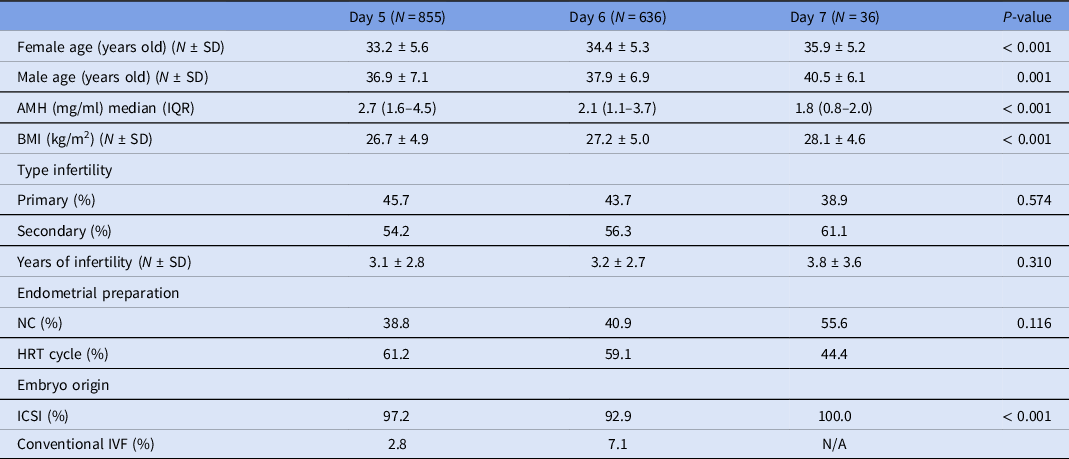
In total, 1527 FET cycles from 1243 patients were included in the study, of which 855 FETs were performed with blastocysts biopsied on D5, 636 on D6 and 36 on D7. Considering the patient characteristics such as female age, male age and BMI levels, values were significantly increased in patients who transferred a D7 euploid blastocyst (33.2 ± 5.6, 34.4 ± 5.3 and 35.9 ± 5.2, P < 0.001; 36.9 ± 7.1, 37.9 ± 6.9 and 40.5 ± 6.1, P = 0.001; and 26.7 ± 4.9, 27.2 ± 5.0 and 28.1 ± 4.6, P < 0.001; for D5, D6 and D7 FET cycles groups, respectively). In contrast, anti-Müllerian hormone (AMH) values were significantly decreased while increasing the day at which blastocysts were biopsied (2.7 [1.6–4.5], 2.1 [1.1–3.7] and 1.8 [0.8–2.0], P < 0.001) for D5, D6 and D7 euploid blastocysts FET cycles, respectively. Additionally, the type of infertility and duration of infertility were not statistically significant different among groups (Table 1). No significant difference was found between the number of FETs performed in NC or in HRT cycles for D5, D6 or D7 blastocysts (Table 1). The overall survival rate of blastocysts was 97.3% and most of the blastocysts transferred were originated by intracytoplasmic sperm injection (ICSI) technique for insemination rather than conventional IVF (Table 1).
Demographics and frozen embryo transfer (FET) cycle characteristics

Patients’ demographics and frozen embryo transfer (FET) cycle characteristics segregated by the day of blastocyst biopsy. Values are expressed as mean ± standard deviation or percentage (%).
AMH: anti-Müllerian hormone; BMI: body mass index; HRT: hormone replacement therapy; ICSI: intracytoplasmic sperm injection; IQR: interquartile range calculated as the difference between the upper and lower quartiles, Q3 and Q1; IVF: in vitro fertilization; N: number; N/A: no available data; NC: natural cycle; SD: standard deviation.
Clinical outcomes
In general, clinical outcomes were compromised when a D7 euploid blastocyst was transferred with a significant reduction in pregnancy rate (PR), CPR and OPR outcomes compared with D5 or D6 euploid blastocysts FET cycles (PR: 70.4%, 59.3% and 16.7%, P < 0.001; CPR: 64.7%, 51.6% and 16.7%, P < 0.001 and OPR: 56.0%, 45.3% and 11.1%, P < 0.001; for D5, D6 and D7 euploid blastocysts FET cycles, respectively). Moreover, delayed blastocyst development on D7 showed a significantly lower live birth rate (LBR) outcome compared with D5 and D6 blastocysts FET cycles (48.7%, 35.5% and 11.1%, P < 0.001, for D5, D6 and D7 euploid blastocysts FET cycles) however, MR did not differ significantly between groups (Table 2). As fresh and frozen oocytes were included in this study, OPR outcomes were compared between transferred blastocysts originating from fresh or frozen oocytes. Out of 1527 FET cycles, only 191 FET cycles were performed with blastocysts originated from frozen oocytes (12.5%) with an OPR of 50.3% and the rest of 1336 FET cycles were performed only with blastocysts originating from fresh oocytes, with an OPR of 50.5%, with no significant difference between groups (P = 0.946). For all clinical outcomes, D5 euploid blastocysts FET cycles were statistically significantly superior to D6 euploid blastocysts FET cycles (P < 0.001).
Clinical outcomes of euploid blastocyst frozen embryo transfer (FET) cycles

Clinical outcomes of euploid blastocysts FET cycles are based on the total number of embryo transfers performed per group (days 5, 6 and 7 of blastocyst biopsy). Live birth rate outcomes considered only the newborns reported during the time frame of the study. Values are expressed as percentage (%). N: number.
Blastocyst quality and its effect on OPR outcomes
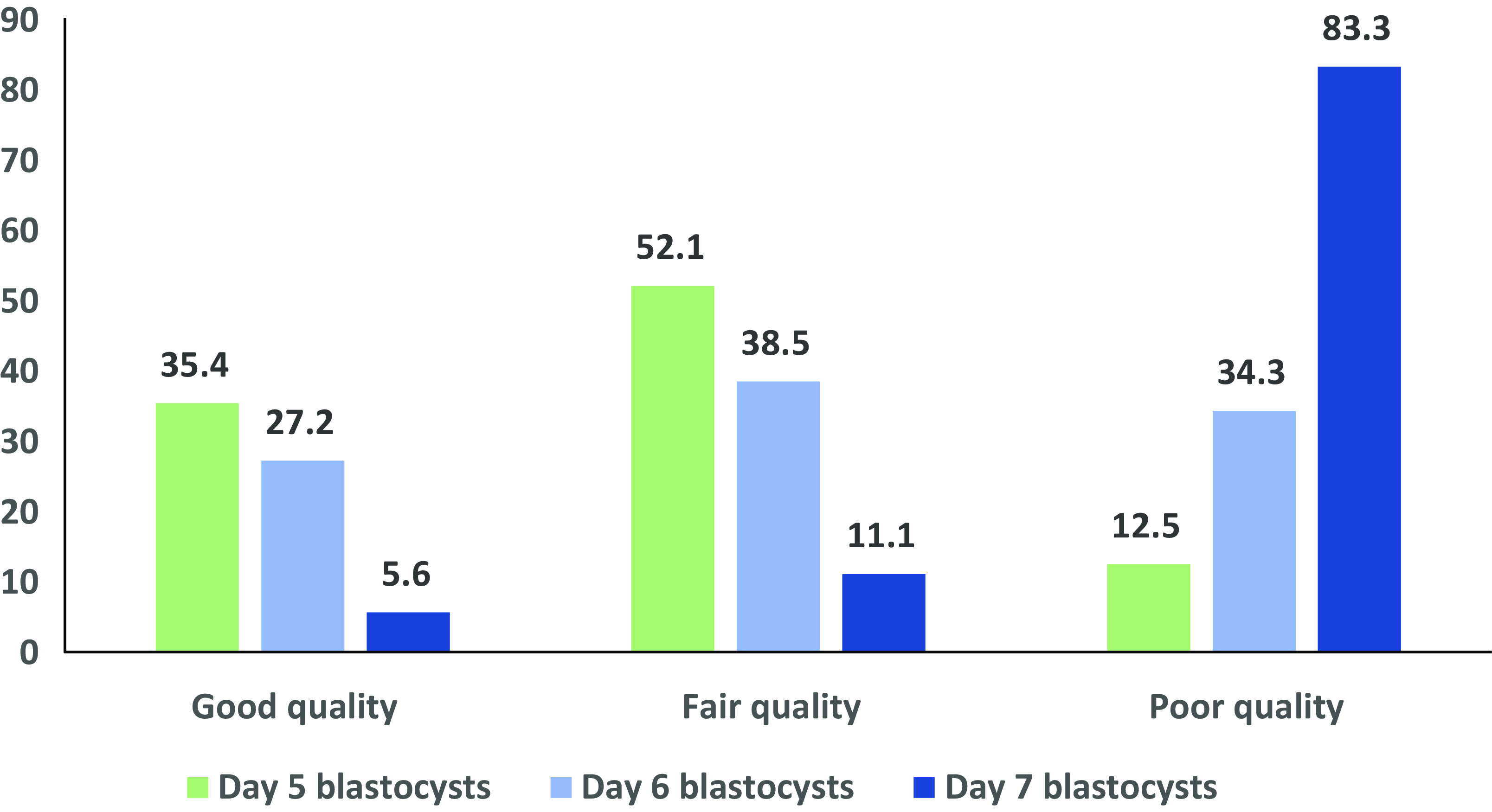
Delayed blastocyst development was associated with worse embryo quality as a significantly higher number of poor quality D7 euploid blastocysts were transferred compared with D5 and D6 euploid blastocysts (Figure 1). As blastocyst quality differed significantly among groups, a further analysis was performed to compare OPR outcomes according to each blastocyst quality category. Results of this analysis showed that, when comparing only good quality blastocysts, OPR outcomes were not significantly different, however only a few good quality D7 euploid blastocysts were transferred. For fair and poor quality blastocysts, OPR differed significantly among D5, D6 and D7 euploid blastocysts FET cycles (Table S1).
Embryo quality of the euploid blastocysts transferred accordingly to the day of biopsy. Distribution of embryo quality of the transferred blastocysts accordingly to the day of biopsy (Days 5, 6 and 7). Blastocysts were classified as good (BL3–BL6, AA/AB/BA), fair (BL3–BL6, BB) or poor (BL3–BL6, AC/BC/CC/CA/CB) quality accordingly to the grade of expansion, inner cell mass (ICM) and trophectoderm (TE) quality, respectively. Values are expressed as percentage (%). A higher proportion of poor quality day 7 euploid blastocysts were transferred in FET cycles compared with day 5 and day 6 euploid blastocysts (P < 0.001).

Adjusted OPR outcomes by confounding factors and the effect of patient’s age
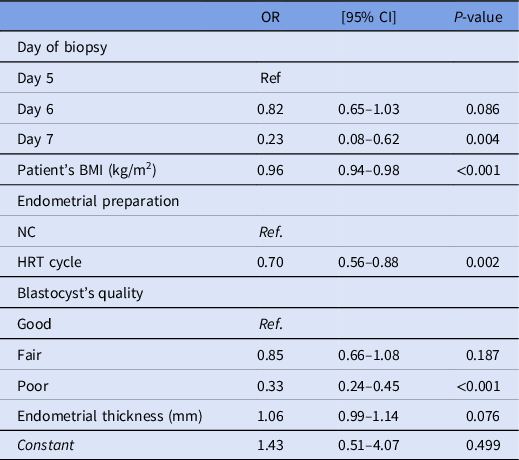
An adjusted multivariate logistic regression model showed that OPR outcomes were significantly negatively affected by D7 euploid blastocysts FET cycles (OR = 0.23 [0.08–0.62], P = 0.004), patient’s BMI (OR = 0.96 [0.94–0.98], P < 0.001), HRT cycles (OR = 0.70 [0.56–0.88], P = 0.002) and poor quality blastocysts (OR = 0.33 [0.24–0.45], P < 0.001). Results of this analysis showed that OPR outcomes were not compromised by D6 euploid blastocysts FET cycles neither by endometrial thickness (Table 3).
Adjusted multivariate model for ongoing pregnancy rate (OPR) outcome

Multivariate model for OPR outcomes adjusted for confounding factors. Blastocysts were classified as good quality (BL3–BL6, AA/AB/BA), fair quality (BL3–BL6, BB) and poor quality (BL3–BL6, AC/BC/CC/CA/CB) accordingly to the grade of expansion, inner cell mass (ICM) and trophectoderm (TE) quality, respectively.
BMI: body mass index; CI: confidence interval; HRT: hormone replacement therapy; NC: natural cycle; OR: odds ratio; Ref.: reference variable.
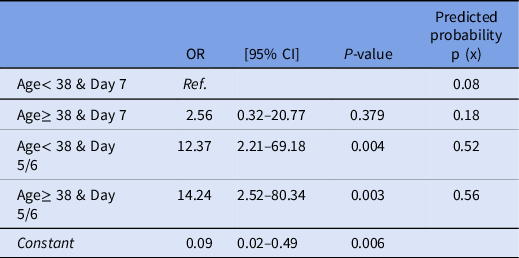
A second multivariate logistic regression model was performed to analyze the effect of patient age and D7 blastocyst FET cycles on OPR outcomes by stratifying the population as represented in Table 4 (patients aged < 38 years who transferred D7 euploid blastocysts as the reference group). In this analysis, for patients aged ≥ 38 who performed a D7 euploid blastocysts FET cycle, the OPR outcome was not significantly different than the reference group (OR = 2.56 [0.32–20.77], P = 0.379). As expected, for patients aged < 38 years who had performed a D5/D6 euploid blastocysts FET cycle, OPR outcomes were significantly higher than the reference group (OR = 12.37 [2.21–69.18], P = 0.004). OPR outcome was also increased for patients aged ≥ 38 years who transferred a D5/D6 euploid blastocyst, in comparison with the reference group (OR = 14.24 [2.52–80.34], P = 0.003).
Effect of patient’s age and day of TE biopsy on ongoing pregnancy rate (OPR) outcomes

Multivariate model for OPR outcomes considering patient’s age and day of blastocyst biopsy.
CI: confidence interval; OR: odds ratio; Ref.: reference variable.
A predicted probability model of OPR was estimated from the previous analysis. Results demonstrated that, in patients aged < 38 years, the predicted probability of OPR is limited to 8% if a D7 euploid blastocyst FET cycle is performed. Interestingly, for patients aged ≥ 38 years such predicted probability is increased to 18%, if a D7 euploid blastocyst is transferred. However, for younger (< 38 years) and older (≥ 38 years) patients, the predicted probabilities of OPR outcomes are significantly superior (52% and 56%) if a D5/D6 euploid blastocyst FET cycle is performed compared with D7 euploid blastocysts FET cycles (Table 4).
Predictive risk factors associated with D7 euploid blastocysts FET cycles
A sub-analysis was conducted to evaluate the predictive risk factors associated with a D7 euploid blastocyst FET cycle. From this analysis, female age (OR = 1.08 [1.01–1.16], P = 0.024), male age (OR = 1.05 [1.01–1.10], P = 0.016) and AMH values (OR = 0.78 [0.62–0.97], P = 0.027) were considered as the risk factors associated with patients that had transferred a D7 euploid blastocyst while patient’s BMI and type of infertility (primary or secondary) were not (Table S2).
Discussion
The selection of the best blastocyst to be transferred is a constant challenge in IVF and the day of blastocyst biopsy is one of the key indicator factors of implantation potential (Kovalevsky et al., Reference Kovalevsky, Carney, Morrison, Boylan, Neithardt and Feinberg2013; Cimadomo et al., Reference Cimadomo, Capalbo, Levi-Setti, Soscia, Orlando, Albani, Parini, Stoppa, Dovere, Tacconi, Ievoli, Maggiulli, Ubaldi and Rienzi2018, Reference Cimadomo, Soscia, Casciani, Innocenti, Trio, Chiappetta, Albricci, Maggiulli, Erlich, Ben-Meir, Har-Vardi, Vaiarelli, Ubaldi and Rienzi2022). Although further studies are warranted to validate the real clinical implication of D7 euploid blastocysts in FET cycles, culturing embryos until day 7 prevents potential euploid blastocysts with delayed growth to be discarded, thereby increasing the yield of usable blastocyst rates.
Previous studies focusing on delayed grown blastocysts on D7 have not been conclusive regarding their biological potential compared with D5 and D6 blastocysts (Kaing et al., Reference Kaing, Kroener, Tassin, Li, Liu, Buyalos, Hubert and Shamonki2018; Hammond et al., Reference Hammond, Cree and Morbeck2018; Tiegs et al., Reference Tiegs, Sun, Patounakis and Scott2019; Hernandez-Nieto et al., Reference Hernandez-Nieto, Lee, Slifkin, Sandler, Copperman and Flisser2019; Corti et al., Reference Corti, Cermisoni, Alteri, Pagliardini, Ambrosini, Andrisani, Papaleo, Viganò and Noventa2022; Lane et al., Reference Lane, Reed, Schoolcraft and Katz-Jaffe2022). Although there is an important heterogeneity in study designs and not all studies reported euploid FET cycles, a trend in favour of D5/D6 over D7 blastocyst on OPR outcomes is observed across most of the studies; a finding that is in line with the results presented here. The presented data add to the current knowledge that delayed blastocyst development on D7 has a poorer clinical prognosis compared with D5/D6 in single euploid FET cycles as already reported (Corti et al., Reference Corti, Cermisoni, Alteri, Pagliardini, Ambrosini, Andrisani, Papaleo, Viganò and Noventa2022) and this trend seems to persist even if the transferred blastocysts are not genetically tested (Du et al., Reference Du, Wang, Fan, Zhang, Yan, Yu, Xi, Chen, Mol, Lyu and Kuang2018). OPR outcomes decrease while the day of biopsy increases (D5: 56.0% vs. D6: 45.3% and D7: 11.1%), with a significant reduction when D7 euploid blastocysts are transferred as shown in this study. In addition, LBR was significantly reduced when D7 euploid blastocysts FET cycles were performed (11.1%), a finding that correlates with Cimadomo et al., who reported an LBR of 14.3% (N = 3/21) when D7 euploid blastocysts were transferred in FET cycles (Cimadomo et al., Reference Cimadomo, Soscia, Casciani, Innocenti, Trio, Chiappetta, Albricci, Maggiulli, Erlich, Ben-Meir, Har-Vardi, Vaiarelli, Ubaldi and Rienzi2022). However, the same authors reported that, although LBR are higher with D5/D6 euploid blastocysts compared with D7 euploid blastocysts in FET cycles, a relative reduction in 4.4% of LBR outcomes occurs if embryo culture is ended at 144 hpi (Cimadomo et al., Reference Cimadomo, Soscia, Casciani, Innocenti, Trio, Chiappetta, Albricci, Maggiulli, Erlich, Ben-Meir, Har-Vardi, Vaiarelli, Ubaldi and Rienzi2022). Moreover, Whitney et al. (Reference Whitney, Balloch, Anderson, Nugent and Schiewe2019) reported an LBR of 43.8% (N = 7/16) when SEET on D7 were performed, yet was significantly reduced compared with D5 or D6 SEET cycles (77.2% and 67.4%, respectively). In contrast, other authors have reported similar reproductive outcomes of D7 euploid blastocysts compared with D5/D6 euploid blastocysts in FET cycles, however due to the small number of D7 ETs included (N = 4, Capalbo et al., Reference Capalbo, Rienzi, Cimadomo, Maggiulli, Elliott, Wright, Nagy and Ubaldi2014; N = 38, Tiegs et al., Reference Tiegs, Sun, Patounakis and Scott2019; N = 3, Niu et al., Reference Niu, Wang, Li, Haddad and Wang2020), results should be interpreted with caution due to the low number of cycles analyzed with D7 blastocysts that can reduce the statistical power of the analysis.
As euploidy rate decreases with advanced maternal age (Demko et al., Reference Demko, Simon, McCoy, Petrov and Rabinowitz2016) and female age was considered a risk factor of having a D7 blastocyst FET cycle (Table S2), culturing blastocysts up to 7 days can be a strategy to optimize outcomes in poor prognosis patients. This approach seems clinically relevant for patients ≥ 38 years who had a predicted probability of 18% on OPR outcome with a D7 euploid blastocyst transfer. Therefore, these patients still have a remaining chance of achieving a viable pregnancy if a D7 euploid blastocyst is available to transfer rather than starting a new cycle. Nevertheless, proper counselling should be given to patients due to the relatively low pregnancy outcomes achieved with D7 euploid blastocyst FET cycles.
Blastocysts with delayed development might be derived from energetically deficient aged oocytes that would require a compensatory demand of ATP (May-Panloup et al., Reference May-Panloup, Chrétien, Jacques, Vasseur, Malthièry and Reynier2005; Duran et al., Reference Duran, Simsek-Duran, Oehninger, Jones and Castora2011; Van Blerkom, Reference Van Blerkom2011; Murakoshi et al., Reference Murakoshi, Sueoka, Takahashi, Sato, Sakurai, Tajima and Yoshimura2013), resulting in a longer time required for embryos to reach a fully expanded blastocyst stage. This might explain the association of delayed blastocyst development with advanced maternal age in this study, an association that was commonly found in other studies (Corti et al., Reference Corti, Cermisoni, Alteri, Pagliardini, Ambrosini, Andrisani, Papaleo, Viganò and Noventa2022; Cimadoro et al., Reference Cimadomo, Soscia, Casciani, Innocenti, Trio, Chiappetta, Albricci, Maggiulli, Erlich, Ben-Meir, Har-Vardi, Vaiarelli, Ubaldi and Rienzi2022). Also, a correlation between poor quality blastocysts with advanced maternal age cannot be neglected, as embryo quality was lower in the group of older patients with delayed blastocyst development for this study. However, D7 euploid blastocysts were capable of implanting with acceptable PR outcomes (16.7%), even though most of the blastocysts transferred were of poor quality (BL3–BL6 AC/BC/CC/CA/CB).
The aetiology of a delayed blastocyst formation seems to be related not only to female patients’ characteristics such as advanced maternal age and low AMH values (Su et al., Reference Su, Li, Wang, Haddad and Wang2016; Cimadomo et al., Reference Cimadomo, Soscia, Vaiarelli, Maggiulli, Capalbo, Ubaldi and Rienzi2019, Reference Cimadomo, Soscia, Casciani, Innocenti, Trio, Chiappetta, Albricci, Maggiulli, Erlich, Ben-Meir, Har-Vardi, Vaiarelli, Ubaldi and Rienzi2022), but also with paternal age (Table S2). The association of advanced paternal age with fertility outcomes has already been described as negatively impacting fertilization, implantation, pregnancy and LBR (Brandt et al., Reference Brandt, Cruz Ithier, Rosen and Ashkinadze2019). The mechanisms beyond are not well understood but low sperm quality and higher sperm DNA fragmentation have been indicated (Johnson et al., Reference Johnson, Dunleavy, Gemmell and Nakagawa2015). This could ultimately affect embryonic developmental competence, compromising blastulation timings and embryo quality. More studies are warranted to find out to which extent male factor and/or age affects embryonic developmental delay.
It might be questionable whether certain conditions encountered in our retrospective dataset could have influenced the outcomes, such as the origin of oocytes (fresh and vitrified), type of culture medium (continuous vs. sequential culture medium), and insemination technique (ICSI vs. conventional IVF). Concerning the origin of oocytes used, whether fresh or frozen, it has already been demonstrated by our group that the blastulation rate on D5 per fertilized oocyte is significantly higher with fresh oocytes compared with sibling frozen oocytes (62% ± 29% versus 44% ± 31%; P < 0.001) (Arnanz et al., Reference Arnanz, De Munck, Bayram, El-Damen, Abdalla, ElKhatib, Melado, Lawrenz and Fatemi2020). However, no differences were found in euploidy outcomes between fresh and frozen oocytes (40.5% versus 38.6%, P = 0.667) with no significant differences in embryo quality on D5 between blastocysts from fresh versus frozen oocytes (P = 0.171). Therefore, frozen oocytes could serve as an additional cause of delayed blastocyst formation, nevertheless OPR outcomes did not differ in the present study between blastocysts originating from fresh or frozen oocytes however, results should be interpreted with caution due to the low numbers (only 12.5% of FET cycles with blastocysts originated from frozen oocytes).
Moreover, the influence of the type of culture medium used on embryo development outcomes and blastocyst quality has already been reported by our group (Arnanz et al., Reference Arnanz, De Munck, Bayram, El-Damen, Abdalla, ElKhatib, Melado, Lawrenz and Fatemi2020; Abdala et al., Reference Abdala, Elkhatib, Bayram, Arnanz, El-Damen, Melado, Lawrenz, Coughlan, Garrido, Fatemi and De Munck2021 and Reference Abdala, Elkhatib, Bayram, El-Damen, Melado, Lawrenz, Fatemi and Nogueira2023). Although the blastulation rate on D5 is higher when blastocysts are cultured in a continuous culture medium compared with a sequential culture medium, no differences in usable blastocyst rate and euploidy rates were found neither for quality. Additionally, the different outcomes considering the methods of insemination that were used for this study (ICSI and conventional IVF), have already been investigated by our group, with no significant differences observed in the number of blastulating embryos on D5 (80.4 vs 70.8%; P = 0.076) and embryo quality on day 5 (P = 0.720) when oocytes were inseminated by ICSI or conventional IVF, respectively (De Munck et al., Reference De Munck, El Khatib, Abdala, El-Damen, Bayram, Arnanz, Melado, Lawrenz and Fatemi2020). Further analysis should be performed to shed light on the possible factors associated with delayed blastocyst development in vitro such as the origin of oocytes, sperm source, insemination method or type of culture medium in a larger database.
The main limitation of the present study is related to its retrospective nature and the low number of D7 euploid blastocysts in FET cycles included for the analysis. However, most of the studies published present the same limitation with lower clinical outcomes of D7 blastocysts compared with D5/D6 blastocysts FET cycles. It should be considered that not all D7 euploid blastocysts obtained after ovarian stimulation have been transferred, due to the priority given to D5/D6 euploid blastocysts as per clinical routine practice and, therefore, their true clinical implication might be underestimated. A query remains of whether OPR outcomes of SEET on D7 significantly differed from SEET on D5/6 due to the possible asynchrony between endometrium and the blastocyst with delayed development that can be reflected also in the implantation phase or because of the detrimental blastocyst quality observed in D7 blastocyst FETs that might be the cause–effect of higher implantation failures.
In conclusion, culturing blastocysts for 7 days might be considered to increase the transferrable blastocyst yield, mainly for older patients who are more likely to have delayed blastocyst formation. Therefore, by extending embryo culture until D7, a higher number of blastocysts can be biopsied, thereby increasing the chances of obtaining a euploid blastocyst, however cost–benefit should be analyzed further. Personalized medicine should be considered in assisted reproductive technologies to improve success rates based on patients’ characteristics to offer individualized treatments.
Supplementary material
To view supplementary material for this article, please visit https://doi.org/10.1017/S0967199423000485
Acknowledgements
We thank our biostatistician Ms Rachna Patel for statistical analysis and critical review of the manuscript.
Author contributions
AA, HF: conception and design of the study; AA, IE, AD, AB, LM, BL, HF: oocyte retrieval; IE, AD, AB, AA: IVF and ICSI procedure and embryo evaluations; IE, AD, AB, AA: blastocyst biopsy, tubing and freezing; IE, AB, LM, BL, HF: embryo transfers; AA: construction of the database and data interpretation; AA: drafting the manuscript; IE, AD, AB, LM, BL, DN, HF: critical review and final approval of the manuscript.
Funding
This research did not receive any specific grant from funding agencies in the public, commercial, or not-for-profit sectors.
Competing interests
No conflicts to declare.