INTRODUCTION
Various environmental stresses such as salinity, drought and extreme temperature are serious threats to modern agriculture. Salinity is the major factor limiting crop productivity, affecting > 0·1 of arable land on earth and resulting in an average yield reduction of >50% for most major crops (Bartels & Sunkar Reference Bartels and Sunkar2005; Munns Reference Munns2005). The area with saline soil is increasing annually and high salinity (i.e. high concentrations of Na+ salt) can cause a series of morphological, physiological, biochemical and molecular changes in crop plants, either directly or indirectly, that affect plant growth and productivity (Wang et al. Reference Wang, Lüttge and Ratajczak2001; Zhu Reference Zhu2001; Verslues et al. Reference Verslues, Agarwal, Katiyar-Agarwal, Zhu and Zhu2006; Ahmad et al. Reference Ahmad, Kim, Back, Kim, Lee, Kwon, Murata, Chung and Kwak2008). The detrimental effects of salt on crop plants are a consequence of both ion toxicity and osmotic stress due to excessive sodium accumulation and water deficit, respectively (Hasegawa et al. Reference Hasegawa, Bressan, Zhu and Bohnert2000; Maeshima Reference Maeshima2000; Golldack & Dietz Reference Golldack and Dietz2001). To overcome these unfavourable conditions, plants have developed a variety of defence mechanisms, including vacuolar compartmentalization of excess Na+, which is an effective process that leads to the elimination of Na+ from the cytosol and increases water uptake into the cells. Mature plant cells usually contain a large vacuole that constitutes approximately 0·4–0·9 of the total intracellular volume (Zhen et al. Reference Zhen, Kim and Rea1997). Accumulation of excessive Na+ into this vacuole is dependent on the proton (H+) electrochemical gradient across the vacuolar membrane (Zhen et al. Reference Zhen, Kim and Rea1994; Leigh Reference Leigh1997).
Proton pumps play a key role in maintaining the critical functions of the vacuole under abiotic stresses. Enhanced expression of vacuolar H+ pumps in crop plant cells can increase the sequestration of ions into the vacuole to induce the activity of protons (Gaxiola et al. Reference Gaxiola, Li, Undurraga, Dang, Allen, Alper and Fink2001). Two approaches have been used to alter vacuolar solutes to augment H+ pump activity in crop plant cells. In the first, the activity of a vacuolar sodium/proton (Na+/H+) antiporter is enhanced, which mediates the exchange of vacuolar H+ for cytoplasmic Na+ (Apse et al. Reference Apse, Aharon, Snedden and Blumwald1999). In the second method, the activity of the vacuolar H+ pump is enhanced so that it transports more H+ ions into the vacuoles. This generates a higher proton electrochemical gradient and leads to increased activity of secondary transporters containing vacuolar Na+/H+ antiporters (Gaxiola et al. Reference Gaxiola, Fink and Hirschi2002). These methods both increase Na+ accumulation in the vacuoles and decrease the risk of Na+ toxicity in the cytoplasm, leading to higher salt resistance in transgenic crop plants (Apse et al. Reference Apse, Aharon, Snedden and Blumwald1999; Gaxiola et al. Reference Gaxiola, Li, Undurraga, Dang, Allen, Alper and Fink2001). However, it appears that the second approach can simultaneously increase acquired tolerance to abiotic stresses (e.g. salt and drought) in transgenic plants (Gaxiola et al. Reference Gaxiola, Fink and Hirschi2002).
Previous studies have demonstrated that overexpression of the Arabidopsis thaliana vacuolar H+-pyrophosphatase (AVP1) gene increased tolerance against high salinity in different organisms, including yeast (Gaxiola et al. Reference Gaxiola, Rao, Sherman, Grisafi, Alper and Fink1999), Arabidopsis (Gaxiola et al. Reference Gaxiola, Li, Undurraga, Dang, Allen, Alper and Fink2001), rice (Zhao et al. Reference Zhao, Zhang, Li, Zhao and Zhang2006), tobacco (Gao et al. Reference Gao, Gao, Duan, Yue, Yang and Zhang2006) and cotton (Lv et al. Reference Lv, Zhang, Gao, Lian, Song and Zhang2008; Pasapula et al. Reference Pasapula, Shen, Kuppu, Paez-Valencia, Mendoza, Hou, Chen, Qiu, Zhu, Zhang, Auld, Blumwald, Zhang, Gaxiola and Payton2011). However, the grain yield of transgenic rice expressing AVP1 under natural conditions in paddy fields has not been reported. As mentioned above, these physiological investigations provided a better understanding of the effects of abiotic stress on plants. However, the results of the studies mentioned above provide only limited information regarding the effects of environmental conditions on plant growth and subsequent agricultural yield in paddy fields, in which the conditions are confounded by a number of factors, such as the non-availability of time inputs, inappropriate growing seasons, pest outbreaks and abiotic stresses (Lee et al. Reference Lee, Kim, Bang, Lee, Kwak and Kwon2007; Tang et al. Reference Tang, Kim, Yang, Kwon, Kim, Kim, Yun, Kwak and Lee2008). The extent of crop yield loss due to environmental stresses can be reduced by manipulating plant metabolism, perhaps through the use of genetically engineered plants. The current paper reports that expression of the A. thaliana AVP1 gene improved agronomic traits in transgenic rice plants (TRPs) in paddy fields and also demonstrates that AVP1-expressing rice plants produced more grain and biomass. This represents the first step in the potential application of this gene to crop plant biotechnology.
MATERIALS AND METHODS
Vector construction and rice transformation
Total RNA was isolated from the leaves of A. thaliana using an RNeasy Plant Mini Kit (Qiagen, Germany). Full-length cDNA (accession no. NM101437.4) encoding A. thaliana pyrophosphate-energized vacuolar membrane proton pump 1 (AVP1) was cloned by reverse-transcription polymerase chain reaction (RT-PCR) from A. thaliana (ecotype Columbia) seedlings using the primers 5′-AAGCTTGATATCGAATTCCTGCAGCCCGATG-3′ and 5′-GGTACCGTTGGGCTGCAGGAATTCGATGGACTAGTTTA-3′ (restriction enzyme sites are underlined) and designated as AVP1. The cDNA was cloned between the maize ubiquitin promoter and the nos terminator of a binary vector, pGA1611 (Kim et al. Reference Kim, Lee, Kang, Jeon, Kim and An2003), using HindIII and KpnI restriction endonucleases, and designated as pOsAVP1. The nucleotide sequences of the promoter and AVP1 were then determined to ensure that there were no frame shifts or nucleotide conversions in the open reading frame (ORF). The complete AVP1 coding sequence contained 2313 base pairs. The pOsAVP1 binary vector was introduced into Agrobacterium strain LBA 4404, which was used to transform rice calli produced from the scutella of mature seeds of Oryza sativa cvar Dongjin. Agrobacterium-mediated rice transformation was performed according to a previously described method (Hiei et al. Reference Hiei, Ohta, Komari and Kumashiro1994; Kang et al. Reference Kang, Jeon, Lee and An1998).
Screening of salt-tolerant transgenic rice plants
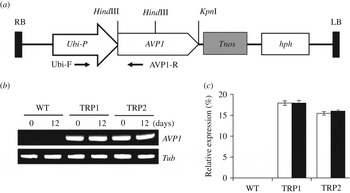
To obtain homozygous rice plants expressing A. thaliana AVP1, 69 event lines (T0 generation) were produced by transforming rice plants harbouring an AVP1 gene construct (pGA1611::AVP1) regulated by the maize ubiquitin promoter and nos terminator (Fig. 1 a). To further investigate whether transgenic plants overexpressing AVP1 are tolerant to high salinity as an abiotic stress, the primary T0 TRP were screened in the presence of hygromycin encoded by the hph gene. The T1 seeds were harvested from 69 independent T0 rice plants: 20 T1 seeds per T1 transgenic line were germinated in a greenhouse, cultivated in a paddy field and harvested (T2 seeds).
Production of the ubiquitin promoter AVP1 in transgenic rice plants. (a) Schematic diagram of the gene construct used to overexpress AVP1 cDNA in rice plants. Ubi:AVP1 consisted of the maize ubiquitin promoter (Ubi-P) linked to the AVP1 coding region and the 3′-region of the Tnos terminating sequence of the nopaline synthase gene, (b) Semi-quantitative RT-PCR and (c) quantitative real-time PCR analysis of TRP1, TRP2 and control WT rice plants after treatment with 5·8 g/l NaCl for 12 days. White bars correspond to results prior to the salt treatment; black bars correspond to results after the salt treatment. Tubulin was used as the internal control. Data are expressed as the mean±s.d. of at least three replications from three independent experiments.

Genomic DNA isolation and polymerase chain reaction analysis
Genomic DNA was isolated from leaves according to the alkali treatment method described by Klimyuk et al. (Reference Klimyuk, Carroll, Thomas and Jones1993). DNA integration of the AVP1 transgene with the ubiquitin promoter in TRP was verified by PCR using the Ubi-F (5′-TGCCTTCATACGCTATTTATTTGCTTG-3′) and AVP1-R (5′-AAGACACCAACATATTTGTACTCCG-3′) primer set. The PCR reaction contained DNA and each of the primers in a total reaction volume of 20 μl. The PCR conditions were as follows: initial denaturation at 93 °C for 3 min followed by 34–36 cycles of 93 °C for 30 s, 50 °C for 30 s and 72 °C for 40 s, with a final extension step at 72 °C for 5 min. The PCR amplicons were resolved on a 1·2% agarose gel.
Analysis of semi-quantitative reverse-transcription polymerase chain reaction and quantitative real-time polymerase chain reaction
To confirm that the AVP1 gene was properly expressed under the control of the ubiquitin promoter in the TRP, semi-quantitative RT-PCR was performed using RNA extracted from the leaf tissue of two independent 4-week-old TRP treated with 5·8 g/l NaCl for 12 days. Also, a mechanism by which AVP1 enables the adaptation of TRP with regard to their photosynthetic capacity was investigated in paddy fields under environmental conditions. Rice leaf tissues were sampled from seedlings grown for 60 days in the paddy fields (2011). Total RNA was isolated from leaf tissues using an RNeasy Plant Mini Kit (Qiagen, Germany). Semi-quantitative RT-PCR was performed according to the manufacturer's instructions using a One-Step RT-PCR PreMix Kit (Intron, South Korea) and primer sets designed to encode the sequence of each gene. Each semi-quantitative RT-PCR reaction contained the total RNA and each primer in a total reaction volume of 20 μl. The primers AVP1-F (5′-ATGGTGGCGCCTGCTTTGTTAC-3′) and AVP1-R (5′-AAGACACCAACATATTTGTACTCCG-3′) were used for this procedure. Semi-quantitative RT-PCR was performed as follows: one cycle at 45 °C for 30 min followed by 26–28 cycles at 94 °C for 30 s, 54 °C for 30 s and 72 °C for 40 s, and a final extension at 72 °C for 5 min. The semi-quantitative RT-PCR amplicons were resolved on a 1·2% agarose gel. The tubulin gene was employed as a housekeeping control and amplified using the following primer set: Tubulin-F 5′-TACCGTGCCCTTACTGTTCC-3′ and Tubulin-R 5′-CGGTGGAATGTCACAGACAC-3′. Quantitative real-time PCR was performed three times for each time point using the StepOnePlus™ Real-Time PCR System (Applied Biosystems, USA) and the results were analysed using the StepOne Software v2.1 (Applied Biosystems, USA). Normalization and relative quantification were conducted using the 2-ΔΔCt method (Ferreira et al. Reference Ferreira, do Rosario and Cravo2006). Transcription was examined on the Gunwi campus (36°24′N, 128°53′E and 95 m a.s.l.) of Kyungpook National University in South Korea: transgenic and wild-type (WT, as controls) rice plants were grown for 60 days under normal paddy field conditions. All leaves were sampled and then used for subsequent experiments.
Analysis of sodium content in plant cells and salt tolerance assay
To further evaluate whether AVP1 overexpression affects overall plant growth and development, the total biomass (including roots and shoots) of the transgenic and WT rice plants were compared. To accomplish this, the WT and TRP were grown for 4 weeks at 28–32 °C in a greenhouse, exposed to 5·8 g/l NaCl for 30 days and then allowed to recover for 14 days in soil pots irrigated with NaCl-free water, as previously described (Wang et al. Reference Wang, Lüttge and Ratajczak2001; Ohta et al. Reference Ohta, Hayashi, Nakashima, Hamada, Tanaka, Nakamura and Hayakawa2002). To measure the dry weight (DW), rice plants were then dried at 80 °C for 72 h. A high vacuole Na+ ratio is known to be a key factor in salt tolerance, so in order to determine whether the salt tolerance of transgenic plants was related to sodium accumulation in whole tissue, the Na+ concentration was measured under conditions of salt stress. Four-week-old rice plants were exposed to 5·8 g/l NaCl for 12 days and the Na+ concentration of roots and leaves were measured. Dried rice plant roots and leaves were ground to a homogenous powder, heated for 1 h at 95 °C in distilled water, and then filtered through polyimide syringe filters. Sodium ion concentration (calculated as NaCl equivalents) was determined using a Mettler Check Mate 90 conductivity instrument (Mettler Toledo, USA).
Photosynthetic capacity measurement
To estimate the photosynthetic capacity in the leaves of transgenic and WT rice plants, chlorophyll-fluorescence was measured using the photochemical yield (Fv/Fm), which represents the maximum quantum yield of photosystem II using a chlorophyll-fluorescence meter Handy-PEA (Hansatech, Kings Lynn, UK) after dark adaptation overnight. Ten leaf discs (1 cm in diameter) from fully extended leaves of different rice plants were exposed to 29 g/l NaCl for 20 h, after which the Fv/Fm value was measured at different intervals (0, 8, 12, 16 and 20 h) at 25 °C under a continuous light intensity of photons (mmol/m2/s). Measurements, taken at 12-h intervals for 72 h, were also conducted with the leaves of the rice plants grown under paddy field conditions for 60 days. The Fv/Fm values were then measured at the indicated times (Oh et al. Reference Oh, Song, Kim, Jang, Kim, Kim, Kim, Nahm and Kim2005).
Evaluation of the agronomic characteristics of rice plants grown in paddy fields
To examine the effects of AVP1 overexpression on agronomic traits, field trials were conducted to investigate the TRP during the 2010 (T2 generation) and 2011 (T3 generation) cultivation periods at Kyungpook National University (Gunwi campus; 36°24′ N, 128°53′ E and 95 m a.s.l.) in South Korea. Transgenic and WT rice plants cultivated for 30 days after germination in a greenhouse were transplanted to a paddy field and cultivated to maturity. A completely randomized block design was used with two replicates. Each plot contained 20 rice plants across two rows for each line with a space of 0·2 m between rice plants within a row and 0·3 m between plots. Control WT rice plants were sown in between (i.e. every two plots) for comparison. The yield parameters of the TRP during the late reproductive stage were evaluated based on phenotypic and agronomic traits. Yield parameters were scored based on 12 rice plants per plot. When plants reached maturity and the grains had ripened, they were harvested and threshed by hand. The unfilled and filled grains were then separated, counted and weighed independently, after which the following agronomic traits were evaluated: total plant biomass fresh weight (g), culm weight (g), root fresh weight (g), number of panicles per plant, number of spikelets per panicle, grain filling rate (%), total grain weight (g) and mean grain weight (MGW, g).
Statistical analysis
Significant differences between the transgenic and WT rice plants in the parameters measured were determined by ANOVA. Comparisons between individual data points were made using Student's t-test and P<0·05 was considered significant. All experiments were carried out in triplicate (at the very least) and all results are expressed as the mean±standard deviation (s.d.).
RESULTS
Overexpression of Arabidopsis thaliana vacuolar H+-pyrophosphatase in transgenic rice plants
Transgenic rice plants harbouring an AVP1 gene construct (pGA1611::AVP1) regulated by the maize ubiquitin promoter and nos terminator (Fig. 1 a) were produced by Agrobacterium-mediated transformation. To confirm that the AVP1 gene was properly expressed under the control of the ubiquitin promoter in the TRP, semi-quantitative RT-PCR was performed. Transcripts of the AVP1 gene were detected in the presence and absence of 5·8 g/l NaCl in transgenic rice plants (TRP1 and TRP2), whereas no signal was detected in WT rice plants under the same conditions (Fig 1 b, c). These results indicate that integration of the AVP1 gene into the rice genome was stable and that it was effectively expressed in TRP both in the presence and absence of 5·8 g/l NaCl.
Selection of salt-tolerant transgenic rice plants
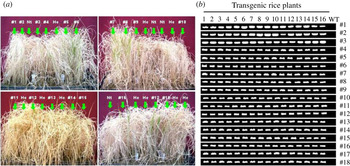
During primary screening of 6900 T2 rice plant lines (69 independent lines×100 T2 seeds), c. 1800 transgenic lines (18 independent lines×100 T2 seeds) showed an increased tolerance to salt stress when compared with WT rice plants in small pots containing a 5·8 g/l NaCl solution under greenhouse conditions at 28–32 °C (Fig. 2 a). Among these 18 independent lines, eight showed excellent characteristics under natural conditions in paddy fields. To ensure the genetic safety of the AVP1 transgene following generation, homozygous TRP were checked using a second PCR run, which confirmed that the Ubi-F and AVP1-R primers had been inserted into the genome of the 18 independent salt-tolerant TRP (Fig. 2 b). Two representative, independent transgenic rice plants (TRP1 and TRP2) were selected and used for subsequent physiological and biochemical assays.
For primary screening, a total of 6900 T2 rice plant lines (69 independent lines×100 T2 seeds) were grown in small pots containing 5·8 g/l NaCl solution under greenhouse conditions at 28–32 °C. (a) Approximately 1800 transgenic lines (18 independent lines × 100 T2 seeds) showed an increased tolerance to salt stress when compared with non-homozygous lines and non-transgenic WT rice plants. Numbers (#1, #2, #3, #4, #5, #6, #7, #8, #9, #10, #11, #12, #13, #14, #15, #16, #17 and #18) indicate independent homozygous transgenic lines. It was found that 6 (TRP1) and 8 (TRP2) showed greater tolerance to salt stress and increased yield parameters. He, heterozygote lines; Nt, non-transgenic lines. (b) PCR analysis of genomic DNA from transgenic rice plants (TRP) to monitor AVP1 gene expression. Numbers (1–16) represent independent transgenic lines (#1–#18); TRP and WT; control WT rice plants. (Colour version available online.)

Stress response and sodium accumulation in the presence of high salinity
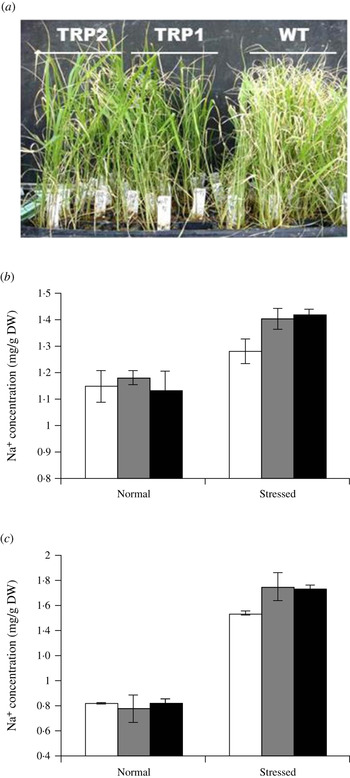
Molecular analysis showed that the AVP1 gene was constitutively expressed in the TRP. On the basis of these results, it was determined whether AVP1 overexpression increased acquired tolerance against salt stress in the TRP. The TRP1 and TRP2 rice plants were tolerant of the presence of 5·8 g/l NaCl when compared with the control WT rice plants (Fig. 3 a). Over time, physiological changes, including plant growth patterns following salt treatment, became visually distinct. Most of the WT rice plants withered and exhibited chlorosis within 21 days of salt treatment, whereas the TRP1 and TRP2 rice plants continued to grow in the absence of these physiological changes under the same conditions. The cellular Na+ concentration of the leaves and roots from TRP was increased by up to 116% when compared with the control WT rice plants, although the WT rice plants accumulated more Na+ in the presence of 5·8 g/l NaCl (Fig. 3 b, c). There was no difference in Na+ concentration between the transgenic and WT rice plants grown under normal conditions. Furthermore, the Na+ concentration was positively correlated with the level of AVP1 expression in TRP cultivated under saline conditions. Taken together, these results indicate that AVP1 overexpression confers enhanced salt tolerance to TRP via ion homoeostasis through increased Na+ ion accumulation capacity.
Salt stress response of transgenic and control WT rice plants. (a) Representative picture taken during salt stress treatment of transgenic and WT rice plants after 3 weeks of treatment with water containing 5·8 g/l NaCl. The Na+ content of (b) roots and (c) leaves of transgenic and WT rice plants subjected to treatment with 5·8 g/l NaCl for 12 days. White bars correspond to control WT rice plant Na+ values calculated as a percentage of total dry weight (DW). Grey and black bars correspond to the TRP1 and TRP2 transgenic rice plants. Data are expressed as the mean±s.d. of at least three replications from three independent experiments. (Colour version available online.)

Biomass analysis of transgenic rice plants grown under salt stress
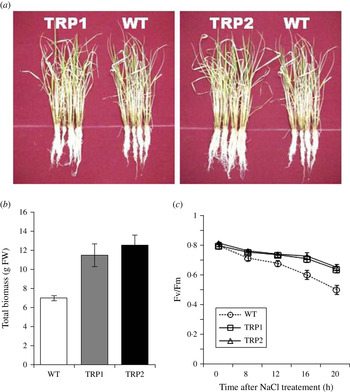
Transgenic rice plants expressing AVP1 performed better than the control WT rice plants, as indicated by their greater growth under saline conditions. The TRP1 and TRP2 plants exhibited better growth in NaCl-free water after salt treatment (Fig. 4 a) compared with the WT plants, even though there was only moderate growth development in the TRP cultivated under normal conditions (Supp. Fig. 1). Further, AVP1 overexpression in transgenic plants significantly increased total biomass accumulation in the shoot and root. The AVP1-expressing TRP had greater root and shoot biomass than the WT rice plants following treatment with 5·8 g/l NaCl and recovery for 14 days in pots irrigated with NaCl-free water (Fig. 4 a). The total biomass of the TRP was 71% (TRP1) and 80% (TRP2) greater compared with the WT rice plants (Fig. 4 b). The Fv/Fm values of transgenic rice plants (TRP1 and TRP2) were higher than those of the WT rice plants grown under 29 g/l NaCl for 20 h, even though the values decreased over time in both TRP1 and TRP2, and in WT rice plants (Fig. 4 c). Thus, these results suggest that improved growth performance results in transgenic plants that overexpress AVP1, at least in part, from improved total biomass through improved ion homoeostasis and increased photosynthetic ability in the presence of salt stress, which led to a reduction of stress-induced damage due to a decrease in root and shoot damage (particularly root injury).
Overexpression of the AVP1 gene in rice plants enhances tolerance of treatment with 5·8 g/l NaCl. (a) Phenotypes of TRP1, TRP2 and WT rice plants after 4 weeks of treatment with 5·8 g/l NaCl and then 2 weeks of recovery in water. (b) Fresh weight of TRP1, TRP2 and WT rice plants after salt treatment (5·8 g/l NaCl for 4 weeks followed by 2 weeks of recovery from salt stress). (c) The Fv/Fm value changes in transgenic (TRP1 to TRP2) and WT rice plants under 29 g/l NaCl conditions for 20 h. Leaf discs were pre-incubated in darkness overnight, after which the Fv/Fm was measured at 25 °C and a light intensity of photons (150 μmol/m2/s). Data are expressed as the mean±s.d. of at least three replications from three independent experiments. (Colour version available online.)

Comparative analysis of the photosynthetic ability of Arabidopsis thaliana vacuolar H+-pyrophosphatase-expressing transgenic rice plants under paddy field conditions
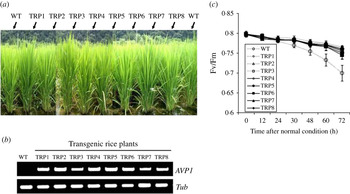
AVP1 expression levels were higher in eight independent TRP from seedlings grown for 60 days in the paddy fields (2011; Fig. 5 a) compared with the control WT rice plants, whereas no signal in WT rice plants was detected (Fig. 5 b). Chlorophyll-fluorescence was evaluated because the photochemical yield (Fv/Fm) of photosystem II is the parameter most commonly used to determine the effects of the stress or adaptation responses to environmental conditions. The initial Fv/Fm values were c. 0·8. Over time, the Fv/Fm values of TRP became higher than those of the WT rice plants, even though the values decreased over time in the transgenic and WT rice plants under normal conditions (Fig. 5 c). These results showed that AVP1 expression led to significant increases in the level of photosynthetic activity during leaf development, resulting in changes in the rate of plant growth development and leaf aging.
Assay of the photosynthetic capacity and phenotype under paddy field conditions. (a) (T3) generation (2011) phenotype analysis of homozygous transgenic rice (TRP1 to TRP8) and segregative WT rice plants at 60 days after rice planting under paddy field conditions. (b) Analysis using semi-quantitative RT-PCR. Semi-quantitative RT-PCR was carried out with leaf tissue of eight independent transgenic rice plants (TRP1 to TRP8) and control WT rice plants. The PCR amplicon of the tubulin (Tub) gene was used as a housekeeping control. (c) Changes in the Fv/Fm value in transgenic (TRP1 to TRP8) and WT rice plants under paddy field conditions. Leaf discs were pre-incubated in darkness overnight, after which Fv/Fm was measured at 25 °C and at a light intensity of photons (150 μmol/m2/s) under normal conditions for 72 h. Data are expressed as the mean±s.d. of at least three replications from three independent experiments. (Colour version available online.)

Phenotype and yield of rice plants grown in the field
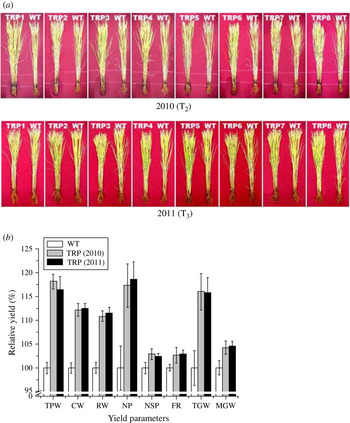
Transgenic rice plants showed increased biomass production (including roots and shoots) under paddy field conditions (Fig. 6 a). The following rice yield parameters increased in field trials in both 2010 and 2011 when compared with the control WT rice plants: culm weight (CW), root fresh weight (RW), number of panicles per hill (NP), number of spikelets per panicle (NSP), grain filling rate (FR), total grain weight (TGW) and mean grain weight (MGW), with increases in TGW of 15% being observed for the TRP (Fig. 6 b and Supp. Fig. 2). The only yield parameters that did not show a clear increase were NSP and FR. The current data also showed that the TRP produced 10–15% more TPW, CW, RW and NP than the WT rice plants. Taken together, the current findings indicate that the increase in TGW observed in the TRP probably resulted from increased TPW and NP. More importantly, the results of the current field tests indicated that TRP grew quickly and had a high rice grain yield (Fig. 6). The TRP also maintained higher chlorophyll-contents and had greater total plant biomass than the WT rice plants. These yield components included differences in agronomic traits, such as grain yield and biomass for AVP1-expressing TRP under the control of the Ubi promoter, which indicated that the AVP1 gene could play a very important role in adaptation to natural field conditions during the growing season.
Comparison of agronomic traits between transgenic and WT rice plants under normal paddy field conditions. (a) Phenotype during the late reproductive stage in both transgenic (TRP1 to TRP8) and WT rice plants in 2010 (upper panel) and 2011 (lower panel). (b) Agronomic traits of transgenic (TRP1 to TRP8) and WT rice plants grown under paddy field conditions for two growing seasons (2010 and 2011). Agronomic traits of 12 independent homozygous (evaluated in 2010 and 2011) rice plants for transgenic (averaged of TRP1 to TRP8) lines together with control WT rice plants were plotted using Microsoft Office Excel 2007. Each data point represents the percentage of the mean values with WT rice plants assigned a reference value of 100%. TPW, total plant biomass fresh weight; CW, culm weight; RW, root fresh weight; NP, number of panicles per hill; NSP, number of spikelets per panicle; FR, grain-filling rate; TGW, total grain weight; MGW, weight of 1000 grains. Data are expressed as the mean±s.d. of at least three replications from three independent experiments. (Colour version available online.)

DISCUSSION
One of the more promising means for increasing agricultural crop productivity is through plant biotechnology using variable genetic sources (Pasapula et al. Reference Pasapula, Shen, Kuppu, Paez-Valencia, Mendoza, Hou, Chen, Qiu, Zhu, Zhang, Auld, Blumwald, Zhang, Gaxiola and Payton2011). Therefore, the present study was conducted to identify methods for improving crop productivity by applying information gained from previous model systems. Currently, c. 0·2 of the world's irrigated land is contaminated with salt (Munns Reference Munns2005) and high salt levels are one of the principal factors limiting crop productivity. One strategy for improving the salt tolerance of plants is to increase the production of small osmolytes or the expression of cell rescue genes that protect against and reduce cellular damage caused by salt stress (Zhu Reference Zhu2001; Shi et al. Reference Shi, Lee, Wu and Zhu2003). Transgenic Arabidopsis plants overexpressing AVP1 have previously been shown to have a higher tolerance to salinity and drought stress than WT plants (Gaxiola et al. Reference Gaxiola, Li, Undurraga, Dang, Allen, Alper and Fink2001). On the basis of those results, the present study was conducted to determine if this method could enhance the traits of rice plants grown under high salinity and normal paddy field conditions. To accomplish this, TRP that express AVP1 under control of the maize ubiquitin promoter were developed. Expression of the transgene was confirmed by semi-quantitative RT-PCR and quantitative real-time PCR. These results indicated that ubiquitin, which is a valuable promoter in most types of monocotyledonous plant cells (McElroy et al. Reference McElroy, Zhang, Cao and Wu1990; McElroy & Brettell Reference McElroy and Brettell1994; Christensen & Quail Reference Christensen and Quail1996), was highly active in rice plants and may be useful for a variety of applications in rice biotechnology.
The activity of the vacuolar cation pump determines the efficiency of the active transport of solutes into vacuoles. Highly efficient import of the solutes decreases vacuolar membrane potential, improving a plant's ability to respond to water loss and leading to enhanced stress response under high salinity conditions (Li et al. Reference Li, Baldwin, Hu, Liu and Luo2010). As mentioned above, the TPR1 and TPR2 rice plants showed increased uptake of Na+, exhibiting higher Na+ levels in the roots and leaves than the control WT rice plants under salt stress. However, there was no difference in the uptake of Na+ between the transgenic and WT rice plants under normal conditions. If Na+ ions accumulate to high levels in other organs, such as the cytosol, but not the vacuoles, the plant cells are subject to detrimental effects including ionic imbalance and a disruption in the uptake of other solutes and nutrients, which leads to unstable metabolic homoeostasis (Li et al. Reference Li, Baldwin, Hu, Liu and Luo2010). Enhanced accumulation of Na+ ions in the vacuole of transgenic plants protects the cells from toxic ions produced by salt stress. The molecular mechanism of Na+ neutralization in the vacuolar zone of cells in response to salt stress is complex in terms of its response to environmental signals and signal conversion in cellular organizations following exogenous stimuli (Zhao et al. Reference Zhao, Zhang, Li, Zhao and Zhang2006). Inorganic pyrophosphatase (V-PPase) is an electrogenic proton pump that can acidify vacuoles in plant cells (Maeshima Reference Maeshima2000; Zhang et al. Reference Zhang, Li, Wang and Chen2011). Vacuolar membrane Na+/H+ antiporters pump Na+ ions into the vacuole through an electrochemical proton gradient (Zhao et al. Reference Zhao, Zhang, Li, Zhao and Zhang2006). It is likely that more protons are pumped into the vacuoles of transgenic plants due to increased V-PPase activity, which also helps restore cytoplasmic alkalinity (Apse et al. Reference Apse, Aharon, Snedden and Blumwald1999, Reference Apse, Sottosanto and Blumwald2003; Maeshima Reference Maeshima2000; Ohta et al. Reference Ohta, Hayashi, Nakashima, Hamada, Tanaka, Nakamura and Hayakawa2002; Zhao et al. Reference Zhao, Zhang, Li, Zhao and Zhang2006; Zhang et al. Reference Zhang, Li, Wang and Chen2011). As shown by the current data, vacuolar membrane Na+/H+ antiporters may reduce toxicity caused by excess Na + in the cytosol through Na+ sequestration within the vacuoles. This would improve the tolerance of rice plants to salt stress due to increased proton translocation resulting from AVP1 overexpression (Gaxiola et al. Reference Gaxiola, Li, Undurraga, Dang, Allen, Alper and Fink2001; Pasapula et al. Reference Pasapula, Shen, Kuppu, Paez-Valencia, Mendoza, Hou, Chen, Qiu, Zhu, Zhang, Auld, Blumwald, Zhang, Gaxiola and Payton2011). Therefore, the improved stress tolerance enhanced by AVP1 overexpression may be, at least partially, ascribed to the increased sequestration of Na+ into vacuoles under conditions of high salinity. This would help the plants to maintain ion homoeostasis, especially Na+ homoeostasis, and finally promote vacuolar osmoregulation. As mentioned above, the extensive roots and leaves of the TRP in the current study allowed greater water uptake during growth periods with limited soil water and increased salt concentrations. Increases in the number of vacuolar ions leads to increased cellular water uptake and maintenance, thereby reducing the extent of dehydration (Sharp et al. Reference Sharp, Poroyko, Hejlek, Spollen, Springer, Bohnert and Nguyen2004; Park et al. Reference Park, Li, Pittman, Berkowitz, Yang, Undurraga, Morris, Hirschi and Gaxiola2005; Pinheiro et al. Reference Pinheiro, Damatta, Chaves, Loureiro and Ducatti2005). Conversely, AVP1 overexpression increases solute accumulation and, therefore, enhances water retention in transgenic Arabidopsis and alfalfa (Gaxiola et al. Reference Gaxiola, Li, Undurraga, Dang, Allen, Alper and Fink2001; Gao et al. Reference Gao, Gao, Duan, Yue, Yang and Zhang2006).
It has previously been observed in transgenic Arabidopsis that plants expressing AVP1 were more tolerant to salt stress than WT plants. In the present study, rice plants expressing AVP1 grew much better under saline conditions in a hydroponic environment and recovered more quickly under salt-free conditions than control WT rice plants. Increased salt tolerance was evaluated by measuring the total biomass of the rice plants. The root and shoot biomass of the TRP1 and TRP2 rice plants were significantly higher than those of the WT rice plants grown for 14 days in salt-free soil after treatment with 5·8 g/l NaCl for 30 days. Furthermore, the current results showed that AVP1 overexpression led to similar improvements in the total biomass of rice plants investigated as observed in other systems, including tomato (Park et al. Reference Park, Li, Pittman, Berkowitz, Yang, Undurraga, Morris, Hirschi and Gaxiola2005), cotton (Pasapula et al. Reference Pasapula, Shen, Kuppu, Paez-Valencia, Mendoza, Hou, Chen, Qiu, Zhu, Zhang, Auld, Blumwald, Zhang, Gaxiola and Payton2011) and rice (Zhao et al. Reference Zhao, Zhang, Li, Zhao and Zhang2006). In the present study, the difference in total biomass between transgenic and WT rice plants can be attributed to an increase in photosynthetic capacity in response to improved ion homoeostasis under salt conditions. Therefore, the TRP1 and TRP2 rice plants maintained much higher chlorophyll contents than the WT rice plants grown in the presence of high salt concentration, which explains the increase in total biomass of the TRP. These results are also consistent with those of previous studies demonstrating that AVP1 expression leads to significant increases in total biomass in plants (Apse et al. Reference Apse, Aharon, Snedden and Blumwald1999; Gaxiola et al. Reference Gaxiola, Li, Undurraga, Dang, Allen, Alper and Fink2001; Li et al. Reference Li, Yang, Peer, Richter, Blakeslee, Bandyopadhyay, Titapiwantakun, Undurraga, Khodakovskaya, Richards, Krizek, Murphy, Gilroy and Gaxiola2005). Moreover, the results of the current field tests indicate that AVP1 TRP grew quickly and had a high grain yield. The transgenic plants were shown to maintain a higher photosynthetic capacity and had greater total biomass than WT rice plants, which explains the differences in biomass and grain yield between the transgenic and WT plants in the field under natural conditions. In the current study, over the two seasons (2010 and 2011) in a paddy field, there were significant differences in mean temperature, total precipitation (i.e. flooding and drought), total sunshine duration (i.e. light/dark cycle) and soil chemistry (e.g. nutrient components, such as minerals and phosphate, and contamination of metal ions and NaCl) (data not shown). The yield parameters evaluated are sensitive to these abiotic stresses including nutrient component, temperature, water stress, UV radiation and the light/dark cycle at different stages of plant growth, such as panicle exertion (Kim et al. Reference Kim, Kim, Bae, Choe, Kim, Park, Kang and Yoon2013). Despite the climatic differences between 2010 and 2011, there were no differences in agronomic traits in TRP that overexpressed AVP1. The functional importance of H+-PPase in the plant's ability to adapt to unfavourable stress has been previously described, but to date there have been no field study reports. The overexpression of AVP1 results in an enhanced tolerance to salt and drought, and an increase in total biomass (i.e. root and shoot) through a stimulation of auxin transport (Lee et al. Reference Lee, Kim, Bang, Lee, Kwak and Kwon2007; Pasapula et al. Reference Pasapula, Shen, Kuppu, Paez-Valencia, Mendoza, Hou, Chen, Qiu, Zhu, Zhang, Auld, Blumwald, Zhang, Gaxiola and Payton2011), or phosphorus nutrition (Yang et al. Reference Yang, Knapp, Koirala, Rajagopal, Peer, Silbart, Murphy and Gaxiola2007), an essential macronutrient required for plant growth and development (Takeda & Matsuoka Reference Takeda and Matsuoka2008). A similar physiological phenotype has been reported in transgenic cotton where the rate of photosynthesis, as determined by chlorophyll retention, stomatal conductance and root development in Thellungiella halophile H+-PPase (TsVP)-overexpressing transgenic cotton plants, was higher than in the control WT plants under non-stress conditions. Of note, these TsVP transgenic cotton plants were also salt tolerant (Gaxiola et al. Reference Gaxiola, Sanchez, Paez-Valencia, Ayre and Elser2012). In other studies it has been shown that transgenic cotton plants with AVP1 expression under the control of the 35S promoter also developed larger root systems under normal conditions (Pasapula et al. Reference Pasapula, Shen, Kuppu, Paez-Valencia, Mendoza, Hou, Chen, Qiu, Zhu, Zhang, Auld, Blumwald, Zhang, Gaxiola and Payton2011; Gaxiola et al. Reference Gaxiola, Sanchez, Paez-Valencia, Ayre and Elser2012). Rice plants expressing a vacuolar H+-PPase subunit c1 (SaVHAc1) gene from a halophyte grass Spartina alterniflora increased ion homoeostasis, net photosynthetic machinery, protein sorting and membrane fusion events that are needed to promote vegetative growth and rice yield (Baisakh et al. Reference Baisakh, RamanaRao, Rajasekaran, Subudhi, Janda, Galbraith, Vanier and Pereira2012). Further, SaVHAc1 expression led to increased accumulation of transcripts of other native genes in transgenic rice, particularly those involved in cation transport (OsCTP and OsNHX1) and ABA signalling (OsPLDα, OsGPA1 and OsSORK) under environmental stress (Baisakh et al. Reference Baisakh, RamanaRao, Rajasekaran, Subudhi, Janda, Galbraith, Vanier and Pereira2012), indicating that H+-PPase influenced plant growth development and signalling, are strongly supported by genetic evidence from studies using a mutant of H+-PPase. The det3 mutant, which reduces subunit C transcription and H+-PPase activity, decreased germination under dark conditions, and its isogenic mature plant was a dwarf compared with the WT plants (Schumacher et al. Reference Schumacher, Vafeados, Mccarthy, Sze, Wilkins and Chory1999). Further, the dsRNA-mediated RNAi mutant plants of VHAc1 showed a decrease in root and hypocotyl length (Baisakh et al. Reference Baisakh, RamanaRao, Rajasekaran, Subudhi, Janda, Galbraith, Vanier and Pereira2012). Taken together, the current results further confirm that, despite the origin of the H+-PPase and the recipient of the expression chimaera, its overexpression shows similar phenotypes, namely, those that are easily explained by a vacuole-localized H+-PPase (e.g. stress tolerance to high salinity and drought) and those that are not (e.g. increased grain yield through enhanced root and shoot biomass) (Gaxiola et al. Reference Gaxiola, Sanchez, Paez-Valencia, Ayre and Elser2012). In addition to H+-PPase, previous studies have also demonstrated that overexpression of stress-related genes in rice plants increases tolerance of abiotic stresses, including heat, drought, cold and salt during the reproductive stage (Singh Reference Singh2001; Peng et al. Reference Peng, Huang, Sheehy, Laza, Visperas, Zhong, Centeno, Khush and Cassman2004; Oh et al. Reference Oh, Song, Kim, Jang, Kim, Kim, Kim, Nahm and Kim2005, Reference Oh, Kim, Kwon, Park, Jeong and Kim2009; Jeong et al. Reference Jeong, Kim, Baek, Jung, Ha, Choi, Kim, Reuzeau and Kim2010), which improves photosynthetic capacity (Lv et al. Reference Lv, Zhang, Gao, Lian, Song and Zhang2008; Nagai & Makino Reference Nagai and Makino2009), growth, total biomass development and grain yield (Zhu Reference Zhu2001; Shi et al. Reference Shi, Lee, Wu and Zhu2003; Peng et al. Reference Peng, Huang, Sheehy, Laza, Visperas, Zhong, Centeno, Khush and Cassman2004; Ibrahim et al. Reference Ibrahim, Khan, Zafar, Mansoor, Yusuf and Mukhtar2009; Kim & Kim Reference Kim and Kim2009; Liu et al. Reference Liu, Tang, Zhang, Wang, Lv, Gao, Li and Zhang2010; Bhaskaran & Savithramma Reference Bhaskaran and Savithramma2011; Pasapula et al. Reference Pasapula, Shen, Kuppu, Paez-Valencia, Mendoza, Hou, Chen, Qiu, Zhu, Zhang, Auld, Blumwald, Zhang, Gaxiola and Payton2011). The current results, along with those of previous studies, strongly suggest that AVP1 can be used to engineer rice plants exhibiting increased total biomass when grown under natural conditions in paddy fields.
The current paper demonstrated that AVP1 expression in TRP increased tolerance to salt stress. This effect was related to Na + accumulation along with an increase in the development of total biomass through enhanced photosynthetic rates to decrease withering and chlorosis of leaves in TRP under salt stress. Ectopic AVP1 expression also improved adjustment to various environmental conditions, augmented rice grain yield, and increased total biomass in rice plants grown in paddy fields. In summary, the results of the current investigation provides valuable information that can be used to improve agronomic traits in natural paddy fields, but also for improving the crop's salt tolerance in areas where salinity is a limiting factor for agricultural productivity. Further study is needed to understand how regulatory networks are correlated with physiological and molecular mechanisms in TRP grown in both the presence of high salt concentrations and under natural conditions in paddy fields.
SUPPLEMENTARY MATERIALS
Available at http://journals.cambridge.org/AGS
This work was supported by a grant from the Next-Generation BioGreen 21 Programme (grant numbers PJ008115012013 and PJ008060022013), Rural Development Administration and in part by the Priority Research Centers Programme (grant number 2011-0030748) through the National Research Foundation funded by the Ministry of Education, Science and Technology, South Korea.