Introduction
Major depressive disorder (MDD) is the main cause of disability worldwide, affecting around 350 million individuals (WHO, 2017) with significant direct and indirect costs. Several drugs are available to manage MDD, from those acting primarily on monoaminergic pathways [selective serotonin reuptake inhibitors (SSRIs), serotonin and norepinephrine reuptake inhibitors (SNRIs), tricyclic antidepressants (TCAs)] (Girardi et al., Reference Girardi, Pompili, Innamorati, Mancini, Serafini, Mazzarini and Baldessarini2009), to agomelatine targeting mainly melatonergic pathways (Pompili et al., Reference Pompili, Serafini, Innamorati, Venturini, Fusar-Poli, Sher and Girardi2013). However, despite several therapeutic alternatives, the outcome of MDD remains poor with low response and remission rates after antidepressant treatment (Trivedi et al., Reference Trivedi, Rush, Wisniewski, Nierenberg, Warden and Ritz2006). A better understanding of the underlying pathophysiology of major depressive episodes (MDEs) in a context of MDD could improve its treatment and prognosis, notably through the identification of biomarkers (Ozomaro, Wahlestedt, & Nemeroff, Reference Ozomaro, Wahlestedt and Nemeroff2013).
Growing evidence suggests changes of mitochondrial metabolites among patients suffering from MDE (Pu et al., Reference Pu, Liu, Zhang, Tian, Gui, Yu and Xie2020; Sharma & Akundi, Reference Sharma and Akundi2019). Indeed, mitochondria produce energy for cerebral cellular function (Jensen, Wodschow, Nilsson, & Rungby, Reference Jensen, Wodschow, Nilsson and Rungby2020), the human brain being one of the organs with the greatest energy needs. A decreased brain energy production has been shown in depressed patients (Manji et al., Reference Manji, Kato, Di Prospero, Ness, Beal, Krams and Chen2012). Besides, symptoms of MDE, including loss of energy, tiredness, weakness, cognitive impairments, sleep disturbance, loss of appetite, are frequent in mitochondrial diseases (Gardner & Boles, Reference Gardner and Boles2011; Manji et al., Reference Manji, Kato, Di Prospero, Ness, Beal, Krams and Chen2012). In preclinical models, depression phenotype leads to reduce mitochondrial dioxygen consumption and acetyl-CoA concentration and induce mitochondrial structural damage (Gong, Chai, Ding, Sun, & Hu, Reference Gong, Chai, Ding, Sun and Hu2011; Rezin, Amboni, Zugno, Quevedo, & Streck, Reference Rezin, Amboni, Zugno, Quevedo and Streck2009).
Among molecules involved in mitochondrial metabolism, acyl-carnitines are mainly involved in energy production (Jones, McDonald, & Borum, Reference Jones, McDonald and Borum2010). The two main forms of carnitines are free (non-esterified) l-carnitine and its short-chain acetyl ester, acetyl-l-carnitine (ALC). Recently, plasma ALC has been shown to be an interesting biomarker in MDE, since it was lower in MDE patients compared to healthy controls (HCs) (Nasca et al., Reference Nasca, Bigio, Lee, Young, Kautz, Albright and Rasgon2018). ALC is widely synthesised in the mitochondrial matrix. l-Carnitine is synthesised partially in the mitochondria, while absorption from diet represents up to 75% of total body carnitines (Jones et al., Reference Jones, McDonald and Borum2010; Reuter & Evans, Reference Reuter and Evans2012). l-Carnitine is mainly known as a shuttle of long-chain fatty acids, involved in β-oxidation, from the cytosol to the mitochondrial matrix (Jones et al., Reference Jones, McDonald and Borum2010; Pettegrew, Levine, & McClure, Reference Pettegrew, Levine and McClure2000). ALC is an antioxidant molecule involved in epigenetics thought the acetylation of histones and proteins (Jones et al., Reference Jones, McDonald and Borum2010; Post, Reference Post2018). Moreover, l-carnitine and ALC are involved in acetyl-CoA homoeostasis. Indeed, ALC provides acetyl moiety to CoA in the case of low concentration of acetyl-CoA and l-carnitine retrieves this moiety in the case of high concentration whereas acetyl-CoA is paramount for the mitochondrial energy metabolism and ATP production (online Supplementary Fig. S1). Hence, the l-carnitine/ALC ratio could be a proxy of the acetyl-CoA availability in mitochondria.
Recent studies suggest l-carnitine and ALC involvements in MDE and its treatment (Ahmed et al., Reference Ahmed, MahmoudianDehkordi, Bhattacharyya, Arnold, Liu, Neavin and Kaddurah-Daouk2020; Nasca et al., Reference Nasca, Bigio, Lee, Young, Kautz, Albright and Rasgon2018; Pu et al., Reference Pu, Liu, Zhang, Tian, Gui, Yu and Xie2020). In a rat model of depression, a reduced cerebral level of ALC has been shown in the hippocampus and in the prefrontal cortex (Nasca et al., Reference Nasca, Xenos, Barone, Caruso, Scaccianoce, Matrisciano and Nicoletti2013). Case–control studies and a meta-analysis showed that plasma ALC levels, but not necessarily l-carnitine levels, may be decreased in depressed patients compared to HCs (Nasca et al., Reference Nasca, Bigio, Lee, Young, Kautz, Albright and Rasgon2018; Nie et al., Reference Nie, Liang, Shan, Xu, Yan, Zhou and Xia2021; Pu et al., Reference Pu, Liu, Zhang, Tian, Gui, Yu and Xie2020) and that plasma ALC levels may be negatively correlated with depression severity (Nasca et al., Reference Nasca, Bigio, Lee, Young, Kautz, Albright and Rasgon2018). However, in depressed patients, the effects of antidepressant drugs on ALC levels remain controversial since studies shown a decrease after treatment with escitalopram or citalopram (Ahmed et al., Reference Ahmed, MahmoudianDehkordi, Bhattacharyya, Arnold, Liu, Neavin and Kaddurah-Daouk2020; MahmoudianDehkordi et al., Reference MahmoudianDehkordi, Ahmed, Bhattacharyya, Han, Baillie and Arnold2021) but an increase in ALC levels after treatment with ketamine or esketamine (Moaddel et al., Reference Moaddel, Shardell, Khadeer, Lovett, Kadriu, Ravichandran and Zarate2018; Rotroff et al., Reference Rotroff, Corum, Motsinger-Reif, Fiehn, Bottrel, Drevets and Kaddurah-Daouk2016).
Consequently, we raised the hypothesis that, in addition to plasma ALC decrease, patients with a current MDE could exhibit a higher plasma l-carnitine level and that those parameters could be restored after antidepressant treatment. Thus, our first aim was to investigate, prospectively, the peripheral levels of l-carnitine, ALC and the l-carnitine/ALC ratio in patients with a current MDE. Our second aim was to assess their changes after antidepressant treatment.
Patients and methods
Patients with major depression
This study was conducted in the METADAP cohort (Corruble et al., Reference Corruble, El Asmar, Trabado, Verstuyft, Falissard, Colle and Becquemont2015), a 6-month prospective, multicentre (six French university hospitals), naturalistic, treatment open study, including patients suffering from a current MDE in a context of MDD (DSM-IV-TR criteria), and requiring a new antidepressant treatment. The antidepressant treatment had to be a monotherapy. The drug and its dose were left to the treating psychiatrist, using ‘real-world’ treatment options, in which the clinician was free to prescribe any antidepressant drug approved by the European authorities and a dose of this antidepressant drug within the recommended therapeutic range. Written informed consent was obtained from all patients participating in this study, which was approved by the Ethics Committee and was registered by the French National Agency for Medicine and Health Products Safety (ANSM) and the Commission Nationale de l'Informatique et des Libertés (CNIL) (ClinicalTrials.gov Identifier: NCT00526383). The authors assert that all procedures contributing to this work comply with the ethical standards of the relevant national and institutional committees on human experimentation and with the Helsinki Declaration of 1975, as revised in 2008.
Patients were included, from November 2009 to March 2013, based on the following criteria: aged 18–65 years, with a minimum score of 18 at the Hamilton Depression Rating Scale-17 items (HDRS-17) (Hamilton, Reference Hamilton1960). Patients with treatment-resistant depression were not excluded. Moreover, patients with suicidal ideation or with a suicide attempt prior to the study were not excluded. Patients with psychotic symptoms were excluded. The other exclusion criteria in this study were patients with bipolar disorders, psychotic disorders, eating disorders, current substance abuse or dependence, organic brain syndromes, severe unstable medical conditions or pregnancy. Patients receiving antipsychotics or mood stabilisers before inclusion and/or for at least 4 months during the last year were not included. From the 624 patients of the METADAP cohort, blood samples of the 164 patients of a single centre were not available for metabolic analyses. Thus, 460 patients were analysed.
Patients were assessed at inclusion before treatment (M0), and 3 months (M3) and 6 months (M6) after the beginning of treatment, which are the recommended durations to assess remission, response and recovery after an antidepressant treatment according to the American College of Neuropsychopharmacology (ACNP) Task Force (Rush et al., Reference Rush, Kraemer, Sackeim, Fava, Trivedi, Frank and Schatzberg2006). Clinical assessments were performed by the same senior psychiatrist for each visit. The HDRS-17 (Hamilton, Reference Hamilton1960) was used to assess the depression severity, this scale being the gold standard to assess symptom changes after antidepressant treatment (Carrozzino, Patierno, Fava, & Guidi, Reference Carrozzino, Patierno, Fava and Guidi2020). There were no missing values at baseline, 8 at M3 and none at M6 for the HDRS-17 during all the follow-ups. Moreover, a self-questionnaire, the Quick Inventory of Depressive Symptomatology – Self-Report (QIDS-SR) (Rush et al., Reference Rush, Trivedi, Ibrahim, Carmody, Arnow, Klein and Keller2003), a questionnaire of 16 items, was chosen to assess the severity of MDE symptoms from the patient viewpoint. The QIDS-SR is validated and widely used to assess the response to an antidepressant treatment (Rush et al., Reference Rush, Kraemer, Sackeim, Fava, Trivedi, Frank and Schatzberg2006). For the QIDS-SR, there were 14 missing values at baseline, 13 at M3 and none at M6. Suicidal ideation was also assessed, high suicidal ideation being defined by a score of 3 or 4 on the HDRS-17 suicide item and a low ideation by a score of 0, 1 and 2 (Kellner et al., Reference Kellner, Fink, Knapp, Petrides, Husain, Rummans and Malur2005).
Response and remission were defined according to the recommendations of the ACNP Task Force (Rush et al., Reference Rush, Kraemer, Sackeim, Fava, Trivedi, Frank and Schatzberg2006). Response was defined according to a HDRS total score decrease of at least 50% from baseline to follow-up. Remission was defined according to a HDRS total score less than or equal to 7.
In total, 282 patients dropped out from the study. The reasons were antidepressant drug changes for insufficient effectiveness or tolerance (n = 103; 36.5%), lost to follow-up (n = 152; 53.9%), the presence of an exclusion criterion during the follow-up as unstable medical condition, psychiatric disorder, substance abuse or pregnancy (n = 13; 4.6%), use of unauthorised drugs as antipsychotics or mood-stabilisers during the follow-up (n = 12; 4.3%) or the death of the patient (n = 2; 0.7%). More specifically, 208 (45.2%) depressed patients dropped out prematurely from the study before 3 months of treatment (of whom 58 due to antidepressant changes, 129 lost to follow-up, 10 for a new exclusion criterion, 9 for using unauthorised drugs and 2 deaths), and 74 patients (29.4%) between 3 and 6 months of treatment (of whom 45 were due to antidepressant changes, 23 were lost to follow-up, 3 for a new exclusion criterion and 3 for using unauthorised drugs). The median time of follow-up was 3 months (min–max: 0–6 months).
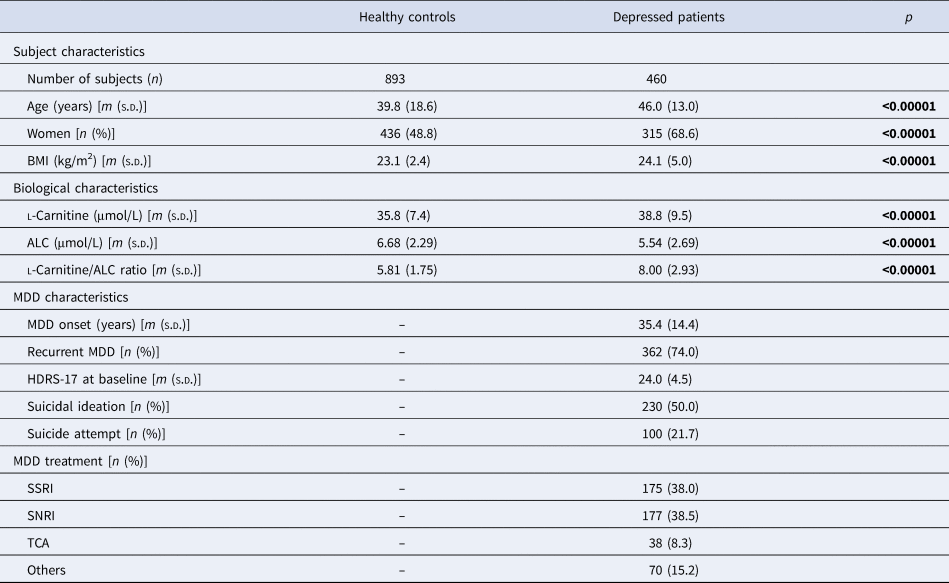
In total, 132 patients (54.1%) were responders and 69 (28.3%) were remitters at 3 months. In total, 119 patients (66.9%) were responders and 77 (43.3%) were remitters after 6 months of treatment. Depressed patients were treated with an SSRI (n = 175, 38.0%), mainly escitalopram and citalopram, 177 (38.5%) were treated with an SNRI mainly venlafaxine, 38 (8.3%) were treated by TCA and 70 (15.2%) with another one (Table 1).
Sociodemographic and clinical characteristics and plasma l-carnitine and ALC levels in HCs and depressed patients at baseline

ALC, acetyl-l-carnitine; BMI. body mass index; MDD, major depressive disorder; HDRS-17, Hamilton Depression Rating Scale 17-Items; n, number of subjects; m, mean; s.d., standard deviation; SSRI, selective serotonin reuptake inhibitor; SNRI, serotonin and norepinephrine reuptake inhibitor; TCA, tricyclic antidepressant; others, other classes of antidepressants.
Wilcoxon tests were performed to compare HCs and depressed patients for clinical characteristics (age, gender and BMI). Linear regressions adjusted for age, gender and BMI were performed to compare HCs and depressed patients for biological characteristics (l-carnitine, ALC and l-carnitine/ALC ratio). Bold p value: significance after Bonferroni corrections (p < 0.0167).
Healthy controls
HCs were those of the VARIETE cohort, a cross-sectional study of the general Caucasian population (Chanson et al., Reference Chanson, Arnoux, Mavromati, Brailly-Tabard, Massart and Young2016; Trabado et al., Reference Trabado, Al-Salameh, Croixmarie, Masson, Corruble, Fève and Chanson2017). Subjects were recruited through clinical research units in 10 French university hospitals between January 2011 and February 2012, in order to constitute a cohort of healthy participants. All participants gave written informed consent before entering the study. This study was approved by the French National Agency for Medicine and Health Products Safety (ANSM) and the Ethics Committee (ClinicalTrials.gov identifier: NCT01831648). To be included in the study, adult subjects (aged 18–89 years) had to be healthy according to medical and psychiatric history, clinical examinations and standard biological tests performed after an overnight fast. The exclusion criteria were any history of medical condition or psychiatric disorder, substance use, pregnancy or breast-feeding and a history of blood transfusion or donation within the 3 months prior to inclusion. The VARIETE cohort included 895 subjects, but two blood samples were not available. Thus, 893 subjects were analysed.
Plasma l-carnitine and ALC measures
Ethylenediamine tetraacetic acid (EDTA) blood samples were obtained from each subject under fasting standardised conditions for both depressed patients and HCs. Blood samples were obtained between 8:00 and 10:00 a.m. after an overnight fast, before any drug intake as previously detailed (Trabado et al., Reference Trabado, Al-Salameh, Croixmarie, Masson, Corruble, Fève and Chanson2017). For depressed patients and HCs, EDTA samples were obtained at each time of the study (M0 ± M3 and M6). EDTA blood samples were obtained from each subject and immediately centrifuged (10 min, 3000 RPM at 4°C), then plasma was aliquoted and immediately stored at −80°C in the same laboratory. One aliquot of 10 μL was analysed with a Biocrates AbsoluteIDQ p180 Kit (Biocrates Life Science AG, Austria) that quantified plasma l-carnitine and ALC. The plasma samples were processed according to the manufacturer's procedure and analysed on an API 4000 Q-TRAP mass spectrometer (AB Sciex, Darmstadt, Germany) coupled to an ACQUITY UPLC I Class system (Waters Corporation, Milford, MA, USA) equipped with an Agilent C18 HPLC column as previously described (Loeb et al., Reference Loeb, El Asmar, Trabado, Gressier, Colle, Rigal and Corruble2020). There were no missing biological data in HCs and in depressed patients at baseline, and 14 and 5 missing data at M3 and M6 in depressed patients, respectively. To prevent potential storage and batch effects, the biological samples were assayed at the same time (mixing randomly both cohorts independently from the time of evaluation for depressed patients) in the same laboratory using the same techniques for depressed patients and HCs.
Statistical analyses
The statistical analyses were performed using R 4.0.3 (The R Foundation; https://www.r-projet.org). The normality of distributions of biological parameters was assessed according to Kolmogorov–Smirnov tests. Bivariate analyses were performed to compare depressed patients and HCs for socio-demographical (χ2 test for qualitative variables and Wilcoxon tests for quantitative variables). Bivariate analyses (Wilcoxon tests, Spearman's correlation tests and Kruskal–Wallis tests) and multivariate analyses adjusted for age, gender and body mass index (BMI) were performed to compare plasma l-carnitine and ALC levels and the l-carnitine/ALC ratio in depressed patients and HCs. Equally, stratified analyses taking into account age, gender and BMI were performed for all biological parameters. Spearman's correlation tests were used to analyse associations between l-carnitine and ALC levels and the l-carnitine/ALC ratio with MDE severity (according to HDRS scores). To assess plasma l-carnitine and ALC level changes and the l-carnitine/ALC ratio change after antidepressant treatment in depressed patients, multivariate analyses based on mixed-effect models for repeated measures adjusted for age, gender, BMI, HDRS and antidepressant class were performed. Using mixed-effect models, we analysed our data in a long format, therefore a patient with missing data on a specific visit/time-point will not result in a complete loss of information for that patient; and an average estimation could still be calculated based on the remaining non-missing data points (Mallinckrodt et al., Reference Mallinckrodt, Sanger, Dubé, DeBrota, Molenberghs, Carroll and Tollefson2003). In the case of significance in mixed-effect models, multivariate linear and logistic regressions adjusted for age, gender, BMI and antidepressant class were performed between each contiguous point and between depressed patients and HCs. Covariables of the multivariate models were selected based on differences in bivariate analyses, with a significant threshold of 0.05. Then, mixed models for repeated measures for plasma l-carnitine and ALC levels and for the l-carnitine/ALC ratio were performed according to response/remission after 3 and 6 months of antidepressant treatment. All tests were two-tailed. The significance threshold retained for mixed model analyses for repeated measures was p < 0.05. Based on the three time points assessed and Bonferroni corrections, the significance threshold retained was p < 0.0167 in bivariate and multivariate analyses.
Results
Socio-demographic and clinical characteristics
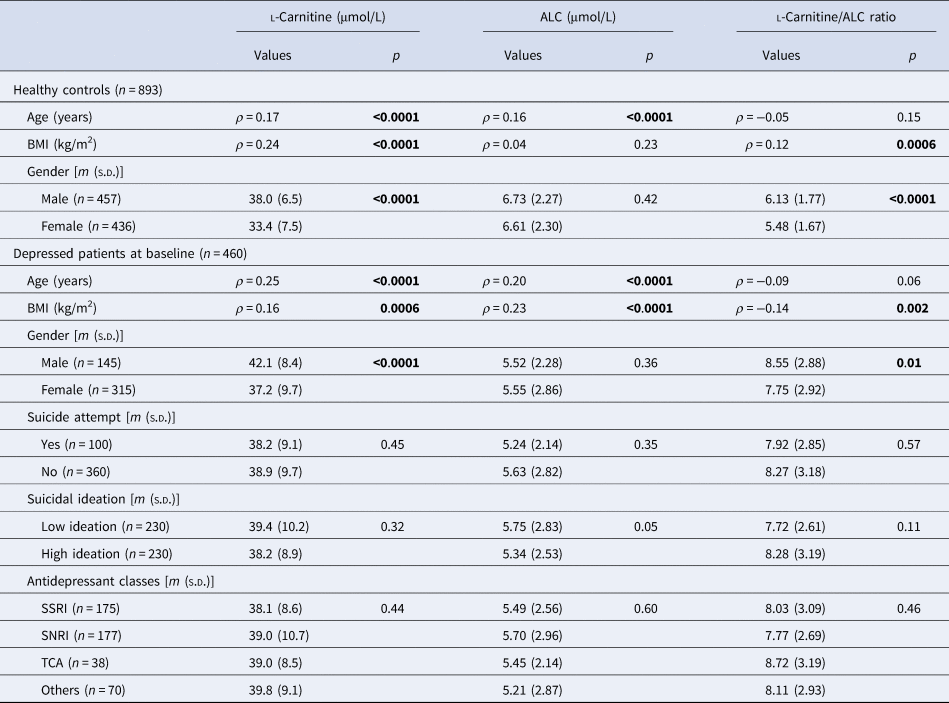
Socio-demographic and clinical characteristics of the 460 depressed patients and 893 HCs are shown in Table 1. Depressed patients and HCs differed for age, gender and BMI. Plasma l-carnitine and ALC levels and l-carnitine/ALC ratios were not normally distributed (p < 0.01 for the three tests). The associations of socio-demographic variables and ALC, l-carnitine levels and l-carnitine/ALC ratios (Table 2) revealed significant associations with age, BMI and gender. However, in depressed patients, there were no associations between these three biological parameters at baseline and suicidal ideation, suicide attempts or antidepressant drug treatments (Table 2).
Association between plasma l-carnitine and ALC levels and the l-carnitine/ALC ratio and sociodemographic characteristics of depressed patients at baseline and HCs

ALC, acetyl-l-carnitine; BMI, body mass index; n, number of patients; m, mean; s.d., standard deviation; SSRI, selective serotonin reuptake inhibitor; SNRI, serotonin and norepinephrine reuptake inhibitor; TCA, tricyclic antidepressant; others, other antidepressants.
Spearman's correlation tests, Wilcoxon tests and Kruskal–Wallis tests were performed. Bold p value: significance after Bonferroni corrections (p < 0.0167).
Depressed patients had lower ALC, higher l-carnitine levels and higher l-carnitine/ALC ratios at baseline
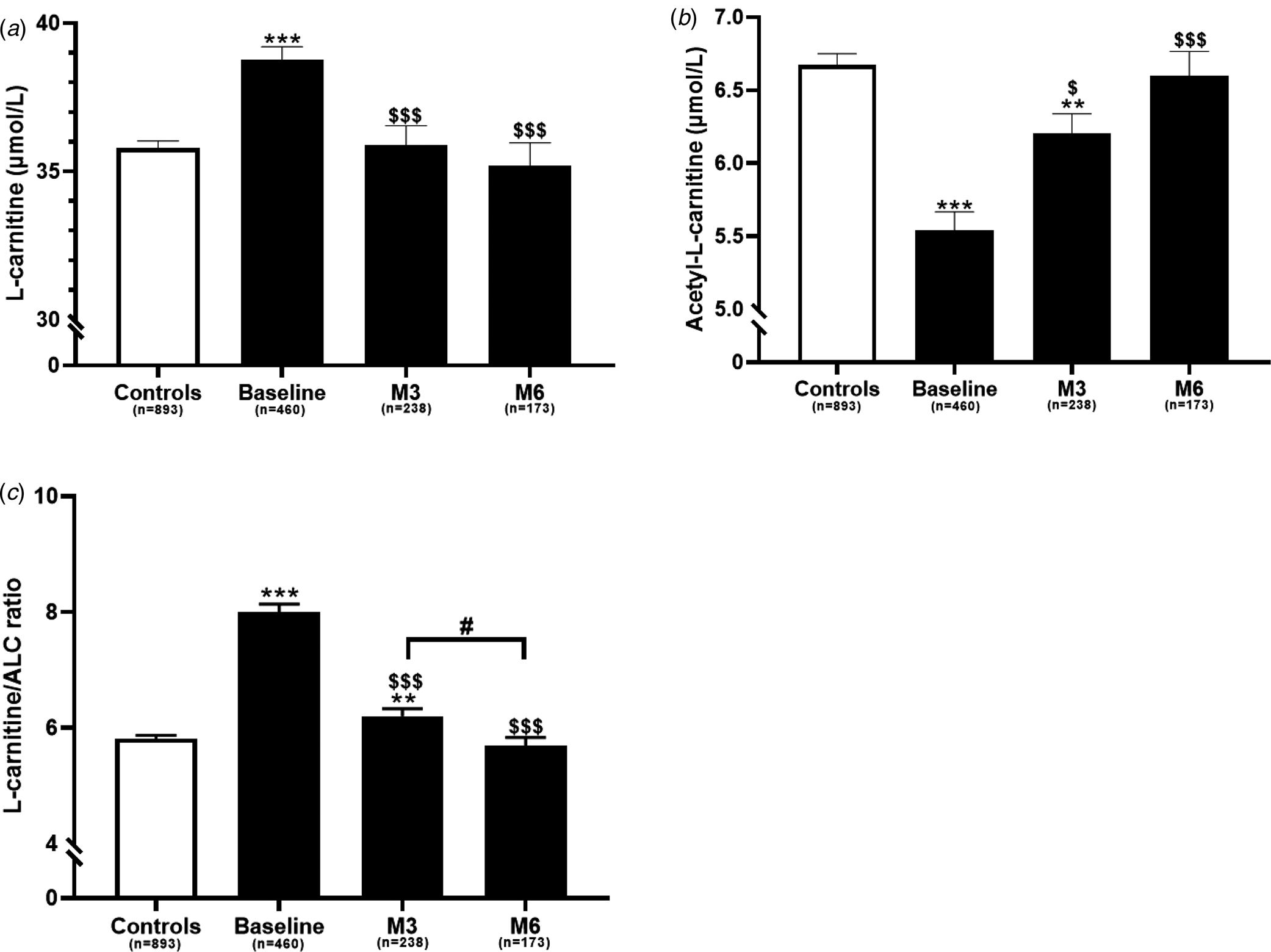
At baseline, depressed patients had significantly higher plasma l-carnitine levels, lower plasma ALC levels and higher l-carnitine/ALC ratios compared to HCs, both in bivariate and multivariate analyses adjusted for age, gender and BMI (Fig. 1 and Table 1). These differences remained significant in stratified analyses according to age, gender and BMI (online Supplementary Table S1).
Plasma l-carnitine and ALC levels and the ratio l-carnitine/ALC in HCs and in depressed patients over time. (a) Plasma l-carnitine levels [m (s.e.m.)] in HCs and in depressed patients over time. (b) Plasma ALC levels [m (s.e.m.)] in HCs and in depressed patients over time. (c) Ratios of l-carnitine/ALC [m (s.e.m.)] in HCs and in depressed patients over time. Multivariate tests by logistic regressions adjusted for age, sex, body mass index and antidepressant class were performed between HCs and depressed patients and between each time points. M3, at 3 months; M6, at 6 months; ALC, acetyl-l-carnitine. **p < 0.001, ***p < 0.0001 compared to HCs, $p < 0.0167, $$$p < 0.0001 compared to depressed patients at baseline, #p < 0.0167.

l-Carnitine and ALC levels and l-carnitine/ALC ratios were associated with the severity of MDE symptoms
In depressed patients at baseline, M3 and M6, there was a negative correlation between HDRS total scores and plasma ALC levels (ρ = −0.19; p < 0.00001) and there were positive correlations between HDRS total scores and plasma l-carnitine levels (ρ = 0.12; p = 0.0003), and l-carnitine/ALC ratios (ρ = 0.28; p < 0.00001) (online Supplementary Fig. S2). Accordingly, in multivariate analyses adjusted for age, gender and BMI, associations remained consistent (respectively p = 0.002, p < 0.00001 and p < 0.00001). Concordant correlations were identified between QIDS-SR total scores and studied parameters (online Supplementary Fig. S3).
l-Carnitine and ALC levels of depressed patients were restored after antidepressant treatment
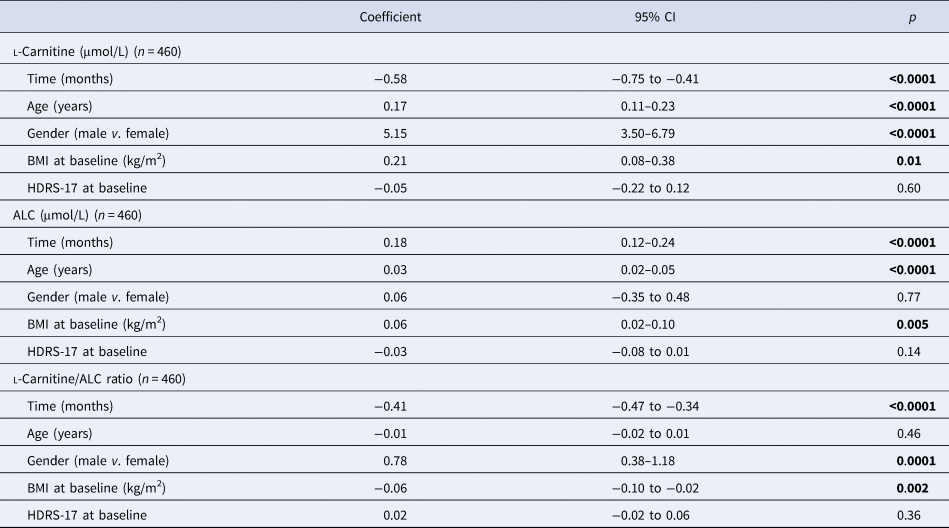
In mixed models for repeated measures adjusted for age, gender, BMI at baseline, HDRS at baseline and antidepressant class (Table 3), plasma l-carnitine levels and l-carnitine/ALC ratios significantly decreased over time after 3 and 6 months of antidepressant treatment in depressed patients. Accordingly, plasma l-carnitine levels and l-carnitine/ALC ratios were significantly lower from baseline after 3 months and 6 months of treatment (Figs. 1a and c).
Mixed model analyses for repeated measures for l-carnitine, ALC and the l-carnitine/ALC ratio in depressed patients over time

HDRS-17, Hamilton Depression Rating Scale 17 Items; n, number of patients; BMI, body mass index.
Mixed model analyses were adjusted for age, gender, BMI at baseline, HDRS at baseline and antidepressant class. Bold p value: p < 0.05.
Plasma ALC levels significantly increased over time after 3 and 6 months of antidepressant treatment in depressed patients (Fig. 1b) in a mixed model for repeated measures adjusted for age, gender, BMI, HDRS and antidepressant class (Table 3). Accordingly, plasma ALC levels were significantly higher from baseline after 3 months and 6 months of treatment (Fig. 1b).
Of note, after 6 months of antidepressant treatment, depressed patients did not differ from HCs, neither for l-carnitine and ALC levels, nor for their ratio (bivariate and multivariate analyses). These results remained significant in stratified analyses according to age, gender and BMI (online Supplementary Table S1).
The l-carnitine and ALC levels and their ratio were not associated with the antidepressant drug treatment (online Supplementary Table S2).
A lower l-carnitine/ALC ratio at baseline could predict remission after 3 months of antidepressant treatment
In mixed models for repeated measures over time adjusted for age, sex, BMI and antidepressant class, there was an interaction between time and remission at M3 [coefficient: −0.16; 95% confidence interval (CI) −0.31 to −0.01; p = 0.03] and response at M3 for the l-carnitine/ALC ratio (coefficient: −0.14; 95% CI −0.28 to −0.00; p = 0.05). No interaction was evidenced for plasma l-carnitine and ALC levels (online Supplementary Tables S3–S5).
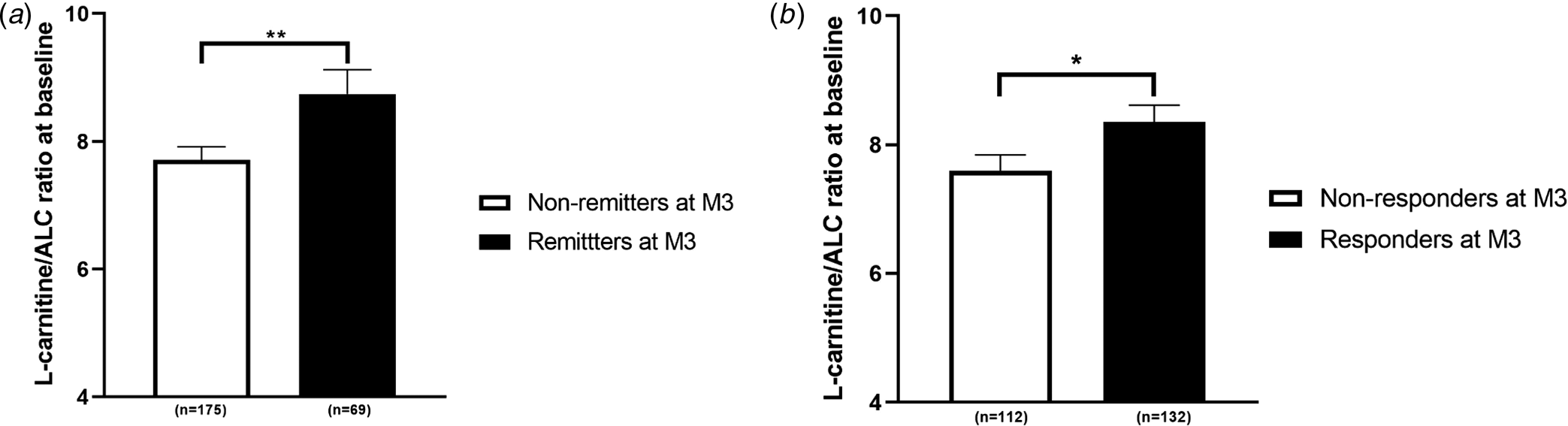
In line with evidenced interactions, compared to non-remitters, remitters after 3 months of antidepressant treatment had a higher l-carnitine/ALC ratio at baseline compared to non-remitters [respectively 8.75 (3.13) μmol/L v. 7.71 (2.70) μmol/L; bivariate p = 0.01] and logistic regression adjusted for age, gender, BMI and antidepressant class confirmed this result [odds ratio (OR) = 1.14; 95% CI 1.03–1.27; p = 0.015] (Fig. 2a). Compared to non-responders, responders at M3 had a trend for a higher l-carnitine/ALC ratio at baseline [respectively 8.35 (3.02) μmol/L v. 7.60 (2.62) μmol/L; bivariate p = 0.04] and logistic regression adjusted for age, gender, BMI and AD class confirmed this trend (OR = 1.11; 95% CI 1.01–1.23; p = 0.03) (Fig. 2b) (online Supplementary Table S5).
l-Carnitine/ALC ratio at baseline predicts clinical outcomes after 3 months of antidepressant treatment. (a) The l-carnitine/ALC ratio [m (s.e.m.)] in remitters and non-remitters at M3. (b) The l-carnitine/ALC ratio [m (s.e.m.)] in responders and non-responders at M3. Multivariate tests by logistic regressions adjusted for age, sex, body mass index and antidepressant class were performed according to clinical response. M3, at 3 months; ALC, acetyl-l-carnitine. **p < 0.0167, *p < 0.05.

Discussion
In this study, depressed patients at baseline had lower plasma ALC levels, higher l-carnitine levels and a higher l-carnitine/ALC ratio than HCs. These biological changes were restored after 6 months of antidepressant treatment. Moreover, the baseline l-carnitine/ALC ratio predicted remission after 3 months of antidepressant treatment.
The lower plasma ALC level of depressed patients at baseline is coherent with available data (Nasca et al., Reference Nasca, Bigio, Lee, Young, Kautz, Albright and Rasgon2018; Nie et al., Reference Nie, Liang, Shan, Xu, Yan, Zhou and Xia2021; Pu et al., Reference Pu, Liu, Zhang, Tian, Gui, Yu and Xie2020). Interestingly, our present data show that plasma l-carnitine levels were significantly higher in depressed patients at baseline whereas previous studies did not show any statistical difference (Nasca et al., Reference Nasca, Bigio, Lee, Young, Kautz, Albright and Rasgon2018; Pu et al., Reference Pu, Liu, Zhang, Tian, Gui, Yu and Xie2020) or a significant decreased of plasma l-carnitine levels, which could describe in this case a lack of intake of carnitines (Nie et al., Reference Nie, Liang, Shan, Xu, Yan, Zhou and Xia2021). Indeed, the largest available meta-analysis exploring plasma l-carnitine and ALC levels, which showed a decreased plasma ALC level and no difference for plasma l-carnitine levels, included 138 depressed patients and 109 healthy subjects (Pu et al., Reference Pu, Liu, Zhang, Tian, Gui, Yu and Xie2020) leading to a possible lack of power. There were no previous data exploring the l-carnitine/ALC ratio between depressed patients and healthy subjects.
Moreover, we also showed for the first time that plasma ALC and l-carnitine levels and the l-carnitine/ALC ratio are restored after antidepressant treatment in MDE patients until a complete normalisation of these biological parameters with no difference between depressed patients after 6-month of antidepressant treatment and HCs. In line with these results, two studies in depressed patients (n = 29 and n = 53) treated with ketamine or esketamine showed an acute decrease of ALC levels in the following days after treatment (Moaddel et al., Reference Moaddel, Shardell, Khadeer, Lovett, Kadriu, Ravichandran and Zarate2018; Rotroff et al., Reference Rotroff, Corum, Motsinger-Reif, Fiehn, Bottrel, Drevets and Kaddurah-Daouk2016) but there were no data over months. However, this observation is controversial as compared to recent studies. Indeed, these studies showed acyl-carnitine metabolomic profiles in depressed patients before and after treatment with escitalopram or citalopram and, reported opposite results with a decrease of plasma ALC levels after 8 weeks of antidepressant treatment (Ahmed et al., Reference Ahmed, MahmoudianDehkordi, Bhattacharyya, Arnold, Liu, Neavin and Kaddurah-Daouk2020; MahmoudianDehkordi et al., Reference MahmoudianDehkordi, Ahmed, Bhattacharyya, Han, Baillie and Arnold2021). Nevertheless, sample sizes did not exceed 136 depressed patients and there were no control group in both. Moreover, in these studies, patients had higher BMI, which could affect levels of carnitines since they are known to be associated with diet and weight (Mihalik et al., Reference Mihalik, Goodpaster, Kelley, Chace, Vockley, Toledo and DeLany2010). Furthermore, changes in diet may explain controversial results. And a limit of our study and previous ones is that data about diet are not available. In addition, unlike other cohorts that explore for each only one type of treatment, we performed a naturalistic cohort where every approved antidepressant drug could be used. To the best of our knowledge, there was no previous published data exploring the l-carnitine/ALC ratio during the follow-up of depressed patients.
Then, the baseline l-carnitine/ALC ratio predicted remission after 3 months of antidepressant treatment. So far, there are currently no data in the literature describing this association. In addition, as previously described (Nasca et al., Reference Nasca, Bigio, Lee, Young, Kautz, Albright and Rasgon2018), we showed a negative correlation between the severity of MDE and plasma ALC levels and we showed positive correlation between the severity of MDE and plasma l-carnitine levels and l-carnitine/ALC ratio. Moreover, we show positive correlations between age and BMI and l-carnitine and ALC levels, which were previously described (Chiu et al., Reference Chiu, Schmidt, Havighurst, Shug, Daynes, Keller and Gravenstein1999; Mihalik et al., Reference Mihalik, Goodpaster, Kelley, Chace, Vockley, Toledo and DeLany2010). As well, we show that men have higher l-carnitine and ALC levels, which is consistent with current data (Chiu et al., Reference Chiu, Schmidt, Havighurst, Shug, Daynes, Keller and Gravenstein1999).
Our data suggest a mitochondrial involvement in MDE and its treatment response. l-Carnitine and ALC could contribute to symptoms and outcomes after antidepressant treatment of MDE thought pleiotropic mechanisms.
ALC is synthesised in the mitochondria from multiple organs including brain, by carnitine acetyltransferase from l-carnitine and acetyl-coenzyme A (acetyl-CoA) which is a reversible reaction. Indeed, l-carnitine is also a buffer of acetyl-CoA and ALC could provide acetyl moieties to CoA in the case of low concentration of acetyl-CoA (Jones et al., Reference Jones, McDonald and Borum2010; Pettegrew et al., Reference Pettegrew, Levine and McClure2000; Reuter & Evans, Reference Reuter and Evans2012). In preclinical studies, different rodent models of depression lead to a reduced level of acetyl-CoA (Xie et al., Reference Xie, Shen, Yu, Xiao, Zhou, Xiong and Fu2020), a compound that is critical in the citric acid cycle and the production of ATP in the mitochondria (online Supplementary Fig. S1). The higher l-carnitine level and lower ALC level could be related to the low acetyl-CoA concentration in depressed patients and could suggest a mitochondrial dysfunction in MDE. In line with these results, we propose that the plasma l-carnitine/ALC ratio could be used in depressed patients as a proxy of mitochondrial dysfunction rather the individual values which are more influenced by diet. Accordingly, the present study suggests that the clinical response after antidepressant treatment is associated with an endophenotype of MDE characterised by mitochondrial impairment at baseline revealed by an altered l-carnitine/ALC ratio.
ALC, which can easily cross the blood–brain barrier, has a rapid-acting antidepressant-like effect in rodent depression-like phenotypes (Bigio et al., Reference Bigio, Mathé, Sousa, Zelli, Svenningsson, McEwen and Nasca2016; Lau, Bigio, Zelli, McEwen, & Nasca, Reference Lau, Bigio, Zelli, McEwen and Nasca2017; Pulvirenti et al., Reference Pulvirenti, Valerio, Spadaro, D'Agata, Freni, Nardo and Drago1990; Wang et al., Reference Wang, Lu, Xue, Li, Wang, Zhao and Zhou2015). Several preclinical studies suggest that ALC can treat and prevent depressive symptoms (Bigio et al., Reference Bigio, Mathé, Sousa, Zelli, Svenningsson, McEwen and Nasca2016; Lau et al., Reference Lau, Bigio, Zelli, McEwen and Nasca2017; Nasca et al., Reference Nasca, Xenos, Barone, Caruso, Scaccianoce, Matrisciano and Nicoletti2013; Pulvirenti et al., Reference Pulvirenti, Valerio, Spadaro, D'Agata, Freni, Nardo and Drago1990.; Tolu et al., Reference Tolu, Masi, Leggio, Scheggi, Tagliamonte, Graziella De Montis and Gambarana2002; Wang et al., Reference Wang, Lu, Xue, Li, Wang, Zhao and Zhou2015). Indeed, in various animal models of depression, such as chronic mild stress, ALC treatment reverses symptoms in mice and rats (Bigio et al., Reference Bigio, Mathé, Sousa, Zelli, Svenningsson, McEwen and Nasca2016; Pulvirenti et al., Reference Pulvirenti, Valerio, Spadaro, D'Agata, Freni, Nardo and Drago1990; Wang et al., Reference Wang, Lu, Xue, Li, Wang, Zhao and Zhou2015). In rats, ALC treatment can protect animals of depressive-like symptoms after stress exposure (Cherix et al., Reference Cherix, Larrieu, Grosse, Rodrigues, McEwen, Nasca and Sandi2020; Lau et al., Reference Lau, Bigio, Zelli, McEwen and Nasca2017; Tolu et al., Reference Tolu, Masi, Leggio, Scheggi, Tagliamonte, Graziella De Montis and Gambarana2002). Finally, in elderly depressed patients, an increase of high-energy phosphate metabolism and a normalisation of phosphomonoester metabolism in the prefrontal cortex, which reflect an improvement of energy production, are found after a treatment with ALC (Pettegrew et al., Reference Pettegrew, Levine, Gershon, Stanley, Servan-Schreiber, Panchalingam and McClure2002). Interestingly, in clinical studies, ALC has been described as a treatment for dysthymia (Bersani et al., Reference Bersani, Meco, Denaro, Liberati, Colletti, Nicolai and Koverech2013), depressive symptoms (Veronese et al., Reference Veronese, Stubbs, Solmi, Ajnakina, Carvalho and Maggi2018), fibromyalgia (Rossini et al., Reference Rossini, Munno, Valentini, Bianchi, Biasi, Cacace and Adami2007) and chronic fatigue (Ledinek, Sajko, & Rot, Reference Ledinek, Sajko and Rot2013). Therefore, in line with previous studies and our data, ALC could be investigated as a treatment for MDE, at least as an add-on treatment.
This study has several limitations. The main limitation was that unlike the cohort of depressed patients with a longitudinal follow-up, the cohort of HCs was assessed only once. And there were differences between depressed patients and HCs with respect to socio-demographic characteristics, but we provided multivariate models and stratified analyses that confirmed these differences in several subgroups according to age, gender and BMI. Moreover, the data about nutritional status and food intake are limited, although it is known that acute changes in diet could modify carnitine concentrations and further metabolomic studies should assess diet in depressed patients (Jones et al., Reference Jones, McDonald and Borum2010; Reuter & Evans, Reference Reuter and Evans2012). Nevertheless, the increased l-carnitine level suggests that there is no deficiency in dietary intake and suggests that the relationship between both l-carnitine and ALC and depression may be independent from diet (Nasca et al., Reference Nasca, Bigio, Lee, Young, Kautz, Albright and Rasgon2018). Furthermore, during chronic diet changes, as can occur in MDE, data show that there is no major impact of nutrition on acyl-carnitine concentration (Reuter & Evans, Reference Reuter and Evans2012). Moreover, we were not able to assess the role of season on these results. This point should be assessed in further studies. In addition, various antidepressant classes were prescribed in this cohort, but this allows naturalistic ‘real-life’ conditions. Lastly, the attrition rate in depressed patients was high, limiting the power of the study. However, it was close to those of other similar cohorts, such as the STAR*D cohort (Trivedi et al., Reference Trivedi, Rush, Wisniewski, Nierenberg, Warden and Ritz2006).
This study has also several strengths. To the best of our knowledge, it provides the largest longitudinal case–control study that assessed in depressed patients compared to HC, peripheral l-carnitine and ALC levels at baseline and after 6 months of antidepressant treatment and their associations with response and remission in depressed patients. The sample size of 460 MDE patients and 893 HCs confers a reasonable degree of confidence and generalisability to the results. It is also a naturalistic study of ‘real-life’ patients, that reduces the gap between research and practice. Additionally, it offers the first extensive quantification of the plasma l-carnitine and ALC levels assessed in a central laboratory with controlled sampling and pre-analytical procedures.
Conclusions
To conclude, this study, which is based on the largest cohort of depressed patients and healthy subjects assessing peripheral ALC and l-carnitine, provides new insights into the biological peripheral signature of MDE. MDEs are associated with lower plasma ALC levels and higher l-carnitine levels with a normalisation after treatment, suggesting these parameters as biomarkers of MDE. Hence, mitochondrial dysfunctions and energy unavailability may be associated with MDE, and these dysfunctions may be normalised after antidepressant treatment. The mechanisms underlying these changes should be further investigated before considering the l-carnitine/ALC pathway as a target for new antidepressant therapeutics strategies.
Supplementary material
The supplementary material for this article can be found at https://doi.org/10.1017/S003329172100413X.
Acknowledgements
The authors acknowledge Centre de Ressources Biologiques Paris-Saclay (CRB PARIS SACLAY) for the METADAP biobank's storage (BRIF Number: BB-0033-00089).
Financial support
This work was supported by the Programme Hospitalier de Recherche Clinique (PHRC) from the French Ministry of Health (AOM06022: PC and AOM09122: EC); and the Assistance Publique – Hôpitaux de Paris (P060219: EC).
Conflict of interest
Abd El Kader Ait Tayeb, Romain Colle, Khalil El-Asmar, Kenneth Chappel, Cécile Acquaviva-Bourdain, Séverine Trabado, Phillipe Chanson, Bruno Feve, Laurent Becquemont, Céline Verstuyft, and Emmanuelle Corruble had no conflict of interest to disclose. Denis J. David serves as a consultant for Lundbeck Inc., received compensation from Lundbeck and named on non-provisional patent applications for the prophylactic use of RS67333 against stress-related psychiatric disorders.