Implications
We propose new ways to understand how stockbreeders find and select the relevant information needed to deal with the situations they encounter and to adapt the way they manage their farms. This is a specific and growing concern for both researchers and advisers working on approaches to support farmers in farm management decision-making. The conceptual model proposed here represents the information system in the whole livestock farming system. Its utility is that it proposes elements, criteria, processes and relationships that help to explain how information becomes a resource for farmers to manage their systems in an increasingly uncertain environment.
Introduction
Farmers have seen their informational environment expand rapidly since 1990, with a sharp increase in the amount and variety of information (Slavik, Reference Slavik2004) to be managed. Globalization, traceability requirements, Common Agricultural Policy reforms and the recognized multifunctionality of agriculture are all issues that have increased the range of information that farmers in developped countries have to be aware of in order to manage their farms. They also have to stay abreast of a constantly growing body of information on these issues if they are to adapt their farm management strategies. Information has thus become a strategic element in farm management, as emphasized in a recent Food and Agriculture Organization of the United Nations (FAO) report (2005) stating that ‘globalization is not limited simply to the tons of exported poultry or pigs, but implies massive flows of investments of capital, information and technology (…)’. Farmers also have to deal with a wider diversity of outside contributors (providers of information) that influence how they run their farms, as this input comes less and less from public organizations (Laurent, Reference Laurent2000; Carberry et al., Reference Carberry, Hochman, McCown, Dalgliesh, Foale, Poulton, Hargreaves, Hargreaves, Cawthray, Hillcoat and Robertson2002). In addition, advances in telecommunications technology have enabled farmers to acquire vast amounts of information that helps them adapt their strategies and reduce uncertainty in the decision-making processes (US National Research Council, 1997; Blackmore, Reference Blackmore2000).
It has thus become clear that it is not shortage of information that will prevent farmers from adapting farm management and keeping their farm alive. The difficulty for farmers lies more in finding and selecting the relevant information needed to deal with the situations they encounter and adapt the way they manage their farms. Farmers have to rethink their information requirements systematically, and weigh up the costs, value and alternative sources of information. They have to identify relevant information before making decisions on how to handle a given situation (Kadlec, Reference Kadlec1985; US North–Central Regional Research Team in Farm Information Systems, 1994). Hence the challenge that farmers are facing is appraising the usefulness, importance and relevance of available information in adapting their farm management strategy and improving farm efficiency (Brook, Reference Brook1988; Kay and Edwards, Reference Kay and Edwards1999; Stafford, Reference Stafford2000; Thysen, Reference Thysen2000). Thus, there is a need to match available information to farmers’ requirements and farm management constraints. Researchers therefore need to understand how farmers choose and use farm management-related information. One of the theoretical foundations of the work presented here is the concept of bounded rationality of Simon (Reference Simon1955). This theory makes allowance for the fact that (i) a decision-maker never possesses all the information that would be necessary to make an ‘optimal’ decision; and (ii) considerations other than technical and economic rationality come into play in decision making. This last factor explains why choices considered shrewd by some are viewed as injudicious by others. Authors who have tested the concept of ‘style of farming’ (Van Der Ploeg, Reference Van Der Ploeg1993) have reported on these different considerations, which include cultural and psychological variables.
Very few studies in farm management research have dealt with information and its management by farmers, and even fewer have focused on how farmers assess information quality (Just et al., Reference Just, Wolf and Zilberman2003). Farm management research is focused more on describing farmers’ decision-making processes and decision outcomes than on information management issues, which are generally dealt with indirectly through the analysis of farmers’ decision-making processes: ‘information is an input required in every step of the decision-making process, that is, goal formulation, problem recognition, problem formulation (identifying the causes of problems), pre-selection of alternative actions, and in more general terms, in uncertainty reduction’ (Timko and Loynes, Reference Timko and Loynes1989; Solano et al., Reference Solano, Leon, Perez and Herrero2003). According to McCown (Reference McCown2002), decision support systems (DSSs) are information systems (ISs), and like them ‘were designed to serve functions deemed by “management scientists” to be potentially useful to managers’. However, the fact that farmers have been slow to adopt DSS models and DSS outputs raises the question of how these ‘management scientists’ have modelled farm-targeted information and information management. It is claimed that DSSs are often so complex in terms of data inputs and outputs that many potential users are unable to collect the data inputs (Stoorvogel and Antle, Reference Stoorvogel and Antle2007). Thus, to support farmers in farm management decision-making there is a need to focus more on ‘information and its management’, particularly the issue of information quality as assessed by farmers. The objective of this study is to determine how and why farmers select and use the information they need to handle the situations encountered in everyday farm management accordingly.
We begin by outlining the analytical framework of the study and the data collection and analysis procedures. We then present the output of the analysis via a description of the conceptual model built (its structure and its working operations). We conclude by discussing the utility of the results obtained in the field of animal sciences and the practical benefits for farmer support services, especially DSSs.
Material and methods
Analytical framework for the farm management IS
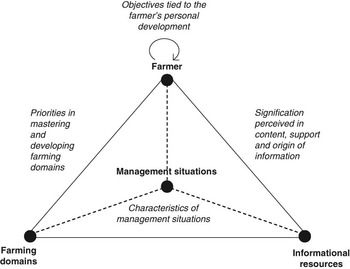
Our framework for analysing how farmers mobilize informational resources hinges on four framework components (Figure 1): (i) the stockbreeder, (ii) the informational resources, (iii) the domains of livestock farming activity (entities that farmers identify as requiring specific informational resources) and (iv) the management situations (situations in which the farmer mobilizes the informational resources).
A framework to analyse stockbreeders’ information system: four framework components (bold) are linked together with hypotheses about where, why and how the information is mobilized by stockbreeders (italics).

Framework component 1: ‘farmer’
The farmer’s strategic thinking is guided by objectives related to the control and development of farm production together with objectives linked to the farmer’s personal development (skills, recognition, legitimacy, etc.).
Framework component 2: ‘informational resources’
The concept of informational resource is used here to account for the fact that information can exist without it being mobilized by the farmer and that farmer make sense of informational input while acquiring and using this information in a given situation. To account for this process, we proposed the concept of informational resource defined through three components: medium, origin and content (Magne et al., Reference Magne, Couzy and Ingrand2005):
1. Different media (paper-based, computer-based human media) are used for the same content in order to secure and validate the information.
2. The origin of the information can be internal to the livestock system (biotechnical subsystem, the farmer’s experience: memory, informational capital), or be external to the system, being held by various other actors (including other farmers) and organizations.
3. The information content revolves around the technical management of livestock farming, a system of farming practices and different tasks to perform in the farming domains.
Framework component 3: ‘farming domain’
In order to cluster in a homogeneous set of entities that farmers consider relevant when they mobilize information, we worked with the farmers to define a consensus set of farming domains, each domain representing a set of activities. The 13 farming domains identified are feeding, reproduction, genetics, breeding, health and hygiene, calving, culling and replacement, feed stocks, pasture management, fertilization, marketing, administrative-regulatory tasks and accounts–financial control.
Framework component 4: ‘management situation’
The management situation is any situation that prompts the farmer to mobilize information. The management situation may stem from one or more of the 13 above-listed farming domains and is triggered by events shaped by a variety of characteristics (urgency, predictability, etc.).
Sample and surveys of farming systems
The study was carried out from 2005 to 2006 in the traditional beef cattle farming area in the Centre region of France. We selected three areas (Allier, Cantal and Haute-Vienne), corresponding to the three main beef cattle breeds (Charolais, Salers and Limousin), to investigate different ‘informational environments’ (advisers, genetic schemes, local policies, etc.).
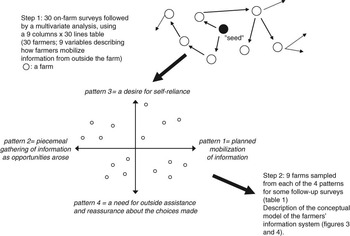
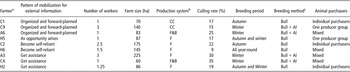
We used a two-step process (Figure 2). In the first step, 30 surveys were carried out to obtain diversity in terms of farmers mobilizing information from outside the farm in connection with livestock farming. A clustering of the 30 surveys, using information mobilization modalities as variables, revealed four distinct behaviour patterns concerning the mobilization of information (Cerf and Magne, Reference Cerf and Magne2007). These four patterns could be placed at the end of two axes (as shown in Figure 2). This breakdown was used to sample the farmers for the follow-up surveys, with the aim of representing all four behaviour patterns. For this, we short-listed 9 of the 30 farms (see Table 1 for data about their main characteristics). The objective of the second step was to carry out a detailed analysis of the relationship between the four behaviour patterns and the farmers’ priorities for mastering the various livestock farming domains.
Scheme presenting the methodology, using a two-step process: (i) data collection and clustering; (ii) other data collection and finally the description of the conceptual model.

Main characteristics of 9 farms sampled out of 30, according to functional and structural variables

The four patterns of mobilization of external information (from outside the farm) identified in the 30 farms are represented.
aA, C, H: department (Allier, Cantal and Haute-Vienne).
bCC: cow-calf system; F: fattening system; F&B: fattening and breeding.
cAI: artificial insemination.
Three successive semidirective interviews were carried out in each of the nine farms to analyse the dynamic nature of the management processes and provide opportunities to cross-check data with the farmers (Rougoor et al., Reference Rougoor, Trip, Hiurne and Renkema1998). All the interviews collected data on (i) the livestock farming practices implemented by the farmers in different domains (feeding, breeding, health and hygiene, replacement/culling, feed stocks, pasture management, accounting and administrative tasks); and (ii) the information (origin, medium and content) mobilized for the implementation of these practices. The interviews were recorded and lasted for 3.5 h on average.
Data analysis
All the data collected were classified and analysed for the purpose of building a conceptual graphic model of an overall IS valid for all the farmers interviewed. This was achieved by describing the system from the most all-encompassing level down to the most detailed level. Each level is described in terms of its structure (building block) and how it works: inter-relations between elements, inter-relations between the system and the outside and relations with the biophysical system, that is, the targets of the farming practices that we collected and analysed (i.e. animals, forage resources, etc.). Three levels are then described in the model. These successive levels are termed ‘system’, ‘subsystem’ and ‘unit’. For each level, the relations between the entities are the key to understand how the overall farmer IS operates. To describe the first level of the conceptual model of the farmers’ IS, we began by distinguishing between the data concerning the subsystem of regulation (driving the decisions) and the data concerning the subsystem that enable the farmers to process the information in order to act in the situation (operations resulting from the decisions). We then went on to refine the model description (subdivision of these subsystems into elementary units) until we reached a level where information was unavailable, unreliable or inapplicable to all the farmers from the sample.
Results: Structure and functioning of the model representing the IS
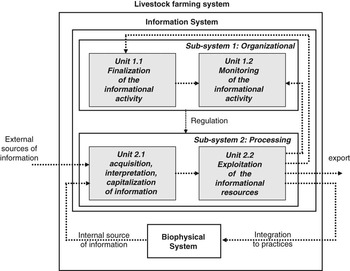
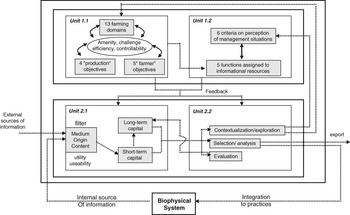
Our conceptual model is composed of two subsystems: the ‘organizational’ (e.g. the one which drives the decisions) and the ‘processing’ subsystem (e.g. the one which process the information in order to operate in a given situation; Figure 3). Each subsystem is composed of two units, as described below.
The ‘organizational’ subsystem
The ‘organizational’ subsystem makes it possible to define and manage objectives; these objectives belong to two separate time horizons. We give account of this by distinguishing a long-term unit and a short-term one.
The ‘long-term’ unit (finalization of the informational activity)
The long-term unit is the driver of the informational activity (Unit 1.1 in Figures 3 and 4). It is composed of three items: (i) the domains of livestock farming activity (n = 13); (ii) the production outcome targeted, that is, the objective assigned to the technical component of the livestock system; and (iii) the farmer’s outcome target, that is, the objective assigned to the farmer’s development. These different objectives vary according to the livestock farming domain, and they are an important factor in understanding why, how and where a given piece of information is mobilized.
Conceptual model of the information system. Identification of two subsystems, the subsystem units and inter-unit information flows (dotted arrows). Relations with the outside and with the biophysical system.

Conceptual model of the information system. Identification of the structural and functional unit content for the two subsystems.

The livestock farming domains do not all share the same level of importance for the farmer, who ranks them according to four relatively independent criteria:
1. Amenity: a reflection of how well the farmer is suited to the domain, the pleasure gained in performing domain-related tasks.
2. Challenge: the farmer’s perception of whether the long-term survival of the farm system depends on success in the domain.
3. Efficiency: the feeling that the objectives set have been achieved (regardless of how high they were), or conversely, areas for improvements the farmer wants to achieve.
4. Controllability: the farmers’ perception of the degree of control they can exercise over the domain (some farmers, for instance, feel they have little or no means of action in the ‘marketing’ domain because they feel they have no control over prices, whereas others actually consider they have an active role to play in this area).
The ‘production’ objectives revolve around the viability and reproducibility of the production activity (focus directed towards the operating system). There are four attributes identified and defined as accounting for ‘production’ objectives as expressed by livestock farmers:
1. Profitability: generating income or profit through the livestock farming domain.
2. Anticipation: implementing precautionary measures protecting production activity to avoid and/or prepare ahead on system stressors.
3. Value creation: capitalizing material and/or informational resources, qualifying/certifying production output through product differentiation initiatives.
4. Organization: devising a strategy for action, with options for (i) coordination, that is, organizing and scheduling production activity to manage time-sequenced chains of actions; (ii) structure-building, that is, spatially organizing the activity to manage spatially-sequenced chains of actions, and (iii) reconfiguration, that is, reshaping, reorganizing and repurposing the farm system.
Information mobilization is also guided by objectives other than strictly technical and economic ones. These additional objectives revolve around more subjective factors (identity-building, relational, personal development, etc.). The ‘farmer’ objectives that we have defined for this model thus integrate the farmer’s personal development through the livestock farming business experience. This personal development stems not only from gaining better control of the production process but also the farmer’s self-realization or personal welfare in the exercise of the farm business.
A similar series of attributes was set for the ‘farmer’ objectives (n = 5):
1. Building social recognition: hinges on how far farmers feel they measure up to third parties.
2. Cognitive development: enables farmers to increase their informational capital (deeper understanding of an event or a situation, memory aids, development of new conceptual frameworks for mapping the livestock farming business).
3. Decreasing workload (physical and mental pressure): simplifying the situation facing farmers, which can be a source of stress when farmers do not feel they have the skills or ability to tackle the problem on their own or when they simply cannot find the time to deal with it.
4. Decision support system: reassures farmers and helps build confidence in their choices.
5. Legitimacy: justifies conformance with the rules governing the farm activity.
The final result of our analysis was that to understand and account for the long-run determinants of information mobilization, it is first necessary to define the corresponding objective or objectives, the attributes linked to these objectives and the position held by the farming domain in the farmer’s classification rankings. We assume that for a given farmer, these objectives and the classified rankings will tend to stay relatively stable over time, despite some trends (due to the period in their career, and shifts in the technical or economic backdrop to the farming business).
The ‘short-term’ unit (monitoring of the informational activity)
The short-term unit gives a picture of how the informational activity is organized (Unit 1.2 in Figures 3 and 4). This unit makes it possible to understand farmers’ decision-making processes as they readjust farm activity strategy in response to a given situation. The core factor in this subsystem is the management situation that the farmer has to deal with, and that triggers information mobilization. This means that the function assigned to the mobilized information is closely linked to the farmer’s perception of the initial situation. In our sample, we identified six criteria qualifying farmer perceptions and four further criteria representing the broad range of functions assignable to mobilized information.
The six criteria qualifying farmer’s perceptions of management situations are the following:
1. Predictability: enables forward planning in a situation recognized in advance.
2. Schedulability: ability to reshuffle when certain actions have to be taken.
3. Familiarity: when the farmer has already had to tackle the same kind of situation in the past.
4. Time horizon: indicates the level of urgency of actions that need to be taken (concerns foreseeable situations).
5. Occurrence: indicates the frequency with which the situation occurs.
6. Intentionality: accounts for the extent to which the situation is dominant-dominated.
The four criteria qualifying the functions of the mobilized information are as follows:
1. Reflexivity: reassessing prevailing practices, looking at potential alternatives, reviewing the situation and possibly questioning the validity of the system in place.
2. Problem-solving: identifying how to eliminate the problem identified and find solutions.
3. Action decision: dealing with the problem, choosing the best solution from a panel of potential options.
4. Designing new options: harnessing all the inputs needed to change the current system, based on the realization that the potential is there to improve certain areas.
The ‘processing’ subsystem
The ‘processing’ subsystem accounts for data acquisition and exploitation (i.e. two different units within the subsystem), in accordance with the regulation of the ‘organizational’ subsystem. This subsystem accounts for information flows from the outside and therefore the transformation of available information into resources that the farmers use for managing their livestock farming system and for their own personal development.
The ‘acquisition’ unit
The ‘acquisition” unit contains the process of building the informational resources by making sense of the information (Unit 2.1 in Figures 3 and 4). It is composed of three interconnected elements: (i) an informational filter-selecting information according to three components (medium, origin and content) and 11 criteria indicating either the utility (n = 3) or the usability (n = 8) of the information; (ii) a short-term informational capital that briefly accumulates the informational resources that have to be validated as useful and usable for facing the situation; and (iii) a long-term informational capital that stabilizes the informational resources evaluated as useful and usable.
The three criteria linked to information utility as perceived by farmers are the following:
1. Relevance of the information: does it answer the question raised; does it address the problem identified?
2. The degree to which the information is compulsory, unavoidable.
3. Complementarity with information already in the farmer’s possession, enabling a more comprehensive assessment of the situation or the action to be taken.
The eight criteria linked to information usability as perceived by farmers are as follows:
1. Comfort: whether farmers are comfortable using the media, origin or content of the information.
2. Notoriety: extent to which the information has already been tried and tested, and recognized as effective.
3. Objectiveness: impartiality, neutrality as perceived by the farmer, especially in terms of information origin.
4. Intelligibility: how well the farmer can understand and assimilate the information content.
5. Availability: the ability to mobilize the information quickly and easily.
6. Effectiveness: degree to which the information can help achieve the results expected.
7. Profitability: ratio of the cost of gaining the information to the benefits obtained.
8. Novelty: often acts as a motivation to mobilize information in its own right. It covers information content, media and origin.
The ‘exploitation’ unit
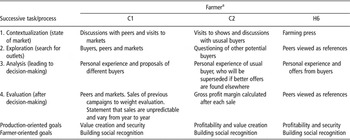
The exploitation unit makes it possible to render the informational resources useful and useable (Unit 2.2 in Figures 3 and 4). It comprises three processes identified as corresponding to three different objectives (i) a contextualization/exploration process, through which the farmer uses the information mobilized to make more sense of the situation the farmer has to deal with; (ii) an action analysis and selection process, through which the farmer uses the information to act on the operating system, that is, to implement concrete actions (livestock farming practices); and (iii) an evaluation process that enables the farmer to select which information is likely to remain useful in the future based on its effectiveness in the current situation. This implies that the informational resources dealt with in this unit ultimately have different targets, that is, they are not limited to conversion into livestock farming practices. These informational resources are also set to act as inputs to the informational activity’s organizational subsystem, making it possible for the farmer to revise his production or development objectives. They can also be exported outside the livestock farming system to serve as inputs to the IS or systems employed by the farmer’s contacts, such as advisors, other livestock farmers, suppliers and/or buyers and possibly also researchers. Table 2 gives an example of a comparison, made between three farmers selected from among the case studies, of the time course of these processes for the same farming domain: marketing. Each farmer sought informational redundancy to stabilize their reasoning and ultimately make a decision for action. The links with the objectives assigned respectively to the production and farmer’s development are also presented for each of the three farmers.
Example of how three farmers use different informational resources to decide on the timing and outlets of sales of weaning calves

A common objective of the three farmers is to seek redundant information so as to be sure of the decision. Relationships with ‘production-oriented’ and ‘farmer-oriented’ goals for each farmer are given (bottom).
aSee Table 1 for the main characteristics of the farm.
Discussion
Variability in the objectives assigned to mobilized informational resources
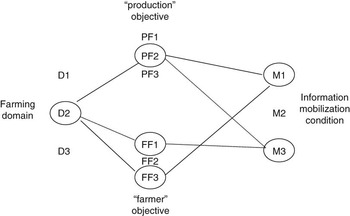
Our results challenge the generally accepted hypothesis of overall consistency of and between farmers’ strategies at livestock farming system scale. Our study suggests that the objectives assigned to informational resources for controlling farming domains vary not only between farmers but also between farming domains as experienced by the same farmer. Some farmers may seek profitability in one farming domain and forward planning in another domain, regardless of whether these two objectives are actually compatible. It is the interplay between ‘production’ objectives and ‘farmer’ objectives that gives insight into what prompts farmers to mobilize informational resources for any given livestock farming domain. Farmers assigning the same ‘production’ objective to informational resources mobilized to ensure control over the same farming domain may actually approach the informational resources differently. The ‘farmer’ objective can explain this difference (Figure 5). A good illustration of this point is the way in which two farmers in our sample mobilized informational resources to secure the market sale of baby beef. For one of the farmers, all the initiatives deployed to mobilize informational resources converged to help build recognition of his role as livestock farmer. The other farmer did not view marketing as part of his line of work; he was aversive to the marketing aspect of his farm business, preferring to delegate marketing tasks to others who, in his view, are better qualified to do the job.
Between two farmers, The process of information mobilization can differ for the same livestock domain because of different ‘production’ or ‘farmer’ objectives.

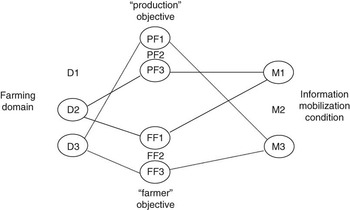
Lastly, farmers do not necessarily assign the same ‘production’ and ‘farmer’ objectives to informational resources for different farming domains. Consequently, farmers do not appear to set objectives at livestock farming system scale; but in fact, cascade objectives down into both ‘production’ and ‘farmer’ registers, at the within-system level of farming domain. Hence, farmers’ objectives may differ according to farming domain (Figure 6).
Within a farm, the process of information mobilization can differ among livestock domains according to different ‘production’ objectives, ‘farmer’ objectives or both.

The second source of variability lies in the management situation encountered. The event triggering the situation may appear to present characteristics such as urgency, unpredictability, etc., which will force an on-the-spot readjustment of the objectives the farmer assigns to the informational resources mobilized for controlling a farming domain.
A representational model centred on the farmer’s standpoint
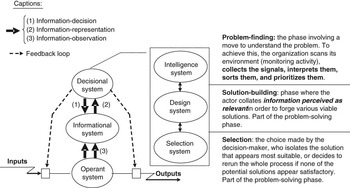
Modelling a farmer-centric IS (i.e. integrating the meaning the farmer attaches to the information) is of major scientific interest for agronomic science as a whole. The ISs in models that have drawn on Le Moigne’s canonical operant informational decisional (OID) model (Reference Le Moigne1990; Figure 7) to represent a farm business have so far remained black box systems whose functions are limited to receiving input data and transferring this input between the decisional and the biotechnical systems. The farmers themselves are left as isolated decision-makers, reductively limited to computational information processing, the information itself being reduced to data that are coded, transferred and deciphered. The conceptual model proposed here opens up the black box by providing the IS with functions for transforming and interpreting the information during the data acquisition, utilization and capitalization phases.
The canonical operant informational decisional (OID) model (from Le Moigne, Reference Le Moigne1990).

By integrating not only the farmer as decision-maker (which gives meaning to both the information and the farmer’s production activity) but also the context surrounding the farmer’s decision-making process, the model accounts for the problem-finding and problem-solving phases underpinning decision-making processes’ (Simon, Reference Simon1955) upstream of the decision selection phase (Figure 7). To date, there have been few, if any, attempts to model these phases in an agronomic context. By providing insight into the modelling of problem-finding and then researching the interplay with the initial phases of problem-solving, we have shown that farmers’ decisions depend less on choices between several alternatives and more on the experience of farmers as decision-makers and their capacity to recognize the situation they find themselves in. These insights prove pivotal when the challenge is to understand decision-making processes in uncertain situations.
A model categorizing farming practices according to information mobilized
The model helps to improve the way the farmer (decision-maker and actor) is factored into farm production management, which has hitherto proved a limitation in animal science research (Gibon and Hermansen, Reference Gibon and Hermansen2006). The analysis described here shows that the global IS employed by farmers operates differently in different farming domains. This vision is consistent with Guyot (Reference Guyot2006), who asserted that the IS, as such, ‘is in fact built of a set of subsystems, with each subsystem dedicated to specific activities, extending from management and production through to marketing and up to R&D’.
The farming domains were set on the basis of the importance that farmers attached to controlling and developing their livestock farming activity, on the assumption that the degree of importance was linked to the informational activity. The farmer-ranked series of farming domain categories can therefore be interpreted as an instructive picture of what factors that farmers consider must or need not be controlled and developed on their farms. The farming domains flagged as most important can therefore, from the farmers’ point of view, represent ‘pivotal domains’ for the long-term survival of their farms. This overlaps the concept of ‘key success factors’ used in business management science (Lorino, Reference Lorino1991), which covers all the factors a firm has to control in order to optimize business management.
Our results suggest that ‘production’ objectives have to be distinguished from ‘farmer’ objectives in order to understand the interplay between subjective rationality (identity-building, relational rationality, etc.) and technical and economic rationality. Researchers studying livestock farming systems have occasionally integrated the social and/or personal dimensions driving decision-making and project-building by focusing on breeder-specific norms and standards (Darré et al., Reference Darré, Mathieu and Lasseur2004) or the ‘empirical knowledge’ of farmers (Girard and Navarrete, Reference Girard and Navarrete2005). By switching from livestock farming practices to the informational activity of animal breeders, our approach to farm management and production provides a different picture of these social, personal or cognitive dimensions. For identical ‘production’ objectives, it is possible to explain between-farmer differences in informational activity by identifying farmer development-centred objectives, and thus better align on-farm intervention, support and consultancy to farmers’ realities. This suggests that the structural and functional elements of the model presented here could be integrated into the decisional component of decision support tools. The main value added, as highlighted above, would take into account the different ways of envisioning informational activity according to the different objectives assigned to the livestock farming system, these objectives being specific to each domain and explicitly differentiating ‘production’-related factors from the farmer’s personal development.
Conclusions
We have developed a new approach to farm business management based on the analysis of farmers’ informational activity. The analytical framework focuses on information management for farm production activities. Our model proposes informational activity categories that can be exploited to integrate human dimensions into the farming system. The informational resources are understood to be part of the farm activity, thereby highlighting how information is just as much a farm resource as more tangible resources such as herd, forage system, farm buildings, etc.
We consider that this model could serve as a component of biodecisional DSS models for assigning information to the decision-making process. This is supported by three findings in our results: (i) farmers are making decisions more on their experience and the way they recognize the management situation; (ii) the information that the farmers are seeking must be analysed with reference to both the ‘farmer; objectives (personal development) and the production objectives and its basic relevance evaluated in terms of how it serves these two dimensions (regardless of whether these are actually explicit); and (iii) there are three components of the information that allow to understand why it may or not become a resource for farmers: its content, its medium and its origin.
Acknowledgements
This study is based on a talk given at the 58th Annual Meeting of the European Association for Animal Production held in Dublin, Ireland, in August 2007. This study was carried out with the financial support of the Agence Nationale de la Recherche (French National Research Agency) under the Programme Agriculture et Développement Durable, project ANR-05-PADD-04-01, Discotech; the French Livestock Institute; and the French Ministry of Research and Education.