It is not uncommon for field-collected wireworms stored in soil before laboratory studies to die from Metarhizium Sorokin (Clavicipitaceae) infection (Kabaluk et al. Reference Kabaluk, Janmaat, Sheedy, Goettel and Noronha2013), complicating research. While the factors contributing to such often-dramatic reductions in populations have been difficult to determine, it is likely affected by storage temperature. Kabaluk and Ericsson (Reference Kabaluk and Ericsson2007) found significantly more mortality in wireworms exposed to Metarhizium brunneum Petch (Clavicipitaceae) conidia in soil at 18 °C than at 12 °C, and van Herk and Vernon (Reference van Herk and Vernon2013a) report a significant increase with temperature in the mortality of Agriotes obscurus (Linnaeus) (Coleoptera: Elateridae) larvae from Metarhizium infection. Other factors thought to affect the incidence of Metarhizium infection in A. obscurus larvae include: wireworm feeding state (more mortality in non-feeding larvae), collection site, and possibly larval mass (we have at times observed higher mortality in heavier larvae) (van Herk and Vernon Reference van Herk and Vernon2011, Reference van Herk and Vernon2013a).
Although later instars of A. obscurus, one of the most destructive wireworm species in Canada, can survive for long periods without food (Vernon and van Herk Reference Vernon and van Herk2012), depriving them of food presumably increases their susceptibility to fungal and other pathogens (Ericsson et al. Reference Ericsson, Kabaluk, Goettel and Myers2007), in part by reducing their ability to mount a humoral response. An increase in susceptibility to Metarhizium infection during starvation may coincide with the reduction and eventual disappearance of the wireworm fat body during prolonged food deprivation (James Reference James1927; Eidt Reference Eidt1958), this being the primary organ for antibacterial and antifungal peptide synthesis (Hoffmann Reference Hoffmann1995; Gillespie et al. Reference Gillespie, Kanost and Trenczek1997). Zacharuk (Reference Zacharuk1971) noted that infection with Metarhizium causes an increase in lysosomes in wireworm fat body cells. This is significant, as lysosomes release non-specific enzymes (e.g., lysozyme) into the hemocoel as part of the humoral immune response of the insect against fungal attack, and as the fat body produces specific antifungal proteins (e.g., protease and metalloprotease inhibitors) and peptides that detoxify fungal secondary metabolites (e.g., destruxins) (Hoffmann Reference Hoffmann1995; Gillespie et al. Reference Gillespie, Kanost and Trenczek1997, Reference Gillespie, Bailey, Cobb and Vilcinskas2000).
Besides storage temperature and food availability, it was hypothesised that sterilising the soil used for wireworm storage would increase larval survival by decreasing the incidence of Metarhizium infection. The study described herein was designed to determine how these three factors affect the survival of field collected A. obscurus during long-term (six months) storage, their susceptibility to Metarhizium, and the combination of factors resulting in highest survival.
Wireworms, were collected by the authors from a single location at the Pacific Agri-Food Research Centre (PARC) in Agassiz, British Columbia, Canada, in early February 2015, and stored in buckets of field soil buried at ground level at the collection location for one to two weeks until they were used. Soil, also collected from a single 5×5 m location at PARC, was sifted through a 3×3 mm mesh to remove rocks, roots, and other coarse organic matter, and thereafter thoroughly homogenised by hand. A portion of this soil, “regular soil”, was allowed to air dry, after which water was added to increase the soil moisture to 20% by weight, and the soil again homogenised. The remainder, “sterilised soil”, was autoclaved at 120 °C and 170 kPa for two hours, dried in an oven for 48 hours at 90 °C, and the soil moisture increased to 20% moisture by weight using deionised water. Soil was collected and both soil types prepared when needed throughout the study, within one week of changing the soil in the containers. Approximately 2.0 L of either “regular” or “sterilised” soil was put into 2.25 L plastic containers (Richards Packaging, Richmond, British Columbia, Canada) on 13–16 February 2015. These containers had been washed, bleached, and thoroughly rinsed before use, and after filling were placed in controlled environment walk-in coolers (Coldmatic Refrigeration, Concord, Ontario, Canada) set at a 12 °C and 16±0.2 °C for four to five days to acclimatise before wireworm insertion. Previous studies suggested low wireworm mortality from Metarhizium at 10 °C, and moderate mortality at 14 °C (van Herk and Vernon Reference van Herk and Vernon2013a). Soil changes were done to reduce the likelihood wireworms encountered cadavers of larvae that had succumbed to Metarhizium infection.
Ten containers (100 wireworms) were allocated to each of the eight treatments in the study. Ten middle to late instar (>10 mm), healthy, mobile wireworms (assessed using the criteria described in van Herk and Vernon Reference van Herk and Vernon2013b) were placed into each container on 17–24 February 2015 after being weighed with an analytic balance (Sartorius CP64; Sartorius AG, Goettingen, Germany). In both coolers, one half of all containers with each soil type were supplied with a single potato cube for food. Potatoes, cultivar Chieftain, were washed and cut into 3×3×1 cm pieces using sterile techniques, so that each cut piece did not contain either peel or greened areas. Potato pieces were placed into the soil so that their top surface was flush with the soil level. Both soil and food were replaced as needed throughout the study, notably on 20 March and 14–15 May (soil, to all containers) and on 27 Feb; 5, 17, 23, 26, 30 March; 2, 7, 10, 13, 16, 20, 23 April; 6, 14 May; 8 June; 13 July; and 6 August (food, to all containers in “with food treatments”). During each food and soil change, and at the end of the study (21 August), potato pieces were carefully inspected for feeding damage and (visible) cadavers of dead wireworms removed. Wireworms were counted on 21 August, and when the soil was changed.
Analysis of variance (ANOVA) was conducted on the mean wireworm weights per container at the start and end of the study, wireworm weight change during the six-month storage period, and on the number per container that were alive, had died from Metarhizium infection, were missing, or were dead from other causes (e.g., bacterial disease) at excavation (21 August). Analysis of variances included the three main study factors and all interaction terms, and were conducted on normalised ranks where data was non-normal (i.e., for non-weight data). Means were separated by the Tukey–Kramer honest significant difference procedure (α=0.05).
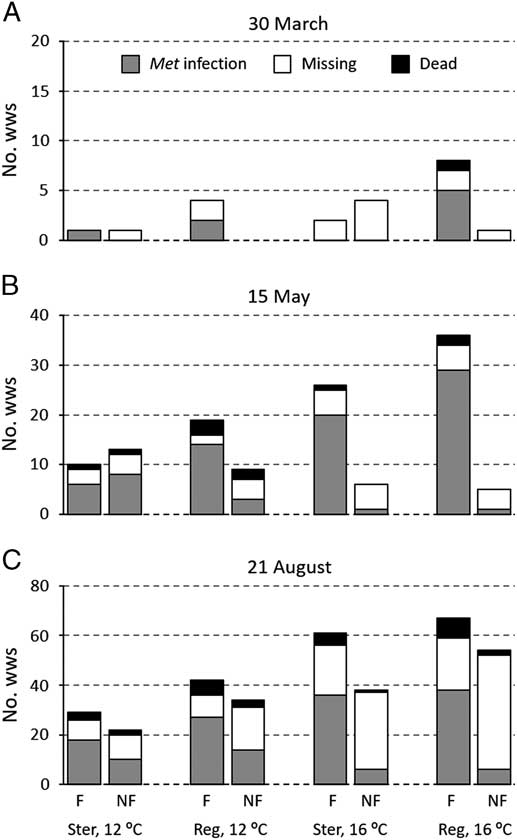
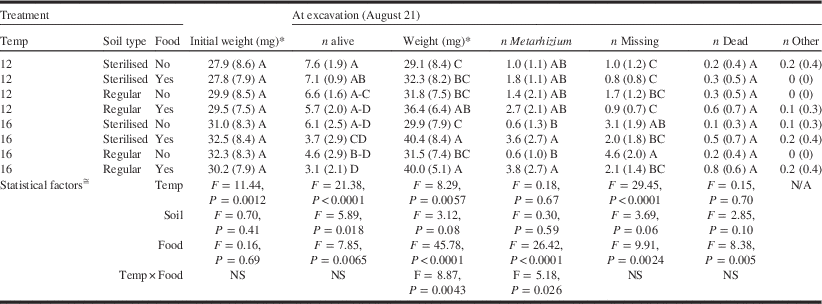
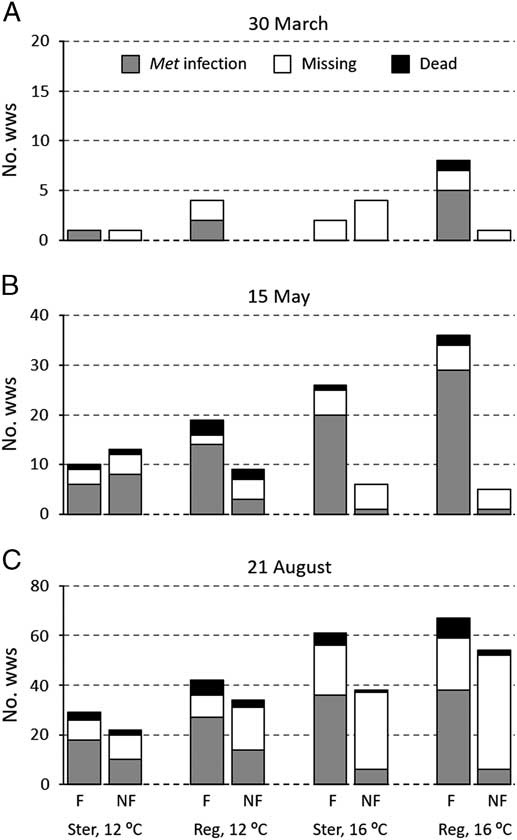
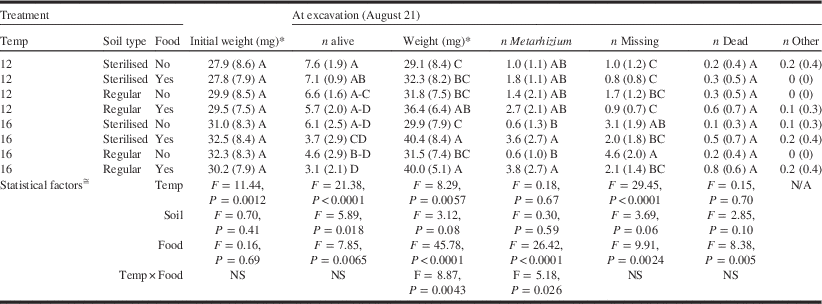
Wireworm survival (total number alive) was significantly (P<0.05) affected by temperature (higher at 12 °C than 16 °C), food (lower if food was available), and soil type (higher in sterilised soil) (Table 1). Of note is that for all soil and temperature combinations, the availability of food increased the number that died from Metarhizium infection (significantly at 16 °C) and other causes (“n Dead”, Table 1), and decreased the number that could not be found during excavations – i.e., were “Missing” (significantly at 16 °C in regular soil) (Table 1). This differing effect of food availability on missing and Metarhizium infected wireworms suggests we cannot equate the two, i.e., assume that missing wireworms had died from Metarhizium infection earlier in the study and had disintegrated. It seems more likely that these missing wireworms had been cannibalised, as suggested by the large increase in missing versus Metarhizium infected wireworms in the 16 °C non-fed (NF), but not fed (F), treatments between 15 May and 21 August (i.e., that the absence of food increased the incidence of cannibalism) (Fig. 1). Wireworms listed as dead from causes other than Metarhizium infection (“n Dead”, Table 1) may have died from bacterial infections, based on their blackened cuticles (Thomas Reference Thomas1940). The number of wireworms lost from the study due to handling and/or pupation was negligible (n=8).
Cumulative number of Agriotes obscurus larvae dead from Metarhizium (“Met”) infection and other causes (“Dead”), or missing after 41 (30 March), 87 (15 May), and 185 (21 August) days of storage with and without food at different temperatures in regular (Reg) or sterilised (Ster) soil. F=food; NF=no food; No. wws=number of wireworms.
Mean (SD) survival and weight of Agriotes obscurus larvae after six-month storage with and without food at two different temperatures in sterilised or non-sterilised (regular) soil.
Notes:
* Weights are based on means of all living wireworms (wws) in the treatment. Initial number of wws per treatment=100. ANOVAs are based on means per container if the number of wws >3 per container.
≅ df=1,72 for all factors except the 21 August weight (df=1,54). Interaction terms that are not shown were not statistically significant (NS) (P>0.05). Numbers in a column followed by the same letter are not significantly different (P>0.05).
The lower survival when food was present was unexpected and counterintuitive, and may suggest the type of food presented (potato, of which this species is a serious pest) did not improve wireworm state, and/or that the feeding activity itself interfered with their ability to withstand an immune challenge. Moreover, the presence of food may have increased the frequency wireworms encountered each other, thereby increasing the likelihood of disease transmission from infected larvae, injury from competition, and/or cannibalism. Future work should focus on evaluating the effect of different food types on wireworm survival in culture, including those reported to result in greater growth rates than potato (e.g., wheat seeds; Evans and Gough Reference Evans and Gough1942).
The availability of food significantly increased post-storage weight (Table 1) and significantly affected mean weight change per container (F=102.05, df=1,54, P<0.0001). Wireworm weight change was significantly greater in regular soil (F=4.26, df=1,54, P=0.04), and there was a significant interaction between soil type and food availability (F=4.62, df=1,54, P=0.036). While storage temperature had no significant effect on wireworm weight change (P>0.05), the significant interaction between food availability and temperature for both post-storage weight (Table 1) and weight change (F=14.02, df=1,54, P=0.0004) reflect that weight increased in wireworms stored without food at 12 °C, but decreased when stored without food at 16 °C (Table 1). The latter may reflect that at the higher temperatures wireworms are more active (van Herk and Vernon Reference van Herk and Vernon2013a). It is conceivable that the source of weight gain in wireworms stored without food was cannibalism and/or the selective mortality of lighter wireworms. The latter would contradict a previous finding that A. obscurus susceptibility to Metarhizium infection increases with weight (van Herk and Vernon Reference van Herk and Vernon2011).
These results indicate storing wireworms at a relatively low temperature, in sterilised soil increases their survival, and suggests future laboratory work (e.g., insecticide screening) should be done at lower temperatures, if possible, to reduce unintended mortality. It remains of interest how food deprivation affects the energetic state and ability of wireworms to resist fungal attack, and if and how the latter depends on the first. Work that could be done towards this are to assess wireworm energetic state by measuring fat body size, hemolymph lipid versus trehalose content (i.e., starvation decreases insect sugar and increases lipids due to fat body lipolysis; Arrese and Soulages Reference Arrese and Soulages2010), and/or cuticle thickness; and to assess their ability to mount an immune response by measuring hemolymph phenyloxidase content and/or ability to withstand a benign immune challenge (e.g., their encapsulation or melanisation response).