INTRODUCTION
The opening of the sea-level Suez Canal in 1869 has led to the colonization of the Mediterranean Sea by a large number of tropical species. They commonly establish populations along the Levantine coast and then spread into the central Mediterranean Sea, in part by natural dispersal, in part by transport of larvae, juveniles or adult specimens by shipping. The increase in human activities, aquaculture and leisure boating in the past century contributed to the introduction of alien species and could contribute to the alteration of autochthonous communities or disrupt delicate balances (Ruiz et al., Reference Ruiz, Carlton, Grosholz and Hines1997; Boudouresque & Verlaque, Reference Boudouresque and Verlaque2002; Gofas & Zenetos, Reference Gofas and Zenetos2003; Occhipinti-Ambrogi & Savini, Reference Occhipinti-Ambrogi and Savini2003; Occhipinti-Ambrogi, Reference Occhipinti-Ambrogi2007).
DISCUSSION
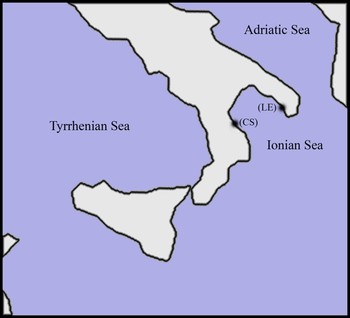
The Taranto Gulf, thanks also to the presence of its big harbour and the roadstead and to several secondary harbours, represents a favourable area for the establishment of exotic species, many of which have been documented to form dense populations, such as Caulerpa racemosa (Buia et al., Reference Buia, Petrocelli and Saracino1998), Branchiomma luctuosum (Licciano et al., Reference Licciano, Giangrande and Gambi2002), Musculista senhousia (Mastrototaro et al., Reference Mastrototaro, Matarrese and D'Onghia2003) and Polyandrocarpa zorritensis (Brunetti & Mastrototaro, Reference Brunetti and Mastrototaro2004). Recently three alien bivalves, Anadara demiri (Piani, 1981), Fulvia fragilis (Forsskål, 1775) and Ruditapes philippinarum (Adams & Reeve, 1850), and an alien isopod belonging to the genus Mesanthura have been reported from the Gulf of Taranto (Crocetta et al., Reference Crocetta, Renda and Colamonaco2008; Lorenti et al., Reference Lorenti, Dappiano and Gambi2008), too. Two new alien species, the plagusiid crab Percnon gibbesi (H. Milne-Edwards, 1853) and the sea-hare Aplysia dactylomela Rang, 1828, are here reported, constituting the first record of these species for the Gulf of Taranto. The first one was noted moving fast into crevices since the summer of 2007 at Schiavonea di Corigliano Calabro (CS), at low depths on a rocky bottom, and both species were also collected in a sandy–rocky bay bounded by the city of Gallipoli and a rocky point, Punta Pizzo, in October 2008 (Figure 1).
The Ionian Sea with the locations (•) where Percnon gibbesi and Aplysia dactylomela were found.

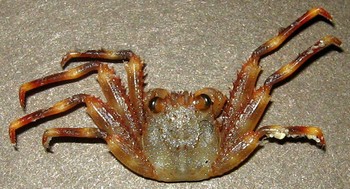
Percnon gibbesi (H. Milne-Edwards, 1853), is a plagusiid crab distributed in the eastern Pacific from California to Chile, the western Atlantic from Florida to Brazil, and the eastern Atlantic from Madeira, the Azores, the Cape Verde Islands to the coast of Africa, from Portugal to Ghana and offshore islands of the Gulf of Guinea (Nobre, Reference Nobre1931; Manning & Holthuis, Reference Manning and Holthuis1981; d'Udekem d'Acoz, Reference Udekem and Acoz1999). The species was first recorded in the Mediterranean Sea in 1999 at Linosa, Pelagie Islands, and Porto Palo di Capo Passero, Sicily (Relini et al., Reference Relini, Orsi, Puccio and Azzurro2000; Mori & Vacchi, Reference Mori and Vacchi2002), the Balearic Islands and Ibiza, Spain (Garcia & Reviriego, Reference Garcia and Reviriego2000; Müller, Reference Müller2001). It spread rapidly along Sicilian shores (Pipitone et al., Reference Pipitone, Badalamenti and Sparrow2001; Greco, Reference Greco2006). Within a few years it had reached Malta (Borg & Attard-Montalto, Reference Borg and Attard-Montalto2002), southern Sardinia, and the Tyrrhenian and Ionian Calabrian shores (Roccella Ionica) of Italy (Galil et al., Reference Galil, Froglia, Noël and Briand2002; Russo & Villani, Reference Russo and Villani2005), Greece (Cannicci et al., Reference Cannicci, Garcia and Galil2006; Thessalou-Legaki et al., Reference Thessalou-Legaki, Zenetos, Kambouroglou, Corsini-Foka, Kouraklis, Dounas and Nicolaidou2006) where it is widely spread and well established in the southern Aegean and Libya (Elkrwe et al., Reference Elkrwe, Elhawaj, Galil and ben Abdallah2008) and since 2006 in southern Turkey (Yokes & Galil, Reference Yokes and Galil2006), and spread further in the western Mediterranean (Abelló et al., Reference Abelló, Visauta, Bucci and Demestre2003). Percnon gibbesi (H. Milne-Edwards, 1853) was noted moving fast into crevices from the summer of 2007 at CS, on a rocky bottom, at low depths (W. Renda, personal observation) and a single juvenile male specimen (carapace length 8 mm; Figure 2) was found at Punta Pizzo, alongside a crevice between rocks.
Percnon gibbesi (8×8 mm) from Gallipoli–Lido Pizzo (LE).

Both natural dispersal (larval transport by surface currents) and shipping-transport by recreational and fishing vessels were suggested as ways of spreading into and inside the Mediterranean Sea.
Percnon gibbesi occurs along rocky shores, among boulders covered with algae, mainly in the subtidal zone (Galil et al., Reference Galil, Froglia, Noël and Briand2002). It is strictly algivorous: the analysis of stomach contents shows that filamentous, calcareous and corticated algae constituted the largest amount together with a small amount of foliose algae and a few fragments of bryozoans, hydrozoans and very small copepods, gastropods and decapods, so it seems that P. gibbesi can feed on a very coriaceous algae and exploit foods that other herbivores cannot (Puccio et al., Reference Puccio, Relini, Azzuro and Orsi Relini2006). Its high fecundity and the exceptionally large megalopa that produces robust juveniles (Paula & Hartnoll, Reference Paula and Hartnoll1989; Hartnoll, Reference Hartnoll1992) could also contribute to its invasion success.
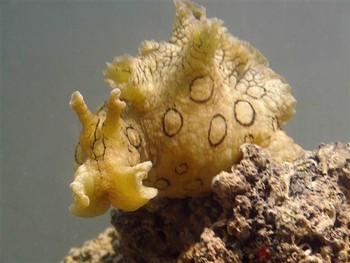
Aplysia dactylomela Rang, 1828 is an opisthobranch mollusc with a worldwide distribution in tropical and warm temperate waters of the Atlantic (d'Orbigny, Reference Orbigny1839; Wirtz, Reference Wirtz1998, Reference Wirtz1999; Ortea et al., Reference Ortea, Moro, Bacallado and Herrera2001) and Indo-Pacific, including the Red Sea (Marcus, Ev. & Marcus, Er., Reference Marcus and Marcus1967; Bebbington, A., Reference Bebbington1974; Dekker & Orlin, Reference Dekker and Orlin2000; Burn, Reference Burn2006). The species was first recorded in the Mediterranean Sea, from Lampedusa Island (AG) (Trainito, Reference Trainito2003), and in quick succession from Greece (Zenetos et al., Reference Zenetos, Vassilopoulou, Salomidi and Poursanidis2007), Turkey (Çinar et al., Reference Çinar, Bilecenoglu, Öztürk and Can2006; Yokes, Reference Yokes2006) and Malta (Schembri, Reference Schembri2008). Photographs posted on the www.seaslugforum.net website attest to the presence of the species in Cyprus and Croatia. Italian records include one specimen in a tide pool at 10–20 cm depth at Riserva Marina ‘Isola Lachea e Faraglioni dei Ciclopi’ (Acitrezza, CT) (Scuderi & Russo, Reference Scuderi and Russo2005) and about 30 specimens and egg-masses at a low depth on rocky bottoms with the presence of algae at Giardini Naxos (ME) (Greco, Reference Greco2006). Personal observations and photographs by SCUBA-diving photographers convince us that A. dactylomela is locally common along the eastern Sicilian shores from Messina to Syracuse. The present specimen (~15 cm long; Figure 3), was found in the daytime near Punta Pizzo (Figure 3), under a small rock, covered by dense algal film with the presence of Caulerpa racemosa, at 50 cm water depth. The provenance of the Mediterranean populations is still unclear because it occurs in the Red Sea and the Atlantic Ocean. However, since no specimens were observed in the western Mediterranean and its distribution is limited in the eastern and central Mediterranean, it could probably have an Indo-Pacific origin. The species occurs mainly along rocky shores with a dense algal cover, from the intertidal to 15 m. Egg-masses spawning (principally on Posidonia oceanica) and purplish egg-masses were observed from September to November at low depths (Greco, Reference Greco2006).
Aplysia dactylomela (about 15 cm TL) from Gallipoli–Lido Pizzo (LE) (specimen in aquarium).

The presence of only a few specimens leads us to think that these aliens have expanded their distributional range only recently and that new stable populations will probably soon settle over the whole of the Gulf of Taranto, given also the proximity of Greece and Sicily, where Aplysia dactylomela and Percnon gibbesi are both already locally common although they only arrived recently. The presence of a juvenile specimen of P. gibbesi far from any commercial route or harbour is, finally, a probable sign of an evident larvae dispersal along the Salentine shores.
ACKNOWLEDGEMENTS
We are grateful to Walter Renda for information about the presence of Percnon gibbesi along Calabrian shores, to Michele Difonzo for taking photographs of Aplysia dactylomela, to Jamie Crummy for the English revision of the text and to two anonymous referees for their valuable comments.