Birth in a country with high tuberculosis (TB) morbidity is a major risk factor for tuberculosis (TB) in the United States.Reference Bibbins-Domingo, Grossman and Curry 1 , 2 National surveillance data from 1995–2007 estimated the rate of TB among non–US-born healthcare personnel (HCP) in the United States to be 10 times higher than among US-born HCP.Reference Lambert, Pratt, Armstrong and Haddad 3 Recent TB transmission has been estimated to account for ~15% of TB cases diagnosed in the United States, but it has not been examined for HCP versus other adults.Reference LoBue and Mermin 4 , Reference Yuen, Kammerer, Marks, Navin and France 5 We examined national surveillance data from 2010 to 2016 to describe characteristics of HCP with TB in the United States.
Methods
Tuberculosis is a notifiable disease in all 50 states and the District of Columbia. Data are collected by health departments and submitted to the Centers for Disease Control and Prevention (CDC) via the Report of Verified Case of TB (RVCT), which includes demographic, clinical, and outcome characteristics of TB cases. 2 Variables are defined in the RVCT Instruction Manual; HCP include “any paid or unpaid persons who worked in a healthcare setting within 12 months prior to TB diagnosis” (HCP data were collected using the terminology “healthcare worker”). 6 TB genotyping results are analyzed to attribute cases to recent transmission, using a previously published plausible source case method.Reference Yuen, Kammerer, Marks, Navin and France 5 , Reference France, Grant, Kammerer and Navin 7
We included TB cases reported from January 1, 2010, through December 31, 2016, among persons aged ≥18 years. Demographic, clinical, and risk factors were compared using descriptive statistics and P values. Analyses were conducted using SAS version 9.3 software (SAS Institute, Cary, NC). This project was determined by CDC and Emory University to be public health surveillance not requiring human subjects research review.
Results
Demographics, site of disease, and drug resistance
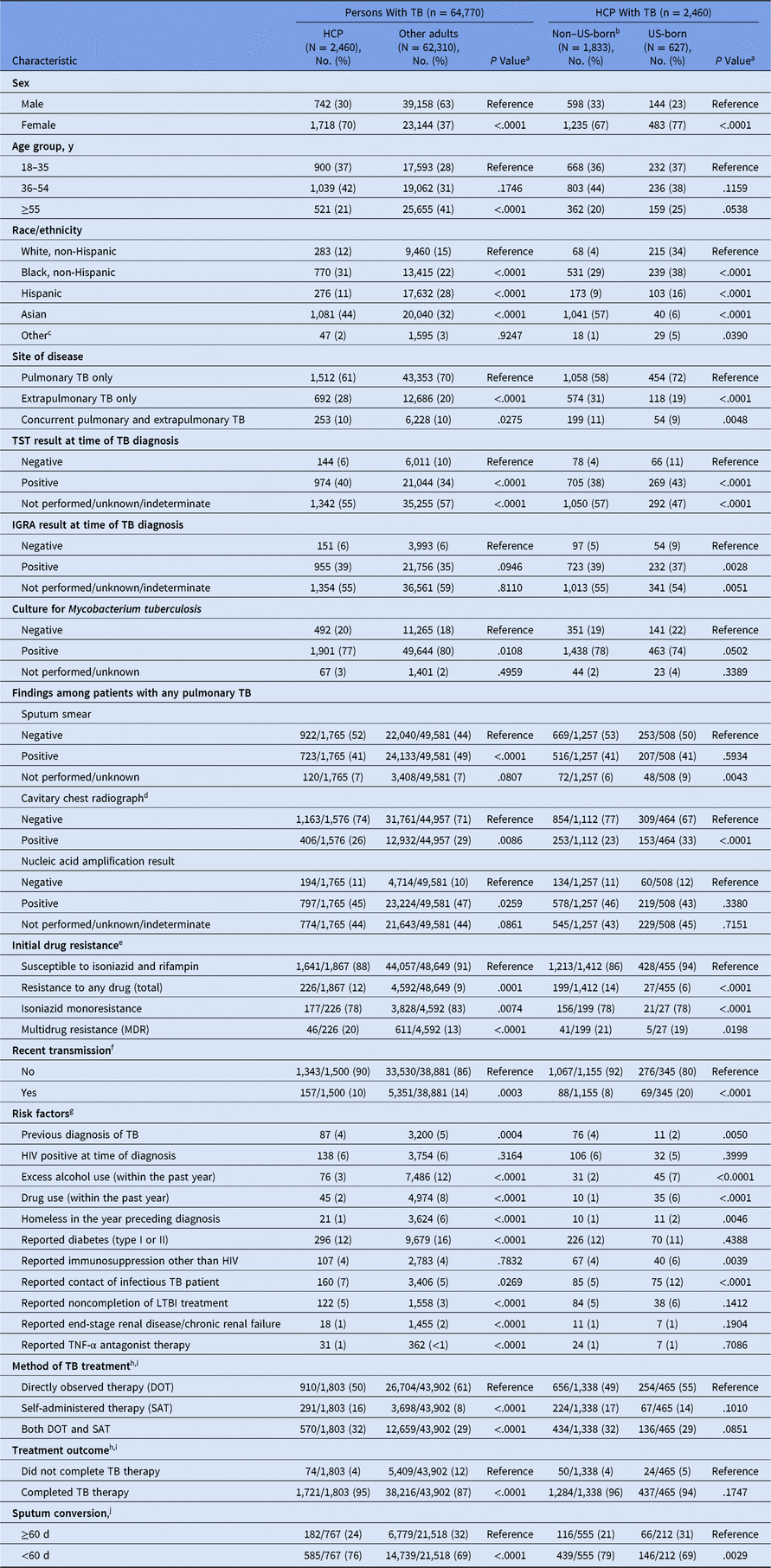
Among 64,770 TB cases reported among persons aged ≥18 years during 2010–2016, 2,460 (4%) were HCP and 62,310 (96%) were other adults (Table 1). Compared with other adults with TB, HCP were more likely to be female, younger, and to have been born outside of the United States (75% vs 67%). HCP were more likely to self-report non-Hispanic black (31% vs 22%) or Asian (44% vs 32%) race. HCP were more likely to have extrapulmonary (extrapulmonary only or extrapulmonary and pulmonary) TB disease (38% vs 30%) or resistance to any TB medications (12% vs 9%), particularly among HCP born outside of the United States. Isoniazid monoresistant TB was more common among non-HCP, whereas multidrug-resistant TB (ie, TB resistant to at least isoniazid and rifampin) was more common among HCP. Of 16 extensively drug-resistant TB cases (ie, TB resistant to at least isoniazid, rifampin, any fluoroquinolone and at least one of amikacin, kanamycin, or capreomycin) reported during 2010–2016, none occurred among HCP.
Characteristics of Persons With Tuberculosis (TB) by Healthcare Personnel (HCP) Status and by Origin of Birth Among Healthcare Personnel, Among Individuals 18 years or Older, United States, 2010–2016

Note. Data are no. (N) or proportion (%) of persons with TB, unless otherwise indicated. Sum of percentages may not equal 100% due to rounding. Eight persons were missing sex. TB, tuberculosis; HCP, healthcare personnel; HIV, human immunodeficiency virus; TST, tuberculin skin test; IGRA, interferon gamma release assay; LTBI, latent TB infection.
a P values were calculated using the Fisher exact test when cell sizes were <5.
b Birth outside the United States or US territories, unless one or both parents were US citizens.
c Includes multiple races and non-Hispanic American Indian/Alaska Native or Native Hawaiian/Pacific Islander.
d Analysis was limited to those who had an initial positive radiograph/computed tomography (CT) scan or other imaging study abnormality consistent with TB.
e Analysis was limited to those with a positive culture result and an isolate that had drug resistance results reported. MDR = resistance to at least isoniazid and rifampin.
f Recent transmission is based on a plausible-source case method that includes the following five characteristics: M. tuberculosis genotype, an infectious form of TB disease, patient who is ≥10 years old, diagnosis within 2 years before the given case, and residential location within 10 miles of a given case.Reference Yuen, Kammerer, Marks, Navin and France 5 – Reference France, Grant, Kammerer and Navin 7
g P values represent the comparison of each risk factor vs. non-risk factor; missing or unknown entries accounted for <1% of each risk factor.
h Analysis was limited to those who were alive at time of diagnosis, had documented initial TB treatment, and analyzed through 2014 to provide a 2-year follow-up on all cases.
i Missing/unknown (<2%) not shown.
j Analysis was limited to those who had an initial positive sputum culture result, had documented sputum conversion, and analyzed through 2014 to provide a 2-year follow-up on all cases.
TB disease risk factors
HCP were less likely to report a previous diagnosis of TB (4% vs 5%) than other adults, although HCP born outside the United States were more likely to report previous TB disease than US-born HCP (4% vs 2%, Table 1). HCP were less likely to report TB risk factors such as diabetes (12% vs 16%), homelessness (1% vs 6%), excess alcohol use (3% vs 12%), or drug use (2% vs 8%) compared with other adults. HIV infection (6%) was similar among all adults; HCP were more likely to report tumor necrosis factor α-antagonist use (1.3% vs 0.6%) and less likely to have end-stage renal disease (1% vs 2%). HCP born outside the United States were less likely to have non-HIV immunosuppression (4% vs 6%), excess alcohol use (2% vs 7%), or drug use (1% vs 6%) than US-born HCP.
Clinical characteristics and outcomes of TB disease
Cases among HCP were less likely to be attributed to recent transmission based on genotyping results (10% vs 14% for other adults), although HCP were more likely to report contact with an infectious TB patient within the last 2 years (7% vs 5%) or noncompletion of treatment for latent TB infection (LTBI) (5% vs 3%). HCP were more likely to have a positive TST result (40% vs 34%), with similar positive interferon-gamma release assay (IGRA) results (39% vs 35%) as other adults. Non–US-born HCP were more likely to have a positive IGRA result in the absence of TST testing (29% vs 23%), or no documented TST or IGRA testing at the time of diagnosis (24% vs 19%), than US-born HCP (Supplementary Table 1 online). Among patients with any pulmonary TB, HCP were less likely to have a positive sputum smear result (41% vs 49%), positive cavitary chest radiograph (26% vs 29%), or positive nucleic acid amplification test (45% vs 47%). HCP were more likely than other adults to self-administer TB therapy (48% vs 37%), to convert to negative sputum culture <60 days after starting treatment (76% vs 69%), and to complete TB treatment (95% vs 87%). The use of directly observed treatment for TB disease and completion of TB treatment did not significantly differ between US-born and non–US-born HCP; however, non–US-born HCP were more likely to convert to negative culture in <60 days (79% vs 69%) among sputum-culture–positive patients.
Tuberculosis rates among HCP in the United States
Using US Census Bureau population estimates for HCP for 2010–2016 (ie, annual average of 11.5 million US-born HCP and 2.4 million non–US-born HCP), the estimated average annual TB incidence was 2.5 cases per 100,000 HCP (range, 2.0–3.0), similar to the average national TB case rate of 3.2 cases per 100,000 persons (range, 2.9–3.6), during the time period. 2 , 8 Akin to national disparities in TB rates by nativity, average incidence for non–US-born HCP was 10.8 cases per 100,000 population (range, 8.6–12.7) compared with 0.8 cases per 100,000 population (range, 0.6–1.1) for US-born HCP. 2 , 8
Discussion
Compared with other adults with TB, HCP were more likely to be women, to be non–US-born, to have extrapulmonary TB, to have drug-resistant TB, to convert sputum in <60 days, and to complete TB treatment. Except for birth outside the United States, contact with an infectious TB case, and use of tumor necrosis factor-α antagonists, HCP reported lower prevalence of TB risk factors than other adults with TB. Genotyping data did not suggest greater prevalence of TB attributed to recent transmission compared with other adults, nor were TB incidence rates higher among HCP than the general population.
The proportion of HCP with TB who were born outside of the United States during 1995–2007 was 55%, compared with 75% during 2011–2016, and 68% of all TB cases nationally in 2016 occurring among persons born outside of the United States. 2 , Reference Lambert, Pratt, Armstrong and Haddad 3 Medical and social risk factors for TB among HCP are rare. HCP are infectious for a shorter time period, as evidenced by sputum conversion, have a lower proportion of cases attributed to recent transmission, and have better treatment outcomes compared with other adults; these findings are reassuring. However, non–US-born HCP are more likely to have extrapulmonary TB, which might delay diagnosis, and drug-resistant TB, which can complicate treatment. HCP are more likely to report a positive TST or IGRA result than other adults, and to report prior incomplete treatment for LTBI, which might represent missed opportunities to prevent TB. Recently updated recommendations indicate improved completion rates with newer shorter treatment regimens for LTBI, and clinical guidelines support use of IGRA over TST when applicable.Reference Borisov, Morris and Njie 9 , Reference Lewinsohn, Leonard and LoBue 10 By testing and more importantly, treating HCP for LTBI, progress can be made toward TB elimination in the United States.Reference Sosa, Njie and Lobato 11
Supplementary material
To view supplementary material for this article, please visit https://doi.org/10.1017/ice.2019.76
Author ORCIDs
Thitipong Mongkolrattanothai 0000-0002-1512-5346
Acknowledgments
The authors thank Robert Pratt for assistance with US Census Bureau data.
Financial support
No financial support was provided relevant to this article.
Conflicts of interest
All authors report no conflicts of interest relevant to this article. The findings and conclusions are those of the authors and do not necessarily represent the position of the Centers for Disease Control and Prevention.