Over the past century, modern medical care has advanced greatly, with more invasive procedures used to treat patients. 1 This trend contributes to the risk of healthcare-associated (HAIs) among vulnerable hospitalized patients. 1 HAIs are a problem in both developed and resource-poor countries; they are a leading cause of morbidity and mortality; and they pose economic burdens to patients and the healthcare system. Reference Klevens, Edwards and Richards2–Reference Ling, Apisarnthanarak and Madriaga6 The first national point-prevalence survey (PPS) on HAIs in acute-care hospitals in Singapore conducted in 2015 revealed that 1 in 9 inpatients had at least 1 HAI on any given day, with the risk of infections being higher in male patients, older patients, and patients with surgery or instrumentation. Reference Cai, Venkatachalam and Tee7
Knowledge of the impact of HAIs on costs, primarily in excess in length of hospital stays and in risks of death, are important to inform decision making about investments in strategies to reduce the risks. Reference Graves8 Length of stay is one of the most important outcomes in HAIs because it is directly linked to morbidity and economic costs. Reference Graves8 However, quantifying the excess length of stay associated with HAIs remains challenging. Reference Manoukian, Stewart and Dancer9 To accurately determine the excess length of stay associated with HAIs, one must adequately account for confounding, the time-dependent nature of the infection, and competing risks in patients for death and discharge. Reference Wolkewitz, Allignol, Harbarth, de Angelis, Schumacher and Beyersmann10,Reference Graves, Harbarth, Beyersmann, Barnett, Halton and Cooper11 Ignoring these factors will produce potentially large biases in the estimation of the effects of HAI on length of stay. Reference Wolkewitz, Allignol, Harbarth, de Angelis, Schumacher and Beyersmann10 In this study, we compared the outcomes of patients with and without HAIs to determine the impact of HAIs on length of stay and mortality, with appropriate consideration of the time-dependent nature of HAIs. Separate estimates were conducted for the major HAI types.
Material and methods
Study design and setting
We conducted a prospective cohort study in 7 public acute-care healthcare institutions in Singapore, using data from the first national PPS on HAIs and antimicrobial use in Singapore hospitals. Reference Cai, Venkatachalam and Tee7 The PPS used a modified version of the standardized PPS protocol developed by the European Centre for Disease Prevention and Control (ECDC). 12 Patients that were surveyed in a national HAI PPS conducted from June 2015 to February 2016 in the public acute-care healthcare institutions were prospectively followed to determine their outcomes. We excluded patients who were discharged after 30 days from the date of PPS because the outcomes of the patients beyond this duration is less likely to be directly associated with the presence or absence of HAI at the time of the PPS (Supplementary Fig. 1 online). Reference Barrasa-Villar, Aibar-Remon, Prieto-Andres, Mareca-Donate and Moliner-Lahoz13 This study was approved by the respective hospitals’ ethics review board prior to initiation. The need for informed consent was waived due to the observational nature of the study.
Data collection
All data were extracted from patients’ inpatient charts and electronic medical records and were entered into Research Electronic Data Capture (REDCap) software. Reference Harris, Taylor, Thielke, Payne, Gonzalez and Conde14 Data on demographics, comorbidities, admission details, presence, and types of HAIs were collected as described in a previous publication. Reference Cai, Venkatachalam and Tee7 Clinical outcomes were collected by the research assistants under the guidance of the survey leaders. The study outcomes were time to 30-day in-hospital all-cause mortality and time to discharge (ie, length of stay).
Study definitions
The definitions used in the study on demographics, comorbidities, admission details, presence, and types of HAIs were modified from the ECDC surveillance criteria and were described in detail in a previous publication. Reference Cai, Venkatachalam and Tee7,12 Briefly, patients were considered to have an active HAI (1) if symptoms of infection were present on the survey date, or if signs and symptoms were present previously and the patient was receiving treatment on the survey date, and (2) if the HAI met the ECDC surveillance criteria for HAI. 12 Time at risk was defined as the number of days from admission to onset of HAI for patients with active HAI(s) and from the time of admission to survey date for patients without HAI. The 30-day in-hospital all-cause mortality was defined as any mortality that occurred during the hospital stay within 30 days from the survey date.
Sample size calculation
We based the sample size calculation on the difference in hazards for discharge and assumed a 2-sided significance level of P ≤ .05. To detect a reduced hazards ratio (HR) of 0.7 for discharge in infected versus uninfected patients, at least 277 and 371 patients were required in each group, for power levels of 80% and 90%, respectively.
Statistical analysis
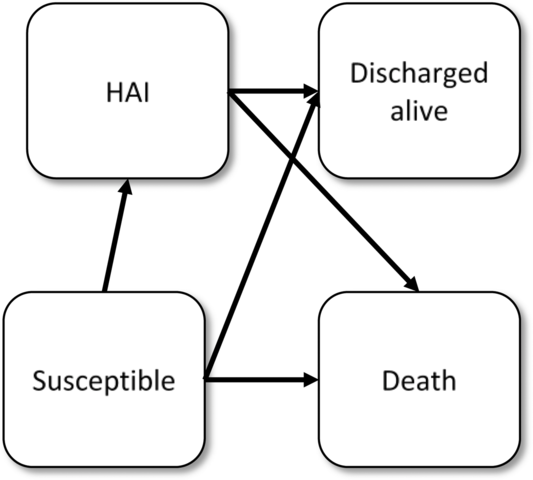
The multistate model employed in our study is shown in Figure 1. Each patient’s admission over time was modeled using 4 states: susceptible to HAI, infected with HAI, discharged alive, or died. Patients enter the initial state (susceptible) upon admission and exit by entering 1 of the 2 absorbing states (death or discharged alive), with or without passing through the intermediate state (HAI).
Multistate model used to determine the excess length of stay and risk of death due to a HAI. Each patient’s admission over time is modelled using the 4 states: (a) susceptible with no HAI, (b) infected, (c) death, and (d) discharged alive to account for the time varying nature of HAIs and the competing risks of discharge and death.

All statistical analyses were conducted using R version 3.6.1 software (R Foundation for Statistical Computing, Vienna, Austria). Hazard ratios for time to all-cause mortality and time to discharge were tabulated using multivariable Cox regression using the ‘mvna’ and ‘survival’ packages, with HAI as a time-dependent variable and with baseline variables (gender, age, ward type, and Charlsons comorbidity index (CCI)) considered as potential confounders. Reference Allignol, Beyersmann and Schumacher15 Stratified analyses were conducted for different infection types: unspecified sepsis, pneumonia, surgical site infections (SSIs), HAIs caused by multidrug-resistant organisms (MDROs) and all HAIs excluding patients with unspecified sepsis. Overall model fit was assessed using the standard lack-of-fit tests based on Martingale residuals. The proportional hazards assumption was evaluated by the cox.zph function and visual inspection of the plot. The excess length of stay between patients with and without HAIs was determined using the “etm” package. Reference Allignol, Schumacher and Beyersmann16 Although we conducted stratified analyses for different infection types (eg, unspecified sepsis, pneumonia, surgical site infections, and HAIs caused by MDROs), the “etm” package does not allow for confounder adjustment in the estimation of excess length of stay. Additionally, there are no parametric equations for calculating 95% CIs for the excess length of stay; hence, 1,000 samples were generated using the bootstrap method with replacement to construct the confidence intervals (CIs) for the excess length of stay.
Results
Description of study cohort
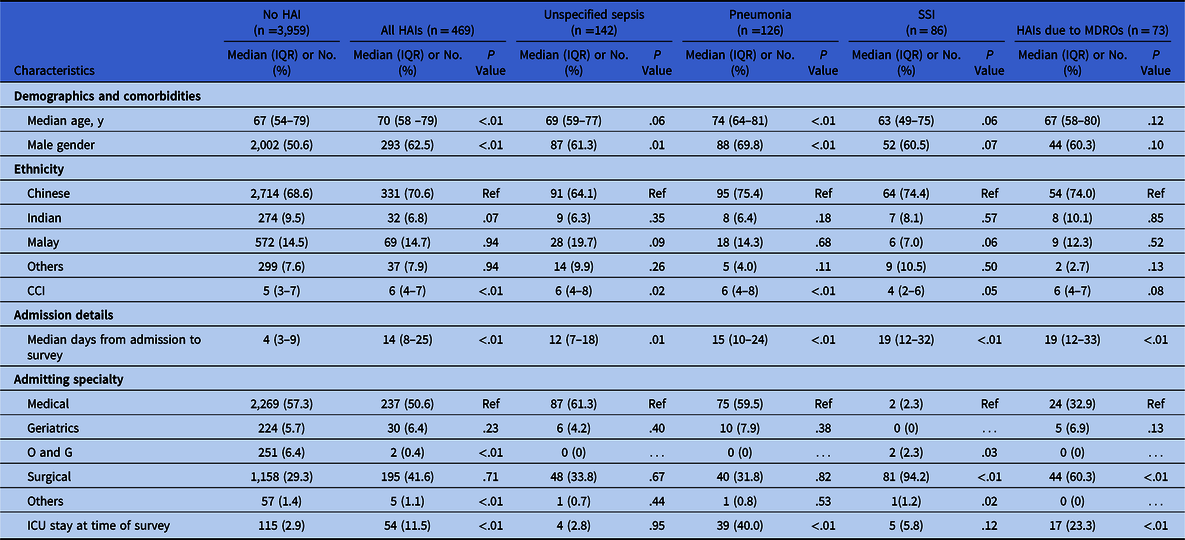
In total, 4,428 patients from 7 public acute-care hospitals were included. The baseline and admission characteristics of the surveyed patients with and without HAIs, as well as for patients with specific HAI types, are shown in Table 1. Compared to patients without HAIs, patients with HAIs had the following characteristics: older, more likely to be male, higher CCI, more patients in the intensive care unit (ICU) at time of survey, and longer time at risk. We observed a higher proportion of ICU patients for all HAI types except for patients with unspecified sepsis.
Characteristics of Patients without Healthcare-Associated Infections (HAIs) and with HAIsa

Note. IQR, interquartile range; CCI, Charlsons comorbidity index; ICU, intensive care unit; MDRO, multidrug-resistant organisms; O and G, obstetrics and gynaecology; SSI, surgical site infection.
a All and selected infection types.
Description of HAIs
In total, 517 HAIs were documented in 469 (10.6%) patients. The most common HAIs documented were unspecified sepsis (27.5%), pneumonia (23.2%), and SSIs (16.6%). Of the 126 patients with pneumonia, 29 (23.0%) were deemed to be ventilator-associated. In total, 73 patients developed HAIs that were deemed to be due to MDROs according to the ECDC definitions (total number of MDROs in the 73 patients = 91 pathogens). 12 The most common pathogen was Staphylococcus aureus (24 of 91, 26.4%).
Hazards of discharge and death
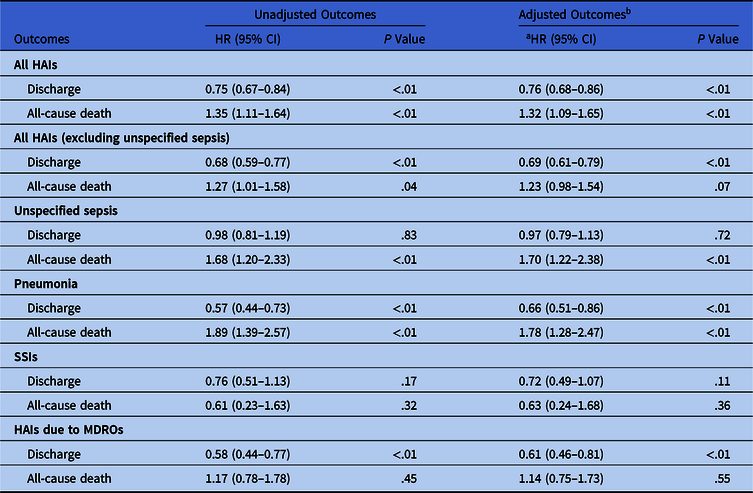
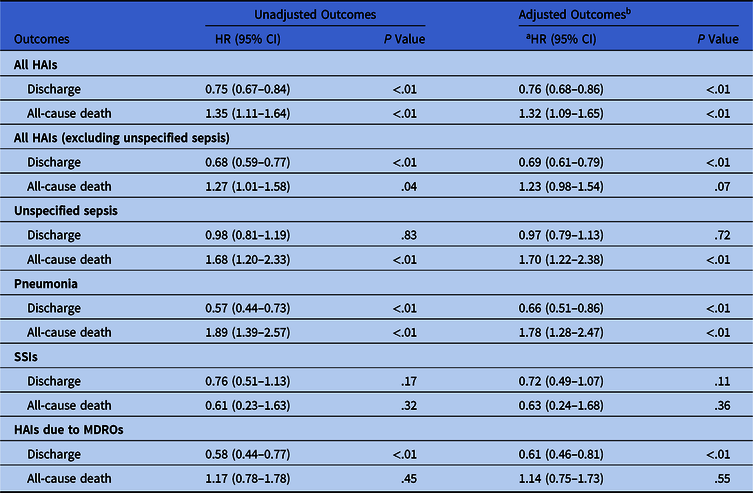
Of the 4,428 patients, 684 (15.4%) patients died within 30 days of the survey. The hazards of discharge and death for selected infection types are shown in Table 2. After adjusting for differences in CCI and ward type, the presence of HAIs significantly increased the hazard of death (aHR, 1.32; 95% CI, 1.09–1.65) and decreased the hazard of discharge (aHR, 0.75; 95% CI, 0.67–0.84) (ie, longer length of stay). If patients with unspecified sepsis were excluded, the adjusted hazards of discharge and death are 0.69 (95% CI, 0.61–0.79) and 1.23 (95% CI, 0.98–0.54), respectively. Among the different infection types, pneumonia was associated with the highest increase in hazard of death (aHR, 1.89; 95% CI, 1.39–2.57). HAIs due to MDROs did not significantly increase the hazard of death but was associated with a significantly reduced hazard of discharge.
Hazards for being discharged and Death in Patients with Healthcare-Associated Infections (HAIs) Compared to Patients with No HAIs
Note. HR, hazard ratio; CI, confidence interval; aHR, adjusted hazard ratio; MDROs, multidrug-resistant organisms; SSIs, surgical site infections.
a All and selected infection types.
b Adjusted for Charlson comorbidity index and ward type.
Excess length of stay
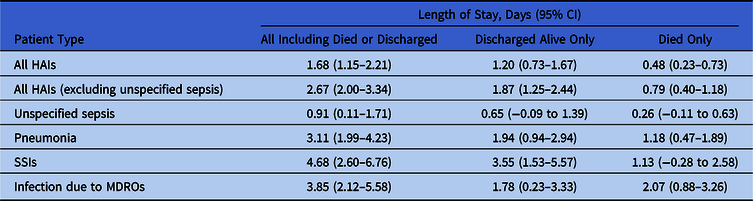
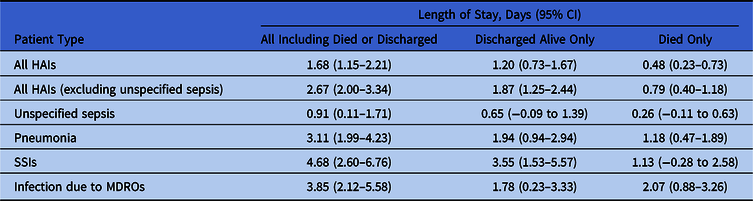
The excess length of stay in patients with HAIs, compared to those without HAIs, is 1.68 days (95% CI, 1.15–2.21). The length of stay was significantly increased for both patients that were discharged alive (1.20 days; 95% CI, 0.73–1.67 days) and patients that died (0.48 days; 95% CI, 0.23–0.73 days). If patients with unspecified sepsis were excluded, the excess length of stay compared to those without HAIs is 2.67 days (95% CI, 2.00–3.44 days). The excess length of stay for the different infection types for all patients, patients that were discharged alive and those that died during admission, are shown in Table 3. SSIs were associated with the greatest increase in length of stay, followed by pneumonia.
Excess Length of Stay in Patients with Different Healthcare-Associated Infections (HAIs) Types based on the Multistate Model
Note. CI, confidence interval; MDROs, multidrug-resistant organisms; SSIs, surgical site infections.
Discussion
Our findings suggest that HAIs observed in a Singapore setting resulted in excess all-cause mortality and length of stay among patients admitted in acute-care hospitals in Singapore. The excess mortality risk and length of stay varied according to infection type and resistance profile of the causative pathogens. Patients with nosocomial pneumonia had the highest increased risk of mortality compared to patients without HAIs, whereas patients with SSIs were associated with the greatest increase in length of stay compared to patients without HAIs. Infections due to MDROs were associated with increased length of stay compared to patients without HAIs.
Currently, data for clinical outcomes of nosocomial infections in Singapore have been limited and are mainly conducted in specific patient groups, settings, or infection types. Reference Pada, Ding and Ling17–Reference Lye, Earnest and Ling19 Our current study has several strengths compared to previous studies. Firstly, we accounted for the time-varying nature of the HAIs through multistate modeling and considered the competing risks of death versus discharge. The multistate modeling method offered the least biased estimation of the excess length of stay attributable to HAIs compared to even matched-cohort studies, as well as for the other “time to” analyses. In a systematic review conducted in 2018 by Manoukian et al, Reference Manoukian, Stewart and Dancer9 of the 92 articles that estimated excess length of stay due to HAIs, only 23 studies employed time-varying methods; of these, only 9 studies utilized multistate modeling. In a detailed article by Wolkewitz et al, Reference Wolkewitz, Allignol, Harbarth, de Angelis, Schumacher and Beyersmann10 the authors demonstrated that if the time-varying nature of HAIs were not considered, the time-dependent bias would have led to an overestimation of the hazards of the unexposed patients and an underestimation in the hazards of the exposed patients. Reference Wolkewitz, Allignol, Harbarth, de Angelis, Schumacher and Beyersmann10 A second advantage of our study was that we prospectively assessed each patient for HAIs using the objective definitions for HAIs provided by the ECDC, which consider a combination of clinical, radiological, and microbiological characteristics. 12 Thirdly, our large sample size allowed us to conduct detailed subgroup analyses on different infection types of interest. In our subgroup analyses, we found that pneumonia and SSIs were associated with the highest increased risk of mortality and in length of stay, respectively. Given the high prevalence of both pneumonia and SSIs and the poor clinical outcomes associated with the infections, prevention of these infections appears to be critical in improving patient health outcomes in our local setting.
After accounting for the time-varying nature of HAI onset, we observed that HAIs resulted in excess length of stay of ~1.7 days. This excess length of stay appeared to be shorter than previous studies. In a single-center study in Germany, HAIs were found to be associated with an excess length of stay of ~8.5 days. Reference Arefian, Hagel and Heublein20 In another study in Belgian hospitals, the excess length of stay associated with HAIs was 7.3 days. Reference Vrijens, Hulstaert, Devriese and van de Sande21 We postulate 2 main reasons for this difference. First, ~25% of the patients with HAIs in our study had unspecified sepsis, which was not associated with an increased length of stay in our subgroup analysis. We hypothesized that in several patients with “unspecified sepsis,” a noninfectious inflammatory aetiology was eventually diagnosed, and prolonged intravenous antibiotic treatment (the most common reason for keeping a patient in the hospital) was unnecessary. Reference Cai, Venkatachalam and Tee7,Reference Pittet, Rangel-Frausto and Li22 To explore this hypothesis, we estimated the excess length of stay in patients with HAIs after excluding patients with unspecified sepsis in our analysis. As shown, the excess length of stay was increased to 2.7 days after excluding patients with unspecified sepsis. The second postulated reason was that we did not assess the patients for the presence of HAIs beyond the time of PPS. As such, patients that did not have an active HAI at the time of survey may subsequently develop a HAI which is undocumented, which can result in an underestimation in the magnitude of clinical outcomes between the groups (Supplementary Fig. 1 online).
Our study has several limitations. We may have underestimated the magnitude of clinical outcomes between the groups because patients were not assessed for the presence of HAIs beyond the time of PPS. However, we attempted to minimize this potential bias by excluding patients who were admitted beyond 30 days from the PPS in our study. Although we attempted to adjust for potential confounders due to difference for patient’s baseline and clinical characteristics in the multivariable regression models, the effect of unmeasured characteristics could not be eliminated in our observational study. In addition, adjusting for confounders could not be done in the estimation of the excess length of stay. Lastly, despite our large sample size, we were unable to provide estimates for all infection types due to the low statistical power in certain infection types.
In conclusion, HAIs have substantial effects on all-cause mortality and length of stay among patients admitted in acute-care hospitals. Most notably, pneumonia and SSIs with the highest risk of death and excess length of hospital stay, respectively. Because HAIs are preventable, coordinated efforts must be made to reduce and eliminate HAIs. Future studies will be necessary to determine the economic burden of HAIs. Continued research is also needed to develop novel methods to combat antimicrobial resistance in nosocomial pathogens.
Acknowledgments
We thank the data collection team: Ms Fathinah Bt. Mohd Jaffar, Ms Huan Xiao Wei, Mr Zaw Linn Kyaw, Ms See Pei Shi, and Ms Bindu Karunakaran for their dedication, and the SingHealth REDCap team. This study was supported by the Communicable Diseases–Public Health Research Grant (CD-PHRG), awarded by the Ministry of Health, Singapore (grant no. CDPHRG-CS/0002/2014). The funders had no role in study design, data collection, or interpretation of the work for publication. All authors report no conflicts of interest relevant to this article.
Supplementary material
To view supplementary material for this article, please visit https://doi.org/10.1017/ice.2020.304