In the last decades, research has increased attention on human behavior in emergency situations such as natural and man-made disasters, though the majority of studies have been carried out in the United States. This stresses the importance of determining the validity of US findings in European survivors (Schmidt, Knuth, & Kehl, 2011). Europe showed an increased number of natural disasters rising from 59 on average per year during 2000-2009 to 70 disasters in 2010 (Guha-Sapir, Vos, Below, & Ponserre, Reference Guha-Sapir, Vos, Below and Ponserre2011), and European citizens have also been affected by man-made incidents such as the bombings in Madrid 2004 and London 2005, or the Torino ThyssenKrupp fire of 2007.
Posttraumatic stress disorder (PTSD) is a common outcome to these traumatic events and it could appear in the aftermath of the incident (Foa, Stein, & MacFarlane, Reference Foa, Stein and McFarlane2006). PTSD symptoms include repeated and unwanted re-experiencing of the event, hyperarousal, emotional numbing, and avoidance of stimuli perceived as reminders of the event (Ehlers & Clark, Reference Ehlers and Clark2000). Previous studies identified many risk and protective factors involved in the development of PTSD (Brewin, Andrews, & Valentine, Reference Brewin, Andrews and Valentine2000). Self-efficacy beliefs have been found to be the most proximal predictor of mental health outcomes during posttraumatic recovery (Benight & Bandura, Reference Benight and Bandura2004). Social cognitive theory (Bandura, Reference Bandura1997) defines self-efficacy as the perceived capacity of managing one’s personal functioning and environmental demands occasioned by stressful and traumatic events. Both cross-sectional studies and longitudinal studies have shown that self-efficacy is protective in respect of the development of PTSD (Benight, Cieslak, Molton, & Johnson, Reference Benight, Cieslak, Molton and Johnson2008; Luszczynska, Benight, & Cieslak, Reference Luszczynska, Benight and Cieslak2009). However, most studies have investigated the influence of self-efficacy on the recovery process in the aftermath of a traumatic event (Cieslak, Benight, Luszczynska, & Laudenslager, Reference Cieslak, Benight, Luszczynska and Laudenslager2011), but none has focused on survivor’s perception of self-efficacy during the emergency situation as protective factor. This knowledge will bring new insights in the understanding of behavior in emergency situations, in which perceived self-efficacy may promote action-oriented strategies (i.e. activating pro-social behaviors, seeking for shelter, evacuating from the location) and predict adaptation. An active behavior during an emergency situation could represent the survivor’s effort of managing a threatening situation and reflect an action-oriented coping strategy (Luszczynska et al., Reference Luszczynska, Benight and Cieslak2009). In fact, prior studies have found a negative association between the use of active coping strategies and distress symptoms among people affected by emergency situations (Benight & Harper, Reference Benight and Harper2002; McPherson, Hale, Richardson, & Obholzer, Reference McPherson, Hale, Richardson and Obholzer2003).
The public discourse concerning the human behavior in emergencies emphasizes the occurrence of panic and irrational behaviors among victims of emergency situations, despite the fact that this notion has not been supported by empirical findings (Drury, Cocking, & Reicher, Reference Drury, Cocking and Reicher2009). In fact, most people react in a conscious and adaptive way, while irrational and maladaptive behaviors are rare (Blake, Galea, Westeng, & Dixon, Reference Blake, Galea, Westeng and Dixon2004). No previous research has explored whether active and conscious behaviors during an emergency situation reduce the occurrence of posttraumatic stress symptoms, therefore in this study we consider this association.
The variables acting during and after the traumatic event are stronger predictors of posttraumatic stress symptoms in comparison with pre-event factors (Ozer, Best, Lipsey, & Weiss, Reference Ozer, Best, Lipsey and Weiss2003). However, few studies have explored if pre-trauma variables reflecting the survivors’ emergency culture, such as risk perception, emergency prevention knowledge, and trust in the capacity of emergency services, have a role in the development of PTSD symptoms. Proulx (2001) hypothesized that previous knowledge and training in emergency situations influence behavior during fires. Research has confirmed that if people are trained, they start earlier with evacuation (Prolux & Pineau, Reference Prolux and Pineau1996). Emergency drills and exercises could increase emergency prevention knowledge, producing benefits among first responders and citizens (Peterson & Perry, Reference Peterson and Perry1999). Another hypothesis is that exercises favor the attribution of credibility to emergency services and increase the likelihood that victims will comply with recommended measures (Perry, Reference Perry2004). An implication is that increased emergency prevention knowledge raises the perception of being able to deal with the situation, resulting in less posttraumatic stress symptoms.
Regarding risk perception, studies among survivors and firefighters have shown that higher risk perception increases the perception of threat resulting in greater stress symptoms (López-Vázquez & Marvan, Reference López-Vázquez and Maraván2003; Prati et al., Reference Prati, Pietrantoni, Saccinto, Kehl, Knuth and Schmidt2013).
Survivors’ trust in emergency personnel is another variable that has received little attention in previous studies on posttraumatic stress predictors. Basolo et al. (Reference Basolo, Steinberg, Burby, Levine, Cruz and Huang2009) found a positive association between disaster preparedness and citizens’ reliance on authorities in respect of their capacity to manage it. If individuals believe that control can be achieved through the managing agency, they will likely engage in more action-oriented strategies aimed at modifying the situation (Folkman, Lazarus, Dunkel-Schetter, DeLongis, & Gruen, Reference Folkman, Lazarus, Dunkel-Schetter, DeLongis and Gruen1986). Consistently, survivors who perceived an accident as predictable by experts showed less levels of stress than those who considered the accident as unpredictable (Evans, Wener, & Phillips, Reference Evans, Wener and Phillips2002; Lange, Toussaint, & Fleming, Reference Lange, Toussaint and Fleming2004). These results stress the importance of exploring the influence that survivor’s reliance in emergency services has on the development of posttraumatic stress.
This study focuses on survivors of natural and man-made disasters and not on interpersonal violence such as rape or domestic violence. We analyzed the contribution of self-efficacy in explaining the variance of posttraumatic stress symptoms in a multivariate model. We expected that an increase in perceived self-efficacy in the emergency situation predicted less posttraumatic stress symptoms. We also expected that predictors of higher levels of posttraumatic stress symptoms could be: less trust in emergency services; less risk perception; less emergency prevention knowledge; no active behavior in comparison to active behavior; and no conscious behavior in comparison to conscious behavior in the emergency situation. Trauma severity (Galea et al., Reference Galea, Resnick, Ahern, Gold, Bucuvalas, Kilpatrick and Vlahov2002), perceived threat (Vázquez, Pérez-Sales, & Matt, 2006), female gender (Başoğlu, Kiliç, Şalcioğlu, & Livanou, Reference Başoğlu, Kiliç, Şalcioğlu and Livanou2004), and older age (Johnson et al., Reference Johnson, Canetti, Palmieri, Galea, Valrey and Hobfoll2009), are risk factors for PTSD symptoms, thus we included them in the regression model as control variables. The time since the emergency situation and the country were also included as control variables because the time frame of the events was wide (11 years) and because we recruited Italian and Spanish survivors who differ in some study variables.
Method
Procedure
Data were collected from July 2010 to March 2011 as part of a funded research project called BeSeCu, which means Behavior, Security and Culture, (contract 218324) under the European Union Framework 7 Security Program initiative Footnote 1 . BeSeCu Research Group developed the questionnaire (Knuth et al., in press), which was aimed to assess behaviors, emotions and cognitions of people affected by emergency situations such as domestic fire, fire in a public building, terrorist attack, flood and earthquake.
Participants had to refer to their experience by answering questions in respect of only one specific emergency situation. At the beginning of the questionnaire, the participant had to indicate to which incident he/she would report. Moreover, in order to avoid misunderstanding, a short title introduced each section of the questionnaire and explained the content of the related questions (e.g. Now some questions about emergency in general; Now some questions about the specific incident you experienced). Several strategies to recruit participants were used: recruitment via online advertisement and via social networks; personal contact with victims after a detailed search of emergency situations in print/online newspapers and web pages related to fire-fighters and civil protection. As for the victims of terrorist attacks, participants were recruited mainly through victims’ associations.
The inclusion criteria for participation were: (a) Participants should be 18 years old or older; (b) The incident should have happened in the last 11 years; (c) Emergency services should have been involved.
Participation was completely voluntary and anonymity was granted. A written informed consent was distributed and signed before the involvement in the study.
The Besecu-S questionnaire was translated from English into Italian and Spanish. A forward-back-translation technique was used in order to achieve best possible cross-cultural harmonization. The questionnaire was available in paper-pencil format and online, for both languages. For both formats participants could obtain more information about the project and the questionnaire by contacting a reference person (we provided name, institution affiliation, address, telephone number, email). A third format used was the “support-mode”, in which the participant completed the questionnaire with the help of a BeSeCu staff member or in the case of the terrorist attack victims, accompanied by a psychologist affiliated to the victims’ association.
Participants
In the present study, data from Italy and Spain have been used and the sample consisted of 214 participants who had experienced an emergency situation. Sixty-three participants reported a domestic fire (n Spanish = 32; n Italian = 31), 21 a terrorist attack (n Spanish = 21), 7 a flood (n Spanish = 1; n Italian = 6), 49 a fire in a public building (n Spanish = 32; n Italian = 17), and 74 an earthquake (n Italian = 74). The average length of time since the emergency situation, which the participant reported, was 1173.21 days (i.e. nearly 3 years) (SD = 977.23).
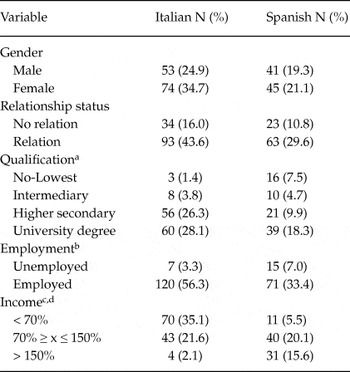
The majority of participants were from Italy (n = 128; 59.8%) and 86 (40.2%) from Spain (χ2 = 8.24; df = 1; p < .01). The mean age for the total sample was 36.85 (SD = 14.28; range: 18-83), 31.63 (SD = 12.80; range: 18-83) for the Italian participants and 44.55 (SD = 12.85; range: 19-82) for the Spanish participants. Table 1 shows the sample characteristics.
Sample characteristics and country differences (n = 214)

Note:
aχ2 = 22.42, df = 3, p < .001, Cramer’s V = .32; bχ2 = 7.88, df = 1; p < .01, φ = .19; cχ2 = 59.6, df = 2, p < .001, Cramer’s V = .55. dThresholds for the three categories were established considering the average income of the country (GfK Group, 2008).
Measures
The Italian and Spanish versions of the questionnaire were composed of the same scales and each scale has the same number of items in the two language versions. Each scale was assessed on a 5-point Likert scale ranging from 1 (not at all) to 5 (extremely) with the exception of the Impact of Event Scale Revised (assessing posttraumatic stress symptoms) and Trauma Severity Scale, which presented different ranges (see below). Internal consistency was calculated as Cronbach’s alpha for each subscale. For the purposes of the current study, we selected the following measures from the BeSeCu-S questionnaire (Schmidt et al., 2011).
Emergency Services Trust Scale
Three items from the Emergency Service Trust Scale were selected to assess to what extent participants relied on Medical Service, Police and Firefighters with a total score ranging from 3 to 15 (e.g. Before the incident occurred, to what extent did you believe you could rely on the Medical Service to assist you in an emergency?). Internal consistency for the total sample was .80 (.87 for the Italian sample and .75 for the Spanish sample).
Emergency Prevention Knowledge Scale
Seven items constituted this scale with a total score ranging from 7 to 35. It explored the participant’s emergency prevention knowledge received by professional activity, first aid course, fire safety knowledge, fire drills at school and work, etc. Examples of items were: I had taken part in fire drills at work; I had read safety notices/evacuation plans in public places, such as in hotel rooms, train carriages, etc. Internal consistency was .75 for the total sample (.64 for the Italian sample and .88 for the Spanish sample).
Risk Perception Scale
Participants were asked to rate (percentage from 0 to 100; total score from 0 to 600) the perceived likelihood of becoming a victim in the future in respect of six emergency situations: domestic fire, fire in a public building, terrorist attack, earthquake, flood and traffic accident. Internal consistency for the total sample was .80 (.78 for the Italian sample and .89 for the Spanish sample).
Self-efficacy in emergency situation
Three items assessed participants’ perception of having been able to deal with the emergency situation throughout the stages of the incident such as in the realization stage, during the evacuation and upon exiting the location (e.g. When you realized you were in an emergency situation, did you think you were able to deal with the situation?; During evacuation/rescue, did you think you were able to deal with the situation?; Upon exiting the location, did you think you were able to deal with the situation?). The total score ranged from 3 to 15. Internal consistency was .88 for the total sample (.89 for the Italian sample and .84 for the Spanish sample).
Automatic Behavior
Participants had to answer a single item (i.e. How would you describe your behavior when you understood something was happening?) by choosing one option between “automatic/instinctive” (0) and “conscious/rational” (1).
Active Behavior
Participants had to indicate their first action during the emergency situation (i.e. What was the first thing you did when you understood something was happening?) by choosing one option in a list of 10 possible actions. The variable was dichotomized in active (1) and passive behaviors (0). Examples of items reflecting an active behavior are I sought help from the emergency services; I tried to alert, comfort or save others who might be threatened by the situation, and examples of passive behaviors are I did nothing for a while; I gave up and let happen whatever was about to happen.
Trauma severity
Four dichotomized items assessed trauma severity (ranging from 0 to 4). Participants had to indicate: if they were admitted to hospital for injuries (yes = 1; no = 0); if they had family/friends seriously injured (yes = 1; no = 0); if family/friends suffered fatal injuries (yes = 1; no = 0) and if their property/belongings incurred any serious damage in the incident (yes = 1; no = 0).
Perceived Personal Threat
Three-items assessed participants’ perception of personal threat throughout the stages of the incident such as in the realization stage, during the evacuation and upon exiting the location (e.g. During evacuation/rescue, did you think your own life was in danger?; Upon exiting the location, did you think your own life was in danger?). The total score ranged from 3 to 15. Internal consistency for the total sample was .85 (.86 for the Italian sample and .85 for the Spanish sample).
Posttraumatic stress symptoms
Posttraumatic stress symptoms were assessed by using the Italian (Giannantonio, Reference Giannantonio2003; Saccinto, Prati, Pietrantoni, & Pérez-Testor, Reference Saccinto, Prati, Pietrantoni and Pérez-Testor2013) and Spanish (Gargurevich, Luyten, Fils, & Corveleyn, Reference Gargurevich, Luyten, Fils and Corveleyn2009) versions of the Impact of Event Scale-Revised (IES-R) (Weiss & Marmar, Reference Weiss, Marmar, Wilson and Keane1997). Participants referred to symptoms related to the emergency situation they described. The instrument is a 22-item self-reported questionnaire designed to capture intrusive, hyperarousal, avoidance and numbing posttraumatic stress symptoms. The total score ranges from 0 to 88, and each item is rated on a 5-point scale (from 0 = not at all and 4 = extremely), reflecting to what extent the particular symptom has been a problem for the respondent during the past week with respect to the described incident. In this study, internal consistency for the total scale was .94, .90 for the intrusion, .87 for the hyperarousal, and .80 for the avoidance-numbing subscales. For the Italian group, internal consistency for the total scale was .94, for the intrusion .90, for the avoidance-numbing .79 and .88 for the hyperarousal subscale. For the Spanish group, internal consistency for the total scale was .97, for the intrusion .95, for the avoidance-numbing .88 and .94 for the hyperarousal subscale. Since the three subscales presented high positive correlations between each other (intrusion and avoidance-numbing: r = .74, p < .01; intrusion and hyperarousal: r = .78, p < .01; hyperarousal and avoidance-numbing: r = .72, p < .01), we decided to use the total score instead of the scores of the three subscales in the following analyses.
Statistical analysis
In order to perform parametric tests, we checked if all variables presented a normal distribution. Age and posttraumatic stress symptoms lacked a normal distribution and were transformed logarithmically. The time since the emergency situation did not have a normal distribution either, and the square root transformed variable was used. Independent t-tests and Pearson Chi-squares were used to determine differences between the Italian and Spanish participants regarding the dependent and independent variables.
A multiple hierarchical regression analysis was used to assess the contribution of the selected predictors to posttraumatic stress symptoms.
To perform regression analysis, multi-collinearity was checked. Correlations between predictor variables and posttraumatic stress symptoms did not exceed the value of .70 (Tabachnik & Fidell, Reference Tabachnik and Fidell2007). Also the Variance Inflation Factor (VIF) and Tolerance statistics, of multiple regression analysis, did not reach significant values below .2 (Menard, Reference Menard1995) and > 10 (Bowerman & O’Connell, 1990), respectively.
Results
Differences between the Italian and the Spanish participants
Regarding the Italian group, more participants reacted in an automatic/instinctive way than in a conscious/rational way (χ2 = 10.78; df = 1; p < .01); Italian participants also presented more active than passive behaviors (χ2 = 28.78; df = 1; p < .001). The Spanish group presented more conscious/rational behaviors than automatic/instinctive behaviors (χ2 = 4.76; df = 1; p < .05) and more active than passive behaviors (χ2 = 28.10; df = 1; p < .001). Each group did not present significant gender differences.
We found that the Spanish participants were significantly older (t = 7.97, df = 211, p < .001) than the Italian participants. Moreover, the average time since the occurrence of the emergency situation was higher for Spanish than Italian participants (t = 3.34, df = 186, p < .01). Furthermore, other differences between the two groups were that Spanish participants presented more conscious behavior during the emergency situation (χ2 = 14.26; df = 1; p < .001), perceived themselves as more self-efficacious (t = −2.97, df = 211, p < .01), and presented less posttraumatic stress symptoms (t = −2.86, df = 203, p < .01) than Italian participants. The two groups did not significantly differ regarding gender, trust in emergency services, emergency prevention knowledge, risk perception, active vs passive behavior, trauma severity and perceived personal threat.
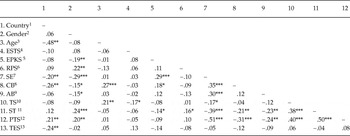
Bivariate correlation analyses between the study variables are presented in table 2.
Correlation matrix of all study variables

Note:
*p < .05; **p < .01; ***p < .001. A point-biserial correlation coefficient (r pb ) was computed for correlations between two binary variables, and a binary variable and an interval variable. A Pearson’s correlation coefficient (r) was computed for correlations between two interval variables.1Country (Spanish = 4; Italian = 8); 2Gender (m = 1; f = 2); 3Logarithm of age; 4Emergency Services Trust Scale; 5Emergency Prevention Knowledge Scale; 6Risk Perception Scale; 7Self-efficacy in emergency situation; 8Conscious Behavior (conscious behavior = 1; no conscious behavior = 0); 9Active Behavior (active behavior = 1; no active behavior = 0); 10Trauma severity; 11Self-threat perception; 12Logarithm of Posttraumatic stress symptoms; 13Time since the emergency situation (square root transformed).
Multiple regression analysis
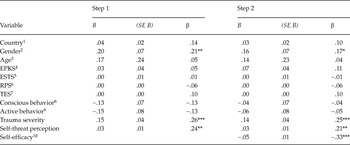
A multiple hierarchical regression analysis was used to assess the contribution of the selected predictors to posttraumatic stress symptoms. The two groups differed regarding the dependent and some independent variables, thus we included the country as control variable. Table 3 shows results of the multiple hierarchical regression analysis.
Hierarchical Multiple Regression analysis predicting Posttraumatic Stress Symptoms

Note:
*p < .05; **p < .01; ***p < .001. Step 1: R 2 = .367***, Adj.R 2 = .320***. Step 2: R 2 = .436***, Adj.R 2 = .391***. 1Country (Italian = 8; Spanish = 4); 2Gender (m = 1; f = 2); 3Logarithm of age; 4Emergency Prevention Knowledge Scale; 5Emergency Services Trust Scale; 6Risk Perception Scale; 7 Time elapsed since the emergency situation; 8Conscious Behavior (conscious behavior = 1; no conscious behavior = 0); 9Active Behavior (active behavior = 1; no active behavior = 0); 10Self-efficacy in emergency situation.
As a first step, country, gender, age, emergency prevention knowledge, trust in emergency service, risk perception, time since the emergency situation, active behavior, conscious behavior, trauma severity and self-threat perception were entered in the regression analysis. The model accounted for 32% of the variance in posttraumatic stress symptoms, F(11, 160) = 7.85, p < .001. Three variables, such as gender (β = .21, p = .004), trauma severity (β = .26, p = .001) and self-threat perception (β = .24, p = .002) significantly predicted the variance in posttraumatic stress symptoms. These results evidenced that women, participants with a higher self-threat perception and those who experienced a more severe traumatic event presented more posttraumatic stress symptoms.
As a second step, the variable perceived self-efficacy during the emergency situation was entered and increased the explained variance of the model (ΔR = .07). The final model accounted for 39.1% of the variance, F(12, 160) = 9.55, p < .001 (ΔF = 18.30). Four variables were significant predictors of posttraumatic stress symptoms: perceived self-efficacy during the emergency situation (β = −.33, p < .001), gender (β = .17, p = .015), trauma severity (β = .25, p < .001) and self-threat perception (β = .21, p = .006). These results mean that participants, who perceived themselves as more self-efficacious during the emergency situation, presented less posttraumatic stress symptoms. In contrast women, participants with a higher self-threat perception and those who experienced a more severe traumatic event presented more posttraumatic stress symptoms.
Discussion
As hypothesized, people who perceived themselves more self-efficacious during the emergency situation presented less posttraumatic stress symptoms in the aftermath of the event, even when controlling for country, gender, age, time since the occurrence of the emergency situation, trauma severity and self-threat perception. In line with previous research, results show that self-efficacy is a protective factor that reduces PTSD symptoms, and predicts recovery among victims of man-made and natural accidents (Benight et al., Reference Benight, Freyaldenhoven, Hughes, Ruiz, Zoschke and Lovallo2000; Benight & Harper, Reference Benight and Harper2002). On the contrary and in accordance with previous research (Ozer et al., Reference Ozer, Best, Lipsey and Weiss2003), female gender, trauma severity and self-threat perception contributed to explain the increase in posttraumatic stress symptoms.
Differently from previous studies, our findings focused on the survivor’s perceived ability to deal with the situation during its occurrence. To our knowledge, this is the first study that links perceived self-efficacy in the emergency situation and posttraumatic stress. Since more self-efficacious individuals can present more adaptive response in the aftermath of the event, our results have some possible implications. First of all, it stresses the importance of increasing people’s self-efficacy and their perception of being able to manage a stressful event. This goal may be achieved, for instance, by developing adequate training programs, which focuses on citizens’ knowledge of how to behave during natural and man-made accidents. The programs should explore if people are prepared to adopt protective actions during a danger situation and include simulations of evacuation. Training programs may be conducted with a participatory approach in order to promote proactive attitudes among participants and encourage people to better know environmental risks and adopt preventive cautionary actions. They also should target different groups with a particular attention to more vulnerable ones, such as migrants, children and women. In our study, we found a significant positive association between survivors’ emergency prevention knowledge and self-efficacy in the bivariate analysis. It is not unreasonable to hypothesize that more emergency prevention knowledge increases self-efficacy in emergency situation, which in turn reduces posttraumatic stress symptoms. Further research should test this hypothesis, which may support the need for the development of preventive plans and educational programs directed towards individuals and communities at risk. Furthermore, future studies could assess perceived peritraumatic self-efficacy in the immediate aftermath of the trauma and evaluate whether it is a predictor in a longitudinal design. To better understand the role of peritraumatic self-efficacy further studies should control for other control variables such as self-esteem and survivors’ level of self-efficacy.
In accordance with Benight and Harper (Reference Benight and Harper2002), we consider that our findings underline the need to support affected survivors to identify perceptions regarding their behaviors during the emergency situation. This will allow the professional to offer support to more vulnerable individuals and, when possible, to value positively survivors’ efforts directed to manage the stressful situation. This may contribute to promote a positive cognitive appraisal of the event and prevent the development of a negative memory concerning the traumatic situation, which may lead to distress and psychopathology (Ehlers & Clarks, Reference Ehlers and Clark2000).
Finally, the current study concerns the experience of survivors who were victims of several emergency situations that occurred in Italy and Spain in the last decade. This is worth mentioning because future disasters may be multinational events and there is a need to extent results regarding behavior in emergency situation to survivors affected by different types of events and/or with different cultural backgrounds. Briere and Elliot (Reference Briere and Elliot2000) pointed out that previous research has focused on participants who experienced a specific category of event (e.g. all participants were victims of earthquakes or traffic accident) and this limited the generalization of results. They also found that the stressor characteristics (i.e. capacity to injure or damage, fear of death) were stronger predictors of distress symptoms than the specific type of event. Our findings have shown that survivors of fires, terrorist attacks, earthquakes and floods with more self-efficacy beliefs have developed less posttraumatic symptoms, even when controlling for the severity of the trauma.
Regarding the pre-event variables, such as emergency prevention knowledge, trust in emergency services and risk perception of becoming a victim of an emergency situation, it emerged that they were not associated to a reduction in posttraumatic stress symptomatology. Although the findings do not support our hypotheses, they are in accordance with previous studies (Ozer et al., Reference Ozer, Best, Lipsey and Weiss2003) showing that posttraumatic stress symptoms are more strongly related to factors operating during and after the traumatic event. It is also possible that the lack of association lies on the fact that we assessed these pre-event variables by collecting survivors’ perceptions and beliefs.
This study has several limitations. First, the sample size was small and not randomly selected. The study has been developed with a convenience sample of survivors who voluntarily participated in the research. It is possible that there are latent biases linked to the decision of participating in the study, or that the difficulty of reaching some population groups limited their recruitment. For instance, in spite of our efforts to recruit a representative sample of survivors of emergency situations, we found difficulties especially in recruiting participants of non-collective events, such as domestic fires. These difficulties may depend on the type of event, which is associated to self-blame for its occurrence (Greenberg & Keane, Reference Greenberg and Keane2001) and favors reluctance to participate. Second, the emergency situation reported by the participant could have occurred up to 11 years ago, and it is possible that this long time affected the retrospective recall of the event and the results. Finally, a further issue is the cross-sectional design of the study, which impedes to identify causal relationships between the studied variables and suggests caution in interpreting and generalizing the observed findings.
Despite these limitations, the study gives a contribution in understanding the role of perceived self-efficacy during the emergency situations in culturally different populations of survivors, which experienced several types of emergency situation such as earthquake, flood, terrorist attack and fires.