Introduction
It is widely accepted that older women suffer from higher rates of disability compared to men. Women tend to live longer than men, however, they tend to suffer more from disabling but non life-threatening conditions, whereas men suffer disproportionately from diseases that have higher mortality rates (Verbrugge and Wingard Reference Verbrugge and Wingard1987). This pattern has been documented in a number of countries, although to date, the majority of studies on sex differences in disability have been conducted in developed countries such as the United States of America (USA), Japan and European countries (Crimmins, Kim and Solé-Auró Reference Crimmins, Kim and Solé-Auró2011; Minicuci et al. Reference Minicuci, Noale, Pluijm, Zunzunegui, Blumstein, Deeg, Bardage and Jylha2004; Oksuzyan et al. Reference Oksuzyan, Crimmins, Saito, O'Rand, Vaupel and Christensen2010). More recently, researchers have begun to examine differences between men and women in less-developed countries. For instance, women have been found to report significantly higher levels of disability in both Mexico (Wong et al. Reference Wong, Gerst, Michaels-Obregon and Palloni2010) and Guatemala (Yount, Hoddinott and Stein Reference Yount, Hoddinott and Stein2010). Disability prevalence is also higher among women in India (Roy and Chaudhuri Reference Roy and Chaudhuri2008), Indonesia (Kaneda and Zimmer Reference Kaneda and Zimmer2007), China (Kaneda et al. Reference Kaneda, Zimmer, Fang and Tang2009; Wang et al. Reference Wong, Gerst, Michaels-Obregon and Palloni2009) and other Asian countries (Ofstedal et al. Reference Ofstedal, Zimmer, Hermalin, Chan, Chuang, Natividad and Tang2007; Zimmer, Linda and Chang Reference Zimmer, Linda and Chang2002). Yount and Agree (Reference Yount and Agree2005) found a similar pattern in Egypt and Tunisia. However, given the large range of contexts in which adults are ageing worldwide, particularly in terms of level of development and with respect to gender roles, it is likely that sex differences in disability are more pronounced in some countries than others.
Yet little is known about under what conditions the gender gap is smaller, non-existent or even reversed. Countries differ in many characteristics and, therefore, examining gender differences across different populations can serve as a ‘natural experiment’ to test whether sex differences are universal or are specific to time and place. Gender differences in physical function and disability may vary across countries because men and women are exposed to protective and risk factors differentially in different contexts.
One major way in which countries differ is in terms of level of development. Increasing economic development has been linked to changes in many well-known proximal risk factors for poor physical function and disability, including the amount of physical labour, obesity, and increased importance of chronic conditions such as arthritis and cardiovascular disease. With increasing levels of development and urbanisation, there is a shift from under- to over-nutrition and towards more sedentary lifestyles (Popkin Reference Popkin1999). It is hard to say whether these changes will affect men or women more. On the other hand, greater economic development, higher standards of living and women's status are linked with a larger gap in life expectancy between men and women (Clark and Peck Reference Clark and Peck2012; Kinsella and Velkoff Reference Kinsella and Velkoff2001), although there is evidence that the sex differential in mortality has narrowed somewhat in recent years (Conti et al. Reference Conti, Farchi, Masocco, Minelli, Toccaceli and Vichi2003; Pampel Reference Pampel2002). Women may be at greater risk of disability as chronic diseases become more prevalent, the survival of both men and women increases, and as the survival gap between the sexes increases (Myers, Lamb and Agree Reference Myers, Lamb, Agree, Robine, Jagger, Mathers, Crimmins and Suzman2003).
Countries also differ markedly in cultural attitudes concerning normative gender roles, as gender is not only biologically rooted, but is also socially constructed. According to the differential exposure hypothesis of health, women are exposed to more risk factors and fewer protective factors (Denton, Prus and Walters Reference Denton, Prus and Walters2004). Compared with men, women tend to experience greater disadvantage in nearly all societies – for example, women are more likely to live in poverty, work in low-paying occupations and become widowed. These disadvantages in upstream or distal factors may translate into poorer functioning and greater disability among women (Kaneda et al. Reference Kaneda, Zimmer, Fang and Tang2009). On the other hand, according to the differential vulnerability hypothesis, women and men respond differently to protective and risk factors (Denton, Prus and Walters Reference Denton, Prus and Walters2004). Thus, it is possible that women may experience poorer physical function and greater disability even in contexts where women and men live similar lives, and are exposed to similar risk factors. There is some evidence to support this hypothesis. For instance, women with arthritis are more likely than men with arthritis to have an activities of daily living (ADL) or instrumental ADL disability (Peek and Coward Reference Peek and Coward1999). The association between body mass index (BMI) and mobility difficulty is also stronger for women versus men (Wray and Blaum Reference Wray and Blaum2001).
However, the magnitude of sex differences in disability likely varies depending on the specific nature of gender roles, which vary both geographically and temporally. In more traditional or less-developed societies, gender roles tend to be more pronounced. Women in such contexts may be much less likely to engage in risky behaviours such as drinking or smoking, but they may also have less education and fewer economic resources, and have experienced greater physiological wear and tear due to pregnancy and child-bearing; factors that could lead to greater risk of disability. In contrast, women's behaviours (e.g. smoking), environmental exposures (e.g. work stress, pollution) and access to resources tend to be more similar to men's in industrialised developed nations with strong social protections. In contexts where gender roles are similar, differences in disability may also be smaller. For example, Chun et al. (Reference Chun, Cho, Khang, Kang and Kim2012) suggest that the recent narrowing of the gender gap in self-rated health in Korea is attributable to increasing gender equality.
Findings from individual studies hint at universal patterns of sex differences, but few studies have attempted to synthesise differences between men and women across countries, especially less-developed countries. Previously, Rahman et al. (1994) examined sex differences in self-reported functional limitations and disability in Jamaica, Malaysia, Bangladesh and the USA, but did not formally compare sex differences between countries. Another study compared sex differences across seven Latin American cities (Alvarado, Guerra and Zunzunegui Reference Alvarado, Guerra and Zunzunegui2007) and found that social and health factors accounted for sex differences in some cities, but not in others. However, previous studies have tended to focus on contexts that are relatively similar and tend to rely on self-reports of disability and physical function. Not only may these be culturally biased, but there may also be environmental differences in what it means to bathe, use the toilet, etc. (e.g. squat versus Western toilets). Only a few comparative studies include objectively measured physical performance, and those that do focus exclusively on developed countries.
To address these gaps in the literature, this study examines gender differences among older adults in both objective and self-reported measures across seven countries/populations, including the Tsimane, an indigenous forager–horticulturalist group living in the Bolivian Amazon. These seven populations (USA, Taiwan, Korea, Mexico, China, Indonesia and the Tsimane of Bolivia) span a wide range in terms of level of economic development and gender roles and equality. In addition, we examine not only self-reported difficulty with ADLs, but also compare self-reported functioning and objectively measured physical performance. Physical performance measures may be less prone to cultural bias (Guralnik et al. Reference Guralnik, Branch, Cummings and Curb1989; Kempen et al. Reference Kempen, Van Heuvelen, Van den Brink, Kooijman, Klein, Houx and Ormel1996) and self-reported functioning measures aim to assess abilities in ‘situation-free’ tasks (Verbrugge and Jette Reference Verbrugge and Jette1994).
For all outcomes, we hypothesise that sex differences will be larger in developing countries, which tend to have more pronounced gender role differences. Additionally, if gender differences are consistent across both reported and measured outcomes, it would suggest that gender differences are real and are not merely due to reporting differences between men and women.
Methods
Data
Data for the USA, Taiwan, Korea, Mexico, China, Indonesia and Bolivia come from seven population-based surveys collected between 2001 and 2011. These data-sets include the 2006 wave of the Health and Retirement Study (HRS) in the USA, the 2006 wave of the Social Environment and Biomarkers of Ageing Study (SEBAS) in Taiwan, the 2006 wave of the Korean Longitudinal Study of Aging (KLoSA), the 2001 wave of the Mexican Health and Aging Study (MHAS), the 2011/2012 China Health and Retirement Longitudinal Study (CHARLS), the 2007/2008 wave of the Indonesian Family Life Study (IFLS-4) and the UNM-UCSB Tsimane Health & Life History Project (THLHP). These seven data-sets were selected to represent the range of high-, middle- and low-income countries; they also include both Western and Asian countries. The traditional forager–horticulturalist population, the Tsimane, is included in order to extend the range of development to a traditional society that is rare in the contemporary world. All of these studies contain comparable measures, including at least one objective physical performance measure. Each survey collected data on both self-reported and objective measures of disability and physical function, and either focused the older population or included substantial numbers of older adults. In addition, considerable effort has been made to harmonise measures and methodologies across these surveys. For this study, we focus on older adults aged 55–85 years because of the small number of very old individuals among the Tsimane, top-coding of age among the Taiwanese, and differential use of nursing homes and, thus, inclusion in the studies among the very old.
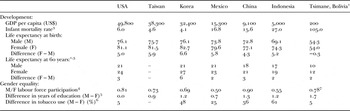
The range in level of development, mortality and life expectancy (both at birth and at age 60), and equality between the sexes is shown in Table 1. For example, per capita gross domestic product (GDP) ranges from nearly $50,000 in the USA to only $200 among the Tsimane of Bolivia. The male/female ratio of labour force participation (LFP), male/female differences in years of education and the prevalence of current tobacco use also varied widely, with the smallest differences generally found in the USA, with the exception of LFP.
Characteristics of study countries

Notes: GDP: gross domestic product. 1. Gurven, Kaplan and Supa (Reference Gurven, Kaplan and Supa2007). 2. Deaths per 1,000 live births. 3. 2012 (World Health Organization 2013). 4. Adults >15 (International Labour Organization 2005). 5. Adults 25+, 2009 (Gakidou et al. Reference Gakidou, Cowling, Lozano and Murray2010). 6. Adults 15+, 2005 (World Health Organization 2013). 7. Gender equality data are for the whole of Bolivia.
Source: Central Intelligence Agency (2012).
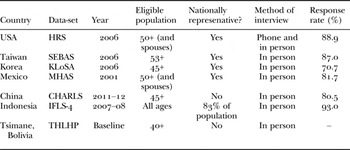
Table 2 gives the characteristics of each data-set: the year of the survey, eligible sample universe, whether it was nationally representative, the method of interview and the response rate. Most surveys focused on older adults, but two included individuals of all ages. All surveys were conducted using in-person interviews, except for the HRS, which used a combination of in-person and telephone interviews. Finally, most surveys were nationally representative. The Tsimane are not representative of the national population, but are an isolated indigenous forager–horticulturist group comprised of approximately 9,000 individuals who live in the Beni region of Bolivia (Beheim Reference Beheim2012). They reside in 80+ small villages of 50–150 people living in extended family clusters. In this traditional population, average life expectancy is very low.
Survey characteristics

Notes: HRS: Health and Retirement Study. SEBAS: Social Environment and Biomarkers of Ageing Study. KLoSA: Korean Longitudinal Study of Aging. MHAS: Mexican Health and Aging Study. CHARLS: China Health and Retirement Longitudinal Study. IFLS-4: Indonesian Family Life Study. THLHP: Tsimane Health & Life History Project.
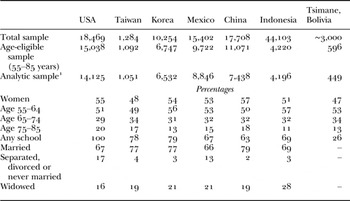
Table 3 shows the total sample size, age-eligible sample size (55–85 years) and analytic sample size for each data-set. The analytic sample size excludes individuals missing data on sex or ADL disability, and those interviewed via proxy. In some cases, sample sizes for specific outcomes may be smaller, particularly for physical performance measures. On average, respondents were in their mid- to upper sixties. The proportion of women ranged from 46.8 per cent among the Tsimane to 55.4 per cent in the USA. The percentage with any schooling was higher in more developed countries, while marital status varied less systematically.
Survey sample characteristics

Note: 1. Excludes those missing data on sex or activities of daily living disability and those interviewed via proxy.
Outcomes
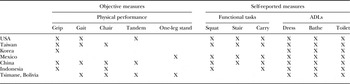
Outcomes include measured physical performance, and self-reported functional limitations and difficulty with ADLs. ADLs were available for all countries, but not all of the physical performance or functional limitation measures were available for all countries. Table 4 summarises the measure available across each data-set.
Available measures by country

Note: ADLs: activities of daily living.
Physical performance measures
Physical performance measures included tests of grip strength, lower extremity function and balance. Grip strength is a measure of upper body strength and is the average of two or three trials using the dominant hand, measured in kilograms (kg). Those who could not perform the test due to injury, surgery, pain or other health/safety reasons were coded as 0 kg. This measure was available for all but two countries (Mexico and the Tsimane).
Lower extremity function was assessed with a measure of gait speed and time to complete five chair stands. Gait speed was measured with a timed walk (USA: 98.5 inches; Tsimane and Taiwan: 3 metres; China: 2.5 metres) averaged over two trials. Gait speed was calculated as metres per second (m/s). Those who tried but were unable or refused for health/safety reasons, and those who used a walking aid were coded as 0 m/s. Since this test was only administered to US adults aged 65+, analysis of this measure was restricted to those 65–85. Lower extremity function was also assessed using performance on the chair stand test as the number of seconds taken to stand up from a sitting position five times, top-coded at 25 seconds. Those who were unable to complete five repetitions, tried but were unable or did not try for health reasons were coded as 25 seconds.
Balance was assessed with two tests: the time a person was able to hold the tandem position and balance on one leg. The full tandem test was administered to the Tsimane and older adults in the USA and China. Among the Tsimane, the tandem test measured the seconds an individual could hold the tandem position, for a maximum of ten seconds. US respondents were first asked to complete a semi-tandem test. If individuals younger and older than 65 could hold the semi-tandem position for 60 and 30 seconds, respectively, then they were asked to hold the tandem position. Respondents in China were administered the full tandem test if they could hold the semi-tandem position for ten seconds. Performance on the tandem stand was dichotomised and poor balance was defined as being unable to hold the tandem position for ten seconds. Individuals who did not try because of safety reasons or who tried and were unable to do the test were coded as having poor balance, as were US and Chinese respondents who could not complete the semi-tandem stand. Tsimane and Mexican older adults were asked to stand on one leg for a maximum of ten seconds. Those who were unable to hold the position for ten seconds were considered to have poor balance, as were those who did not try for safety reasons or who tried and were unable.
Self-reported disability and physical function
Disability was measured using self-reported difficulty with three ADLs that were available in all seven countries (bathing, dressing and going to the toilet). Self-reported measures of physical function were available for some, but not all countries, and included ability to squat, climb stairs and carry a heavy load. Each item was dichotomised to indicate a person either ‘had no difficulty’ or ‘had difficulty/could not perform the task’.
Analysis
Logistic regression was used to determine whether the odds of ADL difficulty, functional limitations and poor performance were significantly higher among women in each country, controlling for categorical age (55–64, 65–74 and 75–85 years). A second model also controlled for education (any schooling) and marital status (married, divorced/separated/never married or widowed) to determine whether these helped explain sex differences. A second model is not provided for the Tsimane because of a lack of data on marital status. Ordinary least-squares (OLS) regression was used to analyse the effect of sex for continuous measures of functioning. Models of grip strength also included BMI to control for the effect of body size. Stata's survey (SVY) command was used to account for the effect of stratified and/or clustered sampling. Data were analysed separately for each country and 95 per cent confidence intervals were examined to assess differences in the effect of sex across countries. Data were analysed using Stata (version 13.1). Finally, we displayed countries ranked according to GDP in our results table to examine whether there was a trend in the effect of sex with increasing economic development.
Results
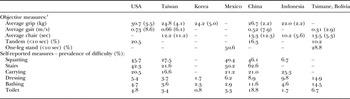
Descriptive statistics for each outcome are shown in Table 5, which gives average performance for continuous measures and the proportion missing, and the prevalence of poor performance or difficulty for dichotomous outcomes.
Descriptive statistics for outcomes by country

Notes: 1. Percentage missing is given in parentheses. kg: kilogram. m/s: metres per second. sec: second.
Physical performance measures
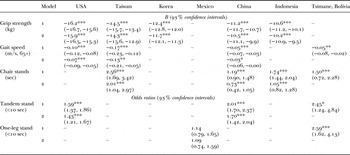
Overall, results from OLS and logistic regression show that women had significantly worse physical performance relative to men for nearly all measures in all countries (Table 6). Results from OLS regression adjusted for age and BMI indicate that grip strength was significantly lower among women in all countries. Women had significantly slower gait speed than men in all four countries with data. Sex differences were greatest among the Taiwanese, where average gait speed was 0.17 m/s slower among women. The effect of sex appeared larger in Taiwan relative to China and the Tsimane. Sex differences in gait speed were also larger in the USA than among those in Indonesia.
Objective performance: regression coefficients and odds ratios for the effect of being female

Notes: Model 1 controls for age; Model 2 controls for age, education and marital status. kg: kilogram. m/s: metres per second. sec: second.
Significance levels: * p < 0.05, ** p < 0.01, *** p < 0.001.
With respect to chair stands, women took significantly longer in all four countries where this test was administered. The effect of being female did not differ by country, except that the effect of being female was smallest in China.
Turning to balance, results from logistic regression show that women had significantly higher odds of being unable to hold the tandem position for ten seconds in all three countries with data, however, the magnitude of sex differences did not vary significantly. For the one-leg stand, Tsimane women had higher odds of poor balance but no significant sex differences were observed in Mexico.
While women had worse physical performance than men in all but one measure for one country, there was little evidence that the magnitude of sex differences varied consistently with per capita GDP for most measures. Grip strength is the exception; the difference between men and women increased with increasing GDP. In addition, results from the second models showed that differences in education and marital status explained some of the effect of female gender, however, differences remained significant.
Functional tasks
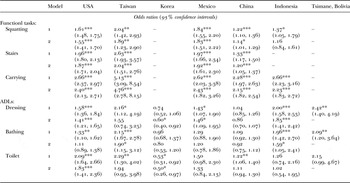
Logistic regression results controlling for age indicate that in all countries examined, women were more likely to report difficulty with each functional task (Table 7). Although there was some overlap in confidence intervals, sex differences in these functional tasks were most pronounced in Taiwan.
Self-reported difficulty with tasks: odds ratios for the effect of being female

Notes: ADLs: activities of daily living. Model 1 controls for age; Model 2 controls for age, education and marital status. kg: kilogram. m/s: metres per second. sec: second.
Significance levels: *p < 0.05, **p < 0.01, ***p < 0.001.
The magnitude of sex differences in difficulty squatting was fairly consistent across the five countries, ranging from 1.2 times higher odds of difficulty in China to 2.0 times higher odds in Taiwan. For difficulty climbing stairs, the effect of sex was also smallest in China (odds ratio (OR) = 1.3) compared with the USA, Taiwan and Mexico, where the odds of difficulty were 2.0–2.6 times higher among women. Finally, for difficulty carrying, the OR associated with being female were quite consistent in the USA, Mexico, China and Indonesia, but the effect of sex was much larger in Taiwan (OR = 5.1).
There was no clear pattern of sex differences with respect to GDP. However, sex differences for all three tasks were the least pronounced in China and the most pronounced in Taiwan. Also, controlling for education and marital status explained some of the differences between men and women, but in almost all cases the effect was only moderately reduced and differences remained significant.
ADLs
Results from logistic regression models controlling for age indicate that where there was a significant difference between the sexes, women generally reported more difficulty with ADL tasks, although there was one exception. In contrast to the physical performance measures and the functional tasks examined above, there is no gender difference in having difficulty with ADL tasks in many cases. In nine of the 21 observations, there is no significant gender difference in reported difficulty. In terms of dressing, women had higher odds of difficulty in all countries except China and Korea. The effect of sex was most pronounced among the Tsimane, Taiwanese and Indonesians, although based on the overlap in confidence intervals, these effects were not significantly greater than that observed in the USA and Mexico. For bathing, women reported greater difficulty in the USA, Taiwan, Indonesia and among the Tsimane, but not in Korea, China and Mexico. Yet among the former, there was little variation in the effect of sex, except that it appears smaller in the USA compared with Taiwan. Finally, in terms of using the toilet, women were more likely to report difficulty in the USA, Taiwan and China. Yet the effect of sex appears significantly smaller in China compared with the USA. Among the Tsimane, the lack of significant sex differences may be due to the small sample size, and among Koreans, women were actually significantly less likely to report difficulty using the toilet (OR = 0.5).
Taken together, results for reported disability were consistent with findings for all other outcomes besides grip strength in that there was no clear trend seen in the relationship between sex differences and GDP. However, sex differences in ADLs were consistently smallest among older adults in Korea and China for all three outcomes. Finally, controlling for education and marital status explained much of the effect of sex across countries and measures, and in Korea, women had significantly lower odds of difficulty dressing and using the toilet in Model 2.
Discussion
Overall, results indicate that sex differences were almost universal for both objective physical performance measures and for self-reported physical function. Women had weaker grip strength, slower gait speed, took longer to rise five times from a sitting position and had worse balance, and they also reported significantly more difficulty squatting, climbing stairs and carrying a heavy load. This is consistent with findings from previous studies of sex differences in physical function (Merrill et al. Reference Merrill, Seeman, Kasl and Berkman1997; Oksuzyan et al. Reference Oksuzyan, Crimmins, Saito, O'Rand, Vaupel and Christensen2010; Steffen, Hacker and Mollinger Reference Steffen, Hacker and Mollinger2002). The female disadvantage in physical ability appears to be remarkably consistent across markedly different contexts, and it is likely that a large part of this is due to differences in body composition between men and women. Women of all ages generally have lower muscle mass and strength and a greater percentage of body fat (Leveille et al. Reference Leveille, Penninx, Melzer, Izmirlian and Guralnik2000). They may also be less physically active (Caspersen, Pereira and Curran Reference Caspersen, Pereira and Curran2000).
Yet relatively few comparative studies or studies of older adults in developing countries have examined objective measures of performance. Many researchers have suggested that sex differences in subjective measures are in part due to a greater tendency to report poor health among women (because of greater sensitivity to symptoms or greater contact with the health-care system), although findings have not been conclusive (Ferrer et al. Reference Ferrer, Lamarca, Orfila and Alonso1999; Macintyre, Hunt and Sweeting Reference Macintyre, Hunt and Sweeting1996). Furthermore, less is known about reporting differences between men and women in non-Western populations. Here, concordance in findings across both self-reported and objective measures suggests that sex differences cannot be explained by reporting differences alone. Despite the fact that there was not one-to-one correspondence between physical and self-reported functioning in this study, the physical performance tasks assess various aspects of strength in major muscle groups and balance that would be needed to be able to perform tasks such as climbing stairs, carrying, squatting and raising arms that are assessed by self-reported items.
Compared with physical function outcomes, findings for ADL tasks were somewhat less consistent – women usually reported greater difficulty although sex differences were not significant in all cases. In Korea, odds of difficulty using the toilet were actually lower among women. Yet this is consistent with previous studies (Lee and Lee Reference Lee and Lee2013). For example, Park, Jung and Lee (Reference Park, Jung and Lee2009) found that the prevalence of ADL limitations was higher among men aged 45–64 years in Korea and was similar among men and women aged 65 and older.
Results for other countries were more consistent with previous findings. For instance, results from a comparative study of 11 Western developed countries found that women had greater odds of ADL difficulties in all countries, although differences were not always significant (Crimmins, Kim and Solé-Auró Reference Crimmins, Kim and Solé-Auró2011). Similarly, a study by Ofstedal et al. (Reference Ofstedal, Zimmer, Hermalin, Chan, Chuang, Natividad and Tang2007) found significant sex differences in Nagi (functional) limitations across all five Asian settings examined, but sex differences in ADL limitations were only significant in one out of four countries.
Yet, while female disadvantage was observed for nearly all measures, sex differences did not appear to show a clear gradient by level of development. There was also little evidence that the magnitude of sex differences varied by the degree of gender equality although we did not test this explicitly. It is difficult to quantify overall gender equality because it varies across different domains within a country. For example, in Table 1, gender differences are relatively small in the USA for all three indicators. However, in China, female-to-male LFP is quite high, but there are large sex differences in the prevalence of smoking and in average years of education. In addition, gender equality is desirable in some areas, such as income or political participation, but detrimental if women start smoking or drinking at the same rates as men. Therefore, it is likely that with increasing gender equality and development, women are still exposed to both protective and risk factors. In other words, gains in some areas may be offset by exposure to other types of risk factors. For example, in the USA, women's higher LFP may have led to greater economic equality, but it also increases women's exposure to stress and changes the nature of familial and social networks. Indeed, controlling for education and marital status did explain some of the male/female differences in outcomes. Previous studies have also found that these explain sex differences in disability to varying degrees (Alvarado, Guerra and Zunzunegui Reference Alvarado, Guerra and Zunzunegui2007; Murtagh and Hubert Reference Murtagh and Hubert2004; Wray and Blaum Reference Wray and Blaum2001).
Finally, although sex differences tended to be quite consistent with little clear pattern by country, sex differences were often found to be the least pronounced among Chinese older adults. This was observed for both objective and subjective measures. The context in China is considerably different compared with other countries, even in Asia. For example, under Communism, women in China had more similar LFP rates as men (Yu and Sarri Reference Yu and Sarri1997). Men and women may also have more similar levels of physical activity since much of the elderly labour force has worked in agriculture (Kaneda et al. Reference Kaneda, Zimmer, Fang and Tang2009). In addition, there is a strong culture of familialism, whereby older adults receive instrumental and financial assistance from their children, and are much less likely to live alone (Zhu and Xu Reference Zhu, Xu and Kosberg1992; Leung Reference Leung1997; Zimmer Reference Zimmer2005). While increasing development has been associated with an erosion of family-based support in many countries, filial responsibility has remained strong in China, and has even been codified into law (Zimmer Reference Zimmer2005). Finally, although Wang et al. (Reference Wong, Gerst, Michaels-Obregon and Palloni2009) found evidence to suggest that sex differences in China increase with age, this could also signify a narrowing of gender differences in younger cohorts, as has been seen in China (Chun et al. 2012).
Limitations
Several limitations merit discussion. First, the use of cross-sectional data means that it is only possible to compare sex differences in the prevalence of disability and poor physical function, and average performance at a single point in time. Since prevalence of difficulty is a function of both onset and duration, the female disadvantage in disability and poor function may be due to earlier onset, a lower likelihood of recovery, increased survival among those in poorer health or a combination of these. However, it is impossible to identify which aspects of the process are responsible for the observed gender disparities. In many cases, longitudinal data are not currently available. However, follow-up waves now exist for many of these studies. Therefore, future work could examine gender differences in disability/functioning transitions.
Other issues arise when comparing findings across countries. For example, it is possible that individuals with similar levels of disability or physical function respond differently across countries, due to differences in question wording, cultural differences and other sources of measurement error. For ADLs, it is likely that clothing and methods of bathing and using the toilet differ somewhat across countries. However, since we compare men and women within each country, this may be less problematic. In addition, this study compares not only self-reported difficulties, but also objectively measured physical performance. Although caution must be exercised in comparing physical performance across countries due to some variation in the measurement protocol for objective measures (e.g. hand dynamometers used to measure grip strength), this is less problematic for between-sex comparisons within countries. Physical performance measures may be less prone to cultural bias and we find good concordance of gender differences between objective and subjective functioning. Although not all surveys collected data on all measures, each survey examined contained at least one objective test of physical performance. Finally, surveys varied in terms of their sample size, therefore, care must be taken to examine both the magnitude and significance of effect sizes. In some cases, lack of statistical significance may be due to low power to detect differences as a result of small sample size.
Conclusion
Overall, there was striking similarity in the magnitude and direction of sex differences across countries despite considerable differences in context, although modest variations in the effect of sex were observed. In addition, education and marital status were able to explain some, but not all, sex differences for most measures. In sum, although sex differences were quite consistent, it is important to note that they may be similar for different reasons. Thus, future work should examine how various protective and risk factors interact and offset each other.