Research on the early acquisition of two languages has evidenced a bilingual advantage in young children on tasks requiring executive control (Barac & Bialystok, Reference Barac and Bialystok2012; Bialystok & Viswanathan, Reference Bialystok and Viswanathan2009; Carlson & Meltzoff, Reference Carlson and Meltzoff2008; Videsott, Della Rosa, Wiater, Franceschini & Abutalebi, Reference Videsott, Della Rosa, Wiater, Franceschini and Abutalebi2012; Yang, Yang & Lust, Reference Yang, Yang and Lust2011). In these tasks, executive control comprises inhibiting attention to misleading information, selective attention, and switching (or shifting) attention in tasks with distracting and competing cues (Bialystok & Martin, Reference Bialystok and Martin2004). For example, bilinguals outperformed their monolingual counterparts on tasks requiring attentional control in ignoring certain perceptual features of stimulus or tasks requiring behavioral inhibition (Bialystok, Reference Bialystok1999).
Despite the accumulating evidence of the bilingual cognitive advantage, some studies have argued against it (Hilchey & Klein, Reference Hilchey and Klein2011; Mezzacappa, Reference Mezzacappa2004; Morton & Harper, Reference Morton and Harper2007; Paap & Greenberg, Reference Paap and Greenberg2013). Valian (Reference Valian2015) argued that the evidence for the bilingual advantage is inconsistent across studies and provides evidence that many cognitively enhancing activities may be beneficial in boosting executive function (EF). Some authors have argued that the hypothesized bilingual advantage may be confounded with variations in SES across bilingual and monolingual populations tested (e.g., Mezzacappa, Reference Mezzacappa2004; Morton & Harper, Reference Morton and Harper2007). This is in line with the literature demonstrating that children from low SES backgrounds perform more poorly on executive function (EF) tasks, compared to their wealthier counterparts (Ardila, Rosselli, Matute & Guajardo, Reference Ardila, Rosselli, Matute and Guajardo2005; Hughes & Ensor, Reference Hughes and Ensor2005; Lipina, Martelli, Vuelta & Colombo, Reference Lipina, Martelli, Vuelta and Colombo2005; Noble, Norman & Farah, Reference Noble, Norman and Farah2005; Noble, McCandliss & Farah, Reference Noble, McCandliss and Farah2007). On the other hand, more recent studies that controlled for SES and background demographics of participants have argued that bilingualism may compensate for the adverse effects of poverty on cognitive processes (e.g., Carlson & Meltzoff, Reference Carlson and Meltzoff2008; Engel de Abreu, Cruz-Santos, Martin & Bialystok, Reference Engel de Abreu, Cruz-Santos, Martin and Bialystok2012).
In this paper, we consider the role of SES in the hypothesized bilingual advantage. We do so, recognizing that many factors may influence children's cognitive performance, possibly in combination with SES, given that it is difficult to dissociate SES from other factors (Valian, Reference Valian2015). One set of factors concerns the nature of children's bilingualism, for example, whether children learn their two languages sequentially or simultaneously (Akhtar & Menjivar, Reference Akhtar, Menjivar and Benson2012). The context of language exposure is another factor – e.g., better inhibitory control might only be observed with bilingualism serving as a buffer against the negative effects of SES if two languages are acquired in similar context (Kovács & Mehler, Reference Kovács and Mehler2009). Other important factors related to language development like level of language proficiency (Videsott et al., Reference Videsott, Della Rosa, Wiater, Franceschini and Abutalebi2012), language use, formal education in both languages (for older children), and quantity of languages the child is exposed to have to be taken into consideration too. Another important issue concerns the potentially variable role of SES, since SES effects are known to vary cross-culturally (Bradley, Reference Bradley and Reese1994; Bronfenbrenner, Reference Bronfenbrenner, Friedman and Wachs1999). With respect to the measurement of SES, common and stable measures comprise occupation, income, and education although these may not always cohere (Ensminger & Fothergill, Reference Ensminger, Fothergill, Bornstein and Bradley2003; Mcloyd, Reference Mcloyd1998; White, Reference White1982). Clearly, SES is not a homogeneous concept.
Finally, a significant amount of previous research on the bilingual advantage has been at least partially confounded by the role of ‘Asian superiority’ effects (Carlson & Meltzoff, Reference Carlson and Meltzoff2008; Lewis, Koyasu, Oh, Ogawa, Short & Huang, Reference Lewis, Koyasu, Oh, Ogawa, Short and Huang2009; Oh & Lewis, Reference Oh and Lewis2008; Sabbagh, Xu, Carlson, Moses & Lee, Reference Sabbagh, Xu, Carlson, Moses and Lee2006; Yang et al., Reference Yang, Yang and Lust2011). In these studies, Asian children outperformed their Western counterparts on tasks of cognitive control, and some researchers attribute this to parenting practices that emphasize self-regulation (Lewis et al., Reference Lewis, Koyasu, Oh, Ogawa, Short and Huang2009) and the focus of Asian preschools on impulse control, as compared to U.S. preschools (Tobin, Wu & Davidson, Reference Tobin, Wu and Davidson1989). Consequently, Carlson & Meltzoff (Reference Carlson and Meltzoff2008) highlighted the need to replicate the bilingual cognitive advantage in ‘non-Chinese’ samples, to further confirm that the bilingual advantage is independent of supposed Asian cultural advantage on executive function tasks.
In this paper, we report the results of an investigation into the development of executive attention in a population of bilingual children, Malay–English speakers – all simultaneous bilingualsFootnote 1 – within the ‘Asian milieu’ of Singapore, who are characterized as ‘low SES’ in Singapore, in terms of income, occupation, education and social indicators, according to official socioeconomic figures (Mutalib, Reference Mutalib2011). We compare results to previous research in Singapore on a contrasting high SES bilingual group, Chinese–English speaking (Yang et al., Reference Yang, Yang and Kang2014)Footnote 2 , as well as to other Asian populations previously assessed for the bilingualism effect (Yang et al., Reference Yang, Yang and Lust2011)Footnote 3 . In Singapore, English is the official medium of instruction, and children are taught all subjects in English at school, except for their ‘Mother Tongue’. What is considered one's ‘Mother Tongue’ is usually assigned based on one's father's ethnicity (i.e., Mandarin for Chinese, Malay for Malays) and is taught as a secondary language at school. In homes, children may regularly be exposed to both languages. In addition to these two languages, due to the interaction of the various ethnic groups, the English language has been adapted to the local needs and has evolved into what is known as ‘Singapore English’ (more commonly known as ‘Singlish’). Singlish, a Creole variety of English spoken in Singapore, is a product of language contact between the local languages and vernacular languages (e.g., Chinese, Hokkien, Cantonese, Malay and, to a lesser extent, Tamil) (Bao & Wee, Reference Bao and Wee1999; Wee, Reference Wee2008). As such, Singlish is perceived as a contact language, where ‘standard’ or Western English is the superstrate language and local languages (Chinese, Malay, etc.) form the substratum (Bao, Reference Bao2005; Pakir, Reference Pakir1991; Wee, Reference Wee2008). Therefore, home language may involve more than one language; and the terms ‘first’ and ‘second’ language are especially difficult to apply in Singapore. It is reputed to be almost impossible to find monolingual speakers in this pervasively multilingual culture of Singapore, with statistics revealing that all three major ethnic groups (Chinese, Malay, Indians) speak at least one other non-English home language (Department of Statistics, 2010). Given the multitude of languages in the Singaporean society (English, Singlish, mother tongues), the population is best described as ‘multilingual’ rather than ‘bilingual’, but in this paper, we will be using the term ‘bilingual’ to capture the basic Malay–English competence of the children we study here.
The Malay–English children we study here are generally characterized as simultaneous bilinguals, given the mandatory bilingual education policy since 1966 in Singapore (Dixon, Reference Dixon, Cohen, McAlister, Rolstad and MacSwan2003), and have no immigration history. An even larger proportion of Malays (82.7% are reported to speak their Mother Tongue (Malay) at home, compared to the other two groups – the Chinese speak Mandarin 47.7% of the time at home, and the Indians speak Tamil 36.7%. (Department of Statistics, 2010). In fact, Stroud (Reference Stroud, Auer and Wei2007) described Malays as being more resistant to a language shift towards English in Singapore.
Above and beyond the differences in low SES Malay and high SES Chinese populations in Singapore, all share the ‘Asian milieu’ of the Singapore culture. The general literacy rate among Singapore residents aged 15 years and above is approximately 96.4% (as of 2012), while unemployment rate is currently at 2.1% (as of the last quarter of 2013) (Department of Statistics, 2013). Through our study of a previously unstudied Malay–English bilingual child culture, we now attempt to investigate whether SES variation within a shared Asian multilingual culture can significantly depress a cognitive advantage assumed to cohere with bilingualism. The socioeconomic progression of the Malays, who form approximately 13.3% of the population (Department of Statistics, 2014) falls behind that of the Chinese and Indians (Association of Muslim Professionals, 2012; Mutalib, Reference Mutalib2005, Reference Mutalib2011). The average monthly household income of the Malays was the lowest of the three main ethnic groups, standing at S$4,575 per month compared to the Chinese and Indians (S$7,326 and S$7,664 respectively) (Department of Statistics, 2010). Despite this, Malays continued to have the largest family size amongst the other two racial groups, and resident Malay females between 40 to 49 years of age had a mean number of 2.73 children in 2010, compared to 1.89 for Chinese and 2.05 for Indians (Department of Statistics, 2010). In terms of education, the Malays had the highest proportion with below secondary level education (i.e., U.S. equivalent of below high school), standing at 37%, compared to 33.8% for the Chinese and 22.5% for the Indians (Department of Statistics, 2010). Only 5.1% of Malays had university-level qualifications, compared to 22.5% for the Chinese and 35% for the Indians (Department of Statistics, 2010).
When examining the occupation types of the heads of the Malay language families, a large percentage had occupations such as sales staff and clerks (28.7%), while almost half of them had low-income professions like cleaners, craftsmen or machine operators (Cavallaro & Serwe, Reference Cavallaro and Serwe2010). The authors concluded that in households where English was not the home language, this served as a “factor against upward social mobility” (Cavallaro & Serwe, Reference Cavallaro and Serwe2010, p.130). Thus, we conclude that the Malay population we studied in this paper can be classified as ‘low SES’.
Methods
Design
Our design allows us to test our leading hypothesis that low SES measures do not necessarily result in depression of executive attention development in bilingual children. We adopt a focused study of executive control, concentrating on ‘executive attention’, and tailor our methodology accordingly. Executive attention emphasizes the role of attention in “monitoring and resolving conflict” between different brain areas (Posner & Fan, Reference Posner, Fan, Pomerantz and Crair2004, p.38). Both theoretical and empirical foundations exist for studying this area (Posner & Fan, Reference Posner, Fan, Pomerantz and Crair2004, Posner & Rothbart, Reference Posner and Rothbart2007). We adopted the child-friendly version of the ANT (Fan, McCandliss, Sommer, Raz & Posner, Reference Fan, McCandliss, Sommer, Raz and Posner2002), the child-ANT (Rueda et al., Reference Rueda, Fan, McCandliss, Halparin, Gruber, Lercari and Posner2004). To provide background and comparison points, we compared the child-ANT performance of our Malay–English bilinguals with those in two other previously published studies with similar-aged children who were also tested with the child-ANT. The first study was conducted with Korean and American monolingual and bilingual children (in Korea and the U.S.) (Yang et al., Reference Yang, Yang and Lust2011), and the other was conducted in Singapore with Chinese–English bilinguals (Yang et al., Reference Yang, Yang and Kang2014).
In our study, SES measures were obtained through caretakers’ responses to questions concerning family background. In addition, a Child Multilingualism Questionnaire (CMQ) (Cornell Language Acquisition Lab and Virtual Center for Language acquisition, in preparation) was completed by caregivers to provide caretaker assessment of the nature of each child's bilingualism. Regression and correlational analyses were employed to investigate whether the SES measures influenced the executive attention performance on the child-ANT.
As background, a test of general intelligence (Kaufman Brief Intelligence Test Second Version, KBIT-2; Kaufman & Kaufman, Reference Kaufman and Kaufman2004) was included to ascertain the general intellectual level of the sample and allow comparability to other bilingual populations tested in the literature and to assess whether SES factors might be significantly depressing general intelligence, as well as executive attention. The Fourth Edition of the English Peabody Picture Vocabulary Test (PPVT-IV; Dunn & Dunn, Reference Dunn and Dunn2007) provided a measure of English language vocabulary competence, which allowed us to examine whether English vocabulary is significantly influenced by SES factors and whether it plays a role in influencing executive attention performance in these Malay–English bilinguals. We included age, the English vocabulary test (PPVT) and the general intelligence test (KBIT-2) scores as predictors in our regression model to investigate how much each of these might independently predict child-ANT performance.
Participants
Thirty-four Malay–English bilingual children were recruited from Singapore (mean age = 66.21 months, SD = 9.14, range = 54 to 77 months, 19 females). It was practically impossible to recruit monolingual preschoolers for this study due to Singapore's mandatory bilingual education policy. All the children were recruited from a public Muslim school, and were educated in both English and Malay at school on a daily basis. Seventeen parents completed the CMQ, which confirmed that all seventeen Malay–English bilinguals spoke both languages at the preschool, at home, and other places. All the parents completed consent forms before testing began. No monetary compensation was given for children's participation in this study.
Tasks
Background measures
Parents first responded to a set of questions regarding their socio-economic background involving the following three types of basic SES information: highest educational attainment, average monthly household income, and parental occupationFootnote 4 . Education was measured by the highest academic qualification received by both parents, which was divided into five levels to calibrate to the Singapore context: 1- None/Primary, 2- Secondary/Pre-University, 3- Vocational/Technical, 4- Tertiary/University and 5- Postgraduate. The average monthly household income was divided into five categories based on Singapore standards, with Level 1 being less than $1000, Level 2 being $1000 to less than $3000, Level 3 being $3000 to less than $6000, Level 4 being $6000 to less than $9000 and level 5 being more than $9000 per month. Parents who were available were then interviewed over the phone for the five-part Virtual Linguistic Lab Child Multilingualism Questionnaire (CMQ) that requested descriptive data on the child, child language, family background, code-switching and reading/writing ability where relevant. We categorized children on the basis of their caregivers’ responses on the CMQ based on relative amounts of language exposure and relative language proficiency estimates in both languages. This categorization was reliability checked by three research assistants.
Receptive English vocabulary in the child was measured using Versions A or B of the Peabody Picture Vocabulary Test (PPVT-IV; Dunn & Dunn, Reference Dunn and Dunn2007. For every item, the child was presented with four colored pictures and asked to select the picture that best illustrated the word the experimenter read aloud. The matrices subtest of the KBIT-2 (second version; Kaufman & Kaufman, Reference Kaufman and Kaufman2004 was used to assess nonverbal intelligence. Standardized KBIT-2 scores were used in correlational and regression analyses, to explore the relationship between nonverbal intelligence and executive attention. This subtest measures non-verbal intelligence in terms of understanding relationships and analyzing visual analogies. This subtest comprised 46 items with 3 levels of increasing difficulty. In the first section, the child had to point to one of five drawings that matched the target image on the center of the page. In the other two sections, the child was presented with an incomplete matrix of visual stimuli and asked to choose one of five options below that completed the pattern displayed.
Executive control task: child-Attention Network Task (Rueda et al., Reference Rueda, Fan, McCandliss, Halparin, Gruber, Lercari and Posner2004)
Posner & Petersen (Reference Posner and Petersen1990) first argued that attention sources could be broken down into three networks that carry out alerting, orienting and executive control functions. The attention network task (ANT) was subsequently developed to measure these three networks in one integrated computerized task (Fan et al., Reference Fan, McCandliss, Sommer, Raz and Posner2002) and has been used to assess executive attention in bilingualism (Costa, Hernández & Sebastián-Gallés, Reference Costa, Hernández and Sebastián-Gallés2008).
The child-ANT was subsequently developed as a more child friendly version of this test. It is a computerized cue by flanker task that measures the three attentional components of alerting, orienting, and executive control in an integrated test (Rueda et al., Reference Rueda, Fan, McCandliss, Halparin, Gruber, Lercari and Posner2004). Rueda et al., (Reference Rueda, Fan, McCandliss, Halparin, Gruber, Lercari and Posner2004) adapted the integrated Attention Network Test (ANT) (Fan et al., Reference Fan, McCandliss, Sommer, Raz and Posner2002) into a child version – through the replacement of the arrows with fish that had arrows embedded in them. The ANT has been shown to provide reliable single subject estimates in all three dimensions (Fan et al., Reference Fan, McCandliss, Sommer, Raz and Posner2002). The efficiency of the three networks can be measured through observing how alerting cues, spatial cues and flankers influence reaction time and accuracy. The stimuli in the child-ANT were presented visually on a laptop, and children were asked to help the experimenter feed hungry fish. Children responded to two input keys on the keyboard with both their index fingers (left/right arrow) as quickly as possible when the fish appeared on the screen. These arrows matched the swimming direction of the arrow in the fish on the screen. The child-ANT comprised 168 trials – a training block of 24 practice trials, and three experimental blocks with 48 trials each. To ensure children were familiarized with the use of the computer, they first completed a training block with 24 practice trials. Experimenters provided children with positive feedback and encouragement throughout the session. To reduce fatigue, experimenters offered the children a short break between each block if the need arose.
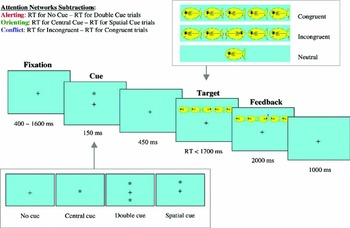
Each of the 168 trials has a combination of four cue (no cue, double cue, central cue and spatial cue) and three flanker conditions (neutral, congruent and incongruent). These conditions test the three attentional networks of alerting, orienting, and executive control. The trials are composed of different combinations of these conditions in a randomized order. The cues function either to direct the child's attention to the location of the target, or to enhance the child's alertness in order to prepare them for the target's impending presentation on the screen. Flankers serve to assess attention control capability when faced with flankers that distract one's attention. A neutral condition is composed of a single fish stimulus that swims to the left or right. A congruent condition comprises five fish swimming in the same direction, and an incongruent condition comprise five fish swimming, but with the central target fish swimming in the opposite direction as its flankers. A diagrammatic explanation on the workings of the child-ANT is shown in Figure A.1 on Appendix A.
Percentage accuracy is based on the number of times the child accurately responds to the direction where the target fish swims. Reaction time (RT)-based efficiency scores are computed for all three components of the network. The alerting function is described as the achievement and maintenance of a state of readiness for the effortful processing of information. The alerting effect is calculated by subtracting the mean RT of the Double Cue condition from mean RT of the No Cue condition. In the No Cue condition, attention is diffused between two potential target locations. The use of double cues not only keeps attention divided between the two potential target locations, but also alerts one to the impending target appearance.
The orienting effect refers to the ability to shift one's focus from one stimulus to another, and this can be measured using valid spatial pre-cues. The orienting effect is calculated by subtracting the mean RT of the Spatial Cue from the mean RT of Central Cue condition. While the center and spatial cues serve as alerting cues, only the spatial cue gives predictive spatial information prompting subjects to start orienting their attention to the appropriate location before the target appears. The center cue, like the single cue, serves as a control because it prompts attention orienting to one location. Lastly, conflict/executive control effect is composed of processes involved when an individual carries out goal-directed behaviors, and is also related to one's ability to overcome distracting stimuli. Executive control is often studied using tasks involving conflict, which is introduced by incongruent flankers producing interference. The conflict/executive control (EC) effect is calculated by subtracting the mean RT of the congruent conditions from the mean RT of incongruent conditions, across cue types. Lower efficiency scores reflect higher network efficiency because they represent a small increase in reaction time when conditions become more difficult. In addition to accuracy and RT scores, inverse efficiency (IE) was also calculated. IE scores are used to analyze both accuracy and RT together, without including speed-accuracy tradeoffs; as such, they provide us with a better understanding of processing efficiency (Townsend & Ashby, Reference Townsend, Ashby, Castellan and Restle1978). This is calculated using the mean reaction times on accurate trials divided by the proportion of accurate responses. A higher inverse efficiency score represents worse performance.
Results
Basic Demographics and Results on Background Measures
SES
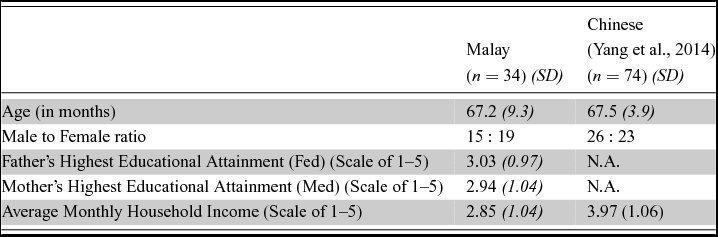
The average monthly household income in the Malay sample was approximately at ‘Level 3’, which is between S$3,000 and less than S$6000. The majority of the Malay sample (n = 28 out of 34) fell below the median household income in Singapore (S$7,570 in 2012) (Department of Statistics, 2013). As for parental occupation, for mothers, half the sample (n = 17) were housewives, while the majority (both parents) were blue-collar workers (e.g., technicians and service industry related workers). Table 1 summarizes demographics for the Malay sample and contrasts this with published results from the Yang et al.'s (Reference Yang, Yang and Kang2014) Singaporean Chinese sample. Based on comparisons of average monthly household income, the Malay sample has a significantly lower monthly income compared to the Chinese sample, t(106) = 5.13, p = .0001 (Cohen's d = 1.07).
Summary of SES demographics of Malay and comparison to Chinese samples.

Note: For Educational Attainment: 1- None/Primary, 2- Secondary/Pre-University, 3- Vocational/Technical, 4- Tertiary/University and 5- Postgraduate. For average monthly household income, 1: less than S$1000, 2: S$1000 – less than S$3000, 3: S$3000 – less than $6000, 4: S$6000 – less than S$9000 and 5: more thanS$9000 per month.
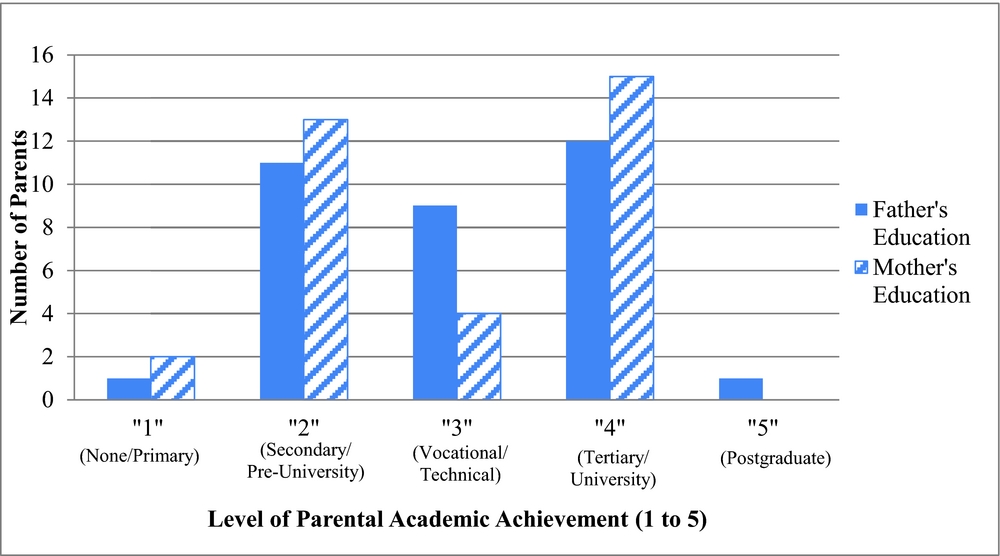
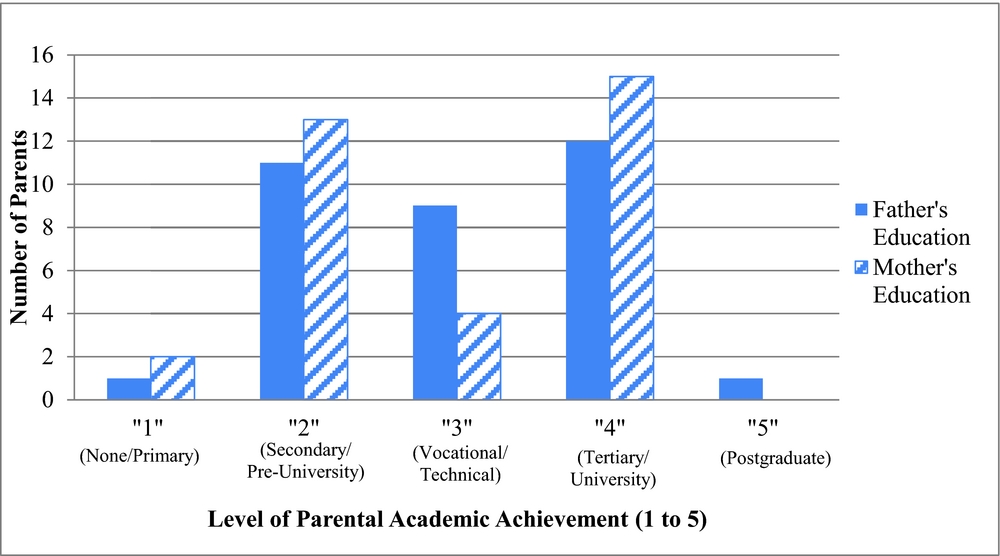
Figure 1 below presents the distribution of father's and mother's highest educational attainment in the Malay sample.
Highest academic achievement for both parents in the Malay Sample.
The average standardized KBIT score for the Malay children was 104.1 (SD = 11.4, range = 77–126), suggesting that this sample fell within the average non-verbal intelligence for their ageFootnote 5 . For the PPVT-IV English test (raw scores), the Malay sample performed significantly worse than the Chinese sample (Yang et al., Reference Yang, Yang and Kang2014) – with the Malays scoring an average of 77.9 (SD = 19.1), and the Chinese scoring an average of 93.1 (SD = 23.4), p = .0013, d = 0.71.
Nature of Bilingualism
Out of 34 parents, 17 were contactable via the phone for the Multilingual Questionnaire interviewFootnote 6 . Based on the caregiver reports, the 17 children's English and Malay estimated proficiency in Listening Comprehension, Oral Production, and Overall proficiency was evaluated. The ratio of the 17 children's overall exposure and overall use of English to Malay revealed that the children are not only exposed to more than one language on a daily basis, but are also using more than one language in their daily communications. Out of 17, 9 were classified as ‘balanced bilinguals’Footnote 7 , while the remaining 8 were classified as either dominant or slightly dominant in English or Malay – 2 dominant in Malay, 2 slightly dominant in English, and 4 dominant in English. All 17 children were exposed to both languages before four years of age, matching Patterson's (Reference Patterson2002) definition of simultaneous bilinguals (i.e., children exposed to two languages during infancy and early childhood). Hence, by this definition, we can classify our Malay sample as simultaneous bilingual learners.
All 17 children were exposed to and used both languages on a daily basis, and a majority of them were exposed to both languages since infancy. The caregivers of these 17 children mentioned that it was important for their child to be bilingual and were all actively involved in teaching the child both languages. This was through reading books in English, Malay, or both languages on a daily basis, or a few times each week. Hence, their literacy practices at home confirm that this sample consists of active bilingual learners. Additionally, reports on the code-switching tendencies of the 17 children revealed that all of them code-switched/code-mixed frequently either between or within sentences, or both.
Hence, background results revealed that our Malay sample was highly bilingual, while low on several SES measures. Through the CMQ, our Malay sample can also be characterized as active bilingual learners.
Child-ANT Results
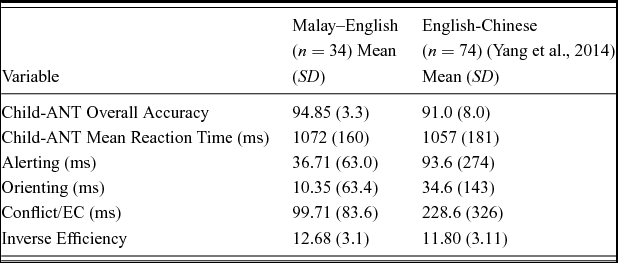
Table 2 summarizes results from the ANT task for the Malay children.
Mean scores and standard deviations on components of the child-ANT in Malay sample with comparison to Chinese bilinguals.

Note: For the 3 networks (Alerting, Orienting, Conflict/EC) and Inverse efficiency, lower scores represent higher efficiency.
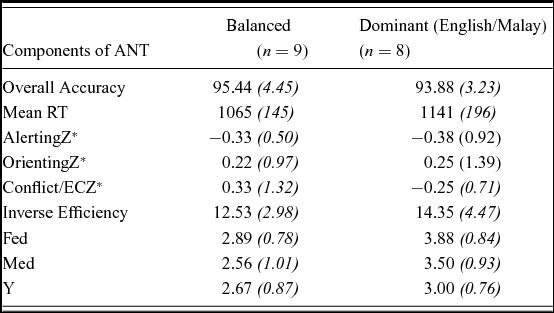
We also performed separate analyses for the sub-sample of 17 Malay children whose parents completed the CMQ. For this sub-sample, although the father's education (Fed) for the dominant bilinguals (M = 3.88, SD = 0.84) was significantly higher than that for the balanced bilinguals (M = 2.98, SD = 0.78); t(15) = 2.52, p = .02, d = 1.22, both groups (balanced and dominant bilinguals) did not significantly differ on any of the components of the child-ANT (i.e., accuracy (t(15) = .82, p = .43, d = .40), mean RT (t(15) = .92, p = .37, d = .44), 3 network efficiency scores (Alerting – t(15) = .14, p = .89, d = .07, Orienting – t(15) = .05, p = .96, d = .03, Conflict/EC – t(15) = 1.11, p = .29, d = .55) and inverse efficiency score (t(15) = 1.00, p = .33, d = .48)). Analysis of data in this subset of the Malay sample suggests that level of bilingualism did not significantly influence executive attention performance on the child-ANT. Table 3 summarizes the comparisons between the balanced and dominant Malay–English bilinguals.
Comparison of Balanced & Dominant Malay Bilinguals.

Note: *Standardized Alerting, Orienting, and Conflict/Executive Control (EC) scores (ms) were employed.
Correlational & Regression Analyses Across child-ANT & SES Measures
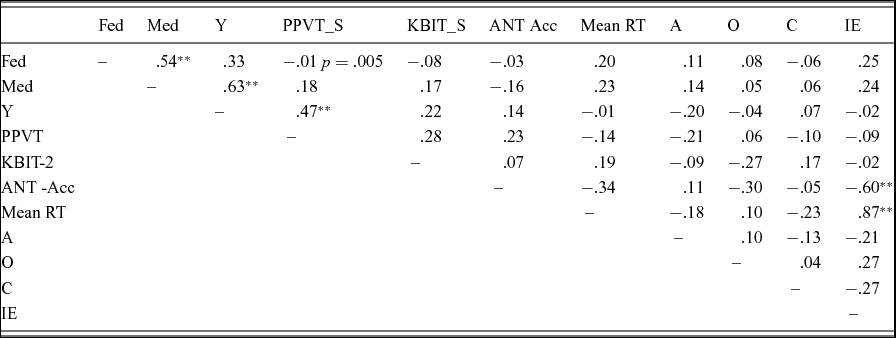
In our Malay sample, correlational analyses revealed that none of three SES measures – father's education (Fed), mother's education (Med), income (Y) – were significantly correlated with any of the ANT scores (overall accuracy (Fed: p = .88, Med: p = .38, Y: p = .42), mean RT (Fed: p = .26, Med: p = .20, Y: p = .96), 3 network efficiency scores ((Alerting) Fed: p = .52, Med: p = .45, Y: p = .25; (Orienting) Fed: p = .67, Med: p = .79, Y: p = .82; (Conflict/EC) p = .72, Med: p = .74, Y: p = .68), inverse efficiency score (p = .15, Med: p = .18, Y: p = .92)). Similarly, nonverbal intelligence (KBIT; standardized score) was not significantly correlated with any SES measure (Fed: p = .65, Med: p = .34, Y: p = .21). At the same time, one of the SES measures (income) was highly correlated with standardized PPVT scores, r(34) = .47, p = .005 Table B.2 (Appendix B) summarizes the full correlational analysis performed.
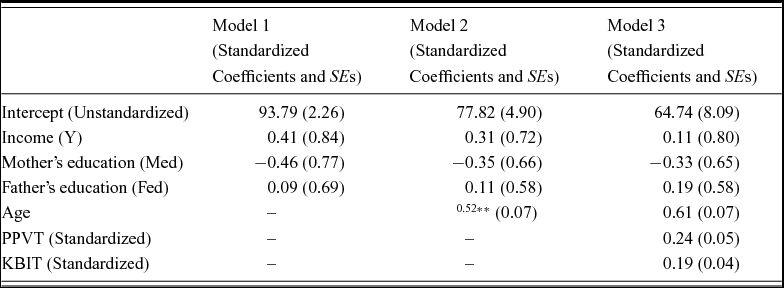
We next asked whether SES factors (defined by the 3 variables) were individually predictive of our outcomes of interest on components of the child-ANT in our Malay sample. To answer this question, we conducted the following regression analyses. First, we estimated a linear regression model predicting overall ANT Accuracy results from three SES variables – father's and mother's education, and income. Age, PPVT (Standardized) and KBIT (Standardized) scores were also included in the model in order to assess possible independent effects of either English vocabulary or general intelligence on executive attention development in this sample.
As Table 4 suggests, individual predictors of SES in the Malay population did not contribute significantly to overall accuracy score on the child-ANT in Model 1. Even when all 3 SES variables were considered as a whole in the Model 1, the effect of SES on overall accuracy was also insignificant, with an overall R 2 value of 0.13 (SE = 3.18), p = .25. Then, an additional predictor (i.e., age) was added to Model 1 and the R 2 value increased to 0.39 (SE = 2.71), p = 0.005. Finally, in Model 3, standardized KBIT and PPVT scores were added to Model 2, and the R 2 value was 0.47 (SE = 2.61), p = .005. In sum, age was the only significant predictor of overall accuracy on the child-ANT. Neither the 3 SES variables nor English vocabulary OR non-verbal intelligence significantly predicted overall accuracy on the child-ANT.
Linear regression model of the Malay–English sample with child-ANT overall accuracy as outcome variable.

Note: ** Significant at .01 level (2-tailed).
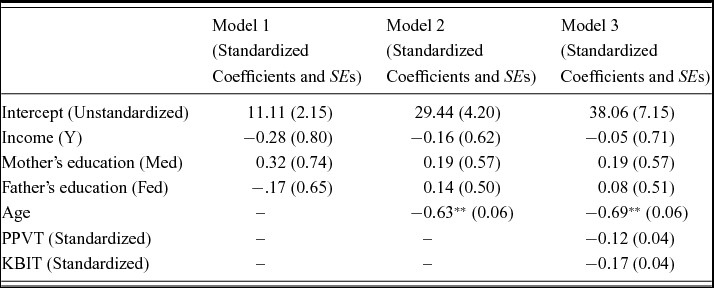
Next, we estimated a linear regression model predicting Inverse Efficiency Score from the three SES variables – father's and mother's education, and income, as well as age and standardized PPVT and KBIT scores. As mentioned above, Inverse efficiency scores were used instead of mean RT, because they analyze both accuracy and RT together, without including speed-accuracy tradeoffs; thereby providing a better understanding of processing efficiency (Townsend & Ashby, Reference Townsend, Ashby, Castellan and Restle1978). As Table 5 suggests, again, individual predictors of SES did not contribute significantly to inverse efficiency on the child-ANT in Model 1. Even when all 3 SES variables were considered as a whole in the Model 1, the effect of SES on overall accuracy was also insignificant, with an overall R 2 value of 0.12 (SE = 3.03), p = .26. Then, age was added to Model 1 and the R 2 value increased to 0.51 (SE = 2.31), p = 0.000. Finally, in Model 3, standardized KBIT and PPVT scores were added to Model 2, and the R 2 value was 0.54 (SE = 2.31), p = .001. In sum, both regression models revealed that while age was a significant predictor of EA performance on the child-ANT, SES (as measured by parental education and income) did not significantly predict EA performance. Additionally, English vocabulary and non-verbal intelligence also did not significantly predict EA performance (as measured by overall accuracy and inverse efficiency).
Linear regression model of the-Malay sample with child-ANT Inverse Efficiency as outcome variable.

Note: ** Significant at .01 level (2-tailed).
Comparisons of Malay child-ANT across other monolingual/bilingual populations
When the child-ANT results of our Malay sample were compared to a Singaporean Chinese sample from Yang et al.'s (Reference Yang, Yang and Kang2014) study, the Malays outperformed the Chinese on overall accuracy and the conflict/EC network score. Independent t-tests revealed that our Malay sample significantly outperformed Yang et al.'s (Reference Yang, Yang and Kang2014) Chinese sample on overall accuracy and the conflict/EC network efficiency score (p = .008, Cohen's d = 0.63 and p = .026, Cohen's d = 0.54 respectively). For other measures of the child-ANT, both groups’ performance did not significantly differ in terms of mean reaction time (RT) (p = 0.68, d = .09), Alerting efficiency (p = 0.24, d = 0.29), Orienting efficiency (p = 0.35, d = 0.23), and Inverse efficiency (p = 0.17, d = 0.28).
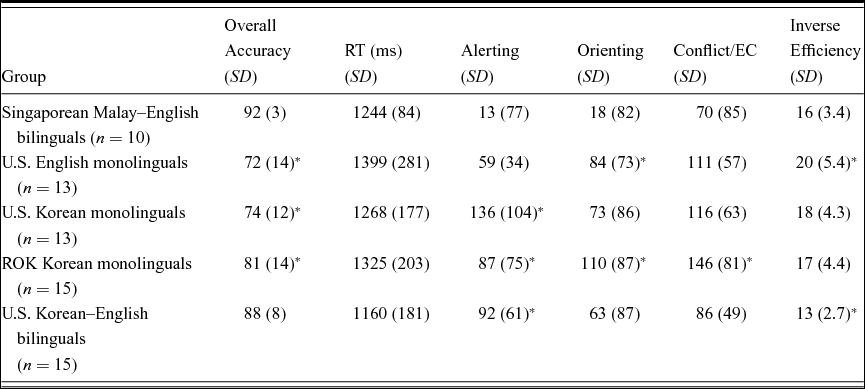
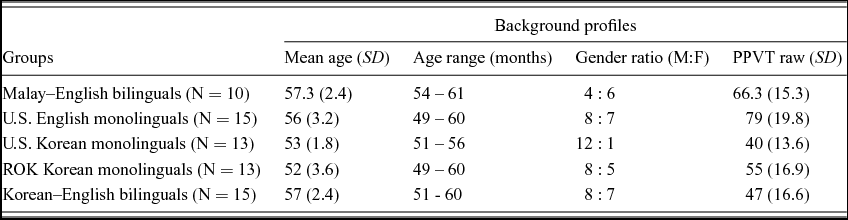
To further investigate how the Singaporean Malay–English bilingual sample fared on overall ANT Accuracy and how their performance compared to similar-aged Asian and American 4-year-old monolinguals and bilinguals, we compared our Malay results to four groups reported in Yang et al. (Reference Yang, Yang and Lust2011) – English monolinguals in the U.S., Korean monolinguals in the U.S., Korean monolinguals in Korea, and Korean–English bilinguals in the U.S. – to dissociate the effects of culture from the bilingual advantage using the child-ANT. In order to more closely match sample age in this comparison, we truncated our sample by selecting only the 4-year-old children in our study (n = 10) to match the age distribution of the children in the Yang et al. (Reference Yang, Yang and Lust2011) study. Table B.1 (Appendix B) summarizes the participants’ descriptions from Yang et al.'s (Reference Yang, Yang and Lust2011) study and the youngest subset of participants from our current study. Independent samples t-tests of the truncated sample revealed that the Malay–English bilinguals scored significantly higher on the overall ANT accuracy compared to all three groups of monolinguals – the U.S. English monolinguals (p = .0002; d = 1.98), the U.S. Korean monolinguals (p = .0002; d = 2.06), and Republic of Korea (ROK) Korean monolinguals (p = .02; d = 1.09). There was also no significant difference in overall accuracy performance between the U.S. Korean–English bilinguals in Yang et al.'s (Reference Yang, Yang and Lust2011) sample and our Malay–English bilinguals (p = 0.15; d = 0.66). Table 6 below summarizes these comparisons.
Mean scores and standard deviations on components of the child-ANT by Malays in comparison to English and Korean monolinguals and Korean–English bilinguals (Yang et al., Reference Yang, Yang and Lust2011).

Notes: For the 3 networks (Alerting, Orienting, Conflict/Executive Control (EC)) and Inverse efficiency, lower scores represent higher efficiency.
(*) represents significant differences from the Singaporean–English Malay sample.
For other components of the child-ANT, our truncated sample of 4-year-old Malay–English bilinguals outperformed certain sub-groups of the Korean–English monolinguals and bilinguals in Yang et al.'s (Reference Yang, Yang and Lust2011) sample on the following: a) Alerting network –the Malay bilinguals performed significantly better than the U.S. Korean monolinguals (p = .005; d = 1.34), the ROK Korean monolinguals (p = .03; d = .97), and the U.S. Korean–English bilinguals (p = .009; d = 1.14), b) Orienting network – the Malay bilinguals performed significantly better than the U.S. English monolinguals (p = .05; Cohen's d = .85) and the ROK Korean monolinguals (p = .01; Cohen's d = 1.09), c) Conflict/EC network – the Malay bilinguals performed significantly better than the ROK Korean monolinguals (p = .03; Cohen's d = .92), and d) Inverse efficiency – the Malay bilinguals performed significantly better than the U.S. English monolinguals (p = .05; Cohen's d = .89) and the U.S. Korean–English bilinguals (p = .02; Cohen's d = .98).
In summary, for overall accuracy on the child-ANT, the lower SES Malay–English bilinguals significantly outperformed all groups of monolinguals in Yang et al.'s (Reference Yang, Yang and Lust2011) Korean–English study, showing no significant differences compared to the Korean–English bilinguals. For all other components of the child-ANT, our Malay bilinguals performed similarly compared to the sub-groups in this Korean–English study, except for the following. For the Alerting network, they showed significantly better performance than the U.S. Korean monolinguals, the ROK Korean monolinguals, and the U.S. Korean–English bilinguals. For the Orienting network, they showed significantly better performance than the U.S. English monolinguals and ROK Korean monolinguals. For the Conflict network, they had significantly better performance compared to the ROK Korean monolinguals. Finally, for the Inverse Efficiency score, our Malay sample showed significantly better performance than the U.S. English monolinguals and the U.S. Korean–English bilinguals.
Summary of Results
Despite being classified as low SES by Singapore's standards, results revealed that the Malay sample's executive attention performance on the child-ANT remained high. In correlational analyses performed to explore the relationship between the SES measures, child-ANT components, PPVT and KBIT scores, none of the SES measures significantly correlated with any of the Malay child-ANT scores. Within the Malay sample, higher SES in terms of Ffather's education, mother's education and household income, did not correlate with better performance on the child-ANT. Similarly, regression analyses performed with overall ANT accuracy and inverse efficiency scores as outcome variables in two regression models revealed that the 3 SES variables combined – father's and mother's education as well as income - did not significantly predict EA performance on accuracy and inverse efficiency. For our Malay sample, English vocabulary (PPVT) and nonverbal intelligence (KBIT) were also not significant predictors of executive attention performance, although income did predict English vocabulary performance on the PPVT. Only age was a significant predictor of EA performance.
Comparisons of our low SES Malay sample with a high SES Singaporean Chinese sample (Yang et al., Reference Yang, Yang and Kang2014) revealed that our Malay sample significantly outperformed the Singaporean Chinese sample on overall accuracy and the conflict/EC network efficiency score while showing no significant differences on other measures of the child-ANT. When compared to other groups of monolinguals (English, Korean) and Korean–English bilinguals (Yang et al. (Reference Yang, Yang and Lust2011), our Malay sample did not show any disadvantaged performance on the child-ANT, but rather even outperformed some of the monolingual and bilingual groups on certain components of the child-ANT as listed above.
Discussion
The results of this study provide evidence that low SES need not diminish high executive attention performance in a bilingual population. Only age was a significant predictor of executive attention performance, consistent with the developmental literature on executive attention (Rueda, Rothbart, McCandliss, Saccomanno & Posner, Reference Rueda, Rothbart, McCandliss, Saccomanno and Posner2005, Rueda et al., Reference Rueda, Rothbart, McCandliss, Saccomanno and Posner2005). The high EA performance on the child-ANT despite the low SES characteristics of this Malay population leads us to inquire as to what factors in the Singapore Malay context may act to override potential diminishment effects that are often expected to cohere with low SES (Ardila et al., Reference Ardila, Rosselli, Matute and Guajardo2005; Hughes et al., 2005; Lipena et al., Reference Lipina, Martelli, Vuelta and Colombo2005; Noble et al., Reference Noble, Norman and Farah2005; Noble et al., Reference Noble, McCandliss and Farah2007).
The prolific productive inclusive ambience of bilingualism in this culture would surely be expected to advantage any positive effects of bilingualism. Community-level influences in language attitudes may have worked to ameliorate the negative effects of SES on cognitive development. Ideals of society may be associated with achievement outcomes even after controlling for individual-level income and education. In Singapore's case, there are strong communities that believe in reading to their children, and doing so in both languages. The generally high literacy rates in the Singapore culture at large, as well as the documented reading of both Malay and English materials to children in the Malay families may be another advancing factor. Future studies could examine possible commonalities and differences between parents of Malay–English bilingual children, compared to parents of other bilingual populations in Singapore (e.g., Chinese–English bilinguals). The CMQ can be developed through more detailed interviews with parents in order to investigate their complex language background information, including pervasive code-switching (i.e., alternating between two or more languages within a conversation) as well as social and cultural factors such as literacy, access to internet, technology, and possibly education (given that Singapore has an excellent education system, even in preschools). These could significantly refine our understanding of cross-cultural variation in low SES and the mechanisms that may underlie its effects. Apart from this, the SES range of the current study was fairly limited; hence, future studies should examine a more varied range of SES within the Malay sample, to provide us with a more nuanced picture of how SES influences cognitive development.
In addition, properties of the child's bilingualism, including simultaneity of acquisition and daily use across contexts, including constant code switching, may also be enhancing the executive attention advantage. For example, recent studies have suggested a possible relationship between code-switching in language and task-switching in general in cognition (Abutalebi & Green, Reference Abutalebi and Green2008; Yim & Bialystok, Reference Yim and Bialystok2012). In a multicultural and multilingual society like Singapore, the frequency of code-switching illustrates the “high degree of linguistic heterogeneity in Singapore” (Leimgruber, Reference Leimgruber2013, p.70). Hence, one's ability to code-switch may be a critical tool in this multilingual context, and has been found to be prevalent even in young children's developing language (Foley, Reference Foley1998). Future work is currently in progress to examine the relationship between frequency and types of code-switching on executive attention.
In conclusion, our results suggest that SES must be viewed as non-homogenous, culturally sensitive and differentiated. SES operates at multiple levels (Bradley & Corwyn, Reference Bradley and Corwyn2002) and may be modulated by culture (Bradley, Reference Bradley and Reese1994; Bronfenbrenner, Reference Bronfenbrenner, Moen, Elder and Lüscher1995. For example, family income does not necessarily correlate with level of education (Ardilia, Rosselli, Matute & Guajardo, Reference Ardila, Rosselli, Matute and Guajardo2005). Although Malay participants had below-median monthly income, parental education was not all in the low range, as can be seen in Figure 1. The distribution of father's and mother's education in the Malay sample highlights that not all parents in this low SES sample had low educational attainment (i.e., distribution is mostly concentrated and equally distributed around levels 2 to 4, with very few 1s and 5s). Future studies comparing samples based on SES should have more precise measurement (e.g., average monthly income, since those used in our study had a wide range), and perhaps include other variables like cultural variations that may cohere with educational variation, such as literacy or nature of bilingualism/multilingualism. Further investigation of languages spoken in the home is required. This may enable us to better examine how socio-cultural factors influence cognitive development of bilingual/multilingual children.
As it was practically impossible to recruit a control group of age-matched monolinguals within the same cultural setting in Singapore, this study could only make within-group bilingual comparisons of Malay Singaporean bilinguals that differed in terms of SES and culture and comparisons to other Asian monolingual groups within and outside of Singapore. Therefore, it is not possible for us to argue conclusively that it is this Malay sample's proficient, productive, prolific bilingualism per se which is causing or supporting the high executive attention development in this sample; nor is it possible for our results to identify the precise mechanism by which bilingualism may cause such advances, issues which we must leave to future research. Future larger samples may aid in differentiating factors which may provide such mechanisms, as well as rule out continuous concern for Type II error. Thus, although our results are consistent with the view that bilingualism may compensate for the adverse effects of poverty on cognitive processes (e.g., Carlson & Meltzoff, Reference Carlson and Meltzoff2008; Engel de Abreu et al., Reference Engel de Abreu, Cruz-Santos, Martin and Bialystok2012), comparative studies of a within-Singapore monolingual population would advance this hypothesis.
On the other hand, our research results do not rule out the possibility that advances in executive attention may potentially be explained to a large degree by properties of the ‘Asian milieu’, for example the self-discipline emphasized by religious practices or by parent-child rearing practices of the community (Lewis et al., Reference Lewis, Koyasu, Oh, Ogawa, Short and Huang2009; Tobin et al., Reference Tobin, Wu and Davidson1989). At the same time, our results highlight the non-homogeneity of the ‘Asian milieu’, as Singapore clearly demonstrates in its diverse ethnic and income groups. Our results suggest that Asian superiority effects extend beyond Chinese populations alone (Carlson & Meltzoff, Reference Carlson and Meltzoff2008). Further research may help to dissociate potential confounding effects of culture and bilingualismFootnote 8 .
Appendix A
Pictorial depiction of the child-ANT (Rueda et al., Reference Rueda, Fan, McCandliss, Halparin, Gruber, Lercari and Posner2004)

Appendix B
Comparison of SES demographics of the Malay sample to a Korean (Korea, U.S.), English (U.S.), and Korean–English sample (U.S.) (Yang et al., Reference Yang, Yang and Lust2011).

Correlation Matrix of child-ANT and SES Measures of Malay Sample.