The persistent arterial duct is a common congenital cardiac disease in infants and children. This cardiac pathology is found in around one in 2000 full-term infants, which represents 5–10% of all congenital cardiac diseases;Reference Mitchell, Korones and Berendes1 therefore, a paediatric interventional cardiologist encounters these children relatively frequently. Prematurity with low birth weight and maternal rubella is associated with a higher prevalence of the persistent arterial duct.Reference Keane and Fyler2
In recent years, percutaneous treatment of the persistent arterial duct in the catheterisation laboratory has become the gold standard and is a safe therapy,Reference Wang, Wu, Hwang, Chiang, Lin and Lue3–Reference Thanopoulos, Hakim and Hiari5 except in extremely small preterm infants and for particularly large “window-like” ducts for which surgical management is still recommended.Reference Ewert6–Reference Giroud and Jacobs8 Owing to the number of children in need of interventional persistent arterial duct closure being significant, the tendency is to develop new devices that are safe, effective, user-friendly, and have the lowest profile possible.
In the Children's Cardiac Centre in Slovakia, we have several options for duct closure with different devices: detachable coils, the Amplatzer duct occluder, and, presently, a relatively new device, the Amplatzer duct occluder II.
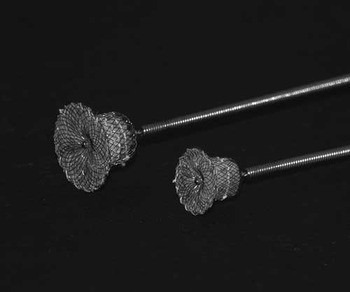
The Amplatzer duct occluder is made of a nitinol wire mesh that is shaped into a cylindrical plug shape with a collar to secure the duct occluder in the persistent arterial duct via polyester fabric inserts. This device can be implanted from the femoral vein only and requires a five to seven French sheath depending on the size of the appropriate device. The Amplatzer duct occluder in two different sizes can be seen in Figure 1.
Amplatzer duct occluder in two different sizes.

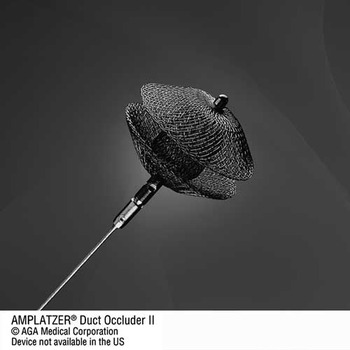
The Amplatzer duct occluder II is a self-expanding nitinol mesh device and is designed to be introduced in a minimally invasive fashion through a catheter. The device has two retention discs positioned on either side of the duct and is connected by the waist.9 The advantage of this new device is that it can be implanted from the arterial or venous side of the persistent arterial duct. It requires sheaths of lower profile – four or five French and its shape is more flexible. This device does not contain any fabric material. The Amplatzer duct occluder II can be seen in Figure 2.
New type of the device – the Amplatzer duct occluder II.

The aim of this study was to determine the safety, efficacy, and the advantages and disadvantages of using the Amplatzer duct occluder or Amplatzer duct occluder II in different types of arterial ducts and in different age categories.
Methods
In this study, we retrospectively reviewed the data from all of our children who underwent device closure of a persistent arterial duct between September, 2005 and February, 2010. Children who had a duct closure with a coil were not included in this study.
Echocardiographic recordings – 24 hours, 1 month, and 1 year after duct closure when available – and angiographic data – before and immediately after duct closure – were analysed. For all children included, the sizes of the arterial duct – ampula if present, width of the duct at the narrowest place, and the length of the duct – and of the aorta – transversal arch measured between the left and right carotid arteries and the descending aorta measured just below the arterial duct – were measured. We determined the angiographic type of the arterial duct according to the description by Krichenko et al.Reference Krichenko, Benson, Burrows, Möes, McLaughlin and Freedom10 We also evaluated for additional cardiac pathologies and other congenital malformations, and we noted the procedure-related complications.
A simple statistical analysis of the data of our children in both groups was performed. The mean values of the Amplatzer duct occluder group and the Amplatzer duct occluder II group were compared in six following parameters: age at ductal closure, weight at ductal closure, descending and transversal aorta dimensions, ductal width, and ductal length. The value of p was calculated using the non-paired Student's t-test and the data were also confirmed by the Mann–Whitney U-test for each parameter with the level of significance set at 0.05. Our results of ductal closure at 24 hours, 1 month, and 1 year post intervention were analysed by comparing both groups by the method of chi-square good-of-fit analysis.
Children population
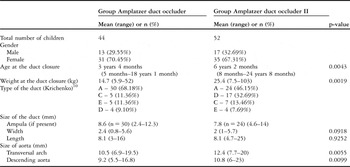
Children were divided into two groups. The Amplatzer duct occluder group consisted of 44 children with a ductal closure using the Amplatzer duct occluder, and the Amplatzer duct occluder II group consisted of 52 children with persistent arterial ducts closed by the new Amplatzer duct occluder II device. The principal characteristics of both groups are summarised in Table 1.
Principal characteristics of the Amplatzer duct occluder group and the Amplatzer duct occluder II group.

Group Amplatzer duct occluder – children with Amplatzer duct occluder ductal closure
Group Amplatzer duct occluder II – children with Amplatzer duct occluder II ductal closure
Mean and range are provided for continuous variables and frequency with percentage for categorical variables
Indications for duct closure
We performed ductal closure in all children in whom a persistent arterial duct was diagnosed by echocardiography, even for asymptomatic silent forms.
However, the decision to close all diagnosed persistent arterial ducts, even the silent ones, is considered as controversial. In our institution, we decided to adopt this strategy because the rate of complications of an interventional closure is remarkably low. Furthermore, we believe that this strategy helps to reduce the risk of infective endocarditis in the presence of a small duct.Reference Dua, Chessa and Piazza11
Procedure
Before the interventional part of the procedure, a descending aortography to visualise the persistent arterial duct was performed in all children – biplane projections, right anterior oblique plus lateral views were used. After measurements were realised from this angiography – ductal width and length, descending aorta dimension – the most appropriate device was selected. From April, 2008, we used the Amplatzer duct occluder II whenever possible for its advantageous characteristics. In children, with a descending aorta less than 8 millimetres and also in smaller children with very short tubular ducts, we prefer the Amplatzer duct occluder; in all other children, we use the new device.
In all children in the Amplatzer duct occluder group, the duct closure was performed from the pulmonary artery via the femoral vein. In these children, both arterial access and venous access were necessary. In children from the Amplatzer duct occluder II group, the duct closure was performed in 30 children (57.69%) either via the aorta, or via the pulmonary artery in 16 children (30.77%), or the closure was assisted by a snare – a wire was introduced through the duct from the aortic side, and was snared from the pulmonary artery and the duct was closed from the pulmonary side in 6 children (11.54%). The snare technique was applied in younger children with small persistent arterial ducts and when it was not possible to cross the persistent duct from the pulmonary artery side with a catheter because of its extremely small size. In these children, we preferred the closure from the pulmonary artery side owing to a better configuration of the device with the screw mechanism left in the pulmonary artery.
The choice of the implantation side of the Amplatzer duct occluder II was based on the children's weight and aortic dimensions. In smaller children and infants with a body weight less than 15 kilograms, the duct closure was performed from the pulmonary artery side; in older children with a body weight more than 15 kilograms, the closure could be realised from the aortic side.
After the closure, a control angiography was performed. In children from the Amplatzer duct occluder group, this was achieved from the aorta with a pigtail catheter with the device attached to the delivery system. A repeated angiography was performed after release of the device, if necessary, in cases where we were not confident of the position of the device or where there was suspicion of a significant residual shunt.
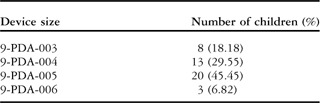
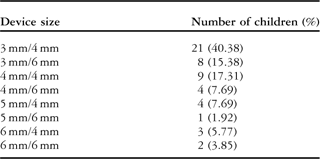
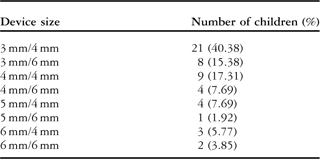
In children from the Amplatzer duct occluder II group, multiple possibilities for the control angiography were available and tested. If the closure procedure was uncomplicated and the device seemed to be in an appropriate and stabilised position, the control angiography was performed via the aorta with a pigtail catheter after the device had been detached. Another method that we used for the control angiography was to perform this angiography from the side arm of the delivery long sheath and with the device attached to the delivery system – Amplatzer duct occluder II device – in ductal closures from the aortic side of the duct. The total amount of contrast that we deemed appropriate for this control was 8–10 millilitres per speed at 8 milliliters per second. If the ductal closure was realised from the pulmonary artery, the control angiography was naturally realised from the aorta with a pigtail catheter. In one child, we tested the feasibility of angiography with a pigtail of five French with a cut tip, which was positioned on the four French delivery cable; this angiography was successfully performed – Amplatzer duct occluder II device – in ductal closure from the aortic side of the duct. The sizes of the implanted devices used can be found in Tables 2 and 3.
Sizes of the Amplatzer duct occluder devices used.
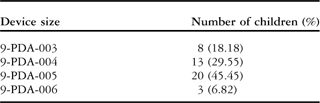
Sizes of the Amplatzer duct occluder II devices used.
Results
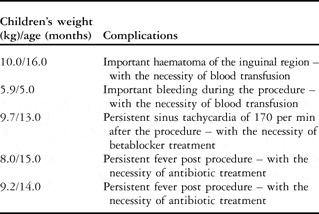
The interventional procedure was successfully terminated in all children in both groups, and no child required surgical intervention. There were no embolisations of the device in either group. No major complications occurred in either group. Minor complications occurred all in children in the Amplatzer duct occluder group who weighed less than or equal to 10 kilograms; these are listed in Table 4. We define major complications as complications leading to death or necessitating another surgical or interventional procedure or prolonging the length of hospitalisation. Minor complications are defined as complications requiring observation or medical treatment, but without prolongation of hospitalisation.
Complications in children with Amplatzer duct occluder closure.

Our results in both groups were evaluated in the following three parameters at 24 hours, 1 month, and 1 year post procedure, if the 1-year follow-up data were available: closure rate, left pulmonary artery stenosis, and descending aorta obstruction.
Closure rate
Amplatzer duct occluder group
In the Amplatzer duct occluder group, the control angiography performed immediately after ductal closure revealed a complete occlusion without any residual left-to-right shunt in 27 children (61.36%). In the rest of the cases, there was a minimal residual left-to-right shunt or foaming across the device, but there were no cases with a haemodynamically significant residual shunt that required replacement with another size of the device.
Control echocardiography at 24 hours after ductal closure confirmed a complete closure of the duct in 42 children (95.45%). In two children (4.55%), a small residual left-to-right shunt was present.
At 1-month follow-up, 41 children from the Amplatzer duct occluder group were examined. For three children, the follow-up data were unavailable. The duct closure was complete in all 41 examined children (100%).
There were 1-year follow-up data available for 27 children (61.36%). All the ducts of the examined children remained closed.
Amplatzer duct occluder II group
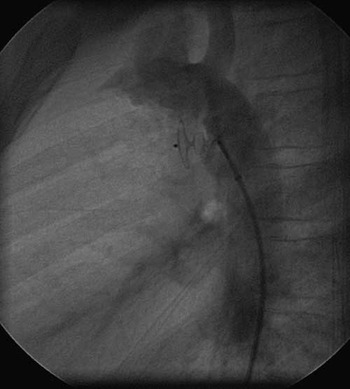
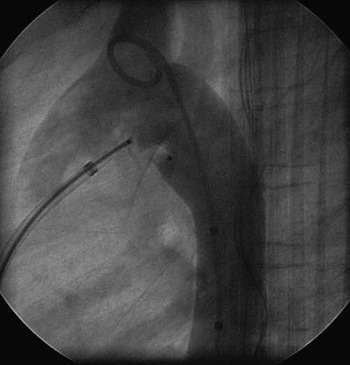
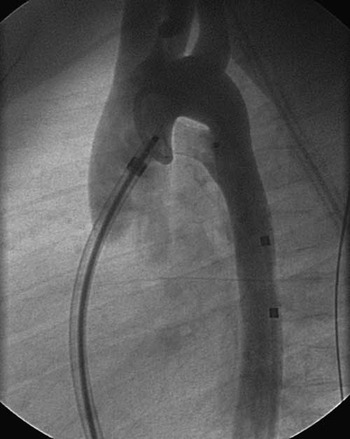
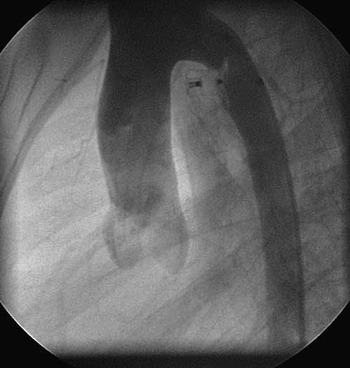
In the Amplatzer duct occluder II group, two children had their arterial duct closed with the Amplatzer duct occluder II device, and these devices had to be removed because of an important protrusion of the device into the descending aorta visualised on the control angiography before the device detachment. The angiography of the nearly 50% protrusion can be seen in Figure 3. The devices were replaced by an Amplatzer duct occluder with a satisfactory result, as seen in Figure 4.
Persistent arterial duct closed with an Amplatzer duct occluder II – nearly 50% protrusion of the device into the descending aorta.

Persistent arterial duct closed with an Amplatzer duct occluder with a satisfactory result – same child as in Figure 3.

In this group, a complete closure of the duct immediately after device closure, as verified by an angiography, was achieved in 41 children (78.85%). In the rest of the cases, there was a minimal residual left-to-right shunt or foaming across the device.
A control echocardiography 24 hours post duct closure confirmed complete closure in 51 children (98.08%). In one child (1.92%), there was a haemodynamically insignificant left-to-right shunt.
At the 1-month follow-up, 50 children (96.15%) from the Amplatzer duct occluder II group were examined, and for two children the follow-up data were unavailable. The duct closure was complete in all children, except in one child (2%) with a small residual left-to-right shunt that was completely closed at the 6-month follow-up.
There were 1-year follow-up data available for only 17 children (32.69%); all ducts were completely closed.
Descending aorta obstruction
Amplatzer duct occluder group
In the Amplatzer duct occluder group, a control echocardiography 24 hours post ductal closure revealed an acceleration of flow in the descending aorta in four children (9.09%) with an echocardiographic gradient of 15–45 millimetres of mercury.
At 1-month follow-up, three children (6.82%) still continued to have an accelerated flow in the descending aorta with an echocardiographic gradient of 15–45 millimetres of mercury. At further follow-up, these findings had a tendency for amelioration with growth, except in one child.
This child was an 11-month-old girl with a body weight of 8.5 kilograms at the time of the interventional procedure. She was recatheterised 26 months after the ductal closure for turbulence and protrusion of the device into the descending aorta. She had a relatively large type A persistent arterial duct. Clinically, she was asymptomatic. The persistent arterial duct was closed with an Amplatzer duct occluder 9-PDA-005. The immediate angiographic result was satisfactory without any residual shunt. The aortic disc of the device protruded 2.4 millimetres into the descending aorta, and the aortic isthmus measured 6.7 millimetres. The angiography immediately after the ductal closure is shown in Figure 5. Echocardiographies at 24 hours and 1 month post closure showed no residual shunt and no stenosis of the left pulmonary artery with a laminar flow in the descending aorta. At the 6-month follow-up, we discovered accelerated flow in the descending aorta with a gradient of 15 millimetres of mercury. This gradient persisted at the 2-year follow-up, and the echocardiographic gradient continued to be mildly elevated at 20 millimetres of mercury with an important protrusion of the device in two-dimensional echocardiographic images. A decision for recatheterisation with measurement of an invasive gradient was made. During the diagnostic procedure, the invasive gradient at the aortic isthmus was 14 millimetres of mercury, and the aortic isthmus was 9.6 millimeters wide – at the first catheterisation, it was 6.7 millimetres wide. The aortic protrusion of the Amplatzer duct occluder disc was almost 50% of the aortic lumen. The angiography from the second catheterisation is shown in Figure 6. The child did not have any haemolysis. We decided not to intervene and to echocardiographically observe the evolution of the gradient and of the disc protrusion. We expect that with the child's growth, this protrusion will become less important. We explained the importance of good infective endocarditis prophylaxis to the parents. If the protrusion persists without any amelioration during the follow-up period, it will be necessary to place a stent into the descending aorta and to push the device into the aortic wall.
Immediate result of persistent arterial duct closure with an Amplatzer duct occluder device.

Angiography 26 months post ductal closure with an Amplatzer duct occluder with a significant protrusion of the device into the descending aorta.

At 1-year post duct closure, four children from 27 examined children (14.81%) continued to be followed for an acceleration of the flow in the descending aorta.
Amplatzer duct occluder II group
In the Amplatzer duct occluder II group at 24-hour echocardiography, two children (3.85%) had an acceleration of the flow in the descending aorta with a gradient of 15–25 millimetres of mercury.
No flow acceleration was observed in the descending aorta at 1 month follow-up echocardiography.
There were 1-year follow-up data available for only 17 children (32.69%); there is no aortic flow acceleration.
Left pulmonary artery stenosis
Amplatzer duct occluder group
In the Amplatzer duct occluder group, at 24 hours echocardiography, in one child (2.27%), an insignificant left pulmonary artery stenosis was detected, which persisted also at 1-month follow-up. At 1-year control echocardiography, there was no left pulmonary artery stenosis in the examined children.
Amplatzer duct occluder II group
In the Amplatzer duct occluder II group, at 24 hours control echocardiography, two children (3.85%) had an insignificant left pulmonary artery stenosis that persisted also at 1-month follow-up. At 1-year control echocardiography, in 17 examined children there was no left pulmonary artery stenosis.
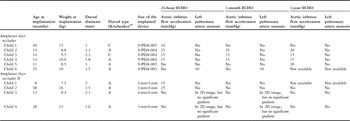
A summary of children, their characteristics, and implanted devices with aortic protrusion or left pulmonary artery stenosis can be found in Table 5.
Summary of children with aortic protrusion or left pulmonary artery stenosis.

ECHO = echocardiography; 2D = two dimensional
Results of the statistical analysis
The differences in characteristics of both groups – age, weight, descending and transversal aorta diameter – are statistically significant, that is p is less than 0.05, but the difference in ductal length and ductal width are not statistically significant, that is p is greater than 0.05. The values of p can be found in Table 1. From these statistical data, we can conclude that even if children in the two groups are different in their attributes, their ductal length and width are very similar and the difference in these parameters between the two groups is not statistically significant.
We also analysed our results of duct closure by comparing both groups by the method of chi-square good-of-fit analysis. Our calculations showed that the difference in results in both groups does not reach statistical significance in the following parameters: immediate complete closure; 24 hours and 1 month complete closure; 24 hours, 1 month, and 1 year flow acceleration in the descending aorta; 24 hours and 1 month left pulmonary artery stenosis. The analysis of the parameter of 1 year complete closure and 1 year left pulmonary artery stenosis is not realisable because all the data are the same in these two parameters.
All our statistical calculations are limited by the small number of children in our two groups.
Discussion
The Amplatzer duct occluder II is a new alternative device for a persistent arterial duct closure. Its implantation is feasible even in small children or infants – recommended for infants with a body weight greater than 6 kilograms. In the current literature, there are several articles on the experience of using the Amplatzer duct occluder II for ductal closures.Reference Dua, Chessa and Piazza11–Reference Saliba, El-Rassi and Abi-Warde16 These results are all particularly encouraging.
After the evaluation of our single-centre experience, we can confirm that this device is safe and highly effective for ductal closures. Almost all angiographic types of arterial ducts can be closed with this device, except for type B ducts and short tubular ducts in small children with small dimensions of their descending aorta. In our group of children, immediate effective closure was achieved in almost 80% of children. Complete closure at 1 day after the closure was achieved in more than 98% of children. At the 6-month follow-up, all the ducts were closed. There were no major procedure-related complications. These data from our institution concerning the closure rate and low rate of complications correspond to the previously published data from different cardiac catheterisation laboratories.Reference Dua, Chessa and Piazza11–Reference Saliba, El-Rassi and Abi-Warde16
By comparing our results between the two groups of children, we found that the immediate closure rate was mildly higher with the new Amplatzer duct occluder II device, but the 24 hour and 1 month follow-ups were similar. The higher immediate closure rate could be good for preventing haemolysis. In the available literature, there are few described cases of important haemolysis after a coil or device closure. Haemolysis occurs when a residual shunt is present and occurs predominantly in the first 24 hours and when using a coil.Reference Vanuranakis, Tzannos, Thanopoulos, Vlasis and Stefanadis17 However, in our group of children, no haemolysis was reported.
When we analysed the complication rates in both groups, we concluded that all of our procedural and post-procedural complications occurred in children with Amplatzer duct occluders and with a body weight of less than or equal to 10 kilograms. Owing to these findings, in asymptomatic infants and children, the timing of the duct closure is questionable. It would most likely be better to postpone the interventional procedure until a body weight of 10 kilograms is obtained.Reference Abadir, Boudjemline and Rey7
The protrusion of the Amplatzer duct occluder device into the descending aorta, which occurred at 6 months post implantation, is a new complication that we have never encountered before. The protrusion of the device augmented progressively with time. We believe that the device most likely moved from its initial position in the post-catheterisation period; however, this is not guaranteed. Despite the fact that we did not perform the control angiography post device release, only the angiography with the device still attached to the delivery system was available. However, at 24 hours and 1 month of echocardiographical follow-up, there was no aortic protrusion – at two-dimensional image and by Doppler evaluation. This protrusion was diagnosed for the first time at the 6-month follow-up. Further echocardiographic observation of the child is indispensable to determine the necessity of a second interventional procedure, namely stenting of the descending aorta.
The two cases where the Amplatzer duct occluder II devices had to be replaced by an Amplatzer duct occluder both occurred at the beginning of our experience with this type of device. Re-analysis of the angiographies proved that both of these ducts were oversized and that the devices were larger than required. Probably a change to a smaller size of the device would result in an adequate device position.
Comparing the follow-up periods, this period is naturally longer for the Amplatzer duct occluder device; for the Amplatzer duct occluder II device, the follow-up remains limited. In our children, the mean follow-up period in the Amplatzer duct occluder group is 31 months, and in the Amplatzer duct occluder II group it is 8 months.
In the children with Amplatzer duct occluder II duct closure performed from the aorta, the aortic protrusion of the device might be caused by the screw mechanism of the device, which protrudes into the aorta. This can be easily avoided by duct closure from the pulmonary artery in smaller children. With the screw mechanism in the pulmonary artery, there is less risk of its protrusion; the configuration of the whole device and also its affixing on the aortic side are better.
After more than 2 years of our experience with the new Amplatzer duct occluder II device, we have progressively developed a strategy for persistent arterial duct closure. Owing to the improved properties of this new device – smaller required delivery system, softer delivery system, and softer shape of the device, which is more flexible during implantation – we implant it whenever possible. In children with a body weight less than 15 kilograms, we obtain both arterial and venous vascular accesses, and in children with more than 15 kilograms of body weight, we start with arterial access alone. After the initial descending aortography, we measure the diameter of the descending aorta just below the arterial duct. We consider the Amplatzer duct occluder II implantation in children with a descending aorta diameter superior to or equal to 8 millimetres. In cases where the descending aorta diameter is less than 8 millimetres, we prefer to close the duct with the Amplatzer duct occluder device – owing to our experience with the aortic protrusion of the device in cases of smaller infants with smaller diameters of their descending aorta. In smaller children with very short tubular ducts, we prefer the older version of the device. Outside of these situations, we prefer the implantation of the new device in longer tubular ducts without any aortic ampula – when we use the 6-millimetre-long device, the aortic disc can be completely pulled into the duct – or in a complex form of ducts with tortuousness or multiple constrictions. In most cases of persistent arterial ducts, a 4-millimetre-long device is sufficient. We use the 6-millimetre device only in particularly elongated ducts.
The choice of the side of implantation of the duct is a function of the body weight of the child. In children with a body weight greater than 15 kilograms, we generally feel confident with aortic access only because the procedure is straightforward and rapid. In children with a body weight less than 15 kilograms, we perform the closure from the pulmonary artery side of the duct – in this case, the screw mechanism is left in the pulmonary artery and does not protrude into the descending aorta. In exceptionally small ducts – without the possibility of crossing the duct from the pulmonary artery side – and in small children, the duct is crossed from the aortic side, and the wire is then snared to obtain an arteriovenous loop. The procedure then continues from the pulmonary artery side.
The advantages of using the Amplatzer duct occluder II device include the required sheath size, which is inferior to the sheath size necessary for the Amplatzer duct occluder implantation and the softer shape of the Amplatzer duct occluder II device. This is particularly interesting in younger children and smaller weight categories.
Conclusion
After evaluating the results of our institution, we can conclude that the Amplatzer duct occluder II device has widened the spectrum of the interventional tools for percutaneous duct closure, mainly for the long tubular and complex forms of persistent arterial ducts. The use of smaller sheaths minimises the complication rates in percutaneous persistent arterial duct closure, as we have also shown by summarising our complications that all occurred in the Amplatzer duct occluder group – with larger required sheaths.
Ductal closure with this device is a safe and effective method in almost all age categories. However, the absence of a device suitable for very small and for premature low birth weight infants persists.
All of our results are limited to a single cardiac centre and to a single catheterisation laboratory and are therefore influenced by a relatively small number of children. The confirmation of our mid-term results would necessitate further observation in a larger number of children.
Acknowledgement
I wish to thank all the members of the Department of Functional Diagnostics in the Children's Cardiac Centre for excellent cooperation during all performed interventional cases and for realized echocardiographical controls in our patients.