


Introduction
Stroke remains a leading cause of adult disability worldwide and a major contributor to long-term functional dependence, reduced quality of life and increased burden on the healthcare systems.1 In Canada, approximately half of individuals living with stroke need assistance with activities of daily living.Reference Holodinsky, Lindsay, Yu, Ganesh, Joundi and Hill2 In Ontario, the average direct healthcare cost in the year following stroke is estimated at $53,000, including both acute care and rehabilitation services.Reference Yu, Smith and Krahn3 Motor and cognitive impairments are among the most prevalent and disabling outcomes after stroke, often limiting participation in daily activities, social roles and return to work. Rehabilitation interventions targeting these domains are therefore essential for optimizing recovery and improving functional independence.
Over the past several decades, research in stroke rehabilitation has expanded rapidly. Globally, the number of randomized controlled trials (RCTs) examining the efficacy of rehabilitation interventions for post-stroke recovery has increased, including trials targeting motorReference Teasell, Safaei-Qomi and Fleet4,Reference Teasell, Safaei-Qomi and Flores-Sandoval5 and cognitive rehabilitation.Reference Mehrabi, Safaei-Qomi and Flores-Sandoval6,Reference Teasell, Safaei-Qomi, Flores-Sandoval, Mehrabi, Payne, Dukelow and Fleet7 However, the nature and focus of rehabilitation research can vary substantially across countries due to differences in healthcare systems, funding priorities, academic infrastructure and collaborative networks. National-level analyses of RCT activity can therefore provide important insights into how research priorities are translated into practice, the types of interventions being investigated and the methodological rigor of clinical studies. Understanding these trends is critical for identifying gaps and informing future research priorities and investments.
In Canada, stroke rehabilitation research benefits from well-established organizations and funding agencies (e.g., previous Canadian Stroke Network, Heart and Stroke Foundation of Canada, academic networks and Canadian Institutes of Health Research). In addition, national academic initiatives and networks (e.g., Canadian Stroke Best Practice Recommendations, CanStroke Recovery Clinical Trials Platform and previous Canadian Partnership for Stroke Recovery) have supported collaboration among rehabilitation scientists, clinicians and policymakers. Despite this strong infrastructure, there has been no comprehensive synthesis of Canadian RCTs to characterize the landscape of Canadian post-stroke rehabilitation research. It therefore remains unclear which types of interventions have been most frequently studied in Canada, how research activity has evolved over time and how Canada’s contributions compare with those of the global research community.
This study aimed to systematically identify and describe all RCTs investigating post-stroke motor and cognitive rehabilitation conducted in Canada up to December 2024, within the broader context of global post-stroke rehabilitation research. This work highlights both strengths and underexplored areas in Canadian post-stroke rehabilitation research and may help inform future priorities in this field.
Methods
The present study is a secondary descriptive/bibliometric analysis of data derived from five integrated and inter-related systematic review projects conducted by the same research group, providing an overview of post-stroke motor and cognitive rehabilitation RCTs conducted in Canada. Each systematic review includes all RCTs from inception to December 31, 2024, with interventions targeting (1) post-stroke upper extremity (UE) motor rehabilitation, (2) post-stroke lower extremity (LE) motor rehabilitation, (3) post-stroke unilateral spatial neglect (USN) rehabilitation, (4) post-stroke aphasia rehabilitation and (5) post-stroke general cognitive rehabilitation. Research protocols, including detailed search strategy and eligibility criteria for each of these systematic reviews, have been previously registered in PROSPERO (Lower Extremity: CRD420251081795; Upper Extremity: CRD420251081727; General Cognitive Disorders: CRD420251061837; Unilateral Spatial Neglect: CRD420251063485; Aphasia CRD420251068878). Please see Supplemental File for the full search strategy of each of each of the included systematic reviews (Table A), as well as the PRISMA diagrams (Figures A to E).
Eligibility criteria
Inclusion criteria were consistent across the five systematic review projects and included (1) RCTs with a parallel or crossover design, (2) publications in English and (3) adult participants (≥18 years) diagnosed with stroke (≥50% of the sample in mixed-etiology studies). In addition, studies were required to (4) evaluate interventions targeting the specific rehabilitation domain addressed in each review (UE motor rehabilitation, LE motor rehabilitation, aphasia, USN or general cognitive impairment) and (5) report at least one outcome measure relevant to that domain. Exclusion criteria were identical across reviews and included (1) secondary analyses, (2) study protocols and (3) interim or incomplete reports.
Study selection and data extraction
For each parent systematic review project, search results were imported into Covidence (www.covidence.org, Veritas Health Innovation, Melbourne, Australia), where duplicates were automatically removed. Title and abstract screening, full-text review and data extraction were performed independently by two reviewers, with a third reviewer available to resolve any disagreements.
Data extractions were performed using a custom data extraction template in Microsoft Excel (V16.0). For the purpose of this study, data from the five parent systematic reviews were pooled into a single master dataset in Microsoft Excel Online. A predetermined subset of variables was selected from the extracted data for synthesis in this manuscript. These variables were examined across the entire master dataset and specifically within the subset of RCTs conducted in Canada, including the year of publication, sample size, number of female and male participants, time post-stroke, type(s) of intervention(s) and control(s), and primary and secondary outcome measures. For all the variables, any missing or not-found variables were recorded as “Not Reported” across the entire dataset. Overlap of RCTs across categories was accounted for in the final numbers; for instance, if an RCTs examined both LE and UE motor rehabilitation, or both motor and cognitive rehabilitation, it was counted only once in the final dataset.
In addition to these variables extracted for all RCTs, further data were extracted only for the Canadian RCTs, including the number of authors and the profession of the first and last authors. Information on the author’s professional background was extracted primarily from the published article, including the institutional affiliation(s), professional credentials (e.g., Medical Doctor (MD), Bachelor of Science (BSc), Master of Science (MSc), Doctor of Philosophy (PhD), Physiotherapist (PT), Occupational Therapist (OT), Registered Nurse (RN)) and author information available at the time of publication. When this information was incomplete or unclear, additional publicly available sources, including institutional webpages and academic profiles, were consulted to supplement the available information. Author classification was performed independently by two reviewers according to predefined criteria, and any discrepancies were resolved through discussion and consensus. If the corresponding author’s professional background could not be determined after these searches and reviewers’ discussion, it was recorded as “Not Reported.” Authors were classified into three mutually exclusive categories using the following predefined criteria: (1) Academic medical doctors: authors holding a medical degree (MD or equivalent), regardless of any additional academic qualifications (e.g., MSc, PhD). (2) Academic therapists: authors holding a regulated clinical qualification (e.g., physiotherapist, occupational therapist, speech–language pathologist, psychologist or registered nurse), regardless of any additional non-clinical academic qualifications (e.g., BSc, MSc and PhD), provided they did not hold an MD. (3) Academic scientists: authors holding academic research qualifications (e.g., BSc, MSc and PhD) without a regulated clinical qualification or an MD.
Classifications and definitions
The country of origin for each RCT was determined based on the affiliation of the corresponding author and the location where the RCT was conducted. In case of discrepancy (e.g., multisite international RCTs), the country of origin was determined based on location where the ethics board approval was issued.
Time post-stroke for each RCT was recorded according to the time between stroke onset and start of the trial and classified as: acute phase (<1month), subacute phase (1–6 months) and chronic phase (>6 months).
Methodological quality
The Physiotherapy Evidence Database (PEDro) tool was used to evaluate the methodological quality of included RCTs.Reference Moseley, Herbert, Sherrington and Maher8 The PEDro score was evaluated by two independent reviewers for each study, with a third senior researcher available to solve any disagreement. Trials were classified as excellent (PEDro 9–10), good (PEDro 6–8), fair (PEDro 4–5) and poor (PEDro ≤ 3).Reference Foley, Teasell, Bhogal and Speechley9
Statistical analysis
Data analyses were performed using IBM SPSS Statistics (version 29.0.2.0). The Shapiro–Wilk and Kolmogorov–Smirnov tests were used to assess normality. The Kruskal–Wallis test was used to compare sample sizes across RCTs conducted in different post-stroke phases. Linear regression and Pearson’s correlation tests were used to assess the change in female participation over time. Chi-square tests of independence were used to examine associations between Canadian and non-Canadian RCTs and study characteristics (including outcome measure use and time post-stroke), as well as between authors’ profession and time post-stroke phase. A p-value < 0.05 was considered statistically significant.
Results
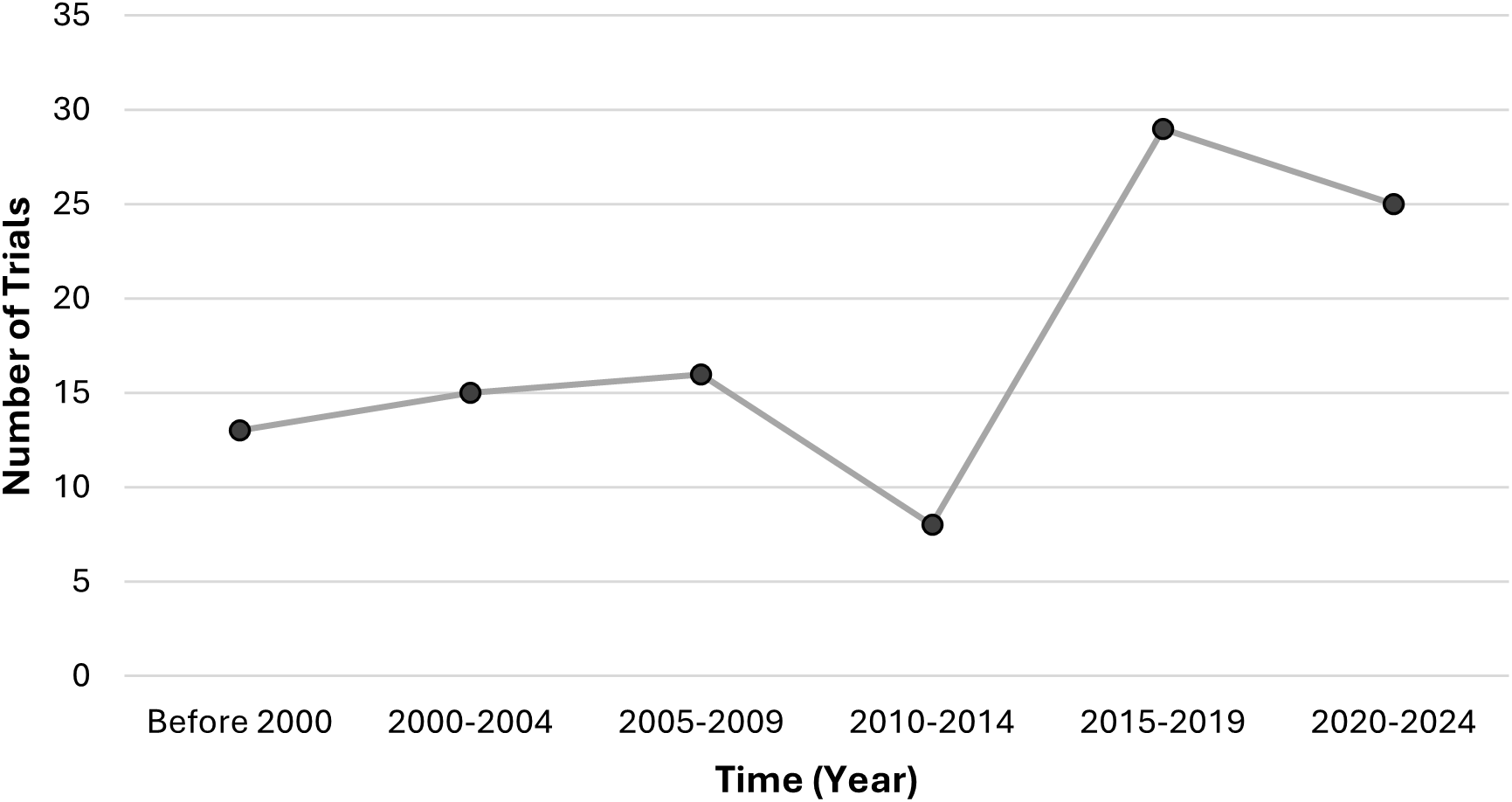
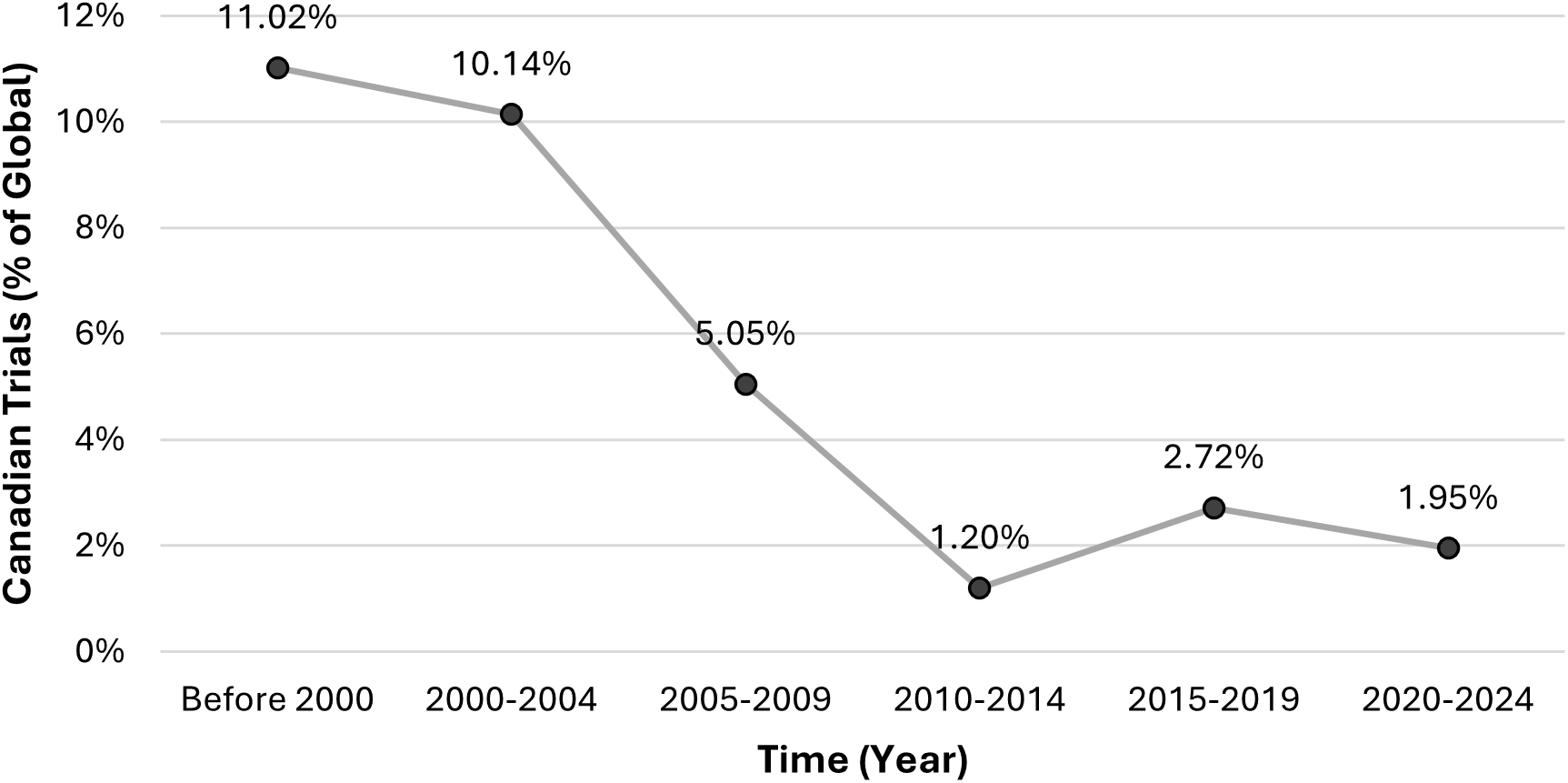
Motor-cognitive post-stroke rehabilitation RCTs account for 3,602 RCTs up to the end of 20247 conducted across 65 different countries, with 106 RCTs (2.9%) conducted in Canada (Table 1). Overall Canada was rated as 10th among countries in terms of number of RCTs. While the number of Canadian RCTs has increased over time (Figure 1), this growth has not kept pace with the overall global expansion of stroke rehabilitation trials, and Canada’s relative contribution to global stroke rehabilitation RCTs has slowed down over time (Figure 2). For example, Canadian RCTs accounted for approximately 11% of worldwide trials before 2000 and about 5% between 2005 and 2009. From 2010 onward, this proportion decreased to between 1.2% and 2.7% of international RCTs (Figure 2). For a full list of all included Canadian studies, see Supplemental File, Table B.
Randomized controlled trials in countries with ≥40 trials over time

Table 1. Long description
The table presents data on the number of motor-cognitive post-stroke rehabilitation randomized controlled trials (RCTs) conducted in various countries over different time periods. It includes 18 columns and 20 rows. The columns are labeled as follows: Country, Total trials, Before 2000, 2000-2004, 2005-2009, 2010-2014, 2015-2019, and 2020-2024. The rows list different countries and the number of trials conducted in each time period. Row 1: South Korea, 508, 0, 1, 12, 103, 218, 174. Row 2: Mainland China, 481, 1, 1, 13, 40, 124, 302. Row 3: United States, 451, 44, 48, 83, 91, 102, 83. Row 4: Italy, 192, 5, 4, 13, 55, 68, 47. Row 5: Taiwan, China, 180, 2, 4, 18, 47, 53, 56. Row 6: United Kingdom, 161, 21, 20, 21, 32, 44, 23. Row 7: Turkey, 145, 2, 2, 11, 20, 38, 72. Row 8: India, 135, 0, 0, 2, 28, 41, 64. Row 9: Germany, 119, 2, 14, 19, 29, 30, 25. Row 10: Canada, 106, 13, 15, 16, 8, 29, 25. Row 11: Japan, 103, 1, 1, 7, 26, 23, 45. Row 12: Australia, 93, 3, 5, 17, 21, 30, 17. Row 13: Brazil, 86, 0, 0, 0, 13, 39, 34. Row 14: Netherlands, 75, 6, 6, 13, 19, 22, 9. Row 15: Spain, 63, 0, 0, 3, 6, 20, 34. Row 16: Iran, 58, 0, 0, 4, 6, 14, 34. Row 17: France, 55, 4, 4, 3, 11, 12, 21. Row 18: Pakistan, 55, 0, 0, 0, 0, 10, 45. Row 19: Hong Kong, China, 52, 1, 3, 9, 8, 15, 16. Row 20: Sweden, 48, 5, 6, 11, 7, 10, 9. Row 21: Egypt, 48, 0, 0, 2, 9, 9, 28.
*Based on the World Bank 2023 income classification.
Number of published Canadian RCTs over time.

Proportion of Canadian RCTs relative to global RCTs over time.

Between 2020 and 2024, Canada ranked 14th worldwide in the number of published RCTs, with a total of 25 trials. During this period, Canada franked behind several high-income countries, including South Korea, the United States, Taiwan (China), Italy and Japan, and several low-to-middle-income countries (LMICs), including Egypt, Pakistan, Iran, Brazil, India, Turkey and Mainland China. The number of Canadian RCTs remained ahead of most European countries and Australia and was tied with Germany during the 2020–2024 period
Study characteristics
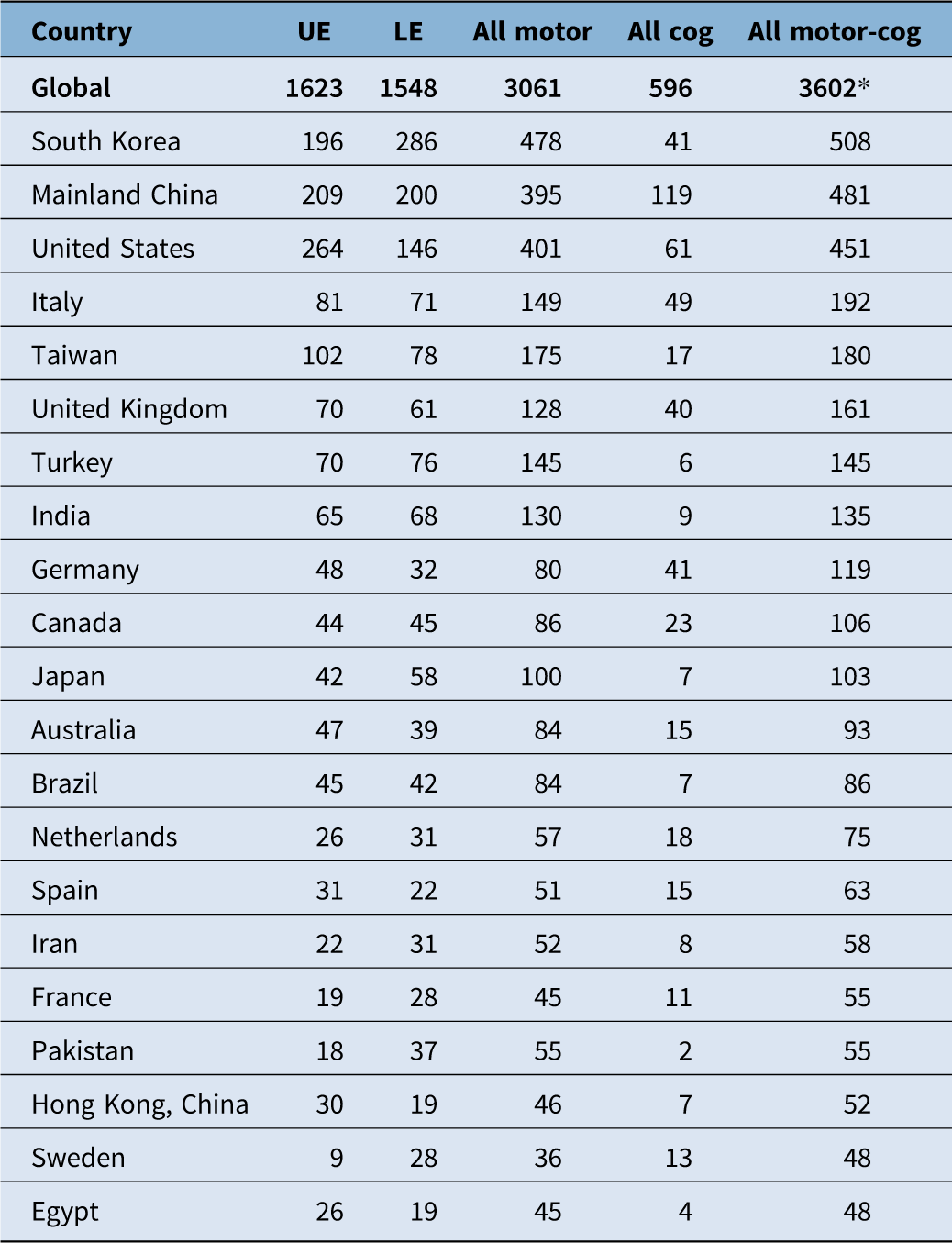
Of the 106 Canadian RCTs, 45 assessed post-stroke LE motor rehabilitation, 44 assessed post-stroke UE motor rehabilitation and 23 examined post-stroke cognitive rehabilitation (Table 2). There was an overlap across categories, with three RCTs assessing both LE and UE motor rehabilitation and three RCTs assessing both motor and cognitive rehabilitation. Within the cognitive rehabilitation RCTs, 15 focused on general cognitive impairment and 8 focused on aphasia rehabilitation. No Canadian RCTs on neglect rehabilitation were identified.
Randomized controlled trials (RCTs) by deficit type across countries

Table 2. Long description
The table presents data on randomized controlled trials (RCTs) by deficit type across various countries. It includes columns for Country, UE, LE, All motor, All cog, and All motor-cog. The table has 22 rows and 6 columns. Row 1: Global, 1623, 1548, 3061, 596, 3602. Row 2: South Korea, 196, 286, 478, 41, 508. Row 3: Mainland China, 209, 200, 395, 119, 481. Row 4: United States, 264, 146, 401, 61, 451. Row 5: Italy, 81, 71, 149, 49, 192. Row 6: Taiwan, China, 102, 78, 175, 17, 180. Row 7: United Kingdom, 70, 61, 128, 40, 161. Row 8: Turkey, 70, 76, 145, 6, 145. Row 9: India, 65, 68, 130, 9, 135. Row 10: Germany, 48, 32, 80, 41, 119. Row 11: Canada, 44, 45, 86, 23, 106. Row 12: Japan, 42, 58, 100, 7, 103. Row 13: Australia, 47, 39, 84, 15, 93. Row 14: Brazil, 45, 42, 84, 7, 86. Row 15: Netherlands, 26, 31, 57, 18, 75. Row 16: Spain, 31, 22, 51, 15, 63. Row 17: Iran, 22, 31, 52, 8, 58. Row 18: France, 19, 28, 45, 11, 55. Row 19: Pakistan, 18, 37, 55, 2, 55. Row 20: Hong Kong, China, 30, 19, 46, 7, 52. Row 21: Sweden, 9, 28, 36, 13, 48. Row 22: Egypt, 26, 19, 45, 4, 48.
* Overlapping RCTs between categories are accounted for in the final numbers.
Globally, Canadian RCTs represented 2.7% of all UE motor rehabilitation trials (44 of 1,623 RCTs), 2.9% of LE motor rehabilitation trials (45 of 1,548 RCTs) and 3.9% of cognitive rehabilitation trials (23 of 596 RCTs).
Time post-stroke
The majority of RCTs (67%) were conducted in the chronic (>6 months) phase post-stroke, and 30.2% were conducted in the acute and subacute phases post-stroke, 17.9% in the subacute phase (1–6 months) and 12.3% in the acute phase (<1 month). Of the included RCTs, three did not report time post-stroke (2.8%) (Table 3). Canadian RCTs were significantly more likely to be conducted in the chronic phase compared with non-Canadian trials (p = 0.001; 95% CI: [1.33–3.09]; OR = 2.03).
Study characteristics across Canadian and global RCTs

Table 3. Long description
A table comparing characteristics of Canadian and global randomized controlled trials (RCTs) post-stroke. The table has 12 rows and 7 columns. Column headers are Time post-stroke, Number (%), Sample size Mean, Sample size Median (IQR) for Canadian RCTs, Number (%), Sample size Mean, Sample size Median (IQR) for Global RCTs. Row labels are Chronic (> 6 months), Subacute (1–6 months), Acute (<1 month), Time not reported, Total, Methodological quality, Poor (PEDro 1–3), Fair (PEDro 4–5), Good (PEDro 6–8), Excellent (PEDro 9–10). Row 1: Chronic (> 6 months), 67 percent, 44.7, 28 (42.5), 50.6 percent, 39.4, 30 (22). Row 2: Subacute (1–6 months), 17.9 percent, 54.0, 41 (47), 27.0 percent, 51.8, 38 (33). Row 3: Acute (<1 month), 12.3 percent, 64.2, 60 (47), 18.3 percent, 81.1, 49.5 (52). Row 4: Time not reported, 2.8 percent, 45.0, 27 (36), 4.1 percent, 64.9, 40 (51). Row 5: Total, 106, 48.8, 32 (49), 3602, 51.4, 34 (30). Row 6: Methodological quality, Number (percent), Number (percent). Row 7: Poor (PEDro 1–3), 8.5 percent, 3.4 percent. Row 8: Fair (PEDro 4–5), 20.8 percent, 27.6 percent. Row 9: Good (PEDro 6–8), 68.9 percent, 65.1 percent. Row 10: Excellent (PEDro 9–10), 1.9 percent, 4.0 percent.
RCT = randomized controlled trial; PEDro = physiotherapy evidence database score.
Sample sizes and participant sex
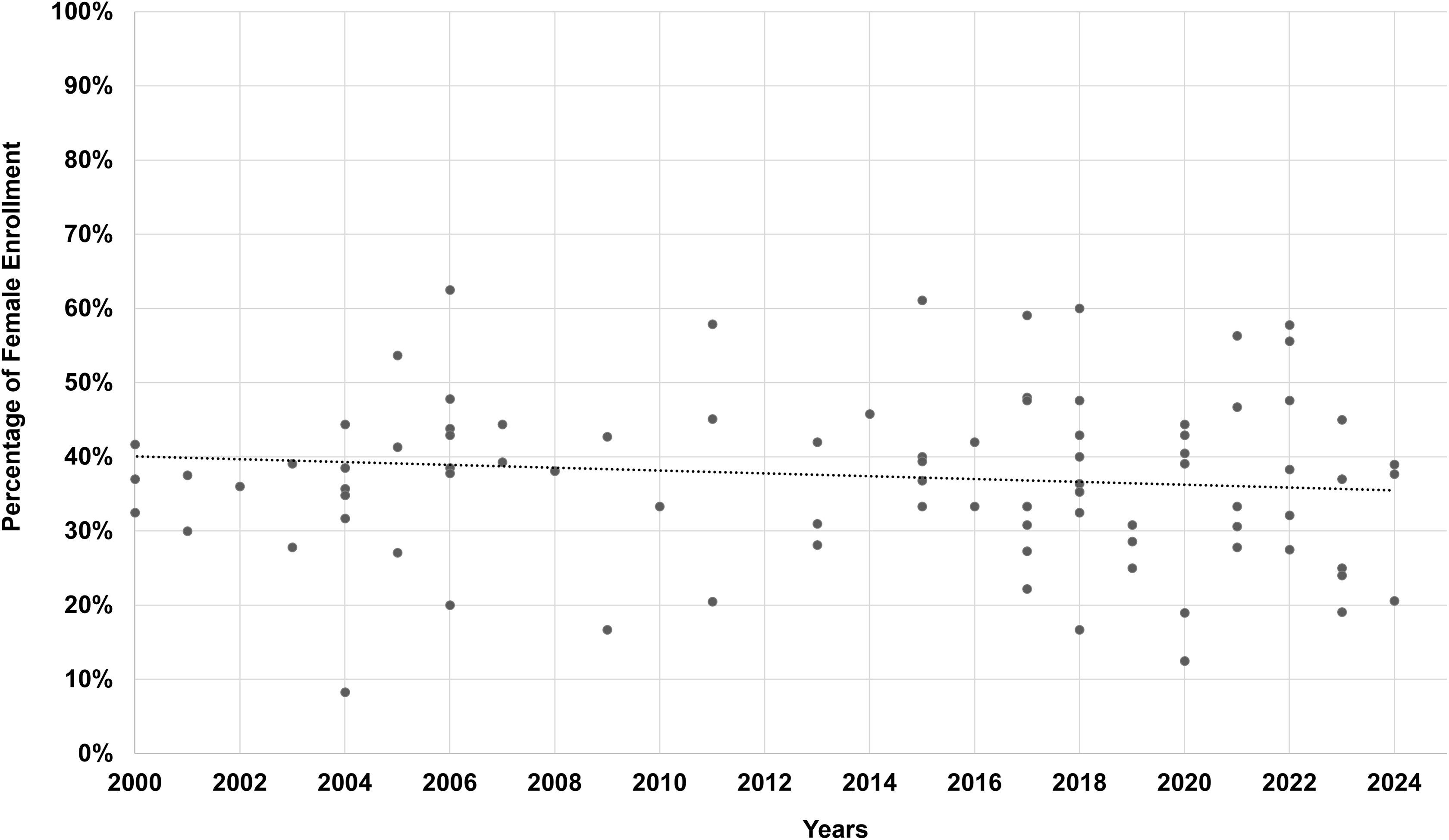
Overall, the sample sizes were comparable across the Canadian and global trials (p = 0.72) (Table 3). There were 10 RCTs with a sample size of more than 100 participantsReference Brouwer, Bryant and Garland10–Reference Wood-Dauphinee, Shapiro and Bass19 The average percentage of female participants across Canadian trials was 38.3%. Linear regression analysis showed a small, non-significant decrease in female participation over time (Figure 3), with an approximate decline of 0.2% per year (B = −0.2, p = 0.09). This finding was supported by Pearson’s correlation, indicating a negative association with time (r = −0.17, p = 0.09).
Percentage of female participants in Canadian RCTs over time.

The sample sizes were significantly smaller in RCTs conducted in the chronic phase post-stroke compared to those in the acute and subacute phases (p = 0.013). The difference in sample size of trials across post-stroke times seems to be a global trend as the similar finding was also identified in all other non-Canadian RCTs with significant smaller sample sizes in RCTs of chronic phase compared to the acute and subacute phases (p < 0.001).
Methodological quality
The methodological quality assessed by PEDro scores are presented in Table 3. The Pedro scores were comparable between Canadian and global trials (p = 0.94). The majority of Canadian RCTs (68.9%) had a good quality (PEDro 6–8), with fewer studies showing fair quality (PEDro 4–5) (20.8%) and poor quality (PEDro 1–3) (8.5%), with only two RCTs showing excellent quality (PEDro 9–10). The overall trend was similar to global RCTs.
Interventions
A total of 53 different intervention types were evaluated across all RCTs. The five most frequently studied interventions were exercise protocols (22 RCTs), aerobic exercise (12 RCTs), task-specific training (12 RCTs), feedback-based training (10 RCTs) and strength training (9 RCTs). Table 4 presents the interventions evaluated in at least four RCTs. Compared to the global trends, Canadian trials were more likely to evaluate exercise protocols, aerobic exercise, feedback-based training, strength training, EMG biofeedback and graded repetitive arm supplementary program (GRASP). Additionally, Canadian trials were more likely to include control groups that received no intervention.
Interventions evaluated across 106 Canadian and global RCTs

Table 4. Long description
A table comparing various interventions evaluated in Canadian and global randomized controlled trials. The table has 16 rows and 5 columns. The columns are labeled “Interventions’, “Canadian RCTs’, “Global RCTs’, “p-Value’, and “OR [95% CI]’. The rows list different interventions and their corresponding values across the columns. Notable interventions include exercise protocols, aerobic exercise, task-specific training, feedback training, strength training, virtual reality training, robot-assisted training, balance training, EMG biofeedback, graded repetitive arm supplementary program, repetitive transcranial magnetic stimulation, speech-language therapy, transcranial direct current stimulation, treadmill training, conventional therapy, sham/placebo, and waitlist, no treatment. Each row provides the number of Canadian RCTs, global RCTs, p-value, and odds ratio with 95% confidence interval for each intervention.
EMG = electromyography; RCT= randomized controlled trial.
Outcome measures
The most frequently used outcome measures among 106 RCTs are summarized in Table 5. Across all studies, the Fugl-Meyer Assessment (FMA), Berg Balance Scale (BBS), 6-Minute Walk Test (6MWT), Trail Making Tests (A & B) and Grip Force were the top five outcome measures.
Outcome measures used in at least five Canadian trials and their representation across global trials

Table 5. Long description
A table comparing outcome measures used in Canadian and global randomized controlled trials (RCTs). The table has 30 rows and 5 columns. Column headers are Outcome measures, Canada RCTs (106), Global RCTs (3602), p-Value, and Odds ratio [95% CI]. Row labels include various outcome measures such as Fugl-Meyer Assessment, Berg Balance Scale, 6-Minute Walk Test, Trail Making Tests, and Grip Force. Each row lists the number of trials using the measure in Canada and globally, along with p-values and odds ratios with 95% confidence intervals. Notable trends include higher usage of certain measures in global trials compared to Canadian trials.
EQ-5D = 5-Dimension EuroQol Group Standardised Measure of Quality of Life; RCT= randomized controlled trial; CI = confidence interval.
1 Seven cognitive rehabilitation trials and one LE motor rehabilitation trial used both Trail Making A and B tests, and one cognitive rehabilitation trial used only Trail Making B.
2 Physiological parameters include blood tests and all vital signs except heart rate which is recorded separately.
Comparing the outcome measure use in Canadian RCTs to worldwide trials, the Canadian RCTs were significantly more likely to assess the following outcome measure: 6-MWT, Grip Force, Stroke Impact Scale (SIS), Motor Activity Log (MAL), Isokinetic & Isometric Muscle Force, the Chedoke-McMaster Stroke Assessment Scale, Upper Extremity Kinematic Measures, Upper Extremity Performance Test for the Elderly, Activities-Specific Balance Confidence Scale, 5-Meter Walk Test, Max/Peak Volume of Oxygen (VO2) Max/Peak, Trail Making Tests, Short Form-36 (SF36), Western Aphasia Battery and Digit Span Forward Test (Table 5). The only outcome measure which was significantly less likely to be used in Canadian trials was the FMA.
Research team characteristics
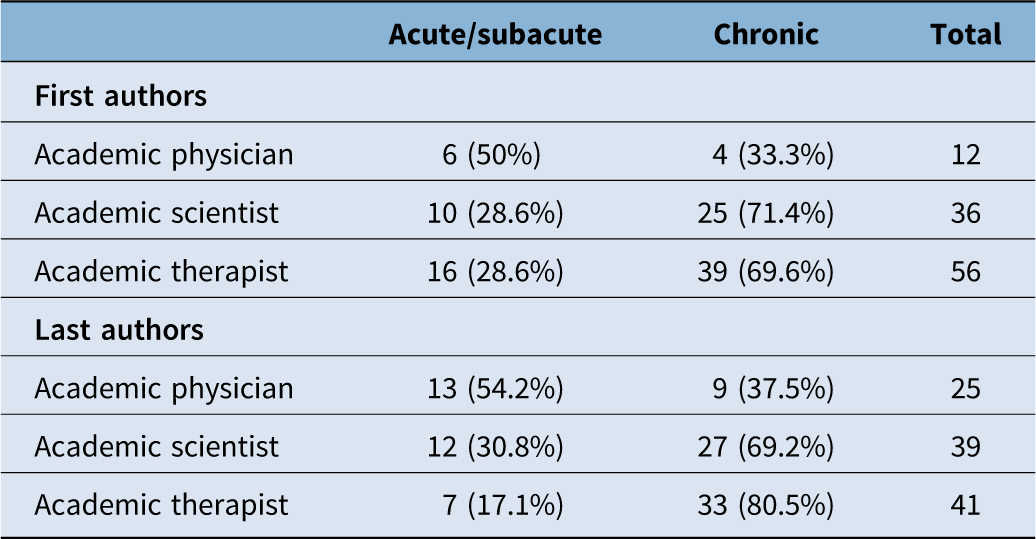
Of the 106 first authors, 56 authors were academic therapists. A total of 35 authors were academic scientists, and 12 were academic MDs, with two authors’ professions not identified. Among the senior authors, 41 authors were academic therapists with a MSc/PhD degree, 39 were academic scientists (MSc, PhD) and 24 were academic MDs, with two authors’ professions not identified (Table 6). Comparing the profession of first and last author across different time post-stroke, there was a significant association between the study time and the senior investigator (last author) profession. The senior author for trials conducted in the acute and subacute phases was more likely to be an academic physician (p = 0.003; OR = 4.7; 95% CI: [1.75–12.73]), while with chronic trials it was more likely to be an academic therapist (p = 0.031; OR = 3.10; 95% CI: [1.19–8.09]).
The profession of first and last authors across Canadian randomized controlled trials by time post-stroke

Table 6. Long description
The table presents data on the professions of first and last authors in Canadian randomized controlled trials, categorized by the time post-stroke (acute/subacute and chronic). It has three columns: Acute/subacute, Chronic, and Total. The rows are grouped into First authors and Last authors, with subcategories for Academic physician, Academic scientist, and Academic therapist. Each cell contains the number and percentage of authors in each category. For first authors, there are 12 academic physicians, 36 academic scientists, and 56 academic therapists. For last authors, there are 25 academic physicians, 39 academic scientists, and 41 academic therapists. Notable trends include a higher percentage of academic therapists among last authors in chronic trials and a higher percentage of academic physicians among last authors in acute/subacute trials.
Discussion
This study examined the contribution of Canadian RCTs to the global body of stroke rehabilitation research. Globally, a total of 3602 Stroke Rehabilitation Motor and Cognitive RCTs were identified, across 65 countries from 1982 to 2024, of which Canada contributed 106 trials (3%). Although the absolute number of Canadian RCTs increased over time, Canada’s relative share of global stroke rehabilitation RCTs decrease over time. This pattern likely reflects the substantial expansion of worldwide rehabilitation research over the past two decades rather than a decline in Canadian research productivity. Previous studies have also demonstrated increasing contributions from LMICs to the global stroke rehabilitation research in the last decade, as well as growing research output from particular countries such Mainland China which has one of the world’s largest populations and highest stroke burdens.Reference Teasell, Safaei-Qomi and Fleet4,Reference Teasell, Safaei-Qomi and Flores-Sandoval5 Factors such as population size, stroke burden, research funding or research capacity may provide important context for international comparisons and should be considered in future studies.
Sample sizes and PEDro scores were comparable between trials conducted in Canada and those conducted internationally, indicating that Canadian RCTs are broadly consistent with global trends in study design and methodological quality. The average percentage of female participants enrolled in Canadian trials is consistent with global trends, with an overall proportion of 39.4% female participants across all 3602 motor and cognitive RCTs.Reference Teasell, Safaei-Qomi, Flores-Sandoval, Mehrabi, Payne, Dukelow and Fleet7 Female underrepresentation in post-stroke motor rehabilitation trials may be due to factors such as older age, trial specific eligibility criteria and risk-taking behaviors.Reference Mehrabi, Harnett and Saikaley20–Reference Cameron, Mehrabi, Flores-Sandoval, Dzongowski, Eng, Fleet, Ryan, Payne, Safaei-Qomi, Tang and Teasell22 Compared to males, females tend to experience stroke at an older age and are more likely to live with disabilities as a result; in addition, older females living alone or in long-term care may also be potential factors affecting participation in trials.Reference Mehrabi, Harnett and Saikaley20 Trial eligibility criteria, specifically older age and presence of comorbidity, may also contribute to lower female enrollment.Reference Safaei-Qomi, Mehrabi and Fleet21 Risk-taking behaviors and unfamiliarity with new technology have also been reported as potential factors impacting female participation in stroke trials; for instance, technology-based interventions studied in motor rehabilitation trials had lower rates of female enrollment, compared to non-technological interventions such as exercise programs.Reference Cameron, Mehrabi, Flores-Sandoval, Dzongowski, Eng, Fleet, Ryan, Payne, Safaei-Qomi, Tang and Teasell22 These findings highlight the need to address barriers to trial enrollment among female individuals in Canada, as well as the need to investigate other potential factors that contribute to low female enrollment.
Canadian trials were more likely to be conducted in the chronic phase post-stroke compared to global trials. However, a consistent trend was observed across both Canadian and international studies, whereby trials conducted in the chronic phase had significantly smaller sample sizes compared to those conducted in the acute and subacute phases. This finding is important, as interventions evaluated in the chronic phase have been shown to underestimate the efficacy of treatments due to reduced neuroplasticity compared to earlier stages of recovery.Reference Mehrabi, Flores-Sandoval, Fleet, Dukelow, Bateman and Teasell23 One possible explanation is that conducting trials in the acute and subacute phases is more challenging due to factors such as patient medical issues, recruitment difficulties and the complexity of capturing treatment effects during periods of rapid neurobiological change. Institutional barriers to recruitment are likely a contributing factor in the acute and subacute phases.
Researcher background and practice setting may also contribute to this trend. In Canadian trials, a large proportion of first and senior authors were academic therapists (e.g., PT, OT, psychologists and RN), followed by academic scientists with MSc/PhD training. These investigators are often based in university or outpatient rehabilitation settings, which may limit direct access to patients during the acute and subacute inpatient phases. In contrast, a smaller proportion of trials were led by medical doctors, and these studies were more frequently conducted in the acute and subacute phases. Additionally, the larger population of chronic stroke survivors compared with newly diagnosed stroke cases may make chronic-phase recruitment faster and more feasible, facilitating trial completion.
Together, these findings suggest that differences in researcher background and access to clinical populations may influence the phase of stroke recovery studied. This may contribute to an overrepresentation of chronic-phase trials, where intervention effects may appear attenuated due to reduced potential for neuroplasticity and higher baseline scores.Reference Mehrabi, Flores-Sandoval, Fleet, Dukelow, Bateman and Teasell23
The proportion of Canadian RCTs targeting upper and lower motor rehabilitation were consistent with global proportion;Reference Cameron, Mehrabi, Flores-Sandoval, Dzongowski, Eng, Fleet, Ryan, Payne, Safaei-Qomi, Tang and Teasell22 however, a higher proportion of Canadian trials (21.5%) targeted cognitive rehabilitation post-stroke, including general cognition and aphasia rehabilitation, compared to the global trend (16.5%).Reference Teasell, Safaei-Qomi, Flores-Sandoval, Mehrabi, Payne, Dukelow and Fleet7 While post-stroke general cognitive and aphasia rehabilitation trials were well represented in Canada, no Canadian RCTs studied post-stroke USN rehabilitation, compared with 123 RCTs conducted globally,Reference Mehrabi, Safaei-Qomi and Flores-Sandoval6 which was somewhat unexpected. One possible explanation relates to the timing of neglect-focused research. Globally, neglect studies are more commonly conducted in the subacute phase rather than the chronic phase,Reference Mehrabi, Safaei-Qomi and Flores-Sandoval6 which may partially account for their absence in the Canadian literature, given the greater proportion of Canadian trials conducted in the chronic phase.
Interventions
Canadian trials were more likely to evaluate exercise-based and rehabilitation-oriented interventions, with the top five studied interventions as exercise programs, aerobic exercise, task-specific training, strength training and feedback-based approaches. These interventions are typically clinician-delivered and emphasize active, repetitive motor practice. Globally, alongside the exercise and task-specific programs, the most frequent interventions were robot-assisted training, virtual reality, repetitive transcranial magnetic stimulation (rTMS) and transcranial direct current stimulation, indicating greater global research interest in technology-driven and neurostimulation approaches.
This pattern may reflect differences in investigator background and research setting. As a substantial proportion of Canadian trials were led by academic therapists, intervention selection may align with their clinical expertise and focus on functionally oriented rehabilitation strategies. In addition, the greater proportion of chronic-phase studies in Canadian research may limit access to hospital-based infrastructure and advanced technologies, such as rTMS, robotic devices and exoskeletons.
Together, these findings suggest that Canadian stroke rehabilitation research may be more strongly oriented toward clinically implementable, therapist-driven interventions, while comparatively fewer studies evaluate emerging or technology-assisted approaches.
Outcome measures
Compared to global trends, Canadian trials demonstrated some differences in outcome measure selection. Previous studies showed that body function and structure outcome measures are the most common outcome measure across stroke motor rehabilitation trials worldwide, including FMA, Modified Ashworth Scale, Motricity Index, Medical Research Council Scale, range of motion and neurophysiological markers.Reference Mehrabi, Fleet and Safaei-Qomi24–Reference Teasell, Flores-Sandoval, Mehrabi, Fleet, Payne, Viana, Peters, Bowman and Safaei-Qomi26 While commonly used global measures such as the FMA were less frequently utilized, Canadian RCTs were more likely to employ outcome measures reflecting functional performance, real-world activity and participation, including the 6MWT, MAL, SIS and SF-36. In addition, Canadian studies more frequently incorporated objective and quantitative assessments such as kinematic analyses, muscle force measurements and VO2 max.
This pattern suggests a greater emphasis on activity-and participation-level outcomes, as well as objective performance metrics, rather than more impairment-based scales. This pattern is consistent with other characteristic of Canadian RCTs, including the chronic time post-stroke, the exercise and performance-based interventions, and the professional background of the most responsible researchers in Canadian RCTs, as therapist-led research may prioritize functionally meaningful outcomes aligned with clinical practice. This aligns with an International Classification of Functioning, Disability and Health (ICF)-based perspective, in which recovery is evaluated not only at the level of body structure and function but also in terms of activity and participation.
While this approach enhances the clinical relevance and patient-centeredness of outcome assessment, it may also have limitations. The lower use of widely adopted impairment-based measures, such as the FMA, may reduce comparability with the broader literature. A reduced focus on impairment-level outcomes may constrain insights into underlying neurobiological recovery mechanisms.
In addition, Canadian RCTs were more likely to employ domain-specific assessments, including the Trail Making Tests, Digit Span and Western Aphasia Battery. These measures target specific cognitive domains such as executive function, attention and language, rather than relying on broader screening tools, suggesting a more targeted approach to cognitive assessment that allows for a greater sensitivity to specific impairments.
Future directions
The findings of this study highlight both strengths and gaps in stroke motor and cognitive rehabilitation trials conducted in Canada. Future RCTs should consider increasing the representation of studies conducted in the acute and subacute phases post-stroke, or alternatively, incorporating stratified analyses based on time post-stroke to better capture phase-specific treatment effects. In addition, expanding research in Canadian centers toward technology-assisted interventions, such as robotics, non-invasive brain stimulation and virtual reality, may facilitate more efficient clinical uptake and translation of these approaches into Canadian clinical rehabilitation practice alongside existing therapy-based approaches.
There is also a need for increased focus on cognitive rehabilitation, particularly in underrepresented domains such as USN. Expanding research in these areas would help address important gaps in the current literature.
While the use of outcome measures reflecting functional performance, real-world activity and participation aligns well with an ICF-based framework, future studies may benefit from incorporating widely used standardized outcome measures alongside these approaches. This would improve comparability across studies and enhance the generalizability of findings within the broader stroke rehabilitation literature.
Overall, findings from the present secondary descriptive/bibliometric analysis highlight the need to address the overrepresentation of chronic-phase trials by conducting more studies in the acute and subacute phases, where intervention effects may not be affected by reduced potential for neuroplasticity. There is also a need to conduct trials with larger sampler sizes and higher enrollment rate of female participants. In terms of outcome assessment, adopting more impairment-based measures has the potential to ensure comparability with the broader post-stroke rehabilitation literature.
Limitations
One limitation of this secondary descriptive/bibliometric analysis is that the parent systematic reviews only considered adult populations (≥18 years) and to trials published in English. As a result, potentially relevant studies involving different age cut-offs for adult versus pediatric populations, as well as studies published in languages other than English, may have been missed. If the authors’ professions and academic degrees were not primarily identified from credentials and affiliations reported in the original publication, the current publicly available professional and academic sources were searched if available. As professional roles and qualifications may evolve over time, small degree of misclassification is possible, particularly for older publications. We acknowledge the limitations in the use of the PEDro scale as the only measure of methodological quality. Additional limitations include potential publication bias, exclusion of grey literature and dependence on the parent reviews specific eligibility criteria. Finally, implementation impact for each trial were not addressed in the present paper.
Conclusion
Canadian RCTs have made important contributions to stroke rehabilitation research. The publication of Canadian RCTs has slightly slowed down, relative to global research, which has expanded and shifted toward more technology-driven interventions. The emphasis on exercise-based and rehabilitation-oriented interventions, as well as activity and participation outcomes, can be seen as a strength making the research more clinically applicable. However, the predominance of research in the chronic phase does not align with the timing of most formal stroke rehabilitation care delivery in Canada, which primarily occurs during the acute and subacute phases post-stroke. This limits generalizability of the data, particularly given the concern about RCTs conducted in the chronic phase often under-evaluating the impact of the studied intervention. Expanding research into earlier recovery phases, integrating technology-driven interventions, and incorporating outcome measures across all three ICF domains will be important to strengthening Canada’s impact and advancing stroke rehabilitation evidence.
Supplementary material
The supplementary material for this article can be found at https://doi.org/10.1017/cjn.2026.10678.
Acknowledgements
We acknowledge the Contribution of Dr Cecilia Flores-Sandoval to this manuscript. For this research, funding was provided by the Heart and Stroke Foundation of Canada, the St Joseph’s Health Care (London) Foundation, the Academic Medical Organization of Southwestern Ontario (AMOSO) (Innovation Fund Project #INN25-014) and the CanStroke Recovery Trials Platform. The CanStroke Platform acknowledges financial support of the Canada Brain Research Fund (CBRF), an innovative arrangement between the Government of Canada (through Health Canada) and Brain Canada Foundation, the Governors of the University of Calgary, Heart & Stroke Foundation Canadian Partnership for Stroke Recovery and Sunnybrook Research Institute. An abstract of the present research had been previously presented at the 2026 “Canadian Association of Physical Medicine and Rehabilitation” conference jointed with the 20th World Congress of the ISPRM, Vancouver, BC, Canada.
Author contributions
RT conceptualized and led the project, provide resources, supervised data analysis and extraction and contributed to editing and writing. SM supervised data extraction and management, ensured methodology and scientific quality, analyzed and interpreted the data and contributed to conceptualization and manuscript writing. MRSQ extracted and managed the data and contributed to manuscript editing and writing. BL, JC, BG, AH and MC contributed to data extraction. SPD contributed to manuscript editing and writing.
Funding statement
In the past 36 months, Dr. Teasell received support/grants from Heart and Stroke Foundation of Canada, St. Joseph’s Health Care (London Foundation), Academic Medical Organization of Southwestern Ontario (AMOSO) Innovation Fund, CanStroke Recovery Trials Platform, Canadian Institute Health Research, PRAXIS, and Ontario Ministry of Health and Long Term Care.
Competing interests
Dr. Dukelow has received honoraria from Abbvie, Ipsen and Merz in the last 2 years. The remaining authors have no conflict of interest to disclose.






 Open access

