By winning the presidency and strengthening its majority in both chambers of Congress, the 2008 election gave control of the government to the Democratic Party. However, as the 2010 election season unfolded, the news for the Democratic Party could not have been much worse. Economic conditions had not improved dramatically. A bitter and lengthy fight over health care reform signaled to citizens that little had changed in how Washington, DC, governed. The stimulus package and its impact on the federal debt caused unease in a segment of the electorate that was concerned with the size of government. In this context, observers of American politics began to take note of the number of citizens affiliating with, or at least expressing favorability toward, a loose coalition of groups known as the Tea Party movement. Tea Party rallies began to occur throughout the United States, seeking to draw attention to the movement's primary issues.
Social movements have always had a complex relationship with political parties in the United States, and the Tea Party movement is no exception. The two major parties in the United States normally serve as the means for aggregating citizens' preferences. However, when dissatisfaction with the political process or government policies increases, social movements become the vehicle to convey that dissatisfaction to the parties or the government itself (Lipset Reference Lipset1972). Depending on the intensity of the dissatisfaction or the prominence of the issues touted by the movement, movements and parties pursue coordinated, invasive, or even hostile strategies to manage their relationships with each other (Schwartz Reference Schwartz2010).
The final word has yet to be written on the various ways in which the Republican Party and the Tea Party Movement interacted during the 2010 electoral cycle. At times, the interactions involved outright hostility between the two, while in other contexts, coordination strategies predominated. To some degree, the variety of relationships reflected the wide range of issues pursued by the Tea Party movement. Many of the claims that social movements in the United States have made have involved postmaterial issues (Berry and Schildkraut Reference Berry, Schildkraut, Costain and McFarland1998). Building on Inglehart's (Reference Inglehart1977) framework, postmaterial issues involve concerns about the quality of life and future of a nation rather than the discrete economic interests of a group's individuals. This framework may help to explain the various types of relationships that exist between the Republican Party and the Tea Party movement. Concerns about the federal deficit, earmarks, taxes, the growth of the federal government, and transparency in Congress have all found their way into Tea Party manifestos. Leaders of the Republican Party could easily embrace some of these issues while remaining wary of others.
Tension between the party and the movement also emanates from the different ends pursued by the two organizations. Parties seek to maximize votes (Downs Reference Downs1957; Schlesinger Reference Schlesinger1985), while movements express ideas and seek specific actions from the government (Meyer and Tarrow Reference Meyer, Tarrow, Meyer and Tarrow1998). If the party seems more concerned about electoral victory than its core ideas, then conflict arises (Schwartz Reference Schwartz2010).
The inevitable tension that arises between political parties and social movements raises the question of effectiveness. On the one hand, social movements can provide resources, energy, and enthusiasm for a political party in its pursuit of votes. On the other hand, social movements can portray negative images of a party, alienate its members, and drain resources from its activities. This article examines the impact of the Tea Party movement on the 2010 midterm cycle. We begin with an analysis of Tea Party endorsements and then examine the relationship between the Republican Party and supporters of the Tea Party movement in two key Senate races.
The Impact of the Tea Party
Given the extensive media attention that Tea Party rallies and other aspects of the movement have received, a key question is: How have Tea Party efforts translated into votes? Specifically, in the 2010 midterm elections, did a Tea Party endorsement lead to an increase in vote share for Republican candidates?Footnote 1 One of the challenges of studying this movement is that by philosophy and design, it lacks a central leadership structure that coordinates nationwide efforts. Instead, the Tea Party is a far-flung patchwork of organizations, some local and some national, with a related set of issue concerns and positions. Some of these organizations—the Tea Party Patriots, the Campaign for Liberty, or Glenn Beck's 9/12 Project, for example—choose not to endorse candidates. Other Tea Party–affiliated groups do offer official or public endorsements, although their efforts do not appear to be coordinated, and, as will become evident, patterns of endorsement vary widely across the different groups.
We identified several organizations or political leaders that either explicitly adopt the Tea Party label or are often identified by news organizations as affiliates of the movement. Groups that endorsed numerous candidates in numerous states and thus seemed to acquire a national presence included the Tea Party Express, the Independence Caucus, the Boston Tea Party, and Dick Armey's FreedomWorks. Based on information from Tea Party organizations themselves and local and national press accounts, we compiled a dataset of variables charting whether each of these organizations endorsed the Republican candidate in every congressional district in the country.Footnote 2 Because of her high profile within the movement and the fact that her candidate endorsements were heavily publicized, we also included a measure of whether Sarah Palin endorsed the Republican candidate. In addition to these national organizations and individuals, we searched the major newspapers within every state for any evidence of endorsement of congressional candidates by local Tea Party groups.
Table 1 presents the effects of Tea Party endorsements on the Republican vote share in House races.Footnote 3 The unit of analysis is the congressional district, and the models include controls for the partisan affiliation of the incumbent, whether the incumbent was a freshman, the quality of the challenger, Obama's vote share in the district in 2008, the Democratic candidate's vote share in the district in 2008, and the log of the median income for the district.Footnote 4 These models account for a great deal of the variation in Republican vote share (R 2 = .88), and the controls function much as we expected. For example, Republican candidates generally did less well in districts where Obama's vote share was high in 2008. And even in a year of unusual turnover in the House, incumbents enjoyed an advantage—incumbency increased the vote share for Democratic candidates by approximately 5.5 points and the vote share for Republican candidates by about seven points.
Determinants of Republican General Election Vote Share

Note. N = 378. Unit of analysis is the congressional district. Robust standard errors in parentheses.
** p < .01,
* p < .05.
The models show that Tea Party endorsements generally had little statistically discernible effect on Republican vote share in the general election. In the model that includes a measure of whether any Tea Party group, local or national, endorsed the Republican candidate, the regression coefficient is small (.30) and does not approach statistical significance (t = 0.51, p = .61). In two cases—endorsements by the Boston Tea Party and the Independence Caucus—the point estimate is actually negative, although again, in neither case can the coefficient be statistically distinguished from zero. Of the Tea Party groups that backed candidates in the general election, only FreedomWorks endorsements were associated with a statistically significant increase in votes for the Republican candidates. The Republican candidate's vote share increased by a little more than two percentage points when a FreedomWorks endorsement was involved.
Given the generally meager findings for Tea Party endorsements, the critical question is: What explains the apparent success of FreedomWorks? Part of the answer could be that FreedomWorks did not only proclaim support for its favored candidates but also donated money—nearly $350,000, according to the Washington Post.Footnote 5 However, the total amount of money donated to any single House candidate tended to be small, typically less than $10,000 and often less than $1,000.Footnote 6 It is unlikely that money is the sole reason for FreedomWorks' relative success compared to other Tea Party groups.
Figure 1 provides additional insight by showing the pattern of endorsements made by each Tea Party group, with black dots indicating endorsed candidates and gray dots showing all other candidates in the election. For each Tea Party organization, we plotted Obama's 2008 vote share in the district against the 2010 Democratic vote share in the district. The figures show that patterns of endorsement varied widely across Tea Party groups—some, like the Boston Tea Party, made only a few endorsements, while others were much more active. More important, it appears that FreedomWorks was more strategic in its choice of candidates than some other Tea Party–affiliated groups. For example, local Tea Party organizations, the Independence Caucus, and Sarah Palin endorsed candidates in a wide variety of different districts, including those that were likely to be safe Democratic seats based on Obama's performance in 2008. Nearly one-quarter of Sarah Palin's endorsements went to candidates in districts where Obama had garnered more than 60% of the vote in 2008, including multiple endorsements for candidates in districts where Obama scored more than 70% of the vote. Palin's endorsements did not, in other words, appear to be closely tied to the candidate's prospects for victory, given the nature of the district.Footnote 7
2008 Obama Vote Share by 2010 Democratic Vote Share with Tea Party Endorsements

FreedomWorks, on the other hand, rarely made endorsements in safe Democratic districts, with the prominent exception of its (perhaps symbolic) support of John Dennis against Nancy Pelosi in California's Eighth District, where Obama received 85% of the vote in 2008. Even including this outlier, only 10% of FreedomWorks' endorsements went to candidates in districts where Obama had received more than 60% of the vote. Compared to other Tea Party–affiliated groups, FreedomWorks endorsements appeared to target districts that were more closely divided between Democrats and Republicans. While other endorsers embraced a more scattershot approach, FreedomWorks went hunting “where the ducks were.” And in those swing districts, the hunting turned out to be good: a FreedomWorks endorsement was correlated with better performance from the Republican candidate.Footnote 8
FreedomWorks aside, our evidence suggests that Tea Party endorsements are typically not associated with increased vote share for Republican candidates in the general election. However, this finding should not be taken as conclusive proof that Tea Party activity did not matter in 2010. Tea Party organizations were also active during the primary election, and their work in primaries helped shape the nature of the subsequent political competition and the political discourse throughout the election cycle. In addition to our general election dataset, we also collected data on endorsements from select Tea Party organizations during the Republican primaries, as well as a measure of whether candidates affiliated themselves with Tea Party goals by signing the “Contract from America.”Footnote 9
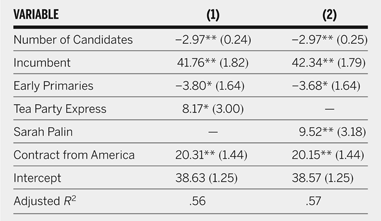
Table 2 presents the determinants of vote share in Republican primaries. The unit of analysis is the candidate, and the models include controls for the number of candidates running, incumbent status, and whether the state held its primaries early in the process.Footnote 10 To these controls, we added indicators of receiving a Tea Party endorsement from either the Tea Party Express or Sarah Palin and an indicator of candidate self-endorsement of Tea Party principles (individuals who signed the Contract from America). The models show that incumbent status is strongly related to better primary performance, increasing candidate vote share by more than 40 percentage points. However, affiliation with the Tea Party also mattered in other important ways. Candidates endorsed by the Tea Party Express and Sarah Palin garnered approximately 8 to 9 percentage points more than candidates who did not receive an endorsement. Candidates who adopted the Tea Party label themselves by signing the Contract from America did even better, with their vote shares increasing by more than 20 points.Footnote 11 In the 2010 Republican primaries, either bearing a Tea Party stamp of approval or showing a willingness to affiliate with Tea Party principles clearly improved a candidate's electoral prospects.
Determinants of Candidate Vote Share in Republican Primaries

Note. N = 897. Unit of analysis is primary candidates. Only Republican primaries or primaries in which Republican candidates were on the ballot are included. Standard errors in parentheses.
** p < .01;
* p < .05.
The Individual-Level Case for Influence
Given the substantial effect that support from Tea Party groups had in Republican primary contests, we turn now to a brief examination of some available individual-level data involving Tea Party candidates. We used data from two 2010 U.S. Senate primary contests in Utah and Colorado that were notable because both Republican contests included credible Tea Party–endorsed candidates. In Utah, one of several Tea Party candidates, Mike Lee, eventually won the general election. In the more competitive partisan environment of Colorado, the Tea Party candidate, Ken Buck, won a come-from-behind race in the primary but narrowly lost the general election.
In Utah, incumbent Senator Robert F. Bennett sought a fourth term against a stiff challenge from several candidates who were partly motivated by anger over Bennett's perceived softening conservatism. Legislation such as the Troubled Asset Relief Program (TARP), which passed during the waning days of the Bush presidency, the economic stimulus package, and Obama's health care reform fueled voters' discontent with Bennett. Two notable challengers emerged, both of whom expressed sympathy for Tea Party principles: Mike Lee, a lawyer and former Supreme Court clerk for Justice Samuel Alito; and Tim Bridgewater, a businessman who had twice previously run and lost for the U.S. House.
Our data were drawn from pre- and postconvention panel surveys of 1,331 Republican state convention delegates who were invited by e-mail or regular postal mail to complete an Internet survey. Utah uses a combination of party precinct caucuses, state conventions, and party primaries to nominate candidates. In March, voters meet in neighborhood or precinct caucus meetings to select about 3,500 delegates to the Republican state convention, which is held a few weeks later. At the May convention, candidates who receive more than 60% of delegate support on a final ballot receive the nomination outright. Otherwise, the two finalists face off in a primary. In 2010, Senator Bennett made it through the first round of convention voting in third place and then was eliminated in the next round, with only 27% of the delegate vote. The Utah State Republican Party provided us access to a delegate list, and all delegates were invited to participate in a preconvention and postconvention survey.Footnote 12
The Utah Republican convention delegates were strongly aligned with the Tea Party. When asked if they had a “favorable or unfavorable impression of the Tea Party movement,” 86% of the delegates reported a favorable impression, with 47% being “strongly favorable.” Nearly half of the delegates (43%) considered themselves to be “active supporters” of the Tea Party movement. Tea Party favorability and active support were both strongly related to vote choice. Examining the second round vote that led to his elimination, Senator Bennett only managed to win majority support from the small proportion of delegates who viewed the Tea Party movement unfavorably. Of the 43% who considered themselves “active supporters,” Lee and Bridgewater managed to capture 92% of the vote.Footnote 13
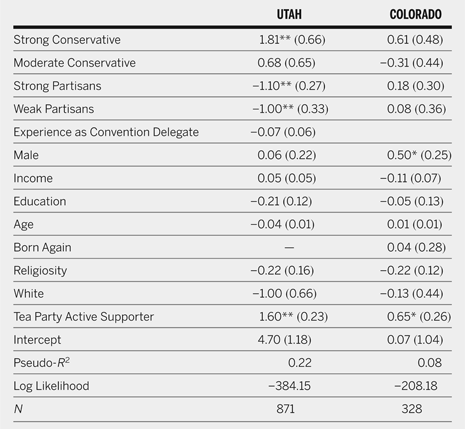
The influence of active Tea Party support in the Utah contest remains strong even when a host of standard controls are included. Model 1, outlined in table 3, presents the results of a logit model regressing active Tea Party support on the convention senate vote (1 = Lee/Bridgewater, 0 = Bennett), with controls for conservative ideology, Republican party strength, the number of previous conventions attended, gender, income, education, age, religiosity, and race. Tea Party support clearly predicts support for Bennett's opponents.Footnote 14 This strength holds even in the presence of significant effects for age, strongly conservative ideology, and Republican partisan strength. The size of the effect is robust to a variety of alternative specifications of Tea Party sympathy available in the survey. Not surprisingly, strong conservatives (compared to a baseline of “middle of the road”) were more likely to support Bennett's challengers. When estimates of predicted probabilities of supporting the challengers were produced, being a Tea Party supporter increased the likelihood of supporting the challengers by 23 percentage points. The only variable that was more strongly predictive of challenger support was being a strong conservative (30 percentage points).
Determinants of Voting for U.S. Senate Tea Party Candidates in Utah Republican Convention and Colorado Republican Primary

Note. Standard errors are in parentheses.
** p < .01;
* p < .05.
An intriguing detail of the model is the appearance of negative and statistically significant coefficients for strong Republicans and “not so strong” Republicans compared to the baseline of independent-leaning Republicans. This result suggests that the strongest support for the upstart challengers would have come from an independent-leaning Republican who was strongly conservative and an active supporter of the Tea Party movement. In fact, nearly half of the independent leaners (49%) identified as active Tea Party supporters, while only 26% of “not so strong” Republicans and 43% of strong Republicans were active Tea Party supporters. This uneven correlation with partisan strength illustrates the potential tension that the Republican Party faces, particularly among party activists, in assimilating the Tea Party movement.
The 2010 Colorado Republican U.S. Senate primary contest provides a second look at individual-level support among Tea Party supporters. This race featured Jane Norton, a former lieutenant governor, versus Ken Buck, a former prosecutor in the Colorado U.S. Attorney's office and the Weld County district attorney. Buck and Norton adopted similar issue positions across the board, but Norton drew the ire of Tea Party groups for supporting Colorado Referendums C and D in 2005. Her support of these referenda was characterized as fiscally irresponsible support for tax increases.
The Colorado data were collected online from a probability sample drawn from the Colorado voter registration file. Respondents were randomly selected from the voter file and sent an invitation letter by first-class U.S. mail that contained a link and an access code for the online poll.Footnote 15 A total of 1,217 likely voters responded to the survey, with roughly half voting in the Colorado Republican and Democratic primary elections. Our analysis is limited to the subset of likely Republican primary voters.
Colorado Republican primary voters were also strongly aligned with the Tea Party movement, with 83% reporting a favorable impression (52% “strongly favorable”). Forty percent considered themselves to be “active supporters.” Again, Tea Party favorability and active support are both strongly related to vote choice. Norton actually won majority support from the small proportion of primary voters who viewed the Tea Party movement unfavorably, along with a narrow majority among voters who viewed the movement somewhat favorably. Buck received a 59% rate of support from those voters who were strongly favorable of the Tea Party. Likewise, of the 40% who considered themselves “active supporters,” Buck received 64% support.
The strength of active Tea Party support in the Colorado primary also holds up to a host of standard controls. Model 2 in table 3 presents the results of a logit model regressing active Tea Party support on the Republican primary vote (1 = Buck, 0 = Norton), with controls for conservative ideology, Republican party strength, gender, income, education, age, religiosity, born-again status, and race. Tea Party support clearly predicts support for Buck among the many control variables, and the size of the effect is again robust to a variety of alternative specifications of Tea Party sympathy available in the survey. Unlike the Utah survey, ideology and party identification strength do not aid the prediction.Footnote 16 Instead, gender and church attendance appear to be related, with men being more supportive of Buck and church attendees being more supportive of Norton. Tea Party support is the strongest predictor of support for Buck, increasing the likelihood of support by 16 percentage points. With candidates and voters who are not as ideologically distinctive as the Utah contest, the Tea Party effect in Colorado is smaller, but still quite strong.
Conclusion
Assessing the impact of the Tea Party movement presents challenges because of its multiple layers and identities. Overall, the endorsement strategies of the movement in general elections did not produce dramatic results. However, strategies targeted to those conditions most favorable to the movement did occasionally have an impact, as demonstrated by the case of FreedomWorks. Endorsements had a larger impact in the primaries, though not as large as the effect of candidates signaling agreement with Tea Party positions by signing the Contract from America. The cases of Utah and Colorado show how activists were able to change the dynamics of those races by selecting the candidates they strongly preferred. Similar dynamics played out in House and Senate races across the country. These examples demonstrate the need for time to sort out the relationship between the movement and the Republican Party. While Republicans benefited from Tea Party support, the Tea Party supporters, who were much more likely to choose Tea Party candidates, were not always the strongest partisans. This outcome suggests that invasive, coordinated, or hostile strategies (Schwartz Reference Schwartz2010) for managing the relationships between the movement and the Republican Party are all still possibilities. Therefore, the day of reckoning between a movement and a party, which always seems to occur in American politics, still looms somewhere in the not-so-distant future.