

The state of gender politics in political science is not nearly as “far from ideal” as it once was (Judith Shklar, quoted in Hoffman Reference Hoffman1989, 833) but neither is it gender-neutral. The “inhospitable institutional climate” cited in the 2005 American Political Science Association (APSA) Report on the Status of Women in Political Science persists in multiple subtle (and sometimes not-so-subtle) ways, as well as in certain spaces (i.e., departments, conferences, and subfields) far more than in others.
One of the most obvious areas of gender disproportionality is in the methodology subfield. When areas of the field lag behind in gender integration, it is cause for concern. This is particularly acute for political methodology, however, because it is both a gender-integration laggard and the area of the field that develops the “rules of the game” for good political science. As such, political methodology is not simply a standalone subfield in the discipline; it also informs the work done in most other subfields. The lack of diversity in political methodology, therefore, raises the uncomfortable possibility that some of our “rules of the game” may embed biases based on the relative privilege of those making them.
Given the disproportionate focus on and status of highly complex statistical methodology within political science as a whole, the fact that such methodology is far more likely to be the province of men than women is concerning, from both a methodological standpoint and a gendered perspective. As practitioners and critical observers of this discipline, and as methodology instructors ourselves, we are concerned about the increasing status of complex statistical methodology (and the perception that it is somehow “better” than qualitative or far simpler quantitative work) as well as persisting gender disparities in the field—and we see these trends as linked. To be clear, our aim is not to rehash the qualitative-versus-quantitative debate but rather to add a new angle: this cleavage in research methods is not gender-neutral.
Anecdotes like Tamara’s abound but systematic data on these questions can be difficult to find or collect. Therefore, this article presents a theory based on initial data rather than well-tested hypotheses, but these are ideas worthy of discussion and further testing. What systematic data we have found—coupled with useful previous literature and our own experiences—allow us to posit a complex and interactive set of gender-related forces operating within political science and particularly affecting graduate students.
Specifically, we suggest that there are two contextual themes and four overlapping processes that operate individually and jointly to reinforce—and reproduce—the overrepresentation of men in subfields that emphasize complex quantitative methodology (including formal theory). The two contextual factors are the discipline’s long history of male domination and the more recent hegemony of quantitative methodology within political methodology and political science overall. Within this context, we find evidence suggesting four interconnected but distinct processes that continue to advantage men within the discipline overall but particularly in areas privileging complex quantitative methodology: (1) initial departmental admission-selection biases by gender; (2) subfield-selection biases by gender; (3) gendered attrition in response to experiences in the field; and (4) gender bias in disappointment when methodology dominates substantive content.
This article examines and explains each element (contextual and procedural) in turn, using the evidence we can find. Overall, we call this a theory of gendered selection and survival biases. Initial selection biases favoring graduate-student applicants with highly quantitative backgrounds are more likely to result in men than in women in graduate cohorts. This is especially true in the study of political methodology because of the gender breakdown in college studies in math, hard science, and statistics. Furthermore, methodological practices that confuse the ends (substance) with the means (methods), we suggest, are more of a turnoff within the field for women as a group than for men as a group—although they also turn off many men who care deeply about the political substance of political science.
Within this context, we find evidence suggesting four interconnected but distinct processes that continue to advantage men within the discipline overall but particularly in areas privileging complex quantitative methodology: (1) initial departmental admission-selection biases by gender; (2) subfield-selection biases by gender; (3) gendered attrition in response to experiences in the field; and (4) gender bias in disappointment when methodology dominates substantive content.
The result is a concentration of women in some subfields (especially comparative politics) and the dominance of political methodology by men, which has adverse effects on the discipline. A more inclusive science, which embraces multiple methods as well as types of people, will be stronger for the wider set of perspectives and questions brought to bear on major political problems. Using multiple methods within a single project also makes it stronger by allowing for triangulation of results arrived at through different pathways, giving greater confidence in a study’s findings. Diversity of thought, perspectives, concerns, questions, and approaches makes for better as well as more-inclusive science.
In the conclusion, we provide suggestions for best practices that departments can engage in (based on both real-world examples and theory) to move toward this better, more inclusive science. Many departments and professors work extremely hard to combat the gender imbalances we describe, often with success, and we want to disseminate their examples while urging others to do the same.
CAN GIRLS DO MATH? (IF SO, WHY AVOID IT?)
When then-Harvard President Lawrence Summers suggested in 2005 that “innate” abilities might have something to do with the lack of women in STEM (science, technology, engineering, mathematics) fields, he was rightly hounded for relying on old assumptions and outdated research (Hemel Reference Hemel2005). Summers’s mistake was a classic one in the nineteenth and for much of the twentieth centuries: that is, extrapolating to the biological from the social. Footnote 1 A plethora of studies from the past four decades found that women and girls can do math and science as well as men and boys—the difference is that they do not choose as often to do so. Women and girls continue to be underrepresented in these classes and professions when they have choice in the matter. However, when everyone is forced to take math and science, as in high school, women and girls generally do as well as their male counterparts (Downey and Yuan Reference Downey and Yuan2005; Hyde and Linn Reference Hyde and Linn2006; Hyde et al. 2008; Niederle and Vesterlund Reference Niederle and Vesterlund2010). Footnote 2
The choice not to focus on (or to leave) STEM as a career for girls and women is not because of innate differences in ability but rather because of the same “push–pull” factors that continue to keep women “opting out” of business and political-leadership positions (Hewlett and Luce Reference Hewlett and Luce2005; see also Shames Reference Shames2017; Valian Reference Valian2004; and Williams Reference Williams2000). The “push” is leaving a field of study or work because one feels forced out or unwelcome; the “pull” is about choosing to leave to do something else that is more appealing or to do the same thing in a place that feels more welcoming (Sinclair-Chapman Reference Sinclair-Chapman2015). In other sciences and in business-leadership research, studies abound on the push–pull factors that lead women (especially women of color) to opt out of male-dominated professions.
Push factors in political science include the effects from subtle and not-so-subtle discrimination; sexual harassment; bullying and backlash (Sarkees and McGlen Reference Sarkees and McGlen1999); and even simply not being comfortable in a workshop, class, cohort, or department. In doing research for this article, we collected numerous examples of experiences like Tamara’s from women in political science in graduate school as well as in both junior and senior positions in the field. In a systematic survey of the graduate students in one department a few years ago, we received comments in the free-response boxes that provided useful qualitative data about how these push factors feel (more discussion follows).
Conversely, the pull factor(s) may include a desire to work more directly in politics instead of academics, to work in a different subfield within the discipline (which also may feel more welcoming), or to spend time with family or friends instead of engaging in political science work. In previous literature, the pull factor often comes from childbearing and rearing. However, we have noticed it even among childless political science graduate students and young professors, who feel pulled to do something different (that is more meaningful to them) with their time.
For example, one author attended a job talk that began: “The overlapping of congressional and state legislative districts offers an ideal way to test this new statistical method I have been developing….” The method was indeed interesting, but it was difficult not to feel like the project’s goals seemed to be methodological rather than substantive. The focus was the statistical technique rather than answering a pressing question about voting. The substantive question (i.e., voting) became a vehicle for the method rather than vice versa. It can be a real turnoff if one is not already interested in the statistical technique for its own sake (as women are less likely to be) and is instead interested in the method as a way to figure out a substance-based rather than a purely methodological question. We suggest that an approach that emphasizes means over ends has disproportionately gendered effects, as does a preference for quantitative over qualitative methodology.
We argue that these push–pull factors continue to operate within political science, spread throughout the discipline by a culture that is increasingly fixated on complex quantitative methodology. The discipline’s attempts to document the climate for women in the profession have centered largely on factors including family policy, spousal hires, and workplace hostility. The veneration of econometrics, we argue, is an understudied and undertheorized component in the gendered nature of selection and survival in the discipline. Its effects take root in graduate school, often before the bulk of work–family conflict comes into play. However, when the gendered institutions of marriage, childbearing, and childrearing begin to affect women more than men, the work–family conflict—already more severe for women as a whole—will result in more women leaving or taking a step back from political science if the work does not feel meaningful. Our hope in expressing our thoughts in this article is to open a wider conversation about the survival biases in our profession and why certain people seem more likely to leave it.
The methods community has made it clear that it considers the “leaky pipeline” to be a problem (see, e.g., the Spring 2014 issue of The Political Methodologist, which focuses entirely on gender issues, and the fantastic work being done by organizations such as Visions in Methodology—an annual women’s methods conference that one author was pleased to attend). We see it as our duty to help point out these leaks and suggest solutions. One initial point, then, is that leaks appear in that pipeline even before women arrive at what is considered the major problem for academic women (i.e., pregnancy and child care). This is doubtless a large part of the gender gap between women and men reaching the tenure stage (American Political Science Association 2005; Valian Reference Valian2004; Williams Reference Williams2000). However, simply equalizing the disadvantages of childbearing and childrearing—even if that were possible—would not make political science gender-neutral. Our question in this article is related to the culture (i.e., the language, assumptions, approaches, and tone) of how we teach and discuss political methodology—particularly complex statistical methods—and our belief that it has strong gendered implications. If political methodology wants to dispel the fear that its value is overstated due to the relative privilege of its scholars, it would do well to diversify its ranks and examine the factors that drive away women and people of color. We appreciate and applaud the efforts of many scholars within the methods community who encourage more diversity among their students, by both gender and methodological ideology.
Our question in this article is related to the culture (i.e., the language, assumptions, approaches, and tone) of how we teach and discuss political methodology—particularly complex statistical methods—and our belief that it has strong gendered implications.
This inhospitable institutional climate can and does apply to race/ethnicity as well as gender, and the two often overlap to produce particular intersectional experiences for women of color. We focus mainly on gender because that is where our data and anecdotal experiences apply, but we believe that many of our findings also would apply to graduate students and young professors of color in the field. We have been distressed to see too many friends and colleagues—especially women and people of color—leave the field. Another hope in publishing our thoughts is to start a wider conversation about the survival biases in our profession and why certain people seem more likely than others to leave.
DEVELOPING THE THEORY
Bringing to bear good data on this question of methodological approaches, culture, and selection into and out of political subfields has not been easy. We first began to gather evidence to understand our own perceptions and our graduate-school experience several years ago, using the quantitative and qualitative data from a systematic survey of our fellow graduate students in a single department. (We also found this to be a terrific tool for talking to our professors and department administrators about our concerns. We found them receptive and willing to work with us, which led to a productive collaboration on key gender issues. More on this follows.) Questioning the generalizability of our initial findings, we looked for other related data in the wider field. The following discussion presents what we found and how we interpret it. The data are piecemeal and suggestive rather than conclusive; we use them to explain and develop ideas rather than to test competing explanations. It is our hope that others will be inspired to collect more data and eventually test these suggestions more systematically.
The next section presents background information on two major contextual factors and their interconnections, which we contend underlie the four processes that continue to produce gender biases in the discipline’s culture of using complex statistical methodology. The two contextual factors are (1) historical male dominance of political science, and (2) hegemony of quantitative methods in answering research questions. We explain each before we discuss the four processes at work within these contexts.
CONTEXTUAL FACTOR 1: HISTORICAL MALE DOMINATION OF THE DISCIPLINE
Until the 1970s, political science was a discipline mostly for and about men. As a result of increased political activity by women and a growing number of female and feminist political scientists, the discipline began a steady process of gender integration of both its members and its subject matter (American Political Science Association 2005; Brandes et al. Reference Brandes, Buker, Burgess, Cook, Flammang and Geiger2001; Shames Reference Shames and O’Connor2010; see also McMurtrie Reference McMurtrie2013). Political science remains a majority-male discipline, but that is changing, albeit more swiftly at the student than at the tenured-faculty level. Women are one quarter of tenured political science professors, up from about 5% in 1980 (figure 1). In the 37 years of collecting and publicizing data on female participation at APSA, Martin Gruberg (who deserves great appreciation for this effort) found massive changes over time. By 2008, the last year of his data collection, women were fully one third of chairs, paper givers, and discussants, up from about one quarter in 1998, one fifth in 1988, about one sixth in 1978, around 5% in 1968, and about 2% in 1959, when he started (Gruberg Reference Gruberg2009).
Percentage of Women in Political Science Roles, Over Time
Sources: APSA 2015a, 2015b; Brandes et al. 2001; and Sarkees and McGlen Reference Sarkees and McGlen1999.
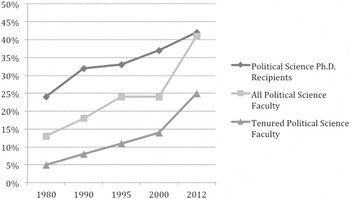
Women are now one half the number of graduate students, up from one quarter in 1980; as of 2012, they were 42% of degree recipients in the field. Women also are reaching the 40% mark for all faculty, but they are disproportionately concentrated in lower and non-tenure-track ranks, which are growing even as tenured professorships decline (Finder Reference Finder2007; Jaschik Reference Jaschik2009).
Those who study gender, work, and economics will not be surprised to note that in our discipline, as in the wider world, status and pay generally (although not always) track the male-dominated subfields. As a recent New York Times headline stated, “As Women Take over a Male-Dominated Field, the Pay Drops” (Miller Reference Miller2016; see also Levanon, England, and Allison Reference Levanon, England and Allison2009)—even for jobs that previously were paid higher when mostly men did them. At the same time, women en masse also self-select into professions and fields with lower pay, partly because of the greater flexibility these jobs afford for balancing work with family and partly because they have ideological reasons for pursuing those jobs (e.g., caregiving, teaching, and nonprofit work) despite the lower pay or status (ibid.; see also Blau and Kahn Reference Blau and Kahn2016; and Goldin Reference Goldin2014). Both processes (i.e., devaluing work when women do it and women’s self-selection) operate to produce current discrepancies in women’s pay and status compared to men’s, and our discipline is not exempt.
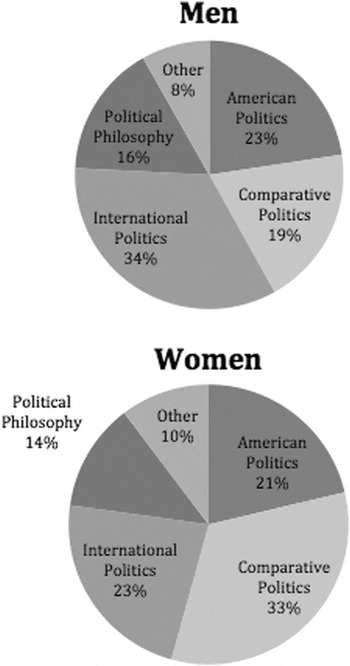
Within political science, women also are unevenly dispersed across the various subfields (figures 2 and 3). As figure 2 demonstrates, most subfields continue to be male-dominated, with the exception of comparative government and the smaller subfields of public administration, public law, and public policy. Figure 3 categorizes the data differently, examining the proportions of men and women as groups who study certain subfields. The figure shows some but not significant divergence in subfield pursuits; the largest proportion of men (about one third) is in international relations (IR), whereas the largest proportion of women (also about one third) is in comparative politics. However, these data may not reveal the full story because they represent APSA members, a group that in some respects is probably both over- and under-inclusive of all political scientists. Nevertheless, the data provide insight about overall proportions.

Proportions of Men and Women Studying Various Subfields in Political Science
Source: APSA 2015a.
Writing in 1979 in a jointly authored book review of one of the first large-scale academic studies of women in politics (i.e., Sex Roles in the Statehouse by Irene Diamond), Kay Schlozman and Jane Mansbridge described a “political pyramid” and noted an important (and persisting) truth: “The fundamental fact about women in United States politics is that inequality between the sexes increases in direct proportion to power” (Schlozman and Mansbridge Reference Schlozman and Mansbridge1979, 554). They continued, “Moreover, within the pyramid of power in any state legislature, women are concentrated at the bottom and excluded from positions of political leadership” (ibid). For a while, this also was true of political science as a field. Yet, especially since reforms in the 1990s, APSA has worked hard to break this gender-pyramid model, particularly in council membership and female presidents (beginning with Judith Shklar in 1989) and, thus far, in living up to the nonbinding 2001 membership resolution “encouraging future APSA nominating Committees to avoid choosing presidents-elect of the same gender for more than two years in a row” (Monroe Reference Monroe2002, 237; see also APSA 2005; Brandes et al. Reference Brandes, Buker, Burgess, Cook, Flammang and Geiger2001; and Shames Reference Shames and O’Connor2010).
Visible women in field leadership represent a great step toward changing a long-established masculine culture, but it does not change the history or current dominance of political science by men. The effects of this as a contextual factor may or may not affect any given woman in the profession, but many or even most have at some point felt like outsiders due to gender (a feeling that is exacerbated for women of color). However, speaking up about this feeling risks further discomfort and sometimes outright hostility (Sarkees and McGlen Reference Sarkees and McGlen1999; see also Mansbridge and Shames Reference Mansbridge and Shames2008), which heightens the feeling of difference. The graduate women we know who are uncomfortable have three main strategies for addressing this feeling: (1) keep your head down and do not make waves, even if occasional sexism or bias feels “icky” (i.e., the “try-to-fit-in” model); (2) stay away from the department or certain people within it, dissertate elsewhere, and only speak to or work with a few people you can trust (i.e., the “avoidance” model); and (3) speak out loudly, risking backlash and possible problems finding jobs, funding, and other perks, in the hope of collective action solving a collective problem (i.e., our model).
CONTEXTUAL FACTOR 2: HEGEMONY OF QUANTITATIVE METHODOLOGY
Quantitative data, as in large surveys or policy datasets, are extremely useful in answering certain types of questions, particularly about the generalizability of findings and big-picture or over-time changes. However, interviews, ethnography, case studies, archival work, and other methods often provide greater depth and particularity. They are wonderfully rich and complex in ways that the quantitative data often are not. We both use statistics regularly in our work; however, although quantitative data are important, they are inherently limited (as are all data, no matter how careful their collection). They also are often as easy to “fudge” as are the conclusions drawn from qualitative data; lying with statistics is an age-old art (Huff Reference Huff1954).
Yet, in recent decades, quantitative data analysis has gained disproportionate status and attention. Undergraduate students absorb this bias, as if by osmosis, from professors, departmental requirements, graduate students, and assigned texts and then tell us that their undergraduate theses must include statistics or will not be “real” social science. These students often barely understand what “quantitative analysis” is but they are determined to do it. One of our students once told us that his chosen investigative method for his senior thesis was “definitely regression analysis.” His sample size? Five.
Departmental requirements are far from neutral in the valuation of quantitative-versus-qualitative methodology. Using information available on school websites for the “top 15” political science graduate programs (as ranked by U.S. News & World Report in 2013), we found that 82% require that PhD candidates take quantitative methods whereas none require qualitative methods. Footnote 3 Increasingly, undergraduate political science departments are offering (or requiring) quantitative—but not qualitative—methods classes. Overall, there is hegemony of quantitative methodology in the discipline and the way we are teaching it.
Pleas for methodological diversity have been a standard feature of intra-field discussion in political science for at least a half-century. In 1969, Schattschneider warned that the behavioral revolution in political science would leave us in danger of producing “a mountain of data surrounding a vacuum” (Schattschneider Reference Schattschneider1969, 8). More recently, the “Perestroika” movement drew attention to what many in the field perceived as the hegemony of econometric models in the discipline’s top journals, among other grievances, some explicitly relating to gender and exclusion (Laitin Reference Laitin2003; Monroe Reference Monroe2005). Footnote 4
THE PROCESSES AT WORK IN GENDERED SELECTION AND SURVIVAL BIAS
Our theory of gendered selection and survival bias postulates four overlapping processes, working within the two contextual factors: (1) initial departmental admission-selection biases by gender; (2) subfield-selection biases by gender; (3) gendered survival biases over time; and (4) gendered reactions to research in which substantive political issues are overshadowed by a focus on quantitative methodology. Our theory begins with the premise that graduate women and men are equally capable of employing the quantitative methods used in political science. Even if women have fewer undergraduate math or statistics classes, the graduate program can and should teach all those in its cohorts the necessary practices for good quantitative work in political science.
Initial Selection Biases by Gender
Overall, women are about 63% of those graduating with master’s degrees, 53% of those with doctoral degrees, and about 40% of those earning PhDs in political science and government (National Center for Education Statistics 2012, 2014). In 2013, as graduate students along with several classmates, we examined the distribution of gender in incoming cohorts of graduate students in our department. We found significant variation in the gender balance of cohorts over time (figure 4). Within our department, between 2005 and 2014, the percentage of women in the incoming cohort varied from as low as 25% to as high as 67%. By interviewing faculty who had served on the admissions committees, we learned that when male graduate students were admitted disproportionately in certain years, the gender discrepancy often was explained in terms of statistical knowledge and experience, particularly in the American politics subfield. Footnote 5 If one is looking for applicants already versed in statistical methodology, one will get many more men than women.
Percentage of Women in Cohorts over Time in One Graduate Program
Source: Research conducted by the authors and fellow members of the Diversity Working Group in our graduate department.

As a result of complex societal pressures, men are more likely than women to study statistics, math, engineering, and/or computer science as undergraduates (National Center for Education Statistics 2013). These pressures come from various sources, including the association of masculinity with physical, scientific, mathematical, and engineering abilities from an early age (and the resulting lack of confidence this can cause for girls); the association of femininity with a lack of these abilities and with emotionality rather than rationality; the lesson that girls are valued for their physical appearance more than their brains or abilities and the subsequent difference of investments of time and interest in girls among boys; the complex feedback loops that lead girls as a whole to select away from male- and boy-dominated spaces, professions, programs, sports, and places; and more (Adler, Kless, and Adler Reference Adler, Kless and Adler1992; Basow Reference Basow1992; Bem Reference Bem1988; Lindsey Reference Lindsey2015; Spencer, Steele, and Quinn Reference Spencer, Steele and Quinn1999; see also Martin Reference Martin1990 and Faludi Reference Faludi1991 on violations of these roles and rules). This set of trends and patterns is well established in the education, psychology, and women’s/gender-studies literature, so we do not address it here. However, readers may remember the 1990s example of the talking Barbie doll who plaintively informed little girls, “Math class is tough.” By the time young men and women reach college, they exhibit significant differences in their propensity to look forward to careers and to choose classes in math and science-related (i.e., STEM) subjects. Moreover, this trend has not changed much in the past decade, despite efforts to the contrary (National Center for Education Statistics 2013).
Selecting students based on previous mathematical experience ensures a gender imbalance and, more important, proceeds from the problematic premise that a mathematical background provides superior potential to excel in political science. Surely the ability to frame good and important questions—and then to design a thoughtful research project to answer them—is more critical as a basis for selection than knowing what one will do to analyze the data once it is obtained. Programs should select on potential and critical-thinking abilities and then teach students the data-analysis skills they will need. Intelligent candidates who lack previous experience in quantitative methods but could be great researchers and thinkers are capable of learning and applying those skills if their research suggests the need, but this should not be a barrier to entry (see Shapiro [Reference Shapiro and Teele2014] on “problem-driven research”).
Why do we see these initial selection biases by gender on the part of faculty admissions committees choosing graduate students? Although there is a paucity of hard data (which may not be possible to collect given social desirability), we provide what we consider a telling anecdote indicating that these biases come from misguided perceptions on the part of some faculty members who are likely at some time to serve on admissions committees.
In the summer of 2014, one author attended the 31st annual meeting of the Society for Political Methodology, known to insiders as “PolMeth.” The first day’s lunch included a “Roundtable on Diversity within the Society,” which was encouraging for a female graduate student studying political methodology. Yet, in the Q&A session, a well-known male professor suggested that diversity was irrelevant and that the issue was simply the lack of methods training at the undergraduate level. He was either unaware or uncaring that his dismissiveness undermined the perspectives and concerns of those who had just bravely spoken up. Whether or not intended, his comments seemed to suggest that female graduate students were not worth teaching if they lacked what he viewed as requisite undergraduate training. Apparently, the statistical techniques that we political methodologists use are so sophisticated that only those with extensive mathematical backgrounds (who are far more likely to be men) can hope to enter the elite “club.” When our attendee suggested in response that political methodology “wasn’t rocket science” and could be taught to students with little mathematical background, one male attendee yelled, “Yes, it is!” and many others responded with jeers and taunts.
In some ways, we understand this response: the messy social systems we study are far more difficult to model than a system governed purely by physical laws. Social science indeed may be “the hardest science.” Conversely, if political methodologists consider themselves to be an elite club of master mathematicians, they will alienate many of their students—male as well as female—who went to graduate school hoping to learn (and perhaps even help change) something about real-life politics. Moreover, if relatively powerful male political methodologists so easily dismiss the deeply felt concerns of their female graduate students, it is no wonder that women continue to leave either the subfield or the discipline as a whole.
Subfield-Selection Biases by Gender
Once admitted to graduate programs, the sexes are not equally distributed across political science subfields. Women are more likely to study comparative government whereas men continue to dominate the study of IR, American government, political theory, and political methodology (see figures 2 and 3). In addition to political theory, both American government and IR are far more quantitative than comparative government, largely because of the availability of more reliable and widespread numerical data in these areas—particularly American government, where good quantitative data on public opinion, legislative actions and behaviors, and a host of other questions are easily acquired. Comparative work, by its very nature, must be more contextual and—even if quantitative—often involves the collection of original data rather than relying on existing large-n datasets. Such work also often emphasizes the strengths of research-method triangulation and therefore inherently values multiple types of methodologies.
Publishing trends also can provide a sense of where women are concentrated. Breuning and Sanders (Reference Breuning and Sanders2007) found that women are more likely to publish in comparative politics whereas men are more likely to publish in other fields, and papers published by female authors are more likely to use qualitative methods. These authors claim that there is no gender difference in who uses statistical analyses, noting that a large proportion of papers published in many of the discipline’s top journals are statistically based. The gender difference they found emerges when reviewing nonstatistical methods, particularly case studies: papers with only male authors used case studies (usually a qualitative method) 14.2% of the time, whereas papers with only female authors used case studies 23.5% of the time (Breuning and Sanders Reference Breuning and Sanders2007, 350, table 5). The study also found that women’s authorship is highest in comparative journals and that “Conversely, journals with higher proportions of statistical analyses (AJPS [American Journal of Political Science] and JOP [Journal of Politics]) are less likely to publish work by women” (Breuning and Sanders Reference Breuning and Sanders2007, 349). Figure 3 also suggests that women are disproportionately likely to study comparative politics rather than other subfields (Maliniak et al. Reference Maliniak, Oakes, Peterson and Tierney2008).
Even within subfields, there appear to be gendered divisions in areas of study; Maliniak et al.(Reference Maliniak, Oakes, Peterson and Tierney2008, 123) found that female IR faculty “research and teach different topics and in noticeably different ways than do their male counterparts,” with men more likely to study US foreign policy and international security and women more likely to focus on transnational actors, international organizations, and non-governmental organizations. These researchers also found a divide in area studies: “women study sub-Saharan Africa and Latin America; men focus on the United States and Europe” (Maliniak et al. Reference Maliniak, Oakes, Peterson and Tierney2008, 123). Finally, they found that women are more likely to call themselves “constructivists who focus on the role of ideas and identities as explanations of world politics, while men are more likely than women to be realists who assume an anarchic international system” and attend to questions of military might and use (ibid.; see also Maliniak, Powers, and Walter Reference Maliniak, Powers and Walter2013 on the gender citation gap in IR).
We do not know why women in political science appear to favor comparative politics as a subfield or certain subareas of IR, but these data suggest hypotheses, which we hope future researchers will subject to rigorous analysis. One hypothesis, deriving from the work of a special task force appointed by Dianne Pinderhughes (when she was APSA president) and chaired by Luis Fraga, suggests that those interested in studying complex issues of identity and marginalization (and who tend to find these questions after personal experiences) may find a purely quantitative approach limiting (Jaschik Reference Jaschik2011). When studying human experiences in depth and trying to understand inter-relational processes situated in particular contexts, qualitative methods (case studies, interviews, ethnographies, archival analysis, and close reading) open important avenues of exploration that reveal information not available in a purely quantitative study.
When studying human experiences in depth and trying to understand inter-relational processes situated in particular contexts, qualitative methods (case studies, interviews, ethnographies, archival analysis, and close reading) open important avenues of exploration that reveal information not available in a purely quantitative study
Another hypothesis that future research should test is the mentorship perspective. If female graduate students seek female mentors (Bos and Schnieder Reference Bos and Schneider2012), which is often but not always the case, they are far more likely to find them in comparative politics than in other subfields; therefore, the current bias may become self-perpetuating. In explaining the theoretical bases for preferring representation of one’s own gender, Mansbridge (Reference Mansbridge1999, 628) suggested that having women as political representatives helps to “create a social meaning of women’s ‘ability to rule’.” Before second-wave feminism, Mansbridge (Reference Mansbridge1999, 649) wrote, it was “part of the definition of ‘female’ to be non-athletic.” However, with the massive change in women’s sports funding, popularity, and acceptance in the intervening years, the definition of being female changed vis-à-vis being athletic; the “social meaning” was changed by living counterexamples. For women in political science who may not feel that they “belong,” having female mentors and advisors can be soul-soothing. Even for those who do feel they belong, practical advice about personal and professional concerns from another woman can be important.
Conversely, women are far less present in the growing field of political methodology. As illustrated in figure 5, the annual conference on political methodology (i.e., PolMeth) has consistently attracted far more men than women. Despite significant gains since the 1980s, when virtually no women attended PolMeth, the proportion of female attendees rarely exceeds 25% and generally hovers around 20%. This proportion does not appear to have changed significantly over time since the mid-1990s. Moreover, even when an experimental “encouragement” design increased the number of female applicants to PolMeth, the conference admission board—which was not in on the experiment—did not admit more women (Quinn, Sen, and Unkovic Reference Quinn, Sen and Unkovic2015).
Attendance at PolMeth Annual Conference, by Gender: 1984–2014
Source: Society for Political Methodology 2014.

Gendered Attrition
The low numbers of women in political methodology not only suggest that the subfield has trouble attracting women from the start but also that interested women may be turned off by what they perceive as a hostile environment dominated by men. In a recent survey Footnote 6 of students in our graduate department, we asked about the tone of the department workshops (i.e., weekly meetings at which both students and faculty present research and receive feedback), focusing especially on the levels of criticism, encouragement, and combativeness. Of the 14 students who reported that they found at least one workshop “too combative,” 10 were women. The workshops that were most commonly perceived as being combative were political economy, applied stats, and American politics—that is, the more quantitatively oriented workshops.
When asked if they had ever felt uncomfortable in workshops due to a lack of gender diversity, more than 80% of female respondents reported that they had, compared with 35% of men (n = 40 for this question). Even given the low number of observations, this difference was statistically significant (p = 0.016). In the open-response section associated with this question, one woman reported: “I often feel like I’m the only woman in the room in one particular workshop, and it’s been like that for years. The style of discourse is very aggressive and only recently have I become comfortable with it. I feel like most other women just left the workshop because of the tone.” Another stated simply, “It’s really hard to attend workshops in which there are no or few women in the room.” Other women used the terms “awkward” and “dread” to describe their feelings about the lack of diversity in the workshops and the often-hypercritical tone. Several other female graduate students also reported specifically gendered experiences, such as male professors talking down to them (but not to male students). Footnote 7
Not only are more quantitative workshops perceived as being more combative, it also is more likely that there are few women in the room. The absence of women is reflected in the faculty who teach methods classes or even list methods as an area of research. Using data available on university websites for the “top 15” programs, we calculated that of the 169 professors at top programs who list political methodology as a field of research, only 25 (about 15%) are women (figure 6). Moreover, our calculations indicated that female faculty teach only about 8% of the graduate methods courses at these schools. Footnote 8
Professors at Top-15 Programs Listing Political Methodology as an Area of Research or Subfield Specialty, by Gender
Source: Data collection by authors based on program websites.

Given the statistics, the likelihood of finding a female mentor in political methodology is low; if a female student chooses to be a methodologist, men will teach the majority of her classes. For some women, this may be acceptable; others seek out female mentors, whether consciously or subconsciously. The lack thereof may instill the impression that political methodology is not “their place,” similar to the fact that a lack of female politicians in a country may create social impressions of women’s inability to rule, whereas their presence can suggest the opposite (Mansbridge Reference Mansbridge1999; Wolbrecht and Campbell Reference Wolbrecht and Campbell2007). For female graduate students, this conscious or unconscious impression about women’s “place” can become exacerbated by a culture that is perceived as hostile or unnecessarily aggressive. There is likely to be a gendered survival bias in who persists in as well as who starts studying political methodology—and perhaps also in those who attend and participate in the PolMeth society and conference.
Survival biases in the field of political science more generally have a gendered component: “Although women are not significantly more likely than men to leave graduate school before completing a degree, their reasons for leaving differ. For men, the most common reason is the lack of employment opportunities; for women, the most common reason is their perception that the work environment is unfriendly or unsupportive” (Tolleson-Rinehart and Carroll Reference Tolleson-Rinehart and Carroll2006, 511). These scholars described evidence from a report showing that female graduate students are less likely than men to “report encouragement to publish or assistance in publishing, and [the women] are more likely to report receiving no help in initial job searches” (ibid.). The data from our survey of fellow graduate students found a similar pattern in terms of publishing readiness: 60% of male students in our department said they were ready to publish versus 25% of the women. Footnote 9 As scholars studying women as political candidates also found, they tend to need more encouragement (but often get less) to take a risk than similarly situated men, such as running for office (Lawless and Fox Reference Lawless and Fox2005, Reference Lawless and Fox2010; Shames Reference Shames2017) or attempting to publish a paper.
Finally, there is a gendered survival bias in who achieves tenure in political science. This likely relates to the trends and patterns about who uses qualitative versus quantitative data and who gets published because publishing is such an important part of tenure. If women across the field are less likely than men to use quantitative methods; are less likely to be accepted when they apply for conferences; need or want more mentoring and support but receive less; and are less likely to feel ready to publish in graduate school, less likely to be cited once published, and less likely to be published in top journals (many of which prize quantitative over qualitative data), it is no surprise that they are less likely to be ready for tenure and have the types of publications in top journals that would assist them in that process.
Beyond publishing, the tenure gap has much to do with “the chronological overlap between the demanding pre-tenure years and the years when family responsibilities are greatest” (Tolleson-Rinehart and Carroll Reference Tolleson-Rinehart and Carroll2006, 511). Time, in other words, is not a panacea when it comes to achieving gender equality in the field. As long as the important work of caring for home, children, and family is gendered, it will be more difficult for women (80% of whom become mothers) to achieve leadership, including tenured positions, in any field (Valian Reference Valian2004). Political science is hardly immune; as Tolleson-Rinehart and Carroll (Reference Tolleson-Rinehart and Carroll2006) noted, political science mirrors the wider culture even as it works to explain it. Good university-wide daycare and parental leave can be crucial in creating more gender equality in this regard as well as ensuring that universities do not lose talented women due to persisting gender gaps in who does more of the work at home.
However, we suggest that consideration of both “push” and “pull” factors is important. The decision to leave, if rational (and we assume it mostly is), would be the result of a pros-versus-cons calculation. If family work pulls in one direction but political science is not providing enough of a pull in the other, it is not difficult to predict which will win. We suggest that it is not time alone that accounts for the greater attrition of women but also that academic political science work can be lacking in a sense of fulfillment. Given the previously discussed trends and patterns about publishing, we might even interpret a feeling of rejection by the discipline that could reasonably decrease female political scientists’ attachment to it. A recent study of why young people do not want to run for political office found that politics, especially of the electoral variety, simply did not feel meaningful to many respondents (Shames Reference Shames2017). Perhaps the same is true for achieving rewards or recognition in political science. Making political science feel both accessible and useful outside of the “ivory tower” might go a long way toward retention of good people (women especially but also many men) that we otherwise are losing.
These forces and biases, rather than a lack of innate ability, are better explanations for persistent lower numbers of women in tenured positions in the field and studying political methodology in particular.
Subordination of Content to Methodology May Disproportionately Turn off Women, across Subfields
Recent research on the lack of women entering two key male-dominated fields (i.e., elective politics and engineering) suggests that the stumbling block is not a lack of ambition, as previous work suggested, but instead a lack of perceiving the social importance of the work involved. The research suggests that women are far less likely than men to view politics as useful in solving important problems and that this perception is significantly related to political ambition (Shames Reference Shames2014, Reference Shames2017). Rationally, those who see politics as useful are more likely to want to serve in office (Thomas Reference Thomas1994, 87). Yet, this linkage between ambition and perceived usefulness is hardly limited to politics. Lina Nilsson, a professor of biomedical engineering, reported in 2015 on results from a new program at University of California, Berkeley, where she teaches. At the Blum Center for Developing Economies, the program—without any targeted outreach—“achieved 50 percent female enrollment in just one academic year” (Nilsson Reference Nilsson2015). How? “[I]f the content of the work itself is made more societally meaningful, women will enroll in droves,” she explained, adding, “That applies not only to computer engineering but also to more traditional, equally male-dominated fields like mechanical and chemical engineering” (ibid.). The women (and men) in her program are “designing solutions for clean drinking water, inventing medical diagnostic equipment for neglected tropical diseases and enabling local manufacturing in poor and remote regions”—and fully half of the inaugural class of students was female (ibid.; see also St. Fleur Reference St. Fleur2014).
If political science is reduced to competitive discussion over mathematical techniques with a macho “my n is bigger than yours” attitude, it likely will continue to be a majority-male discipline.
If political science is reduced to competitive discussion over mathematical techniques with a macho “my n is bigger than yours” attitude, it likely will continue to be a majority-male discipline. This also risks turning off many men who value qualitative methods (or even simple rather than complex statistics) and may feel increasingly left out of the club. Schattschneider (Reference Schattschneider1969) feared that data would displace substance, like the members of the Scholars Strategy Network (an organization of scholars dedicated to making their research more publically accessible and useful in the policy-making process; see Scholars Strategy Network 2015), who deeply want political science to be useful to the world, to be meaningful, to help solve social and political problems, and to make lives and governments better. We share that desire; it is what led both of us to study political science and government in the first place. We believe in the power of multiple methodologies—including but not limited to advanced statistical techniques—to help us discern truth that we hope will assist governments and public policy to better create justice and solutions for major political problems.
Good methodology is crucial to producing findings—and, it is hoped, truth—we can believe and use. However, when substance becomes subordinate to methods, and when methodological discussions seem competitive and nitpicky rather than collaborative and constructive, we want to run in the opposite direction.
OUR PERSPECTIVE
Our perspective in this article is by no means objective. We are writing about trends and patterns that we have observed, based partly on limited data and partly on personal experiences. Beyond question, the institutions that formed us as scholars have fundamentally shaped our experiences. It is difficult to know how representative our experiences are; unfortunately, good, widespread, and generalizable data on these topics proved impossible to find. We know, however, from the meager data that we could obtain that we are not alone in certain perceptions—particularly that complex quantitative methods have disproportionate status and a male bias. As subjective as our perspective may be, however, we believe it to be valuable. Moving through the academic pipeline ourselves, we can see clearly at least some of the places where it is leaking.
We are also relatively young scholars. Perhaps those who are more deeply embedded in the discipline would perceive the situation differently; we welcome their perspectives on this issue. It may be that the disproportionate focus on highly complex statistical methods is felt most strongly by students—especially graduate students but, to some extent, undergraduates as well—and that this pressure is mitigated as one climbs the tenure ladder and has the opportunity to explore other methodologies.
Nevertheless, this pressure in the early years in the discipline is still a deep concern for three reasons. First, it could cause undergraduates uninterested or downright turned off by this focus to self-select out of graduate school. Second, it could lead disgruntled graduate students to select or change to certain subfields or to leave programs altogether. Third, even if scholars later learn new approaches or methods, their graduate training is the bedrock on which that later exploration rests. Requiring graduate students to take multiple stats courses but none in qualitative methods (as was the case for both authors and many current and former colleagues) not only sends a clear signal about what is valued but also can set limits on future methodological explorations. It is difficult as an assistant professor to invest the time one would need to learn, for example, interviewing or ethnography from the ground up.
BEST PRACTICES
A variety of concrete steps can be taken both by individuals and departments to address and even undo the biases, patterns, and trends discussed in this article. It is our hope that this will ignite a larger discussion about how we can make political science a more inclusive space, by gender as well as race/ethnicity. The Fraga committee report referenced previously suggests that many of these conclusions apply to people of color as well as to women, and perhaps more so to women of color in the field (Harris-Lacewell Reference Harris-Lacewell2005; Shames Reference Shames2017, chapter 7). Beyond the inclusion benefits, we strongly believe that methodological pluralism and concern with quality rather than type of data or methods overall will make for better science.
Therefore, studies, anecdotal evidence, and our thinking on this topic suggest the following as best practices:
-
1. Whenever possible, departments should admit gender-balanced cohorts and also make sincere attempts at racial diversity. If the pipeline is leaking, then we should build a new pipeline! The goal is not to be “politically correct” but rather to bring a mix of people and perspectives for the enrichment of the cohort and the field as a whole. Admissions and hiring committees—like people in general—are likely to have implicit biases. Simple awareness of these biases and conscious attempts to create a diverse cohort can interrupt the unconscious mechanisms that often lead homogeneous groups to hire those already like themselves.
-
2. When admitting students, departments should be cautious that they are not consciously or unconsciously favoring students with high math GRE scores or more quantitative undergraduate coursework over those who show engagement with substantive political questions and thought.
-
3. Whenever possible, departments should hire more women to teach quantitative methods. Of course, even well-intentioned departments may find this difficult given the dearth of eligible female candidates. Therefore, departments should ensure that their graduate women are not being turned off from quantitative methodology and try to develop the next generation of female methodology instructors so that this problem does not continue. If hiring explicitly for methods, departments also might think of social science more broadly and consider hiring women with PhDs in economics, psychology, and other disciplines with a strong quantitative component.
-
4. To prevent women from being turned off from a masculinist culture within quantitative methods, faculty (both male and female) will need to change how they present and teach political methodology. Instead of an elite club for master mathematicians, methodology should be an area of the field that is open to everyone, even those with no mathematical background. This may require restructuring the methods requirements to provide more classes for students with diverse backgrounds. We believe this will better serve all students, including women but also those men not as initially interested in quantitative methods. The shortcomings of quantitative methods also should be continually acknowledged and research-method triangulation (using multiple methodologies to compensate for the shortcomings of any one) encouraged. What if graduate students were all required to take qualitative- as well as quantitative-methods courses?
-
5. Departments need to be aware that a combative atmosphere in quantitatively oriented workshops makes many students feel unwelcome (generally women, but many men as well). Guidelines about how to engage in constructive discussions and efforts to ensure that quieter voices are heard are beneficial in making everyone feel comfortable and ensuring better participation and engagement.
-
6. Methods offerings should include qualitative as well as quantitative courses, and departmental requirements should not signal a preference for quantitative techniques.
-
7. Answering questions of causality are vital to the field but are far from the only legitimate form of social science inquiry. King, Keohane, and Verba (Reference King, Keohane and Verba1994) also rightly pointed out that descriptive and causal inference both have a place in the methodological pantheon. The “causal mafia” approach to political science that places a premium on quantitative causal identification (often through experimental or quasi-experimental methods) trumpets the virtues of these methods while all-too-often staying silent on their drawbacks (e.g., the narrowness of questions that can be addressed or the often unrealistic experimental settings with truncated outcome sets). Causal inference should be respected as one—but not prized as the only—key goal of our field’s inquiry.
-
8. Professors and departments can make a conscious effort to root out and punish or at least express disapproval of the type of “bullying” behavior that often attends women in general, especially those who speak out. This is exemplified by the mean-spirited, undermining, and sexist comments frequently posted on the anonymous “Politicalsciencejobrumors.com” website. When he learned that several women in our department had been anonymously attacked on this site, our chair—to his great credit—sent a strongly worded letter to all graduate students not to censor but to censure: “If this is a tradition of sorts,” he wrote, “it is one we can do without. I urge everyone to think of the common good and desist from bullying remarks that serve no useful purpose and can be grossly unfair and hurtful to individual targets and to us all.”
-
9. Graduate students interested in inclusion issues should form groups and collect data, working whenever possible with sympathetic faculty, chairs, and/or administrators. We recommend that these groups survey their graduate-student populations to determine the extent and type of gendered biases in specific departments or subfields. To this end, we are willing to share our survey questions, methods, and results on email request. We have been pleased to see great support for and progress in our own graduate department in shifting long-standing gender imbalances in locations and modes of participation, and we acknowledge the willingness of several department chairs and professors to make possible these changes.
CONCLUSION
The disproportionate status awarded to complex statistical methods—far more often the province of men than women—and the insularity of the political methodology world is part and parcel of continued gender divisions in the field more generally; it also makes for anemic social science. If political science becomes disproportionately geared toward highly complex statistical methodology, we believe that we all lose out. Good science involves a multiplicity of methods and, beyond that, good and careful thinking about substance, whatever one’s method may be.
However, in the political-science-as-only-complex-statistics world, women—for various reasons—lose more than men. This is not because “girls can’t do math” (we can) but rather because of a complex set of contextual and procedural factors. These factors include the fact that men have dominated political science in the past and continue to dominate certain subfields, including methodology; that men disproportionately enter and stay in the methods subfield; that men are more likely to enter graduate school with more mathematical and statistical training; that women as graduate students may seek female mentors; that women seem more likely than men to leave political science as well as certain subfields; and that women appear disproportionately dedicated to connecting political science to substantive concerns rather than focusing so heavily on the method. None of these is a “silver bullet” for explaining women’s position in political science, and many women may not experience any of these as problems. However, as Valian (Reference Valian2004, 210; emphasis in original) explained, “mountains are molehills, piled one on top of another over time.”
On a personal level, we are what might be called “methodologically omnivorous.” If we are shown multiple types of data that support an argument, we are far more likely to believe it. We both appreciate and use quantitative data in our research and have taught quantitative methods classes, but we also appreciate and use qualitative data as well. We also appreciate simple but well-done quantitative statistics rather than fancy but poorly done quantitative methods. Even if they are complex, all statistics should be understandable by smart but untrained readers. As Gary King would often say in our graduate statistics classes, no matter how complicated your work, “My grandmother should be able to understand what you’ve done and what you got.” The attitude that what we do is too important for regular people to understand is elitist and wrong, as is the field-wide hegemony of complex quantitative methodology and the growing power of the “causal mafia” approach. In the interest of improving politics and policy, we also share a commitment to political science work being open and accessible to a wider public.
We believe that the four processes and two contextual factors discussed herein—working individually and interactively—together operate to create and perpetuate gender biases in the field. As political scientists who embrace the use of quantitative methodology, we caution against its disproportionate status in the field, for reasons both scientific and egalitarian. We must examine seriously the pervasive quantitative biases that prevent us from recognizing good data as good (or even “hard-core”)—even qualitative—and bad data as bad, even when couched in fancy statistics. Doing so is not only an essential step toward gender equality in the discipline, it also is a step toward better political science.
ACKNOWLEDGMENTS
The authors gratefully acknowledge the following people for advice, helpful comments, and other support (alphabetical): Amy Atchison, Andrea Campbell, Sarah Childs, Laurel Eckhouse, Kristin Goss, Jennifer Hochschild, Amanda Meyers and the American Political Science Association, the PS editors and helpful anonymous reviewers, Kevin Quinn and the Society for Political Methodology, Dawn Teele, Kathy Thelen, Ben Winterhalter and HippoReads, and the Working Group on Diversity and supportive faculty and administrators in the Harvard University Department of Government.



