Introduction
Toxoplasmosis is a worldwide distributed zoonosis caused by the protozoan Toxoplasma gondii (Dubey, Reference Dubey2010). Felids are the only definitive hosts of this parasite, with a variety of warm-blooded vertebrates acting as intermediate hosts. Felids excrete oocysts by feces, which can be a source of infection for other animals. Dogs can act as mechanical vectors of T. gondii, as it has been shown that oocysts are present on their fur due to the habit of rubbing on the ground where feces are present (Frenkel et al., Reference Frenkel, Lindsay, Parker and Dobesh2003). Dogs can also act as mechanical disseminators because of their coprophagous behaviour, resulting in the risk of ingestion of oocysts that remain viable until they appear in the dog's feces (Lindsay et al., Reference Lindsay, Dubey, Butler and Blagburn1997; Schares et al., Reference Schares, Pantchev, Barutzki, Heydorn, Bauer and Conraths2005; Cong et al., Reference Cong, Elsheikha, Zhou, Peng, Qin, Meng and Qian2018).
According to the World Animal Health Information Database (OIE, 2019), the dog and cat population in Thailand has increased markedly during the last decade. Since 2009, the census increased from about 6.1 and 1.9 million dogs and cats, respectively, to 8.2 and 2.5 million dogs and cats in 2019. In addition to the traditional pet ownership, community dog and cat keeping is a common practice in Thailand and more specifically in Bangkok, which consists of providing food and water to stray animals, but not housing, so they maintain a life completely outdoors and do not usually receive veterinary care (Savvides, Reference Savvides2013; Toukhsati et al., Reference Toukhsati, Phillips, Podberscek and Coleman2015). Both household and free-roaming cats could act as a reservoir of T. gondii, which may imply a risk for people having contact with cat's feces or contaminated environment. In this context, previous studies have shown that 6.4% of cat owners in Bangkok were seropositive (Sukthana et al., Reference Sukthana, Kaewkungwal, Jantanavivat, Lekkla, Chiabchalard and Aumarm2003). Moreover, T. gondii has been found to be widely distributed in the human population in Thailand, as indicated by recent studies in which seropositivity of 17.3% was estimated in 5101 pregnant women (Rostami et al., Reference Rostami, Riahi, Gamble, Fakhri, Nourollahpour Shiadeh, Danesh, Behniafar, Paktinat, Foroutan, Mokdad, Hotez and Gasser2020) and the presence of acute toxoplasmosis infection in 2.8% of seropositive women (Rostami et al., Reference Rostami, Riahi, Contopoulos-Ioannidis, Gamble, Fakhri, Shiadeh, Foroutan, Behniafar, Taghipour, Maldonado, Mokdad and Gasser2019). Drinking water was identified as a risk factor for T. gondii infections in 190 of 760 (25%) pregnant women tested in a hospital in southern Thailand, suggesting contamination of water with oocysts excreted by cats (Andiappan et al., Reference Andiappan, Nissapatorn, Sawangjaroen, Chemoh, Lau, Kumar, i Onichandran, Suwanrath and Chandeying2014).
Considering that dogs and cats can be involved in the maintenance of the urban and peri-urban life cycle of T. gondii, and that they usually share the same areas within cities, serological surveys in both species are the key aspect to address control strategies of this zoonotic pathogen, especially in areas where there are colonies of free-roaming dogs and cats in close contact with humans (Fábrega et al., Reference Fábrega, Restrepo, Torres, Smith, Chan, Pérez, Cumbrera and Caballero2020; Park et al., Reference Park, Noh, Seo, Kim, Min, Yoo, Yun, Kim, Choi, Cheon, Hong, Yoon and Cho2020). In fact, this health concern is reflected in various studies of T. gondii seroprevalence in dogs and cats previously conducted in several areas around the world from a One Health perspective (Rengifo-Herrera et al., Reference Rengifo-Herrera, Pile, García, Pérez, Pérez, Nguyen, de la Guardia, Mcleod and Caballero2017; Cong et al., Reference Cong, Elsheikha, Zhou, Peng, Qin, Meng and Qian2018; de Oliveira et al., Reference de Oliveira, Simões, Schaer, Freire, Nascimento, de Pinheiro, Carvalho, Mariano, de Carvalho and Munhoz2019; Park et al., Reference Park, Noh, Seo, Kim, Min, Yoo, Yun, Kim, Choi, Cheon, Hong, Yoon and Cho2020). In this respect, serological survey studies provide valuable information that allows us to know the contact of host species with T. gondii and, indirectly, to interpret the epidemiological risk that the presence of these animals implies for the human population (Ding et al., Reference Ding, Gao, Deng, Lamberton and Lu2017). In the specific case of Bangkok, this is a very interesting epidemiological scenario for studying shared diseases between humans and domestic animals, due to the aforementioned community pet keeping, which results in a close contact between humans and free-roaming dogs and cats (Jittapalapong et al., Reference Jittapalapong, Nimsupan, Pinyopanuwat, Chimnoi, Kabeya and Maruyama2007). In Bangkok, the seroprevalence of T. gondii infection has been previously assessed in cats (Jittapalapong et al., Reference Jittapalapong, Inpankaew, Pinyopanuwat, Chimnoi, Kengradomkij, Wongnarkpet, Maruyama, Lekkla and Sukthana2010; Sukhumavasi et al., Reference Sukhumavasi, Bellosa, Lucio-Forster, Liotta, Lee, Pornmingmas, Chungpivat, Mohammed, Lorentzen, Dubey and Bowman2012) and dogs (Jittapalapong et al., Reference Jittapalapong, Sittisan, Sakpuaram, Kabeya, Maruyama and Inpankaew2009) separately. Toxoplasma gondii antibodies were detected in 7 of 114 (6.1%) dogs from dairy farms in Thailand (Arunvipas et al., Reference Arunvipas, Jittapalapong, Inpankaew and Pinyopanuwat2013). As far as we are aware, only one study on T. gondii has been conducted in both dogs and cats simultaneously in the same study area (Jittapalapong et al., Reference Jittapalapong, Nimsupan, Pinyopanuwat, Chimnoi, Kabeya and Maruyama2007). Few studies on the dynamics of T. gondii infections in cats and dogs over a period have been performed. In Brazil, the same dogs were tested for T. gondii antibodies three times, on days 0, 180 and 365. The seroprevalences were 5.1, 6.5 and 15.1%, respectively, revealing an annual seroconversion rate of 10.1% (Olbera et al., Reference Olbera, Fornazari, Babboni, Rossi, Sevá, Latosinski, da Silva, Modolo and Langoni2020). In Switzerland, serial blood samples from 65 cats were collected with a time separation of at least 3 months and analysed for anti-T. gondii antibodies, but no changes were detected over time (Schreiber et al., Reference Schreiber, Basso, Riond, Willi, Torgerson and Deplazes2020). Simon et al. (Reference Simon, Pradel, Aubert, Geers, Villena and Poulle2018) carried out a broader longitudinal serosurvey on 130 cats over one year in French farms, where cats were sampled every 3 months. The authors detected seroconversion rates of 0.42–0.96 per cat and year. No such studies were performed elsewhere (Dubey et al., Reference Dubey, Cerqueira-Cézar, Murata, Kwok, Yang and Su2020a, Reference Dubey, Murata, Cerqueira-Cézar, Kwok, Yang and Su2020b).
The aims of this study were (i) to determine the seroprevalence of T. gondii in outdoor dogs and cats from Bangkok, (ii) to identify risk factors associated with the exposure to this zoonotic parasite in both host species and (iii) to assess the dynamics of seropositivity along the study period.
Materials and methods
Animals surveyed and sample collection
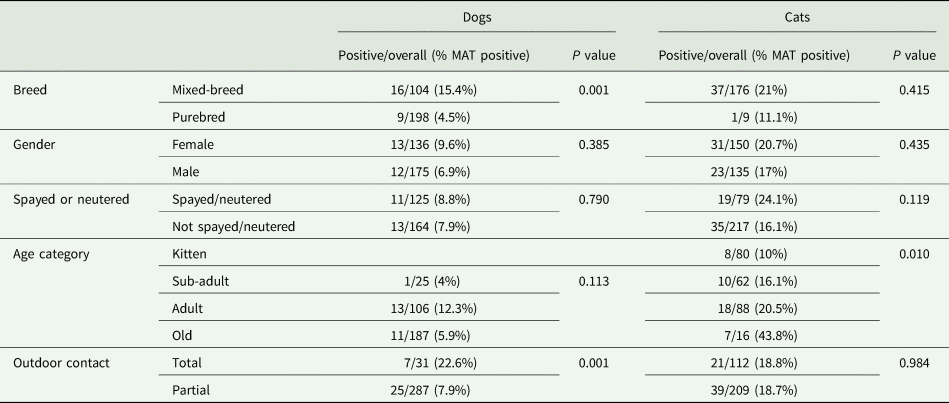
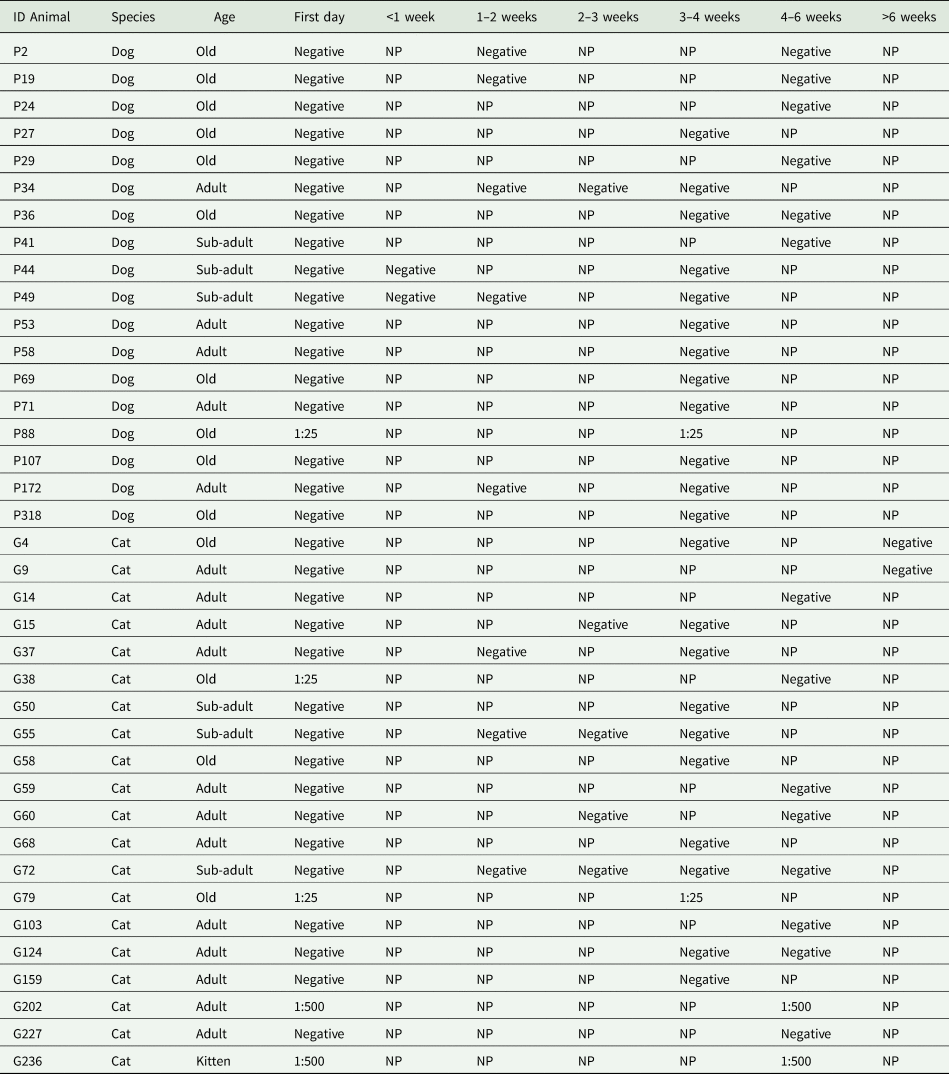
A total of 639 (318 dogs, 321 cats) blood samples were obtained from Bangkok (Table 1). Selected animals had in common a history of outdoor life, irrespective of being owned, stray or community pet animals. All samples were opportunistically collected from animals admitted to the CU Small Animal Teaching Hospital, Chulalongkorn University (Bangkok), or to Neutering Service of Rabies Control Group, Department of Health, Din Daeng (Bangkok) between June and July 2019. Additionally, blood samples from 18 dogs and 20 cats that had been sampled several consecutive times with a minimum of 3 weeks of difference between blood draws were also used for a T. gondii longitudinal study (Table 2). Blood samples were collected by puncture of jugular or cephalic veins using sterile tubes with an anticoagulant (EDTA or heparin). Samples were transported to the laboratory under refrigeration conditions (4°C).
Seroprevalence of Toxoplasma gondii (MAT; titre ⩾1:25) in outdoor dogs and cats in Bangkok, Thailand

MAT, modified agglutination test.
Longitudinal serosurvey of Toxoplasma gondii in outdoor dogs and cats in Bangkok, Thailand

NP, not performed; 1:25, positive with 1:25 titre; 1:500, positive with 1:500 titre.
Serological testing
Blood samples were centrifuged for 5 min at 2370 g and plasma was stored at −20°C. Modified agglutination test (MAT) was used to assay the presence of antibodies against T. gondii as previously described by Dubey and Desmonts (Reference Dubey and Desmonts1987). Serum diluted from 1:25 to 1:3200 (with a minimum titre of 1:200) from a naturally infected pig was included in each test as a positive control. PBS was used as a negative control. Samples were tested at 1:25, 1:50, 1:100 and ⩾1:500. Samples with a 1:25 titre or higher were considered positive. MAT has been extensively used for the diagnosis of toxoplasmosis in both species (El Behairy et al., Reference El Behairy, Choudhary, Ferreira, Kwok, Hilali, Su and Dubey2013; Dubey et al., Reference Dubey, Tiwari, Chikweto, Deallie, Sharma, Thomas, Choudhary, Ferreira, Oliveira, Verma, Kwok and Su2013a, Reference Dubey, Darrington, Tiao, Ferreira, Choudhary, Molla, Saville, Tilahun, Kwok and Gebreyes2013b; de Almeida et al., Reference de Almeida, Frehse, Navarro, Garcia, Biondo and Freire2016). Although there is no validation of MAT for the detection of T. gondii antibodies in cats and dogs, a good correlation has been found between the results of bioassays in mice and serology results at 1:25 dilution (Dubey, Reference Dubey2010; Dubey et al., Reference Dubey, Cerqueira-Cézar, Murata, Kwok, Yang and Su2020a, Reference Dubey, Murata, Cerqueira-Cézar, Kwok, Yang and Su2020b).
Data collection
Whenever possible, data were collected from the animals by completing a clinical form. Animals were grouped according to species (cat or dog), sex (male or female), breed (purebred or mixed-breed), spayed/neutered animals (yes or no) and degree of outdoor contact (animals living permanently outdoors or animals living partially enclosed, which are those animals who live in a house but also, to a greater or lesser degree, have outdoor access). With regard to the estimated age, pets were grouped into several categories, depending on whether they were dogs (sub-adult 10–36 months old, adult 3–8 years old and old individuals >8 years old) or cats (kitten ≤1 year old, sub-adult 1–2 years old, adult 2–10 years old and old cats >10 years old).
Statistical analysis
Seroprevalence of T. gondii was estimated from the ratio of positive samples to the total number of samples tested, with the exact binomial confidence intervals of 95% (95% CI). Associations between seropositivity to T. gondii and epidemiological variables were assessed by Pearson's χ 2 test or Fisher's exact test, as appropriate. Variables with a P value <0.20 in bivariate analysis were selected for inclusion in the multivariate analysis. Cramer's V correlation coefficient between pairs of variables was computed to prevent collinearity. Finally, the effect of the exploratory variables selected on T. gondii seropositivity was investigated using a multiple logistic regression analysis (likelihood-ratio Wald's test, P < 0.05) (Hosmer and Lemeshow, Reference Hosmer and Lemeshow2000). For forward model building, variables were included one at a time, starting with the variable with the lowest P value in bivariate analysis. At each step, the confounding effect of the included variable was assessed by computing the change in the odds ratio. Confounding variables were those that, when added to the model, changed the OR by more than 30%, and were forced into the final model regardless of their significance level. Potential two-way interactions between all the variables were also tested for significance in the models. The goodness of fit was assessed using the Hosmer–Lemeshow goodness-of-fit test. Statistical analyses were carried out using the SPSS software (Statistical Package for Social Sciences – SPSS, Version 22.0, IBM Corp., Armonk, NY, USA).
Results
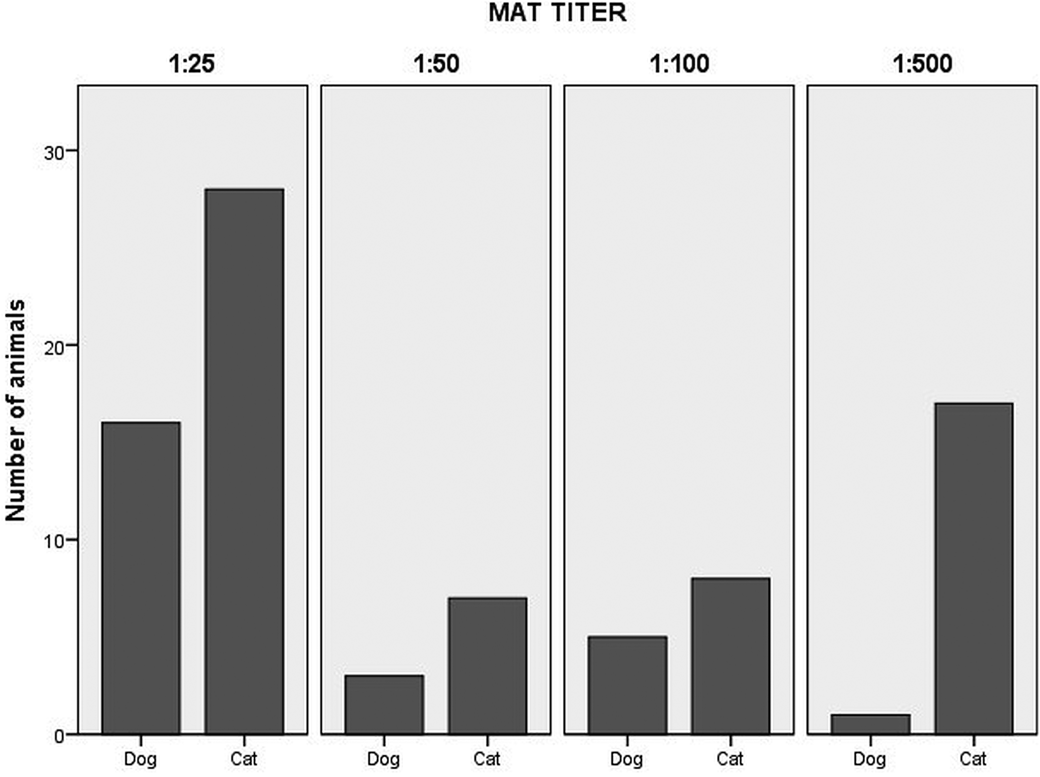
Seroprevalence of T. gondii in dogs from Bangkok was 7.9% (25/318; 95% CI 4.9–10.8%), and 18.7% in cats (60/321; 95% CI 14.4–23.0%). Statistically significant differences were found in seroprevalence between species (P < 0.001). The distribution of antibody titres is represented in Fig. 1. Titres of 1/500 were more frequently found in cats (28%) than in dogs (4%), while low titres (1:25) were detected in 46% of cats and 64% of dogs. However, there were no significant differences in titres between both species (Pearson's χ 2, P = 0.09).
Distribution of anti-Toxoplasma gondii titres by MAT in dogs and cats. MAT, modified agglutination test.

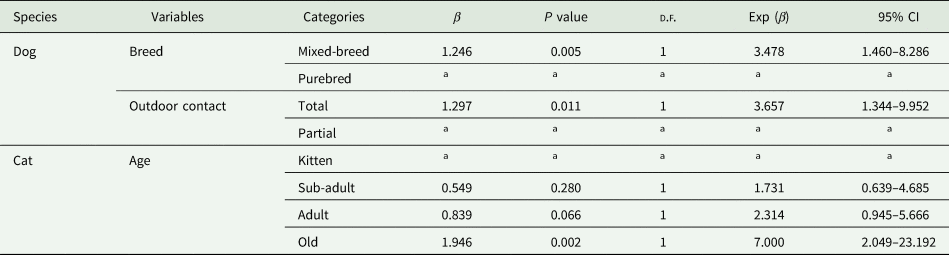
The frequency of seropositive and seronegative animals detected according to the variables analysed in dogs and cats is shown in Table 1. The logistic regression model showed that the main risk factors associated with T. gondii exposure in dogs were breed and degree of outdoor contact, while age class was the main risk factor in cats (Table 3). Seroprevalence in dogs was significantly higher in mixed-breed compared to purebred. In addition, dogs living permanently outdoors had a significantly higher seroprevalence than those that lived partially enclosed. Regarding cats, significantly higher seropositivity was detected in old and adults compared to kittens.
Potential risk factors associated with Toxoplasma gondii seropositivity in outdoor dogs and cats in Bangkok, Thailand

a Reference category.
Seroconversion was not detected in the seronegative individuals longitudinally sampled. One of the 18 dogs and four of the 20 cats were seropositive at the first sampling (Table 2). All seropositive animals maintained the same titre after 4–6 weeks, except one cat, which became seronegative after 36 days from a titre of 1:25.
Discussion
Results of the present study indicate that both dogs and cats in Bangkok are exposed to T. gondii. Our results highlight differences in seroprevalence between the studied host species despite sharing the same habitat, being significantly higher in cats than in dogs. However, regarding antibody titres, there were no statistically significant differences between both species, which agrees with the results obtained by Cong et al. (Reference Cong, Elsheikha, Zhou, Peng, Qin, Meng and Qian2018). The seroprevalence found in dogs in our study was similar (7.9%) to the 9.4–9.6% reported in previous studies performed in stray dogs in Bangkok (Jittapalapong et al., Reference Jittapalapong, Nimsupan, Pinyopanuwat, Chimnoi, Kabeya and Maruyama2007, Reference Jittapalapong, Sittisan, Sakpuaram, Kabeya, Maruyama and Inpankaew2009). This result indicates that there is an urban and peri-urban cycle of T. gondii in which outdoor dogs are involved, either through consumption of infected prey or via ingestion of oocysts (Lindsay et al., Reference Lindsay, Dubey, Butler and Blagburn1997; Cong et al., Reference Cong, Elsheikha, Zhou, Peng, Qin, Meng and Qian2018). Our results indicate that a considerable percentage of Bangkok's stray dogs are seropositive, and therefore they could be considered as sentinels of environmental contamination with T. gondii by health authorities. The seropositivity found in cats (18.7%) was higher than in other studies conducted in stray cats from Bangkok, whose seroprevalence values ranged between 4.8 and 11% (Jittapalapong et al., Reference Jittapalapong, Nimsupan, Pinyopanuwat, Chimnoi, Kabeya and Maruyama2007, Reference Jittapalapong, Inpankaew, Pinyopanuwat, Chimnoi, Kengradomkij, Wongnarkpet, Maruyama, Lekkla and Sukthana2010), and in pet cats, in which a prevalence of anti-T. gondii antibodies of 10.1% was reported (Sukhumavasi et al., Reference Sukhumavasi, Bellosa, Lucio-Forster, Liotta, Lee, Pornmingmas, Chungpivat, Mohammed, Lorentzen, Dubey and Bowman2012). This finding is especially interesting from an epidemiological point of view, since seropositive cats may have eliminated oocysts at some point in their lives, contaminating the soil and being a source of infection in the urban and peri-urban environment that is shared with humans and other warm-blooded vertebrate species, including birds, rodents, dogs and other synanthropic species (Dabritz and Conrad, Reference Dabritz and Conrad2010; Torrey and Yolken, Reference Torrey and Yolken2013; de Wit et al., Reference de Wit, Kilpatrick, VanWormer, Croll, Tershy, Kim and Saphiro2020). Cats can excrete T. gondii oocysts more than once in their life (Zulpo et al., Reference Zulpo, Sammi, dos Santos, Sasse, Martins, Minutti, Cardim, de Barros, Navarro and Garcia2018). Thus, taking into account the growth of the dog and cat population in Thailand (OIE, 2019), the particularly close contact between these species and humans in the study area (Savvides, Reference Savvides2013; Toukhsati et al., Reference Toukhsati, Phillips, Podberscek and Coleman2015) and the seroprevalence detected in this study, outdoor cats and dogs in Bangkok should be considered as hosts with a possibly significant epidemiological role in the maintenance of T. gondii. Regarding other Asian countries, a study carried out in China showed higher seroprevalences (8.2–30.9%) in dogs using the same technique (MAT) on a similar sample size (Dubey et al., Reference Dubey, Murata, Cerqueira-Cézar, Kwok, Yang and Su2020b); in cats, slightly higher seroprevalences have also been described using MAT on a similar sample size in China (19.3–24.4%) and much higher seroprevalence has been reported in Qatar (82%) (Dubey et al., Reference Dubey, Cerqueira-Cézar, Murata, Kwok, Yang and Su2020a).
Our results indicate that mixed-breed dogs and those with permanent outdoor access are more likely to be seropositive and, therefore, these characteristics are risk factors associated with T. gondii exposure. Previous studies have determined that, in general, outdoor dogs have a greater risk of T. gondii infection than those which are indoors (Cano-Terriza et al., Reference Cano-Terriza, Puig-Ribas, Jiménez-Ruiz, Cabezón, Almería, Galán-Relaño, Dubey and García-Bocanegra2016; Ding et al., Reference Ding, Gao, Deng, Lamberton and Lu2017; Wang et al., Reference Wang, Zhou, Xie, Zheng, Zhang, Yao, Wang, Liu and Zhang2017; Zarra-Nezhad et al., Reference Zarra-Nezhad, Borujeni, Mosallanejad and Hamidinejat2017). Outdoor only dogs could have an increased probability of exposition to oocysts-contaminated environments and hunting prey infected by T. gondii, which can explain their higher seroprevalence. Regarding breed, several authors have detected higher seropositivity in mixed-breed dogs (de Moura et al., Reference de Moura, de Souza, Sartor, Bellato, Teixeira, Pisetta and Junior2009; Dantas et al., Reference Dantas, Da Fonsêca Fernandes, De Souza Neto, Mota, Alves and de Azevedo2014), while others found no significant differences (Lopes et al., Reference Lopes, Santos, Neto, Rodrigues, Kwok, Dubey and Cardoso2011; Oi et al., Reference Oi, Yoshikawa, Maruyama and Nogami2015). In our study, the fact that mixed-breed dogs have a greater risk of exposure to T. gondii may simply be because mixed-breed dogs could have been adopted from street or shelters, normally for free, and, therefore, could be less controlled and more frequently exposed to contaminated environments or infected food sources (de Moura et al., Reference de Moura, de Souza, Sartor, Bellato, Teixeira, Pisetta and Junior2009). In contrast, purebred dogs are usually animals purchased by their owners, sometimes under a considerable cost, and, therefore, receive more attention and have restricted movement outdoors (Kasempimolporn et al., Reference Kasempimolporn, Jitapunkul and Sitprija2008). Age was not identified as a risk factor in dogs, in contrast with other studies (Cano-Terriza et al., Reference Cano-Terriza, Puig-Ribas, Jiménez-Ruiz, Cabezón, Almería, Galán-Relaño, Dubey and García-Bocanegra2016; Rengifo-Herrera et al., Reference Rengifo-Herrera, Pile, García, Pérez, Pérez, Nguyen, de la Guardia, Mcleod and Caballero2017). However, this could be due to a possible bias in the present study, as dogs younger than 10 months were not included, because younger dogs have been reported in the literature to have a lower probability of being infected with T. gondii (Cano-Terriza et al., Reference Cano-Terriza, Puig-Ribas, Jiménez-Ruiz, Cabezón, Almería, Galán-Relaño, Dubey and García-Bocanegra2016; Rengifo-Herrera et al., Reference Rengifo-Herrera, Pile, García, Pérez, Pérez, Nguyen, de la Guardia, Mcleod and Caballero2017; Wang et al., Reference Wang, Zhou, Xie, Zheng, Zhang, Yao, Wang, Liu and Zhang2017; Zarra-Nezhad et al., Reference Zarra-Nezhad, Borujeni, Mosallanejad and Hamidinejat2017). Considering cats, age was the only risk factor identified, with T. gondii seroprevalence rising significantly as the cat's age increased. This finding is consistent with those previously reported in this host species (reviewed in Dubey et al., Reference Dubey, Cerqueira-Cézar, Murata, Kwok, Yang and Su2020a). Age-related seropositivity could reflect the long persistence of anti-T. gondii antibodies in the animal and/or the highest probability of having contacted with the parasite along its lifetime (Cano-Terriza et al., Reference Cano-Terriza, Puig-Ribas, Jiménez-Ruiz, Cabezón, Almería, Galán-Relaño, Dubey and García-Bocanegra2016; Rengifo-Herrera et al., Reference Rengifo-Herrera, Pile, García, Pérez, Pérez, Nguyen, de la Guardia, Mcleod and Caballero2017).
Seroconversion was not detected in the animals longitudinally assessed for 6 weeks. However, these results should be interpreted with caution due to the short duration of the present study. Other studies detected changes in serological status in 9.1% (Afonso et al., Reference Afonso, Thulliez and Gilot-Fromont2006) and 18% (Pereira et al., Reference Pereira, da Barbosa, Santos, Bolais, Dardé and Amendoeira2018) of cats, but they had longer sampling intervals (11 years and 4–8 months, respectively). On the other hand, MAT titres were maintained over time in all seropositive individuals, except in one cat with a low titre (1:25) that had a negative result after approximately 1 month. This cat suffered from mammary gland cancer with lung metastasis, so this finding could be associated with its immunodeficiency state. Consistency of antibody titres over a period of time, do however, provide supportive evidence for the results obtained by MAT testing. Further longitudinal studies with a longer testing period are required to assess the parasite circulation within dog and cat populations in Bangkok.
In conclusion, T. gondii seroprevalence in dogs and cats from Bangkok was 7.8 and 18.6%, respectively, indicating the exposure to T. gondii of these domestic species in urban and peri-urban areas. Considering these results, Bangkok citizens should take preventive measures to avoid T. gondii infection when they interact mainly with outdoor cats, their habitat and their co-habitants. The presence of T. gondii was associated with mixed-breed and permanent outdoor contact in dogs and old age in cats.
Data
The datasets used and/or analysed during the current study are available from the corresponding author on reasonable request.
Acknowledgements
The authors would like to express their gratitude to Babi Kye Soe, Sabrina Castro Scholten y Débora Jiménez Martín for their technical advice.
Author contributions
AH-L, WS, SM-S, GA-G, IG-B, JJC and CM-C contributed to the conception and design of the work. AH-L, WS, DC-T, IG-B and CM-C have performed laboratory and statistical work. WS, GA-G, SA, JPD, IG-B, JJC and CM-C provided relevant materials and equipment to the work. AH-L, IG-B and CM-C have drafted the work. All authors have substantively revised the work.
Financial support
This work was supported by the Seneca Foundation of Murcia Region, Spain (project number 19894/GERM/15); the Chulalongkorn University Research Unit for Feline Infectious Disease and Health for Excellence, The Chulalongkorn University Research Unit for Microbial Food Safety and Antimicrobial Resistance, The Chulalongkorn University Research Unit (WS, grant number GRU 6203331007-1); a pre-doctoral grant from University of Murcia (AH-L, grant number R-1207/2017); and the TOXOSOURCES consortium, supported by funding from the European Union's Horizon 2020 Research and Innovation Programme (GA-G, grant number 773830: One Health European Joint Programme).
Conflict of interest
None.
Ethical standards
Serum samples were opportunistically collected from animals subjected to health programmes, medical check-ups or surgical interventions during the study period; therefore, no ethical approval was necessary for this study.