Narration enables persons to relate generally known and personal experiences and situations, and to produce fictional stories (Hudson & Shapiro, Reference Hudson, Shapiro, McCabe and Peterson1991; Hughes, McGillivray, & Schmidek, Reference Hughes, McGillvray and Schmidek1997; Liles, Reference Liles1993; Peterson & McCabe, Reference Peterson and McCabe1983). Narratives have long been of interest to researchers because of the information they provide on children's development with respect to discourse and literacy. It is recognized that narratives require the integration of linguistic, cognitive, and social abilities (e.g., Liles, Reference Liles1993). Narrative skills have also been connected to academic achievement and literacy, and such observations emphasize the importance of narrative analyses (Kaderavek & Sulzby, Reference Kaderavek and Sulzby2000; Reese, Suggate, Long, & Schaughency, Reference Reese, Suggate, Long and Schaughency2010; Suggate, Schaughency, & Reese, Reference Suggate, Schaughency and Reese2011). The aim of the present study was to analyze narrative skills in two groups of children aged 5 to 6 years: Finnish–Swedish bilingual children and Finnish-speaking monolingual children. Several previous studies indicate that children's narratives start to develop rapidly at this age (e.g., Hudson & Shapiro, Reference Hudson, Shapiro, McCabe and Peterson1991; Peterson & McCabe, Reference Peterson and McCabe1983; Price, Roberts, & Jackson, Reference Price, Roberts and Jackson2006), but at the moment it is not clear whether differences in narrative macrostructure between the two languages of bilingual children (coming from relatively similar cultural background and acquiring their languages simultaneously from birth) should be expected. Neither is it clear whether differences in macrostructure between simultaneously bilingual children and monolingual children should be expected.
Assessment of narrative skills is considered useful because it allows for analyses of multiple features based on relatively short language samples (Hayward & Schneider, Reference Hayward and Schneider2000; Heilmann, Miller, Nockerts, & Dunaway, Reference Heilmann, Miller, Nockerts and Dunaway2010; Merrit & Liles, Reference Merrit and Liles1989; Westby, Reference Westby, Catts and Kamhi2005). Furthermore, narrative analysis has been recommended for studies of children with diverse language and cultural backgrounds, because the narrative assessment of bilingual children may be less biased than the assessment of linguistic abilities with instruments that are normed only for monolingual children (Curenton & Justice, Reference Curenton and Justice2004; Heilmann, Miller, & Nockerts, Reference Heilmann, Miller and Nockerts2010; Laing & Kamhi, Reference Laing and Kamhi2003).
Although different types of narrative samples can be elicited (i.e., personal, script, and fictional narratives), the most suitable type for story grammar and story structure analysis is held to be a fictional narrative that can be elicited through story generation (i.e., telling) or story retelling tasks (Hughes et al., Reference Hughes, McGillvray and Schmidek1997). While both types of tasks seem to provide valuable information on children's narrative abilities, it has been claimed that children may provide more story information when retelling stories than when generating them from pictures without hearing an oral version (Schneider & Dubé, Reference Schneider and Dubé1997, Reference Schneider and Dubé2005). Narrative samples enable analyses on two different levels: macrostructure and microstructure. Macrostructure analyses focus on the overall content and organization of narratives, while microstructure analysis concentrates on the more local level of linguistic organization (Liles, Duffy, Merritt, & Purcell, Reference Liles, Duffy, Merritt and Purcell1995; To, Stokes, Cheung, & T’sou, Reference To, Stokes, Cheung and T'sou2010). Because the present study focuses on macrostructure analyses, the following sections will consider only macrostructural elements considered essential to the research.
STORY CONTENT
Narrative macrostructure analysis can be implemented using various approaches. For example, story content and its informativeness can be examined using story grammars, main ideas, or information units. One of the most commonly used story grammar analyses was developed by Stein and Glenn (Reference Stein, Glenn and Freedle1979), according to whom a story consists of two main units: a setting statement and one or more episodes. The setting statement introduces the main character(s) and describes the social, physical, or temporal context of the story. An episode consists of an entire behavioral sequence where units such as initiating events, attempts, and outcomes are indicated more often than, say, units describing a character's inner thoughts or feelings. Ample data exists to suggest a clear developmental trend in story content when narratives are measured using story grammars (e.g., Muñoz, Gillam, Peña, & Gulley-Faehnle, Reference Muñoz, Gillam, Peña and Gulley-Faehnle2003; Price et al., Reference Price, Roberts and Jackson2006; Schneider, Hayward, & Dubé, Reference Schneider, Hayward and Dubé2006; Stein & Albro, Reference Stein, Albro and Bamberg1997). Major development in the use of story grammar units seems to occur among children aged 4 to 5 years in particular (Muñoz et al., Reference Muñoz, Gillam, Peña and Gulley-Faehnle2003; Price et al., Reference Price, Roberts and Jackson2006), while it has been reported that the pace of development reduces around the age of 7 (Schneider et al., Reference Schneider, Hayward and Dubé2006).
Only a few studies of narrative skills have applied the story grammar approach to typically developing bilingual children; many such studies concern Spanish–English bilingual children. For example, Fiestas and Peña (Reference Fiestas and Peña2004) compared Spanish–English bilingual children's mastery of story grammar in Spanish and English at ages 4 to 6 (N = 12; age range = 4 years, 0 months [4;0]–6;11). The children of their study had comparable fluency in both English and Spanish (Mexican). According to parental interviews, they had on average 63% weekly input in Spanish and 37% input in English. The researchers found no differences in overall story grammar ratings between the two languages, but the children produced more initiating events and attempts in Spanish, while using more consequences in English. However, in a follow-up study of Spanish–English bilingual children from kindergarten to first grade (at mean ages of 5.58 and 6.57 years, respectively), Uccelli and Páez (Reference Uccelli and Páez2007) reported higher story structure scores in English than in Spanish, even though approximately half of the parents reported that they used only Spanish at home and only some parents reported using Spanish and English equally. Furthermore, in her study of 7- to 8-year-old Spanish–English bilingual children (N = 33; mean age = 8;2), Gutierrez-Clellen (Reference Gutiérrez-Clellen2002) found that the children recalled more narrative statements in English than in Spanish. According to the reports given by the parents and the teachers, the children had at least 20% input in both languages. Finally, Pearson (Reference Pearson, Oller and Eilers2002) found only small differences in story scores between school-aged English monolingual (N = 80) and Spanish–English bilingual (N = 160) children at ages 7–8 and 10–11. The bilingual children came from homes where primarily Spanish or both English and Spanish were spoken. Because of these somewhat mixed results, definite conclusions on the associations between bilingual language acquisition and the occurrence of story grammar units in the children's narratives cannot yet be drawn.
STRUCTURAL COMPLEXITY
A narrative macrostructure can also be analyzed by examining a story's structural complexity, which can in turn be analyzed using several classification methods indicating different levels of complexity (i.e., structural hierarchy). A somewhat widely used approach is Westby's (Reference Westby, Catts and Kamhi2005) binary decision tree, which is a modification of Stein and Policastro's ideas (Reference Stein, Policastro, Mandl, Stein and Trabasso1984). Using this approach, the hierarchical level of complexity can be determined by analyzing whether the child's production is still an isolated description (no temporally related series of events), whether a temporally (an action sequence) or causally (a reaction sequence) related series of events is already present, whether goal-directed behavior is implicated (an abbreviated episode), whether planning or intentional behavior is explicitly stated (complete episode), or whether the narrative is already elaborated (multiple episodes). A large body of evidence exists that accords fairly well with studies of story grammar, indicating that structural complexity increases in line with the age of the child (e.g., Hughes et al., Reference Hughes, McGillvray and Schmidek1997; Ilgaz & Aksu-Koç, Reference Ilgaz and Aksu-Koç2005; Peterson & McCabe, Reference Peterson and McCabe1983). At preschool age, children's narratives quite often consist of events with relatively simple action and reaction sequences. However, after the age of 5–6 and during the early elementary grades in particular, structural complexity begins to reach the level of abbreviated and complete episodes, becoming even more elaborate as the children grow older.
No extensive studies have been conducted of the structural complexity of narratives by bilingual children, and the few studies reported have addressed Spanish–English bilingual children only. For example, Muños et al. (Reference Muñoz, Gillam, Peña and Gulley-Faehnle2003) studied the structural complexity of the English narratives of predominantly English-speaking 4- and 5-year-old Latino children from families with low socioeconomic status. They found that most of the 4-year-old children studied produced stories with incomplete episodes, whereas all of the 5-year-old children were already producing stories with at least one complete episode and one-third of the stories contained two complete episodes. In their study of 4- to 6-year-old bilingual children, Fiestas and Peña (Reference Fiestas and Peña2004) found that the children produced stories of relatively equal complexity in both of their languages. However, most episodes were still abbreviated or incomplete in both English and Spanish. Because most studies on structural complexity have dealt with Spanish–English bilingual children, more research on children from a range of language combinations is warranted.
INTERNAL STATE TERMS
Cohesive and coherent narratives require the ability to understand one's own and others’ mental states and their causal role (Barnes, Lombardo, Wheelwright, & Baron-Cohen, Reference Barnes, Lombardo, Wheelwright and Baron-Cohen2009). As defined by several researchers, narratives consist of narrative and evaluative clauses (Bamberg & Damrad-Frye, Reference Bamberg and Damrad-Frye1991; Labov & Waletzky, Reference Labov, Waletzky and Helm1967; Peterson & McCabe, Reference Peterson and McCabe1983; Ukrainetz et al., Reference Ukrainetz, Justice, Kaderavek, Eisenberg, Gillam and Harm2005). Several classifications of evaluative clauses have been suggested, many of which also involve references to mental or internal states. Such mental or internal state references include words that reflect the physical states, intentions, thoughts, emotional motivations, and reactions of a character in a story. Thus, the analysis of mental or internal states in narratives can provide information on children's theory of mind (ToM) abilities (Flavell, Reference Flavell2004). Studies on age-related changes in internal states indicate a clear developmental trend in monolingual children. The first mental references begin to emerge in the second half of the third year (Shatz, Wellman, & Silber, Reference Shatz, Wellman and Silber1983), and the acquisition of mental verbs proceeds from an early distinctive use to a later understanding of their definitive descriptions (Johnson & Wellman, Reference Johnston and Wellman1980). For example, Curenton and Justice (Reference Curenton and Justice2004) discovered a marked difference in the number of mental and linguistic verbs used by 3-year-olds and 5-year-olds. Furthermore, Bamberg and Damrad-Frye (Reference Bamberg and Damrad-Frye1991) found that 9-year-olds and college-age adolescents use references to thoughts and emotions more frequently than 5-year-olds. In addition, Ukrainetz et al. (Reference Ukrainetz, Justice, Kaderavek, Eisenberg, Gillam and Harm2005) reported greater frequency and variety in internal state words among 5- to 12-year-olds.
The few studies addressing the use of internal states by bicultural or bilingual children have yielded mixed results. Curenton and Justice (Reference Curenton and Justice2004) found no differences attributable to a specific culture in the use of mental and linguistic verbs, but they did identify differences due to the age of the children. More recently, Chen and Yan (Reference Chen and Yan2011) observed some age-related differences in the use of evaluative expressions at the ages of 5, 8, and 10 (mean ages = 5;6, 8;7, and 10;8, respectively; 20 children in each age group) in bilingual Chinese–English and monolingual English children. However, the distribution of the evaluative devices was largely similar between the monolingual and bilingual groups, even though the bilingual children were systematically exposed to English from age 4 onward. In their study, references to the mental and emotional states and behaviors of story characters were included as one category of evaluative expressions. They also discussed the role of the child's more developed language and of cultural differences in the use of evaluative expressions (e.g., references to the feeling states of story characters). Further, Silliman, Huntley Bahr, Brea, Hnath-Chisolm, and Mahecha (Reference Silliman, Huntley Bahr, Brea, Hnath-Chisolm and Mahecha2002) found somewhat varied use of mental state verbs among 9- to 11-year-old sequentially bilingual Spanish–English children (n = 14 children classified with emergent language proficiency; n = 14 children classified with fluent English proficiency). Total instances of mental state verbs seemed to be higher in Spanish, but only minimal consistency occurred among children in their expression of mental state verbs across languages. The limited number of studies conducted and their mixed results indicate an evident need for more research, particularly of the kind that focuses on both languages, on the use of internal states in the narratives of bilingual children in general.
THE PRESENT STUDY
As we have already stated, narration is a demanding task requiring the integration of linguistic, cognitive, and social abilities, and children's narratives undergo major development in terms of their story content (Muñoz et al., Reference Muñoz, Gillam, Peña and Gulley-Faehnle2003; Price et al., Reference Price, Roberts and Jackson2006; Schneider et al., Reference Schneider, Hayward and Dubé2006) and structural complexity (Hughes et al., Reference Hughes, McGillvray and Schmidek1997; Peterson & McCabe, Reference Peterson and McCabe1983) between the ages of 5 and 6. Moreover, during this period children's developing ToM abilities allow them to relate characters’ internal states to their actions, thus demonstrating the characters’ goals and plans (e.g., Curenton, Reference Curenton2004; Trabasso, Stein, Rodkin, Park Munger, & Baughn, Reference Trabasso, Stein, Rodkin, Park Munger and Baughn1992). We can assume that children of this age can already demonstrate knowledge of narrative structure. These facts suggest that, at the age of 5 to 6 years, simultaneously bilingual children can demonstrate knowledge of narrative structure in both of their languages, assuming that the development of both of the languages is relatively balanced, just as well as their monolingual peers manage to do so in one language. However, no extensive evidence exists on this, because in many of the studies reviewed here, the age of exposure, the amount of input, and even the proficiency in the different languages the children acquire have varied substantially.
In addition to the age of the children and the level of language proficiency in the languages the bilingual children are acquiring (i.e., balanced/unbalanced bilingualism), other aspects that may be reflected in macrostructure are possible cultural differences: do children produce different macrostructure elements or different types of internal state terms because of their cultural background? This suggests a need for further studies to address the development of macrostructure in children acquiring languages other than Germanic or Romance languages (see Mäkinen, Loukusa, Nieminen, Leinonen, & Kunnari, Reference Mäkinen, Loukusa, Nieminen, Leinonen and Kunnari2014; Soodla & Kikas, Reference Soodla and Kikas2010) and coming from diverse cultural backgrounds.
Based on the aforementioned considerations, the present study was designed to investigate story content, structural complexity, and use of internal state terms in Finnish–Swedish bilingual and Finnish-speaking monolingual children at ages 5 to 6. Because compulsory education starts at age 7 in Finland, from the sociocultural perspective, it is highly relevant to investigate children's narrative abilities at this age, that is, before they begin their formal education. Finnish and Swedish were chosen because they are the official national languages in Finland with speakers of Swedish comprising approximately 5.3% of the total population (Statistics Finland, 2014). However, at the moment no information is available on the development of narrative abilities in children acquiring these two languages simultaneously. The only research addressing this issue analyzed data for 20 Swedish–Finnish bilingual children, 10 Swedish-speaking monolingual children, and 10 Finnish-speaking monolingual children at the age of 10 years (Juvonen, Lindberg, & Viberg, Reference Juvonen, Lindberg and Viberg1989). Their preliminary results showed a tendency for the bilingual children at this particular age to express quite the same macrostructure elements in both their languages.
By investigating narrative abilities with parallel assessment methods designed to be used in several languages, one should in theory be able to obtain reliable knowledge on the development of narrative abilities in bilingual children and even insights on balanced/unbalanced bilingualism. Therefore, the purpose of the present study was (a) to conduct interlanguage comparisons of the narrative macrostructure of typically developing 5- to 6 year-old Finnish–Swedish bilingual children; and (b) to compare these bilingual children's narrative macrostructure expressed in Finnish to that of monolingual Finnish children. We further aimed to compare the children's narrative macrostructure in two types of elicitation tasks (telling and retelling). To this end, we applied the novel narrative method Multilingual Assessment Instrument for Narratives (MAIN; Gagarina et al., Reference Gagarina, Klop, Kunnari, Tantele, Välimaa, Balčiūnienė, Armon-Lotem, de Jong and Meir2012, in press). The MAIN has proven to be cross-culturally robust, because it contains parallel elicitation tasks for use in several languages for children aged 3 to 9 years.
METHOD
Participants
A total of 32 Finnish-speaking children participated in the study, 16 in each of the two groups. All of the children were recruited in the city of Kokkola. A parental questionnaire was used to determine the history of the family's and child's language development, their exposure to different languages, and their socioeconomic status. According to the parental questionnaires the children selected for this study were all typically developing, had no history of speech or language disorders or use of the related services, and came from comparable socioeconomic backgrounds (according to the parental questionnaire, 92% of the parents of the bilingual children and 88% of the parents of the monolingual children had higher education).
The first group consisted of 16 bilingual children (8 boys, 8 girls, mean age = 5;8, SD = 0.5, range = 5;0–6;6) recruited from dual language (Finnish–Swedish) day nurseries. According to the parental questionnaires, all of the children came from families where both Finnish and Swedish had been spoken to them from birth. The children could therefore be referred to as bilingual first language acquisition children (De Houwer, Reference De Houwer2009, p. 2). The parents were asked to estimate the percentage of daily exposure to each of the languages in the everyday life of the families. The parents reported that, at the time of the study, the input of Finnish and Swedish was approximately equal; on average the children were subjected to a 46.2% (SD = 17.7) language input in Finnish and a 53.8% (SD = 17.7) input in Swedish. For 62% of the bilingual children, the daily exposure of both languages was equal and balanced. Hereafter, this group of children is referred to as the bilingual group.
The second group participating in the study consisted of 16 monolingual Finnish-speaking children (8 boys, 8 girls, mean age = 5;9, SD = 0.6, range = 5;1–6;7). These children were recruited from monolingual day nurseries. They all came from homes where only Finnish was spoken. The monolingual children were group matched with the bilinguals according to the age of the child (independent samples t test, t = –0.115, p = .91) and gender. Hereafter, this group of children is referred as the monolingual group. Monolingual Swedish-speaking children were not included in this study, because of the extremely small number of monolingual Swedish-speaking children in Finland. Even though the official languages in Finland are Finnish and Swedish, Finnish is spoken by the clear majority of 89.3% of the population (Statistics Finland, 2014).
Materials
The children were evaluated individually, and each session was audiorecorded using an Olympus LS-11 recorder. Narratives were elicited using the MAIN (Gagarina et al., Reference Gagarina, Klop, Kunnari, Tantele, Välimaa and Balciuniene2012, in press), which includes four stories with six-picture sequences (Baby Birds and Baby Goats for telling, Cat and Dog for retelling). The four stories are all matched in terms of the number of main protagonists and goal–attempt–outcome (GAO) sequences. In order to provide the child with more than one opportunity to produce each story structure element targeted for the analyses of macrostructure and internal state terms, the stories portray three short episodes. Moreover, the two stories for telling and the two stories for retelling are parallel in terms of plot structure and the internal states of and general actions performed by the protagonists. The parallelism was achieved by carefully controlling the pictorial content of the MAIN. The pictorial sequences were designed to clearly portray the plot structure according to a slight adaptation of the story grammar model. Each episode was scripted; afterward a professional illustrator paid careful attention to the protagonists’ intentions, emotions, and actions.
Procedure
At the beginning of the assessment session, the child was instructed to choose a story from one of three envelopes and not to let the examiner see which story was selected. This was done in order to control for effects of shared knowledge and joint attention. All of the stories were presented in a foldout fashion, initially showing the child the whole story with all six pictures. The examiner sat opposite to the child folding out the pictures so that only the child was able to see them. Following this, the child was instructed to tell/retell the story and the pictures were unfolded in sets of two (Pictures 1–2 unfolded, Pictures 1–4 unfolded, and Pictures 1–6 unfolded). If the child had problems engaging in the process, she/he was encouraged with the words “Tell me the story/Tell me what is happening.” Thereafter, only neutral prompts (i.e., okay, well, or anything else) were allowed, in order to encourage the child if necessary. The assessment procedure followed the same principles for telling and retelling, the only exception occurring in the case of retelling where the examiner began by reading the story to the child and only then asked the child to retell it to the examiner. The examiner used the scripts of the retelling task provided in the MAIN manual. Quite in line with the pictorial content, the stimulus scripts were designed to be comparable for macrostructure and microstructure. The original English scripts were adapted into Finnish and controlled for macrostructure elements and microstructure information (e.g., number of words and morphosyntactic structures) in order to maintain the parallelism.
For the bilingual group in our study, four narratives were elicited using two elicitation tasks (telling and retelling) in each language. The order of presentation was counterbalanced with regard to language (Finnish and Swedish) and the story (i.e., Baby Birds and Baby Goats for the telling task and Cat and Dog for the retelling task). For the monolingual group, two narratives were elicited based on two elicitation tasks (telling and retelling). For them, the order of presentation was counterbalanced with regard to the story. However, for both groups the assessment session always began with one or the other of the telling tasks. This was done in order to avoid a possible learning effect caused by the reverse order. The bilingual group was assessed by one bilingual examiner, who spoke only in the language of the assessment during both the warm-up phase and the actual assessment session. The testing interval between the two assessment sessions (i.e., the two languages) was approximately 1 week.
Transcription
The narratives were transcribed orthographically using the Codes for Human Analysis of Transcripts format of the Child Language Data Exchange System (MacWhinney, Reference MacWhinney2000). The narratives of the bilingual group were transcribed by a bilingual transcriber, and those of the monolingual group by a monolingual transcriber. Ten percent of the transcripts were randomly selected for the assessment of interrater agreement. Word-by-word agreement for the transcripts was 97.5%. The resulting transcripts were segmented into communication units according to Loban's rules (Hughes et al., Reference Hughes, McGillvray and Schmidek1997). In segmenting, the basic rule required each main clause and its subordinate clauses to be treated as one communication unit. Thereafter, the narratives were coded for story structure, structural complexity, and internal state terms.
Narrative measures and data analyses
All of the analyses of bilingual children's narratives were conducted by a bilingual examiner. For the monolingual children, the analyses were performed by a monolingual examiner. The story structure was analyzed using a slight adaptation of the story grammar model (see Gagarina et al. Reference Gagarina, Klop, Kunnari, Tantele, Välimaa and Balciuniene2012, in press). The number of story structure elements were calculated: setting (time and place reference) and an episode consisting of an internal state term (IST) as an initiating event, goal (G), attempt (A), outcome (O), and an IST as a reaction. In each story, children were awarded a maximum of 2 points for the setting statement (i.e., 1 point for the reference for time and 1 point for the reference for place) and 1 point for each statement referring to any part of the episode (i.e., 1 point for the IST as an initiating event, G, A, O, and IST as a reaction). Because all of the stories included three episodes, the children were awarded a maximum of 17 points for the story structure measure.
The structural complexity analyses were based on Westby's (Reference Westby, Catts and Kamhi2005) binary decision tree (see also Gagarina et al., Reference Gagarina, Klop, Kunnari, Tantele, Välimaa and Balciuniene2012, 2015). For the analyses, all of the episodes were classified into the following levels of structural complexity: (a) complete episodes, which include all three GAO statements; (b) abbreviated or incomplete episodes, which include a goal statement, but lack a complete GAO structure (i.e., G, GA, GO); (c) action or reaction sequences, which do not include a goal statement (i.e., AO); and (d) isolated descriptions (i.e., only A or O statements) or statements reflecting none of the components of the episode. The number of episodes that represented the above-mentioned categories of structural complexity was calculated for each of the narratives (i.e., each episode was classified only once, in accordance with the most complex level).
The internal state language was assessed in terms of the frequency of occurrence for ISTs in which the classification was based on previous taxonomies of mental state verbs (including motivational verbs, experiential expressions, belief verbs, linguistic verbs/verbs of saying and telling, and emotional words; e.g., Fusté-Hermann, Silliman, Bahr, Fasnacht, & Federico, Reference Fusté-Herrmann, Silliman, Bahr, Fasnacht and Federico2006; Greenhalgh & Strong, Reference Greenhalgh and Strong2001). In accordance with the MAIN, the above-mentioned mental state verbs comprise the category of ISTs, including perceptual state terms (e.g., see and hear), physiological state terms (e.g., thirsty and tired), consciousness terms (e.g., alive and awake), emotion terms (e.g., sad and disappointed), mental verbs (e.g., think and decide), and linguistic verbs (e.g., warn and ask). Because the pictures and the plot structure were carefully controlled for elicitation of ISTs, in the present study the frequency of all ISTs produced in the narratives was calculated as a first step in the analyses of the use of the ISTs (as opposed to the portions of the total number of words or different categories of ISTs).
Ten percent of the narratives were randomly selected for an interrater reliability analysis. Reliability was calculated by two different raters, with respect to the presence of story grammar units and the frequency of ISTs. The point-to-point agreements for the ratings were 92.7% and 93.8%, respectively. Because the structural complexity analysis was based on the story grammar units, no separate interrater reliability analysis was conducted.
RESULTS
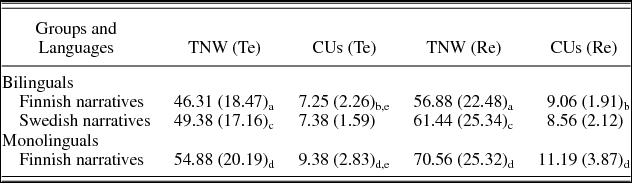
The narrative sample collected comprised 64 narratives for the bilingual children (32 Finnish narratives and 32 Swedish narratives) and 32 narratives for the monolingual children. For the bilingual children, the paired samples t test indicated no statistically significant differences in the length of the Finnish and the Swedish narratives, which were measured as the total number of words and the number of communication units (CUs; see Table 1). However, when the two task types were compared (i.e., telling vs. retelling) the total number of words in the Finnish and Swedish narratives of the bilingual children was higher in the retelling task than in the telling task, Finnish: t = –2.261 (15), p = .039; Swedish: t (15) = –2.355, p = .033. Number of communication units was higher in the retelling task in Finnish only, t (15) = –2.696, p = .017. When the Finnish narratives of the monolingual and the bilingual children were compared, the independent samples t test indicated only one statistically significant difference: there was a higher number of CUs in the narratives of the monolingual children than in the narratives of the bilingual children, telling: t (30) = 2.347, p = .026; retelling: t (30) = 1.970, p = .058. Quite in line with the bilingual children, the monolingual children produced longer narratives in a retelling task than in a telling task, when the two task types were compared, total number of words: t (15) = –3.859, p = .002; CU: t (15) = –2.538, p = .023.
Total number of words (TNWs) and number of communication units (CUs) in the Finnish and Swedish narratives of the bilingual children and in the Finnish narratives of the monolingual children

Note: Te, Telling condition; Re, retelling condition. Values are means (standard deviations), and different subscripts indicate statistically significant differences. Subscripts a–d are from a paired samples t test (p < .05), and subscript e is from an independent samples t test (p < .05).
Macrostructure of Finnish–Swedish bilingual children in both of their languages
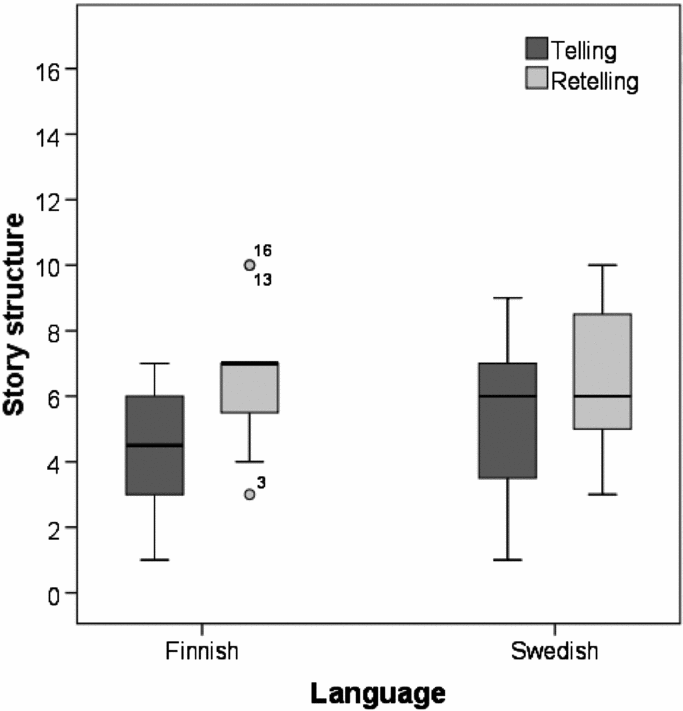
The first question addressed whether, in the case of Finnish–Swedish bilingual children, any differences exist in terms of macrostructure between their two languages. For these analyses, the paired t test for dependent samples was used (within-subject design; significance level set at .05). Effect sizes were determined by computing the value of Hedge's g using the means and pooled standard deviations (Durlak, Reference Durlak2009). Throughout the Results section, effect sizes are reported for hypothesis tests using the set of conventions defined by Durlak (Reference Durlak2009): for bilinguals, small = 0.05, medium = 0.13, and large = 0.20. The story structure analyses revealed a mean score for the bilingual group of 4.56 (95% confidence interval [CI] = 3.57 to 5.55, SD = 1.86) in the story telling task in Finnish and 5.44 (95% CI = 4.22 to 6.65, SD = 2.28) in the story telling task in Swedish (Figure 1). Furthermore, they scored on average 6.56 (95% CI = 5.59 to 7.53, SD = 1.82) in the retelling task in Finnish and 6.38 (95% CI = 5.15 to 7.60, SD = 2.30) in the retelling task in Swedish. The paired samples t test indicated no statistical interlanguage difference, either in the telling task, t (15) = –2.004, p = .063, g = 0.44, or in the retelling task, t (15) = 0.481, p = .637, g = –0.11. However, when the two task types (i.e., telling vs. retelling) were compared, the result revealed a statistically significant difference between storytelling and retelling in Finnish, t (15) = –4.568, p < .001, but no statistically significant difference in Swedish, t (15) = –1.775, p = .096. In order to control Type 1 error, adjustments for multiple comparisons were made using a Bonferroni method with 0.05/n as the threshold for significance. In the present study, n is the number of comparisons within bilingual group or between bilingual and monolingual groups. The interlanguage difference between storytelling and retelling in Finnish was statistically significant also after adjustment for multiple comparisons using a Bonferroni adjustment of 0.05/8 = 0.006 as the threshold for significance.
Story structure score of the bilingual group in both of their languages. The horizontal bold line indicates the median (50% of the data is below this value), the box indicates the upper and the lower 25% of the data, and the whiskers indicate the minimum and the maximum values.

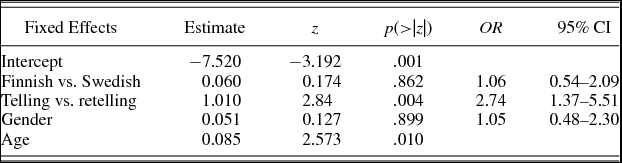
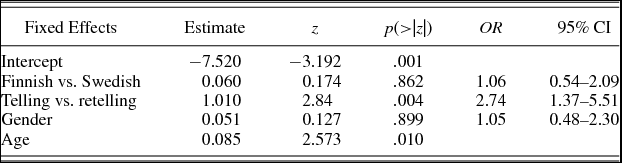
For the purpose of statistical analysis, structural complexity was dichotomized hierarchically: all episodes that indicate a goal statement (i.e., G, GA, GO, and GAO) versus action or reaction sequences, isolated descriptions (i.e., AO, A and O), or productions indicating none of the GAO components. The rationale for such a dichotomization lies in the main difference between episodes and sequences; that is, the goal-directed behavior of the characters is indicated in the episodes, but not in the sequences. Structural complexity was analyzed using the generalized linear mixed model (R version 3.1.0 with glmer-function; Table 2). The modeling was used, because for the purposes of these analyses the categorical variable “structural complexity” (originally a four-category variable) was dichotomized and more basic statistical analyses would not have been sufficient. Based on this model, the fixed effects were language (Finnish vs. Swedish), task type (retelling vs. telling), gender, and age in months; participants were treated as a random effect. The model fit was performed using the Laplace approximation and the odds ratio (OR) and its 95% CI were calculated based on model estimates and standard errors. Structural complexity was measured three times for each child for both telling and retelling tasks in Finnish and also in Swedish. Thus, each child had 12 observations for structural complexity when bilingual group was modeled. Although the results of the bilingual group showed that language had no effect on structural complexity, the number of episodes indicating a goal statement increased by age and by story retelling condition. The OR for the task type was 2.74 (95% CI = 1.37 to 5.51), reflecting a greater number of goal statements in story retelling than in storytelling. Gender had no effect on structural complexity. The qualitative analyses of structural complexity revealed that, in the telling task, only 6.3% of the episodes in the Finnish narratives and 14.6% in the episodes of the Swedish narratives were complete. Abbreviated or incomplete episodes were also quite rare in both languages (8.4% in Finnish; 6.3% in Swedish). Moreover, as many as 85.3% of the productions in Finnish and 79.1% of those in Swedish were isolated descriptions, or temporally or causally related sequences, or statements indicating none of the GAO components. In the retelling task, 14.6% of the episodes produced in Finnish and 12.5% of the episodes produced in Swedish were complete episodes. Abbreviated or incomplete episodes were more frequent (23% in Finnish, 20.8% in Swedish), and over 60% of the productions of the bilingual children were isolated descriptions or temporally or causally related sequences or statements indicating none of the GAO components in either of the languages.
Generalized linear mixed model of the structural complexity of the bilingual group by task type, language, gender, and age
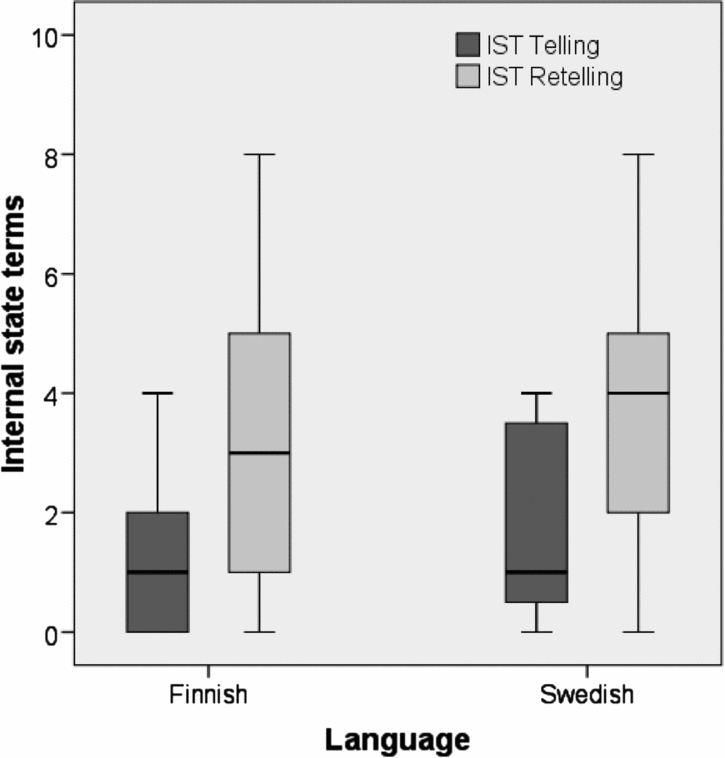
The analysis of the frequency of ISTs among the bilingual group gave an average of 1.25 (95% CI = 0.59 to 1.91, SD = 1.24) ISTs in Finnish and of 1.69 (95% CI = 0.85 to 2.53, SD = 1.58) ISTs in Swedish in the telling task (Figure 2). Further, there was an average of 3.25 (95% CI = 1.97 to 4.53, SD = 2.41) ISTs in Finnish and an average of 3.69 (95% CI = 2.52 to 4.85, SD = 2.18) in Swedish in the retelling task. There were no statistically significant interlanguage differences in storytelling or retelling conditions. However, when the two task types were compared, the paired samples t test demonstrated a statistically significant difference between storytelling and retelling in Finnish, t (15) = –3.814, p = .002, g = 1.01, and in Swedish, t (15) = –3.873, p = .002, g = 0.39. The difference in the frequency of the ISTs between storytelling and retelling in Finnish and in Swedish was statistically significant also after adjustment for multiple comparisons using a Bonferroni adjustment of 0.05/8 = 0.006 as the threshold for significance.
Frequency of internal state terms among the bilingual group in both of their languages. The horizontal bold line indicates the median (50% of the data is below this value), the box indicates the upper and the lower 25% of the data, and the whiskers indicate the minimum and the maximum values.
Comparison of the macrostructure between monolingual and bilingual children
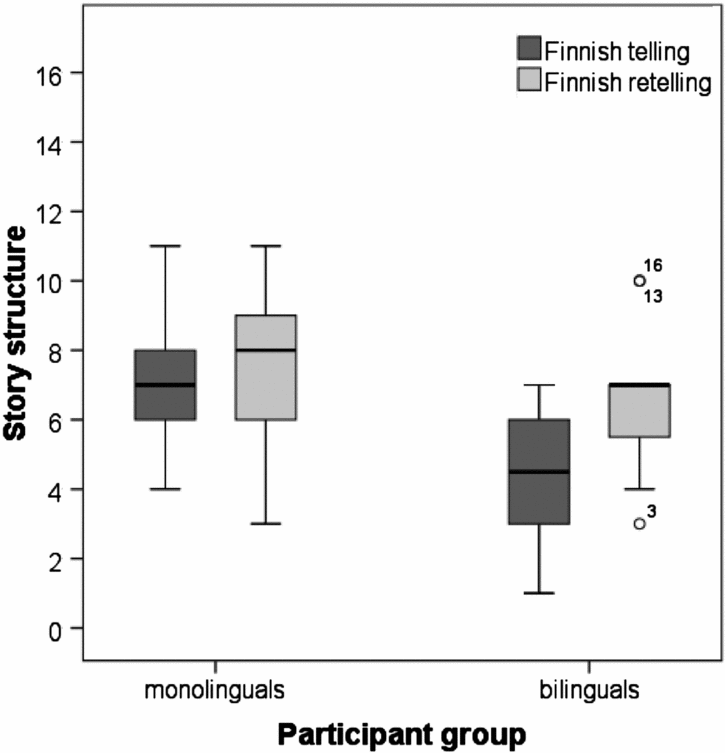
The second question addressed whether there were differences in the macrostructure between Finnish monolingual and Finnish–Swedish bilingual children. For the group comparisons unpaired t test for independent samples was used (between-subject design; the significance level set at 0.05). The story structure analyses indicated clear differences between the monolingual group and the bilingual group in the storytelling task. The monolingual group scored on average 6.94 (95% CI = 6.04 to 7.84, SD = 1.69) and the bilingual group scored 4.56 (95% CI = 3.57 to 5.55, SD = 1.90) in storytelling (Figure 3). The independent samples t test revealed that this difference was also statistically significant, t (30) = 3.777, p = .001, g = –1.20. The group difference in storytelling was statistically significant also after adjustment for multiple comparisons using a Bonferroni adjustment of 0.05/4 = 0.013 as the threshold for significance. However, when the difference between the groups was analyzed in a retelling task, no statistically significant difference resulted, t (30) = 1.452, p = .157, g = –0.45. The monolingual children scored 7.56 (95% CI = 6.46 to 8.66, SD = 2.07) and the bilingual children scored 6.56 (95% CI = 5.59 to 7.53, SD = 1.83).
Story structure score of the monolingual and bilingual groups. The horizontal bold line indicates the median (50% of the data is below this value), the box indicates the upper and the lower 25% of the data, and the whiskers indicate the minimum and the maximum values.
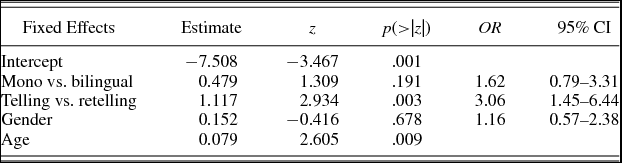
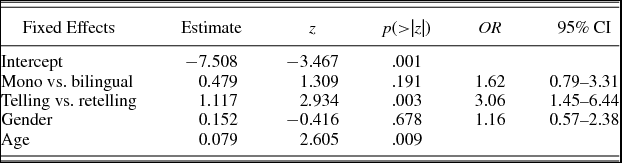
For the analysis of the structural complexity of the monolingual and bilingual groups, the same dichotomization was used as in the analysis of the bilingual group, for both of their languages. Here, too, structural complexity was analyzed using the generalized linear mixed model, where the fixed effects were group (monolingual vs. bilingual), task type (retelling vs. telling), gender, and age in months, and as a random effect, participants (Table 3). Odds ratios and confidence intervals were calculated as in the analyses of the bilingual group. The structural complexity was measured three times (episodes) for each child for both telling and retelling tasks. Thus each child had six observations for structural complexity when monolingual and bilingual groups were modeled. The results showed that the language group (monolingual vs. bilingual) had no effect on the structural complexity of narratives produced in Finnish, but story retelling and age increased the number of episodes indicating a goal statement. The OR for task type was 3.06 (95% CI = 1.45 to 6.44), reflecting the greater number of goal statements in story retelling than telling. In addition, gender had no effect on structural complexity. For the qualitative analyses of structural complexity, the results for the monolingual group and the bilingual group were pooled because the generalized linear mixed model (with Laplace approximation) revealed no effect on the group (monolingual vs. bilingual). The results revealed that, in the telling task, 5.2% of the episodes were complete and 8.3% abbreviated or incomplete. In the retelling task 11.5% of all episodes were complete and 19.8% were abbreviated or incomplete. Moreover, 86.5% of productions in the telling task and 68.7% in the retelling task were still isolated descriptions, temporally or causally related sequences, or statements indicating none of the GAO components.
Generalized linear mixed model of the structural complexity of the monolingual and bilingual groups by task type, language group, gender, and age
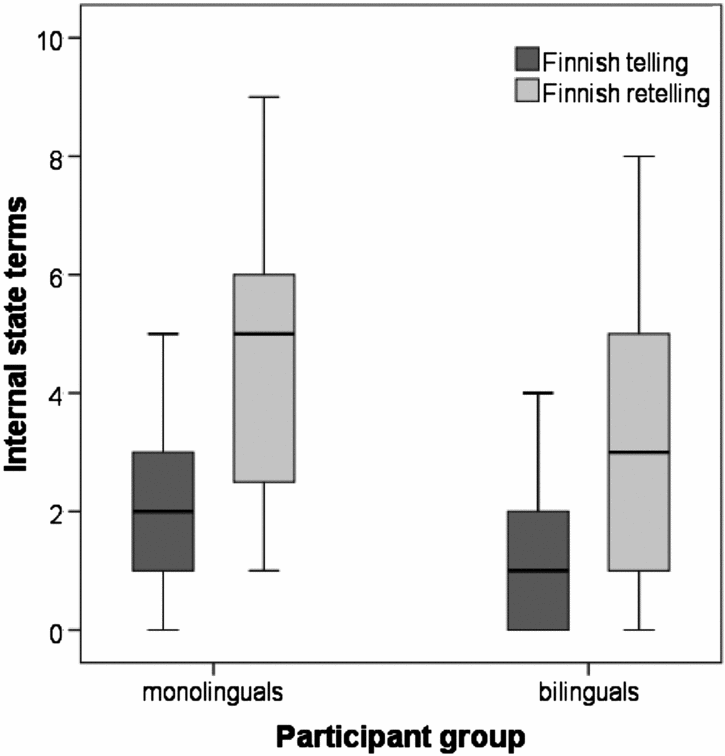
Analyses of the ISTs indicated that the monolingual group produced an average of 2.19 (95% CI = 1.36 to 3.02, SD = 1.56) ISTs and the bilingual group an average of 1.25 (95% CI = 0.59 to 1.91, SD = 1.24) ISTs in the storytelling task (Figure 4). The comparable scores in the retelling task were 4.44 (95% CI = 3.21 to 5.67, SD = 2.31) and 3.25 (95% CI = 1.97 to 4.53, SD = 1.83), respectively. The independent samples t test showed no statistically significant differences between these two groups of children in the two elicitation tasks, t (30) = 1.884, p = .069, g = –0.59; t (30) = 1.424, p = .165, g = –0.45.
Frequency of internal state terms among the monolingual and bilingual groups. The horizontal bold line indicates the median (50% of the data is below this value), the box indicates the upper and the lower 25% of the data, and the whiskers indicate the minimum and the maximum values.
DISCUSSION
The current study was focused on providing insights on the narrative macrostructure of 5- to 6-year-old simultaneously bilingual Finnish–Swedish children who reside in communities in which both languages are widely spoken and valued. In theoretical terms, this age group has proven fruitful for researchers because children's narratives undergo major development during this phase (Hughes et al., Reference Hughes, McGillvray and Schmidek1997; Muñoz et al., Reference Muñoz, Gillam, Peña and Gulley-Faehnle2003; Peterson & McCabe, Reference Peterson and McCabe1983; Price et al., Reference Price, Roberts and Jackson2006; Schneider et al., Reference Schneider, Hayward and Dubé2006). It has been shown that 5-year-olds can produce narratives consisting of interrelated sentences that reflect a coherent plot structure, as well as the narrator's thematic motivation, which demands some interrelation among linguistic, cognitive, and social abilities (reflected in microstructure and macrostructure). Although Finland's official national languages are Finnish and Swedish, very few studies have been conducted on the language development of the related bilingual group, and none have been conducted on narrative development within the group. This study was therefore conducted as a first step toward establishing reference values for a narrative macrostructure elicited using the MAIN (Gagarina et al. Reference Gagarina, Klop, Kunnari, Tantele, Välimaa and Balciuniene2012, in press) with respect to simultaneously Finnish–Swedish bilingual children. Our specific aim was to compare the narrative skills of these bilingual children in both of their languages, and to compare these skills to those of monolingual Finnish children. For both groups of children, the two elicitation tasks (telling and retelling) were also compared.
The results for the bilingual group indicated no statistically significant difference in story structure score between their two languages for either of the elicitation tasks. This result seems to emphasize the effect of a fairly balanced bilingualism; at the age of 5 to 6 years, these children were already able to demonstrate story structure elements almost equally well in both of their languages. Such a result accords with Fiestas and Peña (Reference Fiestas and Peña2004), who found no interlanguage differences in the overall story grammar rating of Spanish–English dual language learners aged 4–6. In contrast, our results contrast with studies of bilingual children by Uccelli and Páez (Reference Uccelli and Páez2007) and Gutierrez-Clellen (Reference Gutiérrez-Clellen2002), who both reported some differences in story structure between Spanish and English narratives. These differences in findings may be attributable to either a different balance between the two languages the participants are acquiring, or sociocultural aspects. Given the fact that the children have fairly equal proficiency in both of their languages and they come from equal sociocultural contexts, the results of the present study seem to emphasize that they should be able to integrate enough relevant information into their stories to convey the elements of the macrostructure.
In our study, story structure score was analyzed separately for storytelling and retelling conditions. The results showed that the bilingual children had clearly lower scores in the storytelling task than in the retelling task when using the Finnish language. No such difference between task types was evident in Swedish. It is interesting that this task difference was only evident in Finnish. Although the children were simultaneously bilingual and the parents reported fairly equal daily input for both languages, and only slight favoring of Swedish, it may still be that Swedish was a somewhat stronger language for some of the children. Our results also indicated statistically significant differences between bilingual Finnish–Swedish children and monolingual Finnish children in their Finnish narratives. Such differences only became evident during the telling task. The telling task (i.e., story generation) may have been more demanding, because the child is expected to generate a story without the benefit of a prior model. As shown by previous studies, the telling task may provide more information than the retelling task on children's capabilities to form independent narratives (Schneider, Reference Schneider1996; Schneider & Dubé, Reference Schneider and Dubé1997, Reference Ilgaz and Aksu-Koç2005; Schneider et al., Reference Schneider, Hayward and Dubé2006). If the language abilities of a bilingual child are somewhat unbalanced between the two languages the child is acquiring, a storytelling task may better reveal any slight differences in her or his narrative abilities. Such minor differences could remain unrevealed if only retelling tasks with prior model are used. In addition, typically developing children can be quite resourceful in taking advantage of the model applied: we might hypothesize that the significant difference observed between telling and retelling in Finnish is indicative of the effect of the prior model, as demonstrated by Soodla (Reference Soodla2011, p. 32), for example, with respect to typically developing Estonian monolingual children. The results of the present study may therefore highlight the importance of using different elicitation tasks when assessing the narrative abilities of bilingual children.
Analyses of the bilingual group's structural complexity revealed that language (Finnish vs. Swedish) had no effect on structural complexity, whereas the task type had; that is, structural complexity was similar in Finnish and Swedish, but story retelling increased the number of episodes indicating a goal statement. In other words, children produced more episodes with higher structural complexity (i.e., abbreviated, incomplete, and complete episodes) in the retelling task, but more sequences with lower structural complexity (i.e., action and reaction sequences, isolated descriptions, or statements indicating none of the GAO components) in the telling task. Our findings regarding the relatively equal complexity in both languages of bilingual children are fairly consistent with the study by Fiestas and Peña (Reference Fiestas and Peña2004), who also reported relatively equal complexity in the case of 4- to 6-year-old Spanish–English bilingual children. Furthermore, the results of our study revealed no group effect (monolingual vs. bilingual) in structural complexity among 5- to 6-year-old monolingual and bilingual children. The level of complexity achieved by these children accords fairly well with the earlier studies, which show that children begin to produce abbreviated, incomplete, and complete episodes in their narratives at around this age. In turn, this indicates a well-established concept of basic narrative structure among such children (e.g., Hughes et al., Reference Hughes, McGillvray and Schmidek1997; Ilgaz & Aksu-Koç, Reference Ilgaz and Aksu-Koç2005; Muñoz et al., Reference Muñoz, Gillam, Peña and Gulley-Faehnle2003; Peterson & McCabe, Reference Peterson and McCabe1983). In the analysis of structural complexity, gender and age were also included as fixed effects. The results revealed that, while gender had no effect on structural complexity, age did. In the present study, the children's ages varied from 5 years to 6 years, 7 months. The fact that age per se had an effect on structural complexity may indicate active development in the children's narrative abilities at this age, as reported in studies of monolingual children. Hence, more research is required on the development of narrative abilities among bilingual children.
No differences between the languages of bilingual children were revealed in the present study's findings on the frequency of use of ISTs. In addition, no difference between monolingual and bilingual children was revealed in terms of the frequency of use of ISTS. However, regardless of the language, all of the children produced more ISTs in the retelling task than in the telling task. This is consistent with Chen and Yan's (Reference Chen and Yan2011) findings on bilingual Chinese–English and monolingual English children. Their results also revealed no differences between monolingual and bilingual children, in terms of references to characters’ mental and emotional states and behaviors. Although their study indicates some differences between monolingual and bilingual children in the use of evaluative expressions in their narratives, such differences may be more attributable to the age of the children and the use of other evaluative elements (i.e., negatives and causal connectors) rather than merely internal states. In general, the present study's results on the emergence of ISTs in narrative production by children accords fairly well with previous studies indicating that, at the ages of 5 to 6, children already relate the internal states of characters to the characters’ actions, thus demonstrating the characters’ goals and plans. This has been shown to be associated with developing ToM abilities (e.g., Curenton, Reference Curenton2004; Trabasso et al., Reference Trabasso, Stein, Rodkin, Park Munger and Baughn1992). By contrast, the low frequency of ISTs indicates that these abilities are still emerging and may lead us to expect more frequent and more varied use of ISTs in the narratives of older children, as also shown by several earlier studies (Bamberg & Damrad-Frye, Reference Bamberg and Damrad-Frye1991; Ukrainetz et al., Reference Ukrainetz, Justice, Kaderavek, Eisenberg, Gillam and Harm2005).
Assessment of the narrative skills of bilingual children poses challenges in terms of study design, because the children's skills should ideally be assessed in both of their languages in order to avoid underestimating their abilities. This holds true in both within-subject and between-subject comparisons of monolingual and bilingual children. In the present study, the order of assessment of bilingual children was counterbalanced with regard to language and story (i.e., the set of picture-based stimuli). This was done in order to minimize the learning effect that might be seen if the children were assessed using the same stimuli in both languages. However, the assessments were initiated with a telling task in each case. This was done to minimize the possible crossover effect caused by the reverse order. The results of the present study revealed within-subject differences in the bilingual children's narrative skills but only in the telling task in Finnish. Such minor differences, which could be attributable to slightly unbalanced skills between the two languages, could remain undiscovered if only one type of story elicitation method is used. In the future, it would be interesting to investigate whether the task type difference changes or stabilizes in the narratives of older children. Furthermore, one cannot totally rule out the possible practice effect caused by the fixed order of assessment (i.e., the telling task always preceding the retelling task).
One clear limitation of the present study is that it addressed narrative macrostructure only at ages 5 to 6. As several previous studies have shown, story content, structural complexity, and the use of ISTs are just beginning to develop at ages 5 to 6 and continue to develop considerably throughout school age. Therefore further studies on the development of the narratives of the Finnish–Swedish bilingual children are needed.
The MAIN used in the present study seemed to elicit narratives that, in developmental terms, could be regarded as fairly comparable to previously reported narratives on monolingual and bilingual children aged 5 to 6 years. Although more information is needed on the reliability and validity of the MAIN, the instrument seems to capture the developmental trend typical of monolingual and bilingual children, at least regarding macrostructure. The relatively low scores achieved in story structure by the 5- to 6-year-olds observed in the present study indicate that the MAIN could be useful in determining the narrative skills of even older bilingual children. Future studies should focus on establishing both macrostructure and microstructure reference values for the developmental trend typical of monolingual and bilingual children, as well as disentangling bilingualism and language disorders.
ACKNOWLEDGMENTS
The research reported in this article was supported by the COST Action IS0804 and by the Academy of Finland. We thank Riikka Lankila and Milla Bucht for their assistance with data collection and the children and their families for participating in this study.