Introduction
Land use changes driven by anthropogenic activities are primary drivers of biodiversity loss and altering ecosystem function, especially in tropical biomes (Srivastava et al. Reference Srivastava, Mohapatra and Latare2019). A dominant human activity was clearing natural forests for development of agricultural activities (Czimczik et al. Reference Czimczik, Mund, Detlef, Wirth, Griffiths and Jarvis2005). These activities are major drivers of habitat fragmentation (Alroy Reference Alroy2017) and forest cover loss globally (Yeshaneh Reference Yeshaneh2015), currently reduced to 3% (Löf et al. Reference Löf, Madsen, Metslaid and Witzell2019). Forest clearing is also a major driver of changes in vegetation structure (Karp et al. Reference Karp, Rominger, Zook, Ehrlich and Daily2012), in light of shifts in forest dynamics (Chancellor et al. 2012a). Also, once a natural land is transformed into agricultural land, different management practices can affect flora and fauna of wild communities by reducing their food and giving place to predators (Bain et al. Reference Bain, Macdonald, Hamer, Gardiner, Johnson and Jones2020). An example is the use of pesticides to protect crops from herbivory which may change species richness and diversity of invertebrates (Römbke et al. Reference Römbke, Schmelz and Pélosi2017). Another example is the use of chemical fertilizers to improve productivity, which may also cause changes in soil properties, and hence the community composition of soil fauna (Thorn et al. Reference Thorn, Bässler, Svoboda and Müller2017; Yeshaneh Reference Yeshaneh2015).
To improve and compensate land degradation ecologically, reforestation activities were applied in different countries (Kooch et al. Reference Kooch, Tavakoli and Akbarinia2018), by regenerating natural forests, or planting exotic tree species (D’Ippolito et al. Reference D’Ippolito, Ferrari, Iovino, Nicolaci and Veltri2013). Reforestation improves human livelihoods (Bullock et al. Reference Bullock, Aronson, Newton, Pywell and Rey-Benayas2011), and provides goods such as firewood, timber and medicines to humans (Frolking et al. Reference Frolking, Palace, Clark, Chambers, Shugart and Hurtt2009). It provides also ecological services (Faber & Wensem Reference Faber and van Wensem2012) such as water and air purification, erosion control and carbon harvesting (Vaglio et al. Reference Vaglio, Hawthorne, Chiti, di Paola, Gatti, Marconi, Noce, Grieco, Pirotti and Valentini2016). However, despite the advantages of reforestation, negative effects were also encountered in different areas, especially when non-native tree species are used (Quine & Humphrey Reference Quine and Humphrey2010). Such reforestation decreases the vegetation cover of native species, consumes high soil nutrients and requires much water (Cao et al. Reference Cao, Chen and Yu2009). Further, regeneration with non-native tree species can facilitate damaging invasions (Ren et al. Reference Ren, Lu, Shen, Huang, Guo, Li and Jian2009), and accelerate the loss of native species (Schlaepfer Reference Schlaepfer2018).
To evaluate effects of land use change and reforestation activities on biodiversity, different studies have used invertebrates as biological indicators (Barlow et al. Reference Barlow, Overal, Araujo, Gardner and Peres2007; Solar et al. Reference Solar, Barlow, Ferreira, Berenguer, Lees, Thomson and Louzada2015) through the assessment of their functions in an ecosystem (Ciaccia et al. Reference Ciaccia, Ceglie, Burgio, Madžarić, Testan, Muzzi, Mimiola and Tittarelli2019). In this perspective, soil-litter arthropod groups are a frequent focus (Maleque et al. Reference Maleque, Maeto and Ishii2009). The most common parameters assessed include changes in their occurrences, abundance and diversity (Yi & Moldenke Reference Yi and Moldenke2005), as well as their ecological functions, such as the decomposition of organic matter (Magcale-Macandog et al. Reference Magcale-Macandog, Manlubatan, Javier, Edrial, Mago, de Luna, Nayoos and Porcioncula2018). Among arthropods, ants (Hymenoptera: Formicidae) are preferred (Basset et al. Reference Basset, Cizek, Cuénoud, Didham, Novotny, Ødegaard and Roslin2015), based on the key functional roles that they play (Luke et al. Reference Luke, Fayle, Eggleton, Turner and Davies2014). These include maintaining soil health and soil fertility, recycling soil nutrients, energy flow, seed dispersal (del Toro et al. Reference Del Toro, Rbbons and Pelini2012) and soil turnover (Hill et al. Reference Hill, Summerville and Brown2008).
In addition, some ant species are successful colonizers of disturbed or restored habitats (Andersen & Majer Reference Andersen and Majer2004; Ferreira et al. Reference Ferreira, Ribeiro, De Castro, Barlow, Andersen, Schoereder, Berenguer, Ferreira and Alan2016). Assessments of land use change therefore may focus on variation in ant species abundance, and overall ant community composition (Andersen & Majer Reference Andersen and Majer2004; Blinova & Dobrydina Reference Blinova and Dobrydina2019; Tibcherani et al. Reference Tibcherani, Nacagava, Aranda and Mello2018). However, few studies have assessed responses of ant species to forest disturbance (Leal & Filgueiras Reference Leal and Filgueiras2012; Vasconcelos & Bruna Reference Vasconcelos and Bruna2012; Vasconcelos et al. Reference Vasconcelos, Vilhena, Magnusson and Albernaz2006), and no such study has been done in Rwanda. To fill this gap and provide a baseline data on effects of land use change on ant communities, the present study examined effects of land use change on ant communities in Gishwati forest, located in northern-western Rwanda.
Although some researchers studied the biodiversity of Gishwati (Chancellor et al. 2012a; Chancellor et al. 2012b; Reference Chancellor, Rundus and Nyandwi2017; Inman & Ntoyinkama Reference Inman and Ntoyinkama2020; Kisioh Reference Kisioh2015; Plumptre et al. Reference Plumptre, Davenport, Behangana, Kityo, Eilu, Ssegawa and Ewango2007); less is known about its entomological diversity. Indeed, no research has been done on the diversity of ants in the area, and less is known about how reforestation activities affect the communities of ants. This study presents the first detailed study of ants in the area. It examined the response of soil-litter ant communities to reforestation in secondary forests composed of regenerated native and exotic tree species based on ants collected in 2019. We addressed three specific questions: (1) how do species richness and species composition of ants vary among natural and reforested lands? (2) how does species diversity vary in each studied forest type? and (3) what ant species are associated with each forest type? We hypothesized that natural and regenerated native forests would offer better conditions for ant species than the forest dominated by exotic plantations.
Materials and methods
Area of study
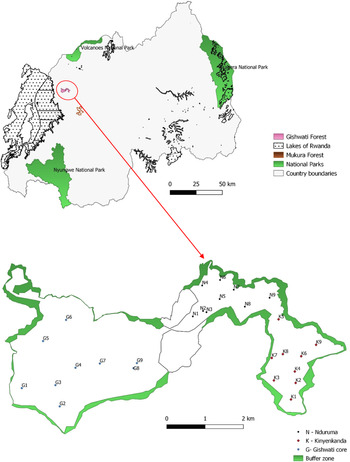
Gishwati forest is located in northern-western Rwanda (Figure 1), in the region of 1°36′52″, 1°52′17″ south, and 29°21′40″, 29°28′50″ east. Its climate is that of the region, dominated by the rainfall. During the period of data collection, average rainfall was 1,823 mm during the rainy season (April–May) and 1,136 mm in the dry season (June–July). Temperature varied between 25°C and 26°C during the day, and between 13°C and 15°C during the night. Elevation varies between 2,020 and 2,500 m (Chancellor et al. 2012a), with the mean slope of 25.6°. This topography produces a wet valley in western part of the forest (Chancellor et al. 2012b). Gishwati forest is made of three fragments comprising the primary natural forest (Gishwati core), regenerated native tree species dominated by Macaranga capensis var kilimandscharica and Maesa lanceolata located at Kinyenkanda, and reforested lands with Acacia melanoxylon and Acacia mearnsii tree species located at Nduruma (Figure 1).
Location of Gishwati forest in Rwanda and location of sampling points in each forest type. G: Gishwati core primary forest, K: Kinyenkanda secondary forest (regenerated native tree species), N: Nduruma secondary forest (reforested with exotic tree species); numbers indicate sampling points pear each forest type.

The forest is part of the Albertine Rift, an area of conservation importance thanks to its richness in animal and plant biodiversity (Olson & Dinerstein Reference Olson and Dinerstein1998). The forest has been reduced gradually by human activities; its largest part being transformed into agricultural lands. It was reduced from its original 800,000 ha to 28,000 ha by the 1970s, and to 600 ha by 2005. Since then, restoration activities started, and 886 ha were designated as Gishwati core primary natural forest in 2007. In 2008, around 336 ha reforested with Acacia tree species were added to the core forest, and in 2009, other 262 ha of regenerated forest dominated by native trees, bamboo and fern species were incorporated in the forest. Gishwati is thus currently composed of 1,484 ha comprising natural land dominated by native primary forest, and reforested lands dominated by a secondary forest made of regenerated native species and exotic tree species (Courard-houri et al. Reference Courard-houri, Chester, Rundus and Chester2016). Together with the neighbouring Mukura forest, Gishwati was decreed as Gishwati-Mukura National Park by the law N0 45/2015 on 15 October 2015 (GoR [Government of Rwanda] 2016).
The main purpose of creating the national park was the conservation of its biodiversity, much of it being endemic to the area. The forest is dominated by around 58 species of indigenous hardwood trees, bamboo and shrubs of particular conservation importance. Animal species identified in the forest include the eastern chimpanzee (Pan troglodytes schweinfurthii), the golden monkey (Cercopithecus mitis kandti) and the l’Hoest’s monkey (Cercopithecus l’hoesti) (Chancellor et al. Reference Chancellor, Rundus and Nyandwi2017). The forest is also home to other mammals such as red river hog (Potamochoerus porcus), black front duiker (Cephalophus nigrifrons), the southern tree hyrax (Dendrohyrax arboreus) and serval (Felis serval). Gishwati forest is also home to around 155 species of birds (Inman & Ntoyinkama Reference Inman and Ntoyinkama2020). Amphibians inhabiting the forest include the brown forest frog (Litoria ewingii) and different species of toads, while reptiles include the great lakes bush viper (Atheris nitschei) and different chameleon species (Kisioh Reference Kisioh2015).
Sampling design and identification
In each forest type, nine sampling points of 1 m2 quadrat were selected by leaving 5 m from the edge to avoid edge effects and keeping a distance varying between 300 and 400 m in the natural forest and between 500 and 600 m in the regenerated forest to avoid autocorrelation. At each sampling point, pitfall traps made of a water plastic bottle (6.5 cm diameter and 12 cm depth) were placed in a soil pit. Each trap was filled with a volume of 30 ml of 70% ethanol to capture and maintain captured ants. Traps were collected every 24 hours for two months in the rainy season (April–May) and two months in the dry season (June–July) in 2019. To collect a wide range of ants, data were also collected by hand sampling especially for foraging ants. Data were collected during 30 minutes at each sampling point, in a 1 m2 quadrat (Tista & Fiedler Reference Tista and Fiedler2011). Further, leaf-litter was collected at each sampling point and sieved through a Winkler extractor. Then, ant specimens were extracted from the litter using the dry sieve method (Wiezik et al. Reference Wiezik, Svitok, Wieziková and Dov2015). Each sampling technique was applied two times in each sampling points, and two times for each season, totalling 108 pitfall traps, 108 hand collections and 108 Winkler extractions.
Ants were first identified morphologically to subfamily and genus (Fisher & Bolton Reference Fisher and Bolton2016). Next, specimens of each genus were identified to species via microscope and keys (Bolton & Fisher Reference Bolton and Fisher2008; Borowiec Reference Borowiec2016; Fischer et al. Reference Fischer, Garcia and Peters2012; Rigato Reference Rigato2016; https://www.antsofafrica.org). When the name of the species was not found in the identification keys, the genus name was maintained, while the species name was designated by the abbreviation SP followed by the numbers from 01. For definitive confirmation of species names, samples were taken to the Royal Belgian Institute of Natural Science, Brussels, Belgium. There, each identified species was compared with image banks available on AntWeb database (AntWeb 2020), and ant collections of the museum. Specimens are now housed at the Centre of Excellence for Biodiversity and Natural Resources Management (CoEB), College of Science and Technology, University of Rwanda.
Data analysis
Ant species richness was calculated based on total observed number of ant species per forest type, sampling technique and sampling points (Verdinelli et al. Reference Verdinelli, Yakhlef, Cossu, Pilia and Mannu2017). Diversity indices namely dominance (D′), Shannon (H′) and equitability (J′) were calculated for each forest type to provide more information on ant communities (Daly et al. Reference Daly, Baetens and de Baets2018; Supriatna Reference Supriatna2018). Further, the ANOVA tests were used for each forest to evaluate the variation in abundance of ant species between forest types (Etherington Reference Etherington2019; Itoh et al. Reference Itoh, Ohkubo, Nanami, Tan and Yamakura2010; Singhal & Rana Reference Singhal and Rana2015). Then, the abundance of ant species per sampling points and forest types were ordinated in non-metric multidimensional scaling (NMDS) based on Bray–Curtis similarity index (Taguchi & Oono Reference Taguchi and Oono2005).
The Bray–Curtis similarity index was also used for analysis of similarity (ANOSIM) to test for the significant differences in species composition between sampling points and forest types (Clarke Reference Clarke1993). This was estimated following the R values. When R was closer to zero, we concluded a low dissimilarity (high similarity) between forest types. On the other hand, when R values were closer to 1, we concluded a high dissimilarity (low similarity) between forest types (Clarke & Green Reference Clarke and Green1988). Finally, the similarity perecentage analysis (SIMPER) was calculated to determine which ant species contributed more to the similarity in species composition among forest types. High percentage implied high contribution, while low percentage explained low contribution to the similarity in species composition among forest types (Clarke Reference Clarke1993; Clarke & Green Reference Clarke and Green1988). All calculations were performed using the Paleontological Statistics Software (PAST) version 4.02.
Results
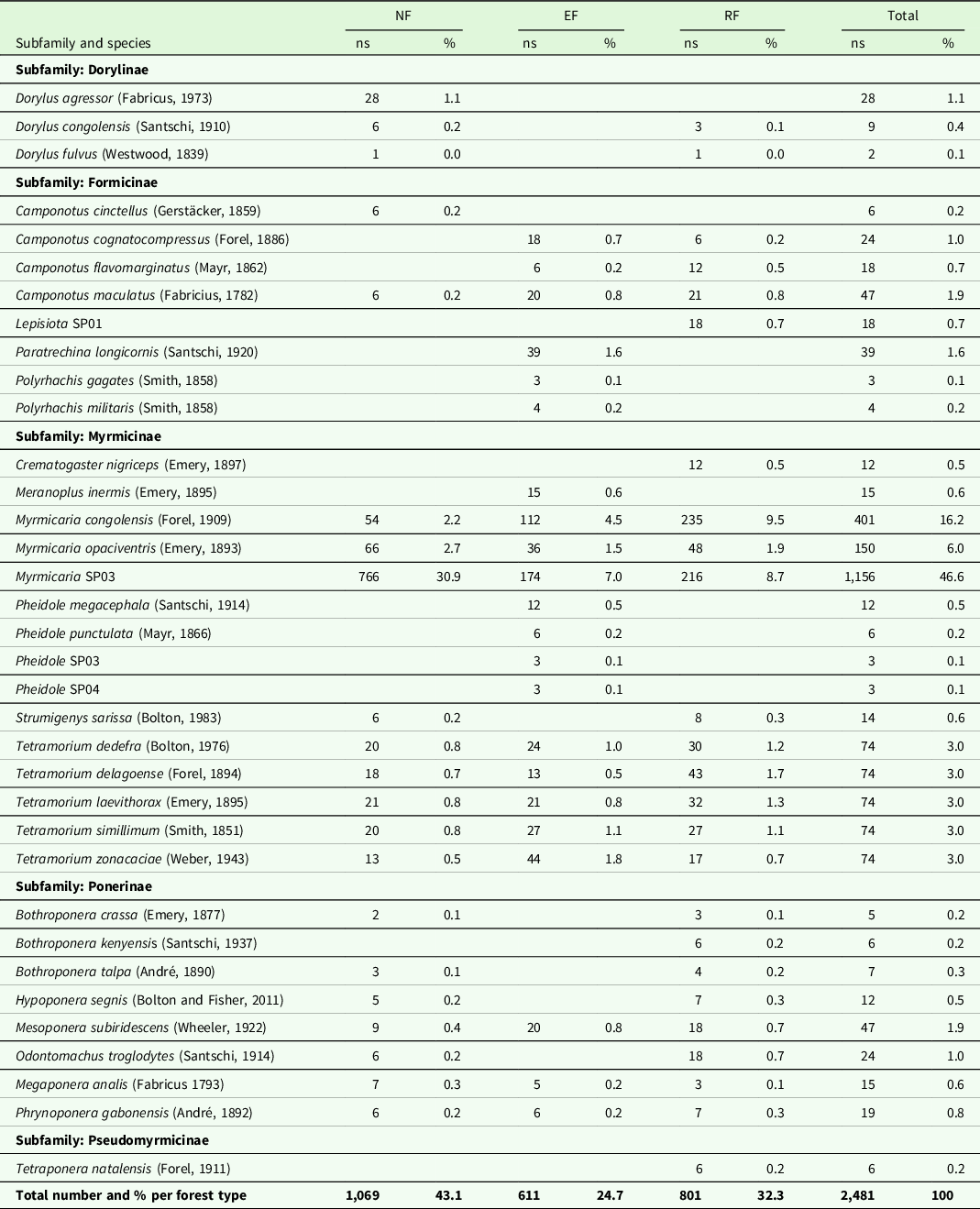
We identified a total of 2,481 individuals belonging to 5 subfamilies, 18 genera and 35 ant species (Table 1). Higher ant abundance was found in native primary forest (43.1% of total abundance), compared to regenerated native species (32.3% of total abundance) and exotic tree species (24.6% of total abundance) of the secondary forests. Higher abundance of ants was collected by using pitfall traps (57.1% of the total abundance) compared to Winkler extractor (31.4% of the total abundance) and hand sorting (11.5% of the total abundance). Taking all results together, the subfamily Myrmicinae had higher total abundance (86.3%) than Formicinae (6.4%), Ponerinae (5.4%), Dorylinae (1.6%) and Pseudomyrmicinae (0.2%). The subfamily Ponerinae had more genera, while Myrmicinae had a higher number of species counted at 15. Myrmicaria SP03 had more abundance (46.6%) than other ant species (Table 1). The Myrmicaria SP03 differed from Myrmicaria opaciventris by the lack of ferruginous dull and in the structure of the postpetiole. It differed from Myrmicaria congolensis by the absence of densely packed fine longitudinal striations actually present at the dorsum of promesonotum in Myrmicaria congolensis. Further, Myrmicaria SP03 does not have the dull and red-brown gaster present in Myrmicaria Congolensis.
Abundance of ant species per forest type (ns: number of specimens, NF: natural forest, EF: exotic forest, RF: regenerated forest, %: percentage)

The total species richness was significantly higher in natural primary forest (mean = 30.5, Standard Error [SE] = 21.8), than the secondary forest with regenerated native (mean = 23.7, SE = 8.8, F = 0.1, p > 0.05), and exotic tree species (mean = 16.7, SE = 5.8, F = 0.4, p > 0.05). Different ant species were commonly found in primary natural forest (D′: mean = 0.5, SE = 0.1, p < 0.05), and in secondary forests of exotic tree species and regenerated native species (D′: mean = 0.2, SE = 0.0). However, the regenerated secondary forest had higher species diversity H′ (mean = 2.0, SE = 0.1), compared to secondary forest with exotic (mean = 1.9, SE = 0.1) and natural primary (mean = 1.1, SE = 0.1) forest. The species equitability (J′) in ant species identified in secondary forest with exotic trees was higher (mean = 0.8, SE = 0.1), than the equitability in the primary native forest (mean = 0.7, SE = 0.0), and the equitability in the secondary forest dominated by regenerated native species (mean = 0.5, SE = 0.0).
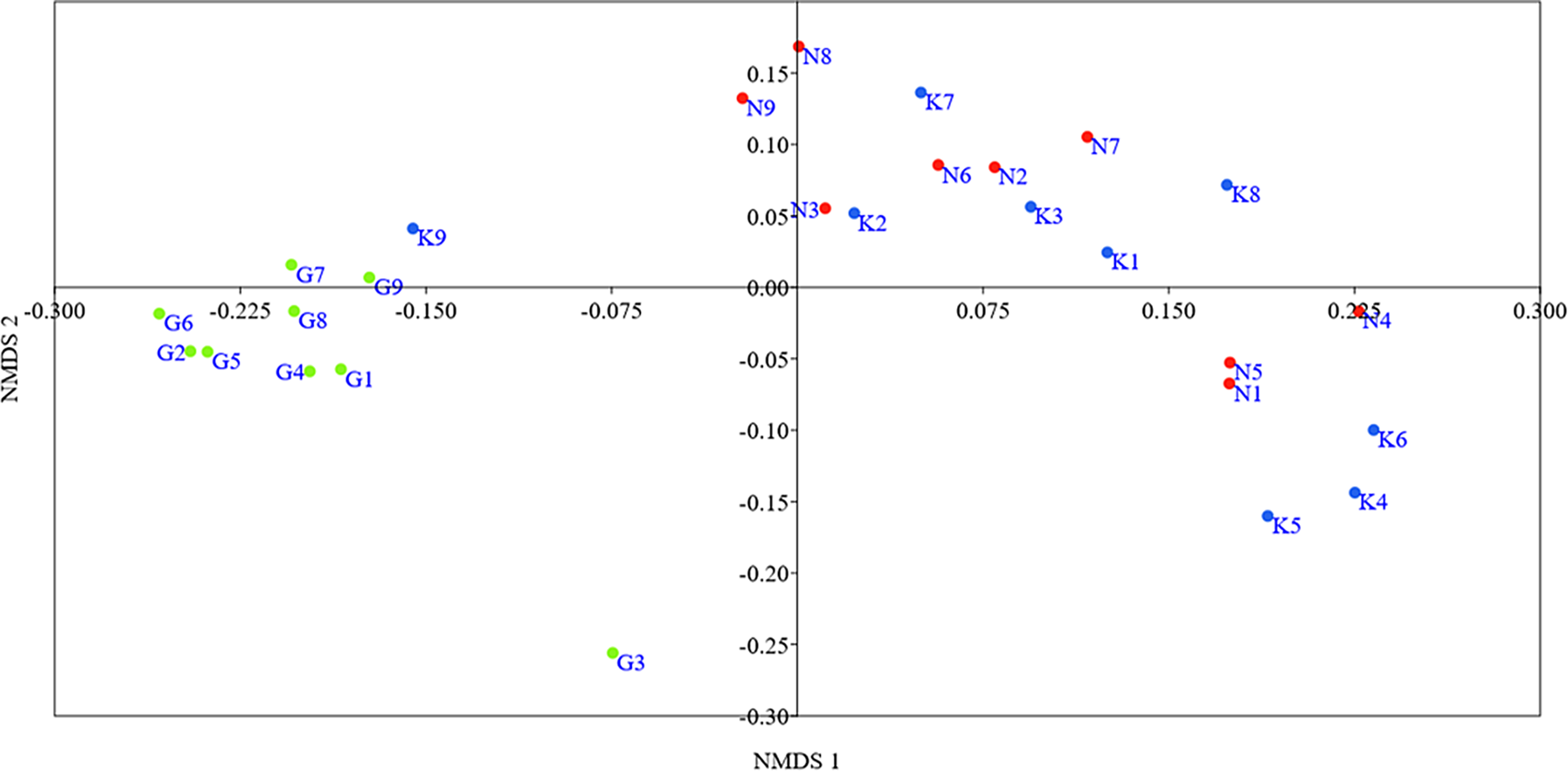
The NMDS based on Bray–Curtis similarity index between forest types indicated differences in sampling points (Stress = 0.14, Axis1 = 0.71, Axis2 = 0.15, p < 0.05, Figure 2). From Figure 2, it is also clear that the ant communities in Gishwati primary forest sampling points were different from that found in secondary forests. The ANOSIM by taking into consideration the whole community of ants indicated that species composition differed among forest types (R = 0.62. p < 0.005). High similarity in species composition was found between ant species collected under native primary forest and regenerated native secondary forest (R = 0.09, p < 0.005). Low similarity was found between ant species sampled under primary native tree forest and exotic secondary forest (R = 0.88, p < 0.005). This was also found in secondary forest, between the forests regenerated with native and exotic tree species (R = 0.75, p < 0.005).
Non-metric multidimensional scaling (NMDS) based on the Bray–Curtis similarity index between the forest types (G: Gishwati core natural primary forest, N: Nduruma land (dominated by exotic tree species), K: Kinyenkanda land (dominated by regenerated native species). The numbers correspond to the sampling points.

The SIMPER showed that 13 ant species most contributed to the average dissimilarity among species assemblages (% dissimilarity > 1%). These are Myrmicaria SP03 (29.5, 38.5%: average dissimilarity and contribution), Myrmicaria congolensis (18.8, 24.5%), Dorylus aggressor (10.5, 13.7%), Myrmicaria opaciventris (3.3, 4.3%), Tetramorium zonacaciae (1.5, 2.0%), Tetramorium simillimum (1.12, 1.43%). Tetramorium dedefra (1.04, 1.36%), Mesoponera subiridescens (1.01, 1.31%) Lepisiota SP01 (1.0, 1.30%), Tetramorium laevithorax (0.98, 1.28%), Camponotus maculatus (0.94, 1.23%), Camponotus flavomarginatus (0.86, 1.13%) and Tetramorium delagoense (0.78, 1.01%). Other ant species showed little average dissimilarity and contribution percentage (% of dissimilarity less than 1%).
Discussion
High abundance of ant species was collected by using pitfall traps, and were found in soil-litter under natural primary forest compared to soil-litter under regenerated native and exotic tree species of the secondary forest. The ability of natural forests to maintain high soil biodiversity has been documented in other studies. It was found to be apparently based on elevated plant diversity and heterogeneity (Kassa et al. Reference Kassa, Dondeyne, Poesen, Frankl and Nyssen2017), that offer nutrients to soil fauna (Bayranvand et al. Reference Bayranvand, Kooch and Rey2017). It is also rooted on the forest canopy density that creates stable macroclimate environments (Kamau et al. Reference Kamau, Barrios, Karanja, Ayuke and Lehmann2017). The influence of environmental conditions and habitats created by primary forest on the abundance of ants was also confirmed by another study conducted in southern Cameroon (Borowiec Reference Borowiec2016; Fotso et al. Reference Fotso Kuate, Hanna, Tindo, Nanga and Nagel2015).
Camponotus cinctellus and Dorylus aggressor were restricted to the primary native forest. Despite suitable conditions offered by the natural primary forest, these ant species might occur there due to their mode of life. The adaptations of the ants of the genus Dorylus might be influenced by their foraging habits and prey preferences. In this regard, most of Dorylus species are either subterranean, leaf litter or surface foragers (McIntyre et al. Reference McIntyre, Rango, Fagan and Faeth2001; Vanthomme et al. Reference Vanthomme, Alonso, Tobi, Rolegha, Hita, Mikissa and Alonso2017) so that they may occur in all land types. Another study indicated that the Camponotus cinctellus is able to survive in most environmental conditions (Nsengimana et al. Reference Nsengimana, Kaplin, Francis, Kouakou, Dekoninck and Nsabimana2018) mainly in open landscapes such as savannah and cleared forests (Pekár & Haddad Reference Pekár and Haddad2011), and tolerates different land uses (Quine & Humphrey Reference Quine and Humphrey2010). The occurrence of Camponotus cinctellus in natural forest might be associated with the effects of human activities that cleared the forest mainly for agricultural activities.
Eight species of the genera Meranoplus, Polyrachis, Pheidole and Paratrechina were restricted to the exotic forest. Our results also indicated that exotic tree species had less abundance of ant species, cases observed also in another study which indicated that exotic tree species have little relevance for biodiversity conservation (Martin et al. Reference Martin, Gheler-Costa, Rosalino and Verdace2012). They induce the extinction of native species by favouring opportunistic invasive species (Rundel et al. Reference Rundel, Dickie and Richardson2014). Another study indicated that non-native forest plantations affect soil water resources, and change soil physical, chemical and biological characteristics (Boudinot & Fisher Reference Boudinot and Fisher2013; Chomicki & Renner Reference Chomicki and Renner2017).
Back to the genus Meranoplus, available information about the mode of life of the genus is limited. Most species nest directly in the soil, under stones, in rotten wood or in leaf litter (Anderson Reference Anderson2006). However, further studies may focus on the mode of life of the species Meranoplus inermis as available information is more generalized to the genus level. In relation to the genus Polyrachis, the species Polyrhachis militaris is an arboreal ant species. Another study indicated that the species has the ability of changing habitats from arboreal to subterranean (Robson & Kohout Reference Robson and Kohout2007). However, nothing is known if this is the same case for the species Polyrhachis gagates. Occurrence of these species in exotic forest type might be due to their adaptations to the environmental conditions imposed by open and disturbed exotic forest type (Underwood & Brian Reference Underwood and Brian2006).
Exotic forest was also dominated by the highly invasive Pheidole megacephala. Another study indicated that this species is adapted to different land uses mainly cleared, open (Vanderwoude et al. Reference Vanderwoude, Lobry De Bruyn and House2000) and disturbed environments (Kouakou et al. Reference Kouakou, Yeo, Vanderheyden, Kone, Delsinne, Ouattara, Herrera and Dekoninck2017). Another study showed that Pheidole megacephala is a highly invasive species (Horwood Reference Horwood1988), able to gradually replace native ants (AntWeb 2020). The forest is also inhabited by Pheidole punctulata, which, like Pheidole megacephala, has the ability to survive in different types of habitats. It was commonly found in open woodlands, human settlements, tropical dry forest and along the roads (AntWeb 2020). Its specific microhabitat preferences include dead trees, spaces under rocks and tree barks, living and dead tree branches (Kouakou et al. Reference Kouakou, Yeo, Vanderheyden, Kone, Delsinne, Ouattara, Herrera and Dekoninck2017). The occurrence of Pheidole punctulata and Pheidole megacephala and their restriction to the secondary forest made of exotic tree species might be related to their adaptations to the conditions and structure of the secondary forest.
Exotic tree species were also dominated by the species Paratrechina longicornis, which is also an invasive species with the ability to survive in disturbed environments. This species is mainly found in urban centers, gardens and other manmade structures in cool temperate climates (Bini et al. Reference Bini, dos Santos, do Carmo, Kishino, Andrade, Zangaro and Marco Antonio Nogueira2013). Its occurrence in exotic tree species might be associated with the adaptations to the conditions imposed by the disturbed and open secondary forest dominated by exotic tree species.
Five ant species were restricted to the regenerated secondary forest made of native trees: Bothroponera kenyensis, Lepisiota SP01, Tetraponera natalensis and Crematogaster nigriceps. Little information is known about the mode of life of ants from the genus Bothroponera (Hita & Fischer Reference Hita and Fischer2014; Hita et al. Reference Hita, Fischer, Kück, Thormann and Peters2010a, Reference Hita, Fischer and Peters2010b). Concerning the genus Lepisiota, a recent study indicated that all ants from the genus are generalist foragers with diverse nesting habitats, including decaying woods, soil and living trees (Sharaf et al. Reference Sharaf, Salman, al Dhafer, Akbar, Abdel-Dayem and Aldawood2016). Even though they were restricted to regenerated native species in this study, Lepisiota species actually have the ability to occur in different types of wild habitats (Chazdon et al. Reference Chazdon, Peres, Dent, Sheil, Lugo, Lamb, Stork and Miller2009). In relation to the species Tetraponera natalensis, another study indicated that the survival of the species is more linked to its competitive character (Blüthgen & Stork Reference Blüthgen and Stork2007). Where they occur, they eliminate many other insects and remain the only dominant species in the area (Palmer & Brody Reference Palmer and Brody2007). This mode of life probably allows them to adapt and survive the conditions imposed by the regenerated native species habitats.
Besides Tetraponera natalensis, survival of the species Crematogaster nigriceps was found to be related to their ability to fight other herbivores and being aggressive to browser insects (Stanton et al. Reference Stanton, Todd, Young, Evans and Turner1999). They mainly depend on the axillary and terminal shoots of the host trees as source of food (Fernandes et al. Reference Fernandes, de Castro, Barbosa and Prezoto2014). Their presence in regenerated forest might be associated with the availability of young axillary and terminal shoots of young tree species.
Two ant species occurred in both native and exotic secondary forests. These are Camponotus flavomarginatus and Camponotus cognatocompressus. Recent studies indicated that these species prefer soft wood and young trees that offer suitable areas for nest construction (Chomicki & Renner Reference Chomicki and Renner2017; Kamau et al. Reference Kamau, Barrios, Karanja, Ayuke and Lehmann2017; Sayad et al. Reference Sayad, Hosseini, Hosseini and Salehe-Shooshtari2012). The occurrence of these species might be associated with young trees found in the studied secondary forests which are still young with soft woods.
Further, seven species were found in both primary native forest and secondary forest dominated by regenerated native tree species: Bothroponera crassa, Bothroponera talpa, Dorylus congolensis, Dorylus fulvus, Hypoponera segnis, Odontomachus troglodytes and Strumigenys sarissa. The occurrence of these different ant species in primary native and secondary regenerated native forest types may depend on either suitable environmental condition offered by native tree species, even though the mode of life of each ant species has also to be considered (Kronauer et al. Reference Kronauer, Schöning, Vilhelmsen and Boomsma2007). Odontomachus troglodytes for instance is a very common and wide-spread wood ant species in Central Africa (Booher Reference Booher2019) as well as Botrhoponera talpa (Joma & Mackay Reference Joma and Mackay2015). Little information about the mode of life is available for Dorylus congolensis (Bolton & Fisher Reference Bolton and Fisher2011), Hypoponera segnis (Raimundo et al. Reference Raimundo, Freitas and Oliveira2009) and Strumigenys sarisa (del Toro et al. Reference Del Toro, Rbbons and Pelini2012).
Twelve ant species occurred in all forest types (Table 1). As it was discussed in the previous paragraphs, less is known about the mode of life of Camponotus species. This is the same for the species under the genus Mesoponera. However, the occurrence of ant species under the genus Myrmicaria in all forest types can be associated with their mode of life as it was found in other studies. The species Myrmicaria congolensis and Myrmicaria opaciventris are predators (Andersen & Majer Reference Andersen and Majer2004), tropical climate specialist (Hernández-Ruiz et al. Reference Hernández-Ruiz, Castaño-Meneses and Cano-Santana2009) and generalized Myrmicinae (Kenne & Dejean Reference Kenne and Dejean1999), that have the ability to adapt to all environmental conditions (Kenne & Dejean Reference Kenne and Dejean1999). The occurrence of these species as well as Myrmicaria SP03 in all forest types might be related to their adaptations to different environmental conditions imposed by forest types (Yusuf et al. Reference Yusuf, Crewe and Pirk2013).
Another species found in all studied forest types is Megaponera analis. During the field data collection, we have mainly found this species in soil-litter rich in termites. The association between Megaponera analis and termites was found to be related to the their mode of feeding habits of the ant species, which mainly rely on termites as a major source of food (Hita et al. 2010). Further, all species under the genus Tetramorium identified in this study occurred in all studied forest types (Table 1). The little-known information about the mode of life of the ant species under Tetramorium genus indicated that they are predominant in old world, few of them being introduced in the new world (Hita & Fischer Reference Hita and Fischer2014). They are mainly found in Afrotropical region, where they inhabit a wide range of microhabitats. This mode of life indicates the diversification of Tetramorium species in Afrotropical region (Hita & Fischer Reference Hita and Fischer2014).
Conclusion
Results of this study indicated high ant species richness and species diversity in a primary forest and regenerated secondary forest using native tree species. This indicates the role of native primary forests and restoration activities using native tree species to maintain and pursued high biological diversity. We conclude that primary and secondary forests dominated by native species play a more significant role in ant biodiversity conservation compared to the secondary forest dominated by exotic tree species. We recommend further studies to focus on more ant collections and to the mode of life of each identified ant species and to understand the adaptations of each ant species to a specific forest type.
Supplementary material
To view supplementary material for this article, please visit https://doi.org/10.1017/S0266467421000237
Acknowledgements
Authors thank Mr Mberwa Josué William for the assistance during field data collection. They also thank the University of Rwanda – Sweden program, central research grants for the financial support for field data collection. Authors also thank the Global Taxonomy Initiative (GTI) within the framework of Capacities for Biodiversity and Sustainable Development (CEBioS) for the financial support for the visit of the entomological collections at the Royal Belgian Institute of Natural Sciences (RBINS), Brussels, Belgium for definitive confirmation of species names.