Introduction
Autism is an early-onset neurodevelopmental disorder, which critically affects daily living activities with significant difficulties in social communication, restrictive interests and repetitive behaviors. 1
A large proportion of children with autism manifests abnormal development during the 1st year of life, and a variable percentage shows a regression between 18 and 24 months of age after a period of apparently typical development.Reference Stefanatos 2 , Reference Ji, Chauhan, Flory and Chauhan 3
Approximately 70% of individuals with autism present a variable degree of intellectual disabilityReference Pagnamenta, Khan and Walker 4 and severe problems in expressive language.Reference Volkmar, Siegel and Woodbury-Smith 5 Other problems, not exclusive to autism, are attention deficit and disturbed behaviors such as etero-autolesivity. In total, 30% of children manifest epileptic seizures by late childhood or adolescence and 10% of cases are associated with several genetic disorders like tuberous sclerosis, Angelman syndrome, phenylketonuria and fragile X syndrome.Reference Hertz-Picciotto, Croen and Hansen 6
Several prevalence studies conducted in the European context indicate rates reaching or exceeding 1%.Reference Baird, Simonoff and Pickles 7 , Reference Saemundsen, Magnússon, Georgsdóttir, Egilsson and Rafnsson 8 Other prevalence studies conducted in non-European regions have higher prevalence estimates ranging from 1.47Reference Christensen 9 to 2.64%.Reference Kim, Leventhal and Koh 10 Indeed, there is no doubt that the prevalence of autism spectrum disorders (ASD) has steadily increased over the past 30 years.Reference Hill, Zuckerman and Fombonne 11
Despite the fact that twins and family studies point out the importance of an inherited predisposition to the disorder, increasing epidemiologic data suggest the strong contribution of prenatal and early postnatal environmental factors. According to authoritative authors genetic factors alone account for no more than 20–30% of all cases, whereas 70–80% are the result of a complex interaction between environmental risk factors and inherited or de novo genetic susceptibility.Reference Lai, Lombardo and Baron-Cohen 12
A meta-analysisReference Wang, Geng, Liu and Zhang 13 related to 37,634 autistic children and 12,081,416 non-autistic children enrolled in 17 studies confirm the association between some pregnancy prenatal, perinatal, and postnatal factors and autism. The factor list includes maternal and paternal age⩾35 years, mother’s and father’s race, gestational hypertension, gestational diabetes, threatened abortion, antepartum hemorrhage, caesarian delivery, gestational age⩽36 weeks, parity⩾4, spontaneous labor, induced labor, breech presentation, preeclampsia and fetal distress. All these factors have been examined individually, thus it is still unclear that whether these factors are causal or play a secondary role in the development of autism. According to authors, further studies are needed to verify these findings, and investigate the effects of multiple factors on autism, rather than the single factor.
Another recent study has summarized many systematic reviews of environmental risk factors for autism.Reference Modabbernia, Velthorst and Reichenberg 14 The authors conclude that there is enough evidence for the association between some heavy metals exposure (most important inorganic mercury and lead) and autism. Reviews on the psychosocial risk factors for autism are scarce, with maternal immigration being the only factor that has shown some association with the disease in systematic reviews. Future studies of autism risk factors would benefit from a developmental psychopathology approach since adverse experiences during the prenatal period (a time of rapid growth and of heightened brain plasticity) have been shown to induce significant effects on neurobiology, metabolism and physiology that can persist across the lifespan. Having taken into account all this literature, which confirms that autism is a multi-factorial disease, where a single risk factor unlikely can provide comprehensive information, our group has selected a list of potential risk factors related to pregnancy, peri- and early postnatal periods with a special attention to stressful life events.
Rather than relying on hospital recovery records, our investigation consisted of a careful interview of mothers of autistic children and compared them with mothers of typically developing children.
The principal aim of this study is to assess the frequency of potential environmental risk factors in pregnancies related to typically developing children, typically developing children siblings of autistic children and children with autism hypothesizing that an increasing prevalence of risk factors going from first to the third group. The choice of risk factors derives from our best assessment of the existing literature.
An ancillary aim is to highlight explicit associations scheme between risk factors and autism outcome through a multivariable modeling of data using Auto-CM artificial neural network (ANN). We hypothesized that ANN will be able to find hidden trends and associations among the variables revealing the risk profiles related to autism.
Methods
Inclusion–exclusion criteria
The inclusion/exclusion criteria of cases and controls were the following:
Inclusion criteria
Cases:
∙ Children and adolescents received independent diagnoses of autism according to DSM-5 criteria, then confirmed by a qualified child and adolescent psychiatrist at the two Italian Institutes.
∙ Signed informed consent by the mother
Controls:
∙ Children and adolescents without symptoms related to autism or learning disabilities living in the same area
Exclusion criteria
Cases:
∙ Genetic conditions, cerebral malformations documented by neuroimaging and epilepsy.
∙ Failure to give informed consent
Controls:
∙ Failure to give informed consent
Case features
Children with autism received independent diagnoses of autism according to DSM-5 criteria, then confirmed by a qualified child and adolescent psychiatrist at Villa Santa Maria Institute and at Stella Maris Institute. Complex genetic syndromes affecting neurodevelopment, cerebral malformations documented by neuroimaging or epilepsy, affected no autistic child. The recruitment of typically developing children controls started with a public announcement spread throughout the village of Tavernerio in Lombardy, where Villa Santa Maria is located, and the city of Tirrenia (near the city of Pisa in Tuscany) where Stella Maris is located. None of the control subjects had symptoms related to ASD or learning disabilities. All the pregnancies considered in the study took place in the regions of Lombardy or Tuscany.
Maternal interviews
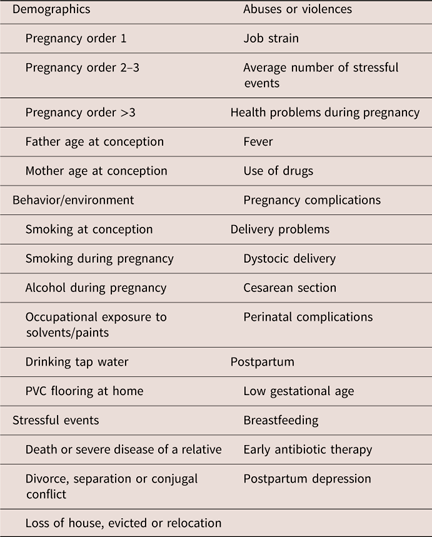
The two institutes’ staff contacted mothers of autistic children who met the inclusion criteria for the research. If the mother agreed to participate, she was invited to an individual structured interview about early risk factors (summarized in Table 1) after an explanation of the scope of the study and after having signed an informed consent. Mothers with non-autistic siblings (who had in all cases the same father of siblings with autism) were interviewed in separate sessions (two or three) each dedicated to a specific pregnancy. The first interview was always dedicated to the child with autism. The same procedure (contact, meeting, explanation, agreement and interview) was performed for the mothers of typical developing children. The same person always carried out the interview, namely, a female medical doctor specialized in child neuro-psychiatry. No refusal to the interview has been registered.
Variables on study

In the structured interview special attention was devoted to stressful life events. Stressful events considered in the survey were death or severe disease of a relative, divorce, separation or conjugal conflict, loss of house or eviction or relocation, abuse or violence and job strain.
The interview used a checklist questionnaire composed of 27 items with yes/no possible answers or multiple choice responses. The answers were then collected in an electronic data set where every column represented a single risk factor (e.g., exposure to solvents; smoking at conception) and then coded as absent (0) or present (1). Smoking was defined with a consumption of at least five cigarettes a day. Alcohol use was defined with a consumption of at least one alcoholic beverage a day. Use of drugs was related to potentially teratogenic drugs like angiotensin converting enzyme inhibitors, isotretinoin, cocaine, high doses of vitamin A, lithium, valproic acid, warfarin, paroxetine at any dosage or length of usage.
We took into account any kind of adverse event in the perinatal period as asphyxia and preeclampsia, premature separation of the placenta from the uterus, breech or transverse presentation, fetal dystocia/abnormal size or position and a prolapsed or exposed umbilical cord.
We asked the mothers to describe their jobs and tasks during the pregnancies and ‘exposure to toxicity’ was coded when a continuous and relevant professional exposure to particular substances was present. In particular, in this study, we focused our attention on paints, lacquers, paint thinner solvents, detergents, disinfectants, toluene, benzene, phenol and metals (in particular chromium) powders which could represent a toxic insult for the fetus. ‘Polyvinyl chloride (PVC) flooring’ means the presence of this kind of pavement on the job or the house. We chose PVC as one of the most representative and widespread fabrics containing phthalates and specifically PVC flooring because PVC furniture or window treatments are less common in the geographic area in question.
Conditions such as placental diseases, preeclampsia, infections, oligohydramnios, etc. were included in the category ‘pregnancy complications.’ Fetal respiratory distress, cyanosis, neonatal hyperbilirubinemia, etc. were included in ‘perinatal complications.’ Low gestational age was considered a birth that occurred before the 37th week of gestation; each case of breastfeeding that was suspended before the end of the first month was considered ‘no breastfeeding’; every antibiotic therapy administered from birth to 3 months was considered ‘early antibiotic therapy.’
Typically developing children were selected in principals amongst the two institution’s professional staffs’ relatives (children or nieces/nephews) matched for age and possibly for gender. Due to the expected strong imbalance of male/female ratio in the autism group, the matching for gender was suboptimal, but, since it is unlikely that the gender of offspring per se can influence the degree of pregnancy criticality, we accepted this imbalance.
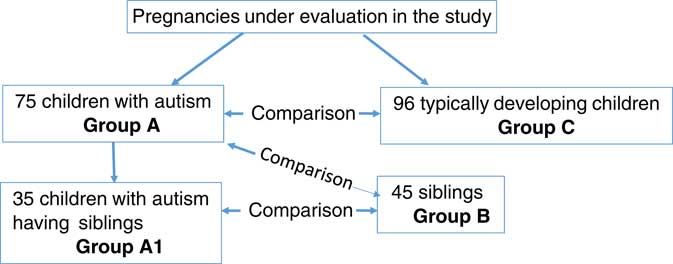
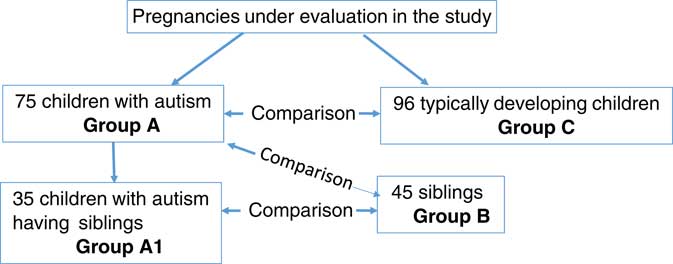
Figure 1 shows the study diagram.
Study diagram.
A Regional Review Board approved the research.
Statistical analyses
Data are presented as number percentages or as means with standard deviations for nominal and continuous variables, respectively.
We performed frequencies comparison among risk factors under study with odds ratio (OR), confidence intervals (CI) and χ2 tests. P value<0.05 were accepted as significant.
Multivariable modeling of data was carried out using Auto-CM ANN.
Auto-CM is a mapping method able to compute the multi-dimensional association of strength of each variable with all other variables in a data set, using a mathematical approach based on ANNs.Reference Buscema and Grossi 15 Auto-CM is especially effective in highlighting any kind of consistent patterns, systematic relationships, hidden trends and associations among variables. Indeed, this method is able to compute and graph a semantic connectivity map which (i) preserves non-linear associations among variables, (ii) captures elusive connection schemes among clusters and (iii) highlights complex similarities among variables. The three-layer architecture and the mathematical models of Auto-CM have been described elsewhere.Reference Buscema and Grossi 15 After the training, Auto-CM determines the so-called ‘weights’ of the vectors matrix, which represent the warped landscape of the data set and permit a direct interpretation. Indeed, these weights are proportional to the strength of many-to-many associations across all variables, and can be easily visualized by transforming them into physical distances: variables whose connection weights are higher get relatively nearer and vice versa. By applying a mathematical filter (Minimum Spanning Tree) to the matrix of distances, a graph named ‘semantic connectivity map’ is generated. This representation allows a visual mapping of the complex web of connection schemes among variables, simplifying the detection of the variables that play a key role in the graph (i.e., hubs). The system provides also a quantification of the ‘strength’ of links among variables (nodes of the graph) by a numerical coefficient, called link strength, ranging from 0 (minimum strength) to 1 (maximum strength). The value superimposed to the link is proportional to the strength of the link, and can be read as the probability of transition from any state-variable to any other one.
Results
Participants
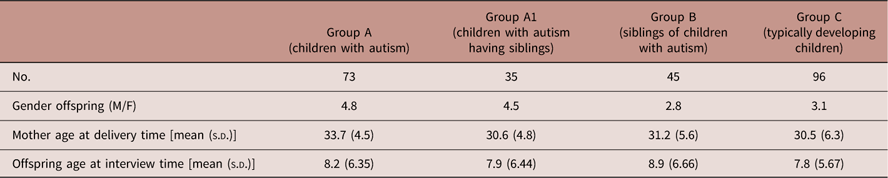
The clinical sample included a cases group of 73 children and adolescents with autism – Group A (mean age 8.2; s.d. 6.35); 35 of them were having 45 siblings typically developing and they constituted Group B (mean age 8.9 years; s.d. 6.66). An additional clinical sample included 96 typically developing children – Group C (mean age 7.8; s.d. 5.67). It is important to note that the Group B represented all the siblings available. Table 2 summarizes the sample characteristics.
Sample characteristics

M, male; F, female.
Comparison between children with autism (Group A) and typically developing children (Group C)
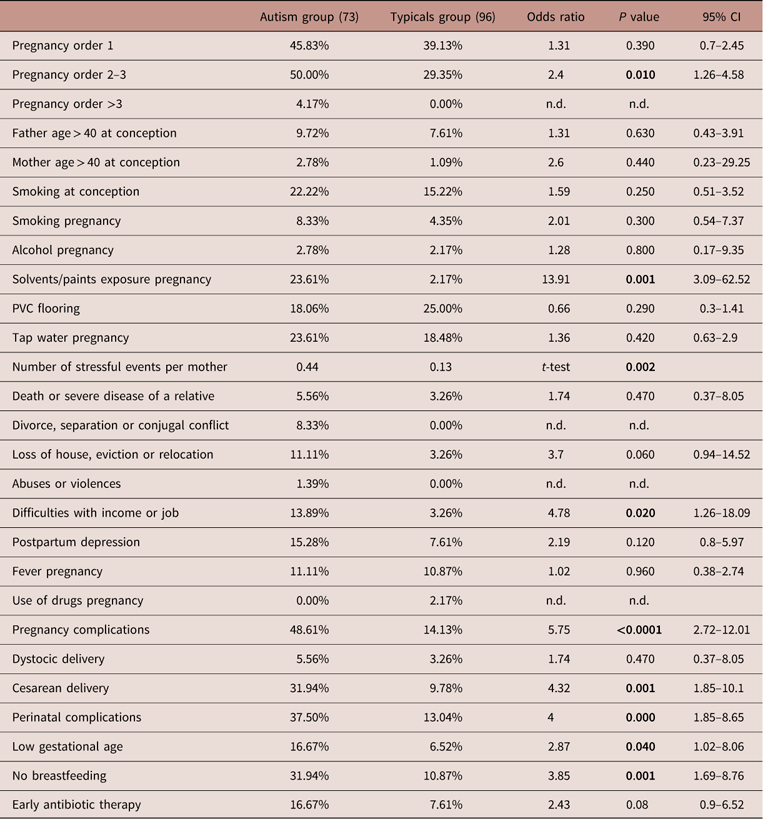
Table 3 shows the comparison of frequencies of different risk factors in the Group A and control Group C. Almost all (25 out of 27) factors we studied presented a higher frequency in Group A.
Comparison of factors under study in mothers of children with autism (group A) and in mothers of typically developing children (group C)

PVC, polyvinyl chloride.
Bold emphasis denotes the presence of significant values for P from statistically point of view.
A statistically significant difference was found for the following eight factors, which were all more frequent in Group A in comparison with the Group C: pregnancy order 2–3; (P=0.010); solvents/paints occupational exposure during pregnancy (P=0.0006); number of stressful events during pregnancy (P=0.0002); difficulties with income or job (P=0.020); pregnancy complications (P=0.0001); perinatal complications (P=0.0004); low gestational age (P=0.040); no breastfeeding after delivery (P=0.0001).
In the comparison of frequencies of factors under study in the Group A and in the Group B, a high number (21 out of 27) factors presented a higher frequency in autism pregnancies.
However, the differences in frequencies were generally less prominent and no factor but perinatal complications (37.5% in Group A v. 19% in Group B – OR=2.56; CI=1.03−6.31) reached the statistical significance, also due to a smaller sample size.
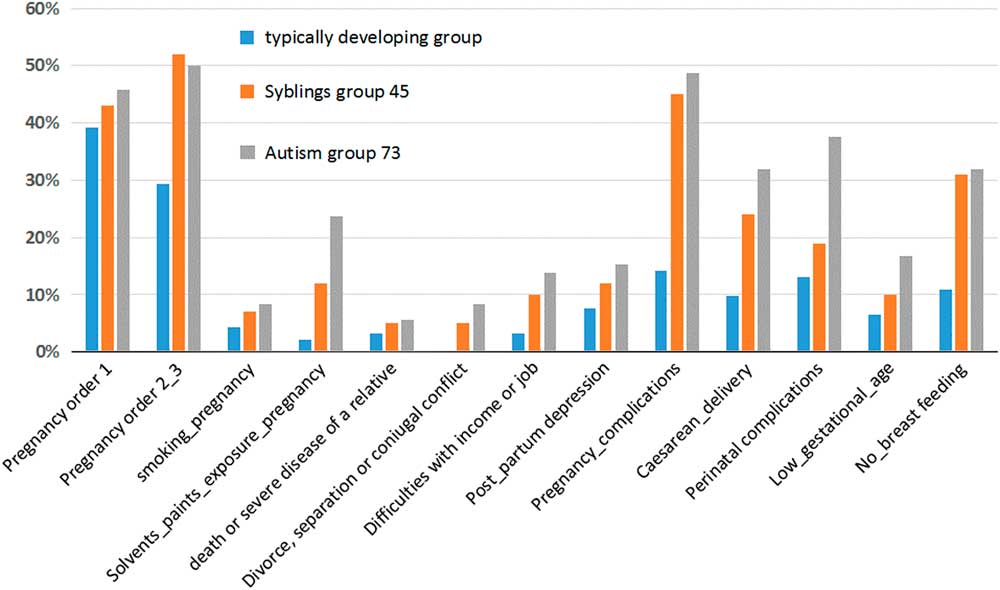
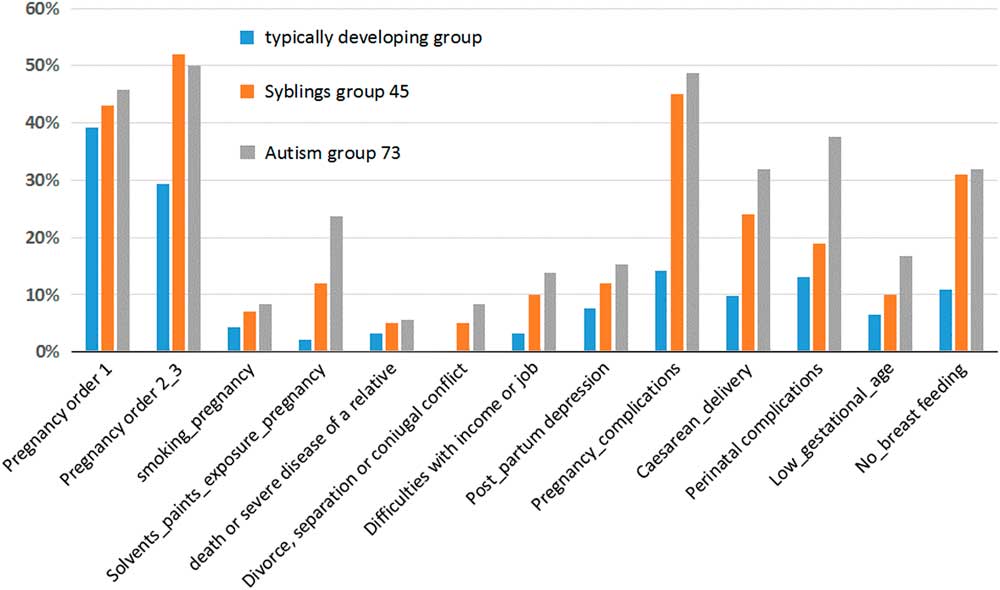
Comparing the frequencies in the Groups A, B and C it is interesting to note that for 13 factors there was a progressive increase in frequency going from the typically developing Group, sibling group and autism group as Fig. 2 shows.
Increasing frequency of 13 factors going from typically developing group to autism group passing per siblings group.
Comparison of children with autism having siblings (Group A1) and their siblings (Group B)
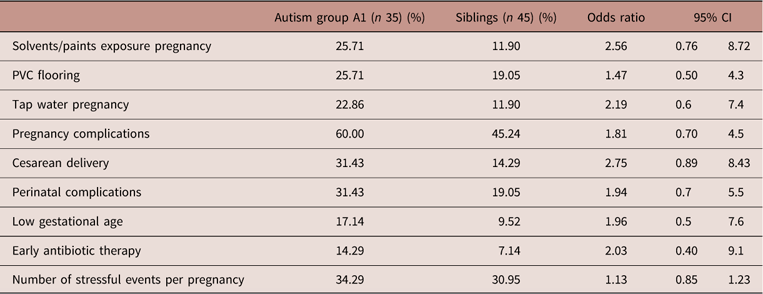
A higher prevalence of environmental risk factors was observed in 11 out of 27 risk factors in Group A1 in comparison with Group B (sign test: P<0.003). As shown in Table 4, for seven of them the odds ratio was higher than 1.5: solvents/paints exposure/pregnancy (OR 2.56); drinking tap water (OR 2.19); pregnancy complications (OR 1.81); cesarean delivery (2.75) perinatal complications (OR 1.94); low gestational age (OR 1.96) and early antibiotic treatment after delivery (OR 2.03). The relative small sample size precluded the reach of statistical significance.
Factors with odds ratio higher than 1.5 in autism A1 subgroup in comparison with Group B

PVC, polyvinyl chloride.
Semantic connectivity map
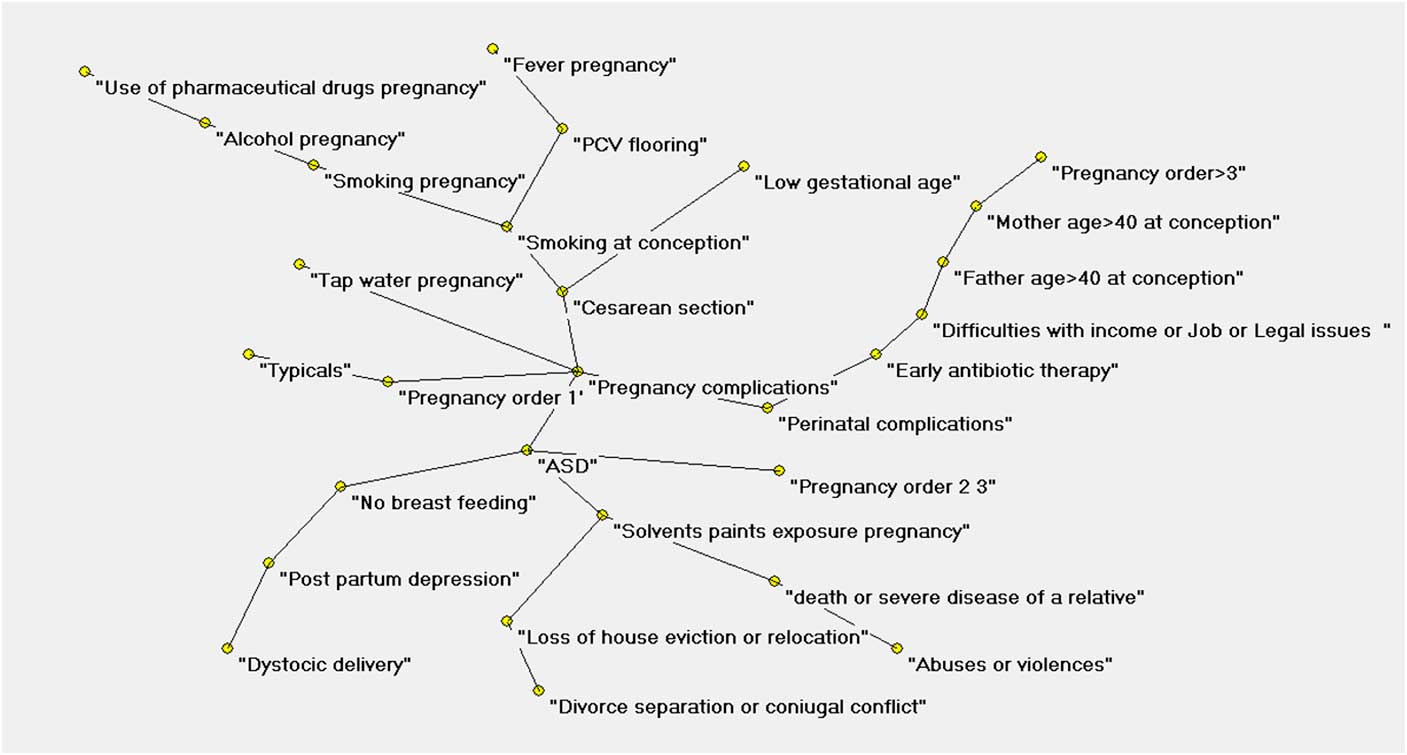
The Fig. 3 shows the semantic connectivity map of factors under study obtained with Auto-CM neural network from the data used to generate Table 2. Autism node, at variance of typical node, acts as a hub (variable with three or more links) receiving convergence from multiple factors, suggesting the existence of multi-causal cumulative effect.
Semantic connectivity map of factors on study. See text for areas description.
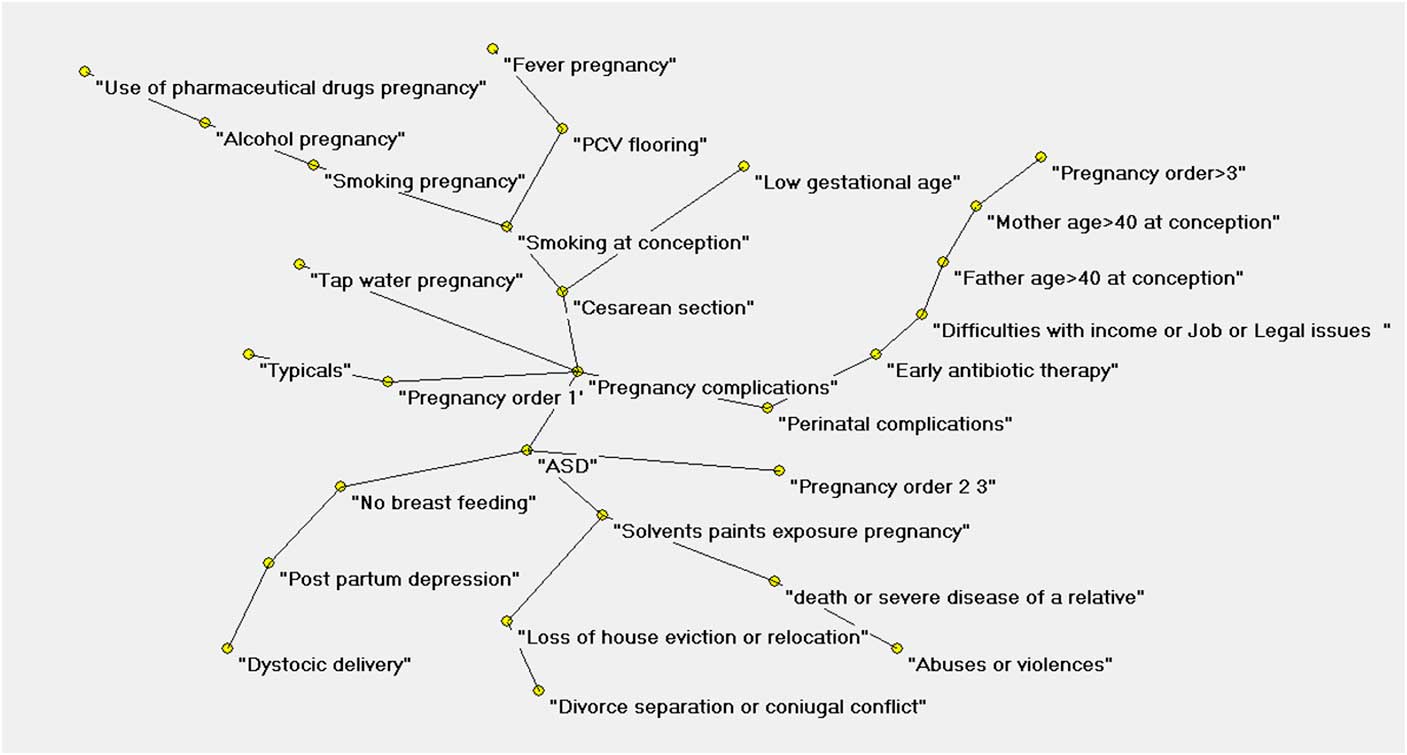
Other hubs in the graph are: smoking at conception, pregnancy complications and solvent/paints exposure. Variables having just one link are the leaves of the tree, representing from a mathematical point of view, factors with lower importance. In this connection, it is interesting to note that the node corresponding to the typicals variable is not recognized by the system to have specific association properties from a mathematical point of view, despite the fact that it is the most frequent variable in the data set.
Some of the strong associations among factors, that is variables with direct links, are extremely interesting and will be commented in the discussion section.
Neither principal component analysis nor hierarchical clustering, applied as benchmarking associations analysis techniques gave meaningful results.
Discussion
This study represents a new model for epidemiological surveys in the autism field and the first attempt to our knowledge to develop a predictive model for autism risk derived by factors collected during and immediately after the pregnancy with ANNs. In our opinion, some points of strength merit consideration.
The first aspect is related to the selection of potential risk factors from an accurate review of published epidemiological case–control studies published in the literature. The selection has considered many factors beyond both their actual relevance in the published report from a statistical point of view, as well as their plausibility in relation to the most recent pathogenic theories.
The second aspect is using a structured direct interview of the mothers carried out by the same medical doctor. Most studies published in this field have used data derived from computerized health records stored in large hospital databases. It is clear that these databases in case of retrospective studies cannot efficiently address delicate factors such as stressful life events or behavioral lifestyles. The confidence posed by mothers in the professional skill of educators and therapists of the two institutions and in particular of the interviewing medical doctor was so strong that none of the mothers refused to sign the informed consent form for the one-to-one interview.
We observed a similarity in differential patterns of frequencies both in comparison with typically developing children and with typically developing siblings with a strong contribution of solvents/paint exposure, stressful events, perinatal complications, low gestational age, absence of breastfeeding and early antibiotic therapy. In our view, this is a remarkable sign of the reliability of the findings, especially when the same mother acts as her own control.
The semantic connectivity map obtained with the Auto-CM system deserves some comment about variables acting as hubs and their interesting links.
Three interesting sequential links lines converging to autism node are: (1) smoking during pregnancy linked to smoking at conception, linked to cesarean delivery, linked to pregnancy complications and then to autism; (2) dystocia delivery linked with postpartum depression, linked to no breastfeeding and then to autism; (3) four stressful events converging two by two to solvents or paint during pregnancy and then to autism.
The fact that smoking is a risk factor for cesarean delivery comes from large epidemiological surveys involving thousands of women like the retrospective analysis carried out by Lurie et al.Reference Lurie, Ribenzaft, Boaz, Golan and Sadan 16
On the other hand, maternal smoking and mode of delivery have been identified as independent risk factors for shorter breastfeeding duration. In a study published by Wallenborn et al.Reference Wallenborn and Masho 17 among smokers, women who had repeat cesarean section had a two-fold higher odds of never breastfeeding and a four-fold higher odds of breastfeeding 8 weeks or less compared with women who gave birth vaginally after cesarean section.
In our graph cesarean section, breastfeeding absence and early antibiotic use are close to autism node. There is nowadays a unanimous consensus about the fact that vaginal delivery and breastfeeding are essential in providing the appropriate starting bacterial substrate for the development of a physiological gut flora. Early antibiotic therapy obviously can influence the equilibrium of intestinal flora as well. The possibility that autism is the consequence of an imperfect development of gut flora is supported by a number of observations like: the frequent coexistence of gastrointestinal symptoms in autistic children; the appearance of the disease after an incidental antimicrobic therapy and the increased levels of urinary biomarkers of specific pathogens of Clostridium spp. in the urine of autistic children.Reference Sekirov, Russell, Antunes and Finlay 18
In our graph, the exposure to solvents or paints during pregnancy is directly linked with autism node. The parental occupational exposure has already been object of studiesReference Mc Canlies, Fekedulegn and Mnatsakanova 19 and a link between some chemicals and the presence of ASD in the offspring seems to be more and more realistic. In our interviews, we did not start from a specific list of chemical agents but we first asked the mothers to describe what kind of job or tasks they had during pregnancy and then we retraced the toxic agents involved. It is important to note that some women, who worked in factories in close contact to potentially toxic agents, left the place of work only after pregnancy detection, leaving consequently the fetus not protected during the first weeks of gestation.
The role of stressful events in contributing to increased autism risk also deserves special attention since very few studies have attempted to collect this kind of information. Adverse experiences during the prenatal period (a time of rapid growth and of heightened brain plasticity) have been shown to induce significant effects on neurobiology, metabolism and physiology that can persist across the lifespan.Reference Weinstock 20 Generally, the more variable the stressor and the earlier the stressors occur in the pregnancy, the more profound the effect on offspring development. Psychological stress during pregnancy increases the secretion of corticotropin-releasing hormone from the hypothalamus, which regulates the hypothalamic–pituitary–adrenal axis. Elevated plasma levels of corticotropin-releasing hormone correlate to preterm labor and to anxiety perceived during pregnancy. Acute stress also elevates serum levels of interleukin-6 produced by mast cells, responsible for neuroinflammatory response and disruption of gut–blood barrier and blood–brain barrier permitting neurotoxic molecules to enter the brain, contributing to autism pathogenesis and symptoms.Reference Angelidou, Asadi and Alysandratos 21 In a study carried out by Varcin et al.,Reference Varcin, Alvares, Uljarević and Whitehouse 22 the authors aimed to determine whether prenatal maternal exposure to stressful life events is associated with symptom severity among individuals with ASD. The authors performed multiple regression analyses to examine associations between retrospectively recalled maternal prenatal stressful life events and the severity of ASD-associated symptoms in 174 children with ASD. Exposure to prenatal stressful life events was a significant predictor of autism-related symptom severity and communication abilities among children with autism, even after controlling for a range of sociodemographic and obstetric variables.
The results from this study suggest therefore that prenatal maternal stress exposure and its sequelae may contribute to variability in symptom severity among children with autism.
We recognize some substantial weaknesses in the present study, key among them the relatively small sample size, which makes full confidence in the statistical estimates rather difficult. In particular, the small sample size creates situations in which high OR values do not necessarily convey significant P-values. Another limitation is the non-perfect matching of cases and external controls in terms of geographical distribution. Nevertheless, mothers could and did complete the survey, even if the recall was sometimes difficult. This implies that the protocol of this pilot study is feasible and could be easily replicated in larger samples. An additional limitation could be the retrospective self-report of occupational exposure to toxic agents, which may result in bias and misclassification. At any rate, this potential memory-based bias resulted equal in the three groups.
Final considerations
The comparison of risk factor profiles in the same mother of two children, one with autism and the other without, is probably the most original feature of our study. Pregnancies related to autism development show a different pattern of pregnancy risk factors in the same mother, with a higher prevalence in 11 out of 27 of them. This suggests that environmental and incidental phenomena can influence pregnancy outcome in predisposed subjects when their sum reaches a critical threshold. Finally the disappointing results obtained with two alternative data mining statistical methods such as hierarchical clustering and principal component analysis strengthen the idea that Auto-CM, thanks to its new sophisticated mathematics, could become, in the future, a reference approach to better understand the complexity of pregnancy risk factors related to autism.
Acknowledgments
The authors thank all the mothers who have participated in this study providing information about their pregnancy.
Financial Support
This research received no specific grant from any funding agency, commercial or not-for-profit sectors.
Conflicts of Interest
None.
Ethical Standards
Every mother was informed about the aim and methods of the study and gave a written consent to data treatment. Ethics Committee of Provincial Health authority approved the study. All investigations have been conducted according to the principles expressed in the Declaration of Helsinki and its later revisions.