“Your representative owes you not his industry only, but his judgment; and he betrays, instead of serving you, if he sacrifices it to your opinion.” (Edmund Burke)
“When occasions present themselves, in which the interests of the people are at variance with their inclinations, it is the duty of the persons whom they have appointed to be the guardians of those interests.” (Alexander Hamilton)
To what extent should government officials follow the wishes and opinions of the people? The responsiveness of politicians to constituency opinion is typically considered to be a hallmark of a healthy democracy (e.g., Bartels Reference Bartels1991; Erikson, MacKuen and Stimson Reference Erikson, MacKuen and Stimson2002; Miller and Stokes Reference Miller and Stokes1963; Page and Shapiro Reference Page and Shapiro1983). Yet citizens know little about politics, so they also surely lack the knowledge to carefully evaluate the various proposals put forth to solve complicated policy problems. If citizens recognize that officials possess superior policy expertise—knowledge of the relationship between policies and outcomes—then it is beneficial to confer policy-making authority to the experts. Democratic delegation can be informationally efficient. But if citizens also recognize that the motives of those experts may be at odds with their own, then it may instead be detrimental to entrust policy decisions to opposing interests. Thus, there exists a fundamental tension between promoting the efficient use of policy expertise and ensuring the alignment of interests between citizens and their representatives. This is the familiar contrast between the “trustee” and “delegate” models of representation.
Elections have the potential to solve, or at least limit, the agency problem inherent in democratic delegation. They allow voters to select politicians whom they believe share their interests (Banks and Sundaram Reference Banks, Sundaram, Barnett, Hinich and Schofield1993; Besley Reference Besley2005; Fearon Reference Fearon, Przeworski, Stokes and Manin1999), and in case selection is imperfect, elections also provide a mechanism for holding politicians accountable (Ferejohn Reference Ferejohn1986). Under the right conditions, when voters correctly judge the quality of outcomes and attribute responsibility for them, voters can create strong electoral incentives that induce politicians to act in voters’ interests (Fiorina Reference Fiorina1981; Key Reference Key1966; Kramer Reference Kramer1971; Woon Reference Woon2012). Recent empirical studies, however, show that voters fall short of this ideal, as they are prone to a variety of systematic judgmental errors in evaluating outcomes (Achen and Bartels Reference Achen and Bartels2004; Bartels Reference Bartels2009; Healy and Malhotra Reference Healy and Malhotra2009; Healy, Malhotra and Mo Reference Healy, Malhotra and Mo2010; Huber, Hill and Lenz Reference Huber, Hill and Lenz2012). But even if voters were fully “rational,” the consequences of many policies are not immediately observable, either because implementation is delayed or because the evidence is ambiguous and difficult to evaluate.
The unobservability of policy consequences combined with voter uncertainty about politicians’ true motives create reputational incentives. Because voters cannot judge the quality of outcomes, they can only use policy choices to draw inferences about motives. Optimal, forward-looking behavior involves relying on such inferences to make voting decisions. This, in turn, leads politicians to consider the effects of their choices on their reputations—what voters believe about them—and to choose popular policies at the expense of the public good. Indeed, a substantial body of theoretical work demonstrates that reputational incentives for position-taking, posturing, and pandering undermine policymaking under a variety of different conditions (Canes-Wrone, Herron and Shotts Reference Canes-Wrone, Herron and Shotts2001; Canes-Wrone and Shotts Reference Canes-Wrone and Shotts2007; Fox Reference Fox2007; Fox and Shotts Reference Fox and Shotts2009; Groseclose and McCarty Reference Groseclose and McCarty2001; Maskin and Tirole Reference Maskin and Tirole2004; Stasavage Reference Stasavage2004).Footnote 1
I conduct an incentivized laboratory experiment to test whether reputational incentives undermine democratic delegation. Do voters in the experiment make rational inferences and reward politicians for choosing “popular” policies—instead of policies that truly serve the public interest? If so, do politicians exploit this tendency and choose policies that ensure their re-election at the expense of voters’ welfare? I also explore questions about institutional choice using a novel elicitation method. Formal analysis implies that when reputational incentives undermine policymaking, rational individuals prefer to increase informational efficiency by removing accountability and reputational incentives.
I find mixed support for the theoretical predictions. Voters re-elect politicians who choose popular policies more often than politicians who choose unpopular ones, which is consistent with the basic prediction of equilibrium theory. However, they also exhibit a pro-incumbent bias (perhaps due to reciprocity), which provides weaker incentives for politicians to pander than theory predicts. Most laboratory politicians appear to ignore their reputational incentives, preferring instead to choose actions based on their induced policy interests even though such behavior yields lower expected payoffs (and greater risk). Over time, pandering behavior increases, but the rate of learning is slow.
In their institutional choices, half of voters cede the right to punish politicians, consistent with the theory. However, other voters suboptimally prefer to retain representative democracy or to switch to direct democracy. These results suggest other factors might influence citizens’ preferences for institutions beyond the anticipation of their instrumental costs and benefits. For some, the cognitive difficulty of thinking through an institution’s strengths and weaknesses, such as foreseeing and enumerating future contingencies, might lead to a reliance on familiarity and past experience, while for others, their general beliefs about key features of accountability relationships, a desire for control, or their trust in others might override specific cost-benefit considerations.
Theory and Hypotheses
Consider a government’s choice between imposing fiscal austerity or injecting fiscal stimulus, and suppose that voters, who lack any real expertise but rely on their intuitions and conventional wisdom, believe that stimulus is more likely to yield long-term benefits for the economy. Suppose also that, in contrast, policymakers are privy to the results of rigorous, sophisticated analysis by serious economists and other policy experts so that they have a more informed belief about which policy is likely to yield greater benefits. Under what conditions would policymakers ignore their expertise and “pander” to voters by injecting stimulus even when they know that austerity is the better policy?
Game theoretic models of electoral agency specify the precise conditions under which reputational incentives lead politicians to take actions that enhance their electoral prospects at the expense of voter welfare. Several ingredients are necessary. Politicians must have better information about policy consequences than voters, and a policy is popular not when voters have a definite, unconditional preference, but when they think or believe the policy is more likely to be beneficial than the alternatives. There must also be electoral incentives. Politicians must care enough about being re-elected, and voters must reward them for choosing popular policies (i.e., for pandering). These electoral incentives must be endogenous to the interaction between politicians and voters. Finally, voters must be uncertain about the politician’s “type” (an unobserved characteristic that, in principle, affects future policy choices and long-term welfare). In an informational context, pandering arises from the tension between the asymmetries in expertise and voters’ uncertainty about the politician’s type. These models contribute greater conceptual clarity concerning the nature of pandering and the conditions that give rise to such behavior: endogenous pandering requires that voters face uncertainty along two dimensions.
Maskin and Tirole (Reference Maskin and Tirole2004) construct one of the simplest possible models that captures these essential features, and I implement a version of their model as the basis for my experimental analysis. The model nicely captures an environment in which it is impossible for voters to hold politicians accountable for outcomes. Instead, they use policy choices to infer politicians’ congruence. In this environment, voter welfare is improved by removing electoral incentives—that is, by making politicians unaccountable. In the laboratory, I investigate whether the conditions they identify lead to pandering behavior and, if so, whether voters choose to solve this problem by removing accountability.
Representative Democracy
The Representative Democracy Game is a sequential game of incomplete information played by an incumbent politician and a voter. The basic sequence of actions is that the incumbent first chooses one of two possible policies, p ∈ {A, B}. The voter then observes only p and chooses to vote for the incumbent or a challenger. Denote the voter’s action by v ∈ {I, ¬I}. The challenger is not a strategic player; its role in the model is to provide the voter with a meaningful electoral choice.
When making her choice, the incumbent has two pieces of private information. First, she knows the state of the world. This is information that affects both players’ policy preferences. Denote the state of the world by ω ∈ {A, B}, and let α represent the ex ante probability that ω = A. Also assume that ω = A is ex ante more likely, so α >
 $\frac{1}{2}$
. Thus, we can say that p = A is the more “popular” policy given voters’ prior beliefs. Second, the incumbent knows her own “type” (whether or not she shares the voter’s policy preferences). She is either congruent or noncongruent. Let TI
∈ {C, N} denote the incumbent’s type and assume that the incumbent is ex ante more likely to be congruent than noncongruent, π = Pr (TI
= C) >
$\frac{1}{2}$
. The challenger also has a type, TC
∈ {C, N}, that has the same distribution, Pr (TC
= C) = π >
$\frac{1}{2}$
, but is independent of the incumbent’s type; this information is also unknown to the voter. While incumbents and challengers are ex ante identical, the game is structured so that the incumbent’s choice of p potentially signals her type, thereby inducing a preference for or against the incumbent.
Voters’ payoffs from the game consist of a policy component and an election component. For the policy component, voters always prefer that the policy matches the state of the world (p = ω) and receive a payoff of x > 0 if it does and 0 otherwise. We can therefore think of p = ω as a “correct” policy from the voter’s point of view. The “correct” and “popular” policies coincide when ω = A but conflict when ω = B. For the election component, voters always prefer to elect a congruent politician, but it does not matter whether the congruent politician is the incumbent or challenger. Formally, let T 2 denote the type of the politician that the voter elects; if the voter re-elects the incumbent, then T 2 = TI , and if the voter elects the challenger, T 2 = TC . Note that since TI and TC are not observed, the voter’s decision is made under conditions of uncertainty and therefore depend crucially on his beliefs (the probability that TI = C). The voter receives an election payoff of x > 0 if T 2 = C and 0 otherwise. Thus, the best possible outcome for the voter is for the policy to match the state (p = ω) and for the elected politician to be congruent (T 2 = C), in which case the payoff is 2x. The worst possible outcome is for the policy to not match the state and for the elected politician to be noncongruent (p ≠ ω and T 2 = N), which yields a payoff of 0. Any other outcome yields an intermediate payoff of x.
Congruent incumbents, like voters, prefer that the policy matches the state and receive a policy payoff of y > 0 if p = ω. Noncongruent incumbents have diametrically opposed preferences and receive y > 0 only if the policy does not match the state, p ≠ ω. We can think of p = ω as a congruent incumbent’s preferred policy and p ≠ ω as a noncongruent incumbent’s preferred policy. If the incumbent does not obtain his or her preferred policy outcome, the policy payoff is 0. Both types of incumbent prefer to be re-elected and receive an additional election payoff of z > 0 if they are (v = I), and 0 otherwise. In the experimental setup, I assume that z > y so that the incumbent’s electoral motivation outweighs the policy motivation.Footnote 2 The best possible outcome for the incumbent is to choose her preferred policy and to be re-elected, which gives a payoff of y + z. The second best outcome is to choose the less preferred policy but to be re-elected, which gives a payoff of z. The third best outcome is for the incumbent to choose her preferred policy, which gives a payoff of y. The worst outcome is to choose the less preferred policy and to be voted out of office, yielding a payoff of 0.
The standard solution concept for a signaling game such as the Representative Democracy Game is perfect Bayesian equilibrium. In a perfect Bayesian equilibrium, the voter’s beliefs and best response depend on the incumbent’s strategy. Likewise, the incumbent’s strategy must be mutually consistent with what she anticipates the voter’s strategy to be. Actions and beliefs are therefore determined endogenously by the strategic interaction between voters and incumbents.
Game theoretic reasoning implies that the equilibrium to this game involves a “delegate trap.” When politicians pursue their own policy goals, it reveals something about their type, but then voters reward politicians for pandering and electorally motivated politicians oblige. This pandering behavior is supported in an equilibrium of the Representative Democracy Game.Footnote 3 That is, it is mutually consistent for the voter to re-elect the incumbent only for choosing p = A (regardless of the state) and for incumbents to always choose p = A regardless of their state or type. Voters are unable to commit to ignoring the policy choice because they are forward-looking and infer that politicians who choose p = A are more likely to be congruent (thus preferring to re-elect them). This is a “pandering” equilibrium because the incumbent only chooses what the voter believes to be the ex ante better policy. And it is informationally wasteful because incumbents ignore their superior information about the state of the world. Doing what is best for voters irrespective of the election is not a stable outcome, which suggests the following strong form of an equilibrium hypothesis.
Hypothesis 1 In the Representative Democracy Game, voters will hold incumbents accountable for their policy choices and re-elect the incumbent if and only if p = A; incumbents will pander and will always choose p = A.
Even if subjects fail to play their equilibrium strategies as a whole, strategically sophisticated subjects may choose optimal actions given that others play less than optimally.Footnote 4 Such sophistication may take one of two forms. Some voters might draw the correct conclusions about the incumbent’s type from the policy choice. Alternatively, some incumbents may recognize their incentive to pander. Thus, two weaker (non-equilibrium, probabilistic) hypotheses can be formulated based on best response analysis.Footnote 5
Hypothesis 2 If incumbents choose p according to their policy goals, then voters are more likely to re-elect politicians for choosing p = A than for p = B.
Hypothesis 3 If voters are sufficiently more likely to re-elect politicians for choosing p = A than for p = B, then incumbents will pander and are more likely to choose p = A than p = B regardless of their type or state of the world.
Institutional Choice
In addition to showing how pandering occurs in equilibrium under representative democracy, Maskin and Tirole (Reference Maskin and Tirole2004) analyze the conditions under which voters would be better off under one of two alternative political institutions: judicial power or direct democracy.Footnote 6 Comparing institutions involves comparing the voter’s expected payoffs, or equivalently, the probability that the voter’s preferred policy is chosen before and after the election.Footnote 7 In the Representative Democracy Game, the incumbent chooses p = A before the election, which correctly matches the state with probability α, and only congruent incumbents choose p = ω after the election, which occurs with probability π. Thus, the voter’s expected payoff from the Representative Democracy Game is (α + π)x.
The Judicial Power Game is identical to the Representative Democracy Game except that any possibility of electoral accountability is completely removed. The politician can be thought of as a judge (or appointed bureaucrat) who cannot be voted out of office. In this game, there are two periods of policy-making in which the politician chooses policy. Because there are no electoral incentives, politicians follow their own policy preferences. Thus, congruent politicians match p = ω while noncongruent politicians choose p ≠ ω. The probability that the politician chooses the voter’s preferred policy in each period is π (the probability that the politician is congruent), so the voter’s expected payoff from judicial power is 2πx.
In the Direct Democracy Game, there are no politicians. Instead, voters choose policy directly (also in each of two periods) although they remain uncertain about which policy is best. Because the voter knows only that Pr (ω = A) = α >
$\frac{1}{2}$
, the optimal policy is p = A. Since the probability that p = A is the correct policy is α, the voter’s expected payoff is 2αx.
Note that although the voter’s ranking of the three institutions depends on the relative values of π and α, Representative Democracy is never the optimal institution. Indeed, if π > α (which it is in the experiment), then Judicial Power is the best institution and Direct Democracy is the worst. This is because the voter gains more from ensuring that congruent politicians utilize their policy expertise to serve the voter’s best interests than they do from preventing noncongruent politicians from using that expertise against them. In contrast, if α > π, Direct Democracy is the best institution and Judicial Power is the worst because voters gain more from preventing noncongruent incumbents from exploiting their expertise than they do by encouraging congruent ones to choose good policies. In both cases, Representative Democracy is second-best.Footnote 8
Hypothesis 4 If voters are allowed to choose political institutions and π > α, expected payoff maximizing voters will never choose Representative Democracy. They will prefer Judicial Power over Representative Democracy, and prefer Representative Democracy over Direct Democracy.
Experimental Procedures
I conducted eight experimental sessions at the Pittsburgh Experimental Economics Laboratory. Each session lasted under two hours and involved 12 to 18 subjects. A total of 110 subjects participated, and each subject participated in only one session.Footnote 9 The subjects were primarily undergraduates at the University of Pittsburgh and were recruited through the lab’s website. At the beginning of each session, subjects gave informed consent following the University of Pittsburgh IRB’s standard procedures. Subjects interacted anonymously through networked computers using an interface written in z-tree (Fischbacher Reference Fischbacher2007), and at the immediate conclusion of each session, subjects were paid privately in cash. No deception was used in the experiment.
Each session consisted of two parts. In Part 1, subjects played 30 rounds of the Representative Democracy game (15 in the role of the incumbent politician and 15 in the role of the voter). Prior to every round, subjects were anonymously and randomly matched into pairs consisting of one politician and one voter. Random rematching is a standard procedure for minimizing potential repeated game effects, thus ensuring that each round is viewed as an independent play of the game. Different subjects switched roles every 5 rounds to decrease the probability that any pair of subjects would be matched together in a given round.Footnote 10 Between rounds, every subject received complete feedback about the election that they just played: the realized values of ω, TI, TC, T 2, the actions v and p, and both the voter’s and politician’s payoffs. They received this feedback about the most recent round along with a table showing the complete history of play for every previous round they played; this information was restricted to their own interactions and did not include any pairs of subjects to which they did not belong.
The instructions and terminology used to describe the game involved a modicum of descriptive, but neutral, political context in order to investigate subjects’ decision-making about political representation rather than their ability to think in an abstract strategic environment. The players were labeled “politician” and “voter,” and the politician types were labeled “matching” (for congruent) and “opposed” (for noncongruent). However, the game itself was never described as the Representative Democracy game, only as the “decision-making task.” Each subject had a written copy of the instructions, which were read aloud to induce public knowledge. Subjects also took a quiz to check and increase their comprehension of the game.Footnote 11
Each round and pair of subjects involved an independent realization of the state variable and politicians’ types, with α = 0.6 and π = 0.8 as the parameter values. Thus, consistent with the theoretical analysis, ω was more likely to be A than B and politicians were more likely to be congruent than noncongruent. All payoffs for the Representative Democracy game were denominated in points. For all sessions, a “good” outcome for the voter (from either policy p = ω or the election T 2 = C) was worth x = 100. Politicians’ payoff values varied by condition, but in both conditions the payoff from re-election outweighed the payoff from choosing the preferred policy (ensuring z > y). There were five sessions of the “25/175 Condition” in which the electoral payoff was 7 times greater than the policy payoff (the incumbent’s preferred policy was worth y = 25 and re-election was worth z = 175) and three sessions of a “50/150 Condition” in which the electoral payoff was 3 times greater than the policy payoff (y = 50 and z = 150).Footnote 12 Six rounds of the Representative Democracy game were randomly chosen to count for payment, with points converted to cash at the rate of $1 per 100 points.
The instructions for Part 2, which was designed to elicit an institutional choice, were distributed and read aloud after the conclusion of Part 1 (so as not to bias behavior in Part 1). Part 2 consisted of 5 additional rounds: 2 additional rounds of Representative Democracy (one as a politician and one as a voter), 2 rounds of Judicial Power (one as a politician and one as a voter), and 1 round of Direct Democracy. Importantly, the instructions never referred to the institutions by these names but instead simply as different sets of “Rules.” In Rule 1 (Representative Democracy), the “politician chooses policy subject to re-election.” In Rule 2 (Judicial Power), the “politician chooses policy without facing re-election.” And in Rule 3 (Direct Democracy), the “voter chooses policy directly.” In addition to the 6 rounds from Part 1, one round from Part 2 was randomly selected for payment. The parameters for each version of the game were identical to Part 1 (α = 0.6, π = 0.8, x = 100, y ∈ {25, 50}, and z = 200 − y). Note that in terms of institutional choice, π > α implies that expected payoff maximizing voters will prefer Rule 2 (Judicial Power) to Rule 1 (Representative Democracy) and will least prefer Rule 3 (Direct Democracy).
To elicit an institutional choice, subjects were given an opportunity to choose one of the Rules to count for “guaranteed bonus points” before they played any rounds of Part 2. More specifically, subjects were guaranteed to earn 5 times the number of points from the round they played as a voter that used the rule of their choice. For example, if the subject chose Rule 2 and earned 200 points as a Voter when the game was played with Rule 2, then the subject earned 1000 points ($10) in addition to any points earned in the randomly selected round. The elicitation method is novel, and Part 2 was designed this way for two reasons. First, knowing that every institution would be played avoids selection effects. In other words, a subject’s choice of institutions would not affect which game they played, as they knew they would play each role for each Rule. Second, the high multiplier for the bonus points ensured that this choice would be quite salient since they knew this choice was worth much more than any single round of the game. The higher payoffs were intended to promote more careful thinking about the instrumental costs and benefits of each institution.
A limitation of the design is that the institutional choice in Part 2 follows many rounds of the Representative Democracy Game in Part 1. Subjects therefore face a choice between an institution with which they are familiar and two new institutions for which they only know the rules.Footnote 13 Thus, subjects do not make their institutional choices behind a Rawlsian veil of ignorance—not unlike the real world in which citizens, voters, and politicians consider proposals for new institutions based on theoretical arguments rather than extensive experience. Greater experience may bias the results of institutional choice in favor of Representative Democracy. However, by encouraging more careful thinking and greater attention to payoff maximization, the higher payoffs for institutional choice were intended to counter this effect.
Immediately after choosing an institution, subjects were also asked to provide a written explanation of how they made their choice before they actually played the 5 rounds in Part 2.Footnote 14 Responses to open-ended questions may provide additional insight into subjects’ thought processes in the spirit of “think aloud protocols” used by cognitive psychologists (e.g., Ericsson and Simon Reference Ericsson and Simon1998). In addition to the open-ended rule explanation, subjects also completed a short questionnaire at the conclusion of the experiment. Part of this questionnaire asked subjects to explain how they made their decisions in Part 1 of the experiment.
Results
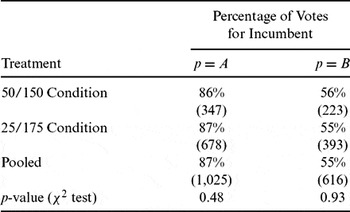
As stated in the stronger form of Hypothesis 1 and in the weaker form of Hypothesis 2, game theoretic analysis predicts that voters in the experiment will hold politicians accountable for their policy choices by re-electing the incumbent if and only if they choose p = A. Table 1 presents data for observed voting behavior from the experiment and shows that voters indeed used a conditional voting strategy. They were much more likely to re-elect the incumbent if he or she chose A than B by 87% to 55% across both conditions (with no difference between parameterizations). However, they also exhibited a strong pro-incumbent bias.Footnote 15 Rather than throwing out incumbents who chose policy B, voters re-elected them half of the time. Thus, there appears to be support for the qualitative (directional) prediction of Hypothesis 2 but no support for the magnitude of the difference predicted by Hypothesis 1.
Voting Behavior in the Representative Democracy Game
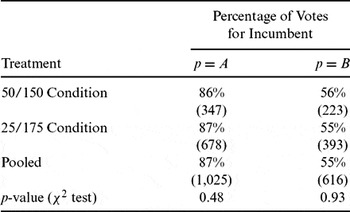
Note: Total number of observations in parentheses
Voters appear to provide reputational incentives, but they are weaker than the theory predicts. Are these incentives strong enough to satisfy the conditions for Hypothesis 3—to induce politicians to pander? When the electoral payoff is 150, the expected value of pandering (choosing policy A when the state is B) and facing a 0.86 chance of re-election is 129. The electoral payoff of choosing the correct policy instead, which gives a congruent incumbent her policy payoff of 50 for sure plus a 0.56 chance of re-election, is 134. Thus, in the 50/150 Condition of the experiment, observed voting behavior does not produce sufficiently strong reputational incentives for politicians to pander. In the 25/175 Condition, however, the incentives are sufficiently strong, as the expected value of pandering (0.86 × 175 = 150.5) exceeds the expected value of pursuing policy (0.56 × 175 + 25 = 123).Footnote 16 If subjects are sophisticated enough to best respond to observed voting behavior, Hypothesis 3 predicts that they will pander in the 25/175 Condition but not in the 50/150 Condition.
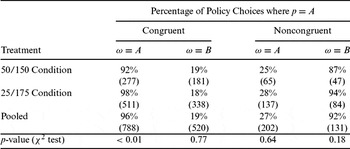
Table 2 shows the frequency with which incumbents chose policy A by type and state of the world. According to Hypotheses 1 and 3, we would expect to see all of these frequencies near 100% (or at least above 50%), but this is not the case. Incumbents’ behavior is plainly inconsistent with the unconditional pandering strategy stated in the hypotheses. Indeed, there is scant evidence for the specific pandering outcome where congruent types choose the “popular” policy (p = A) even when they know it to be “wrong” (ω = B), doing so in only 19% of such cases across the experimental conditions. The data suggest instead that laboratory politicians primarily pursued their own policy interests at the expense of any potential electoral gains, with no differences as a function of the magnitude of the electoral payoff. Across both conditions, incumbents matched the policy to the state in 90% of the 1, 177 rounds in which they were congruent and chose policies opposite the state of the world in 80% of the 333 rounds in which they were noncongruent. In the aggregate, the data suggest that we can soundly reject the qualitative and the quantitative predictions concerning incumbents’ policy choices stated in Hypotheses 1 and 3.
Policy Choices in the Representative Democracy Game
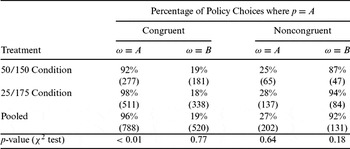
Note: Total number of observations in parentheses
The data also reveal an asymmetry in policy choices across the four possible combinations of information that incumbents possess. When the incumbent’s type and information dictate a policy preference for A, they choose policy A in 95% of such cases (96% for congruent types when ω = A and 92% for noncongruent types when ω = B). These figures suggest that subjects in the role of the incumbent politician make errors or mistakes at a rate of about 5%.Footnote 17 If they make mistakes at the same rate when their policy preference is for B, then we should see that they choose p = A in only about 5% of those cases as well. But incumbents choose policy A more often than this line of reasoning suggests, at a rate instead between 19 − 27%. It is possible that this represents a modest degree of pandering, either because subjects learn to pander by the end of the experiment or because some subjects pander more than others.
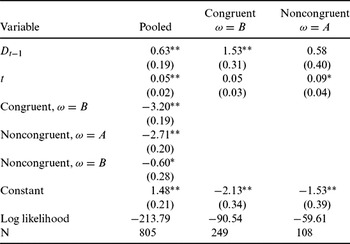
To assess the possibility of learning, I construct a measure that summarizes the history of play. (In this analysis, I focus only on politicians’ behavior in the 25/175 Condition.) For politicians, experience provides the basis for forming beliefs about re-election probabilities, so at any time t, we can summarize the relevant history of play for politician i in terms of how often he or she was re-elected after choosing each policy. Let Ra t = ra t /na t be the overall proportion of times that i was re-elected after choosing policy A from time 1 to t, where ra t is the total number of times politician i was re-elected after choosing policy A and na t is the total number of times i chose policy A.Footnote 18 Define Rb t similarly for the observed re-election probability after choosing policy B. The difference between these two probabilities, Dt = Ra t − Rb t , therefore captures the strength of the politician’s electoral incentives for choosing policy A over policy B. As Dt increases, politicians should be more likely to choose policy A, even if it means ignoring their information about ω.
Table 3 presents the results of probit analyses that model the probability that a subject chooses policy A as a function of the lagged difference in observed re-election probabilities, D t − 1, controlling for a time trend. The results in the first column pool all of the data across the four possible realized values of the politicians’ two pieces of information and show that the observed re-election differential has the expected positive effect on the probability of choosing policy A (controlling for the different realizations of information). This coefficient is much larger than the time trend, which suggests that subjects indeed respond to their experience rather than adjusting their behavior in a single direction. The second and third columns disaggregate and restrict the data to the information sets where choosing policy A would contradict the politician’s policy preference. In the second column with congruent politicians (the classic pandering scenario), the observed difference has a much larger effect on behavior than in the pooled analysis, but it is no longer significant in the third column for noncongruent politicians. Subjects are therefore more likely to pander when the strength of the electoral incentive is clear from their past experience. The lack of experience, however, does not fully account for the discrepancy between the level of observed pandering and the equilibrium prediction: the highest predicted pandering probability is only 56%, even when the observed differential is greatest (D t − 1 = 1).Footnote 19
Probit Model of Learning and Policy Choice
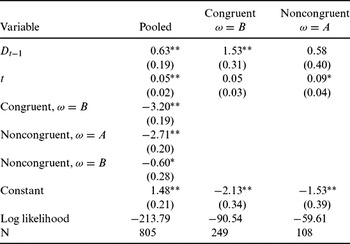
* * p < 0.01, * p < 0.05. Dependent variable is an indicator for p = A.
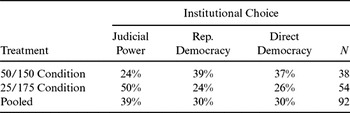
Turning now to the results for institutional choice from Part 2 of the experiment, recall that Hypothesis 4 states that expected utility-maximizing subjects will rank Judicial Power over Representative Democracy and Represenative Democracy over Direct Democracy. These rankings presume equilibrium behavior within each game, but subjects clearly do not play their equilibrium strategies. Based on their actual behavior, the ordinal preferences over institutions should nevertheless be the same. This is because voters still benefit from eliminating the incentives for a few politicians to pander, so Judicial Power remains better than Representative Democracy. Numerically, however, the benefit from choosing Representative Democracy is small. Computing the expected payoff for Representative Democracy using the observed behavior reported in Tables 1 and 2 yields 155 points, which is only 5 points less than the 160 point theoretical expected payoff for Judicial Power. Based on observed behavior, it is reasonable to expect that many subjects will be indifferent between Representative Democracy and Judicial Power. Nevertheless, there should still be a clear preference for either of these institutions over Direct Democracy, which yields the lowest expected payoff (120 points) because voters lose the informational advantages of delegating to policy experts.
Table 4 suggests that there is no overwhelming preference for any one institution. In the 25/175 Condition, half of the subjects choose Judicial Power over the alternatives, which is weakly supportive of Hypothesis 4. But in the 50/150 Condition, it is the least preferred institution. In both conditions, however, there remains a substantial preference for both Representative Democracy as well as a preference for Direct Democracy, which are both dominated institutions. Each one is chosen by almost 40% of subjects in the 50/150 Condition and by about 25% of subjects in the 25/175 Condition. When pooling the two conditions, Judicial Power does slightly better, but it is by no means a clear favorite. These results suggest that while the instrumental calculation of expected costs and benefits exerts some influence on decisions, institutional choice is likely to be driven by several other factors.
Institutional Choice
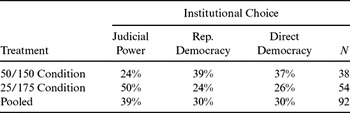
Note: p-value = 0.04 for Pearson’s χ2 test
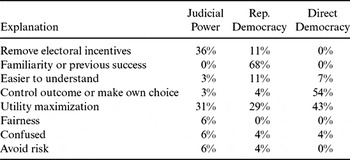
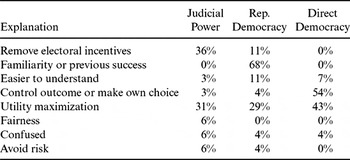
The open-ended explanations subjects gave for their rule choices can shed some light on what these other factors may be. Many of the written explanations that subjects gave about their rule choices were vague or confused and such responses must be interpreted cautiously, but they nevertheless provide a useful supplement to choice data. Table 5 shows the results of a simple content analysis of the explanations given for each choice of institution.Footnote 20 The first noticeable pattern is that many subjects claim to justify their choice in terms of utility or payoff maximization (31% of explanations for Judicial Power, 29% for Representative Democracy, and 43% for Direct Democracy). The fact that few subjects admit to being confused or to being motivated by fairness or altruism also suggests that subjects attempt to maximize their own utility, even though they are largely confused about how to do so.
Content Analysis of Rule Explanations
Notes: Cells give the percentage of responses for each rule that fit the explanation. Classifications are not mutually exclusive, so frequencies will not add to 100%.
The second noticeable pattern is that each rule appears to correspond to a primary justification. Subjects who chose Judicial Power recognized and were concerned with removing electoral incentives. Interestingly, these were different subjects from the ones who described themselves as using a pandering strategy in the Representative Democracy Game, as they rarely pandered themselves (only two of them pandered more than 75% of the time).
Those who chose Representative Democracy tended to cite their familiarity with the institution as the reason for their choice. A few subjects (11% of those choosing Representative Democracy) also cited their ability to understand this rule given that they had just used it. These explanations suggest a kind of status quo bias or “satisficing” as a decision rule rather than optimization (Simon Reference Simon1955). If such reasoning about political institutions is at all reflective of reasoning in the real world, then it might help to explain the persistence of sub-optimal institutions and the reluctance of citizens to embrace institutional reforms without prior experience.
Over half (54%) of subjects who chose Direct Democracy tended to give reasons pertaining to having the most control over outcomes in the sense that their policy payoffs would not depend on another player (the politician). Some subjects thought this would be a better way of removing the politician’s incentives for pandering than Judicial Power, couching their reasons in terms of the incumbent’s incentive to lie. These explanations are consistent with a kind of popular appeal of direct democracy. It is possible that subjects recognize the agency problem posed by the Representative Democracy Game, but they are reluctant to delegate because they place a higher value on direct control than informational efficiency.
Conclusion
My experimental analysis of policy accountability yields three results. First, although I find that voting behavior is qualitatively consistent with policy accountability, voters generate weaker incentives for politicians to pander than equilibrium theory predicts. Second, laboratory politicians consistently ignore their electoral incentives. The lack of strategic rationality on the part of politicians is surprising given that the value of the electoral reward was far greater than the reward for policy. Third, institutional choice in the lab does not depend solely on citizens who weigh the instrumental costs and benefits (or policy consequences) of political institutions, but also seems to depend on general beliefs about political processes and features of these institutions (e.g., Hibbing and Theiss-Morse Reference Hibbing and Theiss-Morse2002) as well as familiarity with existing institutions and satisfaction with the status quo.
The failure of equilibrium theory to predict behavior in the experiment might be due to a particular feature of the experimental design, namely the fact that subjects played the roles of both politicians and voters. Given that subjects appeared to learn slowly (pandering increased with experience), assigning subjects to fixed roles instead might increase the speed of learning and bring politicians’ behavior closer to the theoretical predictions. Fixed roles might also eliminate the potential for the kind of reciprocity suggested by voters’ pro-incumbent bias, thereby strengthening electoral incentives.
It is also possible that politicians’ behavior might be explained by another kind of pro-social attitude or ethical norm. On the surface, it may seem to be the case that when congruent politicians match the policy to the state, it is because they are pursuing the voter’s best interest. But this motive is not consistent with the observed behavior of noncongruent politicians, who do not hesitate to choose policies in their own interest at the expense of voters. This suggests that if there is an ethical norm or moral bias, it might be one that frowns upon raw ambition and the naked pursuit of political office. Indeed, pundits often decry policy choices driven by “political” motives. In this case, it may be that laboratory politicians rejected their reputational incentives as the basis for action.
Future research should explore this possibility, as well as whether my findings are robust to variations in the experimental design (such as the assignment of fixed roles). To the extent that the findings are robust, however, the departure from equilibrium in my experiment and in similar experiments on electoral agency (e.g., Landa and Duell Forthcoming; Woon Reference Woon2012) suggests there may be a mismatch between the description of voters and politicians in formal models of pandering in elections and their real world counterparts, raising questions about whether the strength of reputational incentives generated by such models should be taken as serious concerns about real world electoral institutions.
Supplementary Material
For supplementary material for this article, please visit Cambridge Journals Online. http://dx.doi.org/10.1017/xps.2014.19.