INTRODUCTION
The ‘Nitrate Directive’ (Directive 91/676/EEC), released in 1991 by the European Union (EU), aims to reduce water pollution caused or induced by nitrates from agricultural sources (EU 1991). The German implementation of the Nitrate Directive (‘Düngeverordnung’) became effective in 2006 in a revised form and defines, among other regulations, for the first time thresholds for the N balance (N fertilization minus N offtake by the harvest products; Düngeverordnung Reference Düngeverordnung2006). The surplus must not exceed a threshold of 90 kg N/ha on a 3-year average in the years 2006–08, declining to 60 kg N/ha in 2009–11 in order to reduce the environmental impact of N fertilization.
Several approaches have been discussed to reduce N leaching (e.g. changes in crop rotation, growing catch crops, reducing soil tillage in autumn and reducing N fertilization) (Kuhlmann & Engels Reference Kuhlmann and Engels1989; Smith et al. Reference Smith, Schepers and Porter1990; Lindén & Wallgren Reference Lindén and Wallgren1993; Shepherd & Lord Reference Shepherd and Lord1996; Allison et al. Reference Allison, Armstrong, Jaggard and Todd1998). However, acceptance by farmers remains low, mainly due to economic losses.
N leaching is often a significant problem, especially in rotations including winter oilseed rape (OSR). In northwest (NW) Europe, OSR is used as a favourable crop to precede winter wheat (Sieling et al. Reference Sieling, Stahl, Winkelmann and Christen2005). Due to its low nitrogen harvest index (HI; Aufhammer et al. Reference Aufhammer, Kübler and Bury1994; Sieling et al. Reference Sieling, Schröder and Hanus1998; Malagoli et al. Reference Malagoli, Laine, Rossato and Ourry2005; Rathke et al. Reference Rathke, Christen and Diepenbrock2005), large amounts of N can remain in the soil. These N residues, however, are seldom taken up completely by the subsequent wheat crop and increase the risk of N leaching into the groundwater during the following drainage period (Goss et al. Reference Goss, Howse, Lane, Christian and Harris1993; Sieling & Kage Reference Sieling and Kage2006).
N use efficiency of OSR is normally lower than that of wheat due to its high nutrient requirement in early spring when soil N release is still small (Sieling et al. Reference Sieling, Schröder and Hanus1998). A reduction in N surplus may be difficult to achieve without yield penalties. In recent years, OSR semi-dwarf genotypes (crosses between a dwarf line and a conventional line) were developed with a reduced plant height. The present authors hypothesized that semi-dwarf genotypes would accumulate less vegetative biomass at a similar yield level as compared to conventional genotypes leading to an increased (N-) HI. To achieve their maximum yield, therefore, semi-dwarf genotypes might need less nitrogen compared to conventional hybrids or open pollinating varieties. Consequently, N fertilization could be reduced. In addition, fewer residues and therefore less N would remain in the soil following harvest. N surpluses and the risk of N leaching would be reduced. In order to test this hypothesis, four OSR genotypes were compared with varying growth patterns in a 2-year field trial, measuring their response to N fertilization and their dry matter (DM) and N partitioning patterns. Eight different N treatments (0–240 kg N/ha) allowed N response curves for each genotype and the amount of N required to achieve yield maximum to be estimated.
MATERIALS AND METHODS
Site and soil
The experiments were carried out from 2003/04 to 2005/06 on a pseudogleyic sandy loam (Luvisol: 170 g clay/kg, pH 6·7, 9 mg P/kg, 15 mg K/kg, 13 g Corg/kg,) at the Hohenschulen Experimental Farm (10·0°E, 54·3°N, 30 m asl) of Kiel University, located in NW Germany 15 km west of Kiel (Schleswig-Holstein).
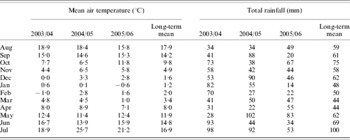
The humid climate at the study site is characterized by a mean annual air temperature of 8·4°C and total annual rainfall of 750 mm, with c. 400 mm received during April–September, the main growing season, and c. 350 mm during October–March (Table 1).
Monthly rainfall (mm) and mean air temperature (°C) at Hohenschulen, Germany

Treatments and design
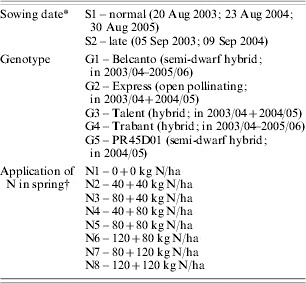
Two experiments were set up. In Expt 1, four varieties, two sowing dates (except 2005/06) and eight mineral N amounts were investigated (Table 2). Belcanto is a French semi-dwarf hybrid that was commercially available at the beginning of the experiment. Although, already released in 1993, Express was used because of its relatively small canopy, whereas Talent and Trabant represent modern hybrids. In 2004/05, the newly registered semi-dwarf hybrid PR45D01 was tested together with Trabant as standard in a separate trial (Expt 2) on another field at the same site and was treated identically as the genotypes in Expt 1.
Experimental factors and levels of factors used in the field trial in 2003/04, 2004/05 and 2005/06

* Seeding rate at the normal sowing date: 40 (hybrids) or 60 seeds/m2 (Express); at the late sowing date: 55 (hybrids) or 70 seeds/m2 (Express).
† 1st application at start of spring growth (04 Mar 2004; 24 Mar 2005; 23 Mar 2006). 2nd application at stem elongation (05 Apr 2004; 14 Apr 2005; 19 Apr 2006).
Each year, the trial was established on a new field previously growing winter barley. The trials in different years were therefore fully independent and not repeated on the same plots. Practical constraints required a split–split-plot design of the field trial with three levels of splitting. The sowing dates were main plots, the genotypes were sub plots split within main plots, and the mineral N treatments were sub–sub plots split within sub plots. The N treatments were replicated four times within the sub plots. The plots sown in Sep 2004 and harvested in 2005 received 30 kg N/ha in October 2004 to ensure crop N supply and adequate crop growth before winter. In 2005/06, only Belcanto and Trabant were compared at one sowing date. The straw of the preceding winter barley crop remained on the plots. The trials were sown within 1 day of ploughing. Sub–sub plot size was 12×3 m, using an area of 3×3 m for plant sampling. OSR volunteers were not removed.
N fertilizers (calcium ammonium nitrate with 270 g N/kg) were applied at the beginning of spring growth and at the beginning of stem elongation. Crop management not involving the treatments (e.g. application of herbicides, fungicides, insecticides and plant regulators) was conducted according to site-specific recommendations to achieve optimal yield.
Plant sampling
Plant samples were taken from the N1, N2, N5 and N8 treatment (Table 2) at five stages (end of autumn growth, start of spring growth, stem elongation, pod filling and harvest) for determination of aboveground total dry matter (TDM) and total N (0·5 m2 sampling area), except for PR45D01. Two weeks before combine harvesting, seed yield, number of pods, 1000 seed weight and straw yield were measured and number of seeds per pod were calculated. The N uptake was obtained by multiplying the TDM (standardized to g/m2) by the total N content of the plant material and the seeds determined by Near Infra Red Spectroscopy (NIRS).
In all plots, an area of 10·5 m2 (9 m2 in 2004) was harvested by combine at maturity and seed yield was standardized to t/ha at a proportion of 0·91 DM based on the moisture content of a seed subsample. Total N concentration of the seeds was estimated by NIRS. N offtake by the seeds was calculated by multiplying the seed yield by the corresponding seed N concentration. The simple N balance results from N fertilization in spring minus N offtake by the seeds.
Statistical analysis
Analyses of variance were done using the SAS statistical package (SAS Institute 1999). Year was used as replication of main plots (sowing date). Standard errors (s.e.) for genotype are based on year×sowing date×genotype interaction effects and those for the mineral N treatments are based on year×sowing date×genotype×N treatment×replication effects. In order to analyse the effects of Belcanto and Trabant for all 3 years, averages were calculated including both sowing dates in 2003/04 and 2004/05. In this case, s.e.s for genotype are based on year×genotype interaction effects and those for the mineral N treatments are based on year×genotype×N treatment×replication effects. The s.e.s apply only to individual treatment means.
For each genotype, two models were fitted to the N response curves using the following equations:


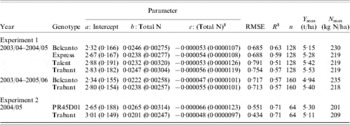
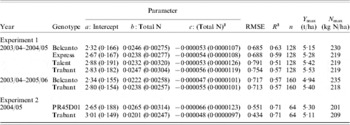
where Y is the grain yield (t/ha), N1 and N2 the amount of N fertilizer applied at both application dates (kg N/ha), and N T the total amount of N fertilizer applied (kg N/ha). a, b, c, b1, b2, c1, c2 and d are parameters. The parameter values were estimated using the REG procedure of SAS, Release 9.1. Since Eqn (1a) did not explain significantly more variation than Eqn (1b), the simpler equation was used. The estimates of parameters are shown in Table 3. The maximum yield (Y max) and the corresponding N amount (N max) were calculated from Eqn (1b).
Estimates of parameters in Eqn (1b) relating grain yield (t/ha) of four OSR genotypes to applied total N amount (kg N/ha), yield maximum (Y max), and corresponding N amount (N max). Standard errors of the estimates are shown in parentheses
RMSE=root mean squared error of model; R 2=multiple regression coefficient.
The proper test for N by genotype interaction effects is to fit a model with separate regression coefficients for each genotype. However, none of the interaction effects was significant at P=0·05. Therefore, all interaction terms have to be excluded, resulting in a set of parallel curves with identical N max values for each genotype. The use of separate curves for each genotype might give an indication of differences in the N response between the genotypes.
RESULTS
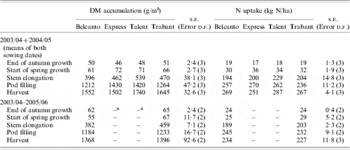
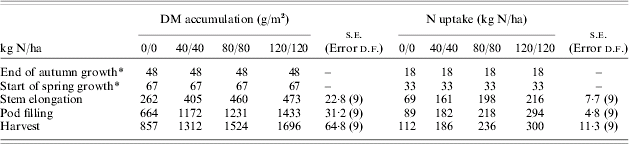
Plants of the semi-dwarf genotypes were observed to be shorter and branching started at lower stem sections compared to the other varieties. However, on average in 2003/04–2004/05 and of both sowing dates, aboveground DM and N uptake at the end of autumn growth and at the start of spring growth were similar for all genotypes (Table 4). Plants sown at the beginning of September accumulated less DM (P=0·035) than those planted in August; however, no significant genotype×sowing date interactions occurred (data not shown). During spring growth, Talent accumulated more aerial biomass (shoot plus leaves) and took up more N than the other varieties, but the differences were significant only at harvest (P<0·05). Belcanto (a semi-dwarf hybrid) tended (0·10 >P>0·05) to produce less shoot DM compared to the conventional hybrids. However, at harvest this difference was no longer detectable. On average, over all 3 years, Belcanto and Trabant showed a similar pattern during the growth period as well as at harvest.
Aboveground DM accumulation (g/m2) and N uptake (kg N/ha) of four OSR genotypes throughout the growing period (mean of 160 and 240 kg N/ha treatments)

* Genotype not grown in 2005/06.
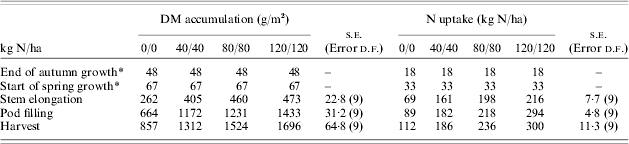
N fertilization in spring significantly enhanced crop growth and N uptake at stem elongation and the subsequent sampling times (Table 5). At harvest, unfertilized OSR took up about 112 kg N/ha, whereas the 120+120 kg N/ha treatment incorporated 300 kg N/ha. No significant genotype×N treatment interaction was observed, indicating that all tested varieties responded similarly to an increased N supply (data not shown).
Effect of N fertilization on aboveground DM accumulation (g/m2) and N uptake (kg N/ha) of OSR throughout the growing period (mean of two years (2003/04–2004/05), two sowing dates, and four genotypes)
* Plant sampling occurred before N was applied.
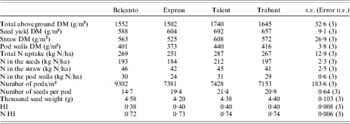
Concerning the seed yield derived from plant sampling at harvest, Talent and Trabant significantly out-yielded Belcanto and Express (Table 6), on average of 2003/04 and 2004/05. Talent also achieved the highest DM of straw and pod walls. There were no significant differences in vegetative biomass of Belcanto, Express and Trabant (P>0·05).
Yield and yield components of four OSR genotypes (mean of two years (2003/04–2004/05), two sowing dates, and the 160 and 240 kg N/ha treatments), derived from plant sampling at harvest

Detailed analysis of the yield components at harvest (Table 6) revealed that Belcanto produced more pods/m2 and slightly larger seeds than the other genotypes (average of the 160 and 240 kg N/ha treatments, both sowing times and both years). In contrast, the calculated number of seeds per pod was markedly reduced (P=0·015). The amount of N in the straw varied from 41 to 46 kg N/ha and that in the pod walls from 24 to 31 kg N/ha between the genotypes, but without clear trends. The HI, the proportion of seed DM to the total aerial biomass, varied slightly from 0·38 to 0·40, while the N HI (N amount in the seeds/N amount of the total aerial biomass) ranged between 0·72 and 0·74.
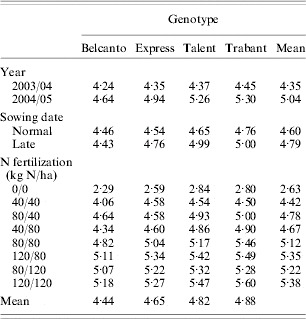
Combine harvested seed yields had a similar range to those estimated from plant samples (Table 7). The highest yields were observed in Trabant (4·88 t/ha) and Talent (4·81 t/ha). Without N fertilization, Belcanto yielded 2·29 t/ha, Express 2·59 t/ha, Talent 2·84 t/ha and Trabant 2·80 t/ha.
Effect of year, sowing date and N fertilization on combine harvested seed yield (t/ha) of four OSR genotypes

s.e. (Error d.f.) for: sowing date, 0·473 (1); genotype, 0·016 (3); N fertilization between genotypes, 0·127 (21); N fertilization within genotypes, 0·063 (63); genotype×sowing date, 0·022 (3); genotype×N fertilization, 0·125 (63).
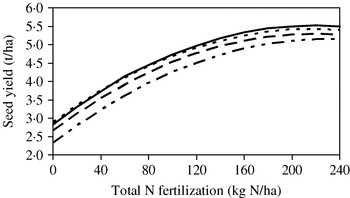
N fertilization significantly enhanced seed yield. Since no genotype×N treatment interaction occurred (Table 7), yield increase was similar for the varieties, but at different levels, as shown by the N response curves separately estimated for each genotype (Table 3, Fig. 1). On average in 2003/04–2004/05 and both sowing dates, Belcanto required 230 kg N/ha to achieve its maximum yield of 5·15 t/ha, whereas other genotypes required 219 kg N/ha to yield 5·29 t/ha (Express), 5·42 t/ha (Talent) and 5·52 t/ha (Trabant), respectively (Table 3). Even the 3-year comparison of Belcanto and Trabant revealed similar figures.
Effect of the N fertilization on seed yield (t/ha at 910 g DM/kg) of four OSR genotypes (mean of 2003/04–2004/05 and two sowing dates). (Belcanto ‐ · ·, Express ‒ ‒, Talent · · · · ·, Trabant ─).

In 2004/05, another semi-dwarf genotype, PR45D01, and Trabant as a conventional hybrid were tested in an additional trial (Expt 2). Without N supply, Trabant out-yielded PR45D01 by 0·4 t/ha (P>0·05), whereas PR45D01 produced a maximum yield of 5·3 t/ha at 201 kg N/ha compared to 5·1 t/ha achieved by Trabant at 209 kg N/ha (P>0·05).
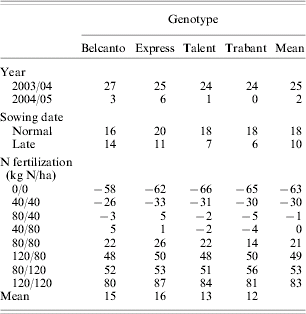
The simple N balance calculated for 2003/04–2004/05 revealed only small, non-significant differences between the genotypes ranging from 12 (Trabant) to 16 kg N/ha (Express) on average over all N treatments (Table 8). N removals in seeds exceeded the N applied at the lower rates, but not at rates >160 kg N/ha. As was previously shown for the seed yield, no genotype×N fertilization interaction was observed for the simple N balance.
Effect of year, sowing date and N fertilization on the simple N balance (N fertilization minus N offtake by the seeds; kg N/ha) of four OSR genotypes
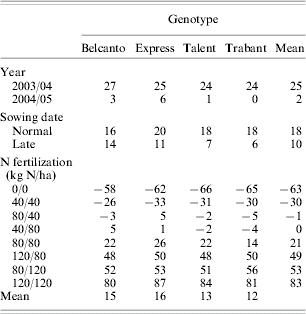
s.e. (Error d.f.) for: sowing date, 8·7 (1); genotype, 0·9 (3); N fertilization between genotypes, 3·9 (21); N fertilization within genotypes, 1·9 (63); genotype×sowing date, 1·2 (3); genotype×N fertilization, 3·9 (63).
DISCUSSION
In relation to N leaching, OSR is an ambivalent crop. In general, due to its ability to take up 40–60 kg N/ha before winter, N leaching under OSR is low compared to cereals. On the other hand, OSR can leave large amounts of leachable nitrate in the soil. Wheat takes up only 10–20 kg N/ha in the autumn and is therefore not suitable to prevent high amounts of nitrate in soil after harvest of OSR from leaching (Sieling et al. Reference Sieling, Günther-Borstel and Hanus1997; Sieling & Kage Reference Sieling and Kage2006). Although, the total N surplus will not inevitably be lost by leaching during the subsequent percolation period, it can be used as an indicator of the risks that are associated with specific farming practices, especially on the regional scale and if integrated over a longer period (Öborn et al. Reference Öborn, Edwards, Witter, Oenema, Ivarsson, Withers, Nilsson and Stinzing2003).
In the current experiments semi-dwarf hybrids were compared with conventional hybrids and an open pollinating variety in order to evaluate the potential of semi-dwarf genotypes to minimize the N residues after OSR, but not to test the yield performance. It was hypothesized that this new type of genotype with its shorter plants accumulates less aboveground biomass without yield penalties and, therefore, requires less N to achieve yield maximum resulting in an increased (N) HI. Consequently, less N would remain in the system after harvest and the risk of N leaching would be reduced. However, the results clearly show that this hypothesis must be rejected. Semi-dwarf OSR genotypes per se do not provide the opportunity to reduce the leaching potential in OSR based rotations. Belcanto, representing the semi-dwarf genotype, produced similar total aerial DM, took up similar amounts of N, showed similar (N) HIs and required at least as much N for yield maximum as the other tested varieties. PR45D01, registered in Germany in autumn 2005, gave similar figures when grown in 2004/05. In a field trial, Hofmann & Christen (Reference Hofmann and Christen2007) measured similar root growth in Belcanto, Express and Talent. However, no further information of husbandry effects on growth and yield of semi-dwarf genotypes is available in the literature, so that no comparison with results from other sites can be made.
It has to be noted that Belcanto was one of the first varieties that was commercially available at the beginning of the experiment. Since the breeding process was at the beginning, Belcanto did not show the same yield level as modern conventional genotypes, whereas PR45D01 even out-yielded Trabant in 2004/05.
A possible cause for no detectable interactions between genotype and N fertilization may be due to the experimental design. The trial consisted of two main plots of early and late sowing divided into genotypes with replication of N treatments within each genotype block. Although this design is not very suitable to test genotype×N fertilization interactions, it was chosen for practical reasons.
In the literature, several different statistical models are discussed to describe the N response, e.g. quadratic polynomial function, linear response and plateau function (LP), quadratic response and plateau function (e.g. Bélanger et al. Reference Bélanger, Walsh, Richards, Milburn and Ziadi2000; Cerrato & Blackmer Reference Cerrato and Blackmer1990); however, there is no clear statement about the most appropriate one. According to Henke et al. (Reference Henke, Breustedt, Sieling and Kage2007) the quadratic curve fit seemed to be quite unsusceptible to uncertainties in year-to-year nitrogen response variation and parameter estimation uncertainty. Using the LP fit resulted in a lower level of Nmax values (177–196 kg N/ha) compared to the quadratic curve fit (219–231 kg N/ha). In the present paper, N required for maximum yield is estimated. In practice, the crop is not fertilized to achieve maximum financial return. Taking the economic optimum into account, the optimum N amount decreased (190–202 kg N/ha), but the range of the genotypes remains similar. Both N application dates might differ in their yield effects. However, as shown in Table 7, the yield differences due to the splitting of the same total N amount into two applications, were small (4·78 v. 4·67 t/ha in the 120 kg N/ha treatment; 5·35 v. 5·22 t/ha in the 200 kg N/ha treatment). In addition, no interactions between the genotypes and the two application dates could be observed (data not shown). Therefore, and in order to calculate N max and Y max from the curve parameters, the quadratic N response model with the total N amount was used.
Plants of semi-dwarf genotypes are 100–300 mm shorter than those of the other varieties. Since OSR was often grown on the experimental fields in the past, a high number of volunteers emerged, especially in the normal sowing treatment. The volunteers that were not removed have affected the growth of the shorter semi-dwarf genotypes. However, in the late sown plots, the number of volunteers was very low and no sowing date×genotype interaction occurred in the present experiment. Therefore, it is argued that the volunteers did not bias the genotype effects. Another field trial investigating a range of different genotypes including two semi-dwarfs, which was carried out on a breeder's field without volunteers, revealed similar results referring to yield and (N-) HIs (T. Harms, personal communication).
Although not significant, the lower DM accumulation of Belcanto during spring growth is remarkable, occurring each year. This might indicate that Belcanto develops slowly during spring and/or produces less aboveground DM. However, no delay in development was visible during plant sampling. The leaves were not sampled separately and no leaf area was measured, so this phenomenon remains unexplained.
The present study only referred to the effects on N balance. However, semi-dwarf genotypes may be favoured by the farmers for other reasons, i.e. their higher lodging resistance and easier harvest and spray applications.
The conclusions from the present work are that semi-dwarf OSR genotypes per se do not provide the opportunity to reduce the N leaching problem in OSR-based rotations. Therefore, other strategies should be developed, e.g. no N fertilization in autumn, taking crop N at start of spring growth into account to optimize spring N fertilization, delay of soil tillage after harvest, changes in crop rotation, etc. However, many small steps are required to grow OSR in an ecologically sound way.
We thank Mrs Kirsten Schulz and Mrs Cordula Weise for performing the plant sampling and the laboratory analyses.