Introduction
Peltula Nyl. is a worldwide distributed lichen genus of c. 40, mostly soil and rock inhabiting, species. It is most diverse and ecologically significant in arid and semi-arid regions or wherever arid microclimates are found (Büdel & Nash Reference Büdel, Nash, Nash, Ryan, Gries and Bungartzs2002), and is particularly noticeable on seepage tracks of both acidic and basic rocks. The diversity of Peltula is high in the Mediterranean basin, which hosts all of the species known so far from the European continent (Hladun & Llimona Reference Hladun and Llimona2002–2007; Feuerer Reference Feuerer2012). Egea (Reference Egea1989) first revised the genus in the Iberian Peninsula, accepting a total of seven species for Spain, of which two were also known to occur in Portugal, namely Peltula euploca (Ach.) Poelt and Peltula omphaliza (Nyl.) Wetmore.
During recent field studies in the Upper Douro region (north-east Portugal), it became apparent that Peltula had been largely overlooked in this somewhat neglected region of the Iberian Peninsula. In fact, few references exist of lichenological studies carried out in this region and these are mainly from the late 19th and early 20th centuries (e.g. Sampaio Reference Sampaio1917), when many sites were still quite difficult to access. The entire country was scarcely visited by lichenologists in the past, when compared to the neighbouring Spain. Contributions to the lichen flora of Portugal are mainly from the second half of the 20th century and have increased only very recently. These include several new records for Portugal (e.g. Carvalho & Jones Reference Carvalho and Jones1997; van den Boom & Giralt Reference van den Boom and Giralt1999) and species new to science (e.g. Paz-Bermúdez & Elix Reference Paz-Bermúdez and Elix2004; Paz-Bermúdez et al. Reference Paz-Bermúdez, Giralt and Elix2009b ).
The Upper Douro region is located in the northern sector of the Central Iberian geotectonic zone (Ribeiro Reference Ribeiro2001) and revolves around the Douro hydrographical basin, c. 200 km upstream from the River Douro estuary, in Porto. The lithology is dominated by intensely folded and faulted metasedimentary rocks (including schist, greywacke and quartzite) intruded by igneous rocks (granite) ranging in age from the Precambrian to the Ordovician (Ribeiro Reference Ribeiro2001; Aubry et al. Reference Aubry, Luís and Dimuccio2011). The rigid tectonic, differential erosion and down-cutting by the River Douro and its tributaries resulted in an irregular topography (Aubry et al. Reference Aubry, Luís and Dimuccio2011) that has had a major influence on the landscape of the region. The climate is predominantly dry meso-Mediterranean (Costa et al. Reference Costa, Aguiar, Capelo, Lousã and Neto1998), sheltered from the Atlantic influence by mountains to the north and west. However, topographic thermo-Mediterranean microclimates are usually produced in most river valleys, where temperatures frequently reach 50°C in summer and the mean annual precipitation is often below 300 mm. A special feature of the landscape is the widespread presence of vertical schist surfaces arranged in layers along the valley slopes, which have been exposed by a sequence of gravity-induced detachment of offset rock joints, perpendicularly to the schistosity plane, in the schist and greywacke basement (Aubry et al. Reference Aubry, Luís and Dimuccio2011); and of massive quartzite outcrops along the residual hills of the original pleneplain (Costa et al. Reference Costa, Aguiar, Capelo, Lousã and Neto1998). Significant intercalations of metacalcareous rocks and calcosilicate veins (Ribeiro Reference Ribeiro2001) provide a source of carbonaceous dust which accumulates in most crevices and horizontal surfaces, caused by limited precipitation.
These features provide an ideal natural context for the occurrence of lichen communities rich in species of Peltula. The study by Paz-Bermúdez et al. (Reference Paz-Bermúdez, Arroyo, Atienza, Fernández-Brime, Burgaz, Carvalho, Figueiras, Llop, López De Silanes and Marcos2009a ) in the valley of the River Sabor (a right bank tributary of the Douro) was the first in the westernmost part of the Upper Douro region and lists the occurrence of Peltula euploca (Ach.) Poelt. The current study extends the exploration further east up to the Spanish border, including the valleys of the rivers Tua, Côa and Douro.
Material and Methods
Approximately 155 specimens of Peltula from the Upper Douro region (NE Portugal) and the provinces of Salamanca and Almeria (NW and SW Spain, respectively) were investigated and deposited in the herbaria of the University of Porto (PO), the University of Hamburg (HBG) and the University of Santiago de Compostela (SANT). Specimens provided by the herbaria ASU, BCN and CANB, and from the personal collection of M. Schultz were studied for comparison. The internal morphology of the lichen thallus and ascomata were studied from hand-cut and cryotome sections, mounted in water and lactophenol-cotton blue, respectively. Ascus structure and amyloid reaction of the ascus wall were observed by adding Lugol's solution directly to sections and squash preparations mounted in water before and after treatment with KOH (10%). Photographs of sections were taken on an Olympus XC50 camera, mounted on an Olympus BX51 compound microscope and using differential interference contrast (DIC). All habit photographs were taken on a Canon EOS 400D digital camera with a Zeiss Luminar 40 mm lens mounted on bellows.
Results
Peltula lobata J. Marques, M. Schultz & Paz-Berm. sp. nov.
MycoBank No.: MB 803401
Similis specie Endocarpon adscendens sed thallo pallide olivaceo, algiis ad ordinem Chroococcales, apotheciis grandis, laminalis, sessilis, discis apertis et ascis polysporis.
Typus: Portugal, Vila Nova de Foz Côa, Foz do Côa, 29TPF589493, 186 m, narrow crevices on vertical schist surfaces, 3 May 2011, J. Marques 927 (PO9021-L—holotypus); Portugal, Macedo de Cavaleiros, Casas, 29TPF8587, 345 m, on wide crevices in schist outcrops, 5 September 2006, J. Marques 517 (PO9024-L—paratypus); Portugal, Vila Nova de Foz Côa, Quinta da Barca, 29TPF5941, 150 m, on vertical schist surfaces, 14 October 2010, J. Marques 503 (HBG-019526—paratypus); Portugal, Vila Nova de Foz Côa, Vale de José Esteves, 29TPF5849, 196 m, on vertical schist surfaces, 2 May 2011, J. Marques 738 (HBG-019527—paratypus); Portugal, Alijó, Vale do Moinho, 29TPF3477, 203 m, on vertical granite surfaces, 7 March 2012, J. Marques 1461 (SANT11708—paratypus); Portugal, Vila Nova de Foz Côa, Canada do Amendoal, 29TPF5946, 310 m, on vertical schist surfaces, 7 April 2011, J. Marques 1466 (SANT11709—paratypus).
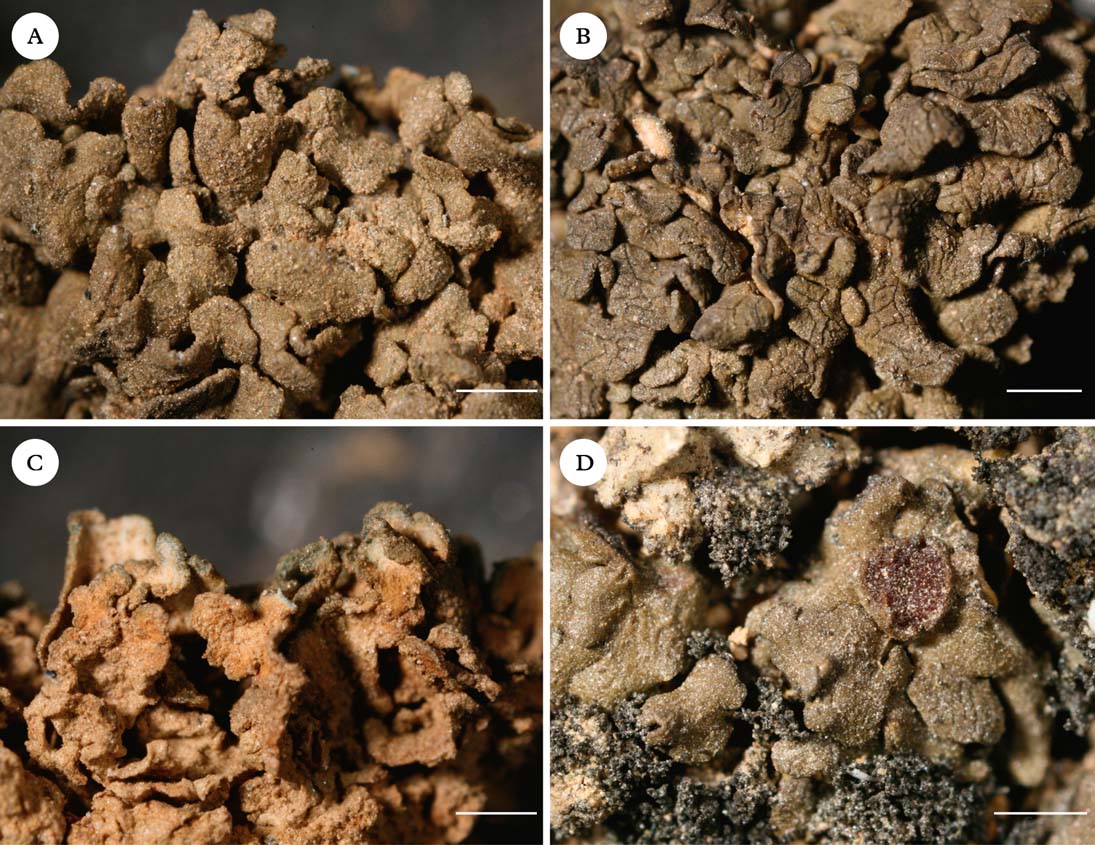
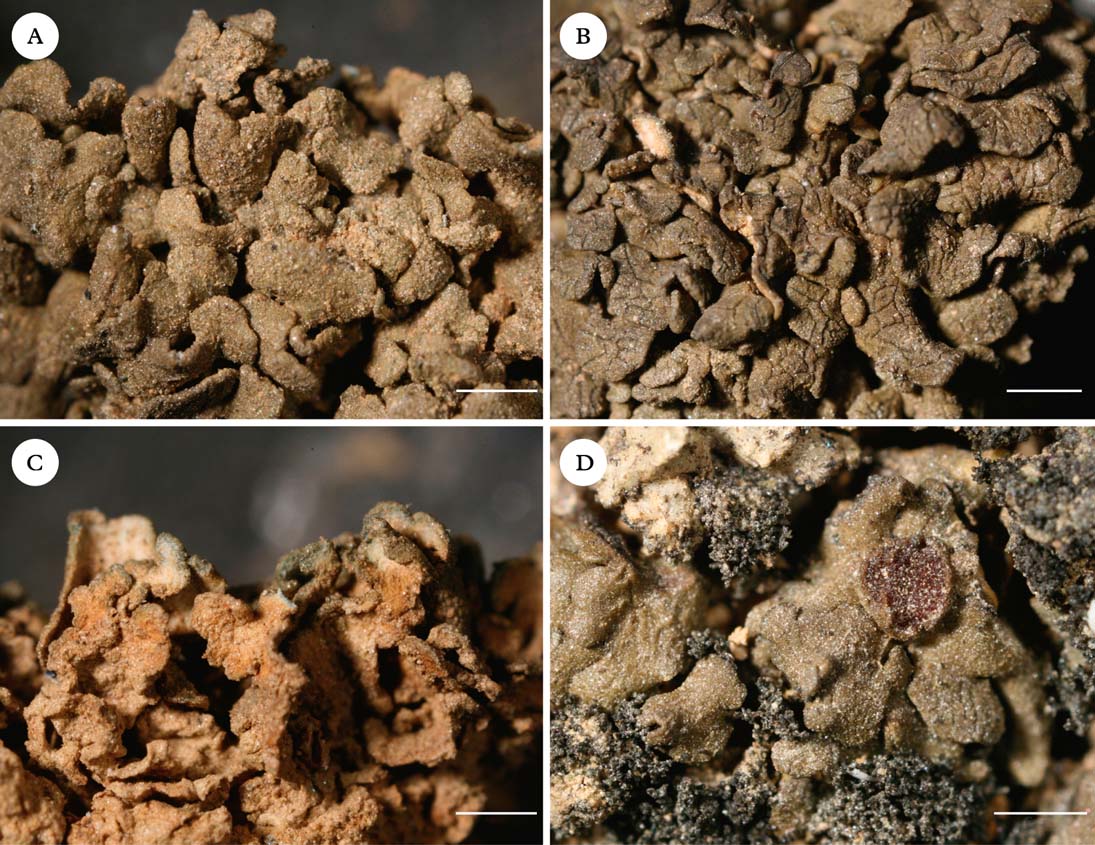
Peltula lobata, habitus. A, smooth upper surface (PO9040-L); B, fissured upper surface (PO9040-L); C, detail of lower surface (PO9040-L); D, detail of upper surface with apothecia (HBG-019527—paratype). Scales: A–D=1 mm. In colour online.
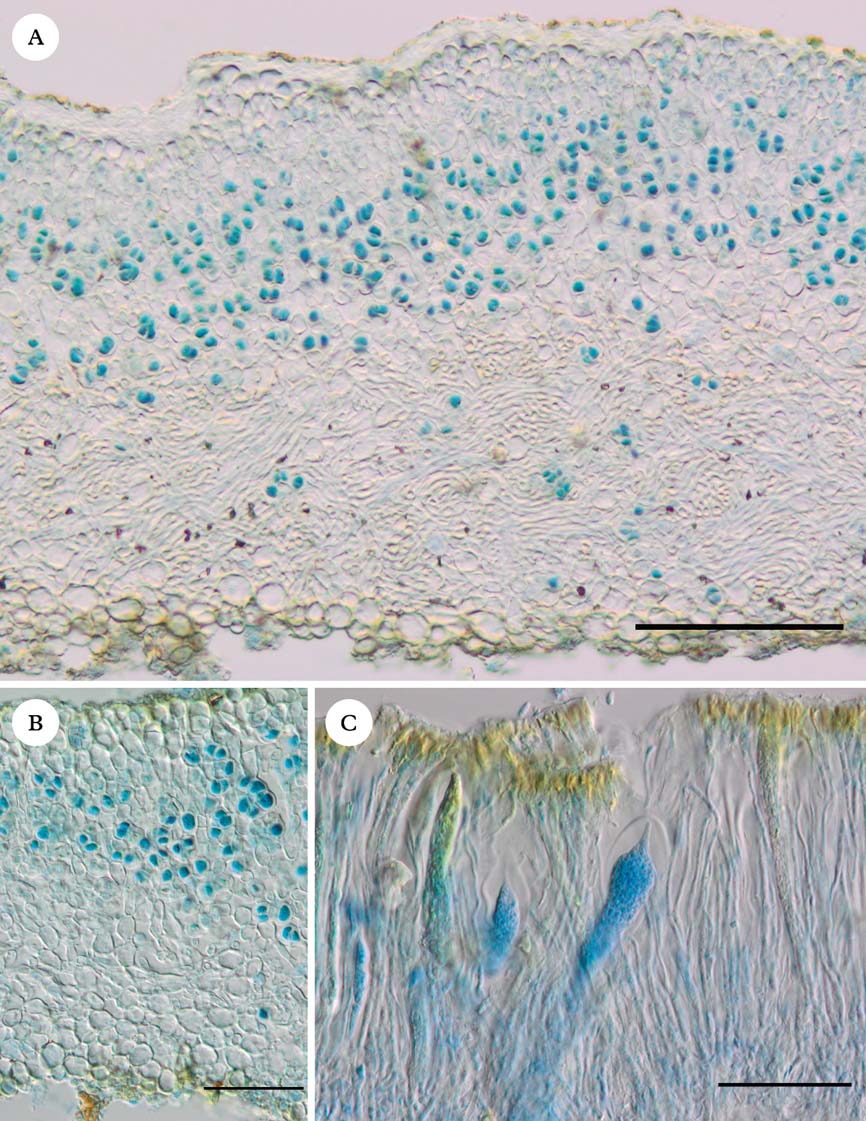
Peltula lobata, anatomy (holotype). A, thallus section of a mature lobe with a thick epinecral layer, upper and lower paraplectenchymatous cortex and prosoplectenchymatous medulla, composed of densely interwoven hyphae (PO9021-L); B, thallus section of a juvenile lobe showing a partly paraplectenchymatous medulla (PO9021-L); C, detail of polysporous ascus (PO9021-L). Scales: A=100 µm; B & C=50 µm. In colour online.
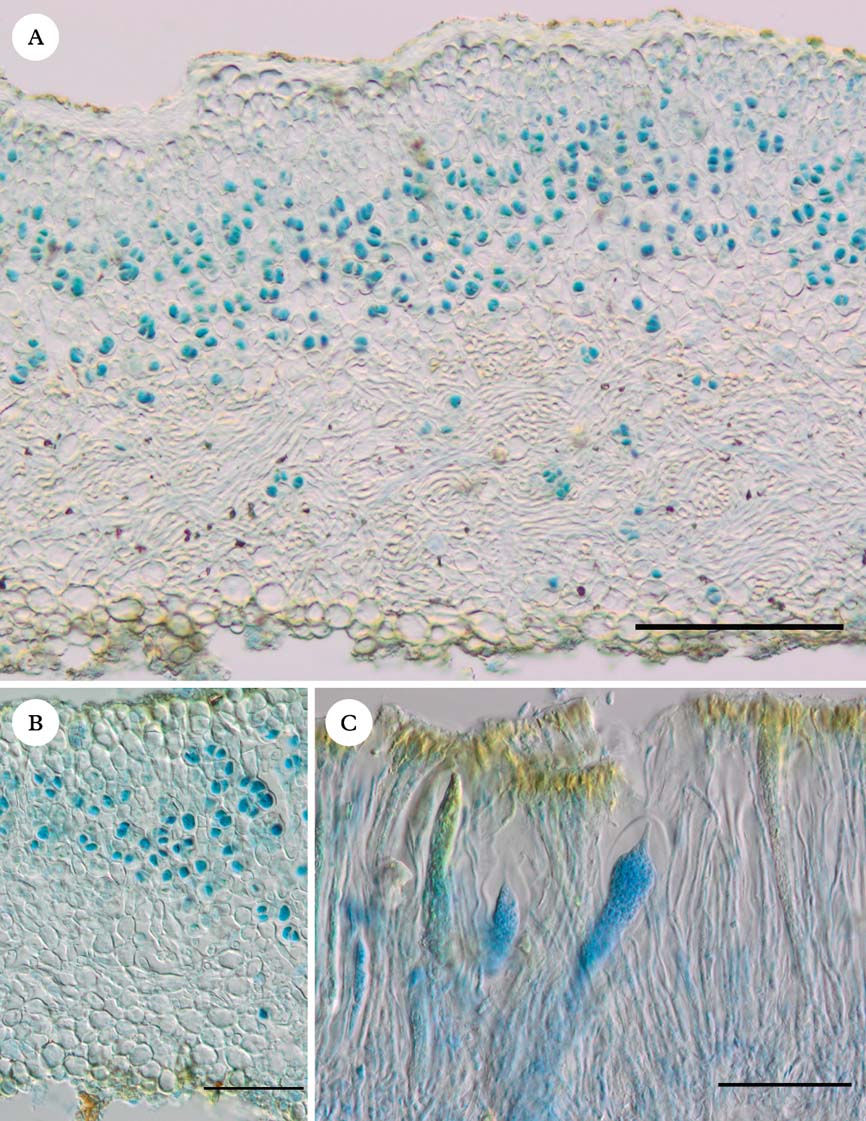
Thallus thick foliose to subfoliose, lobate, initially composed of simple, ascending squamules attached by lateral holdfasts, becoming deeply divided into loosely overlapping to strongly imbricate lobes in well-developed specimens, rising from a common holdfast that may produce a short flattened stalk, and forming extensive cushions up to 4 cm (or larger aggregates); lobes elongate, up to 5 mm long and 3 mm wide, flat to somewhat undulate and contorted, with margins usually bent downwards to occasionally revolute; upper surface olive-green to olive-brown, pale brown towards the base of the lobes, epruinose, matt to sometimes glossy, smooth to slightly rugose (Fig. 1A), occasionally fissured (Fig. 1B), without soredia or isidia; lower surface pale reddish brown to white in well-developed lobes, or darkened by substratum interaction (Fig. 1C); thallus 150–450 µm thick (up to 550 µm at stalk); upper cortex usually present, 12·5–62·5 µm thick, made up of paraplectenchymatous cells varying in diam. from 5–25 µm, with a more or less well delimited continuous algal layer beneath, 50–120 µm thick; a pale yellow smooth epinecral layer 5–18 µm thick is usually present; medulla white, 50–250 µm thick, prosoplectenchymatous, composed of loosely to densely interwoven, elongated hyphae (Fig. 2A) but sometimes more densely arranged and appearing paraplectenchymatous, namely in immature squamules as well as at thallus margins, and then difficult to distinguish from lower cortex (Fig. 2B); lower cortex 35–125 µm thick, made up of paraplectenchymatous cells mostly 10 µm in diam., sometimes becoming eroded at thallus margins.
Apothecia rare, adnate, with a raised rim when mature (Fig. 1D); disc reddish brown, 0·3–1·3 mm diam.; hymenium 100–200 µm tall, orange-brown, I+ wine red; paraphyses moniliform with apices expanded to 6 µm, not branching but sometimes anastomosing; asci clavate to obclavate, with a lacerate gelatinous sheeth, ascus wall I+ reddish brown, blue after pretreatment with K, more than 100-spored (Fig. 2C); ascospores hyaline, ellipsoid to slightly reniform, simple, 5·5–9·0×2·5–4·0 µm.
Pycnidia immersed, cerebriform; conidia ellipsoid, hyaline, 2·0–3·2×0·8–1·5 µm.
Chemistry
Spot tests all negative; secondary metabolites not investigated.
Habitat and distribution
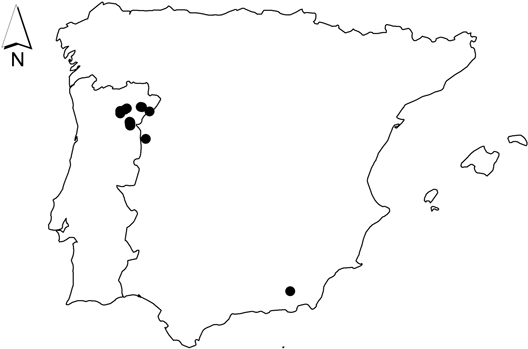
A frequent colonizer of vertical, sun-exposed rock crevices on riverbanks, as well as of periodically submerged rock surfaces in temporary riverbeds. Although commonly found on schist, it also colonizes quartzite and granite. So far it has been observed in only ten localities in north-east Portugal, where it is common and forms large, rather conspicuous brown patches, at low altitudes (between 130 and 500 m); and in two localities in the Spanish provinces of Salamanca (at 700 m) and Almeria (at 780 m) (Fig. 3).
Distribution of Peltula lobata.
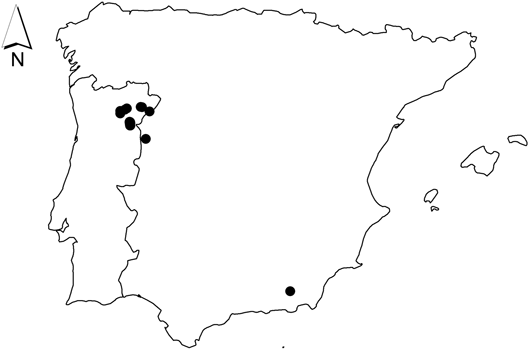
Peltula lobata is frequently the sole colonizer of the thinnest cracks or river-washed crevices, but when these become wider and filled with soil other terricolous species occur, including Endocarpon pusillum Hedw. and Peltula patellata (Bagl.) Swinscow & Krog, among others. On rock surfaces, it is often associated with the siliceous rain-track lichen communities described by Llimona & Egea (Reference Llimona and Egea1985), therefore accompanying other species of Peltula, such as Peltula euploca (Ach.) Poelt and Peltula obscurans (Nyl.) Gyeln., and other members of the Lichinales including, for example, Pyrenopsis triptococca Nyl., Lichinella stipatula Nyl., Caloplaca subsoluta (Nyl.) Zahlbr. and Aspicilia contorta subsp. hoffmanniana S. Ekman & Fröberg are among the dominant species in the driest areas of these rock surfaces. When bryophytes such as Grimmia laevigata (Brid.) Brid. and Grimmia dissimulata E. Maier are present, Peltula lobata occasionally overgrows them, becoming muscicolous.
The outcrops from which Peltula lobata was collected were always in the sub-humid to semi-arid ombroclimate of the meso-Mediterranean to the topographically influenced thermo-Mediterranean belts of the Mediterranean Region (Costa et al. Reference Costa, Aguiar, Capelo, Lousã and Neto1998), amongst Quercus rotundifolia Lam. and Juniperus oxycedrus L., or cultivated olive and vine.
Notes
In the field Peltula lobata closely resembles Endocarpon adscendens (Anzi) Müll. Arg. or Endocarpon loscosii Müll. Arg., with which it may share the same habitat near riverbanks, but it is readily distinguished after closer inspection, since the latter have perithecia and green algae as photobionts. Peltula lobata is also rather similar to species of Heppia but these have 8-spored, thin walled asci and a different thallus anatomy. Sterile specimens may, however, be difficult to distinguish from Heppia.
Peltula lobata is distinguished from all other species of Peltula by the thick lobate, non-sorediate thallus and laminal, sessile apothecia with dark red, open discs. Fully developed specimens of P. lobata are characterized by multi-branched and strongly imbricate lobes and are outstanding in thallus size.
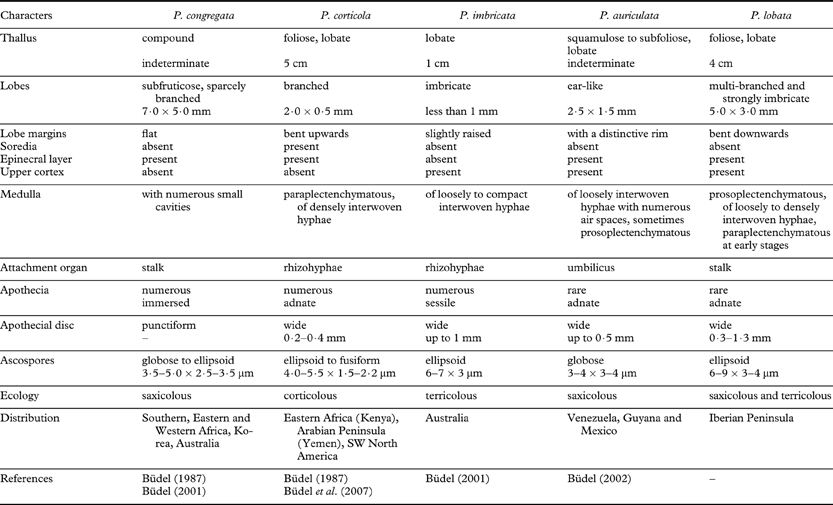
In this predominantly squamulose genus, only a few species have been described with a lobate thallus. Based on the relationship between thallus growth form and ecological preferences among species of Peltula illustrated by Büdel (Reference Büdel1987: 26, fig. 3), P. lobata fits between the peltate type (“peltater Typ”), characteristic for species of seepage track communities, and the lingulate type (“lingulater Typ”), common in species from periodically submerged habitats. This type of thallus development is also found in P. corticola Büdel & R. Sant, P. congregata (Nyl.) Swinscow & Krog, P. imbricata Filson and P. auriculata Büdel et al. (Table 1). Peltula lobata and P. corticola are somewhat similar morphologically and anatomically, including the presence of a completely paraplectenchymous thallus (Büdel Reference Büdel1987) which may be observed in immature thalli of Peltula lobata, but the latter differs in having a larger and thicker thallus, larger apothecia and spores, and an absence of soredia. The type of attachment organ is also different. Peltula corticola is attached with tufts of thick-walled, anastomosing rhizohyphae (Büdel et al. 2007), while P. lobata is attached to the substratum by a rather flat stalk. Furthermore, Peltula corticola is exclusively corticolous while P. lobata is mainly saxicolous or sometimes terricolous. Peltula lobata is clearly distinguished from P. congregata by the thallus anatomy, namely the development of an upper cortex, the type of apothecia and spore size; and from P. imbricata by a much larger thallus and apothecia (see Table 1). Peltula auriculata differs in the presence of characteristic dark-rimmed, ear-shaped appendices along the margins of thallus squamules.
Main diagnostic characters to distinguish among lobate Peltula species.
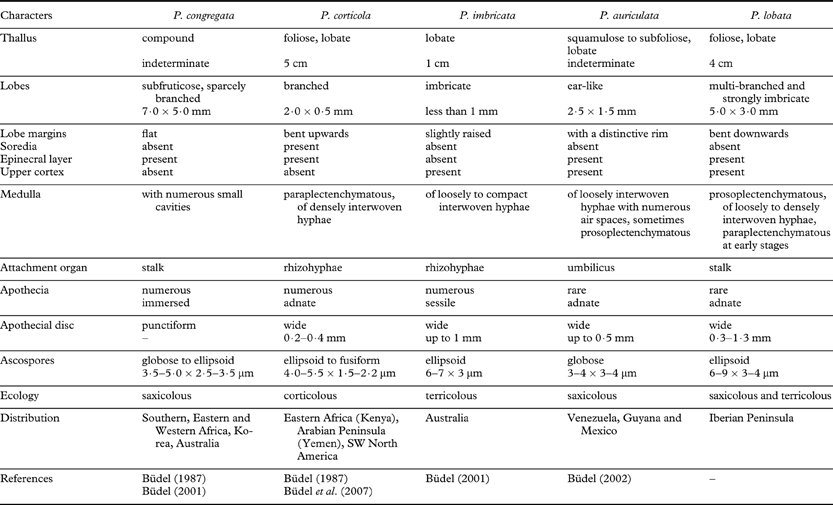
Specimens of co-occurring Peltula obscurans with somewhat lobulate squamules (var. hassei sensu Wetmore 1970), are never as strongly lobate and do not develop such a well-delimited upper cortex as in P. lobata. In fact, the occurrence of a distinct upper cortex in P. lobata is a rather unusual character within the genus Peltula, and might be a structural adaptation to the harsh conditions in Mediterranean riverine habitats, increasing the mechanical strength of its large lobes against damage by water in winter and simultaneously providing protection in summer against drought and excessive solar radiation.
Additional specimens examined. Portugal: Trás os Montes e Alto-Douro: Alijó, Amieiro, 29TPF3471, 153 m, on vertical granite surfaces, 2012, J. Marques (PO9022-L); Vale do Moinho, 29TPF3477, 203 m, on vertical granite surfaces, 2012, J. Marques (PO9023-L); Mirandela, Longra, 29TPF4680, 219 m, on vertical schist surfaces, 2011, J. Marques (PO9037-L); Serra de Valverde, 29TPF5183, 219 m, on narrow crevices in quartzite outcrops, 2011, J. Marques (PO9025-L); Mogadouro, Alto da Fraga, 29TPF8886, 538 m, on wide crevices in ultrabasic outcrops, 2009, J. Marques (PO9026-L); Faia da Água Alta, 29TQF0775, 514 m, on wide crevices in schist outcrops, 2009, J. Marques (PO9000-L); Murça, Ponte do Tinhela, 29TPF3676, 204 m, on vertical schist surfaces, 2011, J. Marques (PO9027-L); Vila Nova de Foz Côa, Canada do Amendoal, 29TPF5946, 367 m, on narrow crevices in schist outcrops, 2012, J. Marques (PO9028-L); Canada do Inferno, 29TPF5846, 126 m, on narrow crevices in schist outcrops, 2006, J. Marques (PO9041-L); Fariseu, 29TPF5844, 127 m, on narrow crevices in schist outcrops, 2010, J. Marques (PO9040-L); Foz do Côa, 29TPF5849, 216 m, on vertical schist surfaces, 2012, J. Marques (PO9036-L); Penascosa, 29TPF5941, 160 m, on vertical schist surfaces, 2007, J. Marques (PO9029-L); Penascosa, 29TPF5941, 164 m, on narrow crevices in schist outcrops, 2007, J. Marques (PO9039-L); Ribeira de Piscos, 29TPF5843, 130 m, on narrow crevices in schist outcrops, 2010, J. Marques (PO9030-L); Vale Cabrões, 29TPF5750, 301 m, on vertical schist surfaces, 2010, J. Marques (PO9031-L); Vale da Figueira, 29TPF5845, 223 m, on vertical schist surfaces, 2012, J. Marques (PO9032-L); Vale do Forno, 29TPF5748, 301 m, on schist, 2011, J. Marques (PO9033-L).—Spain: Almeria: Abla, Las Juntas, 30SWG219115, 780 m, 2012, J. Marques (PO9034-L); Abla, Las Juntas, 30SWG219115, 780 m, 2012, J. Marques (PO9038-L). Salamanca: Ciudad Rodrigo, Siega Verde, 29TPF976080, 588 m, 2012, J. Marques (PO9035-L).
The species new to mainland Europe
Peltula bolanderi (Tuck.) Wetmore
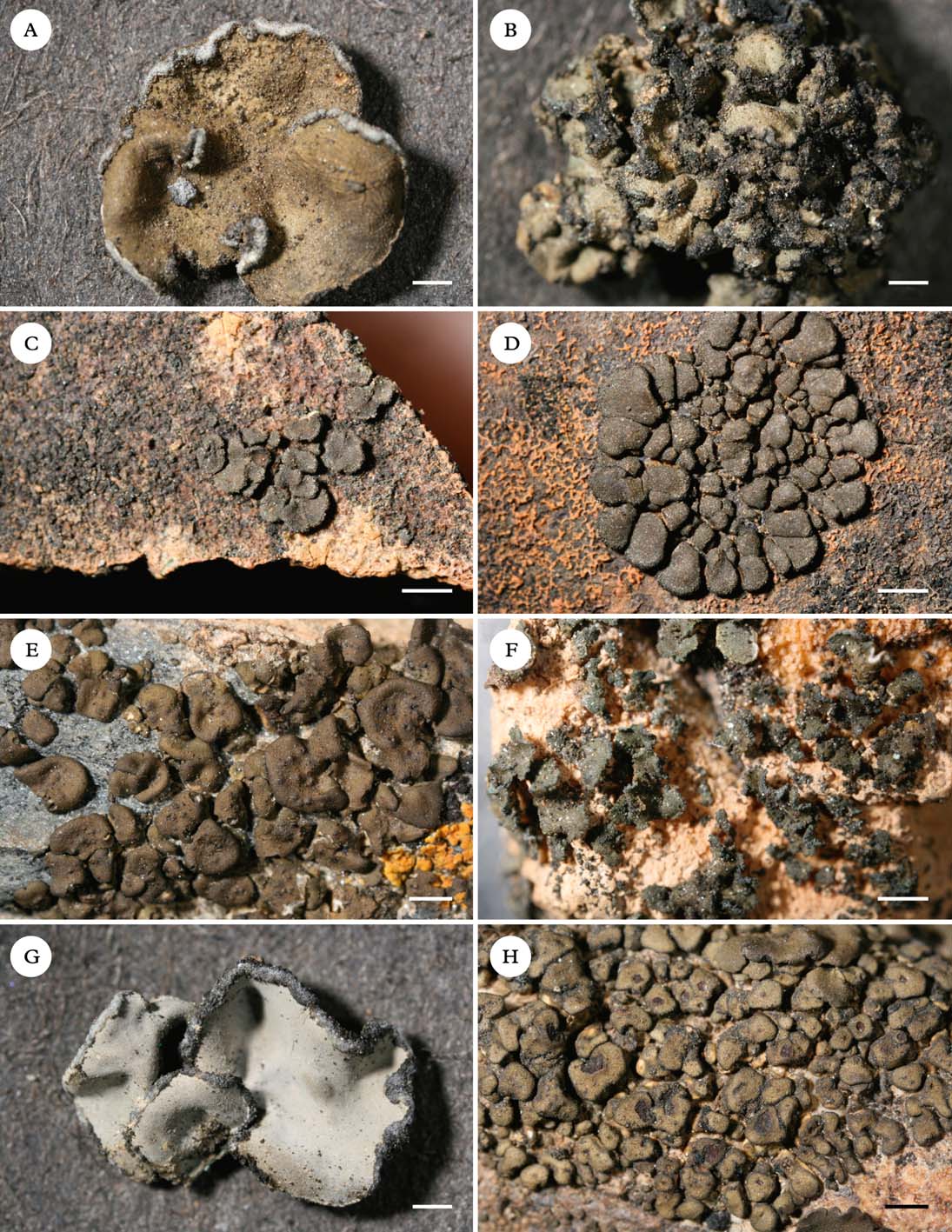
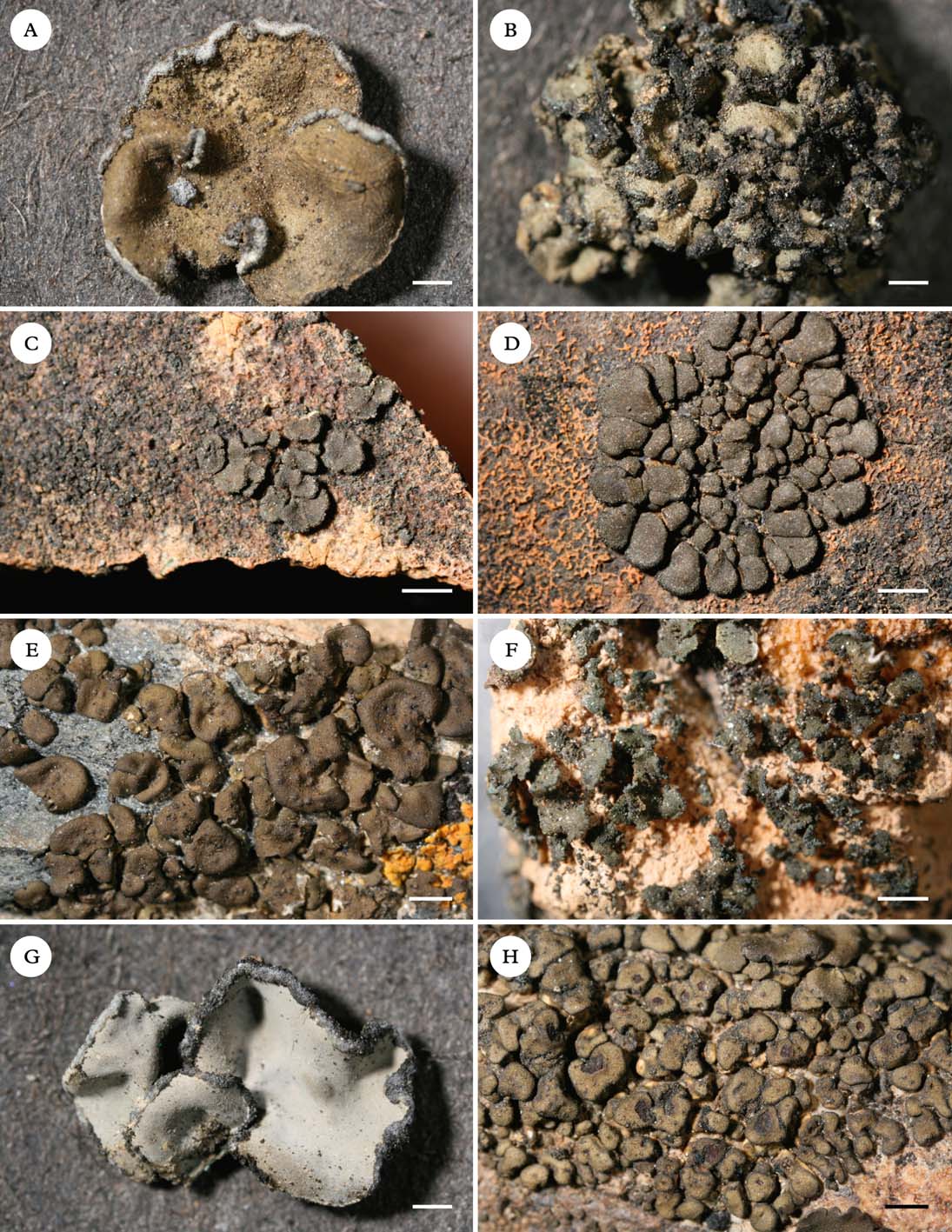
This sorediate species is similar and presumably closely related to P. euploca, with which it has been partly confused, but is readily distinguished by its polyphyllous thallus formed of smaller and thinner squamules with markedly undulate margins (Büdel & Nash Reference Büdel, Nash, Nash, Ryan, Gries and Bungartzs2002) and carrying one to several apothecia (Fig. 4F). These are totally immersed at first but become sessile with a small thalloid rim. The two species share a similar ecology in the study area, thriving on seasonally moist but highly exposed schist surfaces, although P. bolanderi tends to show at least subtle differences in microhabitat preferences, colonizing the more shaded areas of these exposed surfaces, mainly associated with Pyrenopsis triptococca Nyl.
Thallus morphology of selected species of Peltula present in the Upper Douro Region (north-east Portugal). A, P. euploca (typical form); B, P. euploca (polyphyllous form); C, P. euploca (small form); D, P. euploca (small effigurate form); E, P. euploca (esorediate form); F, P. bolanderi; G, P. farinosa; H, P. zahlbruckneri. Scales: A–H=1 mm. In colour online.
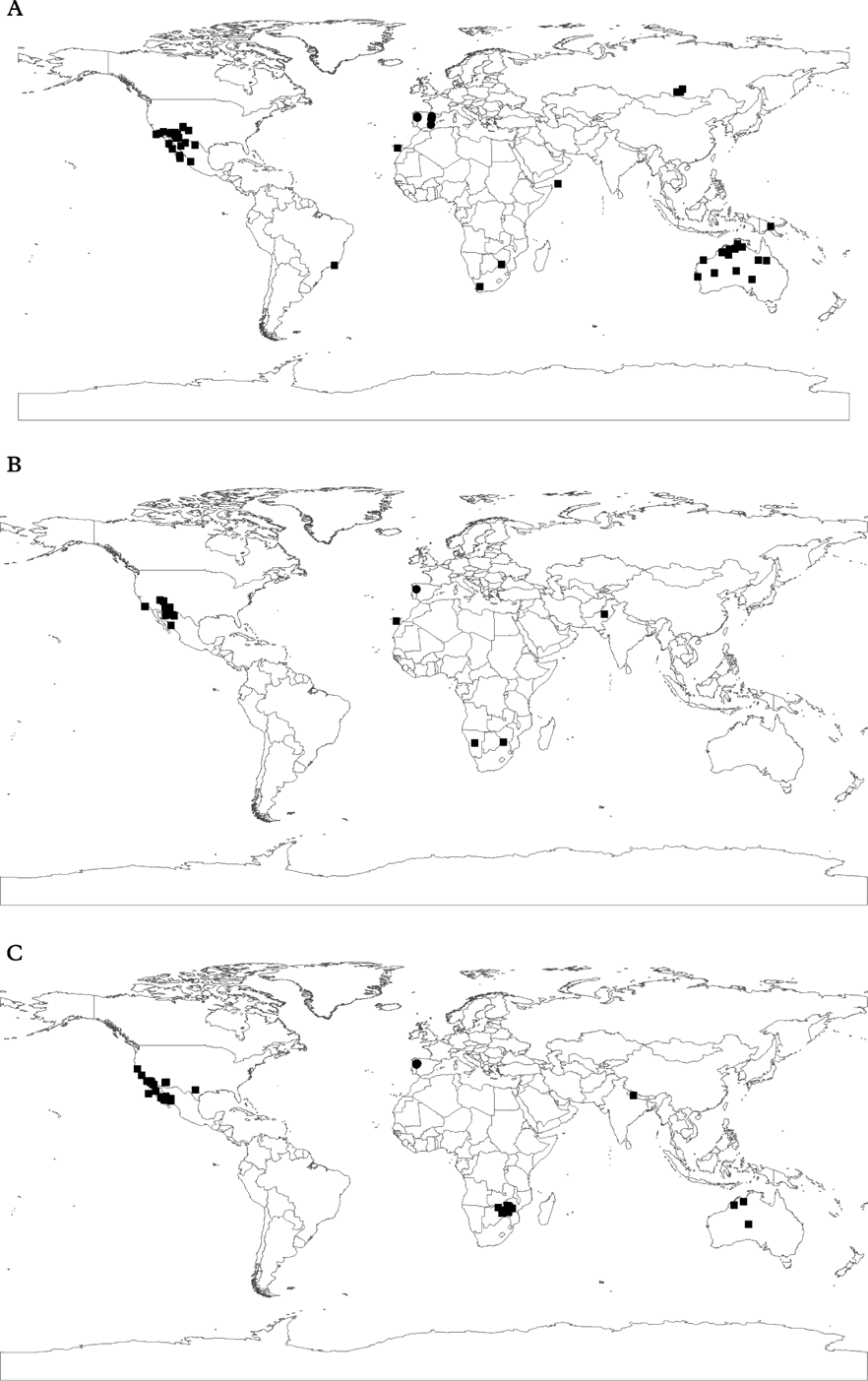
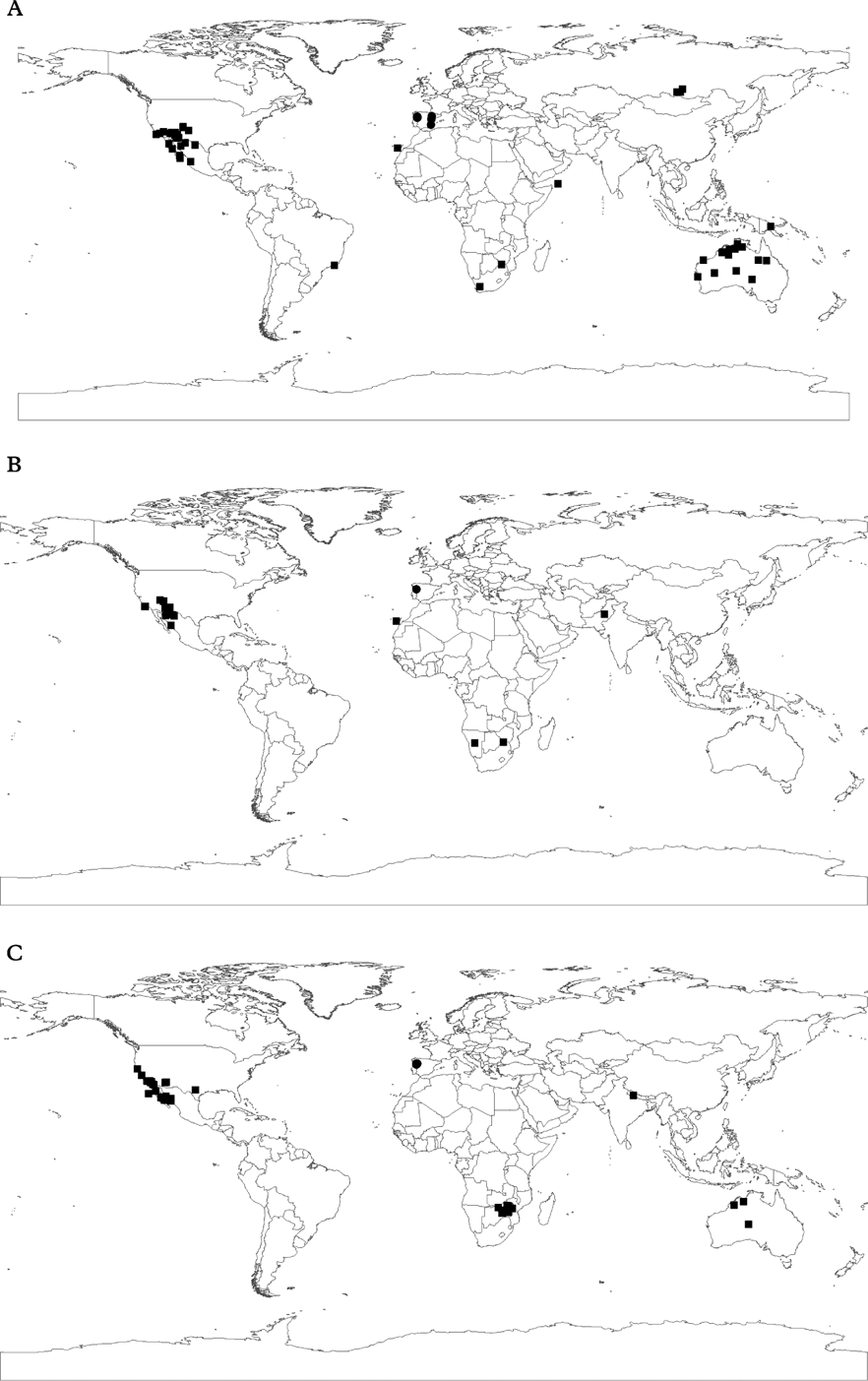
So far, P. bolanderi has been reported from Australia, SW North America, Brazil, southern Africa, the Middle East (Egea Reference Egea1989; Büdel Reference Büdel and McCarthy2001), New Guinea (Aptroot Reference Aptroot1998), the Baikal Region in Siberia (Makryi Reference Makryi1999) and the Canary Islands (Schultz & van den Boom Reference Schultz and van den Boom2007). It has probably been overlooked in the Iberian Peninsula (Fig. 5A).
World distribution of the three species of Peltula new to mainland Europe. A, Peltula bolanderi; B, Peltula farinosa; C, Peltula zahlbruckneri. Circles (•) represent new data resulting from this study. Squares (▪) represent data based in the following literature: Büdel (Reference Büdel1987), Büdel (Reference Büdel and McCarthy2001), Büdel & Nash (Reference Büdel, Nash, Nash, Ryan, Gries and Bungartzs2002), Schultz & van den Boom (Reference Schultz and van den Boom2007) and Schultz et al. (Reference Schultz, Zedda and Rambold2009).
Selected specimens examined. Portugal: Trás-os-Montes e Alto Douro: Carrazeda de Ansiães, Fiolhal, 29TPF3363, 308 m, on schist, 2011, J. Marques (PO8988-L); Mirandela, Serra de Valverde, 29TPF5183, 210 m, on quartzite, 2011, J. Marques (PO8994-L); Vila Nova de Foz Côa, Monte do Fariseu, 29TPF5844, 263 m, on quartzite, 2010, J. Marques (PO8983-L); Penascosa, 29TPF5941, 163 m, on narrow crevices, 2010, J. Marques (PO8984-L); Vale Cabrões, 29TPF5850, 248 m, on schist, 2011, J. Marques (PO8985-L); Quinta da Barca, 29TPF5940, 150 m, on schist, 2010, J. Marques (PO8986-L).—Spain: Teruel: Bezas, 30TXK406659, 1260 m, on sandstone, 2010, J. Marques (PO8875-L).
Peltula farinosa Büdel
Very similar to P. euploca but characterized by a larger thallus up to 22 mm diam. and a markedly pruinose thallus surface (Fig. 4G). It was found only in two sites of the Côa River valley, growing on sheltered to fully exposed schist surfaces. At these sites it seems to be associated with rain-track communities dominated by P. euploca and Glyphopeltis ligustica (B. de Lesd.) Timdal. The possibility of association of this species with calcium-rich secondary deposits, as mentioned by Büdel & Nash (Reference Büdel, Nash, Nash, Ryan, Gries and Bungartzs2002), is consistent with what was observed in the study area, where schist is usually covered with calcium precipitates (T. Aubry & L. Luis, pers. comm.). Previously known from South Africa, Pakistan and SW North America (Büdel & Nash Reference Büdel, Nash, Nash, Ryan, Gries and Bungartzs2002), Namibia (Schultz et al. Reference Schultz, Zedda and Rambold2009) and the Canary Islands (Schultz & van den Boom Reference Schultz and van den Boom2007) (Fig. 5B).
Selected specimen examined. Portugal: Trás-os-Montes e Alto Douro: Vila Nova de Foz Côa, Vale do Forno, 29TPF5749, 297 m, on schist, 2010, J. Marques (PO8989-L).
Peltula zahlbruckneri (Hasse) Wetmore
Composed of distinctively swollen squamules, anchored by a short stalk or umbilicus, dark greenish brown surface with darker to almost black margin. One to several apothecia per squamule, initially punctiform and opening with age, showing a dark reddish brown to more usually black disc (Fig. 4H).
One of the rarest species in the study area, an early colonizer of the hard schist and quartzite surfaces, in close contact with thermophilous and heliophilous lichens such as Acarospora hilaris (Dufour) Hue, Dimelaena oreina (Ach.) Norman, Caloplaca carphinea (Fr.) Jatta and others, frequently accompanied by P. placodizans. It was previously known from SW North America, southern Africa, India and Australia (Büdel Reference Büdel and McCarthy2001). The reference to the presence of P. zahlbruckneri in Sevilla (Spain) by Rowe & Egea (Reference Rowe and Egea1985a , Reference Rowe and Egea b ) is erroneous (J. M. Egea, pers. comm.) and was later corrected by Egea (Reference Egea1989), who excluded this species from the checklist of the Iberian Peninsula. However, the Portuguese specimens agree very well with material collected by one of the authors (MS) in California and match the type of the species, also from California, which is preserved in the herbarium of the Natural History Museum, Vienna (W). Therefore, this is the first confirmed record of P. zahlbruckneri in Europe (Fig. 5C).
Selected specimens examined. Portugal: Trás-os-Montes e Alto Douro: Alfândega da Fé, Santo Antão da Barca, 29TPF7669, 175 m, on schist, 2009, J. Marques (PO8993-L); Mirandela, Serra de Valverde, 29TPF5183, 210 m, on quartzite, 2011, J. Marques (PO8994-L); Vila Nova de Foz Côa, Monte do Fariseu, 29TPF5844, 263 m, on quartzite, 2010, J. Marques (PO9008-L); Ribeira de Piscos, 29TPF5843, 139 m, on schist, 2009, J. Marques (PO8991-L); Vale do Forno, 29TPF5749, 320 m, on schist, 2011, J. Marques (PO8992-L).
The species new for Portugal
Peltula obscurans (Nyl.) Gyeln.
Invariably terricolous in the study area, most specimens collected present sublobulate to lobulate, usually imbricate, squamules anchored by rhizinoids. These lobulate morphotypes closely resemble the description of Peltula crispatula (Nyl.) Egea by Egea (Reference Egea1989), namely in the anatomy of medullary tissue and algal layer, and the form of attachment to the substratum. This author relies on the attachment organ to distinguish P. obscurans, with an umbilicus, from P. crispatula, with rhizinoids. The exclusive presence of an umbilicus in P. obscurans is not followed by Büdel & Nash (Reference Büdel, Nash, Nash, Ryan, Gries and Bungartzs2002) or by Swinscow (Reference Swinscow1982), who considers that it can be “attached to substrate by umbilicus or hyphae or both”. Therefore, in the current study, the type of attachment organ was not considered a good character to differentiate the species, and is most likely a reflection of ecotypic differences. Additional differences between these species are, according to the literature, the paraplectenchymatous medulla and downcurved margins in P. obscurans, while in P. crispatula the medulla is almost absent or invaded by algae and the margin is clearly ascending (Egea Reference Egea1989). Peltula crispatula is a poorly known species from the northern Sahara and southern Spain and has never been observed fertile. Comparisons between the specimens collected and those of P. crispatula from the J. M. Egea collection at the Herbarium of the University of Barcelona (BCN) were inconclusive regarding these characters. Therefore we refrain from using the name P. crispatula and rely on general thallus morphology and apothecial characters to assign the specimens collected to the name P. obscurans.
The distinction of the varieties recognized by Wetmore (Reference Wetmore1970) within P. obscurans, based on thallus morphology and epihymenium reaction with KOH, proved to be unfruitful since both varied in the same specimen, as observed by Egea (Reference Egea1989).
The ecology of P. obscurans in the study area is quite similar to P. patellata, with which it is usually found on fully exposed compacted mineral soil. Peltula obscurans is distributed in southern Europe, Africa, North and South America, Asia and Australia (Büdel Reference Büdel and McCarthy2001). This is the most western reference of the species for the Iberian Peninsula.
Selected specimens examined. Portugal: Trás-os-Montes e Alto Douro: Carrazeda de Ansiães, Fiolhal, 29TPF3363, 308 m, on compacted soil between schist outcrops, 2011, J. Marques (PO8995-L); Mirandela, Serra de Valverde, 29TPF5183, 210 m, on compacted soil between schist outcrops, 2011, J. Marques (PO9005-L); Mogadouro, Faia da Água Alta, 29TQF0775, 514 m, on wide crevices in schist outcrops, 2009, J. Marques (PO9000-L); Murça, Ponte do Tinhela, 29TPF3676, 204 m, on compacted soil between schist outcrops, 2011, J. Marques (PO9018-L); Vila Nova de Foz Côa, Canada da Moreira, 29TPF6047, 316 m, on compacted soil between schist outcrops, 2010, J. Marques (PO8996-L); Penascosa, 29TPF5941, 163 m, on wide crevices in schist outcrops, 2010, J. Marques (PO8997-L); Vale do Forno, 29TPF5749, 320 m, on wide crevices in schist outcrops, 2011, J. Marques (PO8998-L).
Peltula patellata (Bagl.) Swinscow & Krog
Easily recognized by the orbicular to somewhat lobulate squamules, to about 4 mm diam., with a distinctive thickened rim along the margins and one to few apothecia, frequently occupying the whole squamule. This species is widely distributed in southern Europe, Africa, North and Central America, India and Australia (Büdel Reference Büdel and McCarthy2001). Prior to this study it had been rarely collected in the Iberian Peninsula, but was found to be quite common in the study area, growing on dry and exposed earth-filled crevices or compacted calcareous soil between rock outcrops, and less often spreading towards the neighbouring soft schist surfaces. These data extend the known distribution of the species in the Iberian Peninsula towards the north-west.
Selected specimens examined. Portugal: Trás-os-Montes e Alto Douro: Alfândega da Fé, Santo Antão da Barca, 29TPF7669, 175 m, on schist, 2009, J. Marques (PO9004-L); Mirandela, Serra de Valverde, 29TPF5183, 210 m, on compacted soil between schist outcrops, 2011, J. Marques (PO9005-L); Mogadouro, Faia da Água Alta, 29TQF0775, 514 m, on wide crevices, 2009, J. Marques (PO9006-L); Murça, Ponte do Tinhela, 29TPF3676, 204 m, on compacted soil between schist outcrops, 2011, J. Marques (PO9007-L); Vila Nova de Foz Côa, Penascosa, 29TPF5941, 163 m, on soil, 2010, J. Marques (PO8984-L); Vale do Forno, 29TPF5749, 320 m, on wide crevices, 2010, J. Marques (PO9020-L).
Peltula placodizans (Zahlbr.) Wetmore
This species is easily recognized by the small placodioid thallus and black capitate soralia on top of the central areoles. According to Egea (Reference Egea1989), it has its optimum in the arid and sub-arid areas of the western Mediterranean. In the Iberian Peninsula, it is mainly distributed in south-east Spain, locally penetrating the Eurosiberian region, but never collected in mainland Portugal prior to this study. These records extend the known distribution of the species in the Iberian Peninsula towards the north-west. In the study area it seems to be restricted to the warmer and drier areas of the Côa River valley, spreading along fully exposed hard schist and quartzite surfaces.
Selected specimens examined. Portugal: Trás-os-Montes e Alto Douro: Vila Nova de Foz Côa, Canada do Amendoal, 29TPF5946, 309 m, on schist, 2012, J. Marques (PO9010-L); Monte do Fariseu, 29TPF5844, 263 m, on quartzite, 2010, J. Marques (PO9008-L); Ribeira de Piscos, 29TPF5843, 139 m, on schist, 2009, J. Marques (PO9009-L).
Other Peltula species in the study area
Peltula euploca (Ach.) Poelt
Known from all continents apart from Antarctica, it is the most widespread species of the genus, and one of the few previously reported from Portugal, together with Peltula omphaliza (Nyl.) Wetmore (Hladun & Llimona Reference Hladun and Llimona2002–2007). It is quite frequent in the study area, colonizing virtually all sheltered to fully exposed vertical schist surfaces as a dominant species of the rain-track communities described by Llimona & Egea (Reference Llimona and Egea1985). Typically, a single peltate squamule is up to 12 mm wide (Fig. 4A) (Büdel & Nash Reference Büdel, Nash, Nash, Ryan, Gries and Bungartzs2002), but large morphological variation has been described (Egea Reference Egea1989; Büdel & Nash Reference Büdel, Nash, Nash, Ryan, Gries and Bungartzs2002) and also observed in the study area. These include: 1) a polyphyllous form with squamules that are repeatedly divided into elongated, somewhat to distinctly undulating lobules (Fig. 4B); 2) a small form rather close to P. bolanderi with squamules around 2–4 mm wide and with dark, sorediate margins (Fig. 4C), that is usually but not exclusively associated with typical P. euploca; 3) a particularly interesting form, composed of small, closely adnate, sorediate squamules showing a tendency to shape an effigurate thallus (Fig. 4D), a phenomenon that has been described by Wetmore (Reference Wetmore1970) and interpreted as regenerating thalli after mature squamules have become detached from the substratum, frequently accompanied by the well-known placodioid species, P. placodizans, and growing on extremely flat and hard rock surfaces; and 4) a frequent form in the study area that shows general similarities with characteristic specimens of P. euploca, but differs in the somewhat smaller thallus size, the complete absence of soralia and the regular formation of apothecia (Fig. 4E).
This variation may be influenced by the developmental stage of the specimens or site-specific factors such as light intensity and moisture availability, as well as rock characteristics (Büdel Reference Büdel1987), but a more detailed study on the morphological and genetic variability within this species is required and will be conducted in the near future.
Selected specimens examined. Portugal: Trás-os-Montes e Alto Douro: Alfândega da Fé, Santo Antão da Barca, 29TPF7669, 175 m, on schist, 2009, J. Marques (PO9014-L); Carrazeda de Ansiães, Fiolhal, 29TPF3363, 308 m, on schist, 2011, J. Marques (PO8988-L); Mirandela, Serra de Valverde, 29TPF5183, 210 m, on schist, 2011, J. Marques (PO9015-L); Mogadouro, Faia da Água Alta, 29TQF0775, 514 m, on schist, 2009, J. Marques (PO9016-L); Murça, Ponte do Tinhela, 29TPF3676, 204 m, on schist, 2012, J. Marques (PO9017-L); Vila Nova de Foz Côa, Canada do Amendoal, 29TPF5946, 367 m, on schist, 2012, J. Marques (PO8990-L); Penascosa, 29TPF5941, 163 m, on schist, 2010, J. Marques (PO9012-L); Vale de Figueira, 29TPF5845, 218 m, on schist, 2012, J. Marques (PO8999-L); Vale do Forno, 29TPF5749, 320 m, on schist, 2011, J. Marques (PO9013-L).
Discussion
As a result of this study, the number of Peltula species known in mainland Europe increases from eight to twelve (eleven in the Iberian Peninsula), including the new species, Peltula lobata, and Peltula bolanderi, Peltula farinosa and Peltula zahbruckneri as new additions. Peltula bolanderi and Peltula lobata were also found among Spanish material, raising the number of Peltula species known from mainland Spain (Egea Reference Egea1989) to nine. Peltula obscurans (Nyl.) Gyeln., Peltula patellata (Bagl.) Swinscow & Krog and Peltula placodizans (Zahlbr.) Wetmore are reported here for the first time from mainland Portugal. The checklist of Portuguese lichens is thus enlarged from two (Hladun & Llimona Reference Hladun and Llimona2002–2007) to nine species of Peltula.
Given the biogeographical and ecological significance of these findings in the context of both Iberian and European lichen diversity, the Upper Douro region in north-east Portugal may be considered a hotspot for Peltula diversity in Europe. It is possible that the Iberian Peninsula, hosting approximately 25% of currently known species of Peltula and gathering almost the totality of European species, is a major speciation centre for this genus.
A revised key to the lichen genus Peltula in Europe
-
1 Thallus sorediate ... 2
Thallus lacking soredia ... 6
-
2(1) Thallus areolate, margin effigurate; soralia black or dark grey capitate ... P. placodizans
Thallus composed of scattered to confluent squamules; soralia different ... 3
-
3(2) Squamules large, (3–)4–22 mm diam ... 4
Squamules smaller, 1–3 mm diam ... 5
-
4(3) Upper surface olive to olive-brown, epruinose; thallus up to 12 mm diam. with revolute and eventually somewhat lobulate margins; soralia bluish grey, marginal, occasionally laminal to submarginal; apothecia numerous, with punctiform discs but often absent ... P. euploca
Upper surface distinctly greyish-pruinose; thallus up to 22 mm diam. with wavy margins; soralia dark grey to black, marginal; apothecia absent ... P. farinosa
-
5(3) Squamules distinctly lobulate, fragile, lobules strongly undulate and ascending; margins dissolved into granular soralia ... P. bolanderi
Squamules roundish, robust, sometimes effigurate; margins regularly sorediate ... P. euploca (see discussion)
-
6(1) Thallus areolate-squamulose, squamules inflated, dull olive-brown, apothecia puncti-form enlarging with age ... P. zahlbruckneri
Thallus squamulose, peltate or subfoliose, not inflated ... 7
-
7(6) Thallus subfoliose, of elongated, tongue-shaped, slightly branched, ascending and often imbricate lobes; apothecia rare, one or few per squamule, laminal and more or less sessile, with distinct shallow thalline margin and widely opened, dark red disc ... Peltula lobata
Thallus squamulose to peltate, not divided into elongated, tongue-shaped lobes ... 8
-
8(7) Thallus peltate, attached to substratum by central umbilicus; apothecia numerous, punctiform ... 9
Thallus squamulose, attached to substratum by rhizohyphae; apothecia one or few per squamule, enlarging with age ... 10
-
9(8) Thallus of roundish and strongly convex squamules, up to 3 mm in diam ... P. omphaliza
Thallus of larger and more or less flat squamules, deeply divided into 3–5 lobes ... P. rodriguesii
-
10(8) Squamules with a prominent raised and darkened rim ... P. patellata
Squamule lacking raised margins ... 11
-
11(10) Squamules lobulate, up to 1·5 mm diam., with ascending margins; lower cortex of 4–5 layers of large cells ... P. crispatula
Squamules not lobulate nor ascending; lower cortex of 1–2 layers of small cells ... 12
-
12(11) Spores ellipsoid to cylindrical ... P. obscurans
Spores globose to subglobose ... P. obscuratula
The authors are grateful to the Côa Valley and Siega Verde Archaeological Parks for permission to collect lichen specimens. The archaeologists António Batarda Fernandes, Luis Luis and Thierry Aubry (Côa Valley), and the conservator-restorer Cristina Escudero (Siega Verde), are specially thanked for valuable information on the location of important outcrop areas and guided visits in their respective working places. The identity of co-occurring bryophytes was confirmed by our colleague Helena Hespanhol (CIBIO). Both Helena Hespanhol and Cristiana Vieira (CIBIO) are gratefully acknowledged for all the help in field trips and manuscript review. The first author was supported by Fundação para a Ciência e Tecnologia (FCT) through PhD grant SFRH/BD/42248/2007. The study was partially financed by the European Regional Development Fund (ERDF) through the Spanish Ministry of Science and Innovation, under the project CGL2011-22789.