Introduction
Research conducted since the last half of the 20th Century highlights the critical importance of early language development for later development, achievement, and competence. This finding is rooted in descriptive research on factors associated with early language development (e.g., language input, quality parent-child interactions, and socioeconomic status [SES]; Brito, Reference Brito2017; Fernald, Marchman & Weisleder, Reference Fernald, Marchman and Weisleder2013; Hart & Risley, Reference Hart and Risley1995; Kuhl, Reference Kuhl2010; Rowe, Reference Rowe2012), and the relation of early language development to later achievement (e.g., literacy development and academic success; Fernald & Weisleder, Reference Fernald, Weisleder, Neuman and Dickinson2011; Gilkerson, Richards, Warren, Oller, Russo & Vohr, Reference Gilkerson, Richards, Warren, Oller, Russo and Vohr2018; Walker, Greenwood, Hart & Carta, Reference Walker, Greenwood, Hart and Carta1994), and consequences of disparities in early language and its developmental sequelae associated with SES or other demographic variables (Romeo, Leonard, Robinson, West, Mackey, Rowe & Gabrieli, Reference Romeo, Leonard, Robinson, West, Mackey, Rowe and Gabrieli2018; Rowe & Zuckerman, Reference Rowe and Zuckerman2016). The design and delivery of early intervention programs have received considerable attention given the well documented link between environmental factors and early language development (Greenwood, Carta, Walker, Watson-Thompson, Gilkerson, Larson & Schnitz, Reference Greenwood, Carta, Walker, Watson-Thompson, Gilkerson, Larson and Schnitz2017; Leung, Leffel & Suskind, Reference Leung, Leffel and Suskind2018).
Recent theoretical, conceptual, and empirical evaluations highlight the role of parents, adult-child interactions, and the activities that children and caregiving adults share, as rich settings for promoting early language development that can, in turn, when present, reduce language disparities and promote later competence (Crow & O'Leary, Reference Crow and O'Leary2015; Ford, Elmquist, Merbler, Kriese, Will & McConnell, Reference Ford, Elmquist, Merbler, Kriese, Will and McConnell2020; Rowe & Zuckerman, Reference Rowe and Zuckerman2016; Suskind, Leffel, Hernandez, Sapolich, Suskind, Kirkham & Meehan, Reference Suskind, Leffel, Hernandez, Sapolich, Suskind, Kirkham and Meehan2013). Therefore, interventions that can be offered broadly to provide parents and other adult caregivers with information, practice, feedback, and directions for behavior change may have a particular advantage (Greenwood et al., Reference Greenwood, Carta, Walker, Watson-Thompson, Gilkerson, Larson and Schnitz2017; Leung et al., Reference Leung, Leffel and Suskind2018; List, Samek & Suskind, Reference List, Samek and Suskind2018).
Multi-tiered systems of supports (MTTS), often seen in educational settings (Carta & Young, Reference Carta and Young2019) and extensible to a community-level public health approach (Mahoney, McConnell, Larson, Becklenberg & Stapel-Wax, Reference Mahoney, McConnell, Larson, Becklenberg and Stapel-Wax2020), provides a framework for delivering differentiated levels of intervention intensity based on needs. Within an MTTS framework, three tiers provide different levels of support that increase as you move up the tiers. A similar approach would be beneficial for supporting families and language development. First, access to interventions that are universal in scope and embedded within community-based organizations already engaging with parents can increase the reach and impact of early language interventions, while also taking a more preventative approach (e.g., Feil, Baggett, Davis, Landry, Sheeber, Leve & Johnson, Reference Feil, Baggett, Davis, Landry, Sheeber, Leve and Johnson2020; Mahoney et al., Reference Mahoney, McConnell, Larson, Becklenberg and Stapel-Wax2020; Pontoppidan, Klest, Patras & Rayce, Reference Pontoppidan, Klest, Patras and Rayce2016). Some families may need additional supports and resources; these can be provided through tier two and three services, which become increasingly more individualized to a family's needs (e.g., Leung et al., Reference Leung, Hernandez and Suskind2020; Seven & Goldstein, Reference Seven and Goldstein2020). LENA Start™ is one example of a tier one universal-access intervention that has the potential to be provided on a broad scale. The purpose of the current study was to pilot LENA Start™ in a community-based setting and evaluate its efficacy to improve the environments of young children to support language and social development.
LENA Start™
LENA Start™ is a 13-week intervention. Educators implement the intervention in small groups of parents of children birth to 36 months of age. Class sessions and materials are available in English or Spanish. Features of the intervention include: a) education on the importance of language development, and ways parents can support it; b) weekly day-long recordings of adult-child interactions and reports to parents on results of these recordings; c) “talking tips” that provide parents with easy-to-remember strategies to promote high-frequency and high-quality interactions with their child; and d) group sharing time that aims to build social capital across participants by creating group goals and opportunities to share tips on incorporating language promoting strategies into daily routines.
A unique feature of LENA Start™ is the use of the Language ENvironment Analysis (LENA) technology (Richards et al., Reference Richards, Xu, Gilkerson, Yapanel, Gray and Paul2017). Part of this technology is a small digital recording device, often called a ‘speech pedometer,’ that the child wears throughout the day. Recordings are then processed using automated computer algorithms to obtain quantitative measures of child and adult language (Greenwood, Thiemann-Bourque, Walker, Buzhardt & Gilkerson, Reference Greenwood, Thiemann-Bourque, Walker, Buzhardt and Gilkerson2010). Key measures obtained include estimates of the number of adult words the child heard, the number of vocalizations produced by the child, the number of child-adult conversational turns, and the number of minutes of electronic noise.
Throughout the 13-week LENA Start™ program, parent-child dyads complete as many as 12 LENA recordings. Data from these recordings are shared with parents in the group intervention sessions to provide feedback regarding their child's language environment. LENA reports provide vivid and individually relevant information and feedback to help parents monitor their progress and set goals.
LENA Start™ was designed so that it can be provided by trained coordinators in a model that brings parents and their young children together, provides a safe and nurturing setting for the children during adult instruction, and facilitates ongoing interaction across the 13 weeks of instruction and beyond. Particularly noteworthy, these coordinators can represent a broad array of professional backgrounds and disciplines, with the assumption that curricular components and the training to deliver them will bring needed information and expertise to each training session.
LENA Start™ was developed by the LENA Research Foundation (now LENA) and is based on foundational research conducted by Hart and Risley (Reference Hart and Risley1995; Reference Hart and Risley1999) on the impact of a child's home language environment on later language development as well as research on technology to easily assess home language environments (Gilkerson, Richards, Warren, Montgomery, Greenwood, Kimbrough Oller, Hansen & Paul, Reference Gilkerson, Richards, Warren, Montgomery, Greenwood, Kimbrough Oller, Hansen and Paul2017; Gilkerson et al., Reference Gilkerson, Richards, Warren, Oller, Russo and Vohr2018; Greenwood et al., Reference Greenwood, Thiemann-Bourque, Walker, Buzhardt and Gilkerson2010; Richards, Xu, Gilkerson, Yapanel, Gray & Paul, Reference Richards, Xu, Gilkerson, Yapanel, Gray and Paul2017; Xu, Richards & Gilkerson, Reference Xu, Richards and Gilkerson2014) and best practices in universal access group intervention for young parents. In 2012, LENA began working with several organizations interested in implementing and evaluating LENA Start™. These efforts focused on implementation in a variety of settings (primarily health care organizations, public libraries, and public schools).
To date, there are only two published studies evaluating the impact of LENA Start™. These were implemented in a public library. Beecher and Van Pay (Reference Beecher and Van Pay2019) recruited 153 families over two years and found that attending LENA Start™ resulted in significant increases in child-directed speech and conversational turns. In their second study (Beecher & Van Pay, Reference Beecher and Van Payin press), 28 families completed LENA Start™ and control families (n = 28) were recruited and matched to the intervention group using propensity score matching techniques. Results showed significant growth for LENA Start™ families, but not for the comparison group who demonstrated declines in conversational turns and child vocalizations. While there are only two published studies that have empirically evaluated LENA Start™ as an intervention program, several studies have examined the use of LENA recording devices in parent education programs (e.g., Allen, Crawford & Mulla, Reference Allen, Crawford and Mulla2016; Pae, Yoon, Seol, Gilkerson, Richards, Ma & Topping, Reference Pae, Yoon, Seol, Gilkerson, Richards, Ma and Topping2016; Sacks, Shay, Repplinger, Leffel, Sapolich, Suskind, Tannenbaum & Suskind, Reference Sacks, Shay, Repplinger, Leffel, Sapolich, Suskind, Tannenbaum and Suskind2013; Suskind, Graf, Leffel, Hernandez, Suskind, Webber, Tannenbaum & Nevins, Reference Suskind, Graf, Leffel, Hernandez, Suskind, Webber, Tannenbaum and Nevins2016a; Suskind, Leffel, Graf, Hernandez, Gunderson, Sapolich, Suskind, Leininger, Goldin-Meadow & Levine, Reference Suskind, Leffel, Graf, Hernandez, Gunderson, Sapolich, Suskind, Leininger, Goldin-Meadow and Levine2016b). For example, Suskind et al. (Reference Suskind, Leffel, Graf, Hernandez, Gunderson, Sapolich, Suskind, Leininger, Goldin-Meadow and Levine2016b) compared outcomes of a parent-directed language intervention to a control condition. Participants included parents from low-SES households and their children who were between the ages of 1 and 3 years. The 12 parents in the experimental intervention group received eight 60-minute individual home-based intervention sessions. Each session included education, feedback based on LENA recordings, practice, and goal setting. The 11 parents in the control group received eight 10-minute individual home-based sessions focused on nutrition education. Results indicated that, over the course of the intervention period, parent-child dyads in the experimental group demonstrated significant increases in the number of adult words produced, conversational turns, and child vocalizations produced based on LENA recordings. However, there were no significant group differences on these measures post-intervention.
As another example, Pae and colleagues (2016) examined the use of LENA to increase adult word counts and conversational turns produced by parents of children of typical development between 4 and 16 months. Families in this study resided in South Korea and spoke Korean. Thus, this study examined the utility of parent-education programs that include LENA technology in a language and cultural environment different from that in the Suskind et al. (Reference Suskind, Leffel, Graf, Hernandez, Gunderson, Sapolich, Suskind, Leininger, Goldin-Meadow and Levine2016b) investigation. Researchers randomly assigned families to the experimental group (n = 40 completed) or a waitlist control group (n = 44 completed). Families in the experimental group completed a baseline LENA recording followed by weekly recordings with a corresponding activity log for six months. Families in the control group completed recordings at baseline, three months, and six months post-enrollment. Additionally, during the second month of enrollment, the experimental group participated in a workshop individually or with six to nine other families. In the workshop, parents viewed video clips, discussed their experiences, and received feedback to help improve the home language environment. Researchers also taught parents how to interpret their LENA reports received weekly. At the 6-month assessment period, results indicated significant differences between the experimental and control groups based on the LENA conversational turn measure. Families whose performance was below the 50th percentile at baseline were more likely to make significant gains on both the LENA adult word count and conversational turn measures at the 3-month and 6-month assessment periods. These results suggest that LENA may be a viable tool to use to support the language environments of Korean-speaking families in Korean, particularly those with less robust initial language environments.
Other investigations have specifically examined the use of LENA feedback on parent-child behaviors but have not included control conditions. For example, Suskind and colleagues (Reference Suskind, Leffel, Hernandez, Sapolich, Suskind, Kirkham and Meehan2013) compared linguistic input provided by non-parental caregivers before and after receiving a single 60-min training session. Training comprised education on language development, introduction to LENA and its measures, review of caregiver performance prior to implementation of this intervention and presentation of strategies caregivers may use to support language development, such as increasing talking and turn-taking. Statistical analyses of LENA measures revealed that caregivers produced significantly more words and engaged in significantly more child-adult conversational turns after the intervention than before the intervention.
Similarly, Zhang, Xu, Jiang, Gilkerson, Xu, Richards, Harnsberger and Topping (Reference Zhang, Xu, Jiang, Gilkerson, Xu, Richards, Harnsberger and Topping2015) examined changes in language provided to 22 Chinese children between the ages of 3 and 23 months. Parents participated in approximately six 90-min workshops over the 6-month study period. During these workshops, parents received LENA reports at individual and group levels based on weekly or bi-weekly recordings. Parents were encouraged to try to increase their word counts and conversational turns. During workshops, parents also received advice on strategies to enhance the home language environment and had the opportunity to work one-on-one with an instructor. Parents demonstrated significant increases, both from baseline to the first education setting and from baseline to a measure halfway through intervention, on adult word counts and conversational turns. After the last half of treatment, parent language seemed to plateau. However, it is noteworthy that parents who were in the bottom 50% at baseline, continued to significantly increase their word counts throughout the 6-month intervention period. Results from both Suskind et al. (Reference Suskind, Leffel, Hernandez, Sapolich, Suskind, Kirkham and Meehan2013) and Zhang et al. (Reference Zhang, Xu, Jiang, Gilkerson, Xu, Richards, Harnsberger and Topping2015) suggest that caregivers can change the language they produce when caring for a child and that an educational intervention that integrates the use of LENA technology may be beneficial.
Current study
While a growing array of studies are evaluating parent education interventions that either use LENA as an instructional resource and/or use LENA Start™, to date we have few examples of LENA Start™ being implemented using access and instructional resources available in typical community settings. The purpose of this study was to conduct a preliminary evaluation of LENA Start™, with attention to both its implementation using standard community resources and its effects on parent and child behaviors as measured by in situ naturalistic observations. Parents and young children participating in LENA Start™ were compared to participants in other, non-language-focused parent education programs in a quasi-experimental nonequivalent control group comparison. Similar to prior investigations, we included measures derived from day-long LENA recordings and parent reports of child language. Specific study questions were:
1. To what extent do parents enrolled in LENA Start™ attend scheduled classes, meet standards for completing training, and express satisfaction in the training they received?
2. Does the language environment of children whose parents participate in a LENA Start™ program differ from children enrolled in alternative programs after a 13-week intervention period based on LENA measures of adult word counts?
3. Does the language produced by children whose parents participate in a LENA Start™ program differ from those produced by children enrolled in alternative programs after a 13-week intervention period based on naturalistic measures of child vocalization and parent reports of language development?
4. Does the quantity of adult-child interactions for children whose parents participate in a LENA Start™ program differ from those produced by children enrolled in alternative programs after a 13-week intervention period based on LENA measures of conversational turn counts?
Method
Participants
Caregivers and their children were recruited from Early Childhood Family Education (ECFE) programsFootnote 1 across two school districts. Families from five ECFE programs offering LENA Start™ (four in English and one in Spanish) and regular parent education classes (two in English and one in Spanish) were invited to participate in the current study. Families in the intervention group were enrolled in classes providing LENA Start™. Families in the comparison or control group took part in general parent education classes, with no access to LENA recordings and reports, nor LENA Start™ parent education content.
Participants’ assignment to LENA Start™ versus comparison classes was nonrandom. Instead, parent enrollment in scheduled ECFE classes determined assignment. Therefore, we cannot rule out that parents may have intentionally signed up for LENA Start™ over regular ECFE classes. Parent educators in participating districts agreed to provide LENA Start™ as part of their regularly scheduled offerings. They then both accepted parent enrollments resulting from community-wide marketing of program and, in some instances, invited parents from other classes or district programs to enroll. Parents in comparison group classes all selected and enrolled in these programs in response to community-wide marketing. The study start date coincided with the first class of the semester. During the first class, researchers invited families to consent to participate in the study; enrollment was not dependent on study participation. A total of 62 families (LENA Start™: n = 41; Comparison: n = 21) consented to participate in the study, but only families who completed pre and post-test measures (n = 56) were included in the current analyses. Two LENA Start™ families and four Comparison families left the study before post-intervention assessment. Recruitment and study completion occurred in the fall of 2017. We did not have funding to extend the study across several semesters to increase our sample size.
Participants in the current analyses included 56 children aged 1 to 36 months, along with their caregivers (LENA Start™: n = 39; Comparison: n = 17). Dyads included participants whose primary language was English (LENA Start™: n = 29; Comparison: n = 16) and those whose primary language was Spanish (LENA Start: n = 10; Comparison: n = 1). Within the Spanish group, there was variation across families in the amount of English language exposure and interaction available to their children. Given the small number of Spanish-speaking dyads, we analyzed the full group data (Full Sample), which included the Spanish-speaking participants. We also separately analyzed data from participants who only spoke English (English-only; LENA Start™: n = 29; Comparison: n = 16).
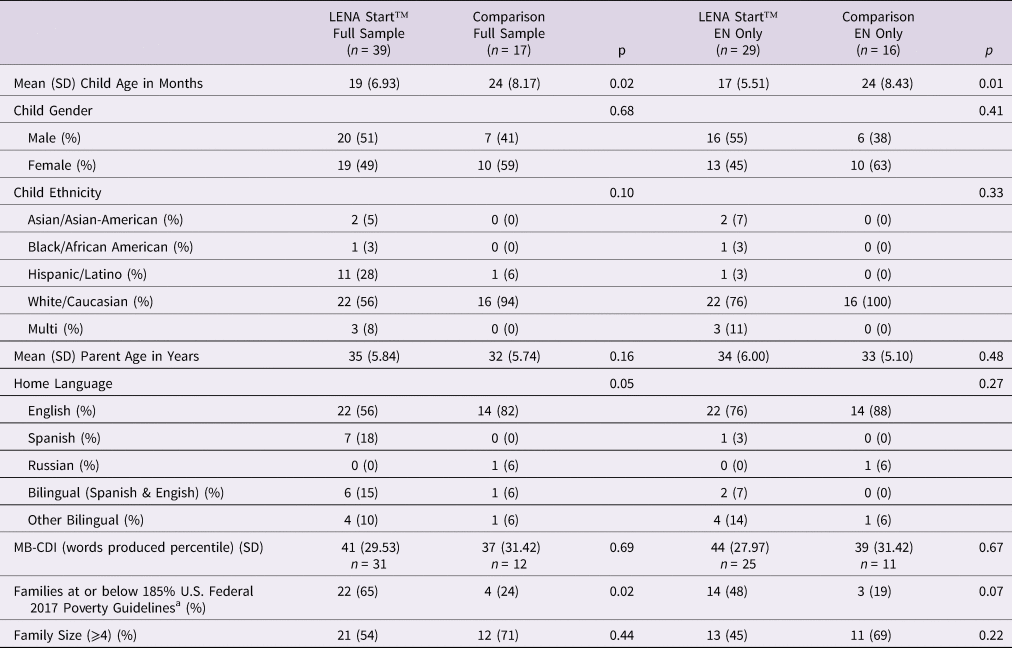
At the beginning of the study, demographic information was obtained from a parent survey developed by the research team. Summary descriptions of participants are presented in Table 1. Across all participants, boys comprised 51% and 41% of the LENA Start™ and Comparison groups, respectively. On average, children in the Full LENA Start™ group were 5 months younger compared to Comparison children, and this difference was statistically significant (p = 0.02). Parent mean age was not significantly different between the two groups. Across all participants, 65% of LENA Start™ families were at or below 185% of the poverty guidelines, compared to 24% of the Comparison families; this difference was also statistically significant (p = 0.02). U.S. Federal poverty guidelines are issued by the U.S Department of Health and Human Services and take account of both income and family/household size.
Sample Characteristics for Full and English Only Samples

Note. SD = standard deviation. Home language = language adult uses when talking to key child, per parent report. Other bilingual = Mandarin, German, and American sign language. Other = Russian. MB-CDI = MacArthur Bates Communicative Development Inventory. a = U.S. Federal poverty guidelines are issued by the U.S Department of Health and Human Services and take account of both income and family/household size.
The MacArthur-Bates Communicative Development Inventory (MB-CDI; Words and Gestures and Words and Sentences; Fenson, Marchman, Thal, Dale, Reznick & Bates, Reference Fenson, Marchman, Thal, Dale, Reznick and Bates2007; Jackson-Maldonado, Thal, Fenson, Marchman, Newton, Conboy & Bates, 2003) was used to provide a norm-referenced assessment of language skills to further characterize the child participants. Parents completed an age-appropriate long form within the first two weeks of the study start date. Parents in the Spanish class received the Spanish versions (Jackson-Maldonado et al., Reference Jackson-Maldonado, Thal, Fenson, Marchman, Newton, Conboy and Bates2003), and those participating in English classes completed the English form (Fenson et al., Reference Fenson, Marchman, Thal, Dale, Reznick and Bates2007). The MB-CDI is an age-based parent rating assessment of child vocabulary comprehension and expression, gestures, and grammar. Ratings are collected separately for children 8 to 18 months of age (Words and Gestures, n = 23) and 16 to 30 months of age (Words and Sentences, n = 33). Reports were scored using the ‘Scoring Program for the MacArthur-Bates Communicative Development Inventories’, Version 2013 (Marchman, Reference Marchman2013)
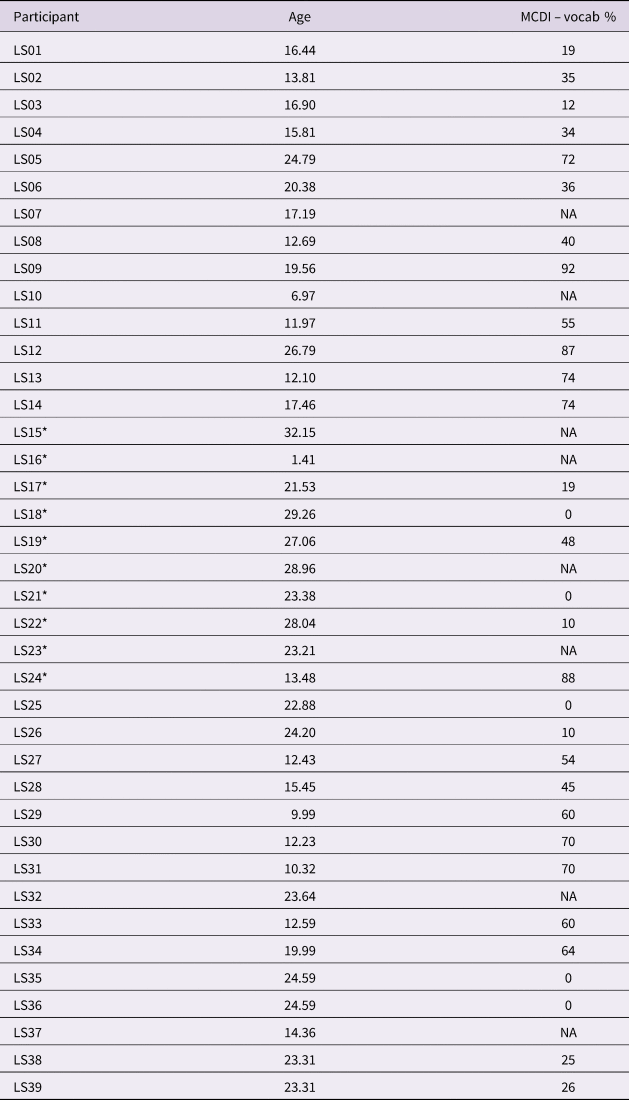
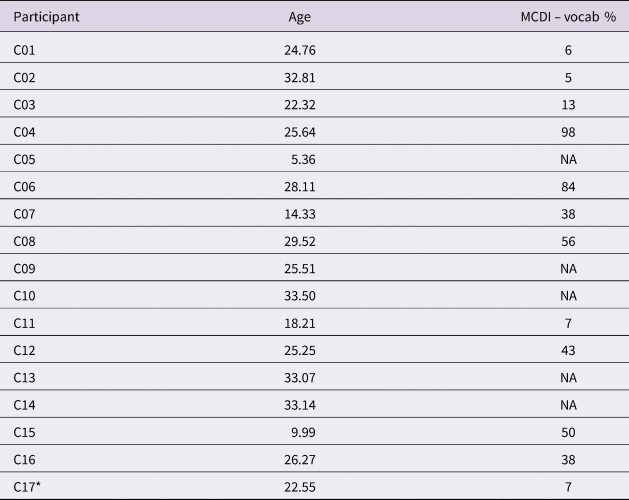
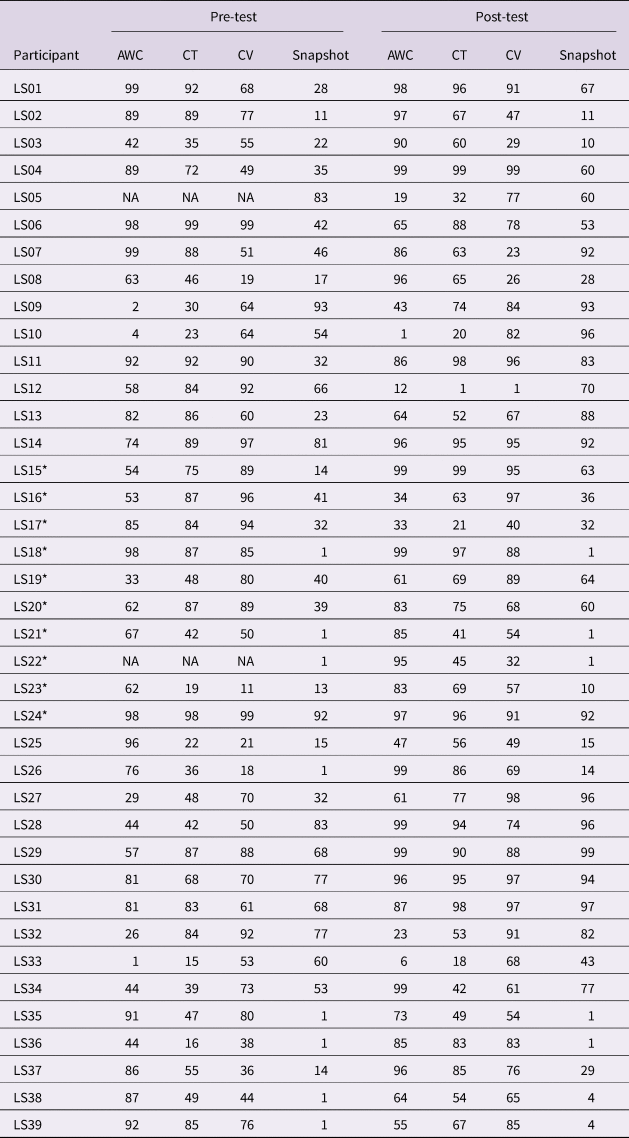
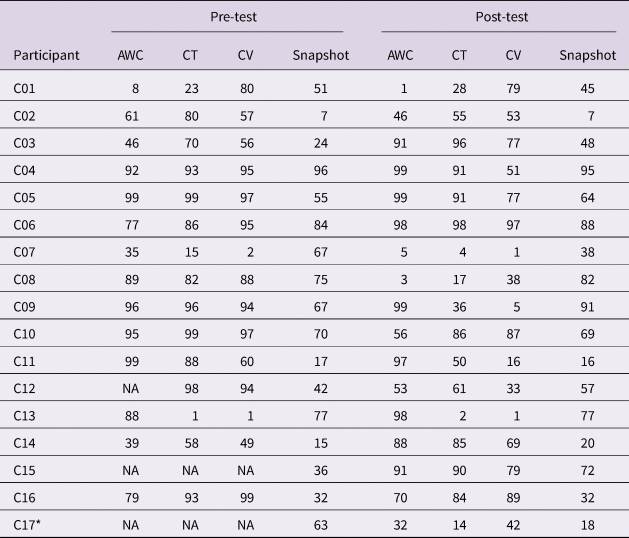
To compare scores across the two versions, Words Produced Percentile was used to provide a standardized score of baseline child vocabulary. Scores for the MB-CDI are presented in Table 1. There was no significant difference in MB-CDI scores between LENA Start™ and Comparison families (Full Sample: p = 0.70; English-only: p = 0.67). Additionally, there was no significant difference between the two age versions, except for the LENA Start™ Full sample (LENA Start™ Full Sample: p = 0.03; LENA Start™ English-only: p = 0.22; Comparison Full Sample: p = 0.52; Comparison English-only: p = 0.22), indicating that children performed differently depending if they completed Words and Gestures or Words and Sentences. Children's words produced percentile rank varied greatly (LENA Start™ Full Sample range 0–92; Comparison Full Sample range 5–98, see Tables 1 & 2 in the Appendix): however, the mean scores between groups were not statistically significant (See Table 1).
Parent educators and setting
All parent education classes were led by licensed Early Childhood Family Educators (English speaking: n = 4; Spanish speaking: n = 1). The educators completed higher education teacher training in parent education and held professional licenses in family education from the state educational licensing board. Typically, and in all instances here, each ECFE class was staffed by two licensed professionals: one responsible for education to parents (parent educator) and the other responsible for early childhood programming while parents were engaged in “parent only” educational activities. All LENA Start™ sessions were led by the parent educator. Typically, ECFE classes are approximately an hour and a half in length (an hour of parent education and half an hour for parent-child time) and are held on weekdays with sessions in the morning or afternoon. Parents sign up for one timeslot per semester and attend weekly. In the current study, participating classes were scheduled Monday through Thursday (morning classes = 5; afternoon classes = 2).
Treatment procedures
Upon consent, families in both the LENA StartTM and Comparison groups completed paper assessments, which were returned within the first two weeks of class. Both LENA Start™ and Comparison families were enrolled in ECFE programs that routinely include both shared parent-child activities and then separate programming for parents and for their children. During parent-child time, typical activities included snack time, circle-time activities (e.g., songs, finger play), and free play. Once separated, children attended an early childhood classroom with a licensed early educator, typically for child-directed or semi-structured preschool activities. Simultaneously, parents met with the parent educator. At this time, parents in the treatment group received the LENA Start™ curriculum. Parents in the Comparison group were enrolled in parent education classes without an explicit focus on language development or promoting language interactions. Parents in the Comparison group received general information on parenting and engaged in discussions facilitated by a parent educator on a variety of different topics (e.g., toilet training, sleep, behavior, language development).
LENA Start™
LENA Start™ is a manualized program designed for all parents and families. The program aims to increase parental knowledge regarding child language development and to teach parents specific strategies, or “talking tips”, to increase the richness of their child's language environment. LENA Start™ is based on the premise that increased interactions and language input promote language development, which in turn increases later academic success.
Parent educators who conducted the LENA Start™ sessions as part of their ECFE duty completed formal training in implementation of the program from LENA professional development staff. LENA Start™ began in the first week of ECFE programming and continued for 13 weeks following LENA's prepared schedule.
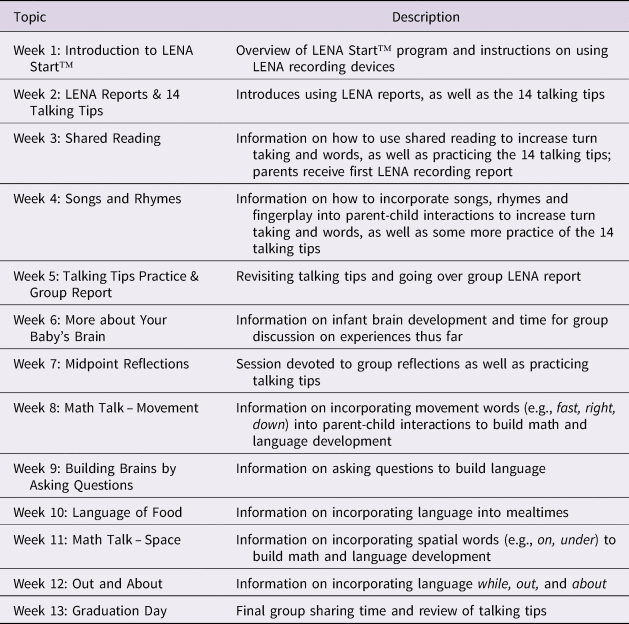
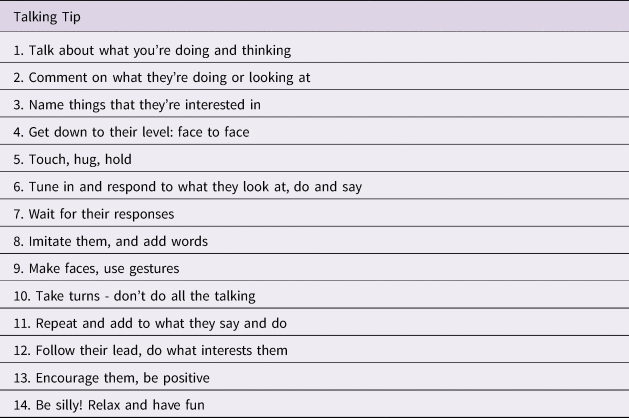
Over the course of the 13-week program, parents attended weekly educational 1-hour sessions with each week covering a different topic. Parent educators were instructed to follow closely planned lessons from the LENA Start™ Coordinators’ guide. The guide provides prepared slides, lecture/discussion, talking points, videos, and other materials designed for each week of intervention. Weekly topics (see Table 2 for full list) included: a) introduction to LENA Start™; b) interpreting LENA reports; c) presentation of 14 talking tips (see Table 3) and use of video models; d) how to engage in shared book reading; e) using songs and rhymes; and f) brain development. At the time of the study, LENA Start™ cost approximately $270 per family, this included all the required materials and resources to implement the program. Families were also provided with an age-appropriate reading book each week throughout the program.
Description of LENA Start™ Weekly Sessions

List of 14 Taking Tips

Note. Content © LENA Foundation
As part of the LENA Start™ program, parents completed weekly LENA language recordings. Parent educators instructed parents to follow standard procedures and asked parents to identify a particular day, before the next class, to complete a recording. On the recording day parents were instructed to: a) turn on the recorder, insert it in the provided vest, and then place the vest on the child when she or he first woke up; b) remove the vest for baths, naps, or other activities where it might interfere, but to keep the recorder running and the vest near the child; and c) remove the vest for bedtime (the recorder automatically turned off after 16 hours).
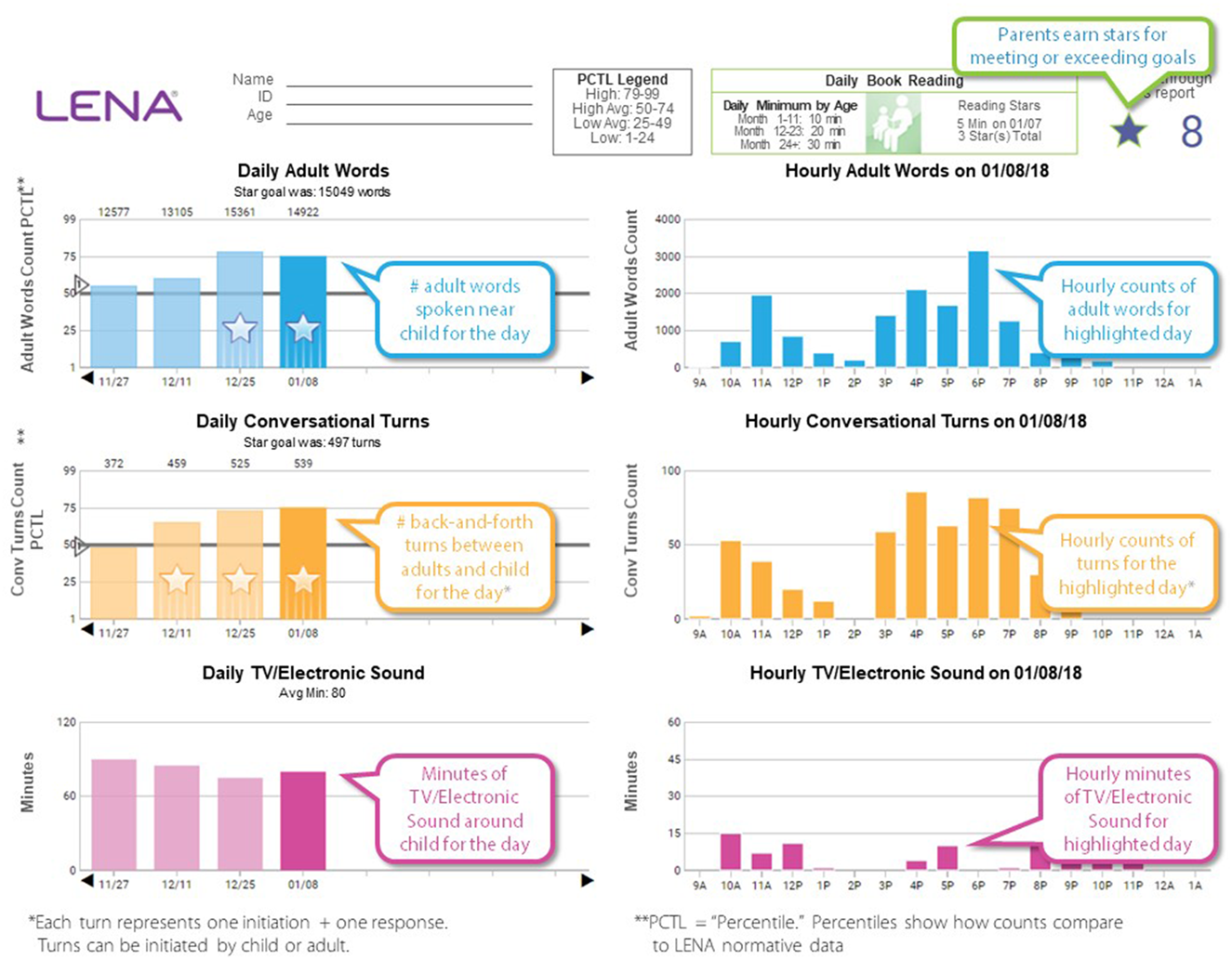
Parents exchanged “full” recorders for replacements each time they attended class. After each class, ECFE educators downloaded and submitted the recordings to LENA for scoring. During the downloading process, audio files were deleted. At the next scheduled class, parents received individualized reports generated from the recording that detailed the number of adult words spoken, conversational turns, and the amount of electronic noise for the most recent recording, and for all past recordings. Measures for the most recent recording were disaggregated and graphed by the clock-hour for the day of recording. Reports also included a record of shared book-reading time, reported by the parent. In addition, parents could receive a maximum of three stars per report; stars were awarded for meeting the reading goal minutes per day, or if adult word counts or conversational turns increased by more than 10% from the last recording, and/or exceeded the 75th percentile. See Figure 1. for a sample report.
Sample parent report.

Parents did not receive individualized feedback based on their reports during group sessions; but, if they wanted to speak individually with parent educators, they could do so at the end of the class. These recording reports served as discussion points during class sessions; however, parents did not have to share their reports. LENA also generated group reports and parents worked collectively to accomplish group goals. Discussion included both formal review of performance against a priori goals for improvement week over week and informal discussion among parents about their respective reports.
Researchers instructed parents in the Comparison group to complete LENA recordings during the first week of programming. This recording and the Week 1 recording from the LENA Start™ group served as the first evaluation point for both groups. For participants in the LENA StartTM group, the recording reports were shared at the next class meeting. Comparison families did not receive their recording reports until after the study was completed. Parents in both groups repeated parent-report measures at the end of their respective classes and Comparison families completed a post-test LENA recording.
All families were compensated for their time upon return of the materials and completion of the assessments.
Study measures
Pre- and post-test measures for all participants included the LENA Developmental Snapshot and three measures from day-long LENA recordings. The LENA measures included: adult word count (AWC), child vocalizations (CV), and conversational turns (CT). At the end of the LENA StartTM treatment period, parents in the intervention group completed the Treatment Evaluation Survey.
Although the LENA recordings can provide additional measures (e.g., automatic vocalization assessment (AVA), electronic noise), we did not include these in any analyses. In addition, we collected pre- and post-test video observations of caregiver-child video interactions, but these are not included in the current analyses.
LENA Developmental Snapshot (Snapshot)
The Snapshot is a parent-completed questionnaire of child language skills developed by LENA. The survey consists of 52 questions on children's expressive and receptive language skills (Gilkerson, Richards, Greenwood & Montgomery, Reference Gilkerson, Richards, Greenwood and Montgomery2016). The survey has a 3-month test-retest reliability of 0.97 and scores are highly correlated with standardized language assessments with an average correlation of 0.93 across the following criterion measures: Receptive Expressive Emergent Language Test, 3rd Edition (Bzoch, League & Brown, Reference Bzoch, League and Brown2003); the Preschool Language Scale, 4th Edition (Zimmerman, Steiner & Pond, Reference Zimmerman, Steiner and Pond2002); the Cognitive Adaptive Test/Clinical Linguistic and Auditory Milestone Scale (Accardo & Capute, Reference Accardo and Capute2005); and the Child Development Inventory (Ireton, Reference Ireton1992). Pre- and post-intervention developmental age and percentile scores were used for the study analyses, with the percentile ranks being used in the quantitative analyses.
LENA measures
LENA recording devices were used to obtain day-long language recordings. The LENA Start™ group completed at least 10 recordings. The first and last recordings were used for current analyses to match the recording schedule of the Comparison group. We did not have the resources to collect weekly recordings for Comparison families. These audio files were analyzed by LENA proprietary software that categorizes the recorded sound waves into adult male or female speech, key child or other child speech, as well as several different background sounds, such as overlapping speech and electronic media. The software produces time-segmented files that provide estimates on a variety of different measures.
Measures were derived for one feature of adult language (i.e., AWC), one of child language (i.e., CV), and one based on child-adult interaction (i.e., CT). We report absolute counts converted to rate per hour (to control for minor variations in recording lengths) for each of these measures. Additionally, percentile ranks are available for each of these measures, which (Gilkerson & Richards, Reference Gilkerson and Richards2008) derived based on LENA data collected from a representative sample of 329 infants and toddlers and their families. Gain scores based on differences between pre- and post-intervention measures were calculated for each percentile measure.
Adult word count
AWC provides an estimate of the total number of adult words a child hears over the course of the recording. Estimates are derived from adult speech segments recognized by the software as adult speech. The algorithm predicts the number of words within each segment and provides an aggregate count for the whole recording. The predicted AWC is highly correlated with counts derived from human transcribers (r = 0.92, p < 0.01; Xu, Yapanel & Gray, Reference Xu, Yapanel and Gray2009).
Child vocalizations
CV provides an estimate of the number of child vocalizations and verbalizations produced by the key child. Segments are classified as child vocalizations, if they are produced by the key child (i.e., the child wearing the LENA recorder) and contained ‘speech’ or speech-like sounds. Sounds are considered speech if they are words, babbles, and/or protophones (i.e., squeals, growls, and raspberries). The algorithm predicts the number of vocalizations within each segment and then aggregates counts across segments. Compared to human-identified segments, the LENA algorithm is able to correctly identify child vocalizations 75% of the time (Xu et al., Reference Xu, Yapanel and Gray2009).
Conversational turns
CT provides an estimate of the total number of conversational turns between the key child and adult. Turns are counted when adult speech and child vocalization segments occur within 5s of each other.
LENA Start™ treatment evaluation survey
Parent satisfaction was measured with the LENA Start™ treatment evaluation survey. The survey consisted of 15 questions regarding different aspects of the program (e.g., feasibility of incorporating talking tips into daily routines, if lesson topics were informative and interesting). Items were scored on a 5-point Likert scale (1 = strongly disagree and 5 = strongly agree). For the current study the following two questions were used to evaluate parent satisfaction: “I liked participating in LENA Start™” and “I would recommend LENA Start™ to other parents.” The percentage of participants responding with each scale item was calculated and served as the dependent measure.
Data analysis
A nonequivalent comparison group design was used to evaluate differences between treatment and comparison group outcomes as measured by AWC, CV, Snapshot, and CT. We conducted both descriptive and inferential statistical analyses to describe and quantify changes in adult and child outcomes. Means and standard deviations (SD) were obtained to describe pre-intervention, post-intervention, and gain scores. Due to variation in age of child participants and the relation between age and direct measures of child vocalization and parent-child interaction, all LENA measures, used in the quantitative analyses, were converted to percentile ranks based on normative data provided by the technology developers (Gilkerson & Richards, Reference Gilkerson and Richards2008).
Within-group and between-group analyses were conducted. For the between-group analyses, Welch two-sample t-tests were conducted on gain scores to determine if the difference in growth between the two groups were significant. Welch's t-test was used as it is more reliable for unequal sample sizes and variance. Cohen's d was used to calculate the between-group effect size (see Formula 1) and within-subject effect size (see Formula 2).
Formula 1: Cohen′s d
 $${\rm Cohe}{\rm n}^{{\prime}}{\rm s\;}d = \displaystyle{{\overline {x_1} -\overline {x_2} } \over {\sqrt {\displaystyle{{( {n_1-1} ) \;\;SD_1^2 + ( {n_2-1} ) \;SD_2^2 } \over {n_1 + n_2-2}}} }}\;\;$$
Where X1 = mean gain score for LENA Start and X2 = mean gain score for the comparison group.
Within-subject effect sizes (Cohen's dz) were also calculated (see Formula 2)
Formula 2: Cohen′s d z
 $${\rm Cohe{n}^{\prime}s\;}d_z = \displaystyle{{Mean_{GS}} \over {\displaystyle{{SD\;of\;GS} \over {\sqrt {2( {1-r} ) } }}}}$$
The Cohen's dz formula comes from Lipsey and Wilson (Reference Lipsey and Wilson2001, pp. 42–44) where the MeanGS is the mean difference between pre and post-test scores and r is the correlation between pre- and post-test scores. Given the small sample size, Cohen's d values were then converted to Hedges g values (See Formula 3; Borenstein, Reference Borenstein, Cooper, Hedges and Velentine2019, pp. 221–235) to reduce bias of the standardized mean. Effect sizes are reported in Hedges g. Paired sample t-tests were conducted to compare within-group gain scores. Effect sizes were interpreted using the following guidelines from Cohen (1988) small effect (g = 0.2), medium effect (g = 0.5) and large effect (g = 0.8). As mentioned previously, analyses were conducted for the Full sample and the English only groups.
Formula 3: Hedges′ g
 $${\rm Hedge}{\rm s}^{{\prime}}g = d{\rm \;}\left({1-{\rm \;\;\;\;}\displaystyle{3 \over {4\;( {df} ) -1}}} \right)$$
Where between group  $df = n_1 + n_2-2$ and within group
 $df = n -1$.
Post-hoc analyses of covariance controlling for child age and poverty (at or below 185% of the poverty guidelines) were conducted to account for significant group differences. Due to our small sample size, these were not part of the original data analyses and were only completed for the Full sample.
Results
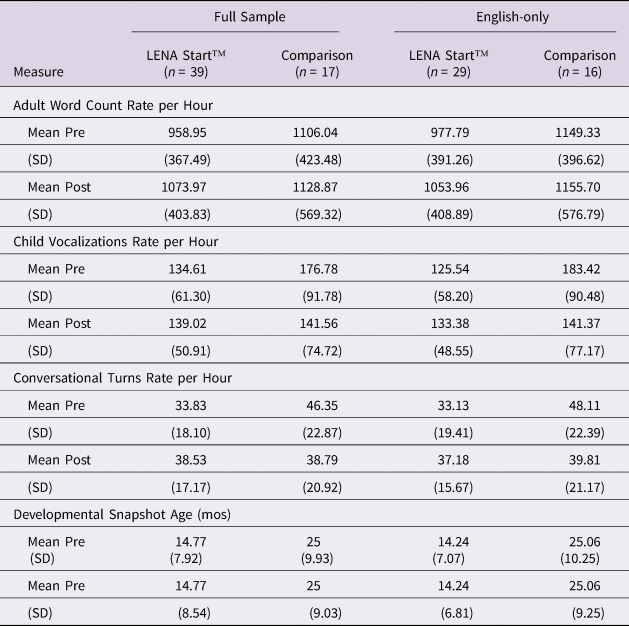
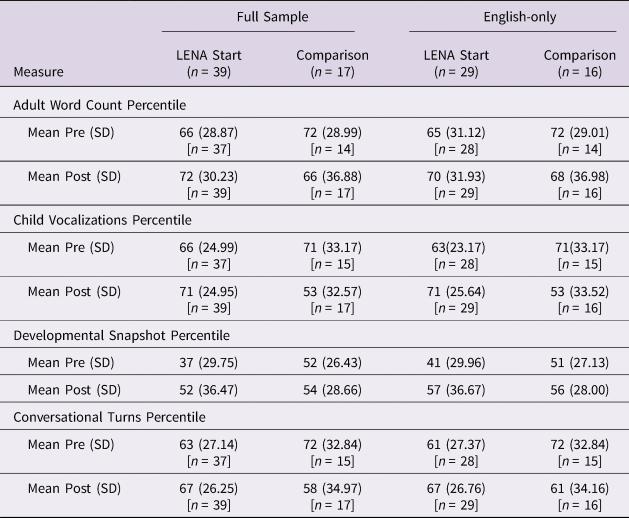
Means and standard deviations of each of the adult and child variables are included in Tables 4 and 5. Table 4 presents rates per hour (due to variation in recording length) for LENA measures of AWC, CV and CT, as well as results for the Snapshot. Results from the measures used in the quantitative analyses are presented in Table 5. For descriptive and analytic purposes, the overall sample (Full Sample) is presented, as are measures for parents and children who only spoke English (English-only).
LENA Measures: Means and Standard Deviations for Pre and Post Intervention

Note. SD = Standard Deviation.
LENA Measures Included in the Quantitative Analyses: Means and Standard Deviations for Pre and Post Intervention

Note. SD = Standard Deviation. For some of the LENA recording measure, there was not enough AWC and CV for the LENA software to provide reliable percentile ranks, as a result there are different n's for these measures.
Across all three LENA measures, pre-intervention counts for Comparison families in both the Full Sample and English-only subsample exceed those for LENA Start™ families. This may reflect a higher mean age for children in the comparison groups, higher levels of family SES, or other factors. Similar differences are noted for pre-intervention scores expressed as percentile ranks. This consistent nonequivalence of pre-intervention scores, all favoring the Comparison group, directly informed decisions to focus analyses of treatment effects on gain scores, or within-participant changes from pre- to post-intervention assessment.
Study question 1: attendance results
To answer Study Question 1, implementation data were collected and analyzed for LENA Start™ families, and results are presented for the Full Sample, as well as the English-only group. Attendance and graduation data were only collected for LENA Start™ families. We did not collect information on who the caregiver in attendance was, but anecdotally most caregivers were mothers.
Attendance and graduation
The percentage of adults attending each of the 13 LENA Start™ sessions ranged from 59% to 100% across the Full Sample and English-only group. Overall, attendance was higher during earlier sessions (Sessions 1–4: 92% -100%), compared to later sessions (Sessions 5–13: 67%-97%).
The majority of families “graduated” from LENA Start™ (Full Sample = 72%; English-only = 69%), meeting the following criteria generated by program developers to indicate sufficient participation to reasonably expect positive outcomes: (a) attend and/or make up each of Sessions 1–4; (b) attend and/or makeup at least five of the later sessions (5–13); and (c) complete at least 10 LENA recordings, lasting at least 10 hours in length. In the Full Sample, 87% of families attended the first four sessions (English-only = 86%); 95% of families attended at least five of the later sessions (English-only = 97%; and 79% of families across both samples completed ‘at least 10 LENA recordings.’
Parent satisfaction
The LENA Start™ evaluation form had a 61% response rate (24/39 families). Two items from the form were used to describe parent satisfaction with the program. Overall, 89% of parents who participated in LENA Start™ liked the program with 67% (16/39) indicating that they “strongly agreed” and 21% (5/39) indicating that they “agreed” with the statement, “I liked participating in LENA Start™.” Parents were also likely to recommend LENA Start™ to other parents as 63% (15/39) of parents reported that they “strongly agreed” and 25% (6/39) “agreed” with the statement, “I would recommend LENA Start™ to other parents.”
Study question 2: home language environment
To answer Study Question 2, gain scores in percentiles of AWC were analyzed to determine if the home language environment of children participating in LENA Start™ differed from children enrolled in alternative ECFE programs. The mean AWC per hour rates for pre- and post-intervention for each group are presented in Table 4 and AWC percentiles results are presented in Table 5.
For the LENA Start™ group, results revealed a small, non-significant effect associated with an increase in AWC percentiles from pre- to post-intervention assessment for both the Full Sample (gz = 0.23, t (36) = 1.45, p = 0.16), and English-only groups (gz = 0.21, t (27) = 1.24, p = 0.23). For the Comparison group, pre- and post-intervention comparisons were also non-significant and were associated with small negative effect sizes for both the Full Sample and English-only groups (gz = -0.11, t (13) = 0.42, p = 0.68). Descriptively, AWC for those participating in LENA StartTM increased 7 percentile-rank points, on average from pre to post intervention; whereas, the same measure for Comparison families declined by an average of 4 percentile-rank points.
Statistical comparisons of the LENA Start™ and Comparison AWC Percentile Gain Scores were non-significant for both the Full Sample (t (20.73) = 1.05, p = 0.31) and the English-only groups (t (23.35) = 1.28, p = 0 .21), with small effect sizes (Full Sample: g = 0.35; English-only: g = 0.34).
Post-hoc analysis of covariance was conducted to test if the effect of LENA Start™ on AWC gain scores, after controlling for child age and poverty, was significant. When controlling for age, the effect of LENA Start™ was not significant (F(2, 48) = 0.63, p = 0.54), nor for poverty (F(2, 45) = 0.54, p = 0.58). One-way analysis of variance (ANOVA) showed that the effect of LENA Start™ was not significant for AWC (F (1, 49) = 1.26, p = 0.28).
Study question 3: child language production and development
Child vocalizations represented as percentiles, as measured by LENA and parent reports of language development, were used to examine differences in language production between children whose parents participated in LENA Start™ and those who attended alternative ECFE programs. The mean CV per hour rates for pre- and post intervention for each group are presented in Table 4 and CV percentiles and Snapshot results are presented in Table 5.
Child vocalizations
There were no significant differences in the pre- and post-intervention CV Percentiles for either of the LENA Start™ groups. These comparisons were associated with small positive effects (Full sample gz = 0.23, t (36) = 1.13, p = 0.26; English-only gz = 0.31, t (27) = 1.35, p = 0.19). However, for the Comparison Full Sample there was a significant medium-sized negative effect (gz = -0.55, t (14) = -2.39, p = 0.03), but this was not significant for the English-only Group (gz = -0.55, t (27) = 1.35, p = 0.19), likely due to the smaller sample size.
Differences in pre-to-post gain scores for CV Percentiles between children in LENA Start™ and Comparison groups were significant (Full Sample t(24.62) = 2.63, p = 0.01; English-only t(28.05) = 2.73, p = 0.01). Additionally, these comparisons were associated with large between group effects (Full Sample: g = 0.81; English-only: g = 0.86) and reflect that children participating in LENA Start™ groups made gains in CV Percentiles (Full Sample: M = 6; English-only: M = 8) compared to children in Comparison group (Full Sample and English-only: M = -19), who showed declines. The declines seen in the Comparison families likely contributed to the significant between-group effects.
Post-hoc analyses showed that when controlling for child age, the effect of LENA Start™ on CV remained significant (F(2,49) = 3.77, p = 0.03), as was the case when controlling for poverty (F(2, 46) = 3.31, p = 0.04). The one-way ANOVA showed that the effect of LENA Start™ on CV was significant also (F(1, 50) = 7.31, p = 0.01).
Development Snapshot Percentile
Within- and between-group comparisons were also completed for the Snapshot Percentiles. Within-group comparisons of pre- and post-percentiles yielded significant differences for the LENA Start™ group (Full Sample: t(38) = 4. 20, p < 0.00; English-only: t(28) = 3.91, p < 0.00). However, these were not significant for the Comparison group (Full Sample: t(16) = 0.53, p = 0.60; English-only: t(15) = 1.46, p = 0.17). The effect sizes for the LENA Start™ groups were small and positive (Full Sample gz = 0.40; English-only gz = 0.45). The effect sizes for the Comparison groups were small (Full Sample gz = -0.07; English-only gz = 0.17).
Comparison of the LENA Start™ and Comparison groups Snapshot Percentiles were significant for the Full Sample (t(34.24) = 2.08, p = 0.04), but not for the English-only group (t(41.43) = 1.95, p = 0.06). These comparisons were associated with a medium-sized effect (Full Sample: g = 0.57; English-only: g = 0.54). Descriptively, children participating in LENA Start™ increased 14 (Full Sample) and 16 (English-only) percentile-ranks on average from pre- to post-intervention; whereas, children in the Comparison group, on average, increased 2 (Full Sample) and 5 (English-only) percentile ranks.
When controlling for age, the effect of LENA Start™ on Snapshot Percentile was no longer significant (F (2, 53) = 3.21, p = 0.05) as well as when controlling for poverty (F(2,49 = 2.09, p = 0.13)). Additionally, a one-way ANOVA also showed insignificant effects (F(1, 54) = 3.40, p = 0.05).
Study question 4: parent-child interactions
Differences in the quantity of conversational turns, as measured by CT in LENA, was used to examine the differences in parent-child interactions between families participating in LENA Start™ compared to families enrolled in the Comparison group. Mean CT per hour rates for pre- and post-intervention for each group are presented in Table 4 and CT percentiles are presented in Table 5.
Within-group comparisons of pre- and post-percentiles did not reveal significant differences for the LENA Start™ (Full Sample: t(36) = 1.20, p = 0.24; English-only: t(27) = 1.36, p = 0.18) and Comparison (Full Sample and English-only: t(14) = -1.84, p = 0.09) groups. For the LENA Start™ groups, these comparisons were associated with small positive effect sizes (Full sample: gz = 0.22; English-only: gz = 0.30). For the Comparison groups, the comparisons were associated with small negative effect sizes (Full Sample and English-only: gz = -0.37).
Statistical comparisons of the CT Percentile Gain Scores yielded significant results for LENA Start participants in the Full Sample (t(29.01) = 2.20, p = 0.04) and the English-only group (t(29.09) = 2.09, p = 0.05). These comparisons were associated medium effects (Full Sample: g = 0.62; English-only: g = 0.68) and reflect the gains made by families participating in LENA Start™ (Full sample: M = 6; English only: M = 8) compared to negative changes in the Comparison group (Full Sample and English-only: M = -13).
Post-hoc analyses showed that, when controlling for child age, the effect of LENA Start™ on CT gains was not significant (F(2, 49) = 2.16, p = 0.13), and this remained true when controlling for poverty (F (2, 46) = 2.30, p = 0.11). The one-way ANOVA showed that the effect of LENA Start™ on CT was significant (F(1, 50) = 4.35, p = 0.04).
Discussion
The purpose of the current study was to conduct a preliminary evaluation of LENA Start™, a manualized parent education program aimed at improving the quantity and quality of children's home language environment and child language outcomes. To evaluate the implementation of LENA Start™, the study first examined several measures drawn from participants in the active intervention condition. We measured parent attendance of education sessions, whether parents met graduation requirements, and parent program satisfaction. Results indicated that attendance was higher for earlier sessions compared to later sessions and that the majority of families graduated from the program. Additionally, most parents enjoyed participating in the program and were likely to recommend it to a friend. For programs like LENA Start™ to be successful in improving the home language environment and child language outcomes, parents will need to attend and engage in sessions. Results from the current study provide initial evidence that parents are likely to attend LENA Start™ sessions and that they find the program enjoyable.
Next, the study examined changes in the home language environment, as well as child language production and development. Results indicate that participating in LENA Start™ was associated with small to moderate, not statistically significant, increases in percentile for the quantity of adult language input and adult-child language interactions. We noted similar effects for child language production and development; there was a small, non-significant, effect for increasing child vocalizations as a function of participating in LENA Start™. However, gains made in Snapshot Percentile ranks were significant and were associated with a small to moderate-sized positive effect. These consistent increases in normative ranking (as well as rates per hour) for all three naturalistic measures of language environments and the Snapshot for LENA Start™ families contrast markedly with consistent declines in normative ranking, and almost consistent declines in absolute counts of adult, child, and interactive behavior for participants in the Comparison condition.
Although at pre-intervention, LENA Start™ families had lower mean scores for all study measures, by post-test, this group either caught up with or exceeded mean performance of the Comparison group. The gains made by LENA Start™ families were significant when compared to gain scores for the Comparison families, for all measures except AWC percentile and the Developmental Snapshot percentile score for the English-only group. Additionally, these were associated with small to large between-group effects; however, it is important to note that these analyses did not control for child age or poverty rating. Post-hoc analyses controlling for child age or poverty rating showed that gains only remained significant for CV – though it is important to note that differences are most likely partly due to LENA Start™ families making pre- to post-intervention modest gains while the Comparison families decreased (AWC, CT and CV) or made insignificant gains (Developmental Snapshot percentile). Thus, these results should be interpreted with caution. We do not know why Comparison families decreased on most measures, but one possibility is reactivity in the initial recording session producing biased estimates of the language environment – though we noted that this decline was not observed in the second recording for LENA Start™ families. Another possibility that might explain the current results – increases in the LENA Start™ group and declines in the Comparison group – is regression to the mean. However, another recent study evaluating the effectiveness of LENA Start™ also found that Comparison families decreased in the number of CT and CV, and LENA Start™ families saw positive gains (Beecher & Van Pay, in press).
The findings from the current study are consistent with other studies using LENA devices to provide quantitative feedback to parents with the aim to increase the number of adult words spoken, child vocalizations, and conversational turns and other population level interventions aimed at increasing child language outcomes (Mahoney et al., Reference Mahoney, McConnell, Larson, Becklenberg and Stapel-Wax2020). Pae et al. (Reference Pae, Yoon, Seol, Gilkerson, Richards, Ma and Topping2016), Suskind et al. (Reference Suskind, Leffel, Hernandez, Sapolich, Suskind, Kirkham and Meehan2013); Suskind et al. (Reference Suskind, Leffel, Graf, Hernandez, Gunderson, Sapolich, Suskind, Leininger, Goldin-Meadow and Levine2016b) and Zhang et al. (Reference Zhang, Xu, Jiang, Gilkerson, Xu, Richards, Harnsberger and Topping2015) found that parents and caregivers enrolled in language programs that utilized LENA demonstrated significant increases on each of these measures over the course of the intervention period. Results from the current study and previous research indicate that LENA, embedded in parent education, can be used as an effective strategy to change the home language environment. However, it is important to note that changes in adult and child language may be attributed to other parts of the intervention package (e.g., awareness of language promoting strategies) and not just LENA devices. Future research is needed to isolate the active ingredients in language interventions utilizing LENA devices.
Additionally, these study results align with other studies examining the use of parent education programs to change child language environment and support child language development. While relatively few studies have evaluated such parent education programs specifically with samples of children who may be at-risk for language impairment due to low SES, in a meta-analysis that included 25 randomized control trials of parent-implemented interventions, Heidlage, Cunningham, Kaiser, Trivette, Barton, Frey and Roberts, (Reference Heidlage, Cunningham, Kaiser, Trivette, Barton, Frey and Roberts2020) included six studies focused on at-risk populations. The meta-analysis suggested significant positive outcomes for these populations on both child and parent language measures. However, it is important to note that the meta-analysis revealed that, across all studies, studies that reported results based on observational measures in contrast to parent reported measures or standardized measures yielded the strongest effects. Our LENA measures should be considered observational; our effect sizes for CV (g = 0.81) and CT (g = 0.62) yielded moderate to large effect sizes akin to those of the observational measures in the meta-analysis (g = 0.46). Thus, it will be important for future investigations to continue to consider observational measures such as the LENA measures, as well as measures of more specified parent and child communication behaviors. For studies to achieve significant changes on outcomes based on standardized measures, more intensive parent-implemented interventions may be needed that span a greater duration of time and include long-term follow-up measures.
The current study also provides evidence that programs like LENA Start™ can be embedded into ECFE programs and similar community education programs with positive parent and child outcomes. Utilizing existing program structures that have established recruitment sources could increase program outreach (Mahoney et al., Reference Mahoney, McConnell, Larson, Becklenberg and Stapel-Wax2020). Additionally, the program was not implemented by research staff, but rather by parent educators engaged in typical professional activities. Like the intervention program in Zhang et al. (Reference Zhang, Xu, Jiang, Gilkerson, Xu, Richards, Harnsberger and Topping2015), parent education sessions were implemented by trained community members.
Additionally, the current study included a LENA Start™ group that was implemented in Spanish. Study results remained the same when the Spanish group was excluded in analyses, except for one measure (Developmental Snapshot Percentile). This suggests that home language did not significantly impact the current results. It is important to have effective parent education programs that can be implemented for a variety of languages.
We note that, while effects on parent and child behavior were assessed over a relatively short (13 week) interval, potentially important effects were noted on naturalistic language measures. In particular, increases in Adult Word Count and Conversational Turns suggest an intervention effect on parents and adult caregivers that, if sustained, might produce even more dramatic effects on child language. This change in adult behavior and adult-child interaction is noteworthy not only for the short-term effects noted here but, to the extent that changes in interaction are mutually reinforcing for children and caregivers, in ways that can be expected to generate continued (if not exponential) changes in child language (Ford et al., Reference Ford, Elmquist, Merbler, Kriese, Will and McConnell2020).
Limitations and future steps
The current study had several limitations including unmatched groups, small sample size, and constrained measures. First, the treatment and comparison group were not well matched in terms of sample size, child age, home language, ethnicity, and SES, adding possible confounds. Future research is required that includes well-matched samples and random assignment to intervention, particularly because many of these variables are associated with the home language environment and child language outcomes. Second, although, we were able to demonstrate significant results with a small sample, future research should include larger samples, to increase generalizability and statistical power. Additionally, there were not enough Spanish-speaking participants for the group to be examined separately. Last, all outcome measures were derived from LENA-developed products. Additional measures either derived from LENA recordings or non-LENA based measures (e.g., parent-child interaction video observations) should be included in future evaluations of the effectiveness of LENA Start™.
Future research should also examine more closely the implementation fidelity of this community-based program and identify key intervention components to include in parent education programs to maximize outcomes. Further research is also needed to adapt LENA Start™ or similar programs to support the language environments of families who speak languages other than English or Spanish; community-based parent-implemented language programs should not be limited to a few languages. Finally, characteristics of language measures can influence observed effects. For example, the conceptual and temporal proximity of measures to intervention content can influence outcomes, possibly in ways that are not closely related to later and more generalized measures (Yoder, Bottema-Beutel, Woynaroski, Chandrasekhar & Sandbank, Reference Yoder, Bottema-Beutel, Woynaroski, Chandrasekhar and Sandbank2013). Therefore, future studies should include a variety of proximal and distal measures that assess both maintenance and generalization of outcomes to evaluate program effectiveness.
Study conclusions
The current study was a preliminary evaluation of LENA Start™, which found that participation in the intervention might be associated with positive changes in the number of adult spoken words, conversational turns, and child vocalizations and development. Between-group comparisons revealed these gains were significant for all measures except the number of adult words. However, these results are likely influenced by the fact that LENA Start™ families increased across measures and Comparison families decreased on most of the measures. These results provide further evidence that the home language environment is malleable, and this can be leveraged to change the language development trajectory of young children and as a result can be used to reduce language disparities.
Acknowledgements
The authors thank administrators and staff of St. Paul Public Schools, Anoka-Hennepin Schools, and other participating districts, as well as the parents and children who participated in this work. We are also grateful for assistance from Anne Larson and Gerri Fischer in launching this effort, and ongoing support from Jill Gilkerson, Traci Martin, Kim Coulter, and Beth Dresser from the LENA Research Foundation. Research reported here was supported in part with funds from the Bush Foundation in partnership with ThinkSmall and Generation Next, the University of Minnesota, and LENA Research Foundation. All work was designed and is the sole responsibility of the authors with no advance reviews from funders, and no endorsements by these funders should be implied.
Appendix 1.
Child age (months) and MCDI words produced percentile for LENA Start™ families

Child age (months) and MCDI words produced percentile for Comparison families

LENA recording and snapshot percentile scores for LENA Start™ families

LENA recording and snapshot percentile scores for Comparison families