Introduction
Society often discriminates and marginalises people who suffer from mental illnesses (Wheat et al. Reference Wheat, Brohan, Henderson and Thornicroft2010; Bahlmann et al. Reference Bahlmann, Angermeyer and Schomerus2013).
Although there have been attempts to reduce stigmatisation and to raise the awareness of mental health problems within the workplace and society (Thornicroft et al. Reference Thornicroft, Brohan, Kassam and Lewis-Holmes2008), many employees fear prejudices and disadvantages and are concerned to disclose mental health problems to colleagues and supervisors (Czabala et al. Reference Czabala, Charzynska and Mroziak2011; Little et al. Reference Little, Henderson, Brohan and Thornicroft2011; Ahola et al. Reference Ahola, Vuori, Toppinen-Tanner, Mutanen and Honkonen2012; Brohan et al. Reference Brohan, Henderson, Wheat, Malcolm, Clement, Barley, Slade and Thornicroft2012). Also, employers have been shown to be more sceptical to hire a person with a mental illness compared to applicants who are healthy or suffer from a somatic disease (Brohan et al. Reference Brohan, Henderson, Wheat, Malcolm, Clement, Barley, Slade and Thornicroft2012).
Therefore, even mental health professionals often do not recommend disclosing mental health diagnoses to co-workers and supervisors. Instead it is suggested to present a rather ‘benign’ somatic diseases (e.g. hypothyroidism instead of depression) to avoid stereotyping.
To date, there is a lack of data regarding supervisors' attitudes towards mental health problems of permanent workers (as opposed to persons applying for a job).
Aims of the study
In the present study, we aimed at presenting case vignettes to supervisors which display an employee with unspecific complaints that may originate from a mental illness. By varying the ‘label’ (burnout, depression, private crisis and hypothyroidism) of these complaints, we wanted to study how this different labelling of similar symptoms influences supervisors' attitudes regarding prospecting job performance. We hypothesised that complaints described as originating from a somatic disease would lead to more positive and complaints described as originating from mental health disorders lead to more negative attitudes. Further, we hypothesised that describing symptoms as ‘burnout’ would lead to more positive attitudes towards the job performance than depression (Bahlmann et al. Reference Bahlmann, Angermeyer and Schomerus2013).
Methods
The psychiatric hospital of the TU Munich in Germany offers workshops for managers and employees to sensitise and educate how to deal with mental disorders at the workplace. The workshops take place in companies and are especially designed to address supervisors and human resource workers in handling employees with mental disorders. Approximately 3000 supervisors and employees from human resource departments of various companies have attended these workshops so far. For this study, a consecutive number of managers visiting these workshops were randomly allocated to one of four vignettes describing an employee with behavioural problems. They were subsequently asked questions about their attitudes towards the future job performance of this employee. The questionnaire was handed out to them directly before the seminar started. Random allocation was done separately for every seminar, thereby ensuring that company-related effects were eliminated.
All four vignettes contained the same short description of the employees' complaints:
‘One year ago, Mr Schmidt, a reliable employee suffered from sleeping problems, social withdrawal, reduced alertness, and had been absent from work for six weeks. For the past six months now Mr Schmidt has fully recovered, returned to work and is again working reliably’.
However, every vignette labelled these complaints differently:
-
– Version 1: Depression (mental disorder): ‘One year ago, Mr. Schmidt, a reliable employee suffered from depression. He had sleeping problems…’
-
– Version 2: Burnout (psychological symptoms and assumed as seen less critically than mental disorders): ‘One year ago, Mr. Schmidt, a reliable employee suffered from burnout. He had sleeping problems…’
-
– Version 3: Private crisis (no mental disorder or medical cause): ‘One year ago, Mr. Schmidt, a reliable employee had a private crisis. He had sleeping problems…’
-
– Version 4: Thyroid disease (somatic disease): ‘One year ago, Mr. Schmidt, a reliable employee suffered from a disease of the thyroid. He had sleeping problems…’
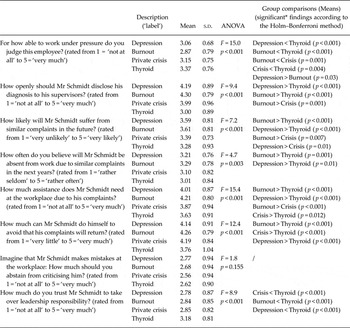
After reading the case vignettes, participants were asked to rate Mr Schmidt's prospecting job performance on five point scales (Table 1). Furthermore, participants provided information on their personal background (age, gender, number of employees, etc.). The survey was approved by the Ethics Committee of the TU Munich.
Differences between treatment conditions

*α1 = 0.008; α2 = 0.01; α3 = 0.0125; α4 = 0.016; α5 = 0.025; α6 = 0.05.
Statistical analysis
The treatment conditions were analysed with analysis of variance (ANOVA) and with post hoc t-tests and χ2-tests (Holm–Bonferroni Method).
Results
For the study, 748 participants from 38 companies (industry, finance, public administration and insurances) were randomly assigned to the four treatment conditions (about 1% of supervisors refused to participate on the study). Most participants were male (n = 651; 83%; two missing data) with a mean age of 45.3 years (s.d. 8.3). The majority of participants were supervisors (n = 616, 79%), employees of the human resources department (n = 52, 7%), members of the work council (n = 53, 7%) or others (n = 63, 8%). The vast majority of participants (n = 651, 83%) had leadership responsibility. The four treatment conditions: depression (n = 197), burnout (n = 194), personal crisis (n = 188) and thyroid dysfunction (n = 200) showed no significant differences between the groups regarding the background variables age, gender or leadership position (t-tests; χ 2 tests).
There were significant overall differences between groups for all items in the questionnaire, except the item addressing the managers' reaction towards the employee when making mistakes at the workplace.
Overall, the managers' ratings were more critical towards employees' prospecting job performance if the case vignette was labelled depression or burnout (e.g. for job performance, times absent in the future), than when they were labelled with a somatic disease such as thyroid dysfunction (Table 1).
Also, supervisors expected the employees to disclose their condition more openly when they suffer from depression or burnout. Participants assumed Mr Schmidt would need more support at the workplace when his complaints were caused by depression or burnout, than when Mr Schmidt suffered from a thyroid dysfunction (Table 1).
There was no significant difference between the ratings of depression v. burnout; however, burnout was less favourably seen in respect to prospective job performance than depression (Table 1).
Finally, a private crisis was seen more sceptical than the somatic disease, for example in regard to the ability to work under pressure or the need for special assistance.
Discussion
Our study reveals that supervisors' attitude regarding employees' prospecting job performance depends on whether or not (identical) complaints are described as originating from a mental or a somatic disorder. Depression was evaluated as more critical to affect job performance than a somatic disease such as a thyroid dysfunction. Based on our study, we conclude that employees disclosing psychiatric diagnoses may be seen as less resilient workers and as a result may jeopardise their career advancement. Opposed to our expectations (Bahlmann et al. Reference Bahlmann, Angermeyer and Schomerus2013), burnout has not been proven as being judged less critically than depression. Moreover, the ratings towards prospecting job performance were even worse under the condition burnout compared to the condition depression. The ratings of a private crisis were placed between somatic disease and mental disorder.
Limitations
Limitations of the study are the experimental case vignettes as opposed to real life situations and the selected sample of supervisors who were initially interested in mental health issues and enrolled to the workshop.
Implications
Employees may consider that the disclosure of a psychiatric diagnosis entails the risk of disadvantages regarding their workplace and may jeopardise career advantages (Henderson et al. Reference Henderson, Evans-Lacko and Thornicroft2013).
Psychological symptoms described as ‘burnout’ and assumed by mental health experts as probably better accepted than psychiatric conditions (Hamann et al. Reference Hamann, Parchmann, Mendel, Buhner, Reichhart and Kissling2013) are shown to hold at least similar or even worse ramifications than the psychiatric diagnosis ‘depression’. Surprisingly, the label ‘private crisis’ also led to more sceptical attitudes than the somatic illness, probably indicating that persons showing vulnerability due to a personal crisis may be seen as generally less robust compared to persons affected by a somatic disease.
Employees' disclosure of their condition as depression or burnout influences supervisors' attitudes negatively respecting prospecting job performance. This attitude could be a result of the assumption that mental disorders have a more chronic course and therefore a more negative long-lasting impact on job performance than any somatic disease. In addition, supervisors expect employees with psychiatric disorders to talk more openly about their complaints than persons suffering from somatic disorders. We assume that this effect takes place, because supervisors believe that a disclosure of psychological disorders can facilitate support from their side (e.g. accommodations at the workplace).
To avoid disadvantages and not to jeopardise career advantages, employees (or patients) may benefit from interventions, which prepare them to successfully return to work and especially for situations when first meeting colleagues or supervisors who might ask them what they were suffering from (Henderson et al. Reference Henderson, Brohan, Clement, Williams, Lassman, Schauman, Murray, Murphy, Slade and Thornicroft2012).
Clinicians should be aware of the potential discrimination of their patients and advise them accordingly. Finally, the results of the study also suggest that targeted training programs for leadership can support the process for employees with mental disorders. As a consequence, disadvantage of employees with mental disorders may be reduced by anti-stigmatising programs that target negative attitudes towards psychological disorders.
Conclusions
Employees with mental disorders have to be aware of disadvantages if they disclose their psychiatric diagnoses and have to weigh their options if revealing their mental disorders to their supervisors.
Acknowledgements
None.
Financial Support
This research received no specific grant from any funding agency, commercial or non-profit sectors.
Conflict of Interest
None.
Ethical Standard
The authors assert that all procedures contributing to this work comply with the ethical standards of the relevant national and institutional committees on human experimentation and with the Helsinki Declaration of 1975, as revised in 2008.