Creativity has been an area of study in the psychological community since J. Paul Guilford's Reference GUILFORD1950 address to the American Psychological Association (Guilford, Reference GUILFORD1950). Researchers have sought to make sense of the complex, multidimensional construct of creativity, by utilising a number of different empirical research approaches that have included psychometric, experimental, biographical, psychodynamic, biological, computational and contextual (Mayer, Reference MAYER and Sternberg1999). In music education research, Peter Webster has been a key figure in the area of ‘creative thinking in music’ (Webster, Reference WEBSTER1977, Reference WEBSTER1979, Reference WEBSTER1990). He finds the general creativity literature supportive of the notion that all creativity including musical creativity be considered in terms of ‘divergency of thought and imagination in context with more convergent thinking that often involves just plain hard work’ (Webster, Reference WEBSTER, Hallam, Cross and Thaut2009, p. 423). This focus on thought processes opened the door for researchers in the field to examine, from a psychological perspective, compositional and improvisational processes and products (Kratus, Reference KRATUS1985, Reference KRATUS1989, Reference KRATUS1994, Reference KRATUS2001; Swanwick & Tillman, Reference SWANWICK and TILLMAN1986; Hickey, Reference HICKEY1995, Reference HICKEY2001; Wiggins, Reference WIGGINS and Hickey2003).
Since this research paradigm started to gain momentum in the 1980s and 1990s, some researchers have chosen to focus more on the study of creativity in real-world educational contexts (Wiggins, Reference WIGGINS1994; Burnard, Reference BURNARD1999, Reference BURNARD2000, Reference BURNARD2002, Reference BURNARD and Bartel2004; Hickey, Reference HICKEY, Colwell and Richardson2002, Reference HICKEY2003; Barrett, Reference BARRETT2006) and specifically on the sociology of musical creativity (Burnard, Reference BURNARD and McPherson2006). This movement seems to have coincided with Csikszentmihalyi's detailing of his Systems Perspective for the Study of Creativity, where creativity he says should not be viewed ‘exclusively as a mental process’, but rather as an interplay of psychological and sociological factors (Reference CSIKSZENTMIHALYI and Sternberg1999, p. 313). Csikszentmihalyi asserts that the momentum for a shift in the research paradigm to include sociological components has been building in the past few decades (Gruber, Reference GRUBER1988; Harrington, Reference HARRINGTON, Runco and Albert1990). In Burnard's words, this movement has been a shift away from ‘large-scale studies aiming to measure creativity in children's composition towards ethnographic, qualitative approaches, and to research focusing on the actual site of operations and practice’ (Burnard, Reference BURNARD and McPherson2006, p. 111). There seems to be a growing concern for examining the cultures, including parents, peer groups and teachers, the individuals that surround students and facilitate their creative work (Barrett, Reference BARRETT2011; Randles, Reference RANDLES2009a, Reference RANDLES2009b; Wiggins, Reference WIGGINS and Barrett2011), as a way of understanding how to bridge the gap between curriculum mandates such as the National Content Standards in the United States (MENC, 1994), and implementation of creative music-making activities into common practice.
This ‘shift in the research paradigm’, as Webster (Reference WEBSTER, Hallam, Cross and Thaut2009) describes it, is marked by the development of socially centred theories on musical creativity (Burnard, Reference BURNARD and McPherson2006). One of the signifiers of a shift from thinking in terms of psychology alone to adopting a more sociology-friendly approach to the study of music teaching and learning in the music education literature has been the rise of ‘identity’ theorisation (Hargreaves et al., Reference HARGREAVES, MIELL, MACDONALD, MacDonald, Hargreaves and Miell2002; North & Hargreaves, Reference NORTH and HARGREAVES2008). While relatively new to music education, this construct has a history in the general literature that goes back at least a century with William James and his theory of ‘I’ and ‘me’ (Reference JAMES1890), Charles Cooley's ‘looking glass self’ (Reference COOLEY1902), and George Herbert Mead's application of James’ ‘I’ and ‘me’ with regard to self-systems viewed through the lens of sociology as well as psychology (Reference MEAD1934). In summary, human behaviour is a product of a complex interaction of psychological and sociological constructs. The work of these early scholars was foundational to the development of self-systems research.
Following this tradition, researchers in music education have examined occupational identity and the musician/teacher dichotomy (Isbell, Reference ISBELL2007; Conway et al., Reference CONWAY, EROS, PELLEGRINO and WEST2010), music listening identity (Abril & Flowers, Reference ABRIL and FLOWERS2007), vocal music education identity (Mills, Reference MILLS2010), identity and instrumental music education recruitment (Miksza & Austin, Reference MIKSZA and AUSTIN2010), identity and meaning as it relates to music in and out of school (Campbell et al., Reference CAMPBELL, CONNELL and BEEGLE2007), and home musical environment and identity (Lum, Reference LUM2008). Creativity and identity have only sparsely been considered together in the music education literature (Carter, Reference CARTER2008).
The two constructs, however, have been considered together outside of the music education area recently in general education (Greenwood, Reference GREENWOOD2009), and social psychology (Jackson et al., Reference JACKSON, SULLIVAN, HARNISH and HODGE1996). Researchers in general creativity describe a new construct, one they term ‘creative personal identity’, to help describe creativity as a social phenomenon within the workplace (Jaussi et al., Reference JAUSSI, RANDEL and DIONNE2007). Creative identity has also been examined in the areas of art (Welkener, Reference WELKENER2000), advertising (Hackley & Kover, Reference HACKLEY and KOVER2007) and music history (Bennett, Reference BENNETT2008).
While there has been descriptive work in this area, and qualitative work (Carter, Reference CARTER2008), this study represents a first attempt to examine empirically the pairing of self-perceptions of identity, creativity and pre-service music teacher education. Pre-service music teaching has been a widely studied area of the music education literature recently, in the area of occupational identity (Isbell, Reference ISBELL2007), teaching experience (Schmidt, Reference SCHMIDT2010), concerns of teachers entering the field (Campbell & Thompson, Reference CAMPBELL and THOMPSON2007), perceptions of fieldwork experiences in a special needs classroom (Hourigan, Reference HOURIGAN2009) and lesson planning (Schmidt, Reference SCHMIDT2005). This study is in some ways an extension of the work of Isbell (Reference ISBELL2008), within the theoretical framework of symbolic interactionism.
The present study was an exploration of the possibility that (1) creativity can be examined in terms of identity, a construct influenced by psychological and sociological factors, and (2) creativity as a function of identity can be measured empirically. Isbell, by way of Woodford (Reference WOODFORD, Colwell and Richardson2002), and Paul and Ballantyne (Reference PAUL, BALLANTYNE and Colwell2002), suggests that:
Comparisons among students attending institutions representing different regional, national, and cultural settings may help trainers of music teachers develop a better understanding of how undergraduate music education majors are socialized to music education practice and professional role identity. (Isbell, Reference ISBELL2008, p. 165)
Isbell examined pre-service music teachers in the USA in terms of musician, music teacher, educator and conductor (2008). He did not examine identity in terms of composer, improviser or facilitator of musical creativity. The roles of composer, improviser or facilitator of musical creativity identity as a function of pre-service teacher identity first in the USA exclusively, and then in two separate ‘national, and cultural settings’ (Isbell, Reference ISBELL2008, p. 165) form a focus of the present study.
Purpose and problems
The purpose of the present study was to validate a measure of creative identity with a population of pre-service teachers in the USA, to further validate the measure with a Finnish population, and to compare the perceptions of both populations regarding their perceptions of themselves as creative musicians. Finland was chosen for this comparison because the music education programmes there are known to be quite progressive (Muhonen, Reference MUHONEN and Karppinen2004, Reference MUHONEN2010; Rikandi, Reference RIKANDI2010). The specific questions were as follows:
1. What factors can explain creative identity in music?
2. What is the internal consistency within the factors that explain creative identity in music?
3. Based on the results of the previous questions, might differences exist between the two populations with regard to each sub-scale?
Method
Survey instrument
A 20-item researcher-devised survey tool was created and used to gather information from pre-service music teachers regarding their beliefs about the importance of various types of musical activities and music teacher tasks or goals. The survey was based on 20 items that were related to musician and teacher identity, that made up a portion of a 128-item questionnaire developed and used by Isbell (Reference ISBELL2008). The format of Isbell's survey questions was used as a guide for developing the questions for this study. Isbell describes how he developed items for his survey in more detail in his method section (Reference ISBELL2008, p. 166–167). The first author piloted the measure in a previous study (Randles & Smith, Reference RANDLES and SMITH2012).
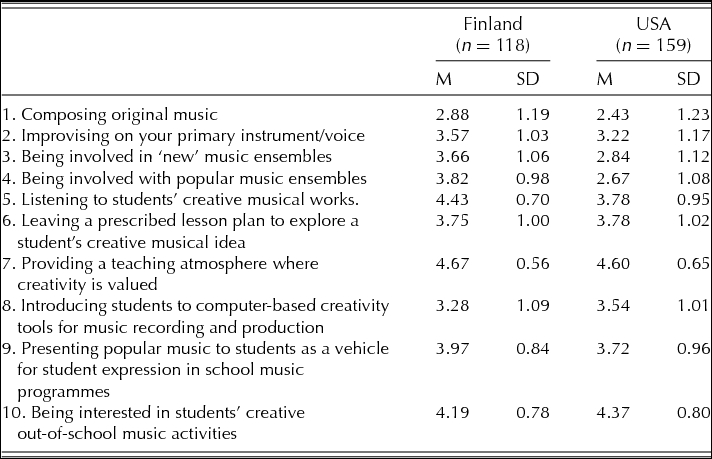
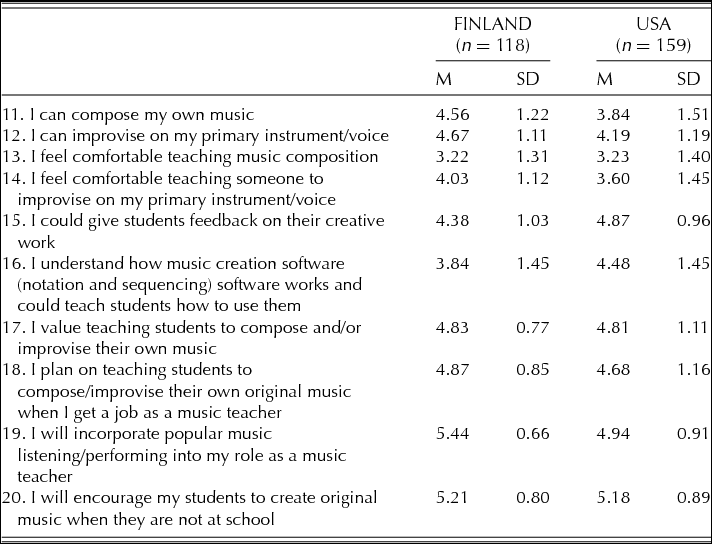
The survey instrument was named the Creative Identity Measure (CIM). The CIM used in this study was administered in an on-line format, which facilitated efficiency in data gathering, management, and information sharing. The CIM contains questions probing areas of creative identity. It specifically targets beliefs about the importance of creative musical pursuits, the value of engaging students in these ways, and future plans concerning teaching students to compose or improvise. An example of the items found in the CIM can be seen in Tables 1 and 2. For the sake of saving space in this document, the example items are displayed within these tables with both the initial validation study descriptive information (the US population only), as well as the further validation study information (which includes the descriptive information from the Finnish population).
Descriptive Statistics for Items of Creative Identity in Music (CIM) Part 1. ‘Rate the importance of:’

Note. Rating scale 1–5; 1 = Not important, 2 = Somewhat important, 3 = Moderately important, 4 = Very important and 5 = Extremely important.
Descriptive Statistics for Items of Creative Identity (CIM) Part 2. ‘Indicate the extent to which you agree or disagree with the following statements:’
Note: Rating scale 1–6; 1 = Strongly disagree, 2 = disagree, 3 = Somewhat disagree, 4 = Somewhat agree, 5 = Agree, 6 = Strongly agree.
Following the design of Isbell's (Reference ISBELL2008) questionnaire, CIM Part 1 asked students to rate the following statements on a 5-point rating scale from ‘not important’ to ‘extremely important’:
• Composing original music.
• Improvising on your primary instrument/voice.
• Being involved with ‘new music’ ensembles.
• Listening to students’ created musical works.
Some examples of the type of survey questions represented in Isbell's first section, which were preceded by the prompt, ‘rate the importance you place on the following activities or outcomes’, include:
• Practicing major instrument.
• Teaching others about music.
• Participating in major performance events.
The researcher used these questions as a guideline to create the following questions, which were also preceded by the same prompt as the Isbell survey:
• Composing original music.
• Introducing students to computer-based creativity tools for music recording and production.
• Being involved in ‘new music’ ensembles.
Part 2 of CIM asked students to ‘indicate the extent to which you agree or disagree with the following statements’ by indicating a response on a 6-point rating scale ranging from ‘strongly disagree’ to ‘strongly agree’:
• I can compose my own music.
• I could give students feedback on their created musical works.
• I value teaching students to compose or improvise their own music.
Some examples of the type of survey questions represented in Isbell's second section include:
• I am confident I will be a good musician.
• I am comfortable about whether I want to be a music major.
• I am certain that I will find my music career to be rewarding.
The researcher used these questions as a guideline to create the following questions for the CIM, which were also preceded by the very same prompt as the Isbell survey:
• I can compose my own music.
• I feel comfortable teaching music composition.
• I could give students feedback on their creative work.
The rating scale design based on both the 5- and 6-point scales was done according to Isbell's original item design (Reference ISBELL2008). During the analysis phase of the project, item response standardisation was necessary to allow for comparison between responses from Part 1 and Part 2. A common denominator of 30 was used to convert items to comparable numbers. For example, 3 out of a possible 6 translates into the number 15 when 30 is the common denominator, and similarly, 2 out of 5 translates into the number 12.
Some items were constructed by the first author to gather information about participant beliefs concerning creativity (Campbell et al., Reference CAMPBELL, CONNELL and BEEGLE2007), computer-based creativity opportunities (Lum, Reference LUM2008), and the importance of the inclusion of popular music listening and performance (Abramo, Reference ABRAMO2011) in the music curriculum. These areas seem to appear frequently together in the recent music education literature when composition, improvisation or general creativity is explored.
Participant population
Nine universities from the USA agreed to be a part of the study, to gather data for both the initial validation of the CIM, and for the further validation of the CIM with a Finnish population. The specific US universities that participated are: University of Arizona, Florida State University, University of North Texas, the University of South Florida, Lee University, Bucknell University, Eastman School of Music at the University of Rochester, Michigan State University and University of Northern Colorado.
From Finland, all three universities that offer degrees in music education agreed to participate in the study: Sibelius Academy, University of Jyväskylä and University of Oulu. Participation by students at the various universities was voluntary. Research board approval was obtained through the university of the US researcher. A statement regarding ethics by way of the research board was attached to each invitation to be a part of the study. Research approvals were also applied from the Finnish universities.
Surveys were sent via e-mail attachment to the pre-service music education students from each of the institutions. Students were asked to take the online survey, which could be accessed by clicking on a link within the e-mail. 159 total surveys were returned out of 698 total e-mails sent from the USA, for a return rate of 22.8%; while 118 total surveys of 532 total e-mails sent were returned from Finland, for a return rate of 22.2%. A total of 277 surveys were returned which made factor analysis possible. A higher response rate would have been better, but the numbers were adequate to perform the necessary statistical procedures.
Factor analysis was used to identify potential sub-scales. Pearson correlations were used to calculate the internal consistency of sub-scale items. A MANOVA was used to calculate differences between the two countries with regard to total creative identity and with regard to each sub-scale, as measured by the CIM.
Results
Factor analysis for CIM
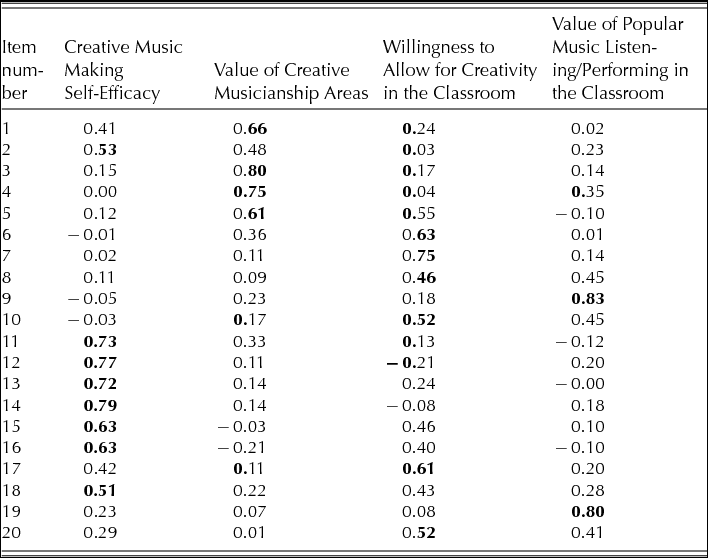
To answer research question 1 (What factors can explain creative identity in music?), factor analysis was performed to identify factors that explain CIM with a US population. The purpose of factor analysis was to identify a smaller number of latent variables that contributed to what is creative identity, as measured by the CIM. Factor analysis allowed for the researchers to say, ‘it's really a matter of comparing this small number of constructs, not this large number of constructs’. The analysis that used principal component analysis as the extraction method and Varimax with Kaiser normalisation as the rotation method required the fewest iterations (n = 9) to converge, yielded the most clearly interpretable factors, and accounted for the greatest amount of cumulative variance (62%). Four factors were identified and each could correspond to a sub-scale of CIM. Table 3 shows the factor pattern matrix for the CIM with a US population.
Factor Loadings for Exploratory Factor Analysis of CIM (Creative Identity in Music) With Varimax Rotation for the US Population Only
Note. Bold font used to illustrate how items loaded together to form the three factors. Eigenvalues = 6.758 for Factor 1, 2.444 for Factor 2, 1.662 for Factor 3 and 1.000 for Factor 4. Factors 1, 2, 3 and 4 accounted for 34%, 12%, 8% and 8% of the variance respectively. Inter-factor correlations are 0.24 (Factor 1 & 2), 0.22 (Factor 1 & 3), 0.28 (Factor 1 & 4), 0.31 (Factor 2 & 3), 0.40 (Factor 2 & 4), and 0.27 (Factor 3 & 4) p < 0.01.
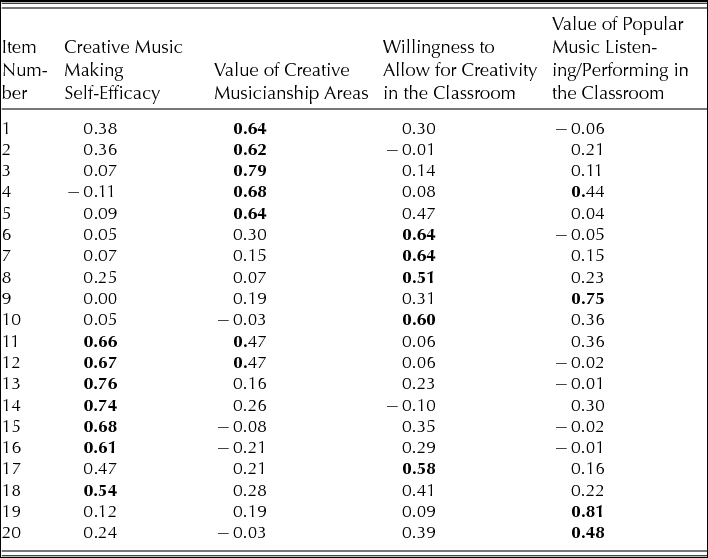
Factor analysis was then performed to identify factors that explain CIM with a US and Finnish population. Again, the analysis that used principal component analysis as the extraction method and Varimax with Kaiser normalisation as the rotation method required the fewest (n = 13) iterations to converge, yielded the most clearly interpretable factors, and accounted for the greatest amount of cumulative variance (60%). Again, four factors were identified and each could correspond to a sub-scale in CIM. Table 4 shows the factor pattern matrix for the CIM with both a US and Finnish population.
Factor Loadings for Exploratory Factor Analysis of CIM (Creative Identity in Music) With Varimax Rotation for the US and Finnish Populations
Note. Bold font used to illustrate how items loaded together to form the three factors. Eigenvalues = 6.597 for Factor 1, 2.109 for Factor 2, 1.817 for Factor 3 and 1.359 for Factor 4. Factors 1, 2, 3 and 4 accounted for 33%, 11%, 9% and 7% of the variance respectively. Interfactor correlations are 0.29 (Factor 1 & 2), 0.18 (Factor 1 & 3), 0.10 (Factor 1 & 4), 0.26 (Factor 2 & 3), 0.24 (Factor 2 & 4) and 0.19 (Factor 3 & 4) p < 0.01.
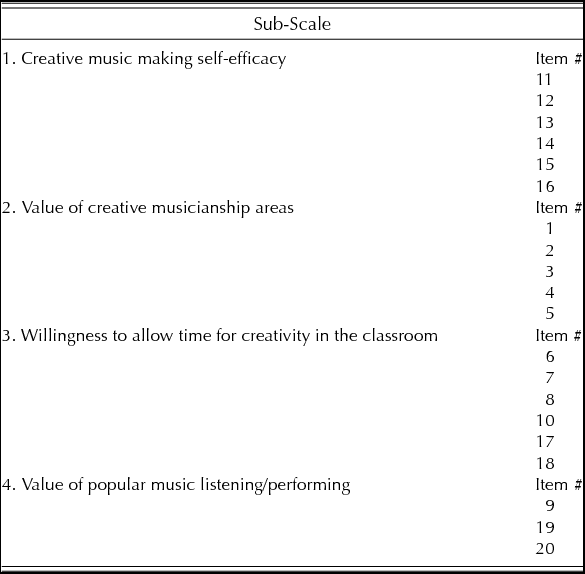
The factors were then analysed by item group to try to determine some sort of logic implicit in the divisions. Since the factor pattern matrix for the initial validation portion of the study (US population only) was quite similar to the factor pattern matrix for the further validation portion of the study (US and Finnish population), the data for both the US and Finland were used in all subsequent analyses. Table 5 shows the measure items categorised according to the four sub-scales. The factors were named ‘1 – Creative music making self-efficacy’, ‘2 – Value of creative musicianship areas’, ‘3 – Willingness to allow for creativity in the classroom’ and ‘4 – Value of popular music listening/performing in the classroom’.
Item Groupings According to Sub-Scale
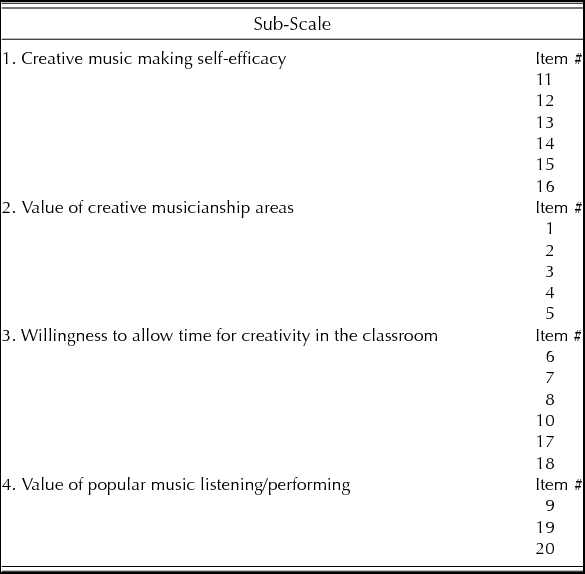
Note. Sample subject n = 277.
Correlations of sub-scale items
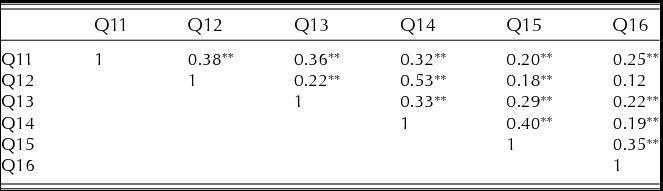
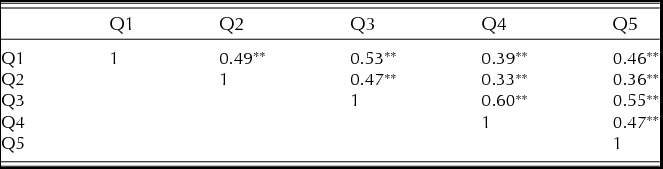
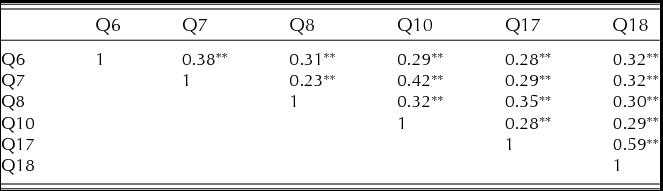
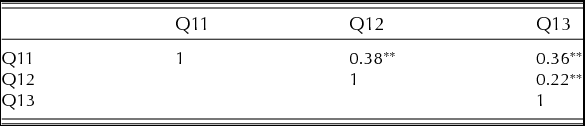
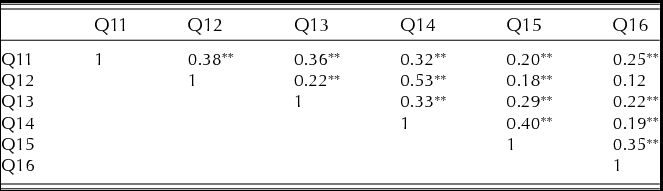
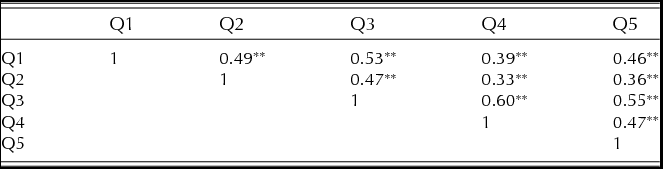
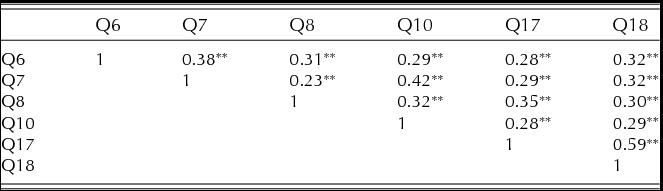
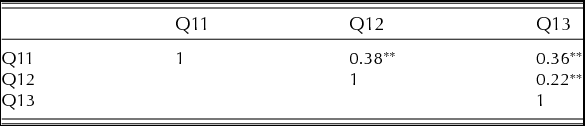
To answer research question number 2 (What is the internal consistency within the factors that explain creative identity in music?), Pearson correlations were calculated for each sub-scale. See Tables 6 through 9.
Correlation Matrix for Sub-Scale #1 – Creative Music Making Self-Efficacy
Note. Sample subject n = 277.
**p < 0.01.
Correlation Matrix for Sub-Scale #2 – Value of Creative Musicianship Areas
Note. Sample subject n = 277.
**p < 0.01.
Correlation Matrix for Sub-Scale #3 – Willingness to Allow Time for Creativity in the Classroom
Note. Sample subject n = 277.
**p < 0.01.
Correlation Matrix for Sub-Scale #4 – Value of Popular Music Listening/Performing
Note. Sample subject n = 277.
**p < 0.01.
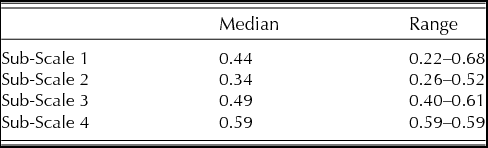
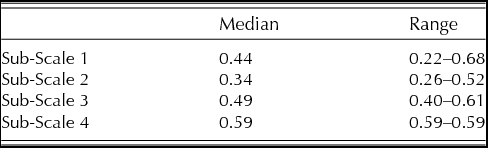
An analysis of these data reveal that in all of the sub-scales, a majority of items are significantly correlated, however, further analysis of median and range for each sub-scale reveal that few of the median correlations are over 0.50, mild to moderate correlations at best (see Table 10). These results suggest that the CIM sub-scale items, while representing a common factor, are measuring different things. These data and results support the use of the CIM as a measure of creative identity.
Variability of Correlation Coefficients according to Sub-Scale
Results of MANOVA
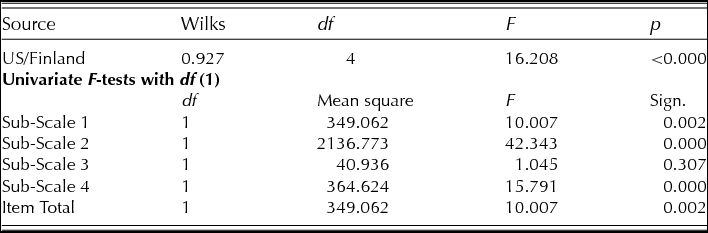
In order to answer research question 3 (Based on the results of the previous questions, might differences exist between the two populations with regard to each sub-scale?), MANOVA (Multiple Analysis of Variance), specifically Wilks’ Lambda distribution, was used to calculate whether overall differences exist between the two populations with regard to performance on this measure. Results indicate that the two populations are significantly different (p < 0.001) with regard to creative identity as measured by the CIM. An analysis of the MANOVA results of each of the four sub-scales reveals that the populations were significantly different (p < 0.01) for sub-scales one (Creative music making self-efficacy), two (Value of creative musicianship areas), and four (Value of popular music listening/performing in the classroom), and for the total item comparison (Table 11). The two samples were not significantly different according to sub-scale three (Willingness to allow for creativity in the classroom).
MANOVA Results of Sub-Scale Comparison of US and Finland Pre-service Teachers
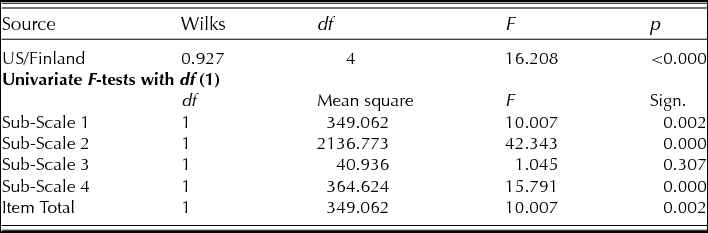
To summarise these results for the layperson, CIM is a valid means of measuring a person's creative identity in music. The four factors that were discovered represent four different dimensions or constructs related to creative identity in music. Finnish pre-service music teachers showed a significantly higher creative music self-efficacy, they value creative music making to a higher extent, and they value the use of popular music listening and performing to a higher extent than their US contemporaries. Both populations of future music teachers feel the same about their willingness to allow time for creative music making to occur in the classroom.
Discussion
The results of this study suggest that the CIM might be a useful tool to empirically assess a person's creative identity in music. This measure should not be considered the absolute test of this emerging construct. Creative identity is certainly a larger concept than can be examined merely by one quantitative tool. However, these data suggest that this measure might account for 60% of what might be viewed as comprising creative identity. That seems like a reasonable start to this line of inquiry, something that could add to previous research in this area (Carter, Reference CARTER2008). If seeing musical creativity being applied more directly in the teaching and learning practice of school districts across the USA is something that the profession values, then a measure such as CIM might be valuable.
What value does musical creativity, a construct examined by researchers in music education for at least 30 years, have in the present music curriculum in the USA? In the general music classroom musical creativity typically takes the shape of vocal improvisation or improvisation on Orff percussion instruments. It could happen with computers or in a keyboard lab environment at the various levels of the school curriculum. After the 4th or 5th grade, general music is typically not available to students in American schools. The curricular focus from the 5th or 6th grade on is more often than not the traditional large ensemble.
In Finland general music instruction is offered to every pupil beginning from pre-school (age 6) and throughout grades 1–7 (ages 7–14). In the 8th and 9th grade (ages 14–16) music is an optional subject. Upper secondary (ages 16–19) school includes at least one 38-hour compulsory course, otherwise music is optional. Creativity can be strongly seen in the aims of the National Core Curriculum for Basic Education (2004) and for Upper Secondary schools concerning music. It may show itself, for example, in forms of improvisation (body, instrumental and vocal), creating soundscapes in groups, inventing movements to music, creating melodies etc. Depending on the teacher's skills there are various possibilities for creating original music with students.
While numerous roles within the area of music offer opportunities for identity to be shaped – including among other roles, that of performer and listener – few opportunities offer students the chance to express their personal identity as when they assume the role of creator. Bennett Reimer supports this claim:
Education for composing has not been provided, except sporadically and perfunctorily, in American music education. The attempt to rectify this shortcoming needs to be, I suggest, a major characteristic of music education in the United States in the foreseeable future. (Reimer, Reference REIMER2003)
Reimer emphasises the importance of introducing students to music composition – not the sole manifestation of creativity, but certainly one of the ways of engaging creatively with music – in the school music education curriculum. This goal may not be attainable, if teachers do not first see the value in changing long-established curricular traditions to move towards achieving the goal. Additionally, in order for teachers to feel comfortable introducing students to music composition, they should first learn to create music themselves, thus establishing a creative identity themselves.
The results of this study suggest that there are differences regarding pre-service teachers self-perceptions of their abilities to be creative with music and to teach these creative avenues based on their socialisation in each respective music education system. There is not a significant difference, however, in pre-service students’ ‘Willingness to allow for creativity in the classroom’ as evidenced by the results of the sub-scale three comparison. Research on the sociology of K-12 music education suggests that school music in the USA, and North America for that matter, has been and is a field devoted almost exclusively to preparing students to be performers of pre-composed music (L’Roy, Reference L’ROY1983; Roberts, Reference ROBERTS1991a, Reference ROBERTS1991b, Reference ROBERTS1991c; Abril & Gault, Reference ABRIL and GAULT2006, Reference ABRIL and GAULT2008). Some researchers have found this also to be the case in Finland and Sweden (Georgii-Hemming & Westvall, Reference GEORGII-HEMMING, WESTVALL and DeNora2009; Muukkonen, Reference MUUKKONEN2010). However, based on the results of this study, perhaps the primary focus on performance in the USA is more pronounced than it is in Finland. The National Content Standards (MENC, 1994) in the USA and the National Curriculum in Finland advocate that music education as a profession be about more than the preparation of music performers. A more expansive description of the music education system in Finland might be helpful in understanding the implications of the results of this study, as it seems to be in part producing a different kind of music teacher, one that possesses a significantly stronger creative identity.
Compulsory basic education in Finland lasts 9 years, starting in the term when the child is 7 years old. Basic education is free to all children in Finland. Every resident is offered an equal opportunity to receive education, including music education. Schooling begins with one year of pre-school for 6-year-olds. Music education in Finland in grades 1–9 (ages 7–16) relies on the National Core Curriculum for Basic Education (2004), which sets both general and subject specific goals for education, emphasising student-oriented active learning. It gives specific objectives, core contents and descriptions of good practice for music education. Teachers partake in forming their regional curricula within the frames set by the national curriculum, and have great freedom in choosing their methods to achieve goals (Korpela et al., Reference KORPELA, KUOPPAMAKI, LAES, MIETTINEN, MUHONEN, MUUKKONEN, NIKKANEN, OJALA, PARTTI, PIHKANEN, RIKANDI and Rikandi2010). The tasks set for music instruction ‘are to help the pupils find their objects of interest in music, to encourage them to engage in musical activity, to give them means of expressing themselves musically, and to support their overall growth’ (Finnish National Core Curriculum for Basic Education, 2004, p. 229).
At grades 1–6 (years 7–13) schools can decide the number of weekly music hours within certain limits. There are typically one or two music lessons per week. Specialised music classes are available from 3rd grade on, where students can elect up to four music lessons per week. Music is taught primarily by general education teachers in Finland at the elementary level, who must complete a music education component to a Master of Education degree to be a teacher. Class teachers have wide-ranging training in university teacher training departments, including compulsory studies in all subjects. Every student attends music studies within their teacher training (e.g. 3–7 ECTS credits at the Helsinki University, 5 ECT). When class teachers are musically skilled and interested, integration with other subjects is possible throughout schooldays and may provide possibilities for creative activities without subject boundaries and tight schedules, which is also supported by the core curriculum. This point might be particularly important when considering that Finnish pre-service music teachers feel much stronger about their abilities to be creative with music than their US counterparts.
Part of an explanation for the differences found in this study might be wrapped up in the way that music students, those individuals who will later enrol in music teacher preparation programmes, are socialised regarding creative involvement with music. The way that Finland has designed their music education system is encouraging music teachers to develop a creative identity to a greater extent than teachers in the USA, as of the writing of this article. It would be beneficial to music educators in the USA to pay close attention to the many dimensions of the Finland music education system.
This being said, there are setbacks to this system, as class teachers sometimes have to teach music without sufficient skills. In Tereska's (Reference TERESKA2003) study nearly one-third of Finnish pre-service elementary teachers (n = 590) stated that they do not want to teach music to their pupils because of their insufficient musical skills, whereas the ones who intended to specialise in music had the most positive attitudes towards music teaching at school. Usually schools can make internal arrangements so that the pupils get the best music teacher possible if that is desired by parents.
Teaching in grades 7–9 and in upper secondary school is mainly handled by music subject teachers with Master of Music degrees who may also work at lower grades, in early childhood education, and in music institutions (music schools and conservatoires) meant for all ages and skill levels. At grade 7 there is usually a weekly hour-long compulsory music class, and in grades 8 and 9 music usually becomes an elective subject. At the end of elementary/middle school the description of a ‘good performance’ (criteria for a grade of number 8 within the scale 4–10) in music concerning creativity includes that the pupil will ‘know how to use the elements of music as building materials in the development and realisation of their own musical ideas and thoughts’ (National Core Curriculum for Basic Education 2004, p. 232).
While music instruction in Finland had its early focus on singing and theory, today it can be described as versatile at all grades and at all levels. There has been an increased importance in instrumental music, listening, physical performance and expression, and, more importantly, creative work in various forms. Music that the pupils are interested in (e.g. pop, rock and heavy metal) is utilised, with the goal of expanding their experiences with music. Muukkonen (Reference MUUKKONEN2010) summarises three cornerstones of the Finnish music subject teacher's lesson planning: active student participation in classroom work, the teacher's morality and an extensive musical world-view.
Conclusion
What has not been explored adequately in the music education literature, perhaps, is the socialisation of music teachers as creative music makers – musicians who compose, improvise and utilise various popular music styles and sensibilities (vernacular musicianship) in music creation. This is surprising in that music teachers are expected – according to the national content standards in music – to introduce music students to creative music making. The CIM might provide a way to measure an individual's creative identity in music. It seems logical to assume that, if teachers do not possess identities as creative music makers, they will not value the fostering of creative identity in their students. This point is cause for concern if one believes that encouraging creative music experiences and nurturing a creative identity in music students is important.
In recent writings about teachers’ perceptions of creativity, Odena and Welch (Reference ODENA, WELCH and Odena2012) examined interview transcripts of experienced teachers talking about their perceptions of creativity over a 4-year time period. The authors suggested that a teacher values creativity based on three areas of experience: (1) musical (experiences of music making across a lifetime), (2) teacher education (experiences in teacher training) and (3) professional teaching (experiences gathered while engaged in teaching over a period of time). This longitudinal qualitative work supports the research findings of the present study, specifically that a teacher's perceptions of themselves as creative music makers are a product of his or her experiences with being creative with music over their history. This work by Odena and Welch (Reference ODENA, WELCH and Odena2012) also supports the design of the CIM, specifically the inclusion of measure items identifying perceptions of musicianship as they relate to composition, improvisation and vernacular musicianship. Odena and Welch's three areas match up almost perfectly with a model proposed by the first author in a previous study (Randles, Reference RANDLES2009a). The authors propose that what Odena and Welch refer to as ‘teachers’ perceptions of creativity’ be at least part of what can be referred to as ‘creative identity’, as identified by the first author in previous work (Randles, Reference RANDLES2009a, Reference RANDLES2010; Randles & Smith, Reference RANDLES and SMITH2012). The researchers view the measurement and development of creative identity in the lives of music students and future music teachers as one of the primary ways ahead for the music education profession.
Reimer (Reference REIMER2003), Elliot (Reference ELLIOTT1995) and Jorgensen (Reference JORGENSEN2003) all agree that music education should be multi-faceted, offering more than simply performance-based experiences with music. To have national standards that include ideals other than performance is one thing; actually implementing such ideals is quite another. The literature suggests a history of music education focused on performance ideals in the USA, perhaps to the expense of other modes of music making. Both national music education systems, in the USA and Finland, promote the inclusion of opportunities for students to create music (composition and improvisation) within the school music curriculum. Both systems have traditions that include both specialised and general music instruction. How these ideals have influenced what is now being done and the music teachers’ creative identities that will turn these ideals into practice should be examined more closely.
Implications
Cultures around the world handle creative music teaching and learning differently. Curricular offerings regarding the use of creativity, and consequently beliefs regarding identity and personal value could be important and valuable ideas to share within the international music education community. While some curricular offerings are specific to each individual country, there may be some offerings that cross cultural boundaries. Composition, improvisation and popular music sensibilities may be examples of curricular areas that could be highly regarded by every culture, but not utilised to full potential by school-based music programmes. These areas seem to be ripe for being examined by the world music education research community.
The present study represents a beginning of a possible research initiative in this area, and a beginning of the possibility for the CIM, a measure of creative identity in music, to be used as a tool to measure the creative identities of music teachers. One of the primary implications of this study is that there may be possible benefits awaiting teachers and researchers who seek ideas from beyond their own national borders. Beyond promoting the useful practice of prompting teachers in schools and in Higher Education to reflect on their own assumptions, practices and beliefs and those of their students, it is hoped that this study will inspire researchers who are interested in creativity and the teaching and learning of music to consider looking internationally for examples of creativity being used effectively in school music programmes. The academic area of music education might benefit greatly by such collaborative work.
Clint Randles is Assistant Professor of Music Education at the University of South Florida where he teaches courses for both graduates and undergraduates that push the boundaries of traditional music education. Randles has presented his work all over the world and is published in many of music education's top journals.
Sari Muhonen works at the Vikki Teacher Training School of Helsinki University as a teacher educator, primary school teacher and music teacher. Her main interests lie in creative approaches to learning and the building of new practices (especially within music and utilising mobile devices in learning processes in general education). She has published in many of music education's top journals, and has presented her work all around the world.