Introduction
Empirical scholars have examined practices of deliberation in parliaments (Steiner et al., Reference Steiner, Bachtiger, Sporndli and Steenbergen2004; Quirk et al., Reference Quirk, Bendix, Bächtiger, Bächtiger, Dryzek, Mansbridge and Warren2018), mini-publics (Warren and Pearse, 2008; Carson et al., 2013; Elstub, Reference Elstub, Elstub and McLaverty2014; Grönlund et al., 2014; Gastil, Reference Gastil2018; Niemeyer and Jennstäl, Reference Niemeyer, Jennstäl, Bächtiger, Dryzek, Mansbridge and Warren2018; Setälä and Smith, Reference Setälä, Smith, Bächtiger, Dryzek, Mansbridge and Warren2018), online forums (Polletta and Lee, Reference Polletta and Lee2006; Black, Reference Black2008; Stromer-Galley and Wichowski, Reference Stromer-Galley, Wichowski, Consalvo, Ess and Burnett2011; Strandberg and Grönlund, Reference Strandberg, Grönlund, Bächtiger, Dryzek, Mansbridge and Warren2018), and face-to-face group discussions (Fishkin, Reference Fishkin2009; Steiner, Reference Steiner2012; Gerber et al., Reference Gerber, Bächtiger, Shikano, Reber and Rohr2016; Himmelroos, Reference Himmelroos2017; Johnson et al., Reference Johnson, Black and Knobloch2017; Steiner et al., Reference Steiner, Jaramillo, Maia and Mameli2017). However, the comparison between ‘forms’ of deliberation in different settings remains essentially unexamined. While retaining a core emphasis on the normative criteria to identify and assess deliberation, most recent research in this field advocates that political discussions in the real world usually mix reason-giving and storytelling in complex ways. To date, no study has directly compared reason-giving and storytelling in actual discussions in institutional places and informal settings.
Using data about discussions of a contentious issue – reducing the age of criminal responsibility in Brazil – both in parliamentary public hearings and in face-to-face groups, this article covers new empirical ground. It has important analytical and theoretical implications. We identify the properties of reasons and personal stories in both formal and informal environments, the interplay between these practices and their functions along the discussion dynamics. These are important questions to investigate because one should not prematurely generalize the role of reason-giving and storytelling for good deliberation. We argue that this role may very well depend on the context, and here the distinction between formal and informal settings may be salient. This article also extends the current literature in this field by putting forward an analytical framework that identifies different ‘moments’ of deliberation, when deliberation is high quality, low quality, or changing. We argue that avoiding the categorization of the entire discussion as ‘deliberative’ leads to a better understanding of circumstances that enable, sustain, or undermine deliberation, and provides a critical yardstick for evaluating the specific structures and functions taken by reasons and personal stories in these moments.
This article is presented in three parts. In the first section, we introduce key conceptualizations of deliberation, focusing on reason-giving practices and personal stories. Then, we present our hypotheses. In the second section, we outline the properties and functional roles of reasons and personal stories, and explain how we combine a formal, logical, type analysis with an interpretative content analysis inspired by the Deliberative Transformative Moments (DTM)methodology (Jaramillo and Steiner, Reference Jaramillo and Steiner2014; Steiner et al., Reference Steiner, Jaramillo, Maia and Mameli2017). The results are presented in the third section. Our analysis suggests that it is important to compare not only variation in reasons and personal stories in different discussion contexts, but also to track their properties and functions within different moments of deliberativeness. In conclusion, we discuss the implication of our analysis to studies on deliberation in multiple sites, in order to capture transitions in the aforementioned practices through the communicative dynamics.
Reason-giving and personal stories in deliberation
Earlier deliberative scholars, despite following distinct traditions, place the exchange of reasons at the core of deliberation. In subsequent debates on what type of communication is needed for deliberation (Young, Reference Young2000; Gabardi, Reference Gabardi2001; Mouffe, Reference Mouffe2005), a number of scholars have developed a more pluralistic approach to reasoned discussion, by acknowledging the merits of rhetoric, storytelling, performances, and humour that can lead to deliberation (Dryzek, Reference Dryzek2000; Bächtiger et al., Reference Bächtiger, Niemeyer, Neblo, Steenbergen and Steiner2010; Dryzek and Hendriks, Reference Dryzek, Hendriks, Fischer and Gottweis2012; Mansbridge et al., Reference Mansbridge, Bohman, Chambers, Christiano, Fung, Parkinson, Warren, Parkinson and Mansbridge2012; Neblo, Reference Neblo2015; Polletta and Gardner, Reference Polletta, Gardner, Bächtiger, Dryzek, Mansbridge and Warren2018). We place ourselves in line with those who argue that rational discussion is compatible with emotions and personal stories (Goodin, Reference Goodin2005; Ulbert and Risse, Reference Ulbert and Risse2005; Thompson, Reference Thompson2008; Bächtiger et al., Reference Bächtiger, Niemeyer, Neblo, Steenbergen and Steiner2010; Steiner, Reference Steiner2012; Maia and Hauber, Reference Maia and Hauber2019).
In this debate, Habermas’ rationalism has been much criticized (Sanders, Reference Sanders1997; Young, Reference Young2000; Ryfe, Reference Ryfe2006). Yet, Habermas conceives emotion as indispensable to his theory of moral judgment and practical reason, in spite of not developing an affective dimension of reason-giving and the role of personal stories in his theoretical framework (Rehg, Reference Rehg1994; Neblo, Reference Neblo2015; Maia and Hauber, Reference Maia and Hauber2019). In some passages, Habermas (Reference Habermas1995: 48–50) explicitly admits that feelings are important for moral perception and the justification of norms and actions; and that personal involvement is necessary for an agent to understand morally relevant elements in a given situation and to make sense of the way in which things matter. He writes: ‘It is here, at the level of personality and knowledge, that the logic of ethical and moral questions first asserted itself’ (Habermas, Reference Habermas1996: 98). We understand that, rather than just provide general maxims of public judgment, Habermas’ theory offers a comprehensive account of the basic structural requirements of rationality in speaking and acting. The structure of argumentative interaction, although ‘rudimentary’ or ‘ingenuous’ in the course of everyday practical activities, lies in the basis of deliberation (Habermas, Reference Habermas1996: 322, Reference Habermas2009, Reference Habermas and Cronin2017). Thus, such a theoretical framework offers significant tools for apprehending deliberation in institutionally organized forums as well as in informal settings.
In the same vein, Mansbridge (Reference Mansbridge and Macedo1999: 211) already claimed that conditions for examining deliberation should be relaxed as we move from structured debates in formal institutions to informal discussions that constitute everyday talk (see also Mansbridge et al., Reference Mansbridge, Bohman, Chambers, Christiano, Fung, Parkinson, Warren, Parkinson and Mansbridge2012). Parkinson has also argued that a ‘loosening of what it might mean to “reason together” is one of the critical intellectual moves that have allowed the deliberative system approach to re-emerge’ (Parkinson, Reference Parkinson, Parkinson and Mansbridge2012: 153). Still, exactly how people build arguments and stories in both formal and informal debate situations is an open-ended question. In the context of this article, we aim at understanding how practices of reason-giving and storytelling operate in formal and informal contexts of debate.
Before explaining our research design, we should clarify the concept of ‘reason-giving’ and ‘storytelling’ underpinning this study. Habermas’ version of deliberation, rooted in the logic of communicative action, continues to inform a number of debates and research efforts. In ideal situations, deliberation should meet a set of conditions; and reason-giving is just one aspect of deliberation (Habermas, Reference Habermas1996: 305–306). Within this theoretical framework, reason refers to considerations and justifications that speakers provide to explain why they have certain beliefs, feelings, or intentions or why they make certain requests, promises, judgments, and so forth (Habermas, Reference Habermas and Cronin2017). By focusing on situations in which discussions are supposed to result in a decision or prepare the way for a collective decision, some scholars have embraced a more restrictive definition of ‘decision-oriented deliberation’ (Thompson, Reference Thompson2008: 502). Here, giving reasons means that speakers offer explanations and justifications for their demands. In Cohen’s (Reference Cohen, Bohman and Rehg1997: 74) words, deliberation is reasoned when parties ‘state reasons for advancing proposals, supporting them, or criticizing them’. Other scholars have adopted a broader conceptualization of reasons. According to Karpowitz and Raphael (Reference Karpowitz and Raphael2014: 219), reason-giving refers to ‘any statement that answers “the why question” about the basis for one’s position’. In this study, we seek to compare formal properties and functional roles of reasons in a legislative forum and in small group discussions.
There is no standard definition of storytelling in the literature on deliberation. According to Black (Reference Black2008: 3), personal stories can be characterized as ‘a series of connected statements in which a speaker recalls some past experience in a roughly sequential order’. Telling stories usually demands an interruption in the flux of communication to set up a scene and narrate a sequence of interconnected actions, in such a way that the narrative composes a plot and establishes the significance of the related events. Polletta and Lee (Reference Polletta and Lee2006: 702) propose that stories are: (a) a venue to ‘integrate description, explanation, and evaluation’; (b) ‘detached from the surrounding discourse’; (c) ‘allusive in meaning’; and (d) ‘iterative in the sense that they elicit more stories in response’. One should further notice that speakers might rely on personal experience in passing. In this case, as Adams (Reference Adams2014: 4) has remarked, speakers use experiential knowledge as evidence to support a statement, without necessarily creating an alternate scene and narration of an event ‘with a beginning, middle and end and pivots around an issue or problem’.
A central question arises within this theoretical framework: What is the relative contribution of reasons and stories to constructive discussion and decisions? Despite disagreements, most deliberative scholars now support the view that the epistemic benefits of these forms of communication are context-dependent. We posit that we should be attentive to the variety of features and functions of arguments and stories; and it is therefore vitally important to approach both benefits and hindrances of reason-giving and storytelling (in terms of attention, judgment, persuasion, legitimacy) as interactive processes.
To craft this study, we assume, following Habermas’ formal pragmatics, that the success of an argument (as having convincing power, relevance, correctness, and so forth) can only be judged from the perspective of the participants themselves. According to Habermas, ‘rationality has less to do with the possession of knowledge than with how speaking and acting subjects acquire and use knowledge’ (Habermas, Reference Habermas1984: 11). While acknowledging that an observer cannot define what constitutes ‘a good’ or ‘a bad’ reason in advance, several deliberative scholars have used code schemes to capture formal aspects of justification. We are in full agreement that measuring if an argument is logical or coherent enables us to detect whether it is or is not comprehensible to others and accessible to rational criticism (Steiner et al., Reference Steiner, Bachtiger, Sporndli and Steenbergen2004; Bächtiger et al., Reference Bächtiger, Niemeyer, Neblo, Steenbergen and Steiner2010: 41; Adams, Reference Adams2014: 3). Yet, this strategy alone runs the risk of pursuing deliberation within a structuralist paradigm, as if the success of reasoning would depend on a logical infrastructure or linguistic construction of arguments – an idea that is distant from the concept of communicative rationality underpinning deliberative theories. To address this problem, this exploratory study brings together a formal analysis of the structure of both reason-giving and storytelling and an interpretative analysis of the discussion flow. By comparing good and bad moments of deliberation, this analytical approach provides important ground for inquiring into differences, similarities and goals, and trade-offs of argumentation and storytelling within the communicative dynamics in formal and informal deliberative forums.
Research design
We adopt the premise, as was hinted at in the introduction, that political communication, in the real world, is not a pure exchange of reasons following the strict criteria of deliberation, but is instead a disorderly mixture of forms and styles of communication (Goodin, Reference Goodin2005; Ulbert and Risse, Reference Ulbert and Risse2005; Thompson, Reference Thompson2008; Steiner, Reference Steiner2012; Bächtiger and Gerber, Reference Bächtiger, Gerber, Grölund, Bächtiger and Setälä2014, Gerber et al., Reference Gerber, Bächtiger, Shikano, Reber and Rohr2016). People move back and forth within diverse forms of interaction, including weighing reasons and offering personal stories, under specific conditions (Holzinger, Reference Holzinger2004; Habermas, Reference Habermas2005, Reference Habermas and Cronin2017; Johnson et al., Reference Johnson, Black and Knobloch2017; Sprain and Black, Reference Sprain and Black2017; Steiner et al., Reference Steiner, Jaramillo, Maia and Mameli2017).
Contexts of deliberation
There is a solid body of evidence indicating that deliberation is shaped by forum designs, types of participants, kinds of tasks, types of publicity, among other factors (Dryzek and Hendriks, Reference Dryzek, Hendriks, Fischer and Gottweis2012; Grönlund et al., 2014; Colombo, Reference Colombo2016; Gastil, Reference Gastil2018; Quirk et al., Reference Quirk, Bendix, Bächtiger, Bächtiger, Dryzek, Mansbridge and Warren2018). We are interested in examining reason-giving and storytelling in legislative public hearings and in small group discussions. The literature in this field offers the hypothesis that reason-giving in legislative forums is more abstract and generalizable than in citizen forums. This hypothesis represents a synthesis of different claims. First, parliaments can be regarded as a ‘context of justification’ (Habermas, Reference Habermas1996: 307) and ‘empowered spaces’ (Dryzek, Reference Dryzek2016), where participants are already consciously aware of conflict lines and often deliver pre-prepared discourses, seeking to exert influence on decision-making. By comparing parliamentary debates in Germany, Switzerland, the United Kingdom, and the US, Steiner et al. (Reference Steiner, Bachtiger, Sporndli and Steenbergen2004) found that plenary discussions were supported by higher levels of justification than discussions in committees. Conditions of publicity/secrecy also influence the quality of deliberation (Chambers, Reference Chambers2004; Goodin, Reference Goodin2005). The studies of Elster (Reference Elster and Elster1998) and Steiner et al. (Reference Steiner, Bachtiger, Sporndli and Steenbergen2004) showed that political representatives tend to make more references to the common good when speaking in public than in discussions behind closed doors; and, therefore, report to the general public and advance proposals that might appear to be good for all, and not just for the speaker. Conversely, citizens frequently engage in discussions to discover adversarial positions in informal forums and they benefit from listening and learning from each other without expecting to exert influence on political decisions (Steiner, Reference Steiner2012; Bächtiger and Gerber, Reference Bächtiger, Gerber, Grölund, Bächtiger and Setälä2014; Gerber et al., Reference Gerber, Bächtiger, Shikano, Reber and Rohr2016; Polletta and Gardner, Reference Polletta, Gardner, Bächtiger, Dryzek, Mansbridge and Warren2018). Typically, ordinary people do not have the common good in mind when they express their arguments (Himmelroos, Reference Himmelroos2017). Drawing on data from an experiment in Finland, and deliberative forums in Belgium and the US, Himmelroos (Reference Himmelroos2017) found that all citizen forums displayed moderate levels of justification and fewer references to the common good compared to the parliamentary debates analyzed by Steiner et al. (Reference Steiner, Bachtiger, Sporndli and Steenbergen2004).
Second, and related to the aforementioned topic, more abstract reasoning in legislatures may reflect an authorial strategy from politicians, experts, and agents trained to communicate in public settings. While these types of speakers are usually invested with the authority to analyze, synthesize, and recommend remedies for social conflicts in forums (Karpowitz and Raphael, Reference Karpowitz and Raphael2014; Quirk et al., Reference Quirk, Bendix, Bächtiger, Bächtiger, Dryzek, Mansbridge and Warren2018), ordinary citizens respond with their own reasons, often making references on their values, interests, and subjective experiences to explain problems and possible solutions (Karpowitz and Mansbridge, Reference Karpowitz and Mansbridge2005; Carson et al., 2013; Gerber et al., Reference Gerber, Bächtiger, Shikano, Reber and Rohr2016). Ordinary citizens invoke their own stories and experiences to make sense of the problem and how they see it affecting them (Polletta and Lee, Reference Polletta and Lee2006; Black and Lubensky, Reference Black, Lubensky, Carson, Gastil, Hartz-Karp and Lubensky2013; Maia, Reference Maia2014; Gerber et al., Reference Gerber, Bächtiger, Shikano, Reber and Rohr2016; Sprain and Black, Reference Sprain and Black2017; Polletta and Gardner, Reference Polletta, Gardner, Bächtiger, Dryzek, Mansbridge and Warren2018). In the face of these considerations, we hypothesize that:
HYPOTHESIS 1: Discussions in informal forums will spur more personal stories and reason-giving based on empirical evidences compared to discussions in formal forums.
Moments of deliberation
We assume that deliberation is constructed and achieved in interaction, insofar as participants fulfill (or approximate) normative principles such as providing justification for their claims in the face of disagreement, being mutually respectful, listening attentively and giving reciprocal responses, etc. To dispel false expectations regarding orderly argumentation throughout the entire discussion, Habermas acknowledges, for instance, that ‘political deliberation shifts correspondingly over a broad range of aspects, from factual or pragmatic discourse to ethical, moral or legal argumentation, and again from arguing to bargaining, that is to the negotiation of power-based interests’ (Habermas, Reference Habermas2005: 387; see also, Ulbert and Risse, Reference Ulbert and Risse2005; Thompson, Reference Thompson2008). In the same vein, Steiner et al. (Reference Steiner, Jaramillo, Maia and Mameli2017: 2) have pointed out that ‘in the course of a particular discussion the various deliberative elements may not always be present to the same extent, and they may even be totally absent’. Sprain and Black (Reference Sprain and Black2017: 11) have likewise searched for ‘deliberative moments’, by identifying the co-occurrence of three elements in the communicative interaction – namely, reason exchange; attentive listening or respect; and inclusion, defined as ‘an orientation to recognizing other perspectives about an issue’.
There is little empirical work on distinctive moments of political discussion offering specific inferences beyond aggregate level data (Black, Reference Black2008; Maia et al., Reference Maia, Cal, Bargas, Oliveira, Rossini and Sampaio2017; Sprain and Black, Reference Sprain and Black2017; Steiner et al., Reference Steiner, Jaramillo, Maia and Mameli2017). That said, we suspect that the structure of reasons as well as storytelling will be different in moments of high-quality and low-quality deliberation. The logic here is straightforward: the provision of reasons and telling stories do not necessarily ensure deliberation. Despite their benefits, personal stories may prompt disengagement from discussion, incite antagonism among discussants, and be used for manipulation (Dryzek, Reference Dryzek2000; Black, Reference Black2013; Steiner, Reference Steiner2012). The speakers may extensively justify their positions but they might be just lecturing, reporting, or commanding, rather than reasoning together (Laden, Reference Laden2012). Clever speakers might use unnecessarily complex argumentation and elaborate assertions, but intentionally leave the argument vague or unclear (Bächtiger et al., Reference Bächtiger, Niemeyer, Neblo, Steenbergen and Steiner2010; Maia et al., Reference Maia, Cal, Bargas, Oliveira, Rossini and Sampaio2017). Thus, it is plausible to expect that mechanisms ensuring tangible evidences for one’s claims and clearer connections between premises and conclusions will emerge in good moments of deliberation, in contrast to those in bad moments. In the face of the framework just laid out, our second expectation emerges:
HYPOTHESIS 2: Storytelling and reason-giving will take different shapes concerning evidences and structural elements in moments when deliberation is at a high level compared to a low-quality level.
Functions of reasons and stories
In order to go a step further in our inquiry, it is worth noting that deliberative scholars have indicated different functions of reason-giving and storytelling in deliberation, but very few have taken up the challenge of investigating these roles empirically. Participants may exchange reasons to clarify issues and problematic situations; and to achieve a better understanding of their claims, interests, and values in a debate situation (Habermas, Reference Habermas1996; Steiner et al., Reference Steiner, Bachtiger, Sporndli and Steenbergen2004; Dryzek, Reference Dryzek2016). Reasons may be issued for the specific purpose of solving problems and finding acceptable solutions (Bohman, Reference Bohman1996; Bohman and Richardson, Reference Bohman and Richardson2009). Moreover, participants may exchange reasons to bring the conflict to the forefront and thus better structure a disagreement (Thompson, Reference Thompson2008; Mansbridge et al., Reference Mansbridge, Bohman, Chambers, Estlund, Føllesdal, Fung, Lafont, Manin and Martí2010). Lastly, reason-giving may be used for imposing, commanding, lecturing, and reporting, and, in this case, dialogical, reciprocal, cooperation is supposed to end (Laden, Reference Laden2012).
Different settings offer specific opportunities and constraints for issuing reasons. In legislative forums, for instance, elected representatives, being bound by party discipline or representing constituencies, frequently operate as bargainers (Holzinger, Reference Holzinger2004; Quirk et al., Reference Quirk, Bendix, Bächtiger, Bächtiger, Dryzek, Mansbridge and Warren2018). They usually address problems and agree with a negotiated compromise for different reasons (Steiner et al., Reference Steiner, Bachtiger, Sporndli and Steenbergen2004; Dryzek and Hendriks, Reference Dryzek, Hendriks, Fischer and Gottweis2012). In contrast, citizens are more open to understanding each other’s arguments in small groups. Not being controlled by party politics, they can express themselves more freely and exchange views on a process and be open to the better argument. Therefore, they are more likely to weigh the pros and cons when defining problems and solutions (Bächtiger and Gerber, Reference Bächtiger, Gerber, Grölund, Bächtiger and Setälä2014: 130; Gerber et al., Reference Gerber, Bächtiger, Shikano, Reber and Rohr2016; Setälä and Smith, Reference Setälä, Smith, Bächtiger, Dryzek, Mansbridge and Warren2018) and thus change their stances, at least when compared to elected representatives in legislative settings (Bächtiger and Wegmann, Reference Bächtiger, Wegmann, Elstub and Mclaverty2014).
The literature also indicates various functions of storytelling in deliberation. People may tell stories to clarify their identities, evincing commonalities and differences with others and how they are connected to larger groups (Polletta and Lee, Reference Polletta and Lee2006; Black, Reference Black2008; Black and Lubensky, Reference Black, Lubensky, Carson, Gastil, Hartz-Karp and Lubensky2013). Narratives here elucidate how discussants situate and resituate themselves in relation to current events, and how aspects of political issues resonate in their everyday life. Moreover, people can tell stories to disclose harm and injustices. Underprivileged people frequently narrate personal experiences to politicize their situation, making different forms of domination visible (discrimination, exclusion, exploitation, etc.) as to facilitate consciousness-raising (Young, Reference Young2000; Maia, Reference Maia2012, Reference Maia2014; Maia and Garcêz, Reference Maia and Garcêz2014; Johnson et al., Reference Johnson, Black and Knobloch2017). When searching for solutions, people can also vocalize stories as to identify otherwise obscure causal mechanisms or reveal the moral complexity of certain problems, particularly when rights are not assured or specific policies are unavailable (Steiner, Reference Steiner2012; Maia, Reference Maia2014; Polletta and Gardner, Reference Polletta, Gardner, Bächtiger, Dryzek, Mansbridge and Warren2018). Still, storytelling can serve to deviate the focus from a discussion or exert coercion.
Given the obvious differences between the discussion contexts in legislative public hearings and small face-to-face groups, differences related to rules and procedures, visibility of debates and the pressure to make a decision, it can be expected that both reason-giving and storytelling practices will perform distinct functions in these settings. Previous studies have indicated, for instance, that speakers in legislatures are more likely to argue for achieving a negotiated compromise for problem resolution, while citizens are more likely to argue for understanding each other’s views and building cooperative solutions (Bächtiger and Gerber, Reference Bächtiger, Gerber, Grölund, Bächtiger and Setälä2014; Bächtiger and Wegmann, Reference Bächtiger, Wegmann, Elstub and Mclaverty2014; Gerber et al., Reference Gerber, Bächtiger, Shikano, Reber and Rohr2016; Setälä and Smith, Reference Setälä, Smith, Bächtiger, Dryzek, Mansbridge and Warren2018). Based on a normative theory of deliberation (Bohman, Reference Bohman1996; Habermas, Reference Habermas1996, Reference Habermas2005, Reference Habermas and Cronin2017; Mansbridge et al., Reference Mansbridge, Bohman, Chambers, Estlund, Føllesdal, Fung, Lafont, Manin and Martí2010; Steiner, Reference Steiner2012), it also plausible to expect that both reason-giving and telling personal stories, related to clarification and search for solutions, are associated with good deliberation whereas these practices enacting imposition or causing deviation from the current discussion are associated with bad moments of deliberation. In the face of these considerations, we place our third hypothesis:
HYPOTHESIS 3: Reason-giving and storytelling will enact different functions in formal and informal forums (H3a) as well as in high-quality and low-quality moments of deliberation (H3b).
A caveat is in order. Since good deliberation is the result of several elements, our analytical framework does not allow us to say if an observed change in the communication flow is the result of offering a reason or a story at a particular moment. This analysis does not enable us to determine the quality of reason-giving or storytelling per se, but just infers if these practices are or are not performing well in the discussion flow. In this sense, this approach provides a critical standard for assessing properties of reasons and personal stories under broader conditions built through intersubjective exchanges.
The empirical case
In Brazil, the proposal to reduce the age of criminal responsibility – currently set at 18 years of age – has become a hot button issue. This is a suitable topic for our study because this type of controversy is deeply felt by ordinary citizens as it touches on core problems related to social inequality and criminal violence, including the sense of an existential threat. Lowering the age of criminal responsibility has been under discussion in Brazil since the creation of the Child and Adolescent Statute (ECA) in 1990. The ECA stipulated that adolescents aged 12–17 years who violated the law should be subjected to socio-educational measures, which range from community service to a maximum of 3 years in a socio-educational institution. Various groups, along with most of the Brazilian population, support lowering the criminal responsibility age.
During the term of this study, there were four bills of law and eight proposals of law amendments being considered by the Brazilian Congress and Senate recommending a reduction in the age of criminal responsibility or extending the time adolescents spend in socio-educational institutions. In particular, an important Constitutional Amendment (PEC 33/2012) was arousing heated debates. The amendment proposed lowering the age of criminal responsibility from 18 to 16 years for severe crimes, such as first-degree murder and rape, and would alter both the Federal Constitution and the ECA itself. The Brazilian Senate organized public hearings about this issue in 2013, enabling us to investigate discussions on this topic in different environments.
Measuring reason-giving and storytelling
Consistent with our purpose to analyze reason-giving and storytelling in distinct forums, we adopted a mixed-method approach. We sought to capture formal aspects of justification and stories, by assuming that the configuration of these practices is context-dependent. To duly capture variation, we distinguished between four moments in the discussion flow and identified properties and functions of reason-giving and storytelling in each moment, as is explained below.
Deliberative moments
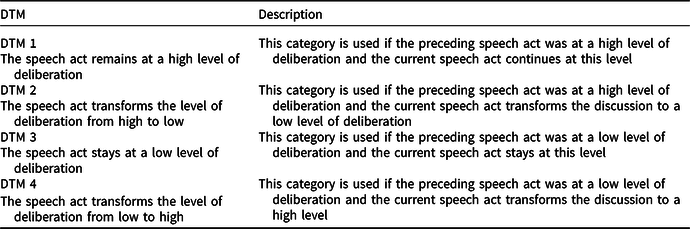
To capture different moments in the communication dynamics, we followed the Deliberative Transformative Moments scheme (Steiner et al., Reference Steiner, Jaramillo, Maia and Mameli2017), focusing on whether the speech act helps the quality of deliberation remain ‘high’ or ‘low’ or transform from high to low or low to high. This methodology represents an innovation to the Discourse Quality Index (DQI). Whereas DQI considers each speech act as a separate indicator of deliberation properties (such as respect, level of justification, etc.), DTM helps observing types of interaction that either enable or disrupt deliberation. The creators of DTM conceive deliberation as a continuum from no deliberation to full deliberation. They establish a cutoff point between high and low levels of deliberation, with the latter including no deliberation at all. This method seeks to assess each speech act and evaluate the way it relates to the discussion dynamics. To capture how a discussion is transformed, we used the following four coding categories for each speech act, as summarized in Table 1:
(a) DTM 1: The speech act remains at a high level of deliberation. This means that the discursive space is inclusive and the opportunity to articulate diverse opinions is available, participants are respectfully listening to each other and exchanging arguments and experiences to justify their positions, and discussion remains within the topic at stake (Steiner et al., Reference Steiner, Jaramillo, Maia and Mameli2017: 4). Deliberation can still remain at a high level, if speakers do not fulfill all these criteria. For example, even if the speech act is brief and not elaborate, the level of deliberation remains high as long as it stays within the topic, and continues the cooperative effort of respectful and reciprocal communication.
(b) DTM 2: The speech act transforms the level of deliberation from high to low. The flow of the discussion is disrupted (Steiner et al., Reference Steiner, Jaramillo, Maia and Mameli2017: 4–5). This situation may include a topic detour and a confrontation that closes the venue to articulating diverse opinions, as well as insults or expressions of disrespect toward other participants or their positions
(c) DTM 3: The speech act stays at a low level of deliberation. Discussants do not reconstruct the discussion in a deliberative way (Steiner et al., Reference Steiner, Jaramillo, Maia and Mameli2017: 5). Examples are off-topic comments and storytelling unrelated to the question under scrutiny, vocalization of expressions of disrespect and efforts to disqualify others. Speech acts may include high incoherence and a lack of clarity.
(d) DTM 4: The speech act transforms the level of deliberation from low to high. Participants are able to successfully conduct the discussion with deliberative interaction, by returning to the topic under discussion, presenting a good argument, summarizing the group’s reflection, or making new propositions to advance the discussion (Steiner et al., Reference Steiner, Jaramillo, Maia and Mameli2017: 5).
DTM category description (Steiner et al., Reference Steiner, Jaramillo, Maia and Mameli2017)

Reason-giving
Drawing on Stephen Toulmin’s (Reference Toulmin1958) model of argumentation, we assume that the act of reason-giving consists of three components. According to Adams (Reference Adams2014), to make an argument comprehensible to others, the speaker needs to offer a conclusion (or a claim, something they are arguing about) and provide evidence to support the conclusions as well as an explanation of how the evidence leads to the conclusion (a warrant). Steiner et al. (Reference Steiner, Bachtiger, Sporndli and Steenbergen2004) refer to this latter element as ‘linkage’ (see also Steiner, Reference Steiner2012: 270), that is, a way to tie together a demand (y) and explain why (x) should or should not be done, within an infrastructure of logical or causal connections. For analyzing empirical communication processes, we used the following codes.
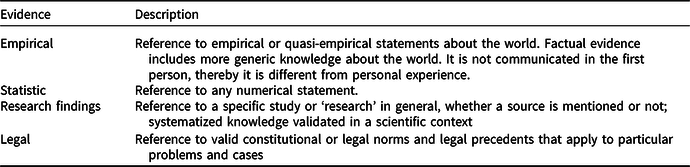
Evidences are statements presented to support a conclusion within the argument; they have different modes of proof, methods of inquiry, and standards of certainty. By adapting Adams’ (Reference Adams2014) and Karpowitz and Raphael’s (Reference Karpowitz and Raphael2014) definitions of evidence, we coded the following (a)–(d) subcategories: (a) empirical evidence; (b) statistic evidence; (c) research findings; (d) legal evidence (see Table 2).
Evidence category description

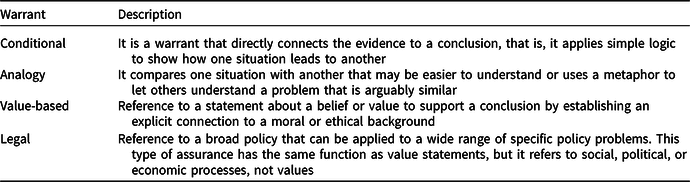
Warrants function as a complex linguistic connective, providing a lexical and structural link between premises and conclusions within the argument. They are typically implicit and allow a movement (an inference) from data/evidences to claims. According to Adams (Reference Adams2014), warrants can be classified as: (a) conditional; (b) analogy; (c) value-based; (d) meta-proposal (see Table 3).
Warrant category description

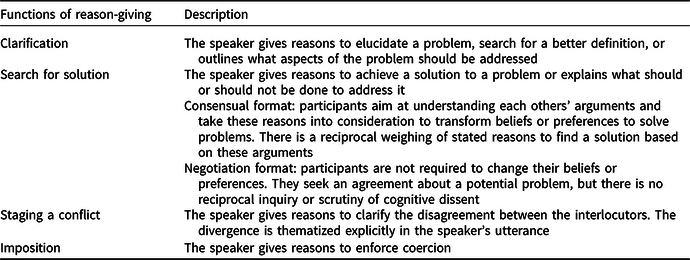
The functions of reason-giving: By surveying theoretical and empirical studies (Cohen, Reference Cohen, Bohman and Rehg1997; Holzinger, Reference Holzinger2004; Goodin, Reference Goodin2005; Bächtiger et al., Reference Bächtiger, Niemeyer, Neblo, Steenbergen and Steiner2010; Mansbridge et al., Reference Mansbridge, Bohman, Chambers, Estlund, Føllesdal, Fung, Lafont, Manin and Martí2010; Laden, Reference Laden2012), we defined the following functions for reason-giving: (a) Clarification; (b) Search for solution, subdivided into two codes, (b.1) consensual format (b.2) negotiation format; (c) Staging a conflict; (d) Imposition (see Table 4).
Description of reason-giving functions

Storytelling
While some authors understand stories as a type of evidence for reasoning (Steiner, Reference Steiner2012; Adams, Reference Adams2014), we coded this practice separately as to enable different conceptions to be examined. We assessed stories according to Black’s (Reference Black2008) definition. Following Adams’ (Reference Adams2014) and Karpowitz and Raphael’s (Reference Karpowitz and Raphael2014) classification, we coded two subcategories: (a) Story; (b) Personal experience (see Table 5).
Storytelling category description

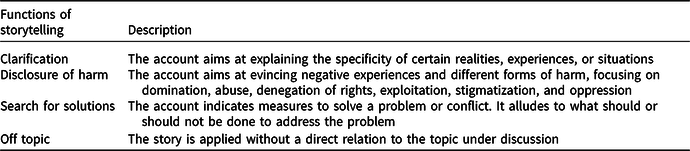
The functions of storytelling were built by surveying theoretical and empirical studies on storytelling (Polletta and Lee, Reference Polletta and Lee2006; Black, Reference Black2008; Black and Lubensky, Reference Black, Lubensky, Carson, Gastil, Hartz-Karp and Lubensky2013; Johnson et al., Reference Johnson, Black and Knobloch2017; Polletta and Gardner, Reference Polletta, Gardner, Bächtiger, Dryzek, Mansbridge and Warren2018) and by reading our research material. The following functions were coded: (a) clarification; (b) disclosure of harm; (c) search for solutions; (d) off topic (see Table 6).
Description of storytelling functions

Method
Sample and procedures: Considering that our research is an initial investigation of reasoning and storytelling in different forums, our sampling strategy was not to take a representative or random sample. Rather, it intended to analyze an issue-specific discussion in different debate situations. We have chosen two environments: (a) public hearings, which typically consist of institutional spaces where debates are structured and aimed at gathering information and exchanging arguments about a controversial issue to inform decision-making by governmental sectors and agencies; (b) face-to-face discussion groups, which are characterized by spontaneous interactions, insofar as participants are invited to take part in discussions about specific topics; (c) the discussions are usually mediated by a moderator who may intervene in different ways. We used transcriptions of three 2013 public hearings in the Brazilian Senate on reducing the age of criminal responsibility and five discussion groups composed of police officers and residents from poor communities, including adolescents.
Public hearings: The Constitution and Justice Commission of the Federal Senate organized three public hearings. Participants included attorneys, lawyers, senators, deputies, magistrates, psychologists, prosecutors, and representatives of civil associations. A senator, who could express his/her opinion, mediated the sections. Each participant spoke on average for 20 minutes, and there was no large variation between utterances. The audience was broadcast live on the Senate website, including via Facebook and Twitter. Citizens could participate, either by asking questions or commenting directly to senators via an internet link on the ‘e-Cidadania Portal’ or by telephone via the ‘Alô Senado’ channel.
Group discussion: We organized five discussion groups – three in Belém (Para) and two in Belo Horizonte (Minas Gerais). These cities are located in the north and southeast of the country, respectively. To help facilitate participant contact, we had support and assistance from the social projects ‘Rede Escola Cidadã’ in Belém and ‘Fica Vivo’ in Belo Horizonte, as well as community members and local police staff. Altogether, 60 people participated in the discussion groups. The groups had a minimum of 10 and a maximum of 17 members and were composed of 1/3 police officers and 2/3 community residents, approximately. The discussion groups occurred in cultural community centers and educational institutions. Participants were offered no financial incentives to participate.
On average, the discussions lasted for two and a half hours. During the first hour, the participants considered how to create a culture of peace between poor community residents and the local police (Part 1). After a short coffee break, the participants discussed the age of criminal responsibility in Brazil for another hour (Part 2). Before and after discussions, we applied questionnaires to all participants about sociodemographic, political, and psychological issues. The data herein involve only Part 2 of the discussions. The moderator played a passive role to enable group discussants to freely interact with each other and speak their minds. To begin the discussion, the moderator asked: ‘What is your opinion about the bill of law recommending the reduction of the age of criminal responsibility? What should be done?’ If conversation prematurely came to an end, the moderator only repeated the aforementioned question or reintroduced the last topic of dialog in the group. Similarly to what happened in public hearings, where the moderator interrupted the discussion to read website users’ arguments, after 30 minutes of discussion participants in our group discussion were exposed to a 12-minute-long video of adversarial arguments circulating in the media. The video presented eight pro arguments and eight con arguments on the criminal responsibility age reduction. Since the aim was to offer ‘conversational resources’ (Gamson, Reference Gamson1992) to the participants, we took special care to produce the video with a balanced account of pro and con arguments and no specific media sources were indicated in order to avoid bias in the debate.
Procedure
Transcription and coding: Our analysis is based on the transcriptions of discussion from all public hearing sessions (220 transcript pages, including 92,454 words) and group discussions (111 transcript pages, including 44,536 words). The unit of analysis is the speech act – every time that a participant spoke, his/her speech counted as one speech act, even in the case of brief interruptions. Each speech act, therefore, had a clear beginning and a clear end. There were 177 speech acts in the public hearings and 201 speech acts in the group discussions (378 altogether). The content analysis was processed by Nvivo’s version 10. The test of agreement was established by randomly choosing 10% of speech acts from each setting. These speech acts were separately coded by a researcher and a postgraduate student who had been trained to be familiar with the coding procedure. After three previous tests and trainings, we report reliability of 96% pairwise agreement.Footnote 1 The percentage agreement is calculated by Nvivo’s Coding Comparison Query, when the two users agree on whether the content may be coded at the node.
Operationalization of variables: To analyze the speech acts, we elaborated a codebook (available in the Appendix). We coded first the moments in accordance with the DTM scheme and, next, the aforementioned variables. In our qualitative analysis, rather than treating the speech act as an isolated artifact, we attempted to follow the narrative of the discussion looking always back to previous utterances and frequently checking records and transcripts to understand the context of each intervention. This strategy enabled us to analyze step by step the different dimensions in the speech act and grasp the specific and contextual elements of interactions. We engaged in hypothesis testing and logistic regressions to estimate the chance of components of reasons and stories in distinct settings and moments of deliberation alike.
Results
While earlier theorists regarded deliberation as primarily consisting of argumentation, our data revealed an interchange between reason-giving and storytelling. Reason exchange was predominant in public hearings (67% reason vs. 19.3% stories), as well as in small group discussions (83% reason vs. 47.8% stories). We predicted that discussions in small groups would reflect reason-giving based on more empirical evidence and would evoke more personal stories compared to discussions in formal forums (Hypothesis 1).
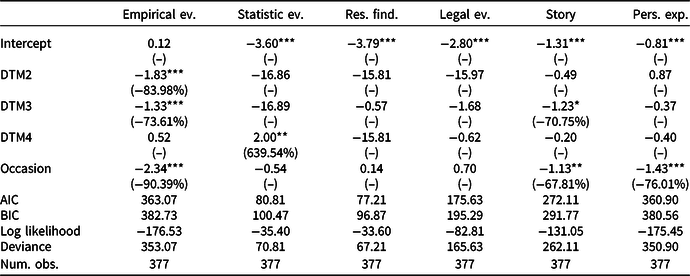
Table 7 presents the results for seven logistic regression models. The dependent variables are: empirical evidence, statistical evidence, research findings, legal evidence, story and personal experience (in passing). We can see that participants in public hearings are 90.4% less likely to use empirical evidence to support their argument compared to discussants in small groups. Moreover, speaking in a formal setting decreases the odds of telling structured stories (−67.8%) as well as of referring to personal experiences in passing (−76.0%). The estimated results for the seven models show the expected statistically significant effects of the explanatory variables.
Logistic regression models – evidences of reasons

Notes: The table presents the estimated logits and the calculated percentages of chances within parenthesis when the parameters were found significant (except for the intercepts). The percentages were calculated by (eb − 1)/100.
AIC=Akaike’s information criteria; BIC=Bayesian information criteria.
* P < 0.05.
** P < 0.01.
*** P < 0.001.
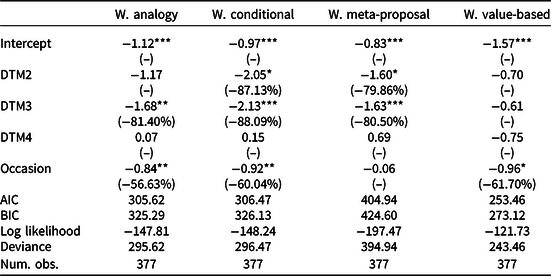
Table 8 presents the results of four logistic regression models estimated to understand the probability of warrants. The context of the discussion also has a significant effect on the type of warrant: justifications in public hearings are less likely to be attached to analogy warrants (−56.6%), conditional warrants (−60.0%), and value warrants (−61.7%), if compared to justifications in small group discussions. The only exception is a meta-proposal warrant that presented no significant result. These findings suggest that deliberators in group discussion rely more heavily on stories, personal experiences, comparisons, analogies, and their own values when justifying why something should or should not be done, whereas participants in legislative discussions evoke more abstract elements to support their conclusions. Overall, these results nicely confirm our first hypothesis.
Logistic regression models – warrants of reasons

Notes: The table presents the estimated logits and the calculated percentages of chances within parenthesis when the parameters were found significant (except for the intercepts). The percentages were calculated by (eb − 1)/100.
AIC=Akaike’s information criteria; BIC=Bayesian information criteria.
* P < 0.05.
** P < 0.01.
*** P < 0.001.
Having found a clear difference between reason-giving and storytelling in formal and informal forums, we tested these practices at different moments of deliberation. The second hypothesis predicted that reason-giving and storytelling would take a different format concerning evinces and their logical structure during moments of high and low levels of deliberation. Let us first look at distinct patterns by contrasting good (DTM1) and bad (DTM3) moments of deliberation. Interestingly, the provision of empirical evidence and telling stories were all related to good moments of deliberation. As Table 7 shows, in non-deliberative moments (DTM3), speakers are 73.6% less likely to provide reasons backed up by empirical evidence when compared to good moments. They also are 70.7% less likely to tell stories in non-deliberative moments. Moreover, a clear distinction emerges in reasons warrants during good and bad deliberative moments (Table 8). When deliberation is at a low level (DTM3), arguments are less likely to present conditional (−88.1%), meta-proposal (−80.5%), and analogy warrants (−81.4%), compared to moments when deliberation is at a high level (DTM1). Overall, these findings confirm our second hypothesis.
However, the changing moments are more ambiguous. In downward moments (DTM2), speakers are 60.8% less likely to support their reasons with empirical evidence compared to moments when deliberation is progressing well (DTM1). Downward moments (DTM2) also decrease the chances of participants issuing arguments with conditional (−87.1%) and meta-proposal warrants (−79.9%). Upward moments (DTM4) revealed no significant results, indicating that transformative moments are less important in determining structural formats of reasons and the expression of stories and personal experiences.
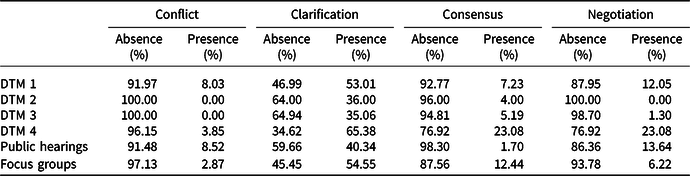
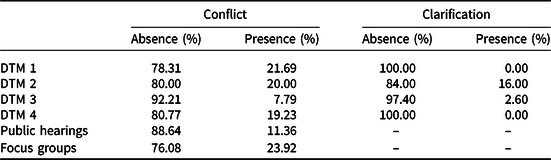
Lastly, we predicted that reason-giving and storytelling would perform different functions in formal and informal forums (Hypothesis 3a), as well as during good and bad moments of deliberation (Hypothesis 3b). We expected that both reason-giving and storytelling related to clarification and the search for solutions would be associated with good deliberation, whereas these practices enacting imposition or causing deviation from the current discussion would be associated with bad moments of deliberation. To test our third hypothesis, we examined the distribution of functions of the two practices along discussion contexts and the DTMs. Table 9 shows that, overall, reasons were offered mostly to clarify questions in both discussion groups and public hearings. While the legislative setting presented the highest proportion of reasons for structuring conflict (9%) and negotiation (14%), discussion groups presented the highest proportions of reasons for clarification (55%) and for consensus building (12%).
Functions of reason-giving per DTM and settings

We found that the distribution of justification functions was highly unequal across DTMs. As seen in Table 9, good deliberation moments (DTM1) reflected the highest proportion of reasons for elucidating conflict (8%) and the upward moment (DTM4) was the second highest (4%). Interestingly, moments that transformed discussion from a low to high level of deliberation (DTM4) had the highest proportion of reasons with the purpose of clarification (65% of the variables), DTM1 and DTM3 followed, respectively. The upward moment (DTM4) also presented the highest share of reasons for reaching consensus (23.8%), followed by DTM1 (7.2%), DTM3 (5.2%), and DTM2 (4%). Similarly, reasons in favor of negotiating a solution predominate in upward moments (23%, DTM4) if compared to moments when deliberation remains high (12%, DTM1). All of these cross tables were tested with a Fisher’s exact test and were significant. Reasons aimed at imposing a certain command did not present a significant result, maybe because of the discursive nature of these forums. Therefore, Hypothesis 3a was confirmed as well, with more complex issues being associated with upward moments of deliberation.
We combined these expectations in a model to test the functions of stories, and the results were more uncertain. As to the discussion group context, only the clarification function had a significant result out of four variables. Table 10 shows that storytelling in small groups reflected 24% of this type of function and 11% in public hearings. Regarding moments of deliberation, stories to clarify issues, interest and value were present in similar proportions during good moments of deliberation (22%, DTM1), downward moments (20%, DTM2), and upward moments (19%, DTM4) alike. This means that stories with clarification purposes can either be displayed in moments that keep, decrease or increase the level of deliberativeness, without a clear predominance. However, in line with our previous analysis, when deliberation is absent, the proportion of this type of story (clarification) is much lower (8%, DTM3). Moreover, off-topic stories were more frequent in downward moments (16%, DTM2) and they appear only slightly during bad moments of deliberation (3%, DTM3). This suggests that deviation from the topic under scrutiny is clearly related to elements that disrupt deliberation. Thus, Hypothesis 3b was only partially confirmed.
Functions of storytelling per DTM and settings

Discussion
Initially, we were interested in two general questions regarding the relationship between reason-giving and storytelling in deliberative discussions. What is the structure of these practices in formal and informal forums of discussion? How are argumentation and storytelling related to good deliberation? We tested different components of reasons and stories in public hearings and in small group discussions at four deliberative moments. The first part of our analysis advances the findings of other studies that have typically focused either on reason-giving or storytelling. To our knowledge, this is the first study of its kind to the present date.
Patterns of reason-giving and storytelling in different settings
Our analysis indicates that legislative discussants not only justified their claims by employing more general, non-empirical elements, but also used more abstract language than citizens discussing in small groups. As Steiner et al. (Reference Steiner, Bachtiger, Sporndli and Steenbergen2004) pointed out some years ago, speakers in plenary debates in parliaments tend to reiterate pre-prepared and well-justified arguments to exert influence on policy-making (Steiner et al., Reference Steiner, Bachtiger, Sporndli and Steenbergen2004). When speaking in public, legislative discussants also frequently have the general public in mind in order to communicate positive or negative developments of norms or policies in terms of the common good (Elster, Reference Elster and Elster1998; Karpowitz and Raphael, Reference Karpowitz and Raphael2014; Quirk et al., Reference Quirk, Bendix, Bächtiger, Bächtiger, Dryzek, Mansbridge and Warren2018). All of these factors contribute to the speakers’ use of a more universalist language in legislative forums. Consistently, our data show that participants in small groups reason together in a more informal way (Karpowitz and Mansbridge, Reference Karpowitz and Mansbridge2005; Carson et al., 2013; Gerber et al., Reference Gerber, Bächtiger, Shikano, Reber and Rohr2016; Himmelroos, Reference Himmelroos2017): they are more likely to resort to stories and personal experiences, ground their justifications in empirical evidences, and use more analogies to form conclusions in comparison to legislative discussants. This also is well in line with studies on storytelling in deliberation (Black, Reference Black2008; Johnson et al., Reference Johnson, Black and Knobloch2017; Polletta and Gardner, Reference Polletta, Gardner, Bächtiger, Dryzek, Mansbridge and Warren2018). Yet, our study offers a more nuanced approach that reasoning through empirical evidences, experiences, and practical perceptions is particularly important for participants to explain their views and positions. Here, we can echo Ryfe’s (Reference Ryfe2006: 63) argument, in a slightly different way, by suggesting that these specific modes of communication ‘anchor reality by organizing experience’ (see also Gerber et al., Reference Gerber, Bächtiger, Shikano, Reber and Rohr2016).
Regarding functions of reasoning, our study revealed that reasoning to make the conflict between discussants explicit as well as to find agreement is more likely to occur in public hearings, whereas reasoning to clarify issues and build shared understandings is more likely to happen in informal groups. This finding is consistent with studies indicating that political representatives and experts usually do not change their stance when speaking in public, since they represent parties or constituents, and seek to appear firm and resolute (Holzinger, Reference Holzinger2004; Steiner et al., Reference Steiner, Bachtiger, Sporndli and Steenbergen2004; Quirk et al., Reference Quirk, Bendix, Bächtiger, Bächtiger, Dryzek, Mansbridge and Warren2018). Moreover, elected representatives, being bound by party discipline, tend to mutually adjust claims to make a concession, or to agree to a compromise (Holzinger, Reference Holzinger2004). Ordinary people are often more open to understanding each other’s arguments especially when no decision-making is at stake in informal forums and, thus, more prone to weigh the pros and cons to persuade others about a worth/fairness of a norm or a demand (Bächtiger and Gerber, Reference Bächtiger, Gerber, Grölund, Bächtiger and Setälä2014: 130; Setälä and Smith, Reference Setälä, Smith, Bächtiger, Dryzek, Mansbridge and Warren2018). Our analysis also shows that citizens presented a greater chance of telling stories to clarify issues compared to speakers in public hearings. This reinforces our claim that ordinary citizens usually recount their experiences to articulate preferences in informal forums, as to understand the consequences of norms or policies in their everyday life, and to organize their conceptions of the political world.
Patterns of reason-giving and storytelling in different moments
While there are good arguments as to why both reason-giving and storytelling can either be beneficial or harmful to deliberation, few scholars have assessed this question empirically. This part of our research advances current studies that conceive discussions in linear terms. One of our main findings is that the use of reasons based on empirical evidences and stories as well as a concrete comparison of real-world agents, organizations, and events are not regrettable in political discussion, but more likely to occur when deliberation is progressing well. This finding casts a positive light on the deliberative potential of storytelling and forms of reasoning anchored in empirical evidences. Naturally, our study does not measure the ability of individual participants to engage with these practices. For example, Gerber et al. (Reference Gerber, Bächtiger, Shikano, Reber and Rohr2016), drawing on data from a transnational deliberative poll (EuroPolis), found that people who make sophisticated justification also use storytelling. Rather, our study indicates that reason-giving and storytelling are not displayed in opposite or alternate moments, but both forms of communication jointly appear in good deliberation moments.
Second, the higher chance that reasons based on empirical evidences will emerge in good moments of deliberation rather than in those when this practice is absent challenges the usual view that deliberation would require a sober and abstract argumentation. This result supports the view advanced by some scholars (Karpowitz and Raphael, Reference Karpowitz and Raphael2014: 224; Steiner et al., Reference Steiner, Jaramillo, Maia and Mameli2017) that empirical evidences work positively for deliberation because they offer factual, concrete, or somewhat practical grounds for reflection and decision-making. We did not find a stable pattern of juridical- and research-based evidences, which suggests that these types of evidence work in more than one way across good, upward and downward moments of deliberation. Evidences based on statistics were related to upward moments of deliberation. Possibly, when discussion is in disarray, systematic data help people to better understand the problem at stake, grasp general trends, and reconstruct the discussion in better terms.
Since reason-giving is present during both high deliberation and non-deliberative moments, how can we explain variation in reasons in these opposing situations? A third main result related to pathway links in the arguments can shed some light on this issue. Our model uncovers that conditional, analogy and meta-proposal warrants are highly unlikely to be present in non-deliberative moments (80% less in DTM3 compared to DTM1). This suggests that in non-deliberative moments, discussants offer reasons to support their claims but arguing here is typically not related to evincing prospective consequences and how one situation may lead to the other; arguing is not connected to comparisons to draw contrast with other issues, places or situations; and arguing is not linked to policy choices, governmental programs, or sociopolitical remedies. Interestingly, the lack of variation of value-based warrants across moments may be explained by the problematic character of this sort of justification, as long as each warrant in itself is a conclusion (Adams, Reference Adams2014). For instance, a deliberator, who opposes lowering the age of criminal responsibility because it is morally wrong to send adolescents to adult prisons, needs further justification to explain the stated conclusion in an infinite regression (i.e., why sending adolescents to adult prisons is wrong).
Mapping the functions of reason-giving/storytelling across four moments of deliberation further advances our understanding of the varied ways these practices operate in the flux of discussions. Given the ostensive differences in the legislative and citizen forums, our analysis revealed some notable patterns contrasting the functions of reasons in good and bad deliberative moments, regardless of context. First, offering reasons for clarification, that is, explaining facts, preferences, values, or interests is much more likely to occur when deliberation is running smoothly or going upward than in non-deliberative or downward moments. This result comfortably conforms to deliberative theory insofar as constructive discussion is praised exactly for promoting mutual clarification and helping to elucidate problems and things held as relevant by participants (Bohman, Reference Bohman1996; Habermas, Reference Habermas1996, Reference Habermas and Cronin2017; Steiner, Reference Steiner2012).
Second, most powerful results hinge on functions of arguments displayed in transformative moments from low to high deliberation. Offering reasons for making the conflict explicit among discussants was present in good deliberation moments, but this sort of reason had a greater chance of being displayed in upward moments. When deliberation is absent, disagreement may lead people to fight, trade insults, or retreat from interactions. In this situation, arguing to structure the conflict seems to be a powerful starting point for a constructive engagement, as it may open the ground required to articulate the problem that deliberation is expected to solve. As Mansbridge et al. (Reference Mansbridge, Bohman, Chambers, Estlund, Føllesdal, Fung, Lafont, Manin and Martí2010) have argued, when participants are willing to work toward a clear awareness of oppositional interests or some form of structuring the disagreement, the conflict becomes a legitimate part of deliberation (see also Gutmann and Thompson, Reference Gutmann and Thompson1996; Warren, Reference Warren2006; Thompson, Reference Thompson2008). Moreover, our model revealed that arguing in order to seek solutions, either taking a consensus format or a negotiation format, was more likely to occur in upward moments than in good moments of deliberation. A possible explanation is: when discussion is in disarray, reasoning to solve problems may signal participants to move forward some answer or remedy to the problem at stake. In other words, reason-giving here indicates a possibility (or a hope) of updating the discussants’ concerns, values, or interests regarding the underlying disagreement (Cohen, Reference Cohen, Bohman and Rehg1997: 75; Mansbridge et al., Reference Mansbridge, Bohman, Chambers, Estlund, Føllesdal, Fung, Lafont, Manin and Martí2010: 90, see also Goodin, Reference Goodin2005: 193; Habermas, Reference Habermas2005: 388). Arguably, this sort of reason contributes to enhancing deliberation because it signals some possible integration of divergent viewpoints, claims, and interests, or some sort of cooperation than no arrangement whatsoever.
Turning our attention to personal stories, our analysis indicates that variation across different moments is more ambiguous than reason-giving. In this line, the study developed by Steiner et al. (Reference Steiner, Jaramillo, Maia and Mameli2017: 253) found that ‘rational arguments and personal stories were about equally successful to transform discussions from a low to a high level of deliberation (…). Personal stories, by contrast, have about equally often a positive and a negative influence on the level of deliberation’. Our results further indicate that stories are particularly used to clarify the specificities of certain realities, experiences, and situations, as well as to articulate identities, commonalities, and differences among individuals and groups. Since telling stories for clarification can equally occur in good moments as well as in downward/upward moments of deliberation, it is difficult to say with certainty if these narratives are related mechanisms that spoil or boost deliberation. However, stories aimed at clarification are unlikely to occur in non-deliberative moments. We did not find any pattern regarding stories for disclosure of harm nor for problem resolution. Previous studies indicate that these types of stories are used in authentic efforts to include the voice of less powerful citizens as well as in populist discourses or victimization discourses alike (Karpowitz and Raphael, Reference Karpowitz and Raphael2014). In our case, maybe the topic under discussion – related to crimes, adolescents’ offenses, and the proposal for lowering the age of criminal responsibility – discouraged participants from telling this type of personal story. Specific studies are needed to establish the correspondence between these stories and the actual content of deliberation. We observed, however, that stories taking the off-topic format are typically related to low levels of deliberation. These narratives were often confusing and generally counterproductive to constructive discussions.
To be sure, it is almost impossible to predict when reason-giving or storytelling will be successful in substantive terms and examining the format of reason-giving and storytelling does not answer more rigorous questions about the epistemic quality of these practices in their singular manifestations. Yet, the findings of this study confirm our expectation that variance in properties/functions of reasons and stories are not arbitrary, but some components will cohere better than others in conditions considered as ‘good’ or ‘bad’ for deliberation. Since these conditions are constructed through dynamic interpersonal interactions, interpretation of the discussion context can advance empirical analysis.
Conclusion
After the systemic turn, many scholars have argued that we should not focus exclusively on a specific setting or institution as the proper place for deliberation, insofar as deliberation might emerge in everyday conversation, interest groups, online debate, legislatures, and in a variety of settings. By focusing on both formal and informal settings, this study offered a meticulous view of the features (evidences, warrants) and functions of reason-giving (clarification, search for a solution, staging a conflict, and imposition) and storytelling (clarification, disclosure of harm, search for solutions, and off-topic) in moments that maintain or transform deliberation levels from high to low or low to high.
This is an important analytical development because conventional analysis tends to approach deliberation as a static process. The findings reported in this study generally corroborate the well-established view that context matters in shaping the deliberative discussions, including whether deliberators are ordinary people or elected representatives, whether deliberation is public or behind closed doors, the type of agenda at stake, tasks concerning decision-making and others. By focusing on the interactive dynamic of discussions, this study expanded the understanding about how reasons and stories are effectively constructed and how they work in moments ranging from optimal to suboptimal conditions of deliberation, including a greater explanatory richness within each situation. This can allow us to move toward new hypotheses and explanations to better understand a deliberative system.
Since our research assessed only two settings, we do not aim to make universal claims about the format of these practices in all forums. Future empirical research could expand a comparative investigation across different forums, areas of policy and political cultures. A closer analysis of the substantive quality of shared information and experiences provided by different groups of participants would advance scholarly work. Since the better educated are typically more able to manage abstract evidence and systematic argumentation, individual-level factors (e.g., education, gender, political interest, personality traits) remain to be tested.
Despite its limitations, our study offered some general insights about how we can balance reason-giving and stories in a broader evaluation. Our approach affirms that the meaning of reason-giving and storytelling, despite being communicated by individuals, emerges in relation to discussion complexities rather than being detached from the interactive process. Even if researchers cannot put themselves in the shoes of participants, this analytical framework has implications on evaluating variation in reason-giving and storytelling and their function shifts across different moments. This relates to better and worse conditions for deliberation constructed and achieved via intersubjective interactions. By preventing these distinctions from canceling each other out along the flow of discussion in the aggregate, this move seems worth pursuing in future research.
Acknowledgments
The authors thank the three anonymous referees for their suggestions for improving this study. We also thank the members of the Public Sphere and Media Research Group (EME/UFMG), Beata Kviatek and Jürg Steiner for their insightful comments for advancing this research, and Luciano Mattar for statistical assistance. We are grateful to the following funding agencies for supporting this research: CNPq 457349/2014-0; CNPq 444293/2015-9; CNPq 308609/2015-8; CNPq 306492/2018-0. Capes/INCT MCTI No. 25/2015.
Supplementary material
To view supplementary material for this article, please visit https://doi.org/10.1017/S1755773919000328