Introduction
The impact of disasters can bring about various manifestations of psychological distress in survivors, including feelings of anxiety and depression, concentration difficulty, hostility and rage, sleep problems, and also intrusion and avoidance of disaster-related memories (Norris et al. Reference Norris, Friedman, Watson, Byrne, Diaz and Kaniasty2002; Bonanno et al. Reference Bonanno, Brewin, Kaniasty and Greca2010). Consequently, in adult survivors of disasters, prevalence rates of post-traumatic stress disorder (PTSD), major depression and anxiety disorders are increased compared with non-exposed populations (Norris et al. Reference Norris, Friedman, Watson, Byrne, Diaz and Kaniasty2002; Neria et al. Reference Neria, Nandi and Galea2008). A body of research has investigated why a minority of disaster survivors show persistent or progressive distress and dysfunctioning whereas most others experience only minor and transient distress or recover from their distress within a period ranging from several months to 1 or 2 years (Bonanno et al. Reference Bonanno, Brewin, Kaniasty and Greca2010). The likelihood of persistent or progressive distress following exposure to a disaster depends on a range of factors, including pre-existing mental health problems (Dirkzwager et al. Reference Dirkzwager, Grievink, van der Velden and Yzermans2006), exposure severity (Galea et al. Reference Galea, Ahern, Resnick, Kilpatrick, Bucuvalas, Gold and Vlahov2002, Reference Galea, Ahern, Tracy, Hubbard, Cerda, Goldmann and Vlahov2008; van Kamp et al. Reference van Kamp, van der Velden, Stellato, Roorda, van Loon, Kleber, Gersons and Lebret2006; DiGrande et al. Reference DiGrande, Neria, Brackbill, Pulliam and Galea2011), initial distress (van der Velden et al. Reference van der Velden, Kleber, Christiaanse, Gersons, Marcelissen, Drogendijk, Grievink, Olff and Meewisse2006), post-disaster social support (Kaniasty & Norris, Reference Kaniasty and Norris2008) and post-disaster stressors.
Post-disaster stressors are of particular interest because foreseeable stressors that are amenable to intervention could serve as potential targets for prevention. In a large survey 2 months following the September 11, 2001 attacks in New York City (Galea et al. Reference Galea, Ahern, Resnick, Kilpatrick, Bucuvalas, Gold and Vlahov2002), PTSD related to the attacks was predicted by stressful life events (SLEs) during the past year. Ongoing stressors following these attacks, including daily life stressors (such as divorce, family problems, and problems at work), played a role in explaining the trajectory of post-traumatic distress over about 4 years (Galea et al. Reference Galea, Ahern, Tracy, Hubbard, Cerda, Goldmann and Vlahov2008). Specifically, higher numbers of reported stressors were associated with a higher risk of persistent disaster-related PTSD. Similarly, post-disaster stressors were associated with progression of disaster-related distress over time in survivors endorsing late-onset PTSD (Boscarino & Adams, Reference Boscarino and Adams2009; Smid et al. Reference Smid, van der Velden, Gersons and Kleber2011).
The effects of post-disaster stressors on disaster-related distress may operate in two different ways. First, the effect may be additive, such that distress related to post-disaster stressors adds to the disaster-related distress. Second, an interactive effect may occur if disaster exposure influences the intensity with which survivors respond to subsequent stressors. Indeed, exposure to extreme stressors may enhance an individual's reactivity to subsequent stressors, a process that has been termed sensitization to stress (Antelman et al. Reference Antelman, Eichler, Black and Kocan1980; Post & Weiss, Reference Post and Weiss1998). Sensitization refers to the situation in which an organism responds more strongly to a variety of previously neutral stimuli after exposure to a potentially threatening or noxious stimulus. It represents a form of non-associative learning (Kandel & Schwartz, Reference Kandel and Schwartz1982).
Stress sensitization can be described as a three-variable relationship in which psychological distress constitutes the dependent variable, recent stressors (e.g. post-disaster SLEs) represent a direct causal variable predicting distress, and prior stressors (e.g. severe disaster exposure) represent a temporally preceding interaction variable moderating the direct effects of recent stressors on distress. The effects of recent stressors on psychological distress may be termed stress responsiveness. Stress sensitization may be defined as elevated stress responsiveness due to the effects of prior stressors. Consistent with the stress sensitization hypothesis, prior exposure to traumatic life events has been found to sensitize a person to be more reactive to subsequent stressors (Kessler et al. Reference Kessler, Sonnega, Bromet, Hughes and Nelson1995; Bland et al. Reference Bland, O'Leary, Farinaro, Jossa and Trevisan1996; King et al. Reference King, King, Foy and Gudanowski1996; Breslau et al. Reference Breslau, Chilcoat, Kessler and Davis1999; Dougall et al. Reference Dougall, Herberman, Delahanty, Inslicht and Baum2000).
Stress sensitization could explain persistence or progression of disaster-related psychological distress over time, as sensitized survivors who experience SLEs may respond with increased distress. Thus, the concept of stress sensitization may deepen our understanding of the course of distress following exposure to disasters necessary for clinical assessment, treatment and prevention. However, almost all of the evidence in support of sensitization is based on studies of trauma survivors retrospectively reporting prior trauma exposure. In retrospective studies, apparent sensitization effects may be attributable to recall bias, given the observation that persons experiencing psychological distress are more likely to recall negative experiences whereas those with no psychological distress might be more likely to forget and less likely to attribute causal meaning to objectively similar events (Blaney, Reference Blaney1986). In addition, retrospective studies do not provide information about the duration of sensitization effects and the possible dependence of stress sensitization on the severity of prior traumatic stressor exposure.
In a prospective study using data collected over a 10-year period (Breslau et al. Reference Breslau, Peterson and Schultz2008), prior trauma increased the risk of PTSD after a subsequent trauma reported 3 to 5 years later among persons who developed PTSD in response to the prior trauma. However, the risk of PTSD among trauma-exposed persons who had experienced prior traumatic events but not PTSD was not significantly elevated relative to trauma-exposed persons with no prior trauma (Breslau et al. Reference Breslau, Peterson and Schultz2008). These findings question the need for a sensitization process to explain findings of increased PTSD risk following prior trauma, as a pre-existing vulnerability may also account for the PTSD response to both the prior trauma and the subsequent trauma. To the best of our knowledge, no prospective study to date has addressed the possibility that sensitization effects may vary according to time since exposure or severity of exposure. Given the high likelihood of disaster-related distress to decrease over time following exposure (Norris et al. Reference Norris, Friedman, Watson, Byrne, Diaz and Kaniasty2002; Neria et al. Reference Neria, Nandi and Galea2008; Bonanno et al. Reference Bonanno, Brewin, Kaniasty and Greca2010; Smid et al. Reference Smid, van der Velden, Gersons and Kleber2011), sensitization effects may be most likely to occur during earlier stages following the disaster.
This study aimed to investigate the occurrence and duration of stress sensitization prospectively following a major disaster. We used data from a 4-year, three-wave longitudinal study to examine whether responsiveness to post-disaster SLEs varied as a function of time since exposure and severity of exposure. We hypothesized that stress sensitization would be most likely to occur (1) in temporal proximity to disaster exposure, that is during the first years, and (2) following extreme levels of disaster exposure. Our research questions were: (1) does stress sensitization occur 18–20 months following a disaster in survivors reporting extreme disaster exposure and (2) is stress sensitization apparent almost 4 years following a disaster?
Method
Participants and procedures
On 13 May 2000, at 15:30 h, a major explosion of a fireworks depot occurred in the city of Enschede (152 000 inhabitants), The Netherlands. The explosion resulted in 22 deaths (18 immediate deaths, three persons missing and later presumed dead, and one death resulting from injuries after 5 months) and about 1000 injured residents. Approximately 1200 residents were forced to relocate for several years because their houses were damaged. The Dutch government declared it a national disaster and decided to launch the comprehensive Enschede Fireworks Disaster Study, aimed at covering both the physical and emotional consequences of the disaster. Additional details of the study have been reported elsewhere (van der Velden et al. Reference van der Velden, Yzermans, Grievink, Neria, Galea and Norris2009).
The present study used data from affected residents of Dutch origin who gave their written informed consent. In brief, participants were recruited through the local media and by letter. All residents directly exposed were invited to participate. At T1 (2–3 weeks after the disaster), 1083 Dutch native residents participated (estimated response=33%). Using pre- and post-disaster data retrieved from residents’ general practitioners, extensive non-response analyses were performed. These analyses revealed that, although women and those aged 45 to 64 years were more likely to participate, the prevalence rates of mental health problems at the first survey were not affected by the non-response (Grievink et al. Reference Grievink, van der Velden, Yzermans, Roorda and Stellato2006). At T2 (18–20 months post-disaster), 1077 residents were asked to participate (six were lost to follow-up due to emigration, death, or moving to an unknown address), and of these, 861 (80%) agreed. At T3 (44–47 months after the disaster), of the 1083 respondents at T1, 1066 residents were asked to participate (17 were lost for the aforementioned reasons), and 756 (71%) responded. The study was approved by the Medical Ethics Committee of The Netherlands Organization for Applied Scientific Research. Participants at T2 and T3 received a gift of €12 (US$15.00).
Measures
Demographic characteristics and stressor exposure
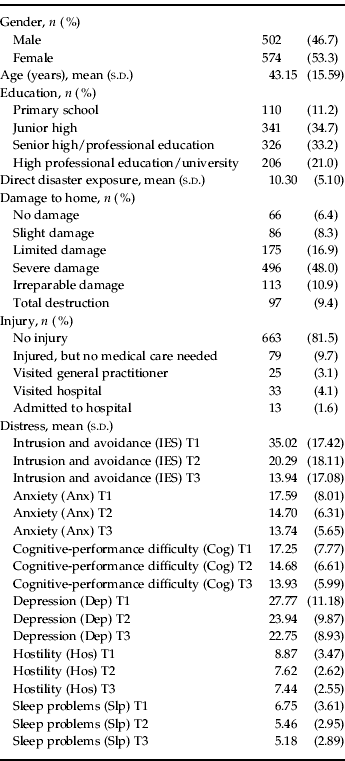
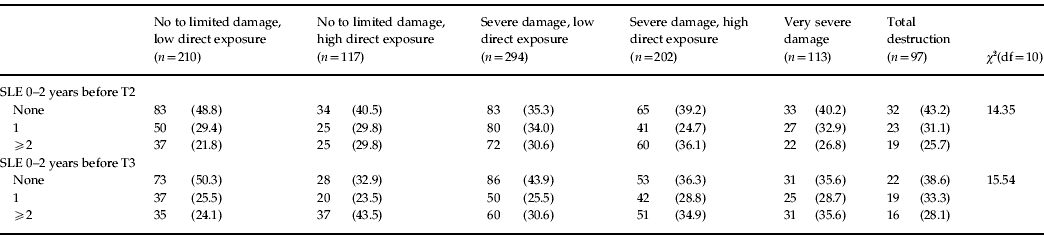
Participants filled in a questionnaire on demographic characteristics (gender, age, education) at all assessments. Disaster exposure was investigated at T1 by using a list of 21 experiences (0=no, 1=yes) describing what participants had seen, felt, heard, or smelt during or within the first hours after the disaster (e.g. seen the explosion, felt the air pressure due to the explosion, seen injured victims, felt intense fear) (van der Velden et al. Reference van der Velden, Yzermans, Kleber and Gersons2007). The questionnaire at T1 included questions about the damage to the victims' homes and also about injuries sustained due to the disaster. The response categories are shown in Table 1. At T2 and T3, participants were asked whether they experienced the following 18 SLEs: death of a spouse, father, mother, child, sibling or significant other, serious illness or injury of self or a significant other, divorce or break-up of a relationship, serious threat, physical and sexual violence, burglary, traffic accident, robbery, assault, and war/combat, using an adapted version of a Dutch life-event scale (van der Velden et al. Reference van der Velden, van der Burg, Steinmetz and van den Bout1992). Response categories included ‘not at all’, ‘1–2 years ago’, ‘6 months–1 year ago’ and ‘during the past 5 months’. For the present study, we calculated the total number of different types of SLEs reported to have occurred within the past 2 years. Participants were instructed to report only events that did not coincide with the disaster. We verified that the number of reported SLEs did not correlate with the severity of disaster exposure (Table 2).
Demographics, disaster exposure, and distress variables

s.d., Standard deviation; IES, Impact of Event Scale.
T1, 2–3 weeks (n=1083); T2, 18–20 months (n=861); and T3, almost 4 years after the disaster (n=756).
Stressful life events (SLEs) by level of disaster exposure

T2, 18–20 months; T3, almost 4 years after the disaster; df, degrees of freedom.
Values given as number (%).
Psychological distress
The Symptom Checklist-90 Revised (SCL-90-R; Derogatis, Reference Derogatis1979) is a multidimensional measure of psychological distress during the past 7 days. The Dutch SCL-90-R (Arrindell & Ettema, Reference Arrindell and Ettema2003) yields scores on eight dimensions. Of these, we used the following as indicators of stress-responsive distress: anxiety, cognitive-performance difficulty, depression, hostility, and sleep disturbance. Psychological distress was measured at T1, T2 and T3. Items were rated on a five-point Likert scale (from 1=not at all to 5=extremely) to assess the degree of distress over the previous 7 days. The Dutch SCL-90-R possesses demonstrated validity and reliability (Arrindell & Ettema, Reference Arrindell and Ettema2003). At all assessments, the internal consistencies of the subscales were excellent (α⩾0.85).
Intrusion and avoidance
The Impact of Event Scale (IES) measures ‘the current degree of subjective impact experienced as a result of a specific event’ (Horowitz et al. Reference Horowitz, Wilner and Alvarez1979, p. 209) by assessing intrusion and avoidance of event-specific memories during the past 7 days. The Dutch version of the IES (Brom & Kleber, Reference Brom and Kleber1985; van der Ploeg et al. Reference van der Ploeg, Mooren, Kleber, van der Velden and Brom2004) was used at T1, T2 and T3. Questions were directed specifically to intrusion and avoidance related to the disaster. Respondents were asked to rate the items on a four-point scale according to how often each had occurred in the previous 7 days. The four points on the scale were 0=not at all, 1=rarely, 3=sometimes and 5=often. At all assessments, the internal consistency was excellent (α⩾0.94).
Analyses
Study groups
To study the effects of damage to home on subsequent stress responsiveness, we divided the sample into groups based on the degree of damage (no to limited damage, severe damage, very severe damage, and total home destruction). To study the effects of direct disaster exposure, we subdivided the groups based on reporting low versus high direct disaster exposure (at or below the median versus above the median score). Because the groups reporting very severe damage and total home destruction were small, we did not subdivide these two groups. Thus, we created six groups: (1) no to limited damage, low direct exposure (n=210); (2) no to limited damage, high direct exposure (n=117); (3) severe damage, low direct exposure (n=294); (4) severe damage, high direct exposure (n=202); (5) very severe damage (n=113); and (6) total home destruction (n=97).
Data screening and preparation
Data screening revealed severe non-normality in both stressor exposure variables (except direct exposure and damage to participants' homes) and distress variables (except intrusion and avoidance). This non-normality was expected because low scores on injury, SLEs and distress variables were the most common, and higher scores increasingly rare. We therefore applied log transformations to SLEs at T2 and T3, and negative inverse transformations to injury and distress variables except intrusion and avoidance. The resulting variable distributions were characterized by skewness and kurtosis values not less than −2 or greater than 2. We applied structural equation modeling using maximum likelihood estimation. Missing data were handled using the full information maximum likelihood procedure (Enders & Bandalos, Reference Enders and Bandalos2001). Following the final analyses, we repeated the analyses using untransformed data. The results were almost identical (not presented here).
Construction of a model of stress-responsive distress
We modeled distress as a latent variable with feelings of anxiety and depression, concentration difficulty, hostility and rage, sleep problems, and intrusion and avoidance as its indicators. This enabled comprehensive and continuous mapping of the distress construct (Edwards & Bagozzi, Reference Edwards and Bagozzi2000). We applied this measurement model to assess distress longitudinally at three points in time following a major disaster. We specified autoregressive effects such that distress at T1 predicted distress at T2, and the latter predicted distress at T3. We assumed factor loading invariance over time, which establishes the identity of factors across occasions (McArdle, Reference McArdle2009). In addition, we expected each indicator's residual variance to be correlated across assessment times. To investigate associations between stressor exposure and distress we added predictor variables as causal indicators to the model. Thus we created a multiple indicators, multiple causes (MIMIC) model. MIMIC models are a broad class of structural equation models, where exogenous observed variables influence latent variables that in turn have multiple indicators (Bollen & Davis, Reference Bollen and Davis2009). We evaluated model fit using the discrepancy χ2, comparative fit index (CFI), non-normed fit index (NNFI), root mean square error of approximation (RMSEA), and Akaike's Information Criterion (AIC). Models that fit well are indicated by CFIs and NNFIs ⩾0.90 and RMSEAs ⩽0.08 (Hu & Bentler, Reference Hu and Bentler1999). Fig. 1 shows a path diagram representation of the model.
Full sample stress–responsive distress model (constrained). For the model: χ2 (269)=933.06, p<0.001, root mean square error of approximation (RMSEA)=0.05, comparative fit index (CFI)=0.96, non-normed fit index (NNFI)=0.94, Akaike's Information Criterion (AIC)=1149.06; n=1083. Adjusted for age and education (covariates not shown). SLE, Stressful life event; IES, Impact of Event Scale; Anx, Anxiety; Cog, Cognitive-performance difficulty; Dep, Depression; Hos, Hostility; Slp, Sleep; =, paths constrained to be equal.

Nested model comparisons
We conducted nested model comparisons to test whether time since disaster exposure moderates the relationship between later SLEs and distress. The corresponding nil hypothesis may be termed equality of stress responsiveness over time. We compared the fit of the constrained with that of the unconstrained model using the χ2 difference (Δχ2) test.
Multiple group analysis
We applied multiple group analysis to test whether degree of disaster exposure moderates the relationship between later SLEs and distress. In multiple group analysis, a model is estimated simultaneously across groups. Through the specification of cross-group equality constraints, group differences on any individual parameter or set of parameters can be tested (Jöreskog, Reference Jöreskog1971; Kline, Reference Kline2004; Kaplan, Reference Kaplan2008). The fit of the nested model with parameters constrained to be equal across the groups is compared with that of the unrestricted model with the Δχ2 test. Jöreskog (Reference Jöreskog1971) suggested a strategy for assessing the comparability of factor structures between groups based on a series of tests of increasingly restricted hypotheses. This strategy can be extended to the general structural equation model (Kaplan, Reference Kaplan2008). Thus we examined differences in direct effects between groups differing in disaster exposure by applying the path analysis model to these groups simultaneously and subsequently testing models corresponding to increasingly restricted hypotheses. Specifically, we applied equality constraints corresponding to the following nil hypotheses: (1) equality of stress responsiveness over time within each exposure group; and (2) equality of stress responsiveness across exposure groups. The damage to home variable was omitted as a predictor variable from groups 3–6 in the multiple group model because it was a constant in these groups.
Between-group differences in levels of distress
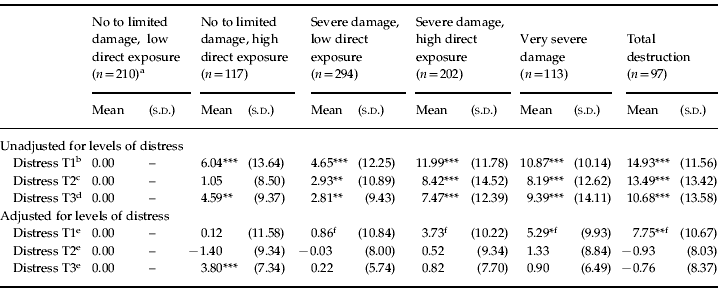
To evaluate the magnitude of stressor exposure effects on distress, we calculated differences in levels of distress between the six study groups differing in level of disaster exposure. We expected that unadjusted mean levels of distress would increase across groups parallel with the severity of disaster exposure. To explore heterogeneity in distress levels after controlling for stressor exposure effects, we calculated between-group differences in distress adjusted for disaster exposure (direct exposure, injury, and damage to the house), SLEs at T2 and T3, distress at the preceding assessment (at T2 and T3), and demographic variables. We calculated unadjusted differences from the cross-sectional distress models at T1, T2 and T3. The units of distress were those of the IES because the unit loading identification constraints were on the IES factor loadings. Using a strategy proposed by Sörbom (Reference Sörbom1974; Kline, Reference Kline2004), we constrained indicator intercepts to be equal across groups. To enable model identification, we fixed the factor mean in one group at 0, turning this group into the reference group. The factor means in the remaining five groups were freely estimated. Subsequently, we calculated adjusted differences in distress between groups from the final multiple group model using the same strategy. Within groups 3–6, we could not adjust distress levels at T1 for damage to the house because this variable was a constant within these groups. All analyses were carried out using software provided by SPSS/Amos, version 18.0 (SPSS Inc., USA).
Results
Descriptive analyses and attrition
Descriptive analyses are presented in Tables 1 and 2. As expected, distress indicators showed a decline across assessments. We found no associations between disaster exposure and reported SLEs at either T2 or T3 (Table 2).
We compared the sample completing the T2 survey (n=861) with the non-responders sample at T2 (n=222), and those completing the T3 survey (n=756) with T3 non-responders (n=327). Female survivors were more likely to respond to the follow-up surveys. The mean age of the participants was higher than that of the non-responders at T2 (44 v. 40 years), but at T3 did not differ between participants and non-responders. Education level, disaster exposure and damage to the house did not differ between study completers and non-responders at both T2 and T3. Participants who reported injuries at T1 were more likely to participate at T3, but at T2 no such difference was apparent. SLEs reported at T2 did not differ between participants and non-responders at T3. Mean levels of anxiety (17.3 v. 18.7), cognitive-performance difficulty (17.0 v. 18.3) and hostility (8.7 v. 9.4) at T1 were lower in study completers at T2 than non-responders, but no such differences were found at T3. Intrusion and avoidance, depression and sleep problems did not differ between study completers and non-responders at either T2 or T3. We concluded that there were no indications of meaningful non-response bias.
Modeling stress-responsive distress
First, we constructed cross-sectional factor models for T1, T2 and T3 representing a single factor (distress) with six indicators (intrusion and avoidance, anxiety, cognitive-performance difficulty, depression, hostility, and sleep problems). These three models fit the data well at all three times. Model fit indices were obtained for the distress T1 model [χ2 (9)=59.60, p=0.000, RMSEA=0.07, CFI=0.99, NNFI=0.98, AIC=95.60], the distress T2 model [χ2 (9)=48.91, p=0.000, RMSEA=0.06, CFI=0.99, NNFI=0.98, AIC=84.91] and the distress T3 model [χ2 (9)=73.61, p=0.000, RMSEA=0.08, CFI=0.98, NNFI=0.95, AIC=109.61].
We then constructed a longitudinal model incorporating the three cross-sectional models with distress T1 predicting distress T2 and the latter predicting distress T3, this resulted in an autoregressive model. In this model, factor loadings were constrained to be equal across occasions, and indicators' residual variances were autocorrelated. All factor loadings were high (>0.60). The longitudinal model fit the data well [χ2 (125)=347.56, p=0.000, RMSEA=0.04, CFI=0.98, NNFI=0.98, AIC=475.56].
The stress-responsive distress model (Fig. 1) consisted of the longitudinal model with added predictor variables, including female sex, damage to participants' homes, injury at T1, and SLEs reported at T2 and T3. We modeled predictor variable effects according to the following hypotheses. We expected severity of exposure to the disaster (direct exposure, injury, and damage to participants' homes reported at T1) to predict stress-responsive distress at T1, and SLEs preceding T2 and T3 to predict distress at these times (Galea et al. Reference Galea, Ahern, Tracy, Hubbard, Cerda, Goldmann and Vlahov2008). We expected that injury and damage to the house were correlated, and that SLEs reported at T2 and T3 were correlated. Stressor effects over time were assumed to be fully mediated by distress. Thus, we hypothesized that increases in distress over time were most likely to be associated with recent as opposed to remote stressors. Female gender was hypothesized to moderate distress associated with disaster exposure, in line with the literature (Bonanno et al. Reference Bonanno, Brewin, Kaniasty and Greca2010). Age and education were included as continuous covariates with paths to distress at T1, T2, and T3, and allowed to covary with all other predictors. This model fit the data well [χ2 (268)=930.82, p<0.001, RMSEA=0.05, CFI=0.96, NNFI=0.94, AIC=1148.82].
For the whole sample, we tested the equality of stress responsiveness over time hypothesis by constraining the path SLE T2→Distress T2 to be equal to the corresponding path at T3 and comparing the fit of the constrained model with the unconstrained model. The fit of the constrained model did not significantly worsen [Δχ(1) 2=2.23, p=0.13], indicating no significant difference between the effects of SLEs on distress between T2 and T3. The constrained stress-responsive distress model demonstrated good fit [χ2(269)=933.06, p<0.001, RMSEA=0.05, CFI=0.96, NNFI=0.94, AIC=1149.06]. A path diagram is represented in Fig. 1. All model parameters shown in the diagram were significant at the p<0.001 level except the path Injury→Distress T1 (p<0.05).
Stratified exposure group comparisons of stress-responsiveness
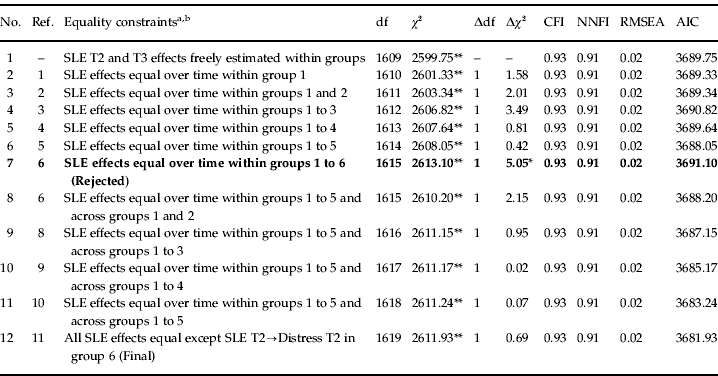
Using the stress-responsive distress model, we examined differences in stress responsiveness between the six groups reporting different levels of damage to their homes in addition to direct disaster exposure. Within each of these six groups, we tested the equality of stress responsiveness over time hypothesis by constraining the path SLE T2→Distress T2 to be equal to the corresponding path at T3 starting with the lowest exposure group. The results of the nested model comparisons are presented in Table 3. As shown in the table, the model in which SLEs effects were constrained to be equal over time within all groups including the total home destruction group (model 7 in Table 3 shown in bold) was rejected because of significant worsening of the model fit.
Multiple group model selection

Ref., Reference model number; SLE, stressful life event; df, degrees of freedom; CFI, comparative fit index; NNFI, non-normed fit index; RMSEA, root mean square error of approximation; AIC, Akaike's Information Criterion; T2, 18–20 months; T3, almost 4 years after the disaster.
a Models represent the reference model with equality constraint(s) added; the model shown in bold was rejected because of significant worsening of model fit.
b Groups: (1) no to moderate damage to home, low direct disaster exposure (n=210); (2) no to moderate damage, high direct exposure (n=117); (3) severe damage, low direct exposure (n=294); (4) severe damage, high direct exposure (n=202); (5) very severe damage (n=113); (6) total home destruction (n=97).
* p<0.05, ** p<0.001.
We then compared stress responsiveness across these six groups by adding cross-group equality constraints one by one, starting with the lowest disaster exposure group at T2. No other difference in stress responsiveness between groups emerged. We selected the final model guided by the nested model comparisons presented in Table 3.
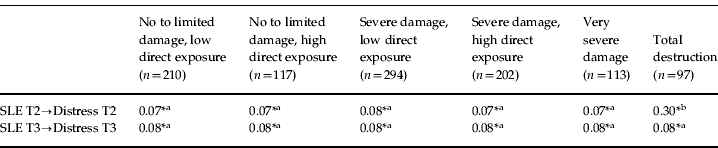
In the final multiple group model, the path SLE T2→Distress T2 was freely estimated within the total home destruction group. Estimates of stress responsiveness from the final multiple group model are shown in Table 4. The results indicate strongly increased stress responsiveness in the total home destruction group at T2, but not at T3.
Stress responsiveness 18–20 months (T2) and almost 4 years after a disaster (T3) by level of disaster exposure

SLE, Stressful life event.
Standardized coefficients based on final multiple group model (model no. 12 in Table 3).
ab Parameters with the same superscripts do not differ in standardized coefficient (p>0.05).
* p<0.001.
Between-group differences in levels of distress
To evaluate the magnitude of stressor exposure effects on distress and to explore heterogeneity in distress, we calculated unadjusted and adjusted differences in levels of distress between the six study groups differing in level of disaster exposure. The results are presented in Table 5. All models show a good fit to the data. As expected, unadjusted mean levels of distress increased across groups parallel with the severity of disaster exposure at all three assessments. After adjustment for stressor effects, distress at the preceding assessment (at T2 and T3) and demographic variables, differences in levels of distress between the groups were small. Only three between-group differences in distress levels were statistically significantly different from 0, including two that could not be adjusted for damage to the house (Table 5).
Differences in distress levels 2–3 weeks (T1), 18–20 months (T2) and almost 4 years after a disaster (T3) by level of disaster exposure

s.d., Standard deviation.
Distress represents a factor with six indicators: feelings of anxiety and depression, concentration difficulty, hostility and rage, sleep problems, and intrusion and avoidance, and is expressed in Impact of Event Scale (IES) units. Unadjusted means indicate mean differences in distress levels with the reference group. Adjusted means are adjusted for distress at the preceding assessment (at T2 and T3), stressor effects, and demographic variables (see path diagram representation in Fig. 1).
a Reference group.
b For the model: χ2 (79)=108.31, p=0.016, RMSEA=0.02, CFI=0.99, NNFI=0.99, AIC=274.31.
c For the model: χ2 (79)=129.86, p=0.000, RMSEA=0.03, CFI=0.99, NNFI=0.98, AIC=295.86.
d For the model: χ2 (79)=173.16, p=0.000, RMSEA=0.03, CFI=0.97, NNFI=0.95, AIC=339.16.
e For the model: χ2 (1695)=2705.40, p=0.000, RMSEA=0.02, CFI=0.93, NNFI=0.92, AIC=3623.40.
f This value was not adjusted for damage to the home because this was a constant within this group.
* p<0.05, ** p<0.01, *** p<0.001.
Discussion
In this study we aimed to investigate the occurrence of psychological sensitization to stress prospectively following a major disaster. Consistent with the stress sensitization hypothesis, we found that residents whose house was completely destroyed by the disaster responded more strongly to SLEs reported 18–20 months following the disaster than residents who reported less extreme disaster exposure. These differences in stress responsiveness were not apparent almost 4 years following the disaster. These results suggest that, during the first years after a disaster, stress sensitization may occur in disaster survivors who experienced extreme disaster exposure. Stress sensitization may explain persistence or progression of distress over time in a minority of disaster survivors because sensitized survivors who experience SLEs may respond with increased distress. To the best of our knowledge, this study is the first to document psychological stress sensitization prospectively following a disaster.
The strengths of the current study include the large sample, the long-term follow-up, and the prospective design. Disaster exposure was assessed as soon as 2 to 3 weeks after the disaster using unambiguous criteria. SLEs consisted of only major life events that were likely to be independent of disaster exposure. Indeed, we found no associations between disaster exposure and reported SLEs at either T2 or T3.
There are also some limitations to this study. First, our findings with regard to SLEs may be limited because the assessment time frame of this variable did not exactly match the timing of our study assessments. Prospective studies with more frequent assessments than those used here would be necessary to ascertain the occurrence of stress sensitization within more precise time frames.
Second, we assessed SLE exposure using a questionnaire only. Use of interview assessment of SLE exposure has been considered most reliable (Monroe, Reference Monroe2008); however, given the large size of our sample, questionnaire assessments were more feasible than interviews.
Third, although our study was prospective, participants were asked to report SLEs retrospectively, concurrently with their level of distress. Mood-dependent memory effects on SLE reporting may therefore have occurred. However, we found that disaster exposure reported at T1 did not influence the likelihood of later SLE endorsement. Stress sensitization in our study refers to the influence of prior stressors (i.e. disaster exposure) on the strength of the association between later stressful events and distress. In our study, this was assessed prospectively and therefore unlikely to be affected by memory bias.
Fourth, attrition in our study represents another potential limitation. Given the frequently high rates of attrition in disaster research (Weisaeth, Reference Weisaeth1989; Scott et al. Reference Scott, Sonis, Creamer and Dennis2006), our completion rates are acceptable. Importantly, symptoms of intrusion/avoidance at the initial assessments did not predict attrition.
Fifth, in our study, we did not assess individual differences in stress reactivity. Individuals with elevated background levels of stress reactivity may be more vulnerable to stress-related mental disorders such as major depression (Wichers et al. Reference Wichers, Schrijvers, Geschwind, Jacobs, Myin-Germeys, Thiery, Derom, Sabbe, Peeters, Delespaul and van Os2009). We addressed this issue by calculating differences in levels of distress between the six exposure groups after controlling for stressor exposure effects. These analyses showed only minor between-group differences in distress. These differences are likely to reflect heterogeneity resulting from individual differences in stress reactivity and also in trajectories of distress. Future studies may further explore these factors.
Explaining the link between disaster exposure and stress sensitization
In accordance with our expectations, stress sensitization was most likely to occur following extreme levels of disaster exposure. Total home destruction may be considered an extreme stressor because of the associated loss of almost all personal belongings and disruption of the social context due to relocation. By contrast, high direct confrontation with the disaster in terms of having seen, heard, felt or smelt the explosion and its immediate devastating impact was not by itself predictive of stress sensitization.
Our results suggest that personal loss and social disruption due to disaster exposure are implicated in the development of stress sensitization. The strong effects of resource loss on mental distress in our sample are consistent with the Conservation of Resources (COR) theory (Zwiebach et al. Reference Zwiebach, Rhodes and Roemer2010). The COR theory states that people strive to retain, protect and build resources and that what constitutes a stressor to them is the potential or actual loss of these resources (Hobfoll, Reference Hobfoll1989). According to this theory, resource loss is disproportionately more salient than resource gain. Therefore, those who already lack resources are more vulnerable to resource loss (Hobfoll, Reference Hobfoll2001). Stress sensitization effects may reflect increased vulnerability to further resource loss in those who lack resources, for example due to total home destruction.
Duration of stress sensitization
As expected, we found only temporary sensitization effects following extreme disaster exposure. Studies of sensitization effects in individuals with a history of childhood adversity generally found more lasting effects (Breslau et al. Reference Breslau, Chilcoat, Kessler and Davis1999; Hammen et al. Reference Hammen, Henry and Daley2000; Wichers et al. Reference Wichers, Schrijvers, Geschwind, Jacobs, Myin-Germeys, Thiery, Derom, Sabbe, Peeters, Delespaul and van Os2009; McLaughlin et al. Reference McLaughlin, Conron, Koenen and Gilman2010). However, these studies assessed exposure to potentially sensitizing adversities retrospectively and their results may therefore have been influenced by recall bias. Nevertheless, childhood trauma may have more durable effects than adult disaster exposure. It is possible that sensitization in adults may prove more persistent if sustained by repeated stressors. Future studies may provide more definitive answers to questions about duration of sensitization effects.
Implications for practice
In addition to levels of distress, levels of stressor exposure prior to, during, and following disasters play a central role in explaining the longitudinal course of disaster-related distress and should therefore be assessed routinely by clinicians dealing with disaster survivors. Assessment of stressor exposure may facilitate efforts at early risk detection and triage to primary or early secondary preventive services. Clinicians may educate disaster survivors that disaster exposure and loss of resources may affect subsequent stress responsiveness and provide reassurance that these effects are likely to diminish over time. Providing practical assistance in the aftermath of disasters may help to prevent further resource losses. Foreseeable stressors and resource losses may be an effective target for secondary prevention of psychological distress on a community level. Agencies participating in recovery efforts should therefore focus their efforts on facilitating and supporting restorative activities to counteract or prevent these stressors.
Acknowledgements
The Enschede Fireworks Disaster Study was conducted on behalf of the Dutch Ministry of Health, Welfare and Sport.
Declaration of Interest
None.